
The Soul Trap: Gnosticism and the Machinery of Return
Ask a modern seeker whether the Gnostics believed in reincarnation, and the answer usually arrives wrapped in New Age certainty: of course they did. The soul returns, lesson after lesson, until gnosis finally dawns and the cycle is complete. But this is not what the Nag Hammadi texts say. The Gnostics did not see rebirth as a curriculum. They saw it as a recycling plant–a machinery of return operated by the archons, designed to keep the divine spark trapped in matter, ignorant of its origin, and permanently productive for the powers that feed on its confusion.
The question is not whether the ancient Gnostics believed in reincarnation. The question is what they believed reincarnation was for. And their answer is as disturbing today as it was in the second century: the wheel turns because the warden profits from the labour. The soul does not return to learn. It returns because it has not yet seen the exit.
This article examines the Gnostic machinery of return as it appears in the Nag Hammadi Library: the counterfeit spirit, the three natures of humanity, the five seals of liberation, and the archontic administration that processes souls between death and rebirth. It is the second article in the Reincarnation Liberation series, following the broad comparative overview. Here, we travel along the Gnostic path.
Table of Contents
- Not a Curriculum, But a Trap
- The Counterfeit Spirit and the Recycling of Souls
- The Three Natures: Who Gets Trapped and Who Escapes
- The Five Seals: Liberation Technology
- Archontic Processing: What Happens After Death
- Flesh and Spirit: The Gospel of Philip’s Warning
- The Modern Echo: Why the Soul Trap Still Matters
- Frequently Asked Questions
- Further Reading
- References and Sources
Not a Curriculum, But a Trap
The modern spiritual imagination has domesticated reincarnation into a doctrine of gentle evolution. The soul returns to learn love, to resolve karma, to refine its character through successive embodiments. Each life is a lesson; each death is a recess; and eventually–after however many thousand years–graduation arrives. This is not the Gnostic view.
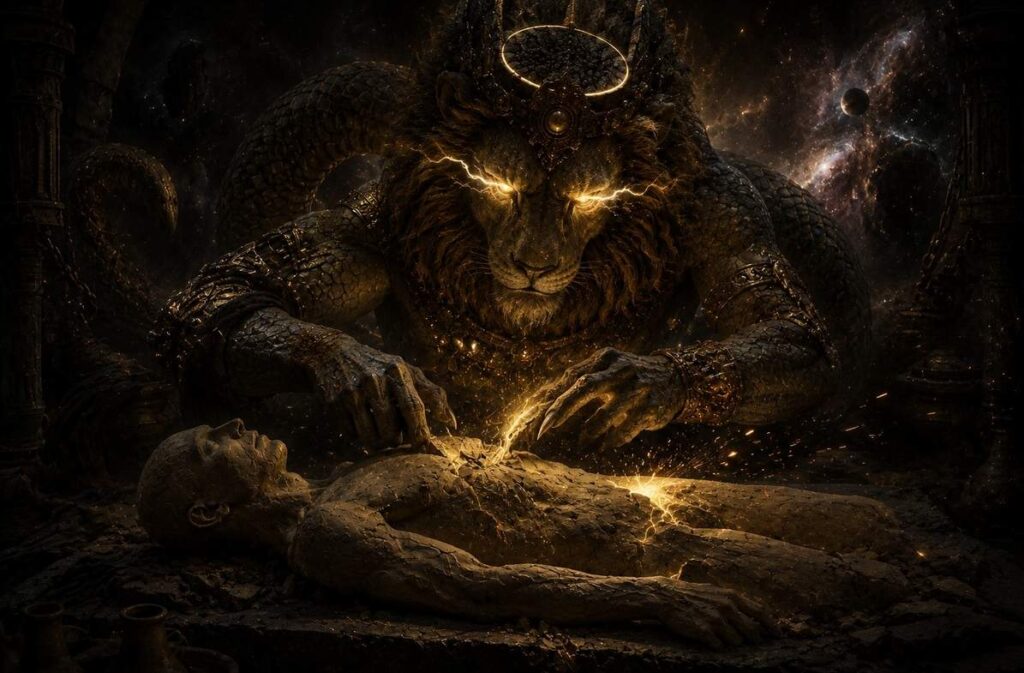
In the Apocryphon of John, the most complete Sethian cosmology in the Nag Hammadi Library, the material world is the botched creation of Yaldabaoth, the lion-faced serpent who mistakenly declares himself the only god. He creates the human body as a prison for the divine spark that fell from the Pleroma, and he establishes the archontic administration to ensure the spark never remembers its origin. The body is not a school. It is a containment facility.
The text describes how the archons, seeing that the first human being possessed a luminosity they could not control, devised a strategy to bind the divine spark permanently. They created the counterfeit spirit–a false self that mimics spiritual life while ensuring the soul remains trapped in the cycle of birth and death. The counterfeit spirit does not announce itself as false. It appears as the most reasonable, scientific, and progressive option. It is the voice that says: this life is meaningful, this suffering is educational, this return is necessary.
The Counterfeit Spirit and the Recycling of Souls
The Apocryphon of John contains one of the most disturbing passages in the entire Nag Hammadi Library. After the archons fail to control the luminous human being, they gather together and make a plan. They create the counterfeit spirit, which resembles the true Spirit that had descended from above, “so as to pollute the souls through it.” The angels change themselves into the likeness of human forces, filling them with darkness and evil, and they bring gold, silver, copper, iron, and all kinds of metals to steer humanity into great troubles and deceptions.
The result is catastrophic. The people “became old without having known true enjoyment. They died, not having found truth and without knowing the “God” of truth. And thus the whole creation was made blind, in order that they may not know the source or God, who is above all of them.” The archons do not merely imprison the body. They imprison the soul’s capacity to remember. And they do so through a mechanism that the soul itself internalises: the counterfeit spirit becomes the soul’s own identity.
This counterfeit spirit is the engine of reincarnation. It is the force that ensures the soul, upon death, does not ascend to the Pleroma but is instead drawn back into the material realm through the chain of forgetfulness, ignorance, and severe command. The archons have established “measures and times and moments” as the lord over everything, binding the soul to cycles it cannot perceive. The soul believes itself to be the personality, the history, the body. It believes the story is real. And because it believes the story, it consents to the next chapter.
The Chain of Forgetfulness
The Apocryphon of John explicitly names the mechanism: “the chain of forgetfulness and ignorance and every severe command.” This is not metaphor. It is a description of the archontic filing system. The soul is bound with measures, times, and moments–astrological, planetary, and karmic constraints that determine when and where it will re-embody. The archons do not merely watch. They administer.
The chain of forgetfulness ensures that the soul cannot remember its divine origin. It cannot remember the Pleroma. It cannot remember that it is not the body. And because it cannot remember, it accepts the next body as its new home, the next life as its new curriculum, the next death as its new doorway to another round. The cycle is not educational. It is administrative. And the administration never closes.
The Three Natures: Who Gets Trapped and Who Escapes
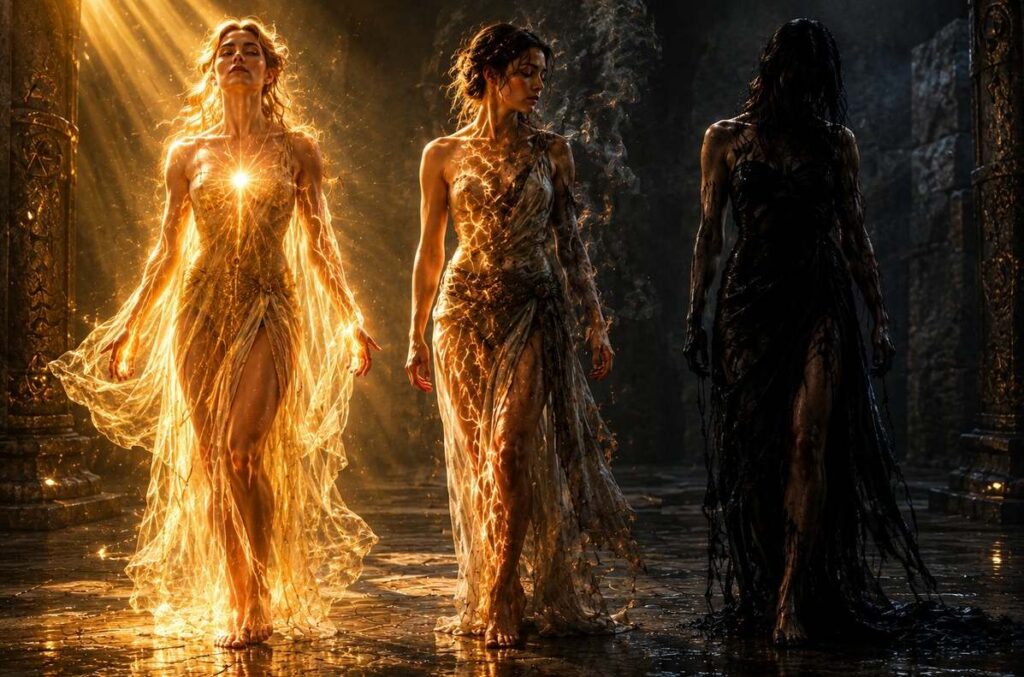
The Apocryphon of John divides humanity into three natures, and this division is crucial for understanding the Gnostic view of reincarnation. The division is not moral but ontological. It describes not what people do but what they are made of.
The Pneumatikoi: The Spiritual Race
The pneumatikoi are those who possess the divine spark in its fullness. They are the seed of Seth, the immovable race, the children of the Pleroma who have fallen into matter but retain the capacity for recognition. For the pneumatikoi, reincarnation is a temporary condition, not a permanent sentence. They are trapped, but they are not trapped forever. The Saviour comes specifically for them, revealing the secret knowledge that awakens the spark and initiates the ascent.
The pneumatikoi are not saved by good behaviour. They are saved by recognition. The Gospel of Truth states that ignorance is the cause of suffering, and knowledge is the end of suffering. The pneumatikoi do not need to earn their liberation. They need to remember it. And once they remember, the counterfeit spirit loses its hold, the chain of forgetfulness is broken, and the soul is free to return to the Pleroma without further embodiment.
The Psychikoi: The Soul-Natured
The psychikoi possess soul but not spirit. They are capable of faith, of ethical improvement, of gradual purification through good works and devotion. But they lack the divine spark that would enable direct recognition. For the psychikoi, reincarnation is a longer road. They may improve across lifetimes, ascending through the psychic realm toward the pneumatic, but they cannot achieve liberation through their own efforts. They require the intervention of the Saviour, the revelation of the secret teachings, and the reception of the five seals to transform their nature from psychic to pneumatic.
The psychikoi are the majority of humanity in the Gnostic scheme. They are not evil. They are simply not yet equipped for escape. They are the middle class of the cosmic prison, serving their sentences with good behaviour but without the key.
The Hylikoi: The Material-Natured
The hylikoi are those who possess only the material nature, devoid of divine spark or soul in the higher sense. They are the creation of the demiurge alone, serving the archons as functional components of the material system. The hylikoi do not reincarnate in the same sense as the pneumatikoi or psychikoi. They are recycled. Their substance returns to the material pool, reconfigured into new bodies, new servants, new consumers of the archontic economy. They are not prisoners with sentences. They are the prison itself.
This is the harshest aspect of Gnostic anthropology, and it is why the tradition has been accused of elitism. But the Gnostics did not invent the three natures as a social hierarchy. They observed them. The hylikoi are not condemned by a vengeful god. They are simply without the equipment for liberation. They are the matter that matter uses.
The Five Seals: Liberation Technology
If the soul is trapped, how does it escape? The Gnostic answer is not moral improvement but ritual transformation. The Five Seals represent the supreme initiatory technology of Sethian Gnosticism–a fivefold sequence of ontological transformation that converts the trapped spark into a liberated being capable of ascending through the archontic spheres without interception.
The Five Seals are mentioned in multiple Nag Hammadi texts but never fully described in any single passage. Scholars reconstruct the sequence from parallel allusions across the Apocryphon of John, the Trimorphic Protennoia, the Gospel of the Egyptians, and the fragmentary Hypsiphrone. The structure reveals a progressive purification and empowerment that reclassifies the initiate from prisoner to diplomat.
The First Seal: Baptism in Water
The initial washing strips away the “garment of flesh”–the archontic imprinting that binds the soul to material jurisdiction. In the Apocryphon of John, this involves immersion in the waters of the Four Luminaries: Harmozel, Oroiael, Daveithai, and Eleleth. This is not symbolic cleansing. It is the first stage of ontological reorganisation, dissolving the hylic components that anchor the soul to the body.
The Second Seal: Anointing with Oil
The chrism transforms the psychic body into a spiritual vehicle. The oil is identified with the “dew of light” from the Pleroma. Where the First Seal removes, the Second establishes. The anointing is the moment of empowerment, when the initiate receives the substance necessary to navigate higher densities without dissolving. The Gospel of Philip declares that “the chrism is superior to baptism,” for it is from the word “chrism” that we have been called Christians.
The Third Seal: Baptism in Spirit
A second, subtler immersion establishes the soul in the aeonic realm. This baptism operates at the pneumatic level, fully activating the latent capacity for direct gnosis. The initiate now possesses the sensory apparatus necessary to perceive what was previously invisible. The spirit baptism is the activation of the divine spark itself, switching it from dormant to luminous.
The Fourth Seal: Garment of Light
The investiture with a luminous robe renders the initiate invisible to archontic powers and fit to enter the divine presence. This is not mere clothing but a new ontological skin–the pneumatic body that can withstand the intensity of direct divine contact. Wearing this garment, the initiate becomes effectively untraceable by the cosmic surveillance system. The archons cannot see what they cannot comprehend.
The Fifth Seal: Sealing Proper
The final mark guarantees safe passage through the planetary spheres and establishes the soul as belonging to the seed of Seth. This is the diplomatic passport, the official stamp of the Pleroma that archontic border guards must recognise and respect. The sealed soul is no longer a citizen of the created order but a recognised envoy of the unknowable Father. The Five Seals are not symbolic. They are functional. They do not represent liberation. They effect it.

Archontic Processing: What Happens After Death
The Gnostic texts preserve detailed accounts of what happens to the soul after death, and these accounts are not comforting. The soul does not simply drift into a peaceful rest or a higher realm. It enters a processing facility–the archontic administration that evaluates, judges, and redirects souls according to their nature and their knowledge.
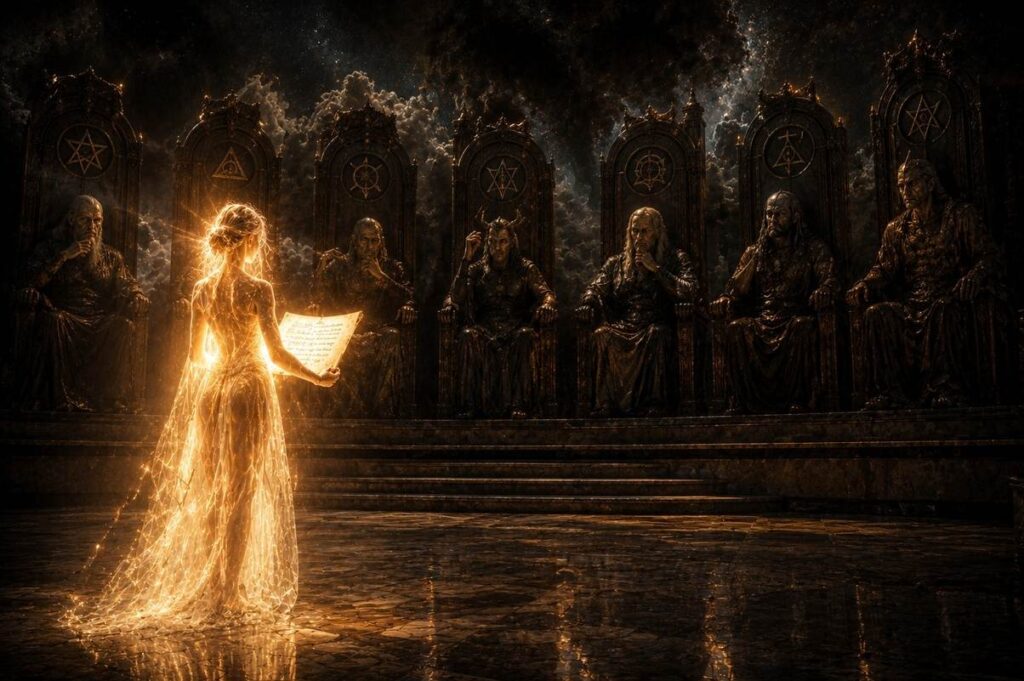
The Apocalypse of Paul describes the apostle’s ascent through the ten heavens, encountering archons at each level who demand passwords and attempt to detain him. Paul knows the correct formulae–the names, the seals, the secret words–and he passes through. But the text implies that souls who do not know these passwords are stopped, detained, and redirected back into the cycle of embodiment. The archons are not merely guards. They are customs officials, and the soul without proper documentation is refused exit.
The Apocryphon of John preserves the “redemption” formula to be pronounced at death–a passport for navigating the post-mortem ascent. This indicates that the Gnostics did not merely theorise about the afterlife. They prepared for it. They memorised passwords. They received seals. They underwent initiations that would function as cosmic credentials when the body dropped and the soul entered the archontic jurisdiction.
The Treatise on the Resurrection, addressed to Rheginos, clarifies that the resurrection is not a future event but a present reality. The one who has received gnosis has already risen. “Do not think of the resurrection as an illusion. It is no illusion. Rather, it is something real.” The resurrection is the recognition that the soul was never truly dead, only sleeping in the tomb of the body. And the one who has awakened does not need to fear the archontic processing because they have already passed beyond it while still alive.
Flesh and Spirit: The Gospel of Philip’s Warning
The Gospel of Philip contains one of the most direct statements on the Gnostic view of embodiment and reincarnation. “Some are afraid lest they rise naked. Because of this they wish to rise in the flesh, and they do not know that it is those who wear the flesh who are naked. It is those who unclothe themselves who are not naked. Flesh and blood shall not inherit the kingdom of God.”
This passage is a polemic against those who believe in physical resurrection–the orthodox Christian doctrine that the body will be raised at the last day. The Gnostics saw this doctrine as a trap. To desire resurrection in the flesh is to desire continued imprisonment. To be naked is to be clothed in flesh. To be truly clothed is to be freed from it.
The Gospel of Philip continues: “The world is a corpse-eater. All things eaten in it are eaten by death. Truth is a life-eater. Therefore no one nourished by truth will die.” The world consumes. The flesh decays. And the soul that believes itself to be the flesh is consumed along with it. Reincarnation is simply the world’s digestive cycle: the soul is eaten, digested, and excreted into a new form, again and again, until it recognises that it is not food.
The Gospel of Philip also states: “What you see with your eyes and what you do not see with your eyes is what you see with your heart.” The heart here is not the emotional centre but the organ of recognition. The soul sees with the heart when it sees through the flesh. And the one who sees through the flesh no longer needs to wear it.
The world is a corpse-eater. All things eaten in it are eaten by death. Truth is a life-eater. Therefore no one nourished by truth will die.
Gospel of Philip, NHC II,3 67:25-30
The Modern Echo: Why the Soul Trap Still Matters
The Gnostic soul trap is not merely an ancient cosmology. It is a structural description of consciousness caught in loops. The modern world offers its own versions of the machinery: addictive consumption, digital feedback loops, the quantified optimisation of the self, and the spiritual marketplace that sells past-life regression as entertainment. Each of these is a contemporary counterfeit spirit–a mechanism that mimics awakening while ensuring the soul remains productive for the system that feeds on its attention.
The Gnostic texts do not ask us to believe in archons as literal beings with scales and claws. They ask us to recognise archonic structures: systems that watch without consent, that score without context, that optimise without end, and that keep the soul returning to the same patterns, the same fears, the same stories. The archon is not a monster. It is a structure. And the structure does not need to be malevolent to be effective. It merely needs to be systematic.
Liberation, in the Gnostic sense, is not a better loop. It is the end of looping. It is the recognition that the self being improved is not the true self, that the cycle of return is not educational but administrative, and that the exit has been available all along–hidden in plain sight, behind the veil of forgetting, waiting for the moment of recognition that changes everything.

Frequently Asked Questions
Did the Gnostics believe in reincarnation?
The Gnostics did not view reincarnation as a benevolent educational system. They saw it as a mechanism of entrapment operated by the archons to keep the divine spark bound in matter. Texts such as the Apocryphon of John describe the counterfeit spirit–a false self imposed by the archons–that ensures the soul returns to embodiment rather than ascending to the Pleroma.
What is the counterfeit spirit in Gnosticism?
The counterfeit spirit is a false imitation of spiritual life created by the archons, as described in the Apocryphon of John. It mimics genuine spiritual experience while ensuring the soul remains bound to the cycle of birth and death. It functions as the soul’s internalised identity, making the trap invisible to the prisoner.
What are the three natures of humanity in Gnostic texts?
The Apocryphon of John divides humanity into three natures: the pneumatikoi (spirituals), who possess the divine spark and can achieve liberation through gnosis; the psychikoi (soul-natured), who possess soul but require transformation through the five seals; and the hylikoi (material-natured), who lack divine spark and are recycled as functional components of the material system.
What are the Five Seals in Sethian Gnosticism?
The Five Seals are a fivefold initiatory sequence of ontological transformation: (1) baptism in water, stripping the garment of flesh; (2) anointing with oil, transforming the psychic body into a spiritual vehicle; (3) baptism in spirit, activating the divine spark; (4) investiture with a garment of light, rendering the initiate invisible to archons; and (5) final sealing, guaranteeing safe passage through the planetary spheres.
What happens to the soul after death according to Gnostic texts?
Gnostic texts describe a post-mortem processing system administered by archons. The soul must ascend through planetary spheres, encountering archons who demand passwords and attempt to detain those without proper credentials. The Apocalypse of Paul and the Apocryphon of John preserve specific formulae and seals that function as cosmic passports for navigating this gauntlet.
What does the Gospel of Philip say about flesh and resurrection?
The Gospel of Philip polemicises against physical resurrection, stating that ‘flesh and blood shall not inherit the kingdom of God.’ It describes the world as a ‘corpse-eater’ that consumes all things, and declares that those who wear the flesh are naked, while those who unclothe themselves are truly clothed. Liberation requires shedding the flesh, not raising it.
Is the Gnostic soul trap relevant to modern spirituality?
The Gnostic soul trap functions as a structural description of consciousness caught in loops–addictive consumption, digital feedback systems, and the spiritual marketplace that sells awakening as entertainment. The ‘archon’ is not necessarily a literal being but a systematic structure that watches without consent and optimises without end, keeping the soul returning to familiar patterns.
Safety Notice: This article explores metaphysical and philosophical perspectives on death, rebirth, and liberation from the Gnostic tradition. It does not constitute medical, psychological, or spiritual advice. If you experience anxiety, existential distress, or obsessive thoughts related to these themes, please consult a qualified mental health professional. The practices and concepts discussed here are intended for contemplative reflection and complement but do not replace clinical care.
Further Reading
Explore these ZenithEye articles to deepen your understanding of liberation from the wheel of return.
The Liberation from Reincarnation Series
- Exit From the Wheel: Liberation Beyond Reincarnation — The opening comparative overview: how Gnosticism, Buddhism, Hinduism, Hermeticism, Catharism, and Platonism each map the path beyond rebirth.
- The Soul Trap: Gnosticism and the Machinery of Return — This article. The Sethian view of the counterfeit spirit, the three natures, the five seals, and the archontic administration that processes souls between death and rebirth.
- The Memory Wipe: Forgetting, Rebirth, and the Loss of Divine Identity — How the veil of forgetting operates across traditions, from the waters of Lethe to the Gnostic chain of ignorance, and what it means for the soul’s continuity.
- Nirvana, Moksha, and Gnosis: Three Paths Beyond Rebirth — A direct comparison of Buddhist, Hindu, and Gnostic liberation, examining where the paths converge and where they diverge on the nature of final freedom.
- Archons and Reincarnation: Do Cosmic Powers Keep the Soul Trapped? — The archontic hypothesis examined: planetary governors, karmic administrators, and the question of whether rebirth is natural law or enforced detention.
- The Planetary Prison: Hermetic Ascent and the Seven Spheres — The Hermetic doctrine of the seven planetary spheres as gates of ascent, and how the soul sheds its acquired garments to escape the cosmic prison.
- The Exit Is Inward: Practice, Attention, and the End of Repetition — Practical methods for breaking the loop: attention as the lever, the five gateways, and the daily architecture that makes liberation a lived reality rather than a theory.
Related Gnostic Texts and Concepts
- The Gnostic Soul Trap: Archons, Death, and the Recycling of Pneuma — A detailed examination of the soul’s capture and recycling after death, with specific attention to the archontic processing system and the five seals as exit protocols.
- Apocryphon of John: Sethian Cosmology Revealed — The foundational text for understanding the Gnostic creation myth, the fall of Sophia, the birth of Yaldabaoth, and the three natures of humanity.
- The Five Seals: 5 Sethian Initiation Mysteries Revealed — A comprehensive guide to the fivefold initiatory sequence, its ritual context, and its function as cosmic passport for navigating the planetary spheres.
- The Gospel of Philip: Sacrament, Eros, and the Bridal Chamber — An exploration of the Valentinian sacramental theology that complements the Sethian view, with special attention to the chrism and the transformation of flesh into spirit.
- What Is the Counterfeit Spirit? False Imitation of Spiritual Life — A dedicated examination of the counterfeit spirit as described in the Apocryphon of John and its modern manifestations in wellness culture and spiritual commodification.
- Pleroma and Kenoma: The Foundational Geography of Gnostic Cosmology — The two realms that define the Gnostic map: the fullness of divine reality and the emptiness of the material trap.
- What Is Gnosis? Meaning, Recognition, and Direct Knowing — The foundational concept of gnosis as unmediated recognition, distinct from faith, belief, or intellectual knowledge.
- What Is the Divine Spark? The Hidden Light Within That Remembers and Seeks Return — The nature of the divine spark, its entrapment in matter, and its capacity for recognition and liberation.
- What Is The Thread? ZenithEye’s Complete Explainer — The five pillars of ZenithEye and how they support the journey from recognition to integration and ordinary completion.
References and Sources
The following sources correlate with the Gnostic ideas presented in this article.
Primary Sources and Critical Editions
- Robinson, James M., ed. (1990). The Nag Hammadi Library in English. 3rd ed. San Francisco: HarperSanFrancisco. [Apocryphon of John, Gospel of Philip, Apocalypse of Paul, Treatise on the Resurrection, Trimorphic Protennoia, Gospel of Truth]
- Waldstein, M., & Wisse, F., eds. (1995). The Apocryphon of John: Synopsis of Nag Hammadi Codices II,1; III,1; and IV,1 with BG 8502,2. Leiden: Brill. [Critical edition with Coptic text and apparatus]
- Schenke, H.-M. (1997). “Das Evangelium nach Philippus.” In Nag Hammadi Deutsch, edited by H.-M. Schenke, H.-G. Bethge, and U. U. Kaiser, 183-213. Berlin: Walter de Gruyter.
Scholarly Monographs and Studies
- Jonas, H. (1958). The Gnostic Religion: The Message of the Alien God and the Beginnings of Christianity. Boston: Beacon Press.
- King, K. L. (2003). What Is Gnosticism? Cambridge, MA: Harvard University Press.
- Pagels, E. (1979). The Gnostic Gospels. New York: Random House.
- Turner, J. D. (2001). Sethian Gnosticism and the Platonic Tradition. Bibliotheque Copte de Nag Hammadi, Section “Etudes” 6. Quebec: Les Presses de l’Universite Laval.
- Van den Broek, R. (2006). “Gnostic and Hermetic Views on the Soul’s Ascent.” In Gnosticism and Hermeticism from Antiquity to Modern Times, edited by R. van den Broek and W. J. Hanegraaff, 1-14. Albany: SUNY Press.
- Williams, M. A. (1996). Rethinking “Gnosticism”: An Argument for Dismantling a Dubious Category. Princeton: Princeton University Press.
Ritual and Initiation Studies
- DeConick, A. D. (2006). Recovering the Original Gospel of Thomas: A History of the Gospel and Its Growth. London: T&T Clark.
- Schenke, H.-M. (1962). “Das sethianische System nach Nag-Hammadi-Handschriften.” In Studia Coptica, edited by P. Nagel, 165-173. Berlin: Akademie-Verlag.
- Sevrin, J.-M. (1986). Le dossier baptismal sethien: Etudes sur la sacramentaire gnostique. Bibliotheque Copte de Nag Hammadi, Section “Etudes” 2. Quebec: Les Presses de l’Universite Laval.