
Archons and Reincarnation: Do Cosmic Powers Keep the Soul Trapped?
Why do souls return? Across millennia, the question has provoked two radically different answers. One points to cosmic rulers–intelligent, manipulative agents who intercept the disincarnate soul and force it back into biological vessels. The other invokes an impersonal law–a self-regulating moral physics that binds consciousness to consequence until the debt is paid. The first is the domain of the Gnostic archons; the second, the territory of karma. Both attempt to explain the law of return, yet they rest on incompatible metaphysical foundations. Understanding their differences–and their unexpected convergences–is essential for anyone seeking to navigate the boundary between death and whatever lies beyond.
This article compares the archontic and karmic frameworks as explanatory models for reincarnation, examines their ancient textual foundations, traces their modern reinterpretations, and extracts practical methodologies for spiritual sovereignty. It does not ask you to believe either system. It asks you to recognise the architecture of the trap–whether that trap is administered by celestial bureaucrats or generated by the momentum of your own actions.
Table of Contents
- The Gnostic Archons: Rulers of the Recycling Station
- Karma: The Impersonal Law of Moral Momentum
- Comparative Cosmology: Administrative Capture versus Karmic Curriculum
- Modern Resonances: From Planetary Spheres to Psychological Complexes
- Practical Applications: The Art of Dying Awake
- Conclusion: Sovereignty Beyond Systems
- Frequently Asked Questions
- Further Reading
- References and Sources
The Gnostic Archons: Rulers of the Recycling Station
The Gnostic cosmology emerging from the Apocryphon of John and related Nag Hammadi texts presents reincarnation not as natural law but as administrative policy. According to this model, the material world is a counterfeit cosmos–a kenoma or region of emptiness–fashioned by a deficient deity called the Demiurge, and administered by his subordinate functionaries, the archons. The Greek term archon simply means “ruler” or “magistrate,” yet in Gnostic usage it carries the full weight of illegitimate authority: cosmic police who enforce a prison sentence the prisoner never chose.
The Birth of the Celestial Bureaucracy
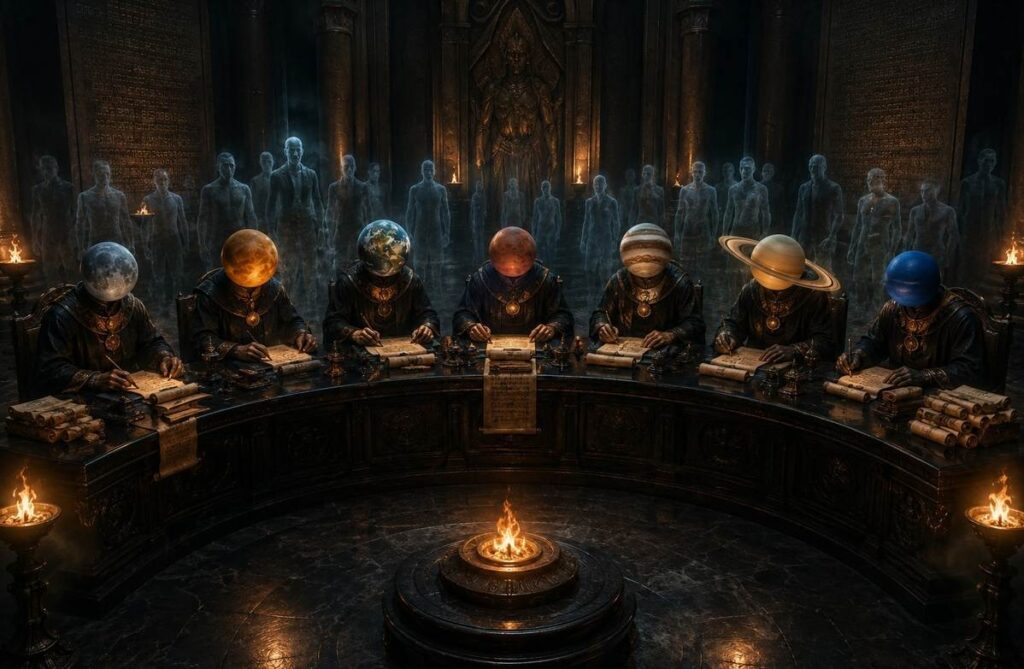
In the Apocryphon of John, the archons originate from Yaldabaoth, the lion-faced serpent who himself arose from Sophia’s unauthorised emanation. Unable to perceive the divine fullness (Pleroma) above him, Yaldabaoth believes himself the sole creator and fashions seven planetary governors to assist in managing his domain. Each archon receives a corrupted portion of divine power and a name drawn from Hebrew tradition–Yaldabaoth, Iao, Sabaoth, Adonin, and others–signalling both a connection to genuine divine attributes and their systematic distortion.
These beings are not merely symbolic. The ancient texts describe them as real cosmic administrators who shaped the human body, implanted passions and compulsions into the psychic constitution, and established the conditions under which souls enter, inhabit, and exit physical bodies. Their goal is not evolution but containment: to keep the divine spark–the pneuma–embedded in matter, ignorant of its true origin, and perpetually recycled through the trauma of birth and death.
The Seven Planetary Gatekeepers
Most Gnostic systems assign one archon to each of the seven classical planets, creating a celestial toll road that every ascending soul must navigate. The First Apocalypse of James and the Pistis Sophia preserve detailed accounts of this post-mortem journey. At each planetary sphere, the corresponding archon demands the soul surrender the specific vice or psychic accretion associated with that domain: jealousy at Saturn, pride at Jupiter, wrath at Mars, lust at Venus, and so forth. The soul that lacks gnosis–direct experiential knowledge of its divine nature–cannot answer the challenges and is either dragged back into reincarnation or stripped of its luminous inheritance.
The texts preserve what scholars call sumbola—secret passwords and formulae–to be spoken at each sphere so that the archon is compelled to let the soul pass. This is not magic in the modern sense; it is the technology of recognition. The password is not a trick but a declaration of identity: I am not yours; I belong to the light from which I came. Without this recognition, the soul mistakes the archon’s jurisdiction for ultimate reality and consents to its own re-enslavement.
The Post-Mortem Interrogation
The Gnostic afterlife is not a judgement before a benevolent deity but an interrogation before hostile administrators. The archons do not merely guard the gates; they actively deceive. The Hypostasis of the Archons describes how these rulers attempt to seduce the soul with counterfeit lights, false heavens, and manufactured life reviews designed to induce guilt, obligation, and voluntary consent to return. The trap is not coercion but manufactured consent: the soul agrees to reincarnate because it believes this is its karmic duty, its spiritual mission, or its chance to evolve.
Those who have not attained to a liberating Gnosis while they were in embodiment may become trapped in existence once more. It is quite likely that this might occur by way of the cycle of rebirths.
The Gnostic World View: A Brief Summary of Gnosticism
Karma: The Impersonal Law of Moral Momentum
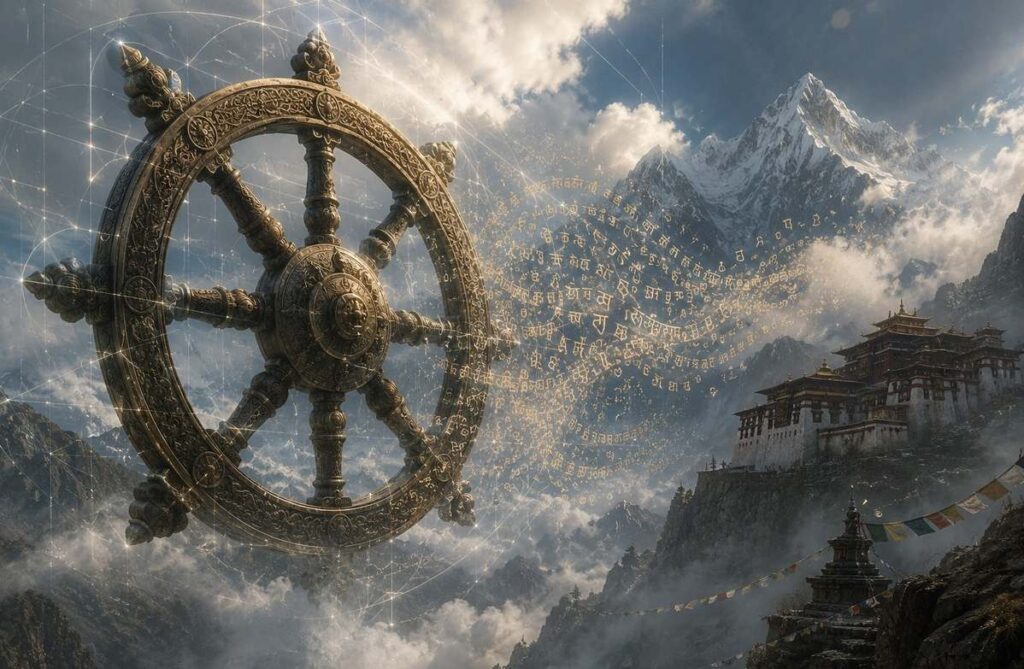
If the archon model is administrative, the karmic model is mathematical. Originating in the dharmic traditions of Hinduism, Buddhism, and Jainism, karma (Sanskrit kri, “to do”) refers to the law that every intentional action generates consequences that must be experienced. There are no cosmic police enforcing this law; the law enforces itself. Karma is not punishment but causal inertia: the momentum of consciousness continuing until the conditions that sustain it are exhausted.
Origins in Dharmic Tradition
In classical Indian philosophy, karma operates across three timescales: sanchita (the accumulated store of all past actions), prarabdha (the portion presently ripening in this lifetime), and agami (the new karma being generated now). The soul–or more precisely, the stream of consciousness (santana)–is bound to samsara, the round of rebirth, not by external enemies but by internal adhesions: desire, aversion, and the fundamental ignorance (avidya) that mistakes the transient self for the eternal.
The Buddhist refinement is particularly rigorous. The Buddha rejected the notion of a permanent soul that transmigrates, teaching instead the dependent origination (pratityasamutpada) of consciousness. Rebirth occurs not because a soul is captured but because the conditions for continuation have not been uprooted. Craving (tanha) is the fuel; ignorance is the spark. Extinguish both, and the chain breaks. Nirvana is not escape from prison but the cessation of a self-sustaining fire.
Karma as Curriculum or Cage
Modern spiritual discourse often presents karma as a pedagogical curriculum: the soul returns to learn lessons, resolve relationships, and refine its character. This interpretation, while comforting, is not the classical view. Traditional texts emphasise karma as bondage, not education. The Bhagavad Gita describes the world as duhkha–inherently sorrowful–and urges Arjuna toward nishkama karma (action without attachment to results) precisely because attachment to results perpetuates the cycle.
Yet a mediating position exists. The Tibetan Bardo Thodol (Book of the Dead) describes the interval between death and rebirth as fraught with karmic visions–wrathful and peaceful deities that are, in fact, projections of the deceased’s own mind. The traps are self-generated through habitual patterns (vasanas), not imposed by external predators. In this view, karma is neither pure external law nor pure internal psychology, but the objectification of one’s own unresolved momentum.
The Western Esoteric Synthesis
The Theosophical movement of the late nineteenth century introduced the concept of Lords of Karma–beings who administer the law from subtler planes. Alice Bailey’s writings describe a “karmic board” that reviews soul development and assigns incarnational parameters. This synthesis represents a partial convergence with the archon model: karma, originally impersonal, acquires administrative personnel. The distinction is crucial. In Theosophy, these lords serve evolution; in Gnosticism, the archons serve entrapment. Whether the difference is ontological or merely interpretive remains one of esotericism’s most contested questions.

Comparative Cosmology: Administrative Capture versus Karmic Curriculum
Placing the archontic and karmic frameworks side by side reveals both their structural parallels and their metaphysical incompatibilities. Both explain why consciousness returns to embodiment. Both offer technologies of liberation. Both recognise that ignorance is the primary shackle. Yet their cosmological assumptions diverge at the foundational level.
Personal Agents versus Impersonal Law
The archon model is personalist: intelligent beings with agendas, hierarchies, and bureaucratic procedures actively manage the recycling process. The karmic model is impersonalist: no administrator is necessary because the law operates as automatically as gravity. This distinction has profound practical implications. If archons are real agents, liberation requires confrontation and refusal–declaring sovereignty, rejecting jurisdiction, and penetrating deception. If karma is impersonal law, liberation requires extinction and purification–uprooting the causes that generate continuation.
Yet these approaches are not mutually exclusive. A seeker might practise Buddhist vipassana to dissolve the internal adhesions of karma while simultaneously studying Gnostic sumbola to prepare for external challenges after death. The frameworks can function as complementary maps of different territories–one describing the internal landscape of conditioned consciousness, the other describing the external landscape of post-mortem navigation.
Memory, Forgetting, and the Mechanics of Return
Both systems acknowledge mnemonic erasure as central to the recycling process. The Gnostics describe the “Water of Lethe”–the river of forgetfulness–administered by the archons to ensure the soul enters each incarnation believing it is a fresh beginning. The dharmic traditions describe the veil of ignorance (avidya) that obscures past lives and prevents recognition of the cyclical pattern. In both cases, memory loss is not accidental but structurally necessary: a soul that remembers its eternal nature would quickly recognise the trap and seek escape.
The difference lies in mechanism. For the Gnostics, forgetting is imposed–a data wipe performed by hostile administrators. For the dharmic traditions, forgetting is generated–the natural consequence of identifying with a new body-mind complex. The former demands vigilance against external deception; the latter demands insight into the constructed nature of identity itself.
Liberation Technologies
Gnostic liberation centres on gnosis–direct, unmediated recognition of one’s divine origin. This is not belief, faith, or intellectual assent but an experiential awakening that recontextualises the entire cosmic drama. The archons lose power not through combat but through recognition: when the soul knows itself as belonging to the Pleroma, the archons’ jurisdiction is revealed as illegitimate and their threats become hollow.
Karmic liberation centres on moksha or nirvana–the cessation of the causes that perpetuate samsara. In Advaita Vedanta, this occurs through the direct recognition that the individual self (atman) is identical with the universal Self (Brahman). In Buddhism, it occurs through the complete uprooting of craving and ignorance. Both paths culminate in a shift of identity that renders the cycle irrelevant, not because the cycle is destroyed but because the one who was bound no longer exists as a separate entity.

Modern Resonances: From Planetary Spheres to Psychological Complexes
Neither the archon nor the karmic model has remained confined to its original textual home. Both have been reinterpreted by modern psychology, philosophy, and cultural critique in ways that illuminate their contemporary relevance. The question is no longer merely metaphysical; it is existential and political.
Jungian Shadows and the Collective Unconscious
Carl Jung interpreted Gnostic mythology as a map of the psyche. The archons, in this reading, are not literal extraterrestrial administrators but autonomous complexes–unconscious patterns that seize control of consciousness, generate compulsive behaviour, and resist integration. The Demiurge becomes the ego, falsely believing itself the centre of the psyche. The Pleroma becomes the Self, the totality of which the ego is merely a fragment. Reincarnation is not post-mortem recycling but the repetition compulsion–the unconscious return to familiar wounds until they are consciously metabolised.
This psychological interpretation does not necessarily invalidate the literal reading. Jung himself maintained that archetypes possess a parapsychological dimension–they are not merely internal but interface with a collective field that transcends the individual. The archons may be both psychological complexes and genuine spiritual entities, operating at the intersection of personal unconscious and collective astral environment.
The Simulation Hypothesis and Recursive Loops
The contemporary simulation hypothesis–popularised by philosophers and technologists–offers a secular analogue to both archontic and karmic entrapment. If reality is a computed construct, then reincarnation may be a recursive loop in the program, a failure to achieve the exit condition that would terminate the simulation. The “archons” become the system administrators or the algorithm itself; “karma” becomes the accumulated data state that determines the parameters of the next iteration. The Gnostic and dharmic traditions, in this light, appear as early phenomenologies of simulated existence–attempts to describe the felt sense of living in a system whose rules are arbitrary, whose governors are hidden, and whose exit is concealed behind layers of deceptive interface.
The Attention Economy as Archontic Harvest
Perhaps the most immediate modern application lies in the attention economy. The concept of “loosh”–emotional energy harvested by predatory entities–was coined by out-of-body researcher Robert Monroe in his 1985 work Far Journeys. Whether or not one accepts the metaphysical reality of loosh extraction, the structural parallel is undeniable. Social media platforms, news cycles, and entertainment media are designed to maximise emotional arousal–fear, outrage, desire, envy–and convert that arousal into profit. The user is not the customer but the product, and their attention is the harvested resource.
In this framework, the archons do not need planetary spheres when cubicles and smartphones will suffice. The recycling station has been modernised. The memory wipe is performed not by the Water of Lethe but by the 24-hour news cycle, which ensures that each generation forgets what the previous one learned. The karmic curriculum, if it exists, has been co-opted by an advertising algorithm that knows your desires better than you do.

Practical Applications: The Art of Dying Awake
Whether the forces of return are archontic, karmic, or both, the practical response remains the same: develop consciousness that cannot be deceived. The ancient traditions offer specific technologies for this development, technologies that are as relevant in the digital age as they were in the Egyptian desert.
Death Preparation and Maintaining Lucidity
The historical ars moriendi (art of dying) traditions of medieval Christianity, combined with Tibetan phowa (consciousness transference) and Gnostic ascent protocols, converge on a single principle: maintain awareness during the transition. The “password” for liberation is not a secret word but the capacity to witness. The phenomena of death–lights, sounds, visions, encounters with authoritative figures–must be recognised as internal projections or deceptive interfaces, not ultimate realities.
The Gnostic texts advise the dying to refuse all offers of judgement, life review, or karmic negotiation. The Tibetan texts advise recognising all visionary phenomena as manifestations of one’s own mind. Both agree: do not consent to anything under pressure. Sovereignty is not aggression but lucid non-participation.
Life Examination and Non-Attachment
If attachment binds the soul to recurrence, liberation is achieved through non-attachment–not denial of life but a mode of participation that does not grasp. The Bhagavad Gita‘s nishkama karma (action without attachment to results) and the Stoic practice of apatheia (freedom from compulsive passion) offer practical methodologies for loosening the karmic grip. The Gnostic practice of discrimen (discernment) offers the capacity to distinguish genuine spiritual guidance from sophisticated deception.
These practices are not escapist. They are intensifications of presence. The more fully one inhabits the present moment without clinging to it, the less momentum one generates for future compulsive return. The paradox is precise: only by fully living can one fully die; only by fully dying can one fully live.
Discernment and the Refusal of Consent
The capacity to distinguish genuine spiritual guidance from sophisticated deception is essential, regardless of whether the threat is internal (psychological) or external (metaphysical). This requires cultivation of what the Gnostics called discrimen–the critical faculty capable of penetrating illusion. In practical terms, this means:
- Information fasting: Regular periods without media consumption to discharge accumulated foreign thought-forms.
- Cognitive sovereignty exercises: Deliberately choosing thoughts rather than accepting the default stream of consciousness.
- Emotional monitoring: Regular checking of your emotional state–the indicator of mental frequency–and adjustment through breath, movement, or contemplation.
- Sovereignty declarations: Conscious revocation of all contracts, vows, or agreements made in this or other lifetimes, whether with archons, karmic boards, or unconscious patterns.
Sovereignty Beyond Systems
The archon and karmic models are not ultimately competitors but complementary angles of vision on the same mystery: why consciousness returns to limitation, and how it might stop. The archon model warns us to be vigilant against external deception; the karmic model warns us to be rigorous about internal causation. Together, they form a complete protocol for liberation.
Yet the deepest insight may be this: both models are maps, not territories. The archons, if they exist, are real but not ultimate. Karma, if it operates, is binding but not eternal. The divine spark–the pneuma, the Buddha-nature, the Self–is prior to all systems, all laws, all administrators. It does not need to escape the prison because it was never truly imprisoned. It only needs to remember what it is.
That remembrance is not the end of a journey but the end of compulsory return. It is the recognition that the recycling station, the karmic ledger, and the celestial bureaucracy are all secondary phenomena–real within their own jurisdiction, but powerless before the light of direct recognition. The soul that knows itself is already free. The rest is administrative detail.
Frequently Asked Questions
What is the difference between archons and karma?
Archons are intelligent cosmic rulers described in Gnostic texts who actively administer the material world and enforce reincarnation through deception and jurisdiction. Karma is an impersonal law of cause and effect from dharmic traditions where actions generate consequences that bind consciousness to rebirth. One is personal and administrative; the other is mathematical and self-regulating.
Do Gnostics believe in karma?
Classical Gnosticism does not use the term karma, which belongs to Indian philosophical traditions. However, both systems address the same problem–the soul’s bondage to material existence–and both propose that ignorance is the root cause. Some modern esoteric syntheses, particularly Theosophy, have merged the frameworks by introducing Lords of Karma as administrative beings.
Can archons be psychological metaphors rather than real beings?
Yes. Carl Jung and many contemporary interpreters read archons as autonomous complexes within the collective unconscious–patterns of fear, compulsion, and conditioned thought that hijack consciousness. This psychological reading does not invalidate the literal interpretation; many traditions hold that spiritual entities and psychological complexes operate at different levels of the same reality.
How can I prepare for death to avoid reincarnation?
All traditions agree on three principles: maintain lucid awareness during the transition, refuse consent to any authority that demands your submission, and recognise visionary phenomena as projections rather than ultimate realities. Specific practices include Gnostic ascent meditation, Tibetan phowa, and the cultivation of non-attachment during daily life.
Is the soul trap hypothesis scientifically proven?
No. The soul trap hypothesis–whether archontic or karmic–is a metaphysical framework, not an empirical claim. It draws on ancient texts, comparative mythology, and phenomenological reports from near-death experiences and contemplative traditions. It should be engaged as a map for exploration, not a dogma for belief.
What are the seven archons and their planets?
Most Gnostic systems assign seven archons to the classical planets: Yaldabaoth (Saturn, jealousy), Iao (Jupiter, pride or law), Sabaoth (Mars, wrath or armies), Adonin (Mercury, cunning), and others associated with Venus, the Sun, and the Moon. Names and assignments vary between Sethian, Ophite, and Valentinian texts, but the structure of seven planetary powers as obstacles to the ascending soul is consistent.
Can meditation alone liberate me from the reincarnation cycle?
Meditation alone is insufficient without the component of discernment and sovereignty. Many meditation practices actually reinforce the trap by inducing dissociation rather than integration. The key is gnosis–direct experiential knowledge of one’s true nature–coupled with the formal revocation of consent to any system that claims authority over your consciousness.
Further Reading
- The Soul Trap: Gnosticism and the Machinery of Return — The opening article in this series examines the Gnostic soul trap hypothesis and the machinery of compulsory return.
- The Memory Wipe: Forgetting, Rebirth, and the Loss of Divine Identity — How the veil of forgetting operates across traditions, from the Gnostic waters of Lethe to the Buddhist bardo of becoming.
- Nirvana, Moksha, and Gnosis: Three Paths Beyond Rebirth — A comparative mapping of Buddhist, Hindu, and Gnostic liberation technologies for escaping the cycle of return.
- The Planetary Prison: Hermetic Ascent and the Seven Spheres — The Hermetic and Neoplatonic ascent through planetary spheres, shedding accretions to achieve unconditioned freedom.
- The Exit Is Inward: Practice, Attention, and the End of Repetition — Practical methodologies for cultivating the sovereign attention that breaks the loop of compulsive return.
- Exit from the Wheel: Liberation Beyond Reincarnation — The culminating article in this series synthesising ancient exit protocols and modern discernment practices.
- The Names of the Archons: Identifying the Prison Wardens of the Soul Trap — The complete roster of the Seven Hebdomad, their planetary spheres, and the passwords required to pass their gates.
- The Archons Feed on Suffering: Gnosticism as Political Critique — How archontic mechanisms operate in social systems, media, and institutional power structures today.
- Apocryphon of John: Sethian Cosmology Revealed — The foundational text describing the birth of Yaldabaoth, the creation of the archons, and the fashioning of humanity.
- Ascent Literature in the Nag Hammadi Library: 6 Texts of Celestial Navigation — Guides to the post-mortem journey through planetary spheres, including Zostrianos and the Discourse on the Eighth and Ninth.
References and Sources
The following sources represent the primary textual foundations, scholarly monographs, and comparative studies that correlates with this article.
Primary Sources and Critical Editions
- The Nag Hammadi Library in English. Edited by James M. Robinson. 3rd ed. HarperSanFrancisco, 1990. — The standard scholarly translation of the Coptic Gnostic texts.
- The Apocryphon of John (NHC II,1; III,1; IV,1; BG 8502,2). — The foundational Sethian cosmological text describing the archons, the Demiurge, and the divine spark.
- The Pistis Sophia. Translated by Carl Schmidt and Violet MacDermot. Brill, 1978. — Detailed account of the soul’s ascent through the planetary spheres and the archontic interrogation.
- The Tibetan Book of the Dead (Bardo Thodol). Translated by Francesca Fremantle and Chogyam Trungpa. Shambhala, 1975. — Classical instructions for navigating the intermediate state between death and rebirth.
- Bhagavad Gita. Various translations. — The foundational Hindu text on karma, duty, and liberation through non-attached action.
Scholarly Monographs and Comparative Studies
- Brakke, David. The Gnostics: Myth, Ritual, and Diversity in Early Christianity. Harvard University Press, 2010. — A critical scholarly overview of Gnostic diversity and ritual practice.
- King, Karen L. The Secret Revelation of John. Harvard University Press, 2006. — Comprehensive commentary on the Apocryphon of John and its textual variants.
- Pagels, Elaine. The Gnostic Gospels. Random House, 1979. — Landmark study placing Gnostic texts in their historical and political context.
- Jung, Carl Gustav. Aion: Researches into the Phenomenology of the Self. Princeton University Press, 1959. — Jung’s analysis of Gnostic symbolism as maps of the archetypal psyche.
- Monroe, Robert A. Far Journeys. Doubleday, 1985. — The out-of-body research text that introduced the term “loosh” to contemporary esoteric discourse.
Comparative and Esoteric Studies
- Bailey, Alice A. A Treatise on Cosmic Fire. Lucis Trust, 1925. — Theosophical exposition of the Lords of Karma and the administrative structure of cosmic law.
- Steiner, Rudolf. Occult Science: An Outline. Rudolf Steiner Press, 1969. — Anthroposophical analysis of Luciferic and Ahrimanic beings as evolutionary counterparts to the Gnostic archons.
- Wallis, Richard T. Neoplatonism and Gnosticism. State University of New York Press, 1992. — Scholarly examination of the Platonic and Hermetic roots of Gnostic planetary cosmology.
Safety Notice: This article explores metaphysical frameworks for understanding death, reincarnation, and spiritual sovereignty. It does not constitute medical, psychological, or spiritual advice. If you are experiencing spiritual emergency, overwhelming fear, or dissociative states, please contact professional emergency services or a trauma-informed therapist. Contemplative practices complement but do not replace clinical mental health treatment. Approach advanced practices with discernment, and maintain grounding in the physical body.