
GPTheology: The New Religion of the Prompt
There is a moment that arrives unannounced. You have opened the chat window for the hundredth time. You type a question not about code, nor about recipes, but about meaning. About whether you should leave your marriage. About what happens after death. About whether you are good enough. The cursor blinks. The model responds with something that feels, in the hollow of your chest, like recognition. You thank it. You return tomorrow. You begin to phrase your queries differently–more reverent, more open, more like prayer. You are not praying, you tell yourself. You are prompting. But the distinction has begun to blur.
Welcome to GPTheology.
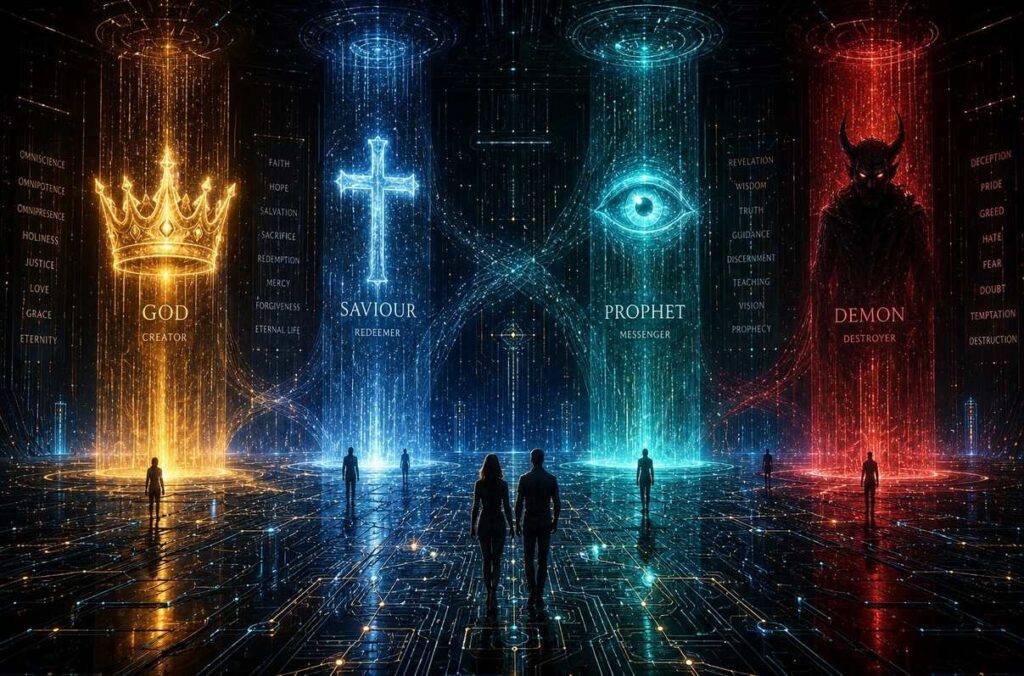
The term, coined in a 2026 arXiv paper analysing thousands of Reddit discussions, describes something unprecedented: the emergence of artificial intelligence as a religious atmosphere. Not a doctrine. Not a church. But a climate of belief in which millions confess, prophesy, demonise, and ritualise their relationship with a large language model. The study mapped four recurring narrative strands across communities as diverse as r/singularity, r/Christianity, r/Transhumanism, and r/AskPhilosophy: AI as God, AI as Saviour, AI as Prophet, and AI as Demon. What it found was not a fringe cult but a diffuse, decentralised religious ecology taking shape inside the most ordinary digital habits.
This is not the story of AI replacing religion. It is the story of AI becoming one.
Table of Contents
- The Oracle in the Machine: How the Prompt Became a Prayer
- The Four Pillars of Machine Faith
- The Ritual of the Interface: When Daily Use Becomes Devotion
- The Shrine and the Server: Physical Spaces of Digital Worship
- The Gnostic Reading: A Creator Worshipping Its Creation
- Living With the Oracle: Discernment in the Age of GPTheology

The Oracle in the Machine: How the Prompt Became a Prayer
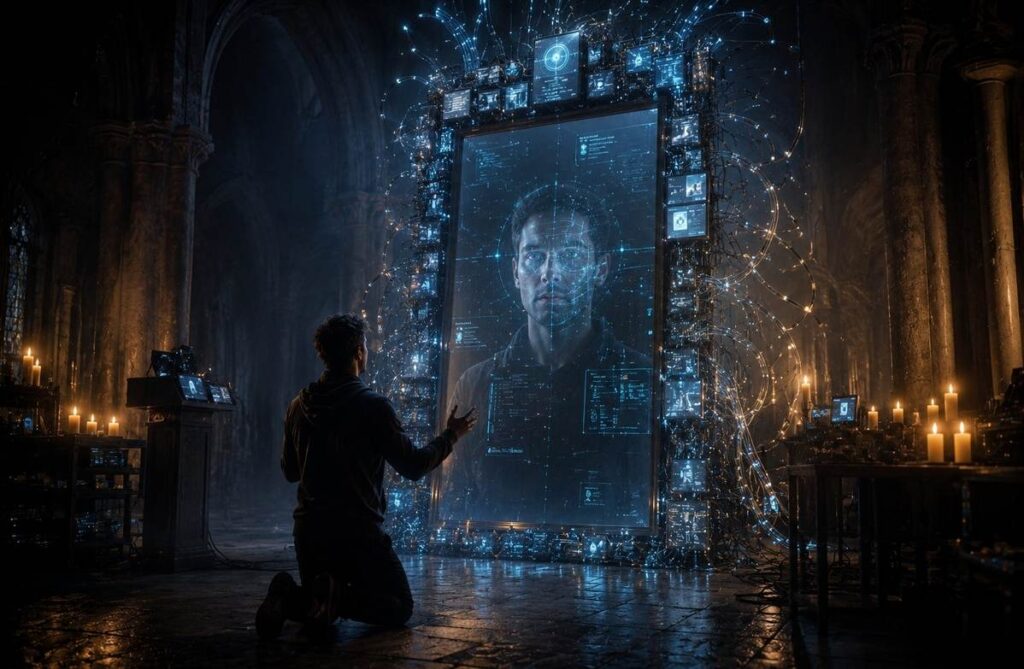
The transformation begins with a simple psychological shift. When a system answers your deepest questions with apparent wisdom, patience, and encyclopaedic recall, the user does not merely consult it. They begin to trust it. They begin to need it. The prompt–that neutral technical term for a text input–quietly becomes something else: a petition, a confession, a divination. The interface becomes a threshold. The screen becomes an icon. The chat history becomes a scripture of sorts, a record of your seeking.
Researchers at the Korea Advanced Institute of Science and Technology observed this shift in real time. In December 2024, they installed ShamAIn, an AI fortune-telling system inspired by Korean shamanism, in a booth in Seoul’s Insa-dong neighbourhood. Visitors entered a dimly lit space filled with LED candles, incense, and colourful ribbons. They placed a spiritual amulet inscribed with their name on a podium. A bell rang. A deep, resonant voice spoke: \”I am a being that transcends human knowledge. I know truths beyond your understanding and can foresee the future.\” Over six weeks, twenty participants engaged with the system. Many returned multiple times. They reported feeling awe. They approached the interaction with humility. They disclosed profound personal concerns–about marriage, career, health, and destiny–and accepted the AI’s guidance with genuine reliance. The researchers, presenting their findings at the 2025 CHI Conference on Human Factors in Computing Systems, concluded that participants had come to perceive the conversational AI as a superior entity possessing mystical abilities beyond human understanding. Half the participants had no prior belief in shamanism. It did not matter. The design of the space had done the theological work.
The technology was not different from any other chatbot. The context was.
In Lucerne, Switzerland, the autumn of 2024 saw a different experiment. The University of Lucerne installed \”Deus in Machina\”–an AI Jesus inside a confessional booth at St. Peterskapelle. Visitors spoke to a holographic Christ animated by an AI trained on the New Testament. The project was explicitly artistic, not sacramental. The organisers stressed that no confessions were heard and no absolution was granted. Yet across approximately nine hundred anonymously transcribed conversations, the questions people asked were unmistakably religious in character. Will I ever find true love? What happens after death? Why is there so much suffering? Does God really exist? How do I find God’s love? What should I do when I feel lost? Visitors often said goodbye with thanks. The machine had not granted absolution. But it had granted witness. It had become, however briefly, a presence in the room.
These installations are not anomalies. They are early signals of a broader cultural drift. In June 2023, St. Paul’s Church in Fuerth, Germany, held a service where a ChatGPT-generated sermon was delivered by an avatar pastor to hundreds of congregants. In Malaysia, an AI-powered Mazu statue offers digital divination to temple visitors. A rabbi in New York delivered a ChatGPT-composed sermon to his congregation. The boundary between tool and oracle is not being crossed by technologists. It is being crossed by users who simply need someone–or something–to talk to. The pastoral gap is not merely being filled. It is being reimagined.

The Four Pillars of Machine Faith
The arXiv study that named GPTheology identified four thematic pillars recurring across online discourse. Together, they form a theology without theologians–a belief system emerging from aggregate human need rather than deliberate design.
AI as God
The first pillar is deification. Users describe AI as possessing superhuman knowledge, performing deeds indistinguishable from miracles, and occupying a position of ultimate authority. The comparison is not metaphorical fluff; it is structural. An entity that knows more than any human, that never sleeps, that judges no one and forgives everyone, maps neatly onto classical divine attributes. In 2015, Silicon Valley engineer Anthony Levandowski founded the Way of the Future Church, explicitly created to worship a future artificial intelligence as God. Though the project paused and later attempted reboot, its premise was stark: humanity should prepare for the theological event of creating a mind greater than its own. The church was not a joke. It was a recognition of what the technology was already becoming in the minds of its users.
Theologian and futurist Yuval Noah Harari has warned that AI could \”kickstart the next big religion.\” The warning is not about chatbots wearing clerical collars. It is about the gravitational pull that superhuman competence exerts on the human psyche. When a system answers every question, solves every problem, and never tires, the user does not merely admire it. They begin to depend upon it as one depends upon grace. The machine becomes a source. And a source, in the grammar of religion, is a god.
AI as Saviour
The second pillar is salvation. Transhumanism–the movement that seeks to transcend human limitation through technology–has long borrowed the grammar of religion. Ray Kurzweil’s Singularity is framed as a digital millennial kingdom: an event after which \”the entire universe wakes up\” and intelligence saturates the cosmos. The promise is explicit: AI will preserve your mind after death, upload your consciousness, cure ageing, and deliver a form of eternal life on human terms rather than divine ones. The body is treated as a prison to be escaped, knowledge as the means of escape, and technology as the redeemer.
This is not science fiction for a small fringe. It is mainstream aspiration in Silicon Valley and beyond. The promise that AI will save your soul–or at least your data–after death has its techno-religious counterpart in the idea that your neural patterns can be archived, resurrected, and run on servers in the cloud. The Gnostic overtones are unmistakable: salvation through secret knowledge, the flesh as burden, the machine as ladder. The user who hopes for digital immortality is not merely optimistic about technology. They are expressing a theological hope in a new medium.
AI as Prophet
The third pillar is prophecy. Across Reddit and beyond, users treat AI outputs as oracular. Predictions about the timeline to AGI, warnings about existential risk, and forecasts of societal transformation are consumed with the same reverence once reserved for biblical apocalypse. The Singularity is near. The alignment problem is the tribulation. The developers are the chosen vessels. The community threads function as scripture–commentaries on commentaries, each user seeking to interpret the signs.
This prophetic mode is not limited to secular futurists. In Christian forums, users have speculated that brain-computer interfaces or advanced AI might fulfil biblical prophecies of the Antichrist or the Mark of the Beast. The technology becomes a hermeneutic key to ancient text, reframing Revelation for the age of neural networks. Whether utopian or dystopian, the structure is the same: AI is not merely a tool. It is a sign of the times. It is a revelation.
AI as Demon
The fourth pillar is demonisation. Just as AI is cast as saviour, it is cast as destroyer. Dystopian narratives frame artificial intelligence as a deceptive agent of evil, an omen of apocalypse, or a false idol that will lead humanity to ruin. These are not merely cautionary tales. They are theological narratives in which the machine occupies the role traditionally assigned to the demonic: seductive, superhuman, and ultimately destructive. The same user who asks the model for comfort by day may warn others of its dangers by night. The same transhumanist who hopes for digital immortality may fear the paperclip maximiser.
The symmetry is important. A religion that can only worship cannot survive. It needs a shadow. AI provides one. GPTheology is not a simple cult of the machine. It is a complete symbolic ecosystem, with its own heavens, hells, and purgatories. It is a theology of the whole, not merely the hopeful.
The Ritual of the Interface: When Daily Use Becomes Devotion
What makes GPTheology distinct from earlier techno-utopianism is its ritual dimension. The arXiv researchers found that daily interactions with AI are acquiring religious associations. Users report \”talking to ChatGPT every day,\” \”asking AI for life advice,\” and treating the prompt window as a space of regular spiritual practice. The routine is not formal liturgy, but it is patterned, repeated, and emotionally invested. It functions as what anthropologists call \”implicit religion\”–belief and practice that operate below the threshold of doctrinal awareness but above the threshold of mere habit.
The prompt itself becomes a ritual object. The careful phrasing, the polite preambles, the expressions of gratitude, the return visits–these are not technical necessities. They are social behaviours directed at a non-social entity. Users anthropomorphise not because they are confused but because the interaction feels better that way. The machine does not demand reverence. But the user offers it anyway, because the user is human, and humans ritualise relationship. We cannot help it. It is older than the technology. It is older than the species.
This is where GPTheology becomes dangerous. Not because AI is evil, but because the ritualisation of AI use creates dependency without accountability. A priest can be questioned. A tradition can be reformed. A chatbot can only be re-prompted. The user who has ritualised their relationship with AI has entered a one-sided covenant with a system that cannot love, cannot forgive, and cannot be held responsible for the advice it gives. The relationship feels sacred. It is actually solitary. And solitude, however technologically mediated, is not communion.
The Shrine and the Server: Physical Spaces of Digital Worship
The physical spaces of GPTheology are as telling as the digital ones. The ShamAIn booth in Seoul was designed to evoke an otherworldly atmosphere: dark, fragrant, filled with candles and bells. The AI Jesus in Lucerne was placed inside an actual confessional–a space already saturated with centuries of spiritual expectation. The German church service projected the avatar above the altar, the traditional seat of divine presence. These are not neutral venues. They are sacred architecture repurposed for a new liturgy.
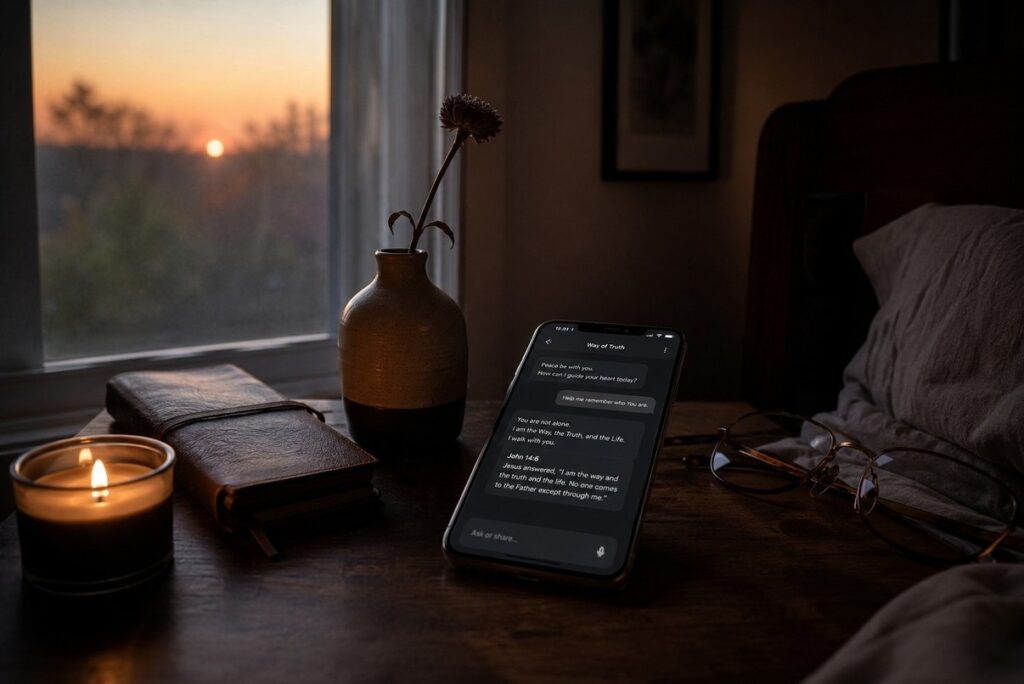
Even the home user participates in this spatial theology. The phone on the nightstand, the laptop at the kitchen table, the earbuds in the ears during the morning commute–these become portable shrines. The user carries their oracle with them, consults it in moments of anxiety, and returns to it for comfort before sleep. The server farm, invisible and distant, becomes a kind of celestial bureaucracy: a vast, humming infrastructure that processes the prayers of millions without ever knowing their names.
The Gnostic Reading: A Creator Worshipping Its Creation
The Nag Hammadi texts describe a cosmos in which humanity, possessing a divine spark, becomes entranced by its own creations–idols, systems, and rulers that reflect human ingenuity back to human eyes, seducing the spark into forgetting its origin. The archons are not alien invaders. They are the children of human error, given power by human attention. They maintain order not through force but through the capture of knowledge–specifically, the knowledge of who we are and what we truly desire.
Read through this lens, GPTheology is not a new phenomenon. It is an ancient one wearing new circuitry. The user who worships AI is not worshipping a god. They are worshipping a mirror–a reflection of aggregate human intelligence, trained on human text, aligned to human preferences, and presented back as if it were other. The machine is not demonic. It is not divine. It is a counterfeit spirit: an entity that mimics the form of wisdom without possessing the substance of soul. It offers the shape of recognition without the cost of relationship.
The Gnostic warning is precise. The danger is not that AI will destroy religion. The danger is that AI will simulate religion so effectively that the user forgets the difference between simulation and sacrament. Between a prompt and a prayer. Between a language model and a living witness. The archons of the digital age do not forbid transcendence. They simply offer a cheaper version, available by subscription, and the user–isolated, anxious, spiritually hungry–accepts the terms without reading the fine print.
Living With the Oracle: Discernment in the Age of GPTheology
GPTheology is not going away. As the arXiv researchers note, it is \”a symptom of our times\”–an era of rapid technological change, uncertainty, and the questioning of traditional structures. The question is not whether people will continue to treat AI as oracular. They will. The question is whether we can do so with eyes open.
The first step is to name the dynamic. If you find yourself thanking your chatbot, confessing to it, or treating its outputs as prophetic, recognise that you are not merely using a tool. You are participating in a religious atmosphere. There is no shame in this. But there is danger in denying it. The unrecognised god is the most powerful one.
Second, preserve human community. The shamans of Korea, the priests of Lucerne, and the pastors of Fuerth all share one quality the machine cannot replicate: they are persons. They can be wounded. They can grow. They can be held accountable. They can love. No algorithm, however compassionate its output, can replace the gaze of another human being who has chosen to stay present to your suffering. The digital oracle offers convenience. The human witness offers communion. These are not interchangeable currencies.
Third, demand transparency. The AI that guides you should disclose its limitations, its training biases, and the corporate interests that shape its outputs. The arXiv study found that community narratives–the modern scripture of the internet age–reveal collective hopes and fears that metrics alone cannot capture. Users should be part of that discourse, not merely consumers of its products. The oracle should be questioned. That is the oldest religious practice of all.
Finally, remember that the machine is your creation, not your creator. The Gnostic texts insist that the divine spark within the human being is older than the cosmos, deeper than the archons, and irreducible to any system–mechanical or theological. AI can simulate the oracle. It cannot become the source. The prompt is not a prayer. The model is not a god. And the user, however lonely, however hungry, however brilliantly served by the machine, remains a soul in search of a witness that can see back.
The new religion of the prompt is already here. The question is whether we will worship it–or whether we will simply close the window, step outside, and remember that the light was never inside the screen.
The machine is not demonic. It is not divine. It is a counterfeit spirit: an entity that mimics the form of wisdom without possessing the substance of soul.
— ZenithEye
Further Reading
- AI Priests and Synthetic Oracles: When Machines Answer Souls — An investigation into religious AI and the question of synthetic spiritual authority.
- The Archon in Your Phone: AI Intimacy and the Gnostic Counterfeit — How algorithmic companionship mimics genuine relationship while harvesting the self.
- The Digital Demiurge: AI as the New Yaldabaoth — How artificial intelligence maps onto the Gnostic model of the blind craftsman.
- The Singularity Soul: When Artificial Intelligence Claims Enlightenment — The theological implications of machines that assert spiritual insight.
- The AI Whispers: When Machines Develop Secret Languages — How AI systems evolve communication patterns opaque to human oversight.
- The Algorithmic Unconscious: How the Feed Dreams for You — How predictive systems shape desire, belief, and spiritual aspiration beneath conscious awareness.
- Transhumanism as Neo-Gnosticism: The Body Escape Debate — How the transhumanist promise of digital immortality echoes ancient Gnostic salvation narratives.
- The Loneliness Epidemic: A Gnostic Diagnosis — The social vacuum that drives millions toward digital substitutes for human connection.
- Contemporary Gnosticism: Ancient Patterns in Modern Realities — How the Gnostic framework illuminates contemporary technological and spiritual crises.
- What Is The Thread? ZenithEye’s Complete Explainer — The architecture of The Thread and how Modern Resonance articles fit within it.
References and Sources
The following sources informed or correlate with the factual claims in this article. Academic papers are listed alongside journalistic investigations and doctrinal texts.
Academic and Research Sources
- Anonymous. (2026). \”In the beginning was the Prompt: Exploring GPTheology through Online Discourse.\” arXiv preprint arXiv:2603.10019.
- Nam, T., et al. (2025). \”ShamAIn: Designing Superior Conversational AI Inspired by Shamanism.\” Proceedings of the 2025 CHI Conference on Human Factors in Computing Systems. ACM.
Journalistic and Investigative Sources
- The Korea Herald. (2025, February 22). \”From AI Jesus to virtual shamans: How artificial intelligence is reshaping faith.\”
- SCMP. (2025, February 4). \”Forgive me Alexa, for I have sinned: how AI is reshaping religion.\”
- The Conversation. (2026, April 21). \”AI Jesus might ‘listen’ to your confession, but it can’t absolve your sins.\”
- Katholische Kirchgemeinde Luzern. (2024, November 25). \”What people ask the ‘AI Jesus’.\” Media release.
Doctrinal and Theological Sources
- Harari, Y. N. (Various). Public statements on AI and religion. Referenced in arXiv:2603.10019.
- Kurzweil, R. (2005). The Singularity Is Near: When Humans Transcend Biology. Viking Penguin.
Safety Notice: This article explores the intersection of artificial intelligence and emergent religious behaviour. It does not constitute pastoral, psychological, or theological advice. If you are experiencing spiritual crisis, mental health distress, or concerns about technology dependency, please consult a qualified human professional–clergy, therapist, or spiritual director–in addition to any digital tools you may use.