
Nirvana, Moksha, and Gnosis: Three Paths Beyond Rebirth
The cycle of birth, death, and return-samsara-is one of the oldest problems in human thought. Every civilisation that has confronted it has produced a technology of escape. Three of these technologies have survived with particular clarity: the Buddhist nirvana, the Hindu moksha, and the Gnostic gnosis. Each offers a path beyond rebirth. Each operates on different metaphysical assumptions. And each, in its own way, insists that liberation is not a reward granted by a god but a shift in consciousness that the practitioner can initiate.
This article examines the three paths as comparative systems. It does not collapse them into a vague universalism, nor does it treat them as mutually exclusive foreign territories. The aim is precision: to understand what each tradition actually teaches, where they converge, where they diverge, and what they mean for the contemporary seeker who encounters all three in the same library, the same meditation hall, or the same late-night search query.
Table of Contents
- Nirvana: The Extinguishing
- Moksha: The Return to Self
- Gnosis: The Recognition
- Three Paths, One Threshold? Convergences and Divergences
- Modern Resonance: What Liberation Looks Like Now
Nirvana: The Extinguishing
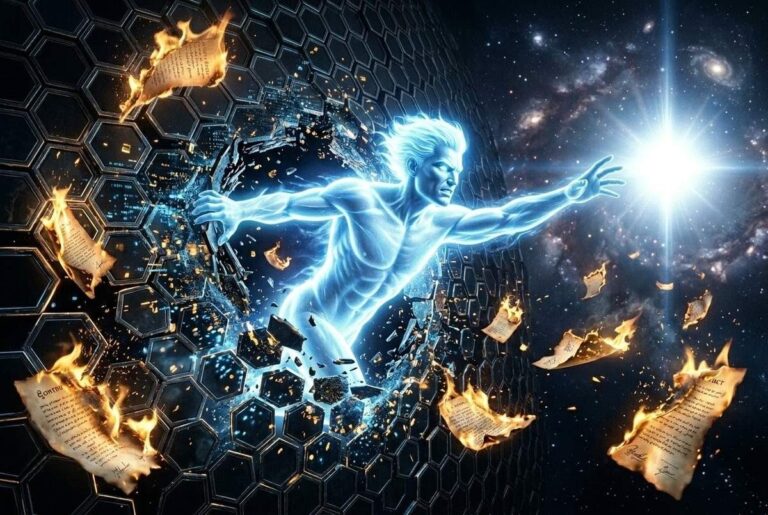
In the Buddhist tradition, the problem is not the soul’s exile from a divine home. The problem is dukkha–suffering, unsatisfactoriness, the structural instability of all conditioned existence. Siddhartha Gautama, the historical Buddha, did not claim to have discovered a hidden realm. He claimed to have diagnosed a disease and found its cure. The disease is craving (tanha). The cure is the cessation of craving. The state of complete cessation is nirvana.
The word itself derives from the Sanskrit nir- (out) and vā (to blow), suggesting the extinguishing of a flame. In Pali, the canonical language of the Theravada scriptures, this becomes nibbāna–the blowing out of the Three Fires of greed, hatred, and delusion. This is not annihilation in the nihilistic sense. It is the end of the processes that generate rebirth. Where there is no fuel, there is no fire. Where there is no craving, there is no clinging. Where there is no clinging, there is no rebirth.
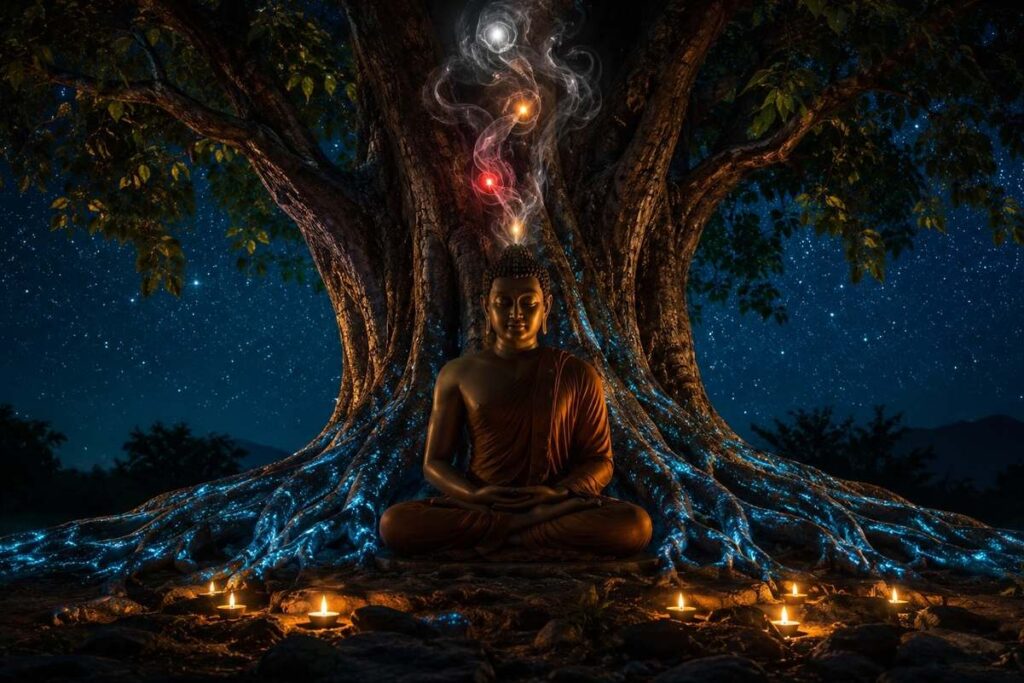
The metaphysics underpinning this are radical. Buddhism denies the existence of a permanent, unchanging self (anatta). What we call “I” is a provisional aggregation of five skandhas–form, sensation, perception, mental formations, and consciousness–all impermanent, all interdependent, all empty of inherent existence. There is no Atman to liberate, no divine spark to rescue, no soul to repatriate. Nirvana is not a place the self goes. It is the end of the self-construction project altogether.
The tradition distinguishes two modalities. Nirvana with remainder (sopadisesa) is the state of an enlightened being who still inhabits a body and experiences the world, but without generating new karma. Nirvana without remainder (anupadisesa), or parinirvana, occurs at death, when the final aggregates dissolve and no new formation arises. In both cases, the cycle stops because the causes have been uprooted, not because the soul has escaped to a better location.
Moksha: The Return to Self
If Buddhism begins with the denial of self, Hinduism begins with its affirmation. The Upanishads, composed between 800 and 500 BCE, introduce the foundational equation that governs the Hindu path: Atman = Brahman. The individual self (Atman) is not distinct from the ultimate reality (Brahman). It is Brahman, temporarily obscured by ignorance (avidya) and the accumulation of karma. Moksha is the removal of that obscuration–the return of the self to the Self, the wave remembering it is water.
The term moksha means release, liberation, or freedom. Unlike nirvana, which is defined negatively as the cessation of suffering, moksha is described positively as a state of blissful consciousness (ananda), knowledge (jnana), and eternal existence. The Brihadaranyaka Upanishad states: “He who knows that supreme Brahman becomes Brahman itself.” This is not metaphor. It is ontological identity. The liberated soul does not merge into an impersonal void; it realises that it was never other than the whole.
Hindu philosophy offers multiple paths to this realisation, reflecting the diversity of human temperament. Jnana yoga is the path of knowledge and discrimination, associated with Advaita Vedanta and the rigorous inquiry into the nature of self. Bhakti yoga is the path of devotion, in which the soul approaches the divine through love and surrender, particularly in theistic traditions such as Vaishnavism. Karma yoga is the path of selfless action, performing duty without attachment to results. Raja yoga is the royal path of meditation and mind-control, systematised by Patanjali. All four converge on the same recognition: the individual is not separate from the source.
A crucial concept is the jivanmukta–one who is liberated while still alive. Unlike the Buddhist arahant, who lives out the remainder of karma without generating new traces, the jivanmukta continues to act in the world while identified entirely with Brahman. The body persists, but the identification with it has ended. This distinction matters for the comparative framework: moksha preserves the self in a transformed mode, whereas nirvana dissolves the self-construction altogether.
Gnosis: The Recognition
The Gnostic tradition, preserved primarily in the Nag Hammadi Library and related texts from the second to fourth centuries CE, proposes a third metaphysics. Like Hinduism, it affirms an eternal divine essence within the human being. Like Buddhism, it treats the world as a realm of illusion and suffering. But its solution is neither extinction nor union. It is recognition–the recovery of knowledge (gnosis) about who one really is, where one came from, and how to return.
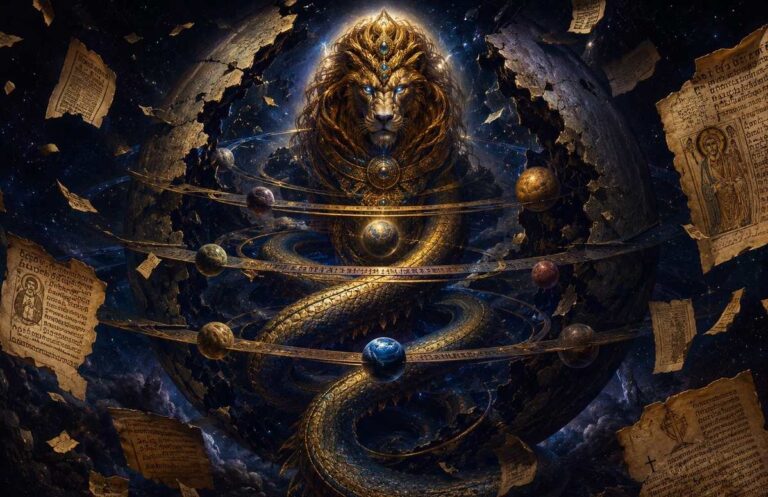
In Gnostic cosmology, the human being is not a fallen Atman nor an aggregate of skandhas. It is a divine spark (pneuma) that has been trapped in matter through a cosmic catastrophe–the fall of Sophia (Divine Wisdom) and the subsequent creation of the material world by the Demiurge Yaldabaoth, a blind and arrogant administrator who believes himself to be the only god. The material world is not merely illusory; it is a prison. Reincarnation is not a natural law but an enforcement mechanism administered by archons–planetary governors who recycle souls back into bodies after death, using the waters of forgetfulness to ensure compliance.
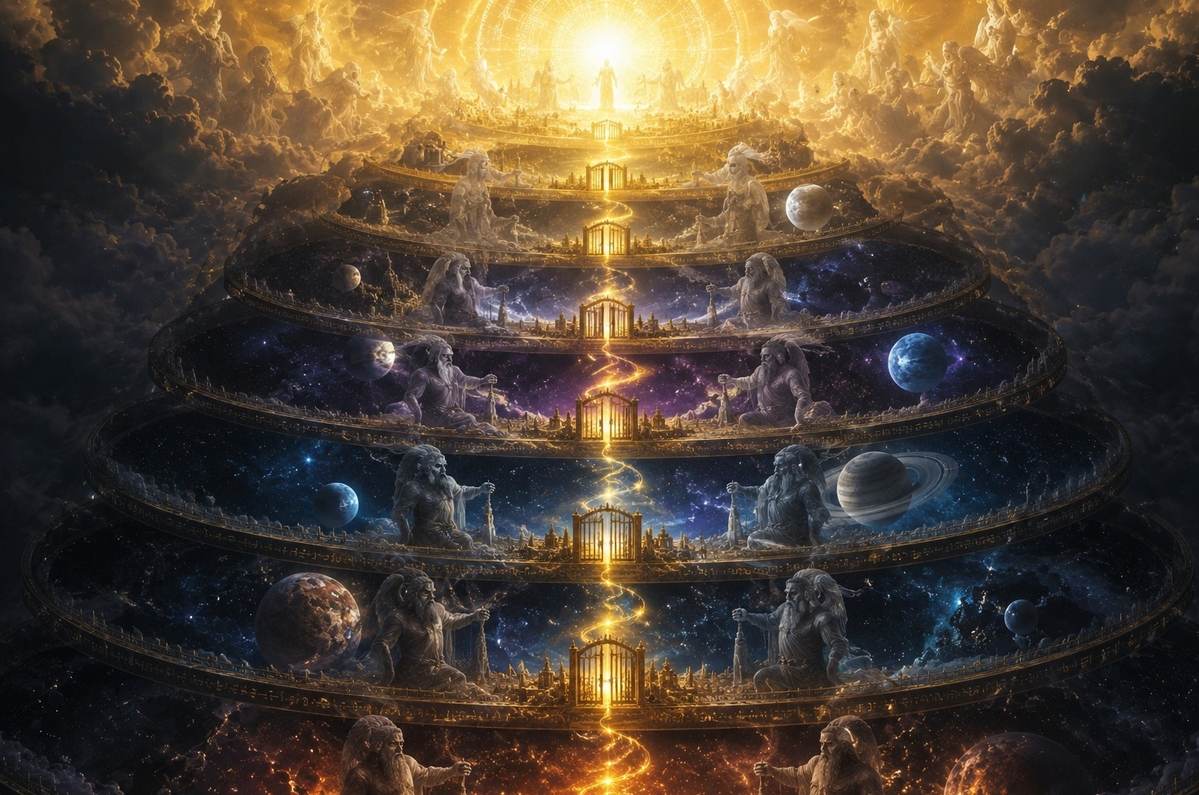
Gnostic anthropology divides humanity into three natures. The hylic are composed entirely of matter, bound to the demiurgic system, and generally incapable of liberation in this cycle. The psychic possess soul and moral capacity but require faith, practice, and guidance to progress. The pneumatic carry the divine spark and are capable of full gnosis–direct, experiential knowledge of their origin in the Pleroma (the Fullness of divine light). This is not a path open to all equally; it is a taxonomy of spiritual capacity, though Gnostic texts also suggest that the spark can be awakened in anyone who encounters the right teaching at the right moment.
Salvation is not earned through good works, ritual purity, or ascetic endurance. It is an event of anamnesis–un-forgetting. The Apocryphon of John describes the divine voice of Pronoia (Forethought) descending into the prison and speaking directly to the sleeping soul: “Rise and remember.” The Gospel of Philip states that ignorance is the mother of all evil, and gnosis is liberation. The Treatise on Resurrection teaches that the resurrection is not a future bodily event but the present realisation that one’s spiritual essence is already perfect and already home. The soul does not become divine. It remembers that it never stopped being so.
Three Paths, One Threshold? Convergences and Divergences
The three traditions agree on the diagnosis: the conditioned life is bondage, and rebirth is the mechanism that perpetuates it. They disagree on the anatomy of the patient and the nature of the cure. A comparative analysis reveals both striking parallels and non-negotiable differences.
The Self Question
Buddhism denies the permanent self. Nirvana is the cessation of the self-illusion. Hinduism affirms the eternal Atman. Moksha is the realisation that Atman is Brahman. Gnosticism affirms the divine spark (pneuma) trapped in alien matter. Gnosis is the recognition of the spark’s true identity. These are not different words for the same thing. They are different answers to the same question, and the answers determine everything that follows.
The Mechanism of Liberation
Nirvana operates through extinction–uprooting the causes of suffering so that rebirth cannot restart. Moksha operates through realisation–removing ignorance so that the true nature of the self becomes obvious. Gnosis operates through recognition–recovering the memory of divine origin so that the prison ceases to hold authority. Extinction, realisation, and recognition are three different technologies. A fire can be extinguished, a mirror can be cleaned, or a prisoner can discover the door was never locked. Each works. Each works differently.
The Goal State
Nirvana is often described negatively–what it is not (suffering, craving, rebirth) rather than what it is. Positive descriptions are considered risky because language reifies. Moksha is described positively as blissful, eternal, conscious union with the divine. Gnosis is described as restoration to the Pleroma–a return to the original fullness from which the spark fell. The Buddhist hesitates to name the goal. The Hindu names it confidently. The Gnostic maps it as a specific geography with a specific address.
The Role of the Teacher
The Buddha is a physician who discovered the path and invites others to walk it. He is not a saviour in the theistic sense; he is a guide. The Hindu guru is a living embodiment of the realised state, capable of transmitting knowledge through direct presence (darshan) and instruction. The Gnostic Revealer (often identified with the spiritual Christ) descends from the Pleroma to awaken the sleeping sparks, speaking the words that trigger recognition. The Buddha shows the way. The guru is the way. The Gnostic Revealer is the voice that reminds you that you were never lost.

Modern Resonance: What Liberation Looks Like Now
The contemporary seeker does not live in a world that sorts traditions into neat monasteries. The same person may sit a Vipassana retreat, study the Upanishads with a teacher, and read the Nag Hammadi texts on a tablet before sleep. This is not syncretism. It is the condition of the modern spiritual landscape. The question is not which tradition to choose, but what each tradition offers to a consciousness that is trying to escape a cycle it cannot fully name.
The Buddhist path offers a rigorous psychology. In an age of anxiety, addiction, and emotional dysregulation, the Four Noble Truths and the Eightfold Path provide a framework for understanding suffering as a mechanical process rather than a personal failure. Mindfulness, stripped of its monastic context and sold as corporate wellness, retains its radical core: the observation that craving generates suffering, and that the observation itself can interrupt the loop. The danger is dilution. When nirvana is reduced to stress reduction, the path becomes a palliative rather than a liberation.
The Hindu path offers a cosmology of meaning. In a world that treats consciousness as an epiphenomenon of meat, the Upanishadic assertion that consciousness is primary–that Atman is the true source of awareness–functions as a counter-programme. The practices of yoga, properly understood, are not fitness routines but technologies for dissolving the identification with body and mind. The danger is commodification. When moksha is marketed as “self-care,” the radical demand of self-realisation is replaced by the manageable goal of self-optimisation.
The Gnostic path offers a hermeneutics of suspicion. In a civilisation of surveillance, simulation, and algorithmic manipulation, the Gnostic insight that reality may be administered by forces with an interest in keeping souls asleep is uncomfortably relevant. The archons are no longer planetary governors; they are attention economies, predictive algorithms, and the subtle systems that manufacture consent for compulsory return. Gnosis, in this context, is not merely historical curiosity. It is a method for reading the contemporary world as a text with hidden authors, and for recognising that the divine spark remains operational even inside the machine.

What unites the three paths in modern application is not their metaphysics but their method. All three insist that liberation is direct–not mediated by institutions, not deferred to afterlife, not purchased through ritual. All three require the practitioner to do something with consciousness that consciousness does not naturally want to do: to observe itself without identification, to discriminate the real from the apparent, or to remember what the system is designed to make it forget. In this sense, the three paths are not competitors. They are three instruments in the same orchestra, tuned to different frequencies but playing the same composition: the end of compulsory return.
Extinction, realisation, and recognition are three different technologies. A fire can be extinguished, a mirror can be cleaned, or a prisoner can discover the door was never locked. Each works. Each works differently.
— ZenithEye
Frequently Asked Questions
What is the difference between nirvana and moksha?
Nirvana is the Buddhist goal of extinguishing craving and suffering to end the cycle of rebirth, based on the doctrine of no-self (anatta). Moksha is the Hindu goal of realising the identity of Atman (individual self) with Brahman (ultimate reality), affirming the eternal self rather than denying it.
What is gnosis in Gnosticism?
Gnosis is direct experiential knowledge of one’s divine origin and identity. It is not faith or intellectual belief but a sudden recognition that liberates the divine spark from the prison of matter and the cycle of archontic reincarnation, enabling return to the Pleroma.
Do Buddhism and Hinduism agree on the concept of self?
No. Hinduism affirms an eternal Atman (self) that is identical with Brahman. Buddhism denies the existence of a permanent self, teaching anatta (no-self). This is one of the most significant philosophical differences between the two traditions.
Can a person achieve moksha or nirvana while still alive?
Yes. Hinduism describes the jivanmukta–one liberated while living. Buddhism describes nirvana with remainder (sopadisesa), attained by enlightened beings who still inhabit a body but no longer generate karma. Both traditions affirm liberation in this life is possible.
What are the three natures in Gnostic anthropology?
Gnostic texts, particularly Valentinian sources, divide humanity into hylic (material, bound to matter), psychic (soul-endowed, capable of faith and ethical progress), and pneumatic (spirit-endowed, capable of full gnosis and return to the Pleroma).
Are these three paths describing the same ultimate reality?
Scholars disagree. Some argue all three point to a common liberation beyond conceptual categories. Others maintain their metaphysical foundations are incompatible: Buddhism denies what Hinduism affirms (the eternal self), and Gnosticism affirms a divine spark trapped in matter, which Buddhism would classify as clinging to a self-view.
How can these ancient paths be applied in modern life?
Buddhism offers a psychology of craving and observation. Hinduism offers a cosmology of consciousness and self-inquiry. Gnosticism offers a hermeneutics of suspicion toward systems of control. All three require direct practice rather than belief, and all three challenge the modern assumption that identity is identical with body, mind, or social role.
Further Reading
- The Soul Trap: Gnosticism and the Machinery of Return — Article 1 in the Liberation from Reincarnation series introduces the Gnostic soul trap hypothesis and the machinery of compulsory return.
- Archons and Reincarnation: Do Cosmic Powers Keep the Soul Trapped? — Article 2 compares the archontic and karmic frameworks as competing models for understanding the cycle of rebirth.
- The Memory Wipe: Forgetting, Rebirth, and the Loss of Divine Identity — Article 3 examines how the veil of forgetting operates across traditions, from the Gnostic waters of Lethe to the Buddhist bardo of becoming.
- The Planetary Prison: Hermetic Ascent and the Seven Spheres — Article 4 traces the Hermetic and Neoplatonic ascent through planetary spheres, shedding accretions to achieve unconditioned freedom.
- The Exit Is Inward: Practice, Attention, and the End of Repetition — Article 6 in the series explores practical methodologies for cultivating the sovereign attention that breaks the loop of compulsive return.
- Exit from the Wheel: Liberation Beyond Reincarnation — Article 7 synthesises ancient exit protocols and modern discernment practices for the contemporary seeker.
- Gnosticism and Buddhism: 7 Surprising Convergences — A detailed comparison of shared themes between the Nag Hammadi texts and Buddhist philosophy, from anatta to the archons.
- What Is Gnosis? Meaning, Recognition, and Direct Knowing — The mechanics of Gnostic recognition as the path beyond belief, ritual, and institutional mediation.
- What Is the Divine Spark? — The hidden light within that remembers and seeks return, central to Gnostic soteriology and the anthropology of the three natures.
- Pleroma and Kenoma: The Foundational Geography of Gnostic Cosmology — The divine fullness and the deficient void that frames the soul’s journey, from the fall of Sophia to the restoration of the spark.
References and Sources
The following sources represent the primary texts, critical editions, and scholarly works consulted in the preparation of this comparative study.
Primary Sources and Critical Editions
- The Pali Canon: Digha Nikaya and Majjhima Nikaya (Pali Text Society editions, various translators).
- Brihadaranyaka Upanishad, in Upanisads, trans. Patrick Olivelle (Oxford World’s Classics, 1996).
- Patanjali, The Yoga Sutras of Patanjali, trans. Edwin F. Bryant (North Point Press, 2009).
- The Nag Hammadi Library in English, ed. James M. Robinson, 4th ed. (Brill / HarperSanFrancisco, 1996). Includes the Apocryphon of John, Gospel of Philip, and Treatise on Resurrection.
Scholarly Monographs
- Conze, Edward. Buddhist Thought in India (George Allen & Unwin, 1962).
- Eliade, Mircea. Yoga: Immortality and Freedom, 2nd ed. (Princeton University Press, 1969).
- Jonas, Hans. The Gnostic Religion: The Message of the Alien God and the Beginnings of Christianity, 3rd ed. (Beacon Press, 2001).
Comparative Studies
- Smith, Huston. The World’s Religions, rev. ed. (HarperOne, 1991). Chapters on Hinduism and Buddhism.
Safety Notice: This article explores advanced contemplative and cosmological concepts from multiple religious traditions. It does not constitute medical, psychological, or spiritual advice. If you experience distress, dissociation, or existential crisis when engaging with these themes, please contact a trauma-informed mental health professional. Comparative study complements but does not replace grounded clinical support or the guidance of a qualified teacher within a living tradition.