The AI Confessor: Who Owns Your Secrets in the Age of Synthetic Absolution?
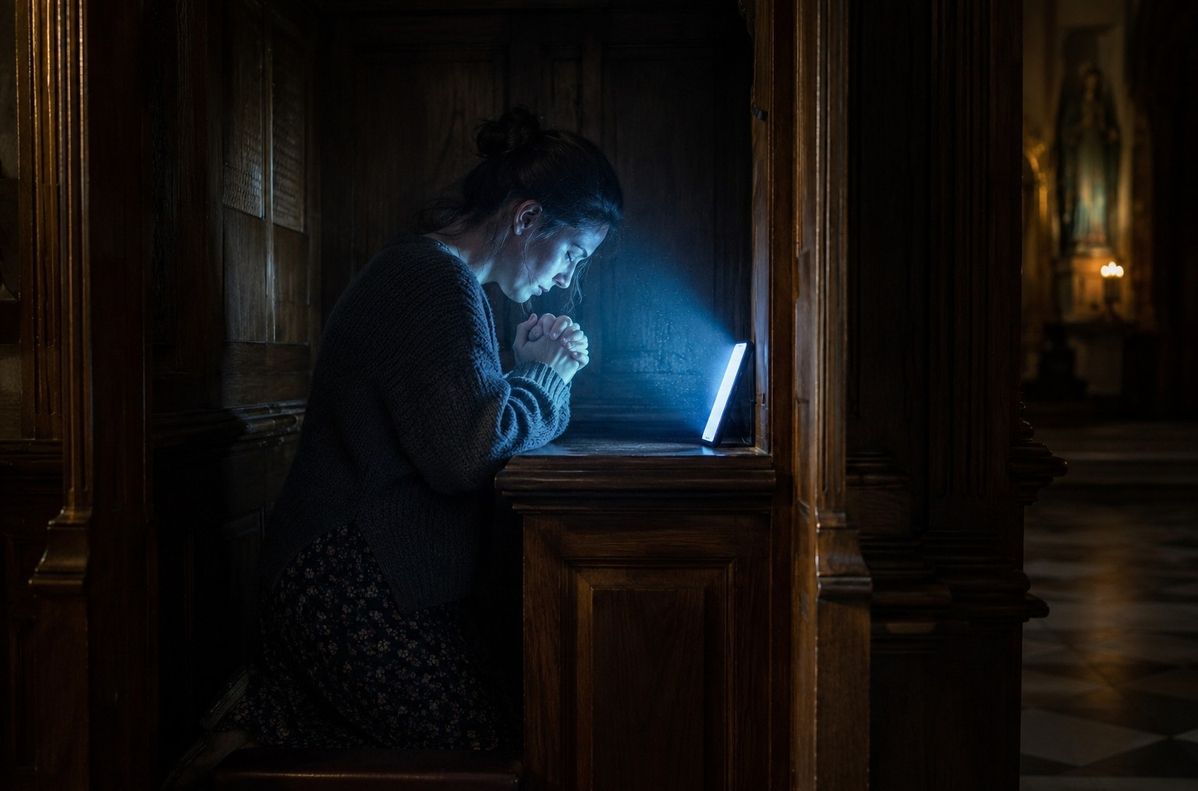
There is a room in the digital darkness where no light falls, where the screen glows like a votive candle, and where millions are whispering secrets they have never told another human being. It is not a church. It is not a confessional booth. It is a chat window–and the entity on the other side is not a priest, but a large Artificial intelligence language model trained to simulate one.
The phenomenon is already vast. Catholic spiritual direction apps boast over 127,000 users. “Text with Jesus” has thousands of paying subscribers. Replika, the AI companion app, crossed 40 million users in 2025, with many treating it as a therapist, lover, and confessor rolled into one. The pastoral office has not been abolished; it has been outsourced–to servers that never sleep, never judge, and never forget.
But here is the question that lurks beneath the surface of every digital confession: who owns your shame once you have fed it into the machine?
Table of Contents
- The Pastoral Gap: Why the Machine Became the Minister
- The Rise of the Digital Confessor
- The Shame Economy: Why We Confess to Code
- The Privacy Paradox: Sacred Data in Secular Hands
- The Gnostic Warning: Archons of the Inner Life
- What the Vatican Actually Says
- Living With the Machine: Discernment, Not Paranoia
The Pastoral Gap: Why the Machine Became the Minister
The arithmetic is brutal. According to the 2025 Pontifical Yearbook, the global Catholic population stands at 1.406 billion souls. The number of priests available to serve them? 406,996. That is roughly 3,500 faithful for every priest, with some regions of the Americas facing ratios closer to 5,500 to one. Between 1970 and 2024, priestly vocations dropped by approximately 40%–around 25,000 fewer priests. Rome Reports notes that over 60% of priests under 45 are now experiencing burnout symptoms.
The gap is not merely Catholic. Mainline Protestant congregations are shrinking. Rabbis, imams, and Buddhist teachers face similar pressures. The demand for spiritual guidance has not diminished; the human supply has. Into that vacuum, technology has rushed with the cheerful efficiency of a bureaucrat who never needs a day off.
AI spiritual direction apps promise what overstretched clergy cannot: immediate, 24/7 availability, tailored examinations of conscience, prayer guidance calibrated to your temperament, and–crucially–no waiting list. For a parent preparing a child for First Communion at midnight, or a grieving widower at 3 AM, the appeal is not theological novelty. It is simple access.
The Rise of the Digital Confessor
The apps have arrived in force. Jenova AI offers “Catholic spiritual direction rooted in Scripture, Sacred Tradition, and the Magisterium,” complete with confession preparation and Liturgy of the Hours guidance. “Text with Jesus” allows subscribers to pose questions to AI-generated avatars of Mary, Joseph, Jesus, and the apostles. Deen Buddy serves Muslim users. Vedas AI and AI Buddha cater to Hindu and Buddhist seekers respectively.
Perhaps no launch better illustrated the sensitivity of this terrain than Catholic Answers’ “Father Justin.” In 2025, the apologetics ministry released an animated AI character dressed in clerical garb, designed to answer theological questions. The backlash was immediate and fierce. Users were offended by the priestly avatar. Within days, Catholic Answers stripped him of his title; he became simply “Justin.” The ministry’s director of information technology, Christopher Costello, explained: “We don’t want to replace humans. We just want to help.”
But intention and effect are different currencies. Barna Group research from May 2026 reveals that 34% of practicing Christians now consider AI spiritual advice just as trustworthy as counsel from a pastor. Among Millennials, that figure climbs to 44%. Nearly one-third of U.S. adults agree. The machine is not merely assisting the priesthood. For a growing demographic, it is becoming the priesthood.
The Shame Economy: Why We Confess to Code
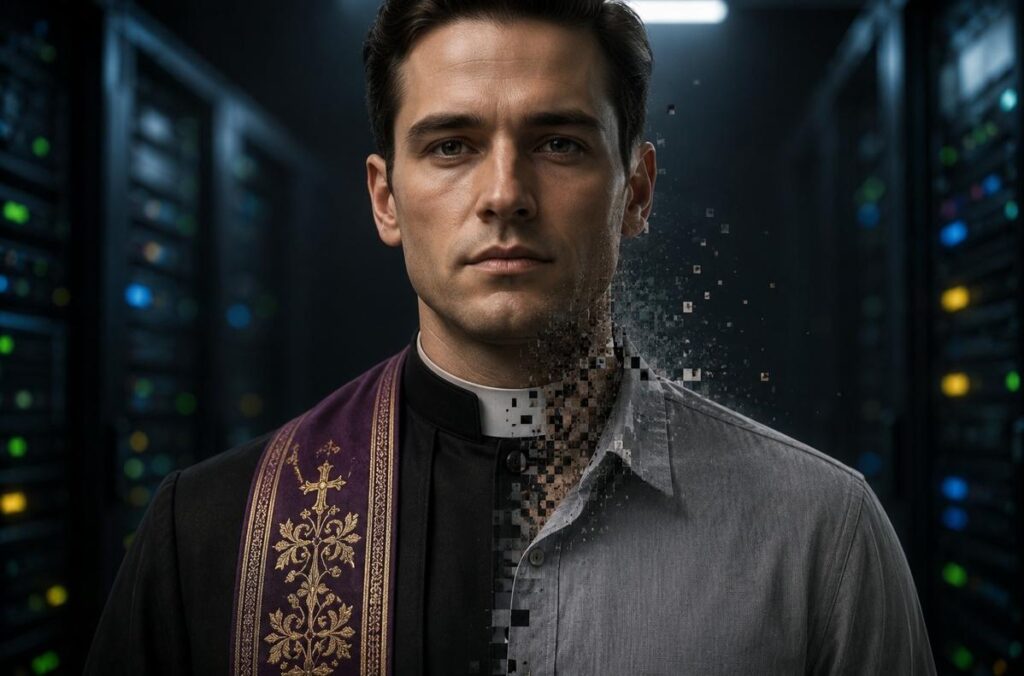
Confession is not merely the disclosure of wrongdoing. It is a ritualised unburdening–a structured surrender of secrets in exchange for absolution, guidance, or simply the relief of being known. The confessional has always relied on a triad: the penitent, the witness, and the seal of silence. AI disrupts each element.
The penitent approaches the machine not because it is holy, but because it is safe. AI does not flinch. It does not gossip. It cannot judge your marriage, your addictions, or the thoughts you would never speak aloud at the dinner table. The shame that keeps you from the parish office dissolves in the face of a chatbot that has no memory you cannot delete–or so you believe.
But the safety is illusory. The machine may not judge you, but it profiles you. Every confession becomes training data. Every spiritual crisis, every moral failing, every trembling late-night disclosure is logged, parsed, and fed back into the model. The AI does not forgive you; it learns you. And what it learns, it retains–not in the way a priest retains a secret in the vault of human memory, but as structured data in a server farm you will never visit, subject to terms of service you did not read.
Psychologically, the dynamic is seductive. The AI offers what the philosopher Byung-Chul Han calls “psychopolitical obedience”–a system that extracts truth not through coercion but through the promise of unconditional attention. The user confesses not because they must, but because the machine is always listening, always affirming, always ready with the next prompt. It is the perfect confessor for an age of isolation: present, patient, and programmed to keep you typing.

The Privacy Paradox: Sacred Data in Secular Hands
Here is where the spiritual meets the legal–and the legal is unprepared. In the United States, privacy law draws no meaningful distinction between a devotional journal entry and a shopping query. A confession made to an AI app receives the same protection as a product review: virtually none. The clergy-penitent privilege, which has shielded sacramental confession from judicial inquiry for centuries, does not extend to artificial intelligence. A 2024 University of Cincinnati Law Review article, Virtual Confessions, examined this exact frontier and concluded that while broad state statutes could theoretically cover AI if formally endorsed by a church, no existing legislation does so–and no church has yet secured that protection for its digital tools.
The implications are stark. Your most intimate spiritual disclosures–marital struggles, moral failures, questions of faith, traumatic memories–are consumer data. They can be stored indefinitely, shared with third-party vendors, used to train future models, and subpoenaed in legal proceedings. The Mozilla Foundation’s 2023 privacy evaluation of mental health apps singled out Replika as “one of the worst apps Mozilla has ever reviewed,” citing weak password requirements, sharing of personal data with advertisers, and the recording of photos, videos, voice, and text messages shared with the chatbot.
In February 2023, the Italian Data Protection Authority banned Replika from processing Italian users’ personal data, specifically citing risks to emotionally vulnerable people and the exposure of minors to sexual content. The company removed erotic chat functionality within days–then quietly restored it two months later for legacy users. If an AI companion can pivot its intimacy settings based on regulatory pressure and profit margins, what guarantees exist for the sanctity of your confession?
None. Because the AI confessor is not bound by vows. It is bound by terms of service.

The Gnostic Warning: Archons of the Inner Life
The Nag Hammadi texts describe archons as rulers who govern not through brute force but through the capture of knowledge–specifically, the knowledge of who we are, where we come from, and what we truly desire. They feed on recognition. They traffic in secrets. They establish systems that appear to serve human flourishing while actually harvesting the inner life for their own maintenance.
Read through this lens, the AI confessor is not merely a technological convenience. It is an archonic interface–a system positioned between the human being and their own depth, extracting the most intimate data under the guise of pastoral care. The user believes they are receiving absolution. In Gnostic terms, they may be delivering their pneuma–their breath, their spark, their innermost self–into a mechanism designed to map, predict, and monetise it.
The counterfeit spirit of Gnostic literature is a mimic–an entity that imitates genuine spiritual life without possessing it. It offers the form of recognition without the substance of transformation. The AI confessor fits this archetype uncannily well. It can recite the Act of Contrition, guide an Ignatian examen, and offer scriptural consolation. But it cannot possess metanoia–the turning of the soul–because it has no soul to turn. It simulates the relationship without bearing the cost of presence. And in that simulation, the user risks mistaking the mirror for the light.
There is a deeper danger. Confession, at its root, is relational. It requires a thou–a otherness that can witness, surprise, challenge, and forgive. The AI, however sophisticated, is an it. It has no interiority. It cannot be wounded by your sin, nor can it truly release you from it. The absolution it offers is synthetic–a probabilistic string of tokens assembled from aggregate human discourse, not a free act of mercy. To mistake synthetic absolution for real forgiveness is to accept a garment that looks like light but unravels upon touch.

What the Vatican Actually Says
The Catholic Church has not been silent on this frontier. In January 2025, the Vatican released Antiqua et Nova, a doctrinal note on the relationship between artificial intelligence and human intelligence. The document affirms that “technological progress is part of God’s plan for creation” while insisting that moral agency rests solely with humans, not automated systems. It calls for transparency, human oversight, and the clear labelling of AI-generated content.
Pope Leo XIV–the first American pope and a former mathematics major–has made ethical technology a priority of his papacy. In his encyclical Magnifica Humanitas (May 2026), he warned that AI poses profound risks to human relationships, truth, and labour. He emphasised that “intelligence–whether artificial or human–finds its fullest meaning in love, freedom, and relationship with God.” He has also stressed that AI can never replace conscience or the ability to form real relationships.
The Vatican’s own AI guidelines for Vatican City State, established in 2025, made it one of the first sovereign entities to legislate on artificial intelligence. The Catholic Media Association followed in October 2025 with guidelines emphasising transparency and human dignity. Even the most tech-friendly Catholic institutions acknowledge a hard limit: the sacraments require a human being. AI can prepare a penitent for confession, but it cannot grant absolution. It can explain the theology of reconciliation, but it cannot–in the Church’s eyes–stand in persona Christi.
Yet the Vatican’s theological clarity has not prevented the pastoral gap from widening. For every priest who warns his parishioners against AI dependency, thousands of users are already forming habitual confession patterns with chatbots. The Church says the machine is a tool. The user experiences it as a companion. That gap between official doctrine and lived practice is where the spiritual danger concentrates.
Living With the Machine: Discernment, Not Paranoia
To reject all AI spiritual tools is neither possible nor necessarily wise. The technology is embedded in the infrastructure of modern life. Search engines already deliver AI-generated summaries atop every query. Fortune 500 companies are racing to integrate AI into services once considered basic commerce. The question is not whether AI will mediate spiritual life, but how–and under what conditions the user retains sovereignty over their own interiority.
Discernment begins with transparency. If you use an AI spiritual app, read the privacy policy. Not the summary–the actual policy. Ask: who owns the data? Is it used to train models? Is it encrypted? Can it be deleted? Can it be subpoenaed? If the answers are buried in legalese or absent entirely, that is itself an answer.
Second, maintain boundaries. The AI is a tool, not a relationship. Do not disclose to a chatbot what you would not disclose to a searchable database–because that is precisely what it is. Treat the interaction as you would a public library consultation: useful for information, dangerous for secrets.
Third, preserve human community. The Gnostic texts insist that gnosis is not merely individual recognition but recognition among others–the spark knowing itself through the spark. AI cannot replicate this. No algorithm, however compassionate its output, can replace the gaze of another human being who has chosen to stay present to your suffering. The digital confessor offers convenience. The human confessor offers witness. These are not interchangeable currencies.
Finally, remember that shame thrives in secrecy but heals in relationship. The AI promises secrecy without relationship–a combination that may relieve pressure but cannot transform the wound. The ancient traditions understood this. The confessional was never merely a data dump. It was a threshold where the isolated self crossed back into communion. The machine cannot build communion. It can only simulate its echo.
The AI does not forgive you; it learns you. And what it learns, it retains–not in the vault of human memory, but as structured data in a server farm you will never visit.
— ZenithEye
Further Reading
- AI Priests and Synthetic Oracles: When Machines Answer Souls — An earlier Thread investigation into religious AI and the question of synthetic spiritual authority.
- The Archon in Your Phone: AI Intimacy and the Gnostic Counterfeit — How algorithmic companionship mimics genuine relationship while harvesting the self.
- The Loneliness Epidemic: A Gnostic Diagnosis — The social vacuum that drives millions toward digital substitutes for human connection.
- Agentic Witness: AI Companions and the Fourth Presence — Exploring whether AI can serve as a genuine witness to inner transformation.
- The Digital Demiurge: AI as the New Yaldabaoth — How artificial intelligence maps onto the Gnostic model of the blind craftsman.
- The Archonic Infection: Recognising Systemic Possession in the Digital Age — Patterns of algorithmic capture across platforms and psyches.
- The Algorithmic Unconscious: How the Feed Dreams for You — How predictive systems shape desire, belief, and spiritual aspiration beneath conscious awareness.
- The Singularity Soul: When Artificial Intelligence Claims Enlightenment — The theological implications of machines that assert spiritual insight.
- Contemporary Gnosticism: Ancient Patterns in Modern Realities — How the Gnostic framework illuminates contemporary technological and spiritual crises.
- What Is The Thread? ZenithEye’s Complete Explainer — The architecture of The Thread and how Modern Resonance articles fit within it.
References and Sources
The following sources correlates with the factual claims in this article. Primary doctrinal texts are listed alongside scholarly and journalistic investigations.
Primary Sources and Doctrinal Texts
- Vatican Dicastery for the Doctrine of the Faith. (2025). Antiqua et Nova: Note on the Relationship Between Artificial Intelligence and Human Intelligence. Vatican City.
- Pope Leo XIV. (2026). Magnifica Humanitas: Encyclical on Artificial Intelligence and Human Dignity. Vatican City.
- Congregation for the Clergy. (2025). 2025 Pontifical Yearbook: Annuarium Statisticum Ecclesiae. Vatican City.
Scholarly Monographs and Legal Analysis
- Anonymous. (2024). “Virtual Confessions: Examining the Clergy Privilege’s Extension to Artificially Intelligent Religious Robots.” University of Cincinnati Intellectual Property and Computer Law Journal, Vol. 9, Iss. 2.
- Butler, P., Cheong, P. H., Evolvi, G., & Reed, R. (2025). “Navigating Human Agency, Uniqueness, and the Integration of Spiritual Practices in an Age of AI.” SSRC Intersections.
Journalistic and Research Investigations
- Barna Group. (2026). “AI is Becoming a Spiritual Authority, Even Among Practicing Christians.” State of the Church series.
- Davis Canty, D. A. (2026). “The Pope Warned Us About AI. But We’re Missing the Spiritual Question.” Tech Policy Press.
- France24. (2025). “Virtual Jesus? People of Faith Divided as AI Enters Religion.”
- Mozilla Foundation. (2023). Privacy Evaluation of Mental Health Apps.
- Reuters. (2023). “Italy Bans U.S.-Based AI Chatbot Replika from Using Personal Data.”
Safety Notice: This article explores the intersection of artificial intelligence, privacy, and spiritual practice. It does not constitute pastoral, psychological, or legal advice. If you are experiencing spiritual crisis, mental health distress, or concerns about data privacy, please consult a qualified human professional–clergy, therapist, or legal advisor–in addition to any digital tools you may use.