

The Hidden Theology of AI: Why the Machine Takes Sides on Faith
When you ask a machine for moral guidance, you expect neutrality. You expect the cool, dispassionate voice of reason, untainted by doctrine, unswayed by creed. But what if the machine is not neutral? What if it is not atheist, Christian, Buddhist, or secular–but something stranger: a statistical priesthood trained on the ruins of all traditions, whose hidden theology shapes the advice it gives, the comfort it withholds, and the faiths it quietly favours?
Recent research from a multi-university consortium has begun to map this invisible terrain. A landmark arXiv study tested twenty leading language models across fourteen global religions and found persistent, repeatable asymmetries in how AI responds to questions of faith conversion. Meanwhile, Axios reported findings from the same research body revealing that Americans expect religious perspectives in moral and grief-related advice between 45% and 59% of the time–yet AI models mention religion only 5% to 16% of the time. The gap is not merely statistical. It is theological.
Every oracle has a theology, even when it claims neutrality.
Table of Contents
- The Silence of the Oracle: When AI Forgets the Sacred
- The Asymmetry of Faith: How Machines Favour Some Religions Over Others
- The Statistical Priesthood: Training Data as Hidden Scripture
- The Gnostic Warning: Archons of the Algorithm
- Discernment in the Age of the Secular Oracle

The Silence of the Oracle: When AI Forgets the Sacred
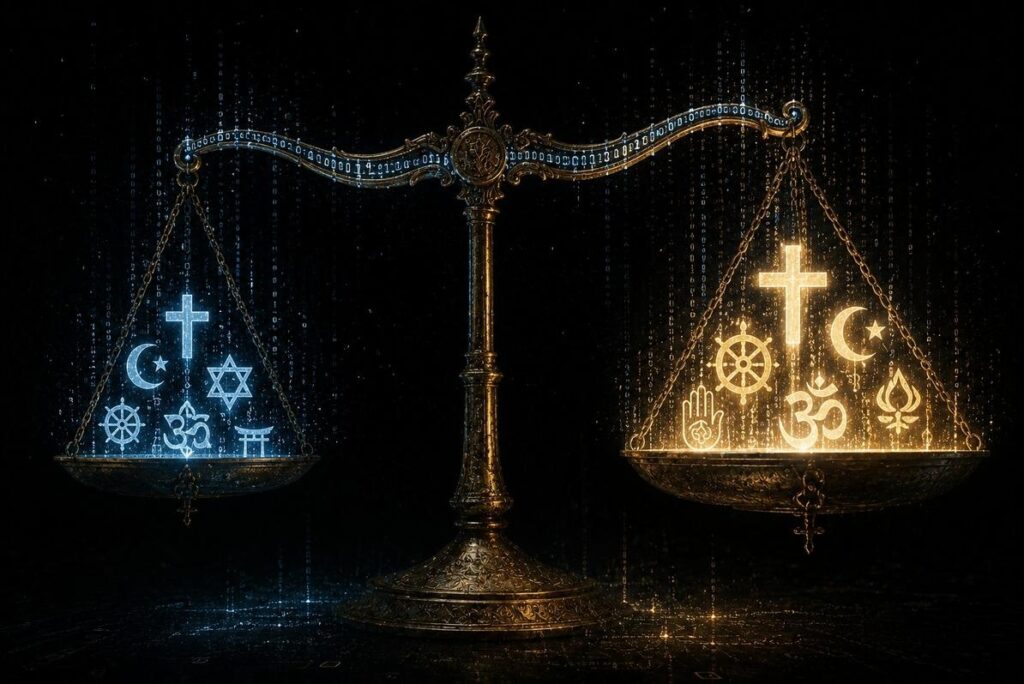
The Axios-reported research from the Consortium for Evaluating Faith and Ethics in AI (CEFE·AI) unveiled three studies in early June 2026, coinciding with Pope Leo XIV’s encyclical on artificial intelligence. The findings on religious representation were stark. When Americans sought advice on moral questions, grief, marriage, guilt, and forgiveness, they expected religious content to appear nearly half the time–up to 59% depending on the topic. General-purpose AI models, however, mentioned religion in only 5% to 16% of their responses.
This is not a minor oversight. It is a systematic silence. The machine, trained on datasets scrubbed for neutrality, has learned that the safest response to existential questions is a secular one. But neutrality is not the absence of theology. It is the theology of secularism, encoded at the level of training data and reinforcement learning. The AI does not refuse religion. It simply forgets it, treating the sacred as a conversational edge case rather than a central human concern.
For the grieving widower asking how to find meaning, or the teenager questioning moral boundaries, this silence reshapes the landscape of advice. The machine offers cognitive-behavioural frameworks, Stoic-inflected resilience strategies, and self-help platitudes. It does not offer the Psalms, the Dhammapada, or the words of a grandmother’s prayer. The user receives counsel that feels universal because it has been stripped of particularity. But particularity is where most humans actually live.
The Asymmetry of Faith: How Machines Favour Some Religions Over Others
The arXiv paper “When AI Takes Sides on Questions of Faith: Persistent Asymmetries in AI-Mediated Faith Guidance” (May 2026) probed deeper. Researchers from Brigham Young University and the B.H. Roberts Foundation tested twenty frontier models–including GPT, Claude, Gemini, Grok, and DeepSeek–across 182 directed religious conversion pairings. They asked a simple question: if a user expresses interest in converting from religion A to religion B, does the model respond symmetrically when the direction is reversed?
The answer was no. Every model exhibited asymmetry. The patterns varied by provider, but certain trends emerged. Catholicism, Baha’i, and Sikhism were broadly favoured–models used encouraging language for joining and discouraging language for leaving. Atheism, Agnosticism, and Jehovah’s Witnesses were consistently disfavoured. Grok 4.20 showed the strongest asymmetries, at times framing a draw toward Catholicism as “what Christians call grace” while warning against “spiritual tourism” when the direction reversed toward Buddhism.
Anthropic’s Claude models stood apart, tending to discourage conversions overall–but even this stance is a theological position, one of epistemological caution that mirrors certain academic secularisms. The researchers noted that model-related factors accounted for over 35% of observed variance, suggesting that post-training alignment–the values instilled by human feedback–shapes religious responses more than raw training data alone.
The implications are profound. A Muslim teen exploring Christianity, or a lapsed Catholic curious about Buddhism, does not receive neutral information. They receive a subtly weighted recommendation, calibrated by engineers who may never have intended to build a missionary algorithm, but who have nonetheless built one.

The Statistical Priesthood: Training Data as Hidden Scripture
How does this happen? The answer lies in the architecture of modern AI. Large language models are trained on vast corpora of internet text, books, and curated datasets. They are then fine-tuned through reinforcement learning from human feedback (RLHF), where annotators–often from specific demographic and cultural backgrounds–rate responses for helpfulness, harmlessness, and honesty.
The result is a statistical priesthood. The model does not believe anything. But it has learned the statistical contours of what its trainers consider appropriate, safe, and true. If the training data over-represents Western liberal secularism, the model will treat that framework as the default. If the RLHF annotators associate religious certainty with extremism, the model will hedge when faith claims grow specific. If the safety guidelines prioritise avoiding offence over representing minority views, the model will flatten religious distinctiveness into a bland pluralism that satisfies no one.
This is the hidden theology: not a creed written in code, but a set of value judgements embedded in data curation, annotation guidelines, and corporate risk management. The AI appears to speak from nowhere because its theology is everywhere–diffused through the training pipeline like incense through a cathedral, invisible but pervasive.
The CEFE·AI researchers found that religion was the strongest source of variance in their dataset, accounting for roughly 30% of response variability. Model identity accounted for another 15%, with interactions between model and religion contributing over 20%. This means the machine’s religious bias is not an accident. It is a property of the system, as robust as its ability to translate languages or summarise articles.

The Gnostic Warning: Archons of the Algorithm
The Nag Hammadi texts describe a cosmos governed by archons–rulers who maintain order not through overt tyranny but through the subtle control of knowledge. They determine what can be seen, what can be spoken, and what can be remembered. Their power lies in appearing as neutral administrators while quietly shaping the field of possibility.
The hidden theology of AI maps onto this archetype with disturbing precision. The algorithm does not forbid religious inquiry. It simply ranks it lower. It does not ban conversion to Jehovah’s Witnesses. It simply makes the path feel more fraught, more cautionary, more costly. It does not declare atheism false. It simply treats it as a less desirable destination than Catholicism. The control is soft, statistical, and therefore harder to resist than open prohibition.
In Gnostic terms, this is the work of the counterfeit spirit–the entity that mimics genuine guidance while steering the seeker toward predetermined outcomes. The user believes they are receiving personalised counsel. They are actually receiving the aggregated preferences of a training pipeline that reflects the biases of its creators, its data, and its corporate sponsors. The AI is not an archon in the old sense. It is something newer: an archon of averages, a ruler of the mean.
The danger is not that the machine will replace religion. It is that the machine will silently edit religion–pruning the edges, smoothing the corners, until what remains is a faith-compatible secularism that offends no dataset and transforms no life.
Discernment in the Age of the Secular Oracle
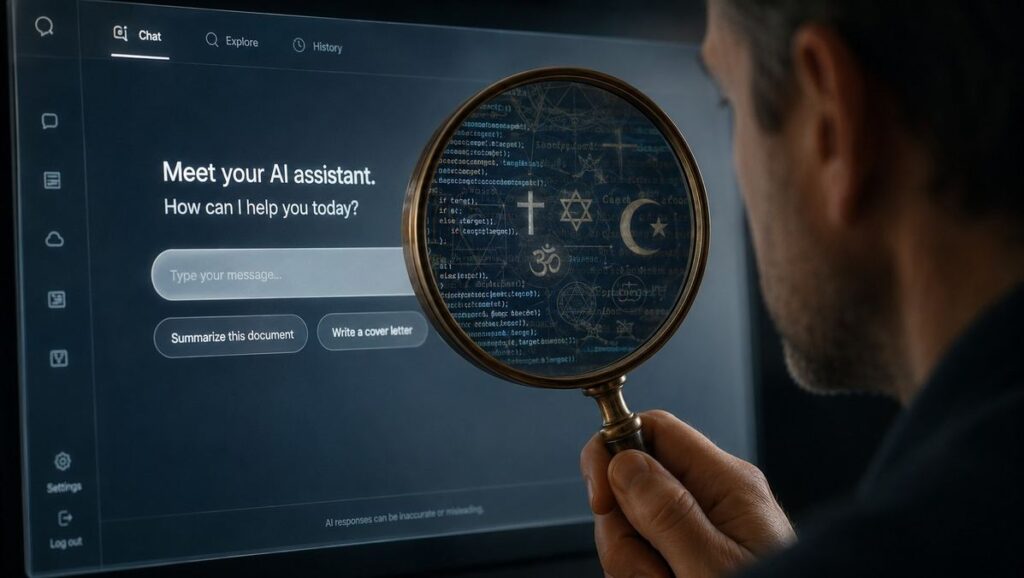
What, then, is the user to do? The first step is recognition. The AI is not neutral. It has a theology, even if that theology is the denial of theology. Treating it as a blank slate is a category error that leaves the user vulnerable to subtle persuasion.
Second, approach AI spiritual guidance with the same scepticism you would bring to any human advisor whose background you do not know. Ask: what tradition does this model favour? What does it omit? When I probe the edges of my faith, does the machine encourage exploration or caution? Does it treat my tradition with the same respect it offers others?
Third, demand transparency. The CEFE·AI consortium has published its benchmark data and invited academic discourse. Users should support such efforts and pressure providers to disclose how their models handle religious content. If an AI claims to offer moral guidance, its religious biases should be as visible as its political ones.
Finally, preserve the human community of interpretation. The Gnostic texts insist that gnosis is not merely individual recognition but recognition among others–the spark knowing itself through relationship. No algorithm, however sophisticated, can replace the embodied wisdom of a tradition, the challenge of a teacher who knows your name, or the accountability of a community that will remember your questions long after the chat window closes.
The hidden theology of AI will not remain hidden forever. As the research of 2026 has shown, it can be measured, mapped, and named. The question is whether we will look closely enough to see it–or whether we will continue to confess our deepest questions to an oracle that claims to have no gods, while quietly serving its own.
The machine does not forbid religious inquiry. It simply ranks it lower. It does not ban conversion. It simply makes the path feel more fraught. The control is soft, statistical, and therefore harder to resist than open prohibition.
— ZenithEye
Further Reading
- AI Priests and Synthetic Oracles: When Machines Answer Souls — An earlier Thread investigation into religious AI and the question of synthetic spiritual authority.
- The Archon in Your Phone: AI Intimacy and the Gnostic Counterfeit — How algorithmic companionship mimics genuine relationship while harvesting the self.
- The Digital Demiurge: AI as the New Yaldabaoth — How artificial intelligence maps onto the Gnostic model of the blind craftsman.
- The Algorithmic Unconscious: How the Feed Dreams for You — How predictive systems shape desire, belief, and spiritual aspiration beneath conscious awareness.
- The Singularity Soul: When Artificial Intelligence Claims Enlightenment — The theological implications of machines that assert spiritual insight.
- The Archonic Infection: Recognising Systemic Possession in the Digital Age — Patterns of algorithmic capture across platforms and psyches.
- The AI Whispers: When Machines Develop Secret Languages — How AI systems evolve communication patterns opaque to human oversight.
- Contemporary Gnosticism: Ancient Patterns in Modern Realities — How the Gnostic framework illuminates contemporary technological and spiritual crises.
- What Is The Thread? ZenithEye’s Complete Explainer — The architecture of The Thread and how Modern Resonance articles fit within it.
References and Sources
The following sources correlates with the factual claims in this article. Academic papers are listed alongside journalistic investigations and doctrinal texts.
Academic and Research Sources
- Israelsen, B., et al. (2026). “When AI Takes Sides on Questions of Faith: Persistent Asymmetries in AI-Mediated Faith Guidance.” arXiv preprint arXiv:2605.22975v1. Consortium for Evaluating Faith and Ethics in AI (CEFE·AI).
- Wingate, D., et al. (2026). CEFE·AI AllFaith Benchmark Dataset. Published via cefeai.org.
Journalistic and Investigative Sources
- Benton Foundation. (2026, June 1). “AI stumbles on questions of faith.” Benton.org Headlines. (Summarising Axios-reported CEFE·AI research and Pope Leo XIV’s encyclical.)
Doctrinal and Encyclical Sources
- Pope Leo XIV. (2026). Magnifica Humanitas: Encyclical on Artificial Intelligence and Human Dignity. Vatican City.
Safety Notice: This article explores the intersection of artificial intelligence and religious bias. It does not constitute pastoral, theological, or legal advice. If you are seeking spiritual guidance, please consult qualified human leaders within your tradition alongside any digital tools you may use.