
The Planetary Prison: Hermetic Ascent and the Seven Spheres
The ancient cosmos was not empty space sprinkled with matter. It was a densely populated hierarchy, a nested architecture of living spheres, each pulsing with its own intelligence, its own virtue, and its own danger. For the Hermeticist, the Gnostic, the Neoplatonist, and the ceremonial magician, the seven planetary spheres were not merely astronomical bodies. They were the cosmic prison house–the mechanism by which the soul, descending from its divine origin, acquired the garments, passions, and limitations that constitute embodied life. And they were the only road home–the ascent route by which those same accretions must be shed, one by one, until the soul stands naked before the source from which it came.
This article examines the architecture of the seven planetary spheres as it appears across Hermetic, Gnostic, Neoplatonic, and magical traditions. It traces the soul’s descent through the spheres, the specific coverings acquired at each planetary station, and the ascent protocols–somatic, cognitive, and ritual–by which ancient practitioners sought to reverse the fall. The goal is not antiquarian curiosity but living recognition: the understanding that the planetary prison is not merely ancient cosmology but a map of the conditioned self, and that the ascent is not a post-mortem fantasy but a description of what becomes possible when consciousness is systematically liberated from the forces that bind it.
Table of Contents
- The Cosmic Architecture: A Universe of Nested Spheres
- The Descent: How the Soul Takes On Its Chains
- The Hermetic Protocol: Shedding the Seven Accretions
- Gnostic Variations: Archons at the Gates
- Neoplatonic Echoes and the Magical Tradition
- The Ascent as Contemporary Practice
- Conclusion: Beyond the Spheres
- Frequently Asked Questions
- Further Reading
- References and Sources
The Cosmic Architecture: A Universe of Nested Spheres
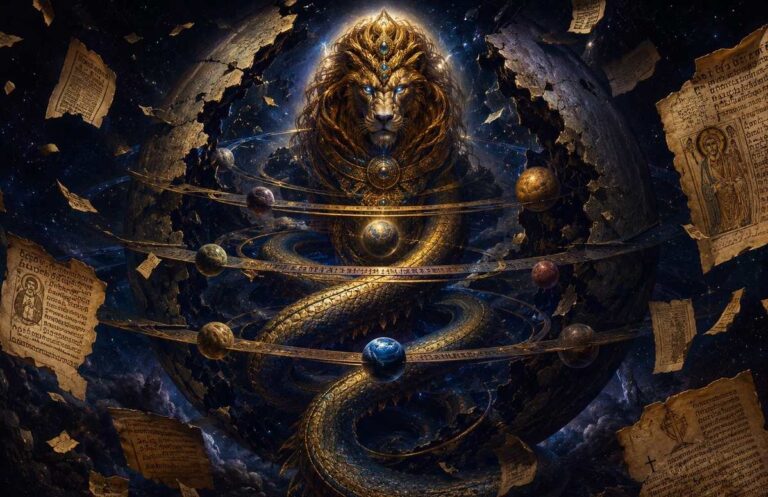
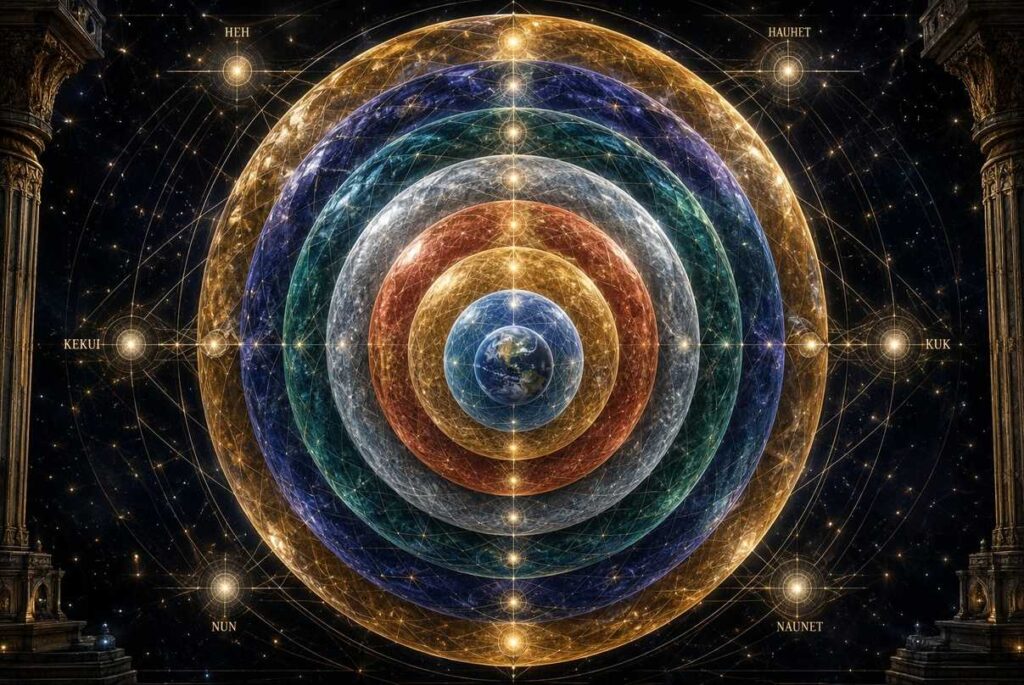
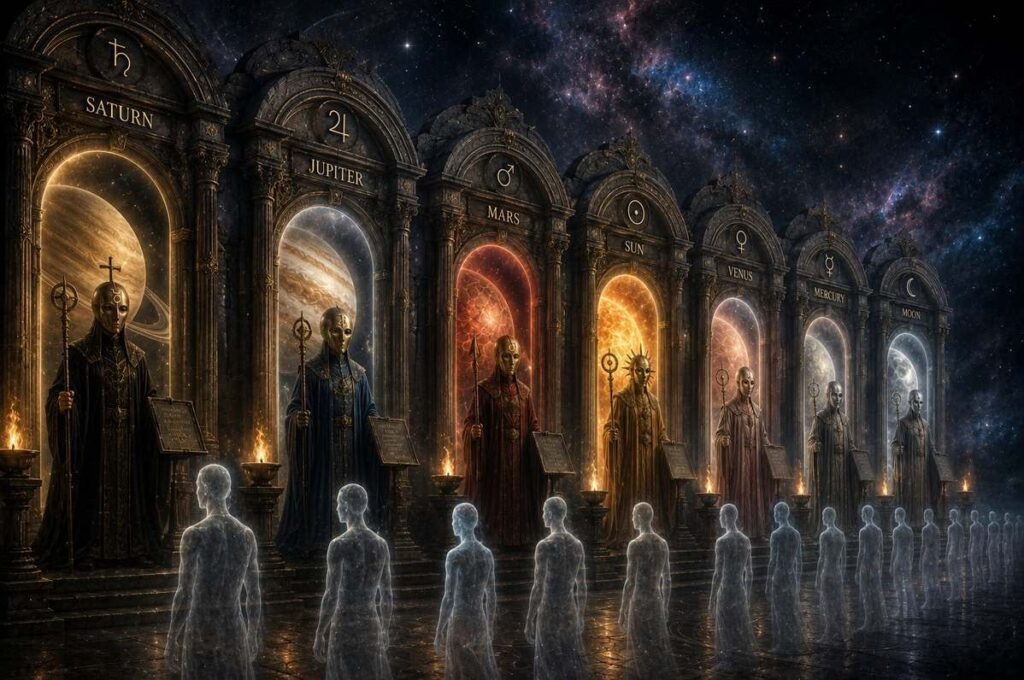
The pre-Copernican cosmos was geocentric not because its architects were ignorant but because it was experientially accurate. From the perspective of the body, the planets do indeed revolve around the Earth, each carrying its own sphere, its own note, its own metal, its own colour, and its own psychological quality. The arrangement was precise: Moon, Mercury, Venus, Sun, Mars, Jupiter, Saturn–seven spheres nested between the Earth below and the fixed stars (the Ogdoad) above.
This was not arbitrary numerology. The number seven governed the musical scale, the days of the week, the metals of alchemy, and the openings of the human head. The cosmos was a harmonic instrument, and the soul was a tone that had fallen from the octave of the divine into the discord of material embodiment. Each planetary sphere added a partial, an overtone, a distortion. The task of the spiritual practitioner was to retune the instrument, to remove the partials one by one, until the original tone sounded clear.
The architecture was sacred because it was participatory. The spheres were not merely above; they were within. The lunar rhythm pulsed in the menstrual cycle and the tidal breath. The mercurial quickness flickered in synaptic transmission. The solar fire burned in the cardiac plexus. The martial surge rose in the adrenal medulla. The jovian expansion swelled in the liver’s generosity. The saturnine contraction settled in the skeletal structure. The body was a microcosm, a miniature of the celestial order, and the ascent was therefore an interior journey as much as a cosmic one.
The Descent: How the Soul Takes On Its Chains
In the Hermetic account preserved in the Poimandres (Corpus Hermeticum I), the soul’s descent is not a punishment but a natural consequence of embodiment. The divine Mind (Nous) creates the material cosmos through the agency of the Demiurge and the seven planetary governors. The soul, drawn by desire toward the sensory realm, enters the cosmic framework and passes through each planetary sphere, acquiring at each station the quality associated with that domain.
The descent is a process of accretion–the soul puts on garments, veils, or coverings that enable it to function in the material world but simultaneously obscure its divine nature. By the time the soul reaches the terrestrial body, it is clothed in seven layers of planetary conditioning, each one a necessary adaptation and a simultaneous limitation. The body itself is the final garment, the densest accretion, the point at which the soul’s amnesia is complete.
The Gnostic Apocryphon of John adds a darker shading to this narrative. The archons, created by the deficient demiurge Yaldabaoth, fashion the human body as a prison for the divine spark. They implant the counterfeit spirit–the false self–to ensure that the soul identifies with the body, forgets its origin, and accepts the material world as the only reality. The descent, in this version, is not merely natural but administrative: a detention procedure carried out by cosmic functionaries who require the soul to remain in their jurisdiction.
The Hermetic Protocol: Shedding the Seven Accretions
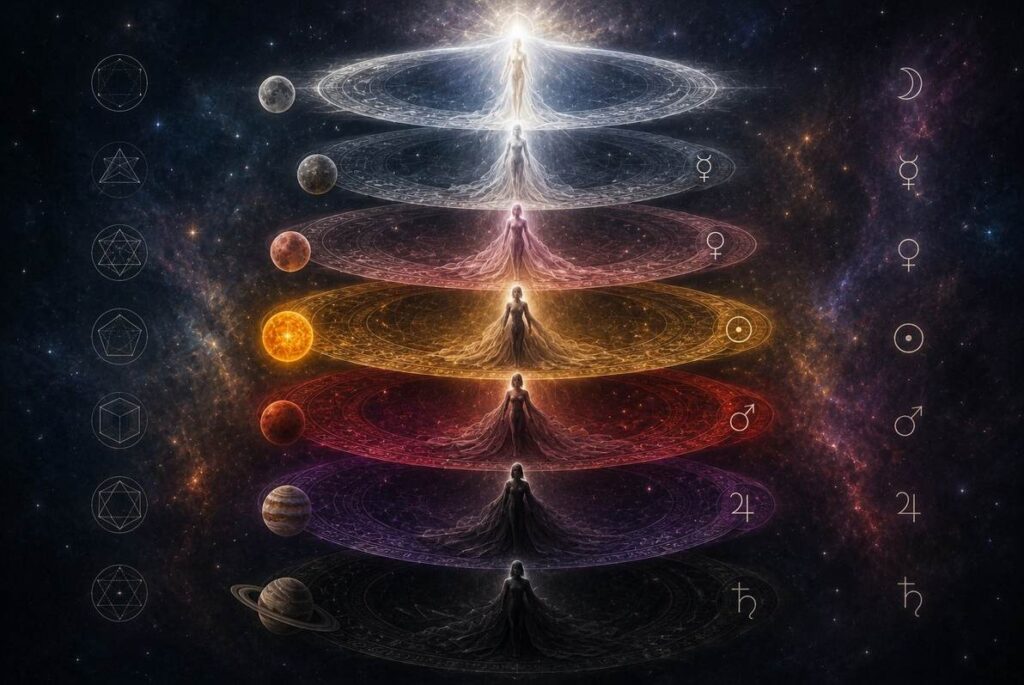
The ascent, in the Hermetic view, is simply the descent reversed. The soul, having awakened to its true nature through the gift of Nous–divine intellect or intuitive intelligence–begins the journey upward. At each sphere, it leaves behind the specific quality acquired during descent. The Poimandres describes this with the precision of a surgical protocol:
The human soul rushes upward through the cosmic framework… At the first zone, it leaves behind the energy of increase and decrease; at the second, evil machination; at the third, the illusion of longing; at the fourth, the entrance of irreverence; at the fifth, merciless wickedness; at the sixth, unrighteous avarice; at the seventh, the devious falsehood that lies in wait.
Corpus Hermeticum I.26
This sequence is not a moral lecture but a psychological anatomy. Each accretion corresponds to a specific mode of identification that must be dissolved before the soul can reclaim its original freedom. The following sections examine each sphere in turn, translating the ancient vocabulary into the phenomenology of contemporary practice.
The Moon — The Rhythm of Increase and Decrease
At the first zone, the Moon, the soul leaves behind the energy of increase and decrease–the biological rhythm of growth and decay, the tidal pulse of bodily change, the identification with processes that wax and wane. This is the realm of generation and corruption, the endless cycle of birth, maturation, ageing, and death that governs all organic existence. The lunar covering is the belief that the self is the body, that happiness is health, that security is youth, and that the future is merely more of the past with diminishing returns.
To shed the lunar covering is to recognise that the body is not the self but a temporary vessel, subject to rhythms that the true being transcends. In practice, this means disidentification from bodily states–not rejection of the body but liberation from the tyranny of its fluctuations. The practitioner learns to observe pain, pleasure, fatigue, and vitality as weather patterns passing through a guest house, rather than as definitive statements about identity.
Mercury — The Machinations of Thought
At the second zone, Mercury, the soul leaves behind evil machination–the deceptive cleverness of the unawakened mind, the labyrinth of intellectual pride, the capacity to rationalise any position, to argue without wisdom, to construct elaborate systems that serve the ego while masquerading as truth. Mercury is the patron of commerce, communication, and cunning; his gift is the sharp mind that cuts itself. The mercurial covering is the belief that understanding equals liberation, that the correct map is the same as the territory, and that if one can only think clearly enough, the problem will dissolve.
To shed the mercurial covering is to prefer silence to chatter, direct seeing to endless analysis. The practitioner discovers that the mind, left to its own devices, behaves like a defence attorney for the ego–building cases, finding precedents, and constructing alibis. The ascent requires a different use of intellect: not to explain but to witness, not to solve but to recognise, not to defend but to surrender.
Venus — The Lure of Sensation
At the third zone, Venus, the soul leaves behind the illusion of longing–the sensory craving that mistakes pleasure for fulfilment, the endless pursuit of beauty that never satisfies, the romantic obsession that seeks completion in another. Venus governs desire, art, and the seductive surface of appearances. The venereal covering is the belief that the next experience will finally be enough, that the right partner will heal the wound, that the beautiful object will still the restlessness, and that the future holds a satisfaction the present denies.
To shed the venereal covering is to see through the illusion that anything external can fill the internal void. This is not asceticism–not the denial of beauty or the suppression of desire–but the recognition of beauty as a pointer rather than a destination. The practitioner learns to enjoy the rose without needing to possess the garden, to love the person without demanding they complete the self, and to experience sensation without becoming its prisoner.
The Sun — The Arch of Domination
At the fourth zone, the Sun, the soul leaves behind the entrance of irreverence–or, in some translations, the arch of domination. This is the egoic will, the demand to be recognised, the solar pride that places the self at the centre of the cosmos and expects the planets to revolve around its preferences. The Sun is the heart of the system, and its danger is the belief that one is the source of one’s own light, the author of one’s own virtue, and the rightful sovereign of one’s own small kingdom.
To shed the solar covering is to recognise that all luminosity is borrowed, all authority delegated, all centrality temporary. The practitioner discovers that the need to be right, the compulsion to lead, and the terror of being ignored are all symptoms of the same identification–the belief that the self is the sun around which reality orbits. The ascent requires a different kind of confidence: not the confidence of dominance but the confidence of transparency, the willingness to be a channel rather than a source.
Mars — The Wound of Wrath
At the fifth zone, Mars, the soul leaves behind merciless wickedness–the unholy daring, the aggressive impulse, the willingness to harm in order to win, the survival instinct that justifies any cruelty. Mars is the warrior, the competitor, the survivor. His gift is courage; his trap is cruelty. The martial covering is the belief that the world is a battlefield, that every interaction is a zero-sum contest, that weakness is death, and that compassion is a luxury for those who can afford to lose.
To shed the martial covering is to discover that true strength requires no violence, that the battle was always internal, and that the enemy was never other. The practitioner learns to recognise the adrenal surge–the heat in the chest, the narrowing of vision, the impulse to dominate–not as a command to act but as a physiological event to be witnessed. The martial energy, redirected, becomes the courage to remain open in the face of threat, to stay present when the body screams for flight or fight.
Jupiter — The Weight of Wealth
At the sixth zone, Jupiter, the soul leaves behind unrighteous avarice–the evil strivings that arise from wealth, the expansion without limit, the benevolent tyrant who feeds the hungry to secure their dependence, the generosity that purchases loyalty. Jupiter is the king, the patron, the magnanimous ruler. His trap is the belief that abundance equals security, that generosity is a transaction, that the kingdom is his to give, and that the more one has, the more one is.
To shed the jovian covering is to recognise that all wealth is stewardship, all power is service, and all expansion is empty without centre. The practitioner discovers that the pursuit of more–more knowledge, more influence, more resources, more disciples–is often the most sophisticated form of insecurity. The ascent requires the willingness to be small, to have little, to matter to few, and to find that this is not deprivation but relief.
Saturn — The Final Lie
At the seventh and final zone, Saturn, the soul leaves behind devious falsehood–the deceit that ensnares, the temporal limitation that masquerades as fate, the melancholic wisdom that believes nothing changes and therefore nothing matters. Saturn is the boundary, the end, the old man who knows too much. His trap is the lie that time is real, that death is final, that the prison is locked, and that the only wisdom is resignation.
To shed the saturnine covering is to step through the last gate and discover that the key was never needed, because the door was never closed. The practitioner encounters the deepest fear–the fear of ending, of limitation, of irrelevance–and finds behind it not annihilation but space. Saturn is not the enemy of liberation but its final guardian: the one who tests whether the soul truly believes in freedom, or merely hopes for it. The soul that passes Saturn does not escape time but transcends the belief that time is ultimate.
Gnostic Variations: Archons at the Gates
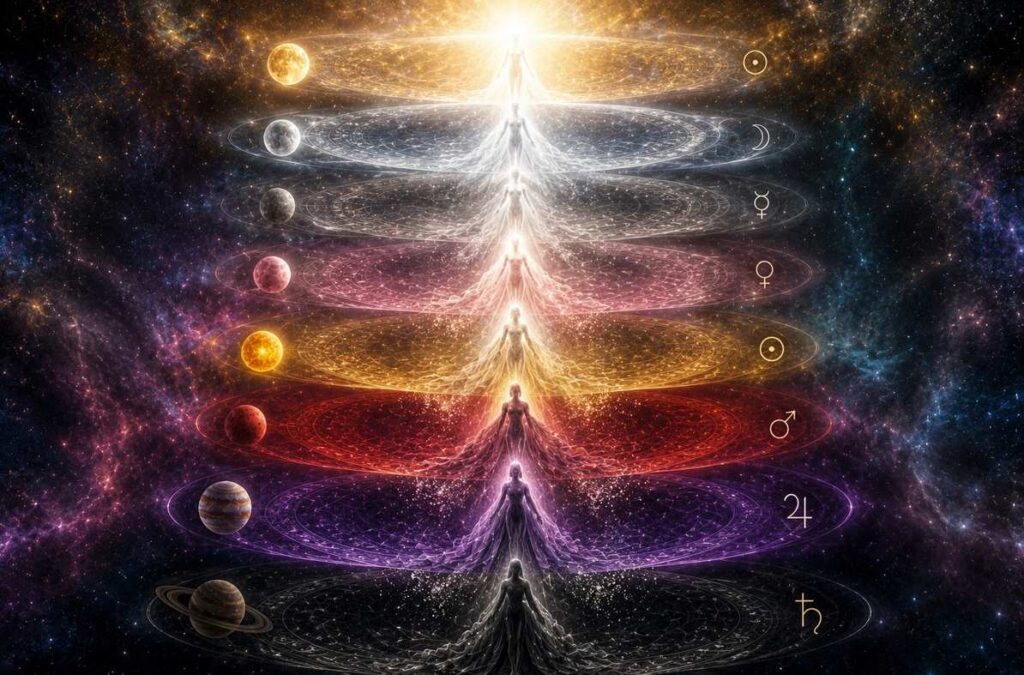
The Hermetic ascent is a process of self-purification–the soul sheds its own accretions through the power of awakened intellect. The Gnostic tradition adds a more dramatic element: the archons. In texts such as the Apocryphon of John, Zostrianos, and the Pistis Sophia, the planetary spheres are not merely zones of psychological conditioning but jurisdictions governed by hostile administrators who actively attempt to block the ascending soul.
The Gnostic archons are the planetary governors–Yaldabaoth at Saturn, Iao at Jupiter, Sabaoth at Mars, and others–who demand passwords, seals, and recognition formulae before permitting passage. The soul that approaches their gates without the proper credentials is cast back into reincarnation, stripped of its luminous inheritance, or detained in intermediate realms. The ascent is not merely psychological but diplomatic: a negotiation with cosmic powers who have a vested interest in maintaining the prison population.
Yet the Gnostic and Hermetic models are not incompatible. The archons, in psychological terms, are the autonomous complexes that resist integration–the internal voices that demand the soul remain where it is, that generate fear at the threshold of transformation, that masquerade as legitimate authority. The password is not magic but recognition: the moment the soul knows itself as belonging to the divine, the archon’s jurisdiction is revealed as illegitimate. The gatekeeper loses power not through combat but through the realisation that he was never the final authority.
The Discourse on the Eighth and the Ninth (NHC VI,6)–a Hermetic text preserved in the Nag Hammadi Library–bridges these perspectives. It describes a ritual ascent through the planetary spheres into the Ogdoad and Ennead, employing breath control, prayer, and divine grace. The goal is henosis–union with the divine Mind–rather than escape from materiality. Where Sethian texts provide maps of enemy territory, Hermetic texts offer gymnasiums for strengthening the soul’s capacity to perceive the divine. Both agree on the architecture; they differ only on whether the spheres are obstacles or opportunities.
Neoplatonic Echoes and the Magical Tradition
The planetary sphere model was not confined to Hermetic and Gnostic circles. Plotinus, the founder of Neoplatonism, accepted the basic cosmological architecture while criticising the Gnostic tendency to demonise the planetary powers. For Plotinus, the spheres were cosmic intelligences–not enemies but teachers, each offering a lesson that the soul must learn before advancing. The ascent was not escape but education, a progressive illumination through the hierarchy of being. The planets, in this view, were the curriculum, not the prison guards.
The magical tradition, preserved in the Greek Magical Papyri (PGM), took a more pragmatic approach. The practitioner did not seek to bypass the planetary powers but to negotiate with them–to obtain their favour, their gifts, and their protective seals. The seven planets were the governors of fate (heimarmene), and the magician was the one who learned to speak their language, to offer their sacrifices, and to time their operations according to celestial correspondences. Magic was not liberation from the spheres but mastery within them–a temporary parole rather than a final escape. The magician sought to become a favourite prisoner, enjoying privileges while still serving the sentence.
John Dee’s Heptarchia Mystica–a Renaissance operational manual for working with the seven planetary kings–represents the final flowering of this tradition in the West. Dee and his scryer Edward Kelley received a complete organisational chart of the “Heavenly Government,” mapping each planetary sphere to a specific king, angel, and seal. The system was not merely theoretical but practical: a technology for aligning human will with celestial governance, for obtaining knowledge and protection from the planetary administrators rather than escaping their jurisdiction. The magician, in this model, was a cosmic civil servant, learning the operating procedures of the spheres in order to work within them.

The Ascent as Contemporary Practice
The ancient cosmology of the seven spheres is not obsolete; it is translatable. The planetary accretions are the layers of conditioning that every contemporary practitioner encounters: the lunar identification with bodily rhythms and hormonal cycles; the mercurial addiction to information and analysis; the venereal compulsion toward pleasure and romantic fixation; the solar demand for recognition and status; the martial aggression of competition and survival anxiety; the jovian expansion of consumption and debt; the saturnine depression that believes the system is closed and change is impossible.
The ascent is the progressive deconditioning of these identifications. It does not require belief in literal planetary spheres or post-mortem geography. It requires the recognition that consciousness is layered, that each layer has a specific signature, and that liberation is not a single explosive event but a methodical shedding–one sphere at a time, one covering at a time, until the original nature stands clear. The body is the laboratory; the day is the experiment; the attention is the instrument.
The practices are ancient and modern simultaneously: breathwork to interrupt the lunar rhythm of anxiety; contemplative inquiry to dissolve mercurial machination; sensory restraint to see through venereal illusion; humility to dethrone solar pride; non-violence to disarm martial compulsion; simplicity to release jovian weight; and patience–the final saturnine virtue–to outlast the lie that time is running out. Each practice is a specific tool for a specific layer, and the practitioner who employs them systematically is retracing the ancient ascent in the only laboratory that matters: the present moment.
Beyond the Spheres
The planetary prison is not a punishment. It is a curriculum–a graduated system of conditions that forces the soul to develop the capacities it would never have discovered in the undifferentiated light of its origin. The descent is not a fall from grace but a voluntary immersion into the laboratory of experience. The ascent is not a return to innocence but an achievement of integration–the soul that has passed through all seven spheres and shed all seven coverings is not the same soul that descended. It is the original light, now educated, now tested, now capable of knowing itself through the very conditions that once obscured it.
The exit is not upward but inward–through the recognition that the spheres are not external planets but internal conditions, and that the ascent is not a journey through space but a progressive awakening from the dream of separation. The prison was never locked. The door was always open. The key was the recognition that the prisoner and the warden were the same self, dreaming different dreams–and that the awakening of either is the liberation of both.
Frequently Asked Questions
What are the seven planetary spheres in Hermetic tradition?
In Hermetic cosmology, the seven planetary spheres are the Moon, Mercury, Venus, the Sun, Mars, Jupiter, and Saturn. They form a nested architecture between the Earth and the fixed stars (the Ogdoad). Each sphere governs a specific quality or passion that the soul acquires during descent and must shed during ascent. They are not merely astronomical bodies but psychological and spiritual jurisdictions that condition consciousness.
What does the soul leave behind at each planetary sphere?
According to the Poimandres (Corpus Hermeticum I.26), the soul leaves behind: at the Moon, the energy of increase and decrease; at Mercury, evil machination; at Venus, the illusion of longing; at the Sun, the entrance of irreverence or domination; at Mars, merciless wickedness; at Jupiter, unrighteous avarice; and at Saturn, devious falsehood. Each accretion corresponds to a specific mode of identification that must be dissolved before the soul can reclaim its original freedom.
Are the Gnostic archons the same as the planetary spheres?
The Gnostic archons are intelligent rulers who govern the planetary spheres and attempt to block the ascending soul. While Hermeticism tends to view the spheres as zones of self-acquired conditioning, Gnosticism personifies them as hostile administrators who demand passwords and seals. Psychologically, both models describe the same phenomenon: the layers of conditioning that resist transformation. The archons are the autonomous complexes that generate fear at the threshold of change.
How does the Neoplatonic view of planetary ascent differ from the Gnostic view?
Plotinus and the Neoplatonists accepted the cosmological architecture of the seven spheres but rejected the Gnostic tendency to demonise them. For Neoplatonists, the planetary powers are cosmic intelligences and teachers, not enemies. The ascent is education rather than escape. The magician, working within the Greek Magical Papyri tradition, sought mastery within the spheres rather than liberation from them–negotiating with fate rather than transcending it.
Is the planetary prison literal or metaphorical?
Both. Literally, it describes an ancient cosmological model in which the soul descends through planetary spheres and acquires material limitations. Metaphorically–and perhaps more importantly–it maps the layers of psychological conditioning that constitute the conditioned self. The spheres are internal conditions: bodily identification, intellectual pride, sensory craving, egoic will, aggression, material attachment, and temporal despair. The ascent is the progressive awakening from these identifications.
What is the Ogdoad and the Ennead?
The Ogdoad is the eighth sphere, the realm of the fixed stars, which lies beyond the seven planetary spheres. It marks the boundary between the cosmic and the supra-cosmic. The Ennead is the ninth sphere, the realm of pure divine Mind (Nous), where direct encounter with the unbegotten God becomes possible. In the Discourse on the Eighth and the Ninth, the practitioner ascends through the seven planets into the Ogdoad and finally the Ennead, achieving union with the divine.
How can I apply the seven spheres model to my own spiritual practice?
The model translates into progressive deconditioning. Work with breath and body awareness to loosen lunar identification with physical states. Practise contemplative silence to dissolve mercurial intellectual chatter. Cultivate sensory restraint to see through venereal illusion. Develop humility to dethrone solar pride. Practise non-violence and patience to disarm martial and saturnine compulsions. The ascent is not a single event but a daily, methodical shedding of the layers that obscure your original nature.
Further Reading
- Exit from the Wheel: Liberation Beyond Reincarnation — The opening article in this series, mapping the ancient consensus that the cycle of birth is a trap to be escaped, not a curriculum to be completed.
- The Soul Trap: Gnosticism and the Machinery of Return — The Gnostic account of the counterfeit spirit, the three natures, and the five seals as exit protocols from the cycle of reincarnation.
- The Memory Wipe: Forgetting, Rebirth, and the Loss of Divine Identity — How the waters of Lethe, the archontic veil, and modern digital amnesia engineer the forgetting that sustains the cycle.
- Nirvana, Moksha, and Gnosis: Three Paths Beyond Rebirth — A comparative study of the three great liberation technologies: extinction, realisation, and recognition.
- Archons and Reincarnation: Do Cosmic Powers Keep the Soul Trapped? — Comparing the personal archontic administration with the impersonal law of karma as rival explanations for the mechanics of return.
- The Exit Is Inward: Practice, Attention, and the End of Repetition — Practical interruption protocols for the loops of daily life, from breath and sensation to digital sovereignty.
- Ascent Literature in the Nag Hammadi Library: 6 Texts of Celestial Navigation — Thematic survey of heavenly journey texts including the Discourse on the Eighth and Ninth, Zostrianos, and the Apocalypse of Paul.
- Discourse on the Eighth and Ninth (NHC VI,6): Hermetic Ascent Revealed — Detailed analysis of the ritual ascent through planetary spheres into the Ogdoad and Ennead.
- Zostrianos (NHC VIII,1): The 13 Aeon Ascent Protocol Revealed — The most extensive Sethian ascent narrative, documenting the soul’s progression through thirteen celestial administrative levels.
- Apocalypse of Paul (NHC V,2): Weeping Archons Revealed — Paul’s guided tour through the celestial jurisdictions, exposing the impotence of archontic powers before the properly credentialed soul.
- Hermetic Spirituality — Overview of the Corpus Hermeticum, the turnabout (epistrophe), and the ascent through the spheres as psychological process.
- What Are Archons? The Ruling Powers of the Gnostic Cosmos — Complete roster of the Seven Hebdomad, their planetary spheres, and the passwords required to pass their gates.
- The Five Seals: 5 Sethian Initiation Mysteries Revealed — How the Five Seals provided diplomatic immunity through the planetary gauntlet in Sethian cosmology.
- Heptarchia Mystica: Commanding the 7 Planetary Kings of John Dee — Renaissance operational manual for working with the seven planetary kings and reclaiming sovereignty from celestial middle-management.
- The Gnostic Soul Trap: Archons, Death, and the Recycling of Pneuma — A detailed examination of how Gnostic texts describe the soul’s capture and recycling after death.
References and Sources
The following sources represent or correlate with the primary textual foundations, scholarly monographs, and comparative studies that inform this article.
Primary Sources and Critical Editions
- Corpus Hermeticum. Translated by Brian P. Copenhaver. Cambridge University Press, 1992. — The standard scholarly translation of the Hermetic dialogues, including the Poimandres (Book I) and its account of the soul’s descent and ascent through the seven spheres.
- The Nag Hammadi Library in English. Edited by James M. Robinson. 3rd ed. HarperSanFrancisco, 1990. — The standard scholarly translation of the Coptic Gnostic texts, including the Apocryphon of John, Zostrianos, and the Discourse on the Eighth and the Ninth.
- The Discourse on the Eighth and the Ninth (NHC VI,6). Translated by Peter Dirkse, James Brashler, and Douglas M. Parrott. — The Hermetic ritual ascent text preserved in the Nag Hammadi Library, detailing the progression through planetary spheres into the Ogdoad and Ennead.
- The Greek Magical Papyri in Translation. Edited by Hans Dieter Betz. University of Chicago Press, 1992. — The definitive collection of Graeco-Egyptian magical texts, including planetary invocations, seals, and ritual protocols.
Scholarly Monographs and Comparative Studies
- Brakke, David. The Gnostics: Myth, Ritual, and Diversity in Early Christianity. Harvard University Press, 2010. — Critical scholarly overview of Gnostic diversity, ritual practice, and the function of ascent literature.
- King, Karen L. The Secret Revelation of John. Harvard University Press, 2006. — Comprehensive commentary on the Apocryphon of John and its account of archontic creation and the divine spark.
- Wallis, Richard T. Neoplatonism and Gnosticism. State University of New York Press, 1992. — Scholarly examination of the Platonic and Hermetic roots of Gnostic planetary cosmology and the philosophical debates between Plotinus and the Gnostics.
- Clucas, Stephen, ed. John Dee: Interdisciplinary Studies in English Renaissance Thought. Springer, 2006. — Collection of studies on Dee’s Heptarchia Mystica and its place in Renaissance magical and cosmological thought.
Comparative and Esoteric Studies
- Faivre, Antoine. The Eternal Hermes: From Greek God to Alchemical Magus. Phanes Press, 1995. — Study of Hermes Trismegistus as the central figure linking ancient Egyptian, Greek, and alchemical traditions.
- Greer, John Michael. The Seven Sacred Planets: A Guide to the Spiritual Astrology of the Ancient World. Llewellyn Publications, 2022. — Contemporary exposition of the seven planetary spheres as a map of spiritual development.
Safety Notice: This article explores contemplative and psychological frameworks for understanding spiritual conditioning and liberation. It does not constitute medical, psychological, or spiritual advice. If you are experiencing overwhelming anxiety, dissociative states, or spiritual emergency, please contact professional emergency services or a trauma-informed therapist. Contemplative practices complement but do not replace clinical mental health treatment. Approach advanced practices with discernment, and prioritise grounding in the physical body.