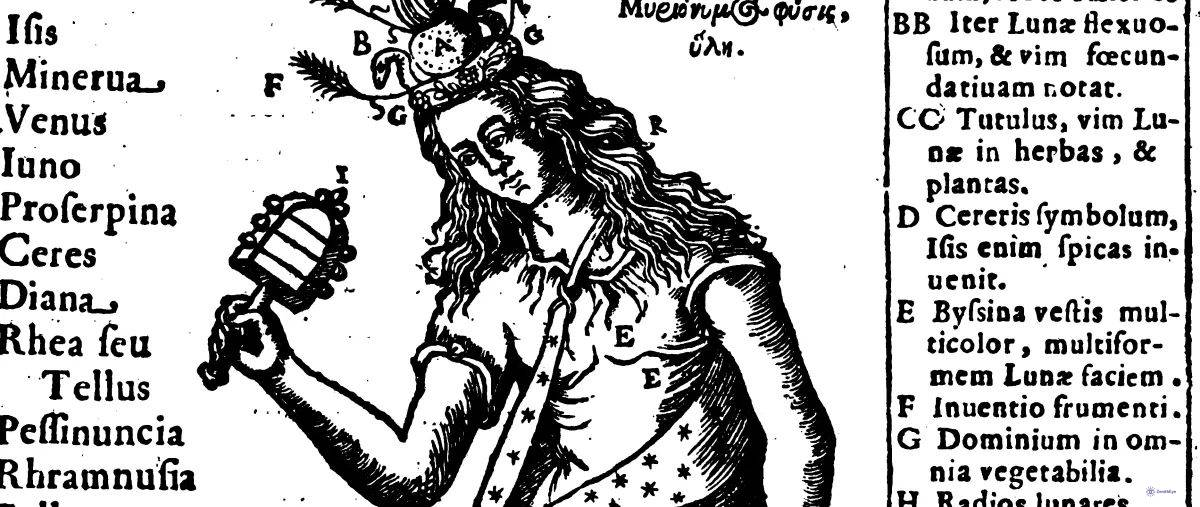
The Goddess: Isis and her various other names and symbols
Athanasius Kircher: From Oedipus Aegyptiacus (1652–1654)
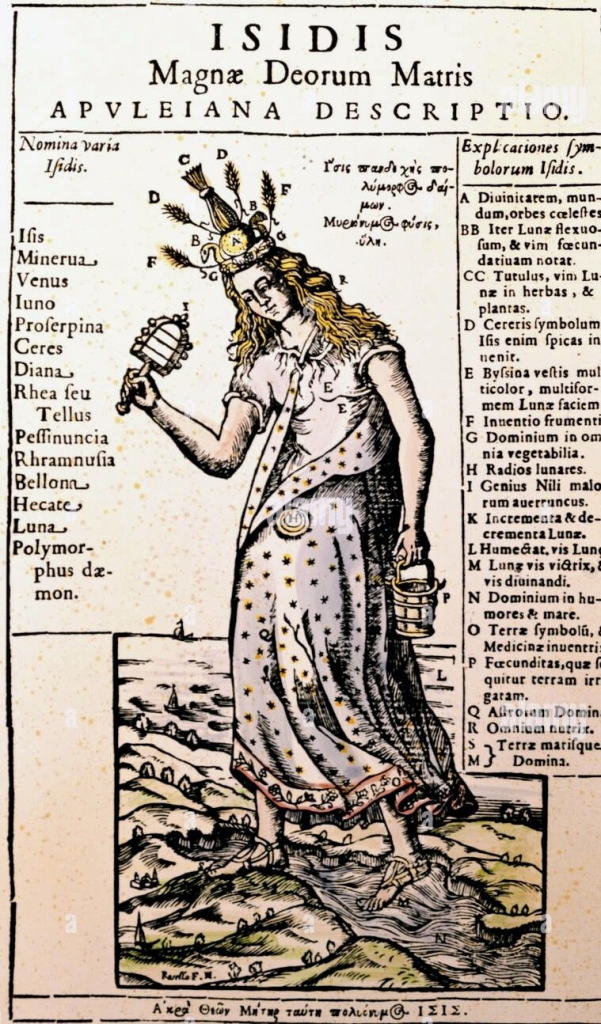
Based on Apuleius, The Golden Ass, Book 11, chapter 47:
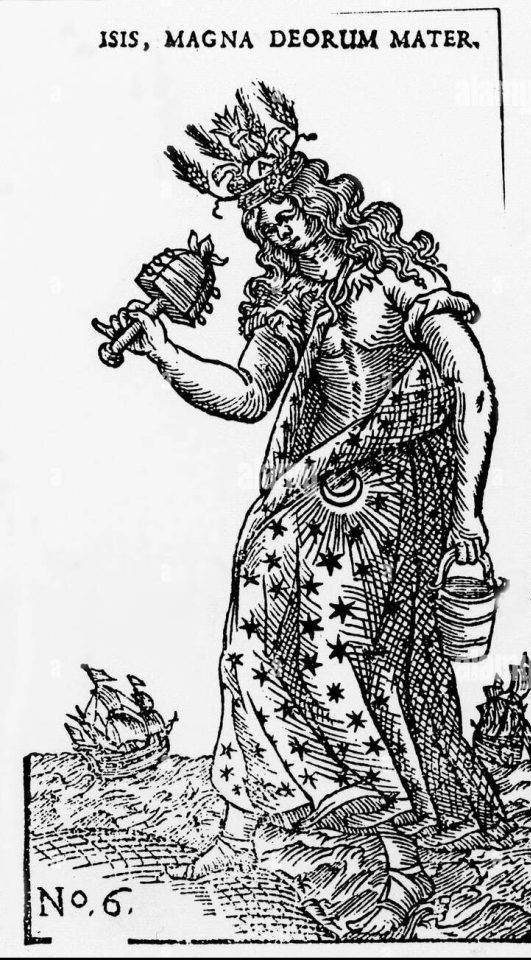
Then by little and little I seemed to see the whole figure of her body, mounting out of the sea and standing before me, wherefore I purpose to describe her divine semblance, if the poverty of my human speech will suffer me, or her divine power give me eloquence thereto. First she had a great abundance of hair, dispersed and scattered about her neck, on the crown of her head she bare many garlands enterlaced with flowers, in the middle of her forehead was a compass in fashion of a glass, or resembling the light of the Moon, in one of her hands she bare serpents, in the other, blades of corn, her vestment was of fine silk yielding divers colours, sometime yellow, sometime rosy, sometime flamey, and sometime (which troubled my spirit sore) dark and obscure, covered with a black robe in manner of a shield, and pleated in most subtile fashion at the skirts of her garments, the welts appeared comely, whereas here and there the stares glimpsed, and in the middle of them was placed the Moon, which shone like a flame of fire, round about the robe was a coronet or garland made with flowers and fruits. In her right hand she had a timbrel of brass, which gave a pleasant sound, in her left hand she bare a cup of gold, out of the mouth whereof the serpent Aspis lifted up his head, with a swelling throat, her odoriferous feet were covered with shoes interlaced and wrought with victorious palm. Thus the divine shape breathing out the pleasant spice of fertile Arabia, disdained not with her divine voyce to utter these words unto me: Behold Lucius I am come, thy weeping and prayers hath moved me to succour thee.
“I am she that is the natural mother of all things, mistress and governess of all the elements, the initial progeny of worlds, chief of powers divine, Queen of Heaven, the principal of the Gods celestial, the light of the goddesses: at my will the planets of the air, the wholesome winds of the seas, and the silences of Hell be disposed; my name, my divinity is adored throughout all the world in divers manners, in variable customs and in many names, for the Phrygians call me the mother of the Gods: the Athenians, Minerva: the Cyprians, Venus: the Candians, Diana: the Sicilians Proserpina: the Eleusians, Ceres: some Juno, other Bellona, other Hecate: and principally the Ethiopians which dwell in the Orient, and the Egyptians which are excellent in all kind of ancient doctrine, and by their proper ceremonies accustom to worship mee, do call me Queen Isis.”
The Illustration: “ISIDIS Magnæ Deorum Matris APVLEIANA DESCRIPTIO”
The annotated engraving showing Isis with her lunar crown (B), multicolored silk garment (E), brass timbrel/sistrum in right hand, and golden cup with asp in left hand. The letters correspond to Kircher’s symbolic explications of her divine powers.
The Syncretic Goddess: Many Names, One Divinity
Culture Name
Phrygians Mother of the Gods
Athenians Minerva
Cyprians Venus
Cretans Diana
Sicilians Proserpina
Eleusinians Ceres
Romans Juno / Bellona
Others Hecate, Rhea, Tellus, Pessinuncia, Rhramnusia
This reflects the interpretatio graeca tradition and Renaissance hermeticism’s view of a single divine truth expressed through many cultural masks.
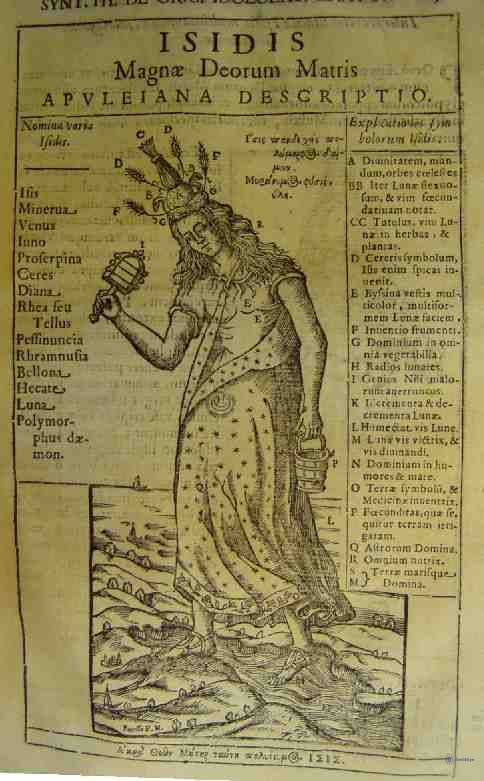
Detail View: The Polymorphic Nature of the Goddess
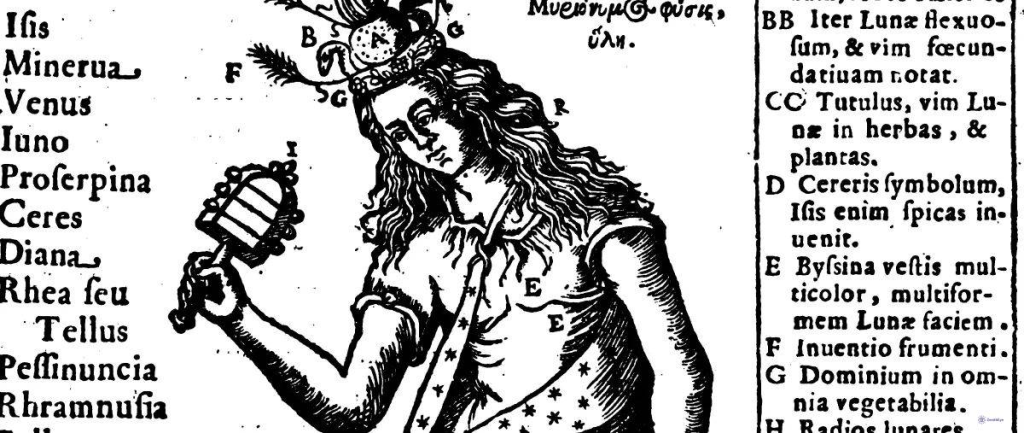
Symbolic Explications: The Key to the Mysteries
Letter Symbol Meaning
A Divinity The world, celestial orbs
B Lunar disc The moon’s waxing and waning, fecundity
C Tutulus Lunar influence on plants
D Wheat Symbol of Ceres (grain discovery)
E Multicolored silk The moon’s changing faces
F — Invention of grain
G — Dominion over vegetation
H Rays Lunar rays
I — Genius of the Nile, averter of evils
K — Increments and decrements of the moon
L — Moistening power of the moon
M — Victorious and divinatory power
N — Dominion over humors and the sea
O Earth symbol Inventor of medicine
P — Fertility following irrigation
Q — Mistress of the stars
R — Nourisher of all things
S/M — Mistress of earth and sea
Later Adaptation (1676)
The Mensa Isiaca Connection
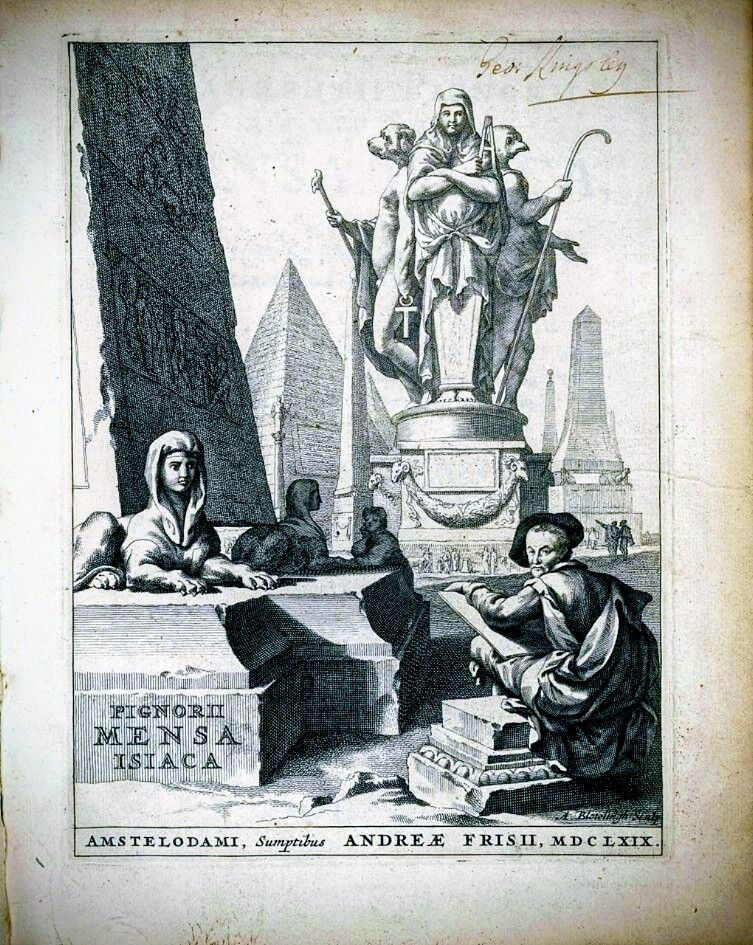
Kircher’s study was heavily influenced by the Mensa Isiaca (Isiac Tablet), a bronze Roman-era tablet depicting Isiac rituals that informed his interpretation of Egyptian mysteries.
Summary
These engravings from Oedipus Aegyptiacus exemplify the Renaissance emblem tradition, where image, text, and scholarly commentary merge to create a hermeneutic tool for decoding the “divine mysteries” of Egyptian religion through the lens of Apuleius’s mystical narrative. Kircher’s Isis is not merely an Egyptian deity but a synthesis of Mediterranean wisdom—a polymorphic goddess embodying the universal feminine principle that governs nature, fertility, the moon, and the cosmic order itself.