The Seven Hermetic Principles: Universal Laws That Govern Reality
“The Principles of Truth are Seven; he who knows these, understandingly, possesses the Magic Key before whose touch all the Doors of the Temple fly open.” So begins the second chapter of The Kybalion, the 1908 text that distilled ancient Hermetic teachings into seven universal principles attributed to Hermes Trismegistus–the “Thrice-Greatest” sage who served as the bridge between Egyptian wisdom and Greek philosophy.
These seven principles are not merely philosophical speculations. They represent, according to the Hermetic tradition, the fundamental laws by which reality operates–the underlying code that governs everything from the movement of galaxies to the fluctuations of consciousness. Understanding them is not an academic exercise but a practical necessity for anyone seeking to navigate reality with mastery rather than being moved about like “pawns on the Chessboard of Life.”
Table of Contents
- The Kybalion in Context
- 1. The Principle of Mentalism
- 2. The Principle of Correspondence
- 3. The Principle of Vibration
- 4. The Principle of Polarity
- 5. The Principle of Rhythm
- 6. The Principle of Cause and Effect
- 7. The Principle of Gender
- Living the Principles
- Frequently Asked Questions
- Further Reading
- References and Sources

The Kybalion in Context
Before examining the principles themselves, it is essential to understand the text that preserved them. The Kybalion first appeared in 1908, published anonymously under the name “The Three Initiates.” Scholars now widely attribute its authorship to William Walker Atkinson (1862-1932), a prolific American writer and prominent figure in the New Thought movement–a late nineteenth-century spiritual current that emphasised the power of mind in shaping reality. Atkinson published dozens of metaphysical works under various pseudonyms, and The Kybalion represents his most enduring contribution to Western esotericism.
The text does not claim to be an ancient manuscript. Rather, it presents itself as a study of the Hermetic philosophy of “Ancient Egypt and Greece,” distilling teachings attributed to Hermes Trismegistus–a legendary syncretic figure combining the Greek god Hermes with the Egyptian god Thoth. The actual Corpus Hermeticum, the collection of Greek texts attributed to Hermes, dates to the first through third centuries CE in Roman Egypt, not to the dynastic period. Similarly, the famed Emerald Tablet, which contains the axiom “as above, so below,” survives in earliest form in Arabic manuscripts from the eighth or ninth century CE, later translated into Latin and becoming central to medieval alchemy. Isaac Newton himself produced a translation and commentary on the tablet.
This chronology matters not to diminish the principles but to locate them accurately. The Kybalion is a modern reformulation–a twentieth-century interpretation that reframes Hermetic ideas through the lens of early quantum physics, psychology, and New Thought metaphysics. Whether the principles are “genuinely ancient” or “modern inventions” is less important than whether they accurately describe patterns observable in consciousness and cosmos. The test of any principle is not its antiquity but its utility.
1. The Principle of Mentalism
“THE ALL IS MIND; The Universe is Mental.”
— The Kybalion
This first principle establishes the foundation of all that follows. Reality, at its most fundamental level, is mental in nature. The material universe–matter, energy, phenomena–is a mental creation of THE ALL, the infinite living mind that underlies all manifestation. We do not live in a material universe that happens to contain consciousness; we live in a conscious universe that manifests as matter.
The implications are profound. If the universe is mental, then mind is not an epiphenomenon of brain activity but the primary reality. The laws of mind–attention, intention, imagination, belief–become the laws of reality manipulation. The placebo effect, the power of suggestion, the capacity of focused attention to influence probability–all find their explanation in the Principle of Mentalism. Modern neuroscience confirms that perception is not passive reception but active construction; the brain generates reality as much as it registers it.
The Observer Effect and Modern Physics
The Principle of Mentalism finds surprising resonance in quantum physics. Max Planck, one of the founding fathers of quantum theory, stated plainly: “I regard consciousness as fundamental. I regard matter as derivative from consciousness. We cannot get behind consciousness. Everything that we talk about, everything that we regard as existing, postulates consciousness.” In a 1944 lecture in Florence, Planck went further, arguing that “there is no matter as such” and that “we must assume behind this force the existence of a conscious and intelligent mind. This mind is the matrix of all matter.”
The observer effect in quantum mechanics–the way measurement influences the behaviour of quantum systems–suggests that consciousness is not separate from the reality it observes but actively participates in its manifestation. Cellular biologist Dr. Bruce Lipton has extended this framework into biology, arguing that our beliefs and perceptions literally shape cellular behaviour, rewriting the genetic expression through epigenetic mechanisms. The body, in this view, is not a machine running on automatic but a community of fifty trillion cells responding to the broadcast signals of the central mind.
From Philosophy to Practice
The practical application of Mentalism is not wishful thinking but disciplined attention. To operate this principle is to recognise that your mental states are causative, not merely reactive. The quality of your attention determines the quality of your experience. Change the signal, and the receiver–reality–retunes accordingly. This is the basis of all contemplative practice: the systematic refinement of attention until it becomes a precise instrument rather than a distracted noise.
2. The Principle of Correspondence
“As above, so below; as below, so above.”
— The Emerald Tablet
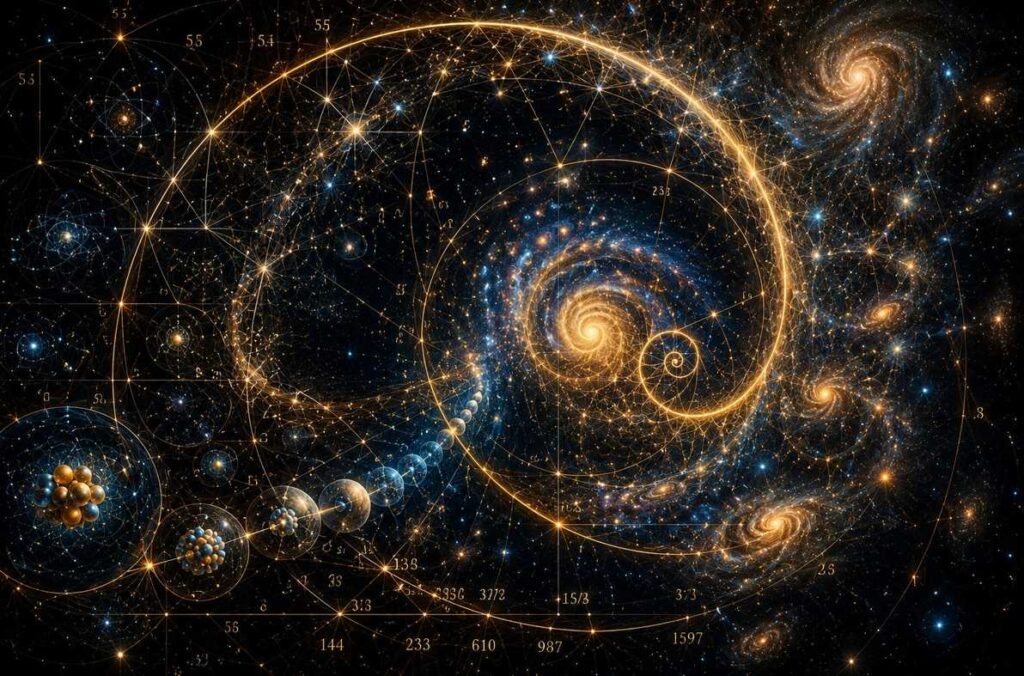
This ancient axiom, inscribed on the Emerald Tablet of Hermes, expresses the fundamental symmetry of reality. The patterns that manifest on one plane of existence–physical, mental, spiritual–correspond to patterns on all other planes. The microcosm reflects the macrocosm; the individual reflects the universe. What occurs in the outer world mirrors what occurs in the inner world, and vice versa.
This principle is the master key to esoteric knowledge. It means that by studying any level of reality with sufficient depth, we can understand all other levels. The structure of the atom reflects the structure of the solar system; the patterns of human psychology reflect the patterns of cosmic evolution; the stages of alchemical transformation reflect the stages of spiritual development. Nothing exists in isolation. The universe is a fractal, and every part contains the pattern of the whole.
The Emerald Tablet and Its Legacy
The Emerald Tablet itself is one of the most influential documents in Western esotericism. Though attributed to Hermes Trismegistus, its earliest known versions appear in Arabic texts from the eighth or ninth century CE. The Latin translation became a pivotal text in medieval Europe, where it shaped the development of alchemy, natural philosophy, and occult science. Albertus Magnus, Roger Bacon, and Isaac Newton all produced commentaries on its terse verses. The tablet’s influence extends beyond esotericism into the scientific revolution itself–Newton’s alchemical studies informed his optical and gravitational work.
Symbolic Systems and the Microcosm
This principle also establishes the basis for all symbolic systems. Astrology operates on correspondence: the movements of planets correspond to movements of consciousness. The Tarot functions because its archetypes correspond to universal patterns of human experience. Sacred geometry works because mathematical relationships correspond to the fundamental structure of manifestation. These are not superstitious projections but structured languages for reading the correspondences between planes. To learn the language is to gain access to information otherwise invisible to the literal mind.
3. The Principle of Vibration
“Nothing rests; everything moves; everything vibrates.”
— The Kybalion
From the standpoint of modern physics, this principle seems almost self-evident. We now know that matter is not solid but consists of atoms in constant motion, that atoms themselves are mostly empty space with particles vibrating in energy fields. But the Hermetic teaching extends beyond the physical to encompass the mental and spiritual planes as well.
Everything vibrates at a specific frequency–matter, energy, mind, spirit. And frequency determines quality. The difference between heat and cold, light and dark, sound and silence, love and fear, is ultimately a difference of vibrational rate. Higher vibrations correspond to higher states of consciousness, greater coherence, increased complexity, and expanded awareness. Lower vibrations correspond to contraction, fragmentation, and entropy.
Quantum Fields and Constant Motion
Twentieth-century physics rediscovered what Hermeticism had maintained for centuries: that motion is fundamental to all existence. Quantum field theory describes a universe where particles are excitations of underlying fields, where “empty” space teems with virtual particles flickering in and out of existence. Even THE ALL, in Hermetic teaching, manifests a constant vibration of such infinite intensity and rapid motion that it may be practically considered as at rest–the still point at the centre of infinite motion.
The Art of Frequency Management
The practical application involves the art of “vibrational management”–consciously raising one’s vibrational frequency through thought, emotion, action, and environment. This is not mystical fantasy but practical physics: change the frequency, change the manifestation. The alchemist transmutes lead into gold by changing vibrational rates; the mystic transmutes suffering into wisdom by the same principle. As one old Hermetic writer observed: “He who understands the Principle of Vibration, has grasped the sceptre of Power.”
Dr. Bruce Lipton uses the placebo effect as a primary example of this principle in biological operation. Positive belief raises cellular vibration, enhancing immune function and tissue repair; negative belief lowers it, producing stress hormones and inflammatory responses. The body is a tuning fork, and the mind strikes the note.
4. The Principle of Polarity
“Everything is Dual; everything has poles; everything has its pair of opposites.”
— The Kybalion
Reality manifests through the play of opposites: hot and cold, light and dark, positive and negative, masculine and feminine, spirit and matter. But–and this is crucial–these opposites are not truly separate but extremes of the same continuum. They are identical in nature, different only in degree.
The principle dissolves the illusion of absolute dualism. Good and evil are not separate forces in eternal conflict but poles of the same moral spectrum. Spirit and matter are not separate substances but different densities of the same underlying reality. The apparent opposites are reconciled in the understanding that transcends them both. As the Kybalion states: “All paradoxes may be reconciled.”
Transmutation Through Degree
This principle also contains the secret of transmutation. Just as heat and cold are the same thing differing only in degree, so are love and hate, courage and fear, health and disease. By “raising the vibration” of any quality, we can transmute it into its opposite. Fear becomes courage; hatred becomes love; illness becomes health–not by fighting the negative but by raising it to a higher octave of the same scale.
Lipton describes polarity through the lens of wave-particle duality in quantum physics–light and matter exhibit qualities of both waves and particles, behaving in apparently opposite ways depending on context. Waves pass through each other; particles bounce off. Yet they are not different entities but different expressions of the same underlying phenomenon. The polarity is real at the level of manifestation but illusory at the level of essence.
Beyond Absolute Dualism
The practical consequence is liberation from binary thinking. Most human suffering arises from the insistence that things must be either/or–success or failure, right or wrong, us or them. The Principle of Polarity reveals that these are not opposing forces but coordinates on the same map. The sage does not choose sides but occupies the centre, from which all poles are visible and none dominate. This is the “Art of Polarisation” taught in the Hermetic tradition: the capacity to shift position along any continuum at will.

5. The Principle of Rhythm
“Everything flows, out and in; everything has its tides; all things rise and fall.”
— The Kybalion
The pendulum swings. The tide ebbs and flows. Nations rise and fall. Economies expand and contract. Relationships warm and cool. Consciousness itself moves through cycles of clarity and confusion, expansion and contraction, awakening and forgetting.
This principle describes the rhythmic nature of all manifestation. Nothing remains static; everything moves in measured motion between poles. The measure of the swing to the right is the measure of the swing to the left. Rhythm compensates; what goes up must come down; what descends must eventually rise. The Kybalion warns: “Rhythm compensates.”
The Pendulum and the Law of Neutralisation
The Hermetic masters developed methods to escape the destructive effects of rhythm while remaining subject to the principle itself. Through the “Mental Law of Neutralisation,” they learned to polarise themselves at the desired point and maintain equilibrium despite the pendulum’s swing. They do not stop the rhythm–that is impossible–but they rise above it, observing the swing without being swept away by it.
This is not stoic suppression of emotion but a cultivated detachment that permits full engagement without identification. The master experiences joy without clinging, sorrow without despair, success without arrogance, failure without collapse. The rhythm continues, but the rider no longer falls from the horse.
Cycles in Nature and Consciousness
Modern science confirms the ubiquity of rhythmic patterns. Circadian rhythms govern cellular metabolism; cardiac cycles maintain life; seasonal patterns structure ecosystems; economic cycles shape civilisations. Even the universe itself expands and will eventually contract, according to some cosmological models. To resist these rhythms is to exhaust oneself in futility; to understand them is to surf rather than drown.
6. The Principle of Cause and Effect
“Every Cause has its Effect; every Effect has its Cause; everything happens according to Law.”
— The Kybalion
Nothing happens by chance. Every event has its cause; every cause produces its effect. The universe is lawful down to its smallest detail. What we call “chance” is simply law operating beyond our current understanding. As the Kybalion states: “Chance is but a name for Law not recognised.”
This principle establishes the basis for both science and magic. Science works by identifying causes and predicting effects. Magic works by understanding higher causes that produce effects on lower planes. Both assume the fundamental lawfulness of reality. The difference lies not in the principle but in the plane of operation.
From Pawn to Player
The masses of humanity, the Kybalion teaches, are “carried along, obedient to environment; the wills and desires of others stronger than themselves; heredity; suggestion; and other outward causes moving them about like pawns on the Chessboard of Life.” But the masters “rising to the plane above, dominate their moods, characters, qualities, and powers, as well as the environment surrounding them, and become Movers instead of pawns.”
To rise above the plane of ordinary cause and effect is to become a conscious cause–to act from intention rather than reaction, from vision rather than circumstance. This is the meaning of freedom within the lawful universe. Freedom is not the absence of law but the understanding of law sufficient to operate it rather than being operated by it.
The Architecture of Intention
Dr. Lipton argues that the highest application of these principles lies in allowing them to guide intention, which “boosts the signal of our mental, vibrational waves to become the cause affecting how particles organise to render our experience of reality.” Intention is not mere wanting; it is the alignment of thought, emotion, and action into a coherent causal vector. When these three are unified, the effect is inevitable. When they are divided–when you think one thing, feel another, and do a third–the signal cancels itself.
7. The Principle of Gender
“Gender is in everything; everything has its Masculine and Feminine Principles.”
— The Kybalion
Gender manifests on all planes–not merely the physical distinction between male and female but the universal play of active and receptive, positive and negative, yang and yin. Every creation, whether physical, mental, or spiritual, requires the union of masculine and feminine principles.
On the physical plane, gender manifests as sex. On the mental plane, it manifests as the active, projective quality of thought and the receptive, imaginative quality of mind. On the spiritual plane, it manifests as the union of spirit and soul, consciousness and being, the transcendent and the immanent. Lipton describes this as the balance of structure and movement on the masculine side with vegetation and growth on the feminine side–both necessary for any organism to survive and thrive.
Masculine and Feminine on All Planes
The Kybalion illustrates this through atomic functionality: positively charged particles exert energy upon negatively charged particles, resulting in the organisation and formation of atoms. “Arising from their unions, or combinations, manifest the varied phenomena of light, heat, electricity, magnetism, attraction, repulsion, chemical affinity and the reverse, and similar phenomena. And all this arises from the operation of the principle of Gender on the plane of energy.”
Creation Through Complementary Forces
The principle warns against the degradation of gender into mere sexuality. The Hermetic teaching has “no reference to the many base, pernicious and degrading lustful theories, teachings and practices… which are a prostitution of the great natural principle of Gender.” To the pure, all things are pure; to the base, all things are base. Gender, in its Hermetic sense, is the engine of creation–the dynamic tension between opposites that generates all manifestation. Without this interplay, there is no movement, no change, no world.
Living the Principles
These seven principles are not meant to be merely contemplated but lived. They provide a framework for understanding reality and a toolkit for navigating it. As Lipton emphasises, “the highest and best use of these principles lies in allowing them to guide our intentions, which boosts the signal of our mental, vibrational waves to become the cause affecting how particles organise to render our experience of reality.”
To know the principles is to possess the master key. To apply them is to open the doors of the temple–to transform from pawn to player, from effect to cause, from sleepwalker to awakened master of the art of living. The knowledge remains theoretical until it becomes operational. The map is useless if you never leave the house.
The integration of all seven principles produces a coherent operating system. Mentalism establishes that reality is mind; Correspondence reveals that all levels mirror each other; Vibration shows that quality is frequency; Polarity demonstrates that opposites are unified; Rhythm reminds us that all things cycle; Cause and Effect insists that we are responsible; Gender teaches that creation requires union. Together, they form a complete philosophy of conscious participation in the universe.
Frequently Asked Questions
What is The Kybalion and who wrote it?
The Kybalion is a 1908 text published anonymously by Three Initiates, now widely attributed to William Walker Atkinson (1862-1932), a New Thought writer and lawyer. It presents seven Hermetic principles drawn from the Western esoteric tradition, reframed through early twentieth-century metaphysics and popular science. It is not an ancient text but a modern interpretation of Hermetic philosophy.
Are the Seven Hermetic Principles genuinely ancient?
The principles as formulated in The Kybalion are modern distillations. While concepts like Mentalism, Correspondence, and Gender appear in classical Hermetic and alchemical texts, the specific wording and systematic presentation of all seven principles is unique to the 1908 text. Some principles, such as Vibration, reflect nineteenth-century scientific discoveries rather than ancient doctrine. The value of the principles lies in their descriptive accuracy, not their antiquity.
How does the Principle of Mentalism relate to quantum physics?
The Principle of Mentalism–that the universe is fundamentally mental–finds parallels in quantum physics, particularly the observer effect and the role of consciousness in measurement. Max Planck stated that consciousness is fundamental and matter derivative. However, this is a philosophical interpretation of physics, not a scientific proof of metaphysics. The principles are compatible with quantum insights but should not be presented as scientifically proven.
What is the difference between the Emerald Tablet and The Kybalion?
The Emerald Tablet is a short Hermetic text known from Arabic manuscripts of the eighth or ninth century CE, later translated into Latin. It contains the famous axiom As above, so below. The Kybalion is a 1908 book that expands seven principles into a complete philosophical system. The tablet is a medieval alchemical document; The Kybalion is a modern metaphysical manual.
Can anyone apply the Seven Hermetic Principles?
Yes. The Kybalion presents these principles as universal laws operating for all beings regardless of belief or initiation. Application requires disciplined attention, honest self-observation, and sustained practice rather than esoteric credentials. The text explicitly states that the principles are available to anyone who studies them with understanding.
What does the Principle of Gender mean if it is not about biological sex?
In Hermetic philosophy, Gender refers to the universal presence of active and receptive forces in all phenomena. On the physical plane this manifests as biological sex; on the mental plane as active thought and receptive imagination; on the spiritual plane as transcendent spirit and immanent soul. It is a cosmological principle about creative polarity, not a statement about gender identity or sexuality.
How do the Seven Principles work together in practice?
The principles form an integrated system. Mentalism establishes that consciousness is primary; Correspondence shows that inner and outer mirror each other; Vibration reveals that quality is frequency; Polarity demonstrates that apparent opposites are unified; Rhythm reminds us that all things cycle; Cause and Effect makes us responsible agents; Gender teaches that creation requires the union of complementary forces. Together they provide a complete framework for conscious participation in reality.
Further Reading
- Hermetic Spirituality — A reconstruction of Hermeticism as a genuine Western contemplative tradition, examining its anthropology, cosmology, and practical methods.
- Hermetic Connections: Egyptian Wisdom Meets Greek Philosophy — Comparative analysis of Hermetic and Gnostic texts within the Nag Hammadi Library, tracing shared themes and significant differences.
- Discourse on the Eighth and Ninth: Hermetic Ascent — Deep dive into the ritual ascent protocol, vowel intonations, and the hymn in silence that transcends logos.
- The 5 Gateways to Direct Knowing: A Complete Map — Practical contemplative techniques for stabilising gnosis and transforming peak experiences into continuous awakening.
- 7 Integration Practices After Mystical Experience — Essential guidance for grounding peak experiences and stabilising transformation through somatic and psychological methods.
- The Transformation After Mystical Experience — What actually changes after awakening, and how to navigate the return to ordinary life.
- Holographic Universe Theory and Consciousness — Exploring the intersection of modern physics and ancient wisdom regarding the nature of reality.
- States of Knowing: What Happens When Consciousness Unravels — The phenomenology of non-ordinary states and their integration.
- Complete Nag Hammadi Reading Order: All 46 Texts Listed — The master index for navigating the entire Nag Hammadi Library, including Hermetic texts in Codex VI.
References and Sources
This article draws upon primary Hermetic texts, modern scholarly analysis, and contemporary scientific commentary. Sources are grouped by category for clarity.
Primary Hermetic and Esoteric Texts
- Atkinson, W. W. (attrib.) (1908). The Kybalion: A Study of the Hermetic Philosophy of Ancient Egypt and Greece. Chicago: Yogi Publication Society.
- Hermes Trismegistus (attrib.). The Emerald Tablet. Earliest Arabic manuscripts, 8th-9th century CE. Latin translation: Tabula Smaragdina.
- Corpus Hermeticum. Greek texts, 1st-3rd centuries CE. Marsilio Ficino (trans.), 1471.
- Discourse on the Eighth and the Ninth (NHC VI,6). Nag Hammadi Library.
- Prayer of Thanksgiving (NHC VI,7). Nag Hammadi Library.
- Asclepius (NHC VI,8). Nag Hammadi Library.
Scholarly Monographs and Critical Studies
- Copenhaver, B. P. (1992). Hermetica: The Greek Corpus Hermeticum and the Latin Asclepius in a New English Translation, with Notes and Introduction. Cambridge University Press.
- Ebeling, F. (2007). The Secret History of Hermes Trismegistus: Hermeticism from Ancient to Modern Times. Cornell University Press.
- Faivre, A. (1995). The Eternal Hermes: From Greek God to Alchemical Magus. Phanes Press.
- Goodrick-Clarke, N. (2008). The Western Esoteric Traditions: A Historical Introduction. Oxford University Press.
Scientific and Contemporary Sources
- Lipton, B. H. (2005). The Biology of Belief: Unleashing the Power of Consciousness, Matter and Miracles. Mountain of Love/Elite Books.
- Planck, M. (1944). Das Wesen der Materie (The Nature of Matter). Speech delivered in Florence, Italy.
- Planck, M. Quoted in: Pickover, C. A. (2008). Archimedes to Hawking: Laws of Science and the Great Minds Behind Them. Oxford University Press.
- Hankins, M. (2025). “Physics, Biology and the Seven Hermetic Principles.” Tetragrammaton.