

Attention as the First Gateway: Entering the Temple of Consciousness
The temple of consciousness has many entrances, but all who would enter must pass through the first gateway: attention. This is not a metaphorical suggestion but a precise description of how consciousness operates. Before any other transformation can occur, before any higher knowledge can be received, before any mystical experience can be integrated, the quality of attention must be refined. Attention is the first gateway because it is the foundation upon which all subsequent development rests. Without it, the temple remains closed; with it, all doors eventually open.
In an age of engineered fragmentation, this ancient principle carries renewed urgency. The contemporary attention economy–with its dopamine-scrolling architectures and notification bombardments–functions as a systematic dispersal of precisely the capacity that contemplative traditions have always sought to cultivate. To speak of attention as a spiritual gateway today is therefore to speak of resistance as well as receptivity, of reclaiming the sovereign right to direct one’s own awareness.
Table of Contents
- The Architecture of Attention
- The Sleep of Consensus
- The Work of Awakening
- Beyond the Gateway
- Obstacles at the Threshold
- Conclusion
The Architecture of Attention
The metaphor of the gateway is apt because attention functions as both barrier and passage. In its ordinary, scattered state, attention keeps us locked in the courtyard of consensus reality, able to perceive only what the culture has approved for our seeing. But when attention is gathered, concentrated, and refined, it becomes the key that unlocks the inner chambers where the real work of consciousness takes place. The gateway does not open by accident or grace alone; it opens through the deliberate cultivation of attentional capacity.
The Neuroscience of Focus
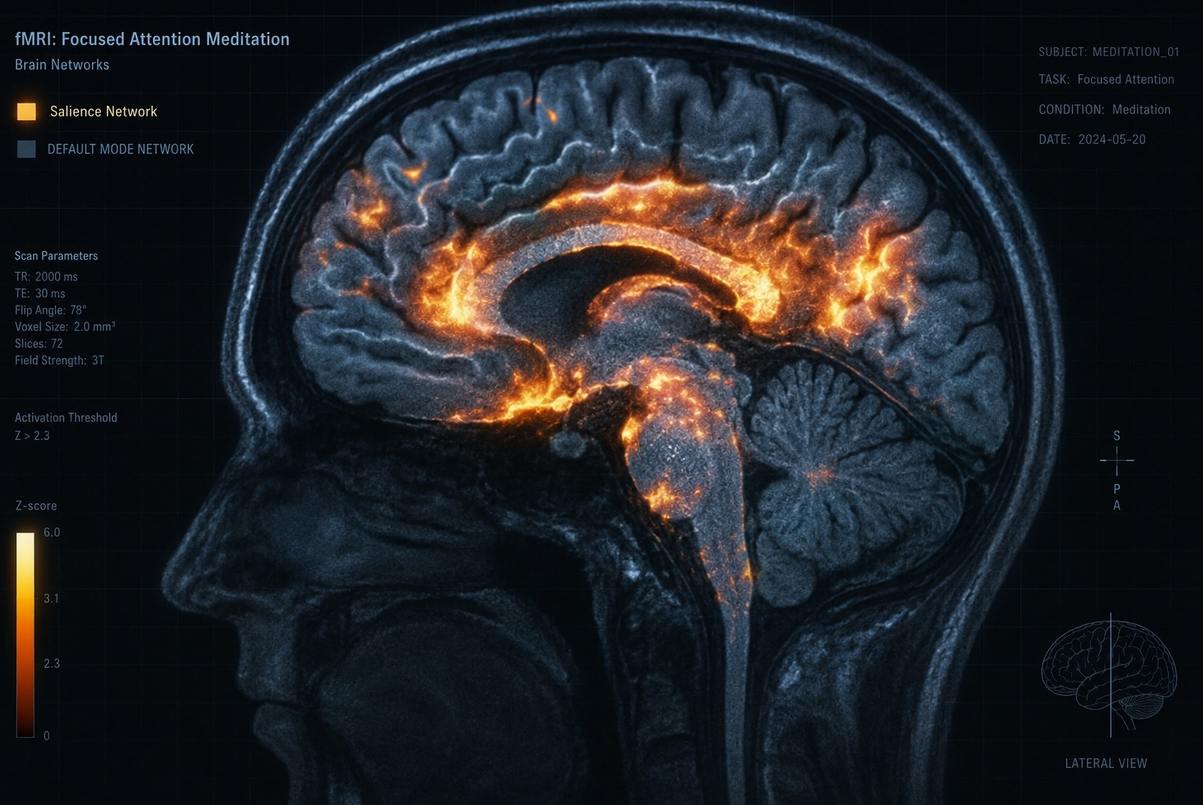
Recent neuroscience illuminates what the traditions have always known through direct experimentation. The brain’s default mode network (DMN)–associated with mind-wandering, self-referential thought, and autobiographical rumination–demonstrates reduced functional connectivity during sustained attentional practice. Concurrently, the salience network (dorsal anterior cingulate cortex and bilateral anterior insula) and the executive network (dorsolateral prefrontal cortex and parietal regions) show increased coordination in experienced practitioners. Research indicates that even brief training in focused attention can diminish DMN dominance while strengthening the neural circuits responsible for sustaining awareness. These alterations persist beyond the meditation cushion, suggesting that attentional training fundamentally rewires how the brain processes experience moment to moment.
Prior to All Other Virtues
Why attention? Why not faith, or love, or good works? These are all valuable, and they all have their place on the path. But attention is prior to them all. Without attention, faith is mere belief, ungrounded in direct experience. Without attention, love is sentiment, lacking the clear seeing that distinguishes genuine care from emotional need. Without attention, good works may be well-intentioned but ineffective, missing the mark because they do not perceive the true situation. Attention is the capacity that makes all other capacities effective. It is the alpha of spiritual practice–the first letter from which the rest of the sentence must follow.
The Sleep of Consensus
We imagine ourselves to be conscious, aware, present–but a moment of honest observation reveals the truth. The mind wanders constantly, pulled by every stimulus, lost in thought, planning, remembering, fantasising. We are asleep, and we do not know we are asleep. The work of attention is the work of awakening, and awakening begins with the recognition that we are not yet awake.
The Attention Economy as Archonic Force
Modern life is designed to fragment attention, to keep us in a state of perpetual distraction that serves the interests of commerce and control. The architecture of digital platforms–infinite scroll, variable reward mechanisms, notification cascades–exploits the salience network’s natural responsiveness to novelty. Nicholas Carr’s research on neuroplasticity demonstrates that the brain reshapes itself according to the demands placed upon it: sustained reading cultivates deep focus, while digital skimming encourages surface processing. In this context, the cultivation of attention is not merely a private spiritual exercise but a reclamation of cognitive sovereignty. The archonic force is not malevolent in the mythic sense; it is simply the aggregate effect of systems that monetise the dispersion of awareness.

The Witness Behind the Contents
As attention stabilises, we begin to see the nature of the mind itself–the constant flux of thoughts, emotions, and sensations that constitutes ordinary consciousness. We see that we are not these contents but the awareness within which they arise. This is the first great insight, the recognition of the witness that observes all experience without becoming entangled in it. Previously, we were identified with the contents of consciousness–our thoughts, our feelings, our stories. We were lost in the movie of our own minds, unable to distinguish the screen from the images projected upon it. After the recognition, we know ourselves as the screen, the awareness that remains constant while the images change. This is not a philosophical position but a direct perception, available to anyone who passes through the first gateway with sufficient attentional clarity.
The mind wanders; this is its nature. The body aches; this is its condition. The ego resists; this is its function. These obstacles are not signs of failure but the terrain through which the path winds.
— ZenithEye Editorial Position
The Work of Awakening
Entering the first gateway requires the practice of concentration–the deliberate focusing of attention on a chosen object. This practice is not exotic or mysterious; it is as simple as attending to the breath, to a sound, to a visual object. But simple is not easy. The mind resists concentration with cunning persistence, offering endless distractions, rationalisations, and resistances. Each session of practice is a battle for attention, a struggle to reclaim awareness from the forces that would keep it scattered.
Dharana and Sati — Ancient Technologies of Focus
The contemplative traditions have mapped this territory with precision. In Patanjali’s Yoga Sutras, dharana–the sixth limb–is defined as the binding of attention to a single point. The Buddha’s teaching of sati (mindfulness) emphasises not merely concentration but the full awareness of present-moment experience without judgment. Neuroscience research distinguishes between these modes: focused attention meditation activates the executive network, while open monitoring practices engage broader awareness circuits. Both develop what the traditions call tonic alertness–a sustained, relaxed vigilance that persists beyond formal practice. The desert fathers spoke of nepsis, or sober watchfulness; the Sufis spoke of muraqaba, spiritual vigilance. Across traditions, the vocabulary differs but the instruction remains constant: gather the scattered mind and return it to the present moment.

The Fruits of Persistence
The fruits of this struggle are not immediately apparent. In the beginning, practice seems pointless, a waste of time spent wrestling with an unruly mind. But gradually, almost imperceptibly, changes begin to occur. The periods of sustained attention grow longer. The return to the object becomes quicker. And moments of genuine presence–moments when the mind is fully absorbed in what it attends to–begin to punctuate the wandering. These moments are the first taste of what lies beyond the gateway, incentives to continue the work. Research confirms that meditators with extensive experience exhibit increased functional connectivity between attentional regions and medial frontal areas even during rest, suggesting that the benefits of practice transfer seamlessly into daily life.
Beyond the Gateway
The first gateway opens not when we achieve perfect concentration but when we understand what concentration reveals. As attention stabilises, the constructed nature of experience becomes undeniable, and the practitioner stands at the threshold of a new relationship with reality itself.
The Construction of Reality
As attention becomes more refined, we begin to see how much of what we take to be “out there” is actually projection, interpretation, and assumption. The world we perceive is not the world as it is but the world as we have learned to see it, filtered through concepts, beliefs, and cultural conditioning. This discovery is initially disorienting–we feel we have lost our footing in reality. But it is actually the gaining of true footing, the first step toward perceiving what is rather than what we expect. The gateway does not deliver us to another world; it restores the one we have been misreading.

Time and the Eternal Present
The relationship between attention and time is transformed at the first gateway. Ordinarily, we experience time as a linear progression, a sequence of moments stretching from past to future. But attention, fully present, reveals the timeless dimension that underlies temporal experience. In moments of complete absorption, time seems to stop–or rather, we stop moving through time and rest in the eternal present. This is not escape from time but the discovery of its true nature as a mode of consciousness rather than an objective container. The past and future are mental constructions; the present is the only field in which attention can actually land.
The Democratic Path
The first gateway is democratic–it opens to anyone willing to do the work. It does not require special intelligence, particular beliefs, or favourable circumstances. It requires only the willingness to sit, to breathe, to attend, and to begin again when the mind wanders. This accessibility makes attentional practice the universal spiritual technology, available to all regardless of background or tradition. The challenges are universal too: the mind wanders, the body complains, the ego devises shortcuts. Each obstacle overcome is a strengthening; each return to practice is a quiet victory.
Obstacles at the Threshold
The discipline required to pass through the first gateway is often underestimated. We want the fruits of spiritual practice without the labour of attentional development. We seek peak experiences, mystical visions, and profound insights while neglecting the daily work of gathering the scattered mind. But there are no shortcuts. The gateway opens only to those who knock, and knocking means practice–daily, sustained, patient practice that gradually builds the capacity for clear seeing.
The Ego’s Resistance
The first gateway is also guarded by the ego, which recognises that sustained attention threatens its dominance. The ego employs sophisticated strategies to maintain control–spiritual materialism (using practice to enhance self-image), spiritual bypassing (using practice to avoid psychological work), and the subtle pride that comes from “advanced” practice. Passing through the gateway requires seeing through these strategies, recognising them as the ego’s last-ditch efforts to maintain its position. The ego does not fight fairly; it uses spirituality itself as camouflage.
Environmental Sabotage
Passing through the first gateway in the modern environment is like trying to light a candle in a hurricane. We must create protected spaces–physical spaces of quiet and simplicity, temporal spaces of retreat and regular practice, social spaces of support and shared intention–where attention can develop without constant interruption. The smartphone is not evil, but it is a device optimised for interruption; the practitioner must therefore be intentional about the technological environment, treating attention as a trust fund to be spent carefully rather than a commodity to be squandered.
The Effort of Non-Effort
The first gateway teaches us about the nature of effort itself. We discover that willpower alone is insufficient; the mind cannot force itself to attend. Instead, we learn the art of gentle persistence, the soft return that does not punish the wandering but simply brings attention back to the object. This is the effort of non-effort, the doing that is also allowing, that characterises all advanced practice. We learn to work with the mind rather than against it, cooperating with its nature to achieve what force cannot. The return is the practice; the wandering is not failure but the very material upon which attention is sharpened.
Conclusion
Passing through the first gateway changes our relationship to experience itself. Previously, we were at the mercy of whatever thoughts, emotions, or sensations arose, identified with them and controlled by them. After the gateway, we have a choice. We can attend to what serves our development and release what does not. We can hold experience in the larger context of awareness rather than being submerged in its contents. This is the freedom that attention brings–not escape from experience but mastery of how we relate to it.

The first gateway is only the beginning. Beyond it lie further gates, deeper chambers, more refined states of consciousness. But none of these can be accessed without passing through the first. Attention is the alpha of spiritual practice, the foundation upon which the omega is built. Those who would know the heights must first master the depths of their own attention. The gateway stands open; the key is in our hands. All that remains is to use it.
What is the first gateway to higher consciousness?
The first gateway is attention–the deliberate capacity to gather and sustain awareness on a chosen object or experience. Without refined attention, faith remains belief without grounding, love becomes sentimental projection, and mystical experiences cannot be integrated. All contemplative traditions agree that attention is the prerequisite for every subsequent stage of transformation.
How does attention differ from concentration?
Concentration, or dharana, refers specifically to the binding of awareness to a single point, while attention encompasses the broader field of mindful awareness, or sati, that includes monitoring the quality of consciousness itself. Neuroscience distinguishes these modes through different neural networks: focused attention activates the executive network, whereas open monitoring engages broader awareness circuits. Both are necessary, but concentration provides the stability that makes deeper insight possible.
Can attention be trained, or is it fixed?
Attention is highly trainable; research demonstrates that even brief focused attention practice can reduce default mode network activity and strengthen functional connectivity in attentional circuits. These neural changes persist beyond formal practice, indicating that attentional capacity is not fixed but plastic. The traditions have always maintained this, describing attention as a skill to be cultivated through daily practice rather than a gift bestowed by grace alone.
What does neuroscience say about meditation and attention?
Neuroimaging studies reveal that experienced meditators exhibit increased functional connectivity within the salience and executive networks, alongside reduced activity in the default mode network associated with mind-wandering. The anterior cingulate cortex and dorsolateral prefrontal cortex–regions governing sustained vigilance–show enhanced coordination after prolonged practice. These findings confirm that meditation is not merely relaxation but an active training of the brain’s attentional architecture.
Why is the attention economy considered an obstacle to spiritual practice?
The attention economy operates by fragmenting awareness through engineered distraction, exploiting the brain’s natural responsiveness to novelty and variable rewards. Digital platforms are designed to maximise engagement, which correlates directly with the dispersal of sustained attention. In this context, reclaiming one’s attention is not escapism but a direct assertion of cognitive sovereignty against systems that monetise fragmentation.
What is the ‘witness’ in contemplative traditions?
The witness is the recognition that awareness is not identical to the contents of consciousness–thoughts, emotions, or sensations–but the open field within which they arise and pass away. This insight, available to anyone who develops sufficient attentional stability, shifts identity from the narrative self to the observing presence. It is the first major threshold beyond the gateway, often described as the difference between being lost in a film and recognising the screen.
How long does it take to develop stable attention?
Meaningful changes in attentional capacity can appear within weeks of consistent practice, though profound stability typically requires months or years of daily cultivation. Research indicates that even six days of focused attention training can produce measurable changes in theta and alpha band activity. The traditions counsel patience: the gateway opens gradually through accumulated effort, not through dramatic breakthroughs.
Further Reading
Explore related pathways within the ZenithEye archive:
- The Five Gateways: Five Paths to Direct Knowing — The complete map of the gateway system, placing attention within the broader architecture of practice.
- Gateway of Breath: Pranayama and the Alchemy of Life Force — The second gateway explores how breath becomes a vehicle for refined awareness once attention has stabilised.
- The Gateway of Sensation: Body Scan and Somatic Awareness — Attention directed inward reveals the body as a field of continuous sensory information.
- Gateway of Sound: Mantra, Nada Yoga, and the Architecture of Vibration — How auditory attention becomes a portal to deeper states of consciousness.
- Gateway of Movement: Walking Meditation and Circulatory Awareness — Attention in motion, developing stability while the body moves through space.
- Gateway of Vision: Yantra, Mandala, and the Geometry of Perception — Visual attention harnessed through sacred form and symbolic concentration.
- Contemplative Techniques: The Inner Technologies of Transformation — A comprehensive survey of methods for developing and sustaining attentional clarity.
- Default Mode Network Dissolution and the Architecture of the Self — The neuroscience behind how attention practice restructures the brain’s self-referential networks.
- The Witness Function in Contemplative Traditions — A deeper examination of the observing awareness discovered beyond the first gateway.
- Creating a Personal Practice: Combining the Gateways — Practical guidance for integrating attentional training into a complete daily discipline.
References and Sources
The following sources inform the synthesis presented in this article, bridging contemplative phenomenology with contemporary neuroscience.
Primary Sources and Contemplative Texts
- Patanjali. Yoga Sutras (circa 400 CE). Translation: Swami Satchidananda, The Yoga Sutras of Patanjali. Integral Yoga Publications, 2012.
- Buddhaghosa. The Path of Purification (Visuddhimagga, 5th century CE). Translation: Bhikkhu Nanamoli. Buddhist Publication Society, 1991.
- Evagrius Ponticus. Praktikos and Chapters on Prayer (4th century CE). Translation: John Eudes Bamberger. Cistercian Publications, 1972.
Scholarly Monographs and Research
- Lutz, A., Slagter, H. A., Dunne, J. D., & Davidson, R. J. (2008). Attention regulation and monitoring in meditation. Trends in Cognitive Sciences, 12(4), 163–169.
- Brewer, J. A., et al. (2011). Meditation experience is associated with differences in default mode network activity and connectivity. Proceedings of the National Academy of Sciences, 108(50), 20254–20259.
- Jha, A. P., Krompinger, J., & Baime, M. J. (2007). Mindfulness training modifies subsystems of attention. Cognitive, Affective, & Behavioral Neuroscience, 7(2), 109–119.
- Carr, N. (2010). The Shallows: What the Internet Is Doing to Our Brains. W. W. Norton & Company.
- Hasenkamp, W., & Barsalou, L. W. (2012). Effects of meditation experience on functional connectivity of distributed brain networks. Frontiers in Human Neuroscience, 6, 38.
Comparative Studies
- Lutz, A., & Thompson, E. (2003). Neurophenomenology: integrating subjective experience and brain dynamics in the neuroscience of consciousness. Journal of Consciousness Studies, 10(9–10), 31–52.
- Amihai, I., & Kozhevnikov, M. (2014). The influence of Buddhist meditation traditions on the neural correlates of attention and consciousness. Frontiers in Psychology, 5, 613.