
Creating Your Personal Practice: Selecting and Combining the Five Gateways
A personal contemplative practice begins where you actually are, not where a heroic spiritual fantasy says you should be. The Five Gateways, breath, sensation, sound, vision, and movement, are not mandatory levels to conquer. They are living resources. Each offers a different way into attention, embodiment, regulation, symbol, rhythm, and direct knowing.
The work is not to master every gateway at maximum intensity. The work is to choose the right doorway for your body, temperament, life rhythm, history, nervous system, and present season. Some readers need grounding before subtle practice. Some need activation before stillness is possible. Some need sound because silence becomes too abstract. Some need movement because the body thinks more honestly when it is allowed to walk.
This article offers a grounded way to select and combine the Five Gateways into a sustainable personal practice. It treats practice as design rather than performance: assess honestly, begin simply, combine carefully, adapt continuously, and let the thread extend through the life you actually live.

In Plain Terms
The Five Gateways are breath, sensation, sound, vision, and movement. Each gives consciousness a different way to become steady, embodied, and available to direct knowing.
A personal practice means choosing the gateway or combination of gateways that fits your actual life: your body, time, energy, history, temperament, health, and current state.
The right practice is not the most dramatic one. It is the one you can sustain safely, honestly, and consistently. It should make you clearer, steadier, kinder, more embodied, and more capable of ordinary life.
Sources and Traditions Discussed
- The Five Gateways, the ZenithEye practice route of breath, sensation, sound, vision, and movement as entrances into direct knowing.
- Yogic practice, especially pranayama, body awareness, mantra, yantra, mandala, movement, ethical preparation, and gradual cultivation.
- Buddhist contemplative practice, especially mindfulness, walking meditation, breath, body, continuity, compassion, and non-reactive awareness.
- Christian and Sufi resonances, including repeated prayer, remembrance, silence, devotion, and contemplative rhythm in ordinary life.
- Trauma-informed and somatic practice, especially consent, choice, pacing, grounding, external anchors, nervous-system safety, and invitational language.
- Modern contemplative research, including studies on meditation, compassion, mantra, yoga, stress, wellbeing, and practice consistency.
- Gnostic symbolic reading, where practice is not self-improvement theatre, but the recovery of attention from automaticity, imitation, distraction, and forgetfulness.
How to Read This Article
This article discusses breath practice, body awareness, mantra, inner listening, visual concentration, walking meditation, movement, and practice design. Read it as educational and reflective, not as personalised medical, psychological, trauma, meditation, or spiritual-direction advice.
Any practice can be helpful or unsuitable depending on the person. Breathwork may be activating. Body scans may be difficult for trauma-sensitive readers. Sound practice may interact with tinnitus or anxiety. Visual practice may strain the eyes or intensify imagery. Movement practice may need adaptation for pain, illness, disability, vertigo, or fatigue.
The measure is not intensity. The measure is fit. A practice should serve your actual body and life rather than demand that you become someone else before beginning.
The practice is not a trophy for the spiritual self. It is the daily art of staying available to recognition.
Table of Contents
- Practice as Design, Not Performance
- The Assessment Comes First
- Reading Your Current State
- History, Temperament, and Accessibility
- The Five Gateways at a Glance
- Choosing Your Gateways
- Combining the Gateways
- Three Simple Practice Templates
- The Trauma-Informed Constraint
- Adaptation: Evolution, Not Rigidity
- Consistency Without Heroics
- The Gnostic Reading: The Thread Through Your Specific Life
- Related Glossary Terms
- Read Next
- Frequently Asked Questions
- Further Reading
- References and Sources
Practice as Design, Not Performance
Many seekers begin with the wrong question: what is the most advanced practice? A better question is: what practice can I actually sustain without harming, inflating, or abandoning myself?
A useful practice is not necessarily impressive. It may be five minutes of breathing before the day begins. It may be feeling the feet while washing dishes. It may be a whispered phrase before sleep. It may be a short walk without headphones. It may be closing the laptop and looking at one candle flame until the eye remembers how to stay.
Practice becomes unstable when it is chosen for image rather than fit. A person may adopt intense breathwork when the nervous system needs softness. Another may attempt visualisation when embodiment is weak. Another may use silence to avoid relationship, movement to avoid stillness, or study to avoid practice altogether.
Personal practice is design. It asks what supports recognition in this life, with this body, under these conditions. It does not demand one perfect system. It builds an intelligent rhythm.
Some research on contemplative behaviour supports this multidimensional view. A large Stanford WELL for Life analysis associated several forms of contemplative behaviour, including embodied observing, non-reactive meditation, self-compassion, and compassion for others, with wellbeing across multiple domains. The useful lesson is not that one method fixes everything. It is that contemplative life is often composite: body, attention, compassion, non-reactivity, and daily behaviour working together.
The Assessment Comes First
Before selecting a practice, assess honestly. This is not a test. It is a map. The wrong practice at the wrong time can create boredom, avoidance, agitation, dissociation, self-judgement, or spiritual pride. The right practice at the right time can quietly open the next step.
Assessment begins with three questions:
- What is my current state? Agitated, dull, tired, anxious, numb, scattered, rigid, overstimulated, ungrounded, or steady?
- What is my history? Trauma, meditation experience, physical practice, faith background, artistic sensitivity, health conditions, body relationship, sleep, attention, and prior destabilisation all matter.
- What is my circumstance? How much time, space, privacy, energy, support, and consistency are actually available?
The honest answer may be very ordinary. You may have ten minutes, a tired body, a noisy house, and a nervous system that does not need enlightenment fireworks before breakfast. Good. Begin there. The gate does not open because conditions are glamorous. It opens because attention becomes sincere.

Reading Your Current State
Different states ask for different gateways. The same practice that helps one condition may intensify another. This is why practice should be responsive rather than rigid.
If You Are Agitated or Overstimulated
Begin with grounding. Sensation, slow walking, lengthened exhalation, simple body orientation, and reduced input are usually more useful than intense breathwork or visionary practice.
A simple sequence might be: feel the feet, lengthen the exhale gently, walk slowly for five minutes, then sit quietly for two minutes. Do not try to force silence. Let the body come down from the tree first.
If You Are Dull, Heavy, or Lethargic
Use gentle activation. Movement, upright posture, natural daylight, walking meditation, audible mantra, or a slightly more alert breath rhythm may help. The aim is to awaken energy without pushing the system into strain.
A simple sequence might be: stand, stretch, walk at a natural pace, repeat a short phrase aloud, then sit for a brief period. The body sometimes needs to move before stillness becomes honest.
If You Are Anxious
Choose containment. Breath may help, but only if it remains gentle. Strong breath control can increase anxiety in some people. External anchors are often safer: looking around the room, naming objects, feeling the chair, walking slowly, or listening to ordinary sounds.
A simple sequence might be: orient to the room, feel the feet, breathe naturally, repeat a calming phrase quietly, and end by doing one ordinary task. Let practice strengthen ordinary reality rather than pull you away from it.
If You Feel Dissociated or Unreal
Do not begin with deep inward exploration, intense visualisation, inner sound hunting, or long body scans if these make you feel more distant from the world. Use external grounding, movement, sensation through safe contact, and ordinary environment.
A simple sequence might be: open the eyes, look around, name five objects, feel the ground, walk slowly, touch a textured object, drink water, and stop there. The practice is return, not depth.
If You Are Trapped in Thought
Use a gateway that gives the mind a clear object. Mantra, breath counting, candle flame, a simple yantra, or walking with counted steps can help. The mind may not need more analysis. It may need a track.
A simple sequence might be: choose one phrase, repeat it with the breath for five minutes, then rest in silence for one minute. The aim is not to defeat thought, but to give attention somewhere reliable to return.
History, Temperament, and Accessibility
Your history matters. A practice that looks simple on paper may be intense in the body. A body scan may feel safe for one person and overwhelming for another. Chanting may feel devotional to one reader and exposing to another. A candle flame may focus one person and trigger headache in another. Walking may be liberating for one body and painful for another.
Temperament also matters. Visual thinkers may love yantra and mandala. Auditory or devotional readers may find mantra natural. Kinetic readers may need walking, stretching, or daily-task practice. Analytical readers may require a clear structure before surrender becomes possible. Sensitive readers may need less intensity, more grounding, and shorter sessions.
Accessibility is part of practice design, not an afterthought. A person with mobility limits can practise movement through hands, breath-linked gesture, wheelchair motion, seated rocking, or the felt intention to move. A person with visual sensitivity can use breath, sensation, or sound instead of gazing. A person with tinnitus may avoid inner sound work and use external rhythm or spoken prayer. The gate adapts to the body, not the body to an imagined gate.
The Five Gateways at a Glance
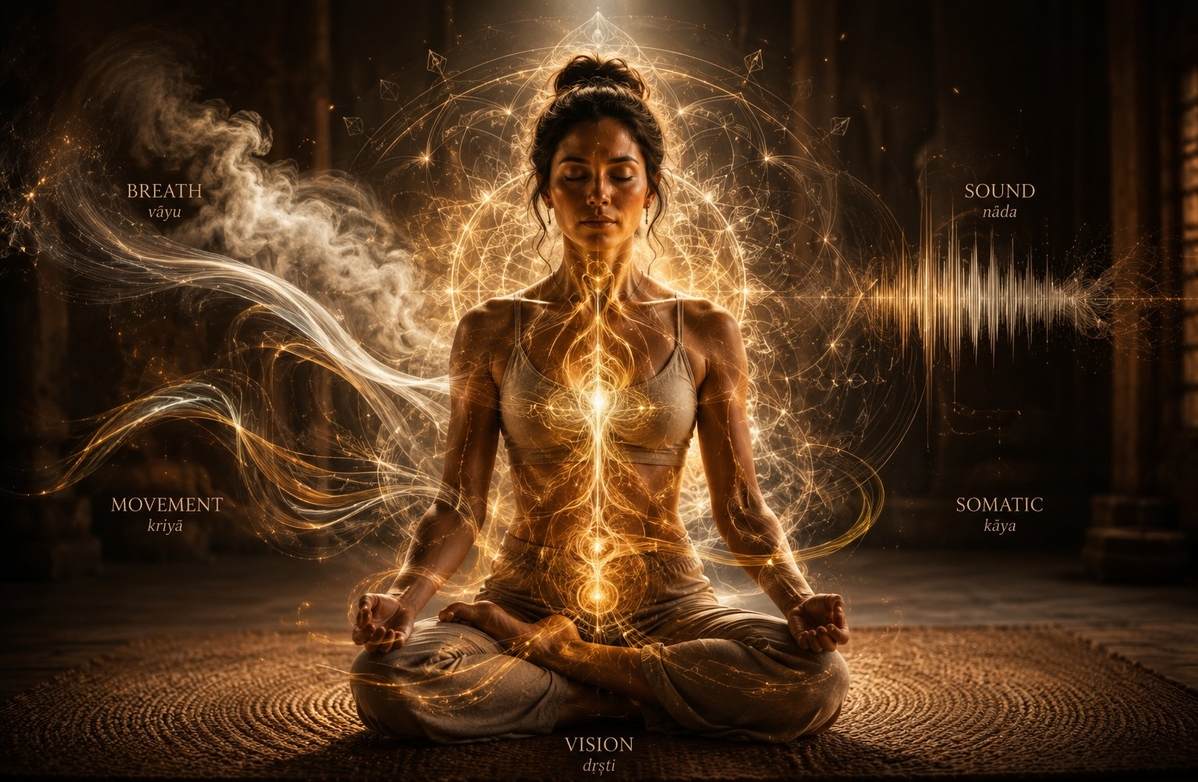
Each gateway has a distinct function. They overlap, but they do not all do the same work.
Breath
Primary function: regulation, rhythm, state-shifting, and the bridge between automatic and conscious life.
Useful when: attention is scattered, the body needs settling, practice needs a simple foundation, or the day needs a reset.
Caution: intense breathwork and retention may destabilise some readers. Begin gently.
Sensation
Primary function: grounding, embodiment, interoception, contact, and returning from abstraction into the body.
Useful when: practice becomes too mental, dissociated, ungrounded, or disconnected from ordinary life.
Caution: trauma-sensitive readers may need external anchors or movement before internal body scans.
Sound
Primary function: rhythm, vibration, mantra, prayer, listening, concentration, and devotional return.
Useful when: the mind needs a repeated object, silence feels too diffuse, or speech and breath need to become aligned.
Caution: inner listening should not be confused with tinnitus or auditory symptoms.
Vision
Primary function: form, symbol, centre, visual concentration, afterimage, mandala, yantra, and sacred seeing.
Useful when: visual attention needs discipline, the mind responds to geometry or image, or symbolic practice is helpful.
Caution: avoid eye strain, migraine triggers, obsessive visual practice, or forced inner imagery.
Movement
Primary function: integration, walking meditation, circulation, grounding in motion, and continuity between practice and life.
Useful when: sitting becomes dull, the body needs inclusion, or practice must enter ordinary action.
Caution: adapt for pain, mobility, fatigue, vertigo, balance, and health conditions.

Choosing Your Gateways
A complete practice does not require equal time in all five gateways. Most readers will have one foundation gateway, one supporting gateway, and one integration gateway.
Choose a Foundation Gateway
For many people, the foundation is breath, because breath is always available and directly linked with state. For trauma-sensitive readers, the foundation may initially be external grounding or movement rather than breath control. For some, the foundation may be sensation: feet, hands, chair, posture, and contact.
A foundation gateway should feel stable, accessible, and repeatable. It should be simple enough to do on a bad day. If your foundation requires candles, music, perfect silence, special clothing, and a nervous system already serene enough to float through the ceiling, it may not be a foundation. It may be interior decorating.
Choose a Supporting Gateway
The supporting gateway adds depth or balance. If breath is your foundation, sensation may ground it. If sensation is your foundation, sound may give rhythm. If movement is your foundation, breath may steady it. If vision is powerful for you, sensation may prevent the practice from becoming too head-centred.
A supporting gateway should complement rather than compete. Do not stack practices to feel more spiritual. Combine only what makes attention clearer and the body more available.
Choose an Integration Gateway
Every practice needs a way back into life. Movement is often the best integration gateway because it teaches recognition to walk. Ordinary tasks can also serve: washing dishes, making tea, gardening, cleaning, walking to the shop, or speaking one sentence more consciously than usual.
The integration gateway prevents practice from becoming a private aquarium of refined states. It brings the fish back to the river.
Combining the Gateways
The gateways can be combined, but combination should be simple. The more elements you add, the more likely the mind becomes busy managing technique instead of entering practice.
Begin with two gateways. Add a third only when the first two feel natural.
Breath and Sensation
This is the safest core combination for many readers. Feel the body while breathing. Notice the ribs, belly, feet, hands, chair, or floor. Breath gives rhythm. Sensation gives ground.
Use this when you need regulation, grounding, and a return from thought into the body.
Breath and Sound
Here the breath carries a phrase, mantra, prayer, hum, or sacred word. The sound gives the breath meaning and rhythm. The breath gives the sound embodiment.
Use this when the mind needs a thread, when silence feels too empty, or when devotion needs a steady vessel.
Sensation and Movement
This combination turns walking, stretching, standing, reaching, or working into practice. Feel the body in motion. Let the movement reveal where attention leaves and returns.
Use this when seated practice becomes dull, dissociated, painful, or disconnected from daily life.
Vision and Sound
Yantra with mantra, candle with prayer, icon with chant, or mandala with breath-linked phrase can gather attention through both image and vibration. This can be powerful, so keep it simple.
Use this when visual form and sacred phrase naturally deepen each other. Avoid it when it becomes too intense, performative, or overstimulating.
Movement and Breath
Walking with breath, stretching with exhale, or standing with natural breathing can make practice mobile. The body moves, but attention does not vanish.
Use this when you need integration, regulation, and continuity between formal practice and ordinary action.
Three Simple Practice Templates
Templates are not laws. Use them as starting shapes. Then adjust.
The Five-Minute Practice
- One minute: feel the body, feet, hands, chair, or ground.
- Two minutes: breathe naturally or lengthen the exhale gently.
- One minute: repeat one phrase, prayer, or grounding word.
- One minute: stand or walk slowly, carrying attention into movement.
This is enough on a busy day. Do not despise small practice. A small practice actually done is stronger than an elaborate practice permanently postponed.
The Fifteen-Minute Practice
- Three minutes: grounding through sensation and posture.
- Five minutes: gentle breath awareness or simple pranayama without strain.
- Four minutes: mantra, prayer, yantra, candle, or open awareness.
- Three minutes: walking, stretching, or one ordinary task performed consciously.
This structure balances stillness and movement. It also prevents the common mistake of ending practice in the head. The final movement returns recognition to the body.
The Weekly Rhythm
A weekly rhythm may include different gateways on different days:
- Daily: brief breath and sensation foundation.
- Two or three times weekly: mantra, sound, or contemplative reading.
- Once or twice weekly: visual practice with candle, yantra, mandala, or nature pattern.
- Several times weekly: walking meditation or mindful movement.
- Weekly: short review: what helped, what strained, what needs adaptation?
The review is important. Without review, practice can become mechanical. With review, it remains alive.
The Trauma-Informed Constraint
Depth should never precede safety. This is the first rule of practice design. A method that overwhelms the nervous system does not become spiritual because it has Sanskrit, incense, or impressive terminology attached to it.
Trauma-informed practice emphasises choice, consent, pacing, orientation, support, and invitational language. The practitioner is not forced inward. They are invited to notice what is safe enough to notice.
For trauma-sensitive readers, the following principles are useful:
- External anchors before internal exploration: room, sound, feet, objects, light, texture, and movement may be safer than deep body scanning.
- Short sessions before long sessions: the body learns trust through manageable practice.
- Choice before obedience: stop, open the eyes, change posture, move, or end practice when needed.
- Grounding before intensity: do not begin with strong breathwork, prolonged silence, intense visualisation, or forced emotional excavation.
- Support before isolation: qualified help matters when practice touches trauma, dissociation, panic, or destabilisation.
Safety is not a lack of seriousness. Safety is what allows seriousness to continue without damaging the vessel.
Adaptation: Evolution, Not Rigidity
A practice must change because life changes. Health changes. Work changes. Age changes. Sleep changes. Grief arrives. Relationships shift. Energy rises and falls. The form that served last year may not serve this month.
Adaptation is not failure. It is intelligence. Rigidity often disguises itself as discipline. A living practice knows how to bend without losing direction.
Signs Your Practice Needs Adaptation
- Practice has become mechanical and lifeless.
- You feel increasing dread, strain, or avoidance around it.
- Your body is giving clear signals of fatigue, pain, agitation, or overwhelm.
- Your life circumstances have changed, but the practice has not.
- You are using practice to avoid relationship, work, rest, grief, or ordinary responsibility.
- You feel proud of the form, but the fruits are not appearing in life.
The Form Changes, the Direction Continues
The form may change from sitting to walking, from mantra to silence, from visual practice to body grounding, from thirty minutes to five, from solitude to community, from intensity to rest. The direction remains: attention, honesty, embodiment, compassion, direct knowing, and integration.
Do not confuse loyalty to the path with loyalty to one frozen routine. A tree remains rooted by growing, not by refusing the seasons.

Consistency Without Heroics
Motivation is unreliable. Structure is kinder. Anchor practice to existing moments: after waking, before checking the phone, after brushing teeth, before sleep, during a walk, after work, before eating, or whenever the kettle boils.
Small gates are still gates. Three conscious breaths before a difficult conversation. Feeling the feet in a queue. One minute of mantra while washing a cup. A five-minute walk without the phone. Looking at the sky before entering the house. These are not lesser practices. They are practice refusing to become a museum object.
The heroic approach often burns brightly and disappears. The ordinary approach continues. It becomes part of the day, then part of the body, then part of the way life is met.
Five minutes of genuine attention is better than thirty minutes of distracted ritual. One honest return is better than a calendar full of spiritual ambition.

The Gnostic Reading: The Thread Through Your Specific Life
Gnostic myth often describes forgetfulness: the divine spark lost in imitation, false authority, distraction, fear, appetite, and inherited pattern. A personal practice is one way of refusing that forgetfulness in the exact conditions where it operates.
There is no abstract practitioner. There is only this body, this history, this nervous system, this room, this grief, this work, this age, this attention, this life. The false self wants an impressive path because an impressive path can become identity. The living thread asks for something more exacting: the practice that actually restores recognition.
Breath interrupts automatic reaction. Sensation interrupts dissociation. Sound interrupts mental scattering. Vision interrupts visual capture. Movement interrupts unconscious functioning. Together, the gateways return attention to itself through the ordinary elements of human life.
The practice is not the goal. It is direction. A continued orientation towards recognition. A repeated availability to transformation. A way of keeping the inner lamp trimmed without turning the lamp into a stage prop.
You create. The practice, personal and grounded, opens the gate. The thread continues through your specific life towards what your life is ready to reveal.
Related Glossary Terms
For quick definitions, use the main ZenithEye Glossary. The key terms for this article are:
Read Next
Continue with: The Gateway of Sensation: Body Scan and Somatic Awareness
If this article helps you design a personal practice, the next step is to ground that design in the body. Sensation is where practice becomes honest: feet, breath, contact, pressure, warmth, tension, safety, and the felt reality of the present moment.
Within Practice & Method
This article belongs to The Five Gateways, the Practice & Method route where breath, sensation, sound, vision, movement, grounding, and daily rhythm become practical entrances into direct knowing.
Frequently Asked Questions About Creating a Personal Practice
Do I need to practise all five gateways?
No. The Five Gateways are available resources, not mandatory levels. Most practitioners work best with one foundation gateway, one supporting gateway, and one integration gateway. Breath, sensation, sound, vision, and movement can be combined gradually according to need, temperament, safety, and life rhythm.
Which gateway should I begin with?
Many people begin with breath or sensation because they are simple, embodied, and accessible. However, trauma-sensitive readers may need external grounding or gentle movement before internal body awareness or breath control. The best starting point is the gateway that makes you more stable, present, and able to return to ordinary life.
How long should my daily practice be?
Begin small. Five to fifteen minutes of steady practice is enough for many readers. Consistency matters more than duration. A short practice that is actually done will usually serve better than an elaborate routine that collapses after three days.
Can I combine gateways immediately?
Yes, but keep combinations simple. Breath and sensation, breath and sound, sensation and movement, or vision and breath are good starting combinations. Avoid stacking too many techniques at once. The aim is clarity, not complexity.
How do I know if a practice is wrong for me?
A practice may need adjustment if it creates persistent anxiety, dissociation, panic, insomnia, eye strain, pain, compulsive behaviour, spiritual pride, emotional flooding, or difficulty functioning. Good practice should make you more grounded, embodied, honest, compassionate, and capable of ordinary life.
What if I have trauma history?
Use trauma-informed principles: safety before depth, choice before obedience, external anchors before deep internal exploration, and short sessions before long ones. Body scans, breathwork, silence, and visual practice may need adaptation. Seek qualified support if practice triggers panic, dissociation, traumatic memory, or destabilisation.
What if I do not have time for formal practice?
The gateways scale. Three conscious breaths, feeling the feet in a queue, repeating one phrase while washing a cup, walking without headphones, or pausing before sleep can all become practice. The point is not ceremony. The point is genuine attention.
How does personal practice relate to Gnostic awakening?
In a Gnostic symbolic reading, personal practice helps recover attention from automaticity, distraction, false identity, and forgetfulness. Breath, sensation, sound, vision, and movement return consciousness to direct relationship with the body, the present, and the living thread of recognition.
Study and Safety Note
This article explores personal contemplative practice, breath regulation, body awareness, mantra, visual concentration, movement, trauma-informed mindfulness, integration, and Gnostic symbolism for educational and reflective purposes. It does not provide medical, psychological, psychiatric, trauma, breathwork, meditation-instruction, physical therapy, or spiritual-direction advice.
Practices involving breathwork, body scans, silence, mantra, inner listening, visual concentration, or movement may need adaptation for trauma history, panic, dissociation, cardiovascular conditions, respiratory illness, tinnitus, migraines, visual sensitivity, vertigo, mobility limitations, chronic pain, pregnancy, or unstable mental health.
If practice produces panic, dissociation, derealisation, depersonalisation, insomnia, emotional flooding, chest pain, dizziness, severe distress, suicidal thoughts, or difficulty functioning, pause and seek appropriate qualified support. Depth follows safety. A practice that harms the vessel is not deeper. It is simply miscalibrated.
Further Reading
These ZenithEye links continue the themes of the Five Gateways, embodied practice, nervous-system safety, rhythm, and integration:
- The Gateway of Sensation: Body Scan and Somatic Awareness – The next article in the live Five Gateways route, grounding personal practice in body, contact, and felt presence.
- The Five Gateways to Direct Knowing: A Complete Map – The wider gateway architecture of breath, sensation, sound, vision, and movement.
- The Gateway of Breath: Pranayama Techniques for Altered States – Breath as the foundational gateway for regulation, state, and conscious participation.
- The Gateway of Sound: Mantra and Nada Yoga – Mantra, vibration, listening, rhythm, and sonic concentration.
- The Gateway of Vision: Yantra and Mandala Practice – Visual concentration, sacred form, mandala, yantra, and centre-based seeing.
- The Gateway of Movement: Walking Meditation and Circulation – Movement as integration, walking meditation, circulation, and recognition in action.
- Contemplative Techniques: Methods for Stabilisation – A wider framework for stabilising insight through practical contemplative methods.
- Nervous System Regulation: The New Meditation and Embodied Spirituality – Why regulation, embodiment, and safety matter for sustainable practice.
- The Chronos Trap: Why Awakening Has No Timeline – A reminder that development is not a stopwatch and practice is not a race.
- Integration and Grounding After Mystical Experience – Returning insight into ordinary life, relationships, body, task, and rhythm.
- The Ordinary Saint: Invisibility as Completion – The mature fruit of practice when transformation becomes ordinary, embodied, and unperformed.
- The Return to Ordinary Life After Awakening – The practical test of awakening through function, work, relationship, and daily responsibility.
References and Sources
The following sources support the contemplative, psychological, trauma-informed, and practice-design framework used in this article.
Primary Research and Contemplative Studies
- [1] Hecht, F. M., et al. “Contemplative Practices Behavior Is Positively Associated with Well-Being in Three Global Multi-Regional Stanford WELL for Life Cohorts.” 2022. Study of contemplative practice behaviour and wellbeing across large international cohorts.
- [2] Avvenuti, G., et al. “Brain Modifications After Transcendental Meditation Practice.” Brain and Cognition / related meditation research literature, 2020. Study of mantra-based practice, anxiety, stress, and functional brain changes.
- [3] Gagrani, M., et al. Research on integrated yoga-based stress reduction, asana, pranayama, meditation, and stress physiology.
- [4] Tang, Yi-Yuan, Hölzel, Britta K., and Posner, Michael I. “The Neuroscience of Mindfulness Meditation.” Nature Reviews Neuroscience, 16, 213-225, 2015.
- [5] Goleman, Daniel and Davidson, Richard J. Altered Traits: Science Reveals How Meditation Changes Your Mind, Brain, and Body. Avery, 2017.
- [6] Kabat-Zinn, Jon. Full Catastrophe Living. Delacorte, 1990.
Trauma-Informed Practice and Somatic Safety
- [7] Treleaven, David A. Trauma-Sensitive Mindfulness: Practices for Safe and Transformative Healing. W. W. Norton, 2018.
- [8] van der Kolk, Bessel. The Body Keeps the Score: Brain, Mind, and Body in the Healing of Trauma. Viking, 2014.
- [9] Ogden, Pat, Minton, Kekuni, and Pain, Clare. Trauma and the Body: A Sensorimotor Approach to Psychotherapy. W. W. Norton, 2006.
- [10] Payne, Peter, Levine, Peter A., and Crane-Godreau, Mardi. “Somatic Experiencing: Using Interoception and Proprioception as Core Elements of Trauma Therapy.” Frontiers in Psychology, 2015.
- [11] Mindful.org. “8 Tips and Scripts for Trauma-Informed Mindfulness Teaching.” Guidance on orientation, external anchors, choice, and normalising varied experience.
- [12] Psychology Today. “Trauma-Informed Mindfulness Is a Matter of CHOICE.” Discussion of consent, honesty, help, humility, orientation, inquiry, choice, comfort, embodiment, and empowerment.
Yoga, Breath, Body, Sound, Vision, and Movement
- [13] Patanjali. Yoga Sutras. Classical source for disciplined practice, concentration, meditation, and absorption.
- [14] Svatmarama. Hatha Yoga Pradipika. Classical hatha yoga source for posture, breath, subtle body, and meditative preparation.
- [15] Gheranda Samhita. Classical hatha yoga text on purification, posture, mudra, breath, meditation, and samadhi.
- [16] Mandukya Upanishad. Classical Vedantic source for Om and the contemplative mapping of waking, dreaming, deep sleep, and silence.
- [17] Satipatthana Sutta (MN 10). Pali Canon source for mindfulness of body, feeling, mind, and phenomena.
- [18] Cankama Sutta (AN 5.29). Pali Canon source on the benefits of walking meditation.
- [19] Thich Nhat Hanh. Walking Meditation. Parallax Press, 2015.
- [20] Gunaratana, Bhante Henepola. Mindfulness in Plain English. Wisdom Publications.
Practice Design, Integration, and Daily Life
- [21] Kornfield, Jack. After the Ecstasy, the Laundry. Bantam, 2000.
- [22] Welwood, John. Toward a Psychology of Awakening. Shambhala, 2000.
- [23] McColman, Carl. “Five Elements of a Daily Contemplative Practice.” Writing on silence, sacred reading, structured prayer, community, and self-care balance.
- [24] Sanford, Monica. “The Work of a Life: Cultivating Contemplative Practice.” Harvard Divinity School interview on interwoven daily practice, walking, breathwork, reflection, and self-knowledge.
- [25] Grof, Stanislav and Grof, Christina. Spiritual Emergency: When Personal Transformation Becomes a Crisis. Tarcher, 1989.
- [26] Lindahl, Jared R., et al. “The Varieties of Contemplative Experience: A Mixed-Methods Study of Meditation-Related Challenges in Western Buddhists.” PLOS ONE, 12(5), 2017.
Gnostic and Comparative Context
- [27] Robinson, James M. (ed.). The Nag Hammadi Library in English. Revised edition. HarperOne, 1990.
- [28] Meyer, Marvin (ed.). The Nag Hammadi Scriptures. HarperOne, 2007.
- [29] Layton, Bentley. The Gnostic Scriptures. Yale University Press, 1987.
- [30] Brakke, David. The Gnostics: Myth, Ritual, and Diversity in Early Christianity. Harvard University Press, 2010.
- [31] King, Karen L. What Is Gnosticism?. Harvard University Press, 2003.
- [32] Williams, Michael Allen. Rethinking “Gnosticism”: An Argument for Dismantling a Dubious Category. Princeton University Press, 1996.