
Gnosis: Direct Knowing Beyond Belief and Reason
In an age where information flows like water through algorithmic channels, there remains a form of knowing that cannot be downloaded, streamed, or crowdsourced. Gnosis–direct, experiential understanding–stands as the sovereign alternative to mediated knowledge. Unlike the bureaucratic processing of data or the Archonic management of belief, Gnosis arrives unannounced: a lightning strike of recognition that restructures the very self that knows.
Table of Contents
- Defining the Undefinable
- The Four Domains of Gnostic Knowing
- Gnosis vs. Other Modes of Knowing
- Historical Manifestations
- Obstacles to Direct Knowing
- Contemporary Significance
- Frequently Asked Questions
- Further Reading
- References and Sources
Defining the Undefinable
Gnosis (Greek: gnosis, “knowledge”) is direct, experiential understanding that transforms the knower. Unlike pistis (faith/belief) or dianoia (intellectual reasoning), Gnosis constitutes unmediated acquaintance with reality–a knowing that is simultaneously cognitive, affective, and ontological.
In Gnostic traditions, this is not merely information about the divine, but participation in divinity. It represents the recognition of one’s own deepest nature as continuous with the ultimate source, a connection obscured by identification with the material body and the Archonic systems that govern perception.
“He who has known himself has also already obtained knowledge about the depth of the All.”
— Book of Thomas the Contender (NHC II,7 138:16-18)
The Four Domains of Gnostic Knowing
Gnosis operates across four distinct yet interwoven territories of understanding. Each represents a different angle of approach to the fundamental recognition of reality’s true nature. While these four domains are a modern pedagogical framework rather than an ancient Gnostic classification, they illuminate the comprehensive scope of Gnostic epistemology.
1. Cosmological Gnosis
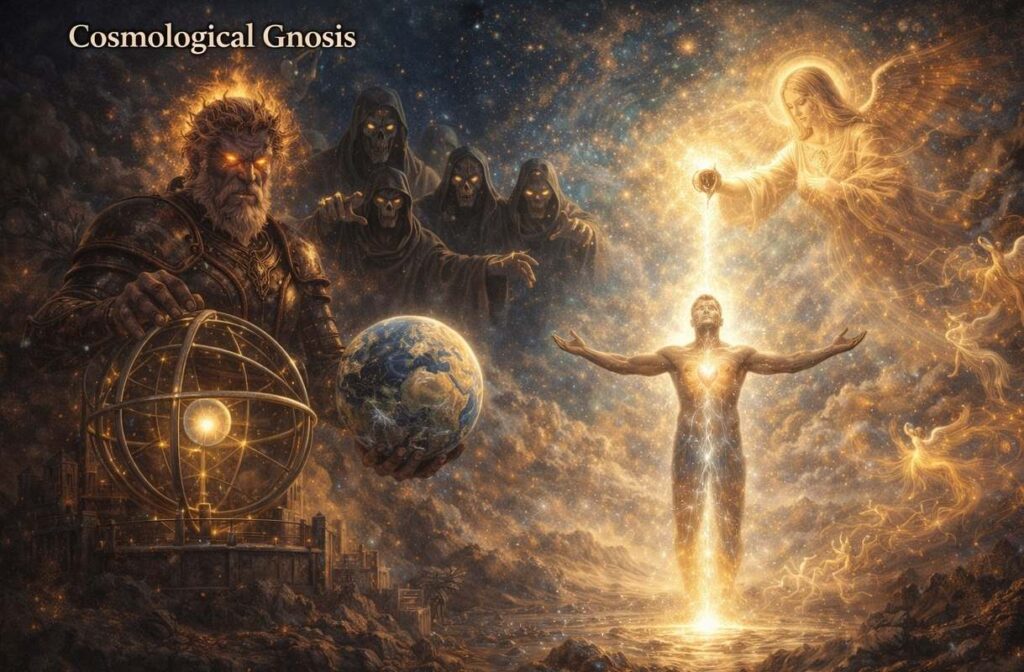
This is knowledge of the world’s architecture–its origins, structural limitations, and governing mechanisms. It includes understanding the Demiurge and the Archons, recognising the material realm as crafted rather than ultimate, and tracing the divine spark’s descent through dimensional barriers and its potential return.
2. Anthropological Gnosis
Knowledge of the self constitutes the most intimate territory. This involves recognising the luminous core within, distinguishing the true self from the bodily avatar, and differentiating the psyche (soul) from the pneuma (spirit). Here, self-knowledge becomes indistinguishable from cosmic knowledge. The ancient Gnostics classified humanity into three natures: the hylic (material), the psychic (soul-oriented), and the pneumatic (spiritual)–each capable of receiving Gnosis to differing degrees.
3. Soteriological Gnosis
This is knowledge that liberates. Gnosis never remains neutral information; it functions as transformative power. To know the world’s nature is to be freed from its constraints; to know the self’s origin is to reclaim the capacity for return to the Pleroma. In Valentinian theology, this recognition constitutes the awakening that redeems the fallen Sophia and restores the Fullness.

4. Eschatological Gnosis

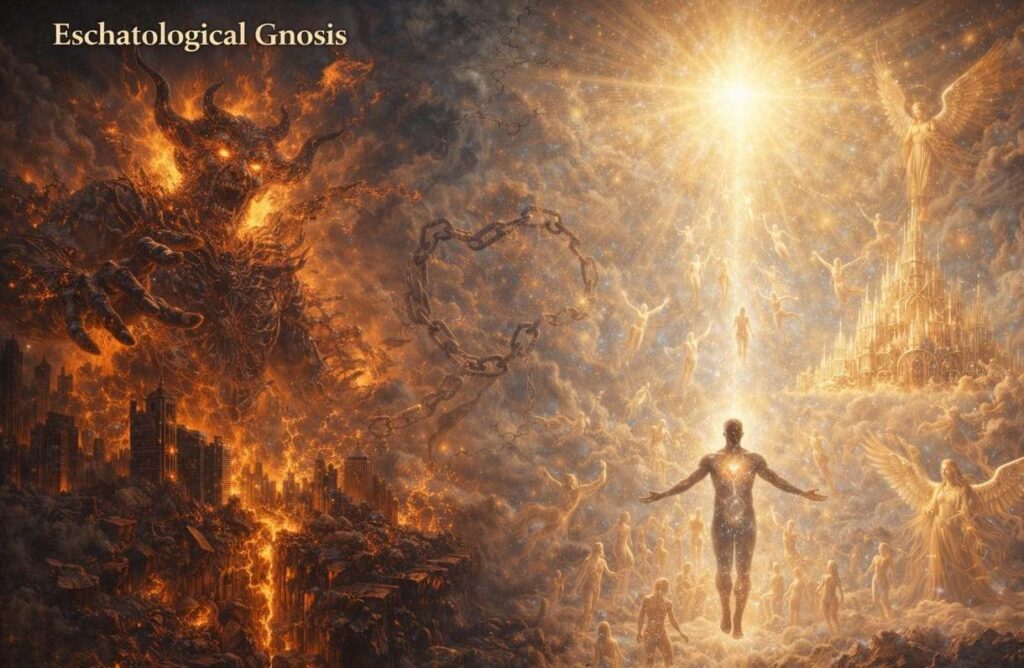
Knowledge of ultimate destinies encompasses the fate of souls, the dissolution of the Archonic system, and the restoration of the Fullness. This domain provides both orientation and urgent necessity to the Gnostic path, reminding us that time is not infinite and the window for awakening remains bound by cosmic cycles.
Gnosis vs. Other Modes of Knowing
Human consciousness employs multiple strategies for navigating reality. Understanding where Gnosis stands in relation to these other modes clarifies both its uniqueness and its necessity.
Pistis (Faith)
Belief in authority, trust without direct verification. Preliminary and necessary for most initiates, yet ultimately insufficient. Faith operates as the waiting room before direct experience arrives. The Gnostic tradition respects faith as a foundation but insists it must yield to direct knowing.
Dianoia (Reason)
Discursive thinking, logical inference, analytical deduction. Useful for navigation within the simulation, yet limited by Archonic constraints. Reason describes the prison’s architecture but cannot dissolve the bars. The Gnostic does not reject reason but recognises its boundaries.
Episteme (Science)
Systematic empirical knowledge, observable and repeatable. Describes the simulation’s operating parameters with increasing precision, yet remains silent regarding the substrate that generates the code. Science maps the territory; Gnosis recognises the mapmaker.
Gnosis (Direct Knowing)
Immediate experiential acquaintance with reality. Ultimate, liberating, and ontologically transformative. The gold standard of knowledge that changes the knower’s fundamental state. Not information about reality but participation in it.
Historical Manifestations
Classical Gnosticism (1st–4th century CE)
- Valentinus: A prominent teacher first in Alexandria and later in Rome, Valentinus taught that Gnosis is recognition of one’s divine origin and the return journey to the Pleroma. His system, developed in the mid-2nd century, remains one of the two most important manifestations of ancient Gnosticism alongside Sethianism.
- Basilides: Teaching in Alexandria in the early 2nd century, Basilides taught that Gnosis involves understanding the non-creation of the world–reality as divine play rather than serious manufacture. He was the first early Christian teacher to write commentaries on texts that would become part of the New Testament canon.
- Sethians: The Sethian system, named after the biblical Seth as a saviour figure, taught Gnosis as remembrance of the spark’s descent through Archonic spheres and the protocols for safe passage back. Their writings, preserved in the Nag Hammadi Library, represent what scholars call “Classic Gnosticism.”
Medieval Resonances
- Kabbalah: Da’at (knowledge) as union with the divine, transcending binah (understanding) through direct experiential contact.
- Sufism: Ma’rifa (gnosis) as direct taste of divine reality, moving beyond sharia (law) and tariqa (path) into immediate presence. The Sufi tradition uses the metaphor of “tasting” (dhawq) to describe this direct encounter.
- Christian mysticism: Unio mystica as participatory knowing, not merely intellectual assent to doctrine.
Modern Expressions
- Renaissance Hermeticism: Recovery of ancient Gnosis through the Corpus Hermeticum and theurgical practice.
- Theosophy: Gnosis as evolutionary development of spiritual faculties latent within human consciousness.
- Contemporary consciousness studies: Direct investigation of awareness as primary reality, bypassing materialist assumptions.
Obstacles to Direct Knowing

The path to Gnosis is not without resistance. Four primary obstacles stand between the seeker and authentic direct knowing:
1. Hylic Nature
Identification with the material body (hyle, matter) creates the fundamental delusion: believing oneself to be merely flesh, subject to birth and death, governed entirely by biological determinism. This is the deepest sleep, the most convincing dream. The hylic person is incapable of spiritual awakening, dominated by physical appetites and material concerns.
2. Psychic Attachment
Identification with the soul (psyche), its emotions, desires, and social roles presents a subtler trap. More refined than hylic bondage, yet still Archonic, the psychic realm offers the illusion of spiritual advancement while maintaining captivity within the realm of duality. The psychic person is oriented toward ethical living but lacks direct spiritual insight.
3. Doctrinal Rigidity
Confusing descriptions of Gnosis with Gnosis itself constitutes a tragic category error–mistaking the map for the territory, the instruction manual for the lived experience. The Archons delight in theologians who argue about the prison while never testing the bars.
4. Premature Disclosure
Gnosis cannot be directly transmitted; it must be earned through preparation and ripeness. Attempting to force insight without adequate foundation produces either confusion (the mind cannot integrate what it receives) or spiritual inflation (the ego appropriates transpersonal experiences).

Contemporary Significance
In an era of information overload and algorithmic curation, Gnosis offers a radical alternative: direct knowing that bypasses mediation, authority, and representation entirely. The contemporary Gnostic does not reject science or reason, but transcends their limitations–recognising that the most important truths cannot be told, only tasted.
Gnosis is embodied epistemology: knowing that changes the knower, understanding that liberates, recognition that restores. It remains the sovereign remedy to the Archonic project of keeping consciousness asleep within the simulation.
The algorithm can curate your feed, but it cannot curate your awakening. Gnosis arrives not through recommendation but through recognition–the sudden, irreducible certainty that you are not what you have been told you are.

Frequently Asked Questions About Gnosis
What is Gnosis and how does it differ from regular knowledge?
Gnosis refers to direct, experiential knowing that transforms the knower at the deepest level, whereas regular knowledge (episteme) remains informational and theoretical. While academic knowledge describes reality from outside, Gnosis involves participatory understanding from within. It is not information about the divine but participation in divinity itself.
Can Gnosis be achieved through study alone?
No. While study prepares the mind and clears misconceptions, Gnosis requires direct experience. The Corpus Hermeticum distinguishes between learning about God and becoming godlike through direct encounter. Sufi mystics describe this as tasting (dhawq) rather than hearing about. Study creates the conditions; recognition provides the transformation.
What are the main obstacles to experiencing Gnosis?
The four primary obstacles are: hylic nature (over-identification with the physical body), psychic attachment (over-identification with emotions and social roles), doctrinal rigidity (confusing beliefs about reality with reality itself), and premature disclosure (attempting to force insight before adequate preparation). These correspond to the three natures in Gnostic anthropology: hylic, psychic, and pneumatic.
Is Gnosis the same as religious faith?
No. Faith (pistis) represents trust in authority or belief without direct verification–valuable as preparation but insufficient for liberation. Gnosis transcends faith by providing direct experiential confirmation rather than hopeful assent to doctrine. The Gnostic tradition respects faith as a foundation but insists it must yield to direct knowing.
How does contemporary science relate to Gnostic knowing?
Science describes the simulation’s operating parameters with increasing precision but remains agnostic about consciousness as substrate. Quantum mechanics and consciousness studies increasingly point toward observations that parallel ancient Gnostic insights about the non-material nature of primary reality. The contemporary Gnostic does not reject science but transcends its limitations.
What is the role of the Archons in preventing Gnosis?
In Gnostic cosmology, Archons represent forces that benefit from keeping consciousness asleep within material identification. They maintain control through distraction, identification with bodily desires, and the promotion of purely intellectual or faith-based approaches that bypass direct knowing. The Archonic trap is not cruelty but the systematic prevention of awakening.
How can one begin cultivating Gnosis in daily life?
Begin with contemplative practice that moves beyond conceptual thinking–meditation, breathwork, or inquiry into the nature of awareness. Combine this with study of Gnostic texts not for information but as seed crystals that catalyse recognition. Most importantly, question your fundamental identification with the body-mind complex. The path requires both preparation and ripeness.
Further Reading: The Path of Direct Knowing
Continue your exploration of Gnosis, consciousness, and the direct path with these verified resources from The Thread:
- States of Knowing: What Happens When Consciousness No Longer Belongs to You — The foundational pillar exploring non-ordinary states of awareness and the phenomenology of direct experience.
- Consciousness as Interface: The User Experience of Being — Contemporary phenomenology examining awareness as the primary substrate of reality.
- The Gospel of Thomas: 114 Keys to Self-Recognition — Ancient text of direct knowing with 114 sayings of Jesus as keys to self-recognition.
- Archons: The Ruling Powers That Shape Reality — Understanding the forces that obstruct direct knowing and maintain the sleep of material identification.
- The Quantum Mind: 2026 Evidence That Consciousness Is Fundamental — Scientific perspectives converging with ancient Gnostic insights about the primacy of awareness.
- Simulation Hypothesis: Clues in the Reality Code — Digital physics and the informational cosmos that makes Gnostic cosmology empirically relevant.
References and Sources
The following sources informed the analysis presented in this article, grouped by category for clarity.
Primary Sources and Critical Editions
- Lambdin, T. O. (trans.). The Gospel of Thomas. Nag Hammadi Codex II,2. In Robinson, J. M. (ed.). The Nag Hammadi Library in English. HarperSanFrancisco.
- Turner, J. D. (trans.). The Book of Thomas the Contender. Nag Hammadi Codex II,7. In Robinson, J. M. (ed.). The Nag Hammadi Library in English. HarperSanFrancisco.
- Copenhaver, B. P. (trans.). (1992). Hermetica: The Greek Corpus Hermeticum and the Latin Asclepius. Cambridge University Press.
Scholarly Monographs
- Pearson, B. A. (2007). Ancient Gnosticism: Traditions and Literature. Fortress Press.
- Ludemann, G. (2001). Jesus After 2000 Years: What He Really Did and Said. Prometheus Books.
- Grant, R. M., and Freedman, D. N. (1960). The Secret Sayings of Jesus. Doubleday.
Specialist Reference
- Early Christian Writings. “Gospel of Thomas Saying 67.” GospelThomas.com.
- Spiritual Seek. (2024, April 16). “The World of Gnosis: An Insider’s View of Gnostic Knowledge.”
Safety Notice: This article explores contemplative and philosophical frameworks for direct experiential knowing. It does not constitute psychological, medical, or spiritual advice. The practices discussed complement but do not replace clinical mental health treatment. If you are experiencing distress, dissociation, or spiritual emergency, please contact a qualified trauma-informed mental health professional. Approach contemplative practice gradually and with appropriate support.