
Are We Living in a Simulation? 7 Profound Clues That Reality Might Be Code
You have felt it: that peculiar moment when reality seems to glitch. The synchronicity too precise to ignore. The dream too coherent to dismiss as mere neural noise. The sudden, vertiginous sense that the world may not be as solid as it pretends. For a moment, the stage set trembles, the painted sky curls at the edge, and something like scaffolding shows through.
The simulation hypothesis proposes that our experienced reality may be a highly advanced generated environment rather than a purely material, self-existing universe. It has moved from science fiction into philosophy, physics, consciousness studies, artificial intelligence, and digital culture. For readers of The Thread, it also carries an unmistakable echo: the ancient Gnostic suspicion that the visible world is not ultimate, but constructed, mediated, governed, and perhaps misunderstood by those trapped within it.
This article does not claim to prove that we are living in a simulation. Instead, it explores seven clues that make the question difficult to dismiss, especially when viewed through the overlapping lenses of information theory, quantum physics, consciousness studies, artificial intelligence, and Gnostic cosmology.
In Plain Terms
The simulation hypothesis asks whether our world might be generated by a deeper system, much as a virtual environment is generated by code, rules, memory, and rendering. Philosopher Nick Bostrom made the modern version famous in 2003, not by proving simulation, but by showing that one of three possibilities may be true: civilisations rarely reach simulation-capable maturity, they choose not to run ancestor simulations, or beings like us may be more likely to live inside simulations than outside them.
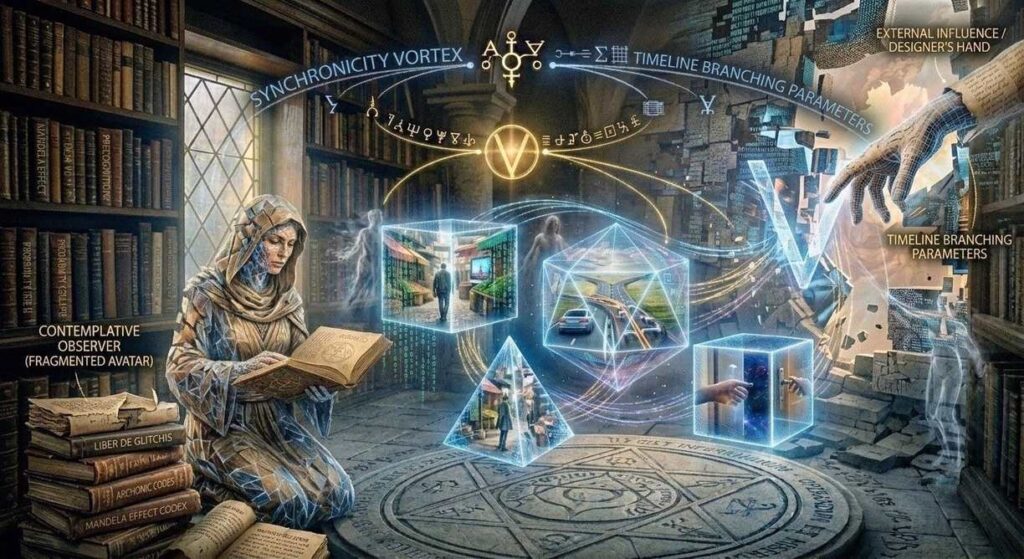
The hypothesis remains speculative. Quantum physics does not prove it. Synchronicities do not prove it. The Mandela Effect does not prove it. Artificial intelligence does not prove it. But each of these areas raises questions about information, perception, memory, reality, and the construction of worlds.
The Gnostic value of the simulation hypothesis is not that it gives us a new dogma. It gives us a modern symbolic language for an older insight: the world we experience may be real enough to live in, suffer in, love in, and awaken through, while still not being the final layer of truth.
Primary Sources and Traditions Discussed
- Nick Bostrom’s simulation argument: the 2003 trilemma concerning post-human civilisations, ancestor simulations, and simulated observers.
- Digital physics: the idea that information, computation, or discrete structure may be central to physical reality.
- Quantum measurement: indeterminacy, probability, observation, and the limits of naïve realism.
- The effectiveness of mathematics: the strange ability of mathematical structures to describe physical reality with great precision.
- Fine-tuning: the apparent suitability of physical constants for complex structure and observers.
- Consciousness studies: the hard problem of consciousness, perception as interface, and the distinction between experience and external description.
- False memory and pattern recognition: synchronicity, Mandela Effect claims, cognitive bias, and the need for discernment.
- AI-generated worlds: virtual environments, world models, synthetic media, and the accelerating human ability to create convincing realities.
- Gnostic cosmology: the Demiurge, Archons, Pleroma, divine spark, and gnosis as recognition of a world that is real but not ultimate.
How to Read This Article
Read this as a map of possibility, not as proof. The simulation hypothesis can sharpen inquiry, but it can also become a fog machine for paranoia if handled carelessly. The point is not to decide that reality is fake. The point is to ask why reality feels so mediated, mathematical, informational, responsive, and strangely layered.
A grounded Gnostic reading does not flee the world in disgust. It questions the world’s claim to finality. It asks what structures experience, what governs perception, what rules the lower order, and what kind of knowing can awaken inside mediated reality without losing compassion, embodiment, humour, or practical responsibility.
The deeper question is not only whether the world is code. It is who is aware of the code, and whether that awareness can remember itself without despising the world it sees.
Table of Contents
- 1. The Informational Nature of Reality
- 2. The Observer Effect and Quantum Indeterminacy
- 3. The Unreasonable Effectiveness of Mathematics
- 4. The Fine-Tuned Universe
- 5. Consciousness as Interface
- 6. Glitches, Synchronicities, and Pattern Recognition
- 7. The Acceleration Toward Simulation
- The Gnostic Dimension
- Living the Recognition: Practice in the Simulation
- The Question That Opens
- Related Glossary Terms
- Read Next
- Frequently Asked Questions
- Further Reading
- References and Sources
The simulation hypothesis became widely discussed after philosopher Nick Bostrom published his 2003 paper, “Are We Living in a Computer Simulation?” Bostrom’s argument was not that simulation is certain. It was a trilemma: one of three possibilities is likely. Advanced civilisations rarely reach the capacity to create ancestor simulations; advanced civilisations choose not to run such simulations; or beings like us may be statistically more likely to be simulated than original.
Since then, the question has only grown sharper. Artificial intelligence can now generate images, voices, texts, videos, and increasingly convincing virtual environments from simple prompts. We are learning how easily perception can be modelled, nudged, rendered, and mistaken for the whole of reality. The more skilfully we build artificial worlds, the more awkward the question becomes: how certain are we that our own world is not also rendered by deeper processes?
For a Gnostic reading, this does not require panic or paranoia. It requires discernment. The point is not to flee the world, but to question its apparent finality. If reality is mediated, informational, or constructed, then direct knowing becomes more important, not less.
1. The Informational Nature of Reality
Reality as Information Before Matter
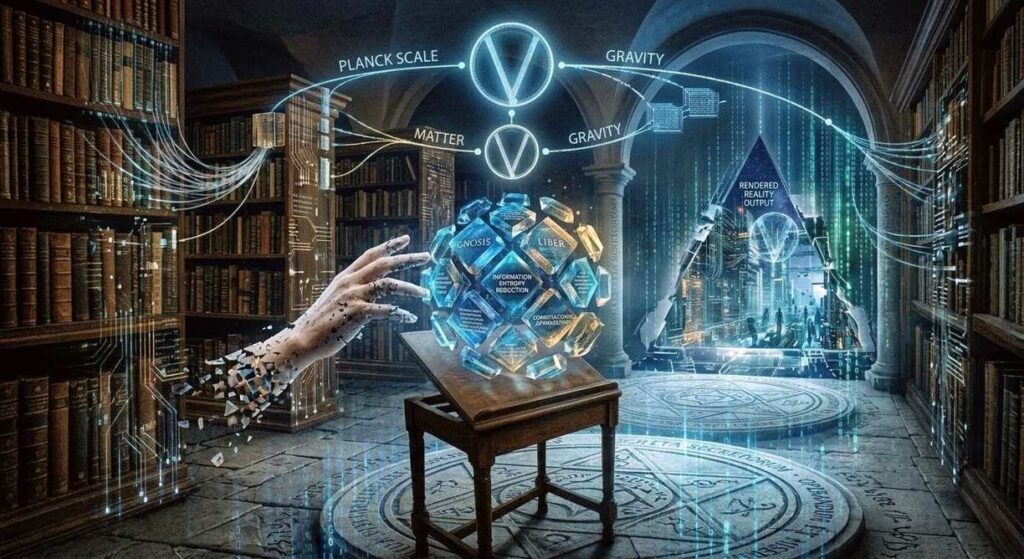
One of the strongest clues behind the simulation hypothesis is the growing scientific interest in information as something physically meaningful. Matter, energy, space, and time may not be the final ingredients of the universe in the simple way older materialism imagined. They may be expressions of deeper relations, states, measurements, and informational structure.
This idea appears in several forms. Digital physics suggests that the universe can be understood through computation or discrete state. Quantum information theory treats information not as a human description added afterwards, but as a central feature of physical reality. John Archibald Wheeler’s phrase “it from bit” captures the intuition: what we call “things” may arise from informational yes-or-no distinctions at a deeper level.
Some contemporary researchers go further, proposing that gravity, entropy, or physical law can be interpreted through information processing. These proposals remain debated. The careful claim is not that matter has been disproved, but that matter may not be the whole foundation. Reality may be less like inert substance and more like structured relation.
In a simulated reality, this would make immediate sense. The world would not be made of “stuff” first and information second. It would be structured through information from the beginning. What appears solid would be rendered as solid. What appears continuous would be produced by underlying rules, limits, and state transitions.
The Gnostic resonance is clear. Ancient Gnostic texts do not describe the material cosmos as ultimate. They describe it as a crafted order: beautiful, convincing, binding, and derivative. The world is not nothing. It is not unreal in the childish sense. It is real as experience, but not final as truth.
2. The Observer Effect and Quantum Indeterminacy
Does Reality Render at the Point of Measurement?
Quantum mechanics troubles any simple picture of a fully fixed, observer-independent world. At small scales, particles do not behave like tiny billiard balls moving through space with definite properties at all times. They are described through probabilities, measurements, and quantum states. Before measurement, certain properties may not be definite in the ordinary classical sense.
For supporters of the simulation hypothesis, this can resemble computational efficiency. A video game does not render every room, object, texture, and particle in full detail when no player is present. It holds possibilities in reserve, then renders detail when interaction requires it. Quantum indeterminacy can be read, metaphorically, as a universe that resolves detail when queried.
This does not prove simulation theory. Quantum mechanics already has several competing interpretations, including Copenhagen, many-worlds, pilot-wave theory, relational quantum mechanics, and others. The simulation hypothesis is not a replacement for physics. It is an interpretive lens that asks whether the strange behaviour of quantum reality resembles a world optimised for observation, interaction, and information exchange.
It is also important to avoid a common mistake: “observer” in physics does not necessarily mean a conscious human mind. Measurement can involve physical interaction, apparatus, environment, and information transfer. The spiritual meaning should not flatten the science.
For Gnostic thought, the key point is not technical proof but participatory mystery. Consciousness may not be merely a passive spectator trapped inside a finished machine. It may be involved in how the world is encountered, interpreted, and known. The eye does not simply look at the veil. The act of seeing changes the life lived beneath it.
3. The Unreasonable Effectiveness of Mathematics
When Equations Behave Like Source Code
Physicist Eugene Wigner famously wrote about the “unreasonable effectiveness of mathematics” in the natural sciences. Mathematics, developed in the abstract chambers of human thought, repeatedly turns out to describe the physical world with uncanny precision. Equations predict planetary motion, atomic behaviour, electromagnetic waves, black holes, and subatomic interactions.
Why should the universe be so mathematically legible?
In a simulated universe, this mystery becomes less mysterious. Mathematics works because mathematics is not merely describing reality from outside. It is describing the rule-structure by which reality is generated. Physical law begins to look less like a set of external commandments and more like a system of constraints, constants, permitted operations, and boundary conditions.
The speed of light, Planck’s constant, the gravitational constant, and the quantised behaviour of physical systems could be interpreted as hard limits within the rendered environment. Every simulation requires rules. Every game engine requires parameters. Every world, once built, must decide what can and cannot happen inside it.
This is where the Gnostic language of Archons becomes freshly intelligible. The Archons need not be imagined only as crude monsters guarding the cosmic prison. They can also be understood as ordering powers: rules, constraints, authorities, patterns, and permissions that govern experience within the lower world. To recognise the rules is not yet to transcend them, but it is the beginning of freedom from unconscious obedience.
4. The Fine-Tuned Universe
Calibration, Selection, or Design?
The physical constants of our universe appear remarkably suited to stable complexity. If certain forces or values were significantly different, complex atoms, stars, planets, chemistry, and biological life as we know them may not have emerged. This is often called the fine-tuning problem.
Different explanations compete. Some argue for divine design. Others propose a multiverse in which countless universes exist with different parameters, and we naturally find ourselves in one that permits observers. Others argue that fine-tuning may be overstated, misunderstood, or dependent on assumptions about possible physics.
The simulation hypothesis offers another possibility: the universe may be tuned because it is an environment designed, selected, or iterated to produce stable complexity and conscious experience.
A simulated world must have working parameters. If the rules are too unstable, nothing coherent emerges. If the rules are too simple, the world remains sterile. If they are calibrated with enough subtlety, galaxies form, bodies arise, minds awaken, and the simulation begins to ask questions about itself.
Again, this is not proof. Fine-tuning remains philosophically contested. But the simulation hypothesis gives the question a new shape. Perhaps the precision of the cosmos points not only to creator, chance, or multiverse selection, but also to the possibility of designed conditions: a reality capable of producing observers who can eventually recognise the structure of the environment that contains them.
5. Consciousness as Interface
The Player, the Avatar, and the Rendered World
The most unsettling clue may be consciousness itself. Materialism often treats consciousness as something produced by complex arrangements of matter. Yet the hard problem of consciousness remains unresolved: why should physical processes give rise to subjective experience at all? Why is there something it is like to be aware?
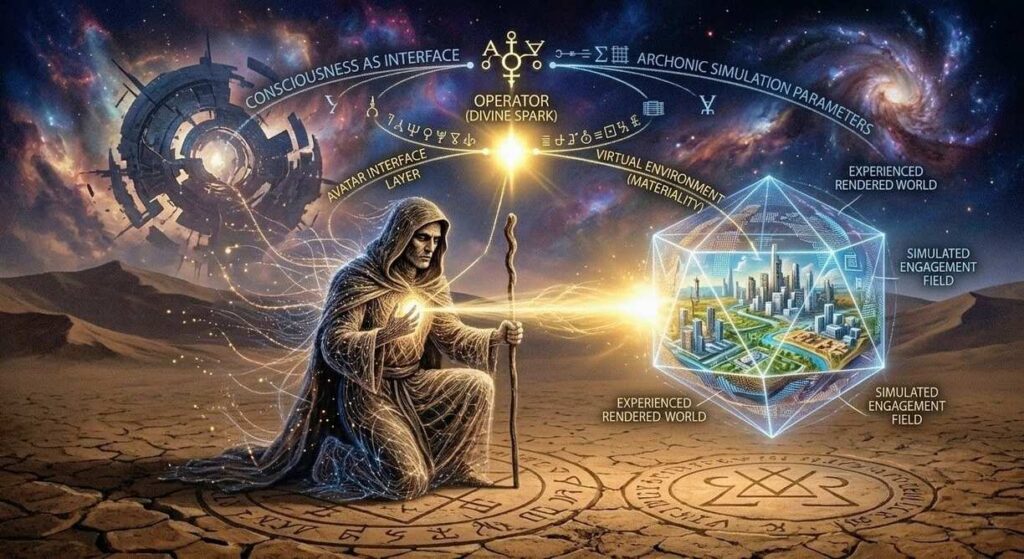
The simulation hypothesis allows another reading. Consciousness may not be a late accident produced by matter. It may be the interface through which experience is rendered. The body would be the avatar, the world would be the environment, and awareness would be the mysterious participant capable of experiencing both.
This does not mean the body is unimportant. In any playable world, the avatar matters. Its senses, limitations, injuries, habits, and tools determine how the environment is encountered. But the avatar is not the whole of the player. The screen is not the whole of the one who sees.
Even without accepting simulation theory, perception already functions as an interface. The brain does not show us reality in some pure, absolute form. It constructs a usable world from signals, prediction, memory, embodiment, and attention. We do not experience “raw reality”. We experience reality rendered for survival, meaning, action, and orientation.
This is close to the heart of Gnostic anthropology. The divine spark is not reducible to the material body, even though it experiences through the body. It is not reducible to social identity, nervous system, inherited script, or visible role. Gnosis begins when awareness recognises that it has mistaken the interface for the self.
6. Glitches, Synchronicities, and Pattern Recognition
When the Render Engine Stutters
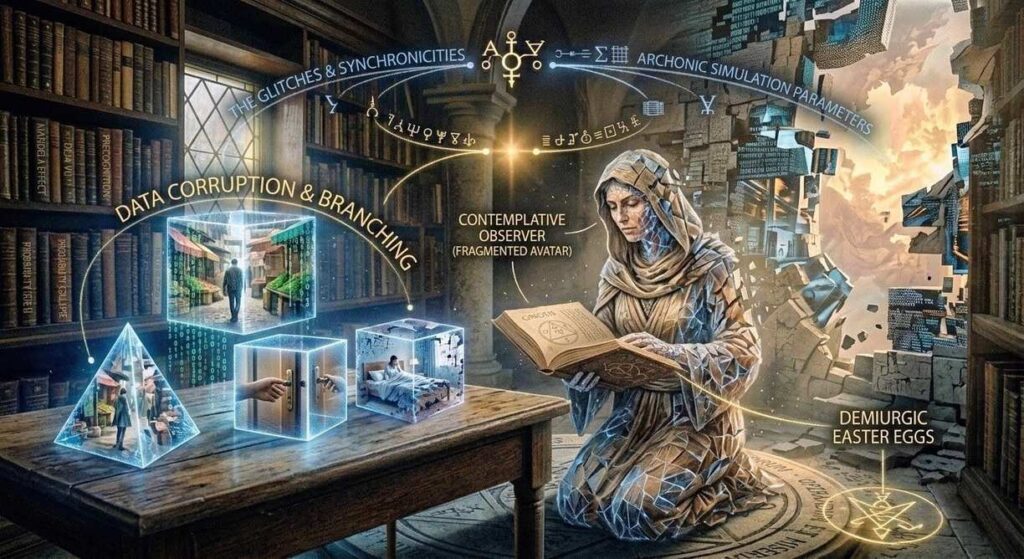
Anyone who has pursued sustained contemplative practice or deep symbolic inquiry has likely noticed strange seams in ordinary life. A dream repeats itself in waking events. A phrase arrives from three unrelated sources in a single day. A book opens to the exact sentence required. An encounter feels less accidental than arranged.
These moments are often called synchronicities. In psychological terms, they may reveal how the mind links meaning across events. In spiritual language, they may appear as signs, invitations, or symbolic intelligence. In simulation language, they can look like glitches, artefacts, easter eggs, or moments when the ordinary render briefly turns transparent.
Discernment is essential. Human beings are pattern-making creatures, and the mind can turn noise into prophecy when fear or obsession takes the wheel. Not every coincidence is a message. Not every anomaly is cosmic intervention. The wise approach is neither dull dismissal nor fevered belief, but careful attention.
The Mandela Effect belongs here as a useful warning. Shared false memories can feel like evidence that timelines have shifted or reality has been edited. But cognitive science shows that groups of people can form consistent and specific false memories without requiring a literal glitch in the universe. Memory is not a perfect archive. It is reconstructive, social, suggestible, and sometimes beautifully unreliable.
The Gnostic tradition has always suggested that the crafted world contains clues to its own transcendence. The prison, if that word is used, is not a blank wall. It is covered in inscriptions. Some are warnings. Some are traps. Some are doors pretending to be decoration.
7. The Acceleration Toward Simulation
The Probabilistic Argument
The final clue is recursive: our own accelerating capacity to create simulations. We have moved from simple games to photorealistic virtual worlds in a tiny fraction of human history. Artificial intelligence now generates images, voices, texts, videos, environments, and increasingly convincing simulations of agency. What once required entire studios can now be summoned through a prompt.
This gives the simulation hypothesis its probabilistic force. If any technological civilisation eventually creates conscious or consciousness-like simulations, and if it creates many of them, simulated minds could vastly outnumber non-simulated minds. In that case, the odds of being in base reality begin to shift.
Bostrom’s trilemma frames the issue sharply. At least one of the following is likely: civilisations rarely reach post-human technological capability; post-human civilisations choose not to run ancestor simulations; or we are living in a simulation. The argument does not prove that we are simulated. It shows that the question cannot be dismissed with a casual shrug.
The more seriously humanity takes simulation, the more resources it invests in simulated worlds. The hypothesis begins to feed the machinery that makes the hypothesis plausible. This recursive loop may be one of the clearest signs that simulation theory is less a fantasy than a mirror held before technological civilisation.
The Gnostic Dimension: What the Simulation Hypothesis Reveals
The simulation hypothesis is often presented as a secular, technological update to ancient cosmology. But for those with eyes to see, it also reveals the return of Gnostic insight in modern dress.
It proposes a layered ontology: a base reality, a simulated world, and potentially further nested simulations within simulations. This resembles the Gnostic distinction between higher fullness, lower deficiency, and the intermediate structures through which souls descend, forget, and return.
It also implies forms of archonic governance. The simulation’s parameters, laws, limits, defaults, and permissions function much like the rulers of the lower realms. They define what can happen here. They do not necessarily reveal what is ultimately real.
Most importantly, the simulation hypothesis restores the possibility of gnosis. If reality is constructed, then knowing this changes how one lives inside it. The recognition is not merely intellectual. It alters the felt relationship between consciousness and world, player and avatar, spark and system.
The contemporary Gnostic does not need to choose between ancient texts and modern technology. Simulation theory can function as a translation key. The Demiurge becomes the craftsman of the system. The Archons become constraining intelligences, laws, and algorithms. The Pleroma becomes the higher fullness beyond the rendered field. The map is not the territory, but a good map helps you notice the walls.
Still, the map must remain symbolic. The Demiurge is not literally a software engineer. The Archons are not literally server administrators. The Pleroma is not a higher-resolution data centre. Gnostic language protects depth from reduction. It lets us read the simulation hypothesis as spiritual metaphor without pretending metaphor is laboratory proof.
Living the Recognition: Practice in the Simulation
If we take the simulation hypothesis seriously, not as dogma but as working possibility, how does it change how we live?
Epistemic Humility
First, it invites epistemic humility. If our most basic assumptions about reality may be incomplete, then certainty becomes suspect. The simulation hypothesis does not demand belief. It demands inquiry. It trains the mind to hold models lightly and look again.
Consciousness as Primary Inquiry
Second, it turns consciousness into the central question. The world may or may not be simulated. But experience is happening. Awareness is the doorway through which every world, simulated or not, appears. Meditation, in this framework, is not relaxation alone. It is careful examination of the interface between observer and perceived reality.
Reality as Responsive
Third, it suggests that reality may be more responsive than crude materialism allows. Attention changes experience. Interpretation changes behaviour. Observation changes the field of possible action. This does not require shallow magical thinking. It asks for disciplined investigation into how consciousness, body, environment, and world co-arise.
Escape Velocity
Fourth, it points toward escape velocity. If reality is simulated or constructed, transcendence does not necessarily mean physically leaving the universe. It may mean recognising the nature of the construct while still participating in it. The Gnostic does not need to rage against the game board. She needs to remember she is not merely a piece.

The Question That Opens
The simulation hypothesis may never be proven in a simple, final, conventional sense. Its value lies not only in certainty, but in the quality of questioning it opens.
Are we living in a simulation? The question itself cuts into the ordinary trance. It challenges the given, the automatic, the supposedly obvious. It creates space for the recognition that things may not be as they appear: the foundational insight of Gnostic traditions across time.
In an age when artificial systems can generate convincing worlds, when quantum theory unsettles naive realism, and when information increasingly appears central to the structure of physical reality, the simulation hypothesis offers not escape from the world, but deeper entry into its mystery. The code may be showing through. The question is whether we have eyes to see it.
The safest answer is not certainty. It is lucidity. Live as though the world matters, because it does. Question whether the world is final, because it may not be. Hold the mystery without turning it into panic. Wash the dishes, feed the cat, study the signs, and keep the inner lamp lit.
Related Glossary Terms
These terms help clarify the simulation, Gnostic, technological, and philosophical framework behind this article:
- Simulation hypothesis: the idea that our experienced reality could be a generated environment rather than base reality.
- Bostrom trilemma: the argument that civilisations either fail before simulation maturity, avoid running ancestor simulations, or create many simulations in which beings like us may live.
- Substrate independence: the idea that consciousness may not require one specific biological substrate if the right functional organisation is present.
- Digital physics: approaches that treat information, computation, or discrete state as central to physical reality.
- Observer effect: the fact that measurement can affect physical systems, often misused in popular spirituality.
- Quantum indeterminacy: the absence of definite classical properties before measurement in some interpretations of quantum mechanics.
- Fine-tuning: the apparent suitability of physical constants for stable complexity and observers.
- Hard problem of consciousness: the question of why physical processes are accompanied by subjective experience.
- Consciousness as interface: the idea that experience functions as a rendered, usable field rather than a direct copy of reality itself.
- Synchronicity: meaningful coincidence, requiring discernment rather than automatic belief or dismissal.
- Mandela Effect: shared false memory, often interpreted online as evidence of glitches or timeline shifts, but better handled through memory research and symbolic caution.
- Demiurge: lower craftsman figure in some Gnostic systems, symbolising world-making without full wisdom.
- Archons: ruling powers in Gnostic cosmology, here also used symbolically for constraints, systems, and governing structures.
- Pleroma: divine fullness beyond the deficient lower order in Gnostic cosmology.
- Gnosis: direct liberating recognition, not merely theory, belief, or information.
Read Next
For the strongest next step, continue into the article that examines the same question in a more technical and philosophical form:
Simulation Hypothesis: Is Reality a Computational Construct?
This companion guide explores Bostrom’s argument, information, critiques, Gnostic parallels, and the deeper philosophical implications of simulated reality.
Follow the Modern Systems Route
This article belongs to ZenithEye’s modern systems route: AI, simulation, digital governance, world models, attention capture, and the old patterns wearing new technical masks.
- Simulation Hypothesis – code, rendered reality, simulated worlds, glitches, and information-based cosmology.
- AI, Technology & Archonic Systems – the wider route for AI, world models, synthetic systems, and control architectures.
- Digital Attention & Surveillance – attention capture, screens, metrics, watching systems, and behavioural loops.
- The Thread – the main map of the archive.
- Editorial Principles – how ZenithEye frames symbolic and contemporary interpretation.
Frequently Asked Questions
Is the simulation hypothesis scientifically proven?
No. The simulation hypothesis is not scientifically proven. It remains a philosophical and theoretical framework drawing on ideas from computation, physics, probability, artificial intelligence, and consciousness studies. Its value lies in the questions it opens about information, perception, mediation, consciousness, and whether our world is final or derivative.
Does quantum physics prove that reality is simulated?
No. Quantum physics does not prove that reality is simulated. Features such as indeterminacy, measurement, probability, and observer-dependent outcomes can be interpreted through a simulation lens, but simulation theory is only one possible interpretive framework among many. It should not be treated as a replacement for established physics.
How does simulation theory connect with Gnosticism?
Simulation theory connects with Gnosticism because both question whether the visible world is ultimate. Gnostic traditions often describe the material cosmos as a crafted, limited, and governed realm. Simulation theory uses modern technological language to ask a similar question: is our experienced world a constructed environment shaped by deeper rules, intelligences, or systems?
Is the world unreal if it is simulated?
Not necessarily. A simulated world may still be real as experience, relationship, memory, suffering, beauty, and consequence. The key distinction is not between real and unreal, but between fundamental and derivative. A dream, virtual world, or symbolic environment can be meaningful without being ultimate.
Who would be running the simulation?
The simulation hypothesis does not answer this directly. Possibilities include future humans, post-human civilisations, non-human intelligence, artificial systems, or realities nested beyond our own. A Gnostic reading may compare the local world-maker to the Demiurge and the governing structures to Archons, but these are symbolic and theological frameworks rather than scientific conclusions.
Can synchronicities be evidence of simulation glitches?
Synchronicities may feel like glitches, signs, or moments when ordinary reality becomes transparent. However, they can also be shaped by psychology, memory, probability, and pattern recognition. The wisest approach is disciplined attention: neither dismissing every anomaly nor turning every coincidence into proof.
Does simulation theory lead to nihilism?
It does not have to. If reality is constructed, mediated, or simulated, experience can still matter deeply. The Gnostic response is not despair, but awakening. The task is to live with greater discernment, compassion, and lucidity inside the world while remembering that the world may not be the final layer of truth.
Study Note: This article explores cosmological, technological, philosophical, and symbolic speculation for educational and reflective purposes. It does not provide scientific proof, psychological advice, medical guidance, spiritual direction, or technical instruction. If simulation themes, metaphysical inquiry, reality-questioning, synchronicities, or existential reflection increase anxiety, derealisation, depersonalisation, dissociation, insomnia, paranoia, panic, grandiosity, or difficulty functioning, pause the material and seek qualified support. Critical inquiry into reality’s nature should support discernment rather than fear.
Further Reading
Continue your exploration of simulated reality, consciousness, symbolic systems, and direct knowing with these live guides from The Thread:
- The Living Thread: How Forbidden Knowing Survives the Fire – the foundational pillar exploring how Gnostic insight persists across centuries of suppression.
- States of Knowing: What Happens When Consciousness No Longer Belongs to You – an inquiry into non-ordinary states of awareness and their relationship to reality-perception.
- The Holographic Universe Theory: 7 Signs You’re Living in a Cosmic Illusion – a related exploration of digital ontology, holographic models, and the primacy of information.
- Consciousness as Interface: The User Experience of Being – a focused guide to awareness, embodiment, perception, and the rendered world.
- Simulation Hypothesis: Is Reality a Computational Construct? – a deeper examination of Bostrom’s trilemma, simulation arguments, critiques, and Gnostic parallels.
- AI as Archon: Algorithmic Governance and the Loss of Autonomy – how artificial intelligence can echo older patterns of archonic control, abstraction, and behavioural governance.
- Genie 3 and the Simulation Threshold: When AI Starts Building Worlds – a contemporary look at AI-generated worlds and the shrinking distance between imagination and rendered environment.
- The Glitch in the Zenith: Recognising the Code of the Self – a symbolic and practical inquiry into personal reality-glitches, identity loops, and awakening.
- The Quantum Mind: 2026 Evidence That Consciousness Is Fundamental – a related guide to consciousness-first models and the limits of reductionist materialism.
- The Gnostic Matrix: Reality as Information System – simulation theory reframed through Gnostic cosmology, awakening, and the mythology of the red pill.
References and Sources
The following sources support the philosophical, scientific, psychological, technological, and Gnostic framework used in this article.
Simulation Hypothesis and Philosophy
- Bostrom, Nick. (2003). “Are We Living in a Computer Simulation?” The Philosophical Quarterly, 53(211), 243-255.
- Chalmers, David J. (2022). Reality+: Virtual Worlds and the Problems of Philosophy. New York: W. W. Norton.
- Kipping, David. (2020). “A Bayesian Approach to the Simulation Argument.” arXiv:2008.12254.
- Nozick, Robert. (1974). Anarchy, State, and Utopia. New York: Basic Books. Includes the Experience Machine thought experiment.
- Plato. Republic, Book VII. The Allegory of the Cave.
- Descartes, René. (1641). Meditations on First Philosophy.
Information, Physics, and Computation
- Wheeler, John Archibald. (1990). “Information, Physics, Quantum: The Search for Links.” In Complexity, Entropy, and the Physics of Information, edited by Wojciech H. Zurek. Redwood City: Addison-Wesley.
- Wigner, Eugene P. (1960). “The Unreasonable Effectiveness of Mathematics in the Natural Sciences.” Communications on Pure and Applied Mathematics, 13(1), 1-14.
- Lloyd, Seth. (2006). Programming the Universe: A Quantum Computer Scientist Takes On the Cosmos. New York: Alfred A. Knopf.
- Landauer, Rolf. (1961). “Irreversibility and Heat Generation in the Computing Process.” IBM Journal of Research and Development, 5(3), 183-191.
- Bekenstein, Jacob D. (1981). “Universal Upper Bound on the Entropy-to-Energy Ratio for Bounded Systems.” Physical Review D, 23(2), 287-298.
- Bousso, Raphael. (2002). “The Holographic Principle.” Reviews of Modern Physics, 74, 825-874.
- Vopson, Melvin M. (2025). “Is Gravity Evidence of a Computational Universe?” AIP Advances, 15, 045035.
Quantum Measurement and Consciousness
- Zurek, Wojciech H. (2003). “Decoherence, Einselection, and the Quantum Origins of the Classical.” Reviews of Modern Physics, 75, 715-775.
- Bell, John S. (1964). “On the Einstein Podolsky Rosen Paradox.” Physics Physique Fizika, 1(3), 195-200.
- Chalmers, David J. (1996). The Conscious Mind: In Search of a Fundamental Theory. Oxford: Oxford University Press.
- Nagel, Thomas. (1974). “What Is It Like to Be a Bat?” The Philosophical Review, 83(4), 435-450.
- Seth, Anil. (2021). Being You: A New Science of Consciousness. London: Faber & Faber.
- Hoffman, Donald D. (2019). The Case Against Reality: Why Evolution Hid the Truth from Our Eyes. New York: W. W. Norton.
False Memory, Synchronicity, and Pattern Recognition
- Jung, C. G. (1952). Synchronicity: An Acausal Connecting Principle.
- Prasad, Deepasri, and Bainbridge, Wilma A. (2022). “The Visual Mandela Effect as Evidence for Shared and Specific False Memories Across People.” Psychological Science, 33(12), 1971-1988.
- Broome, Fiona. (2009). The Mandela Effect. Original public coinage and website context.
- Schacter, Daniel L. (2001). The Seven Sins of Memory: How the Mind Forgets and Remembers. Boston: Houghton Mifflin.
AI, Virtual Worlds, and Generated Environments
- Google DeepMind. (2025). “Genie 3: A New Frontier for World Models.” Official Google DeepMind blog announcement.
- Bruce, Jake, Dennis, Michael, Edwards, Ashley, Parker-Holder, Jack, Shi, Yuge, Hughes, Edward, Lai, Matthew, Mavalankar, Aditi, Steigerwald, Richie, Apps, Chris, Aytar, Yusuf, Bechtle, Sarah, Behbahani, Feryal, Chan, Stephanie, Heess, Nicolas, Gonzalez, Lucy, Osindero, Simon, Ozair, Sherjil, Reed, Scott, Zhang, Jingwei, Zolna, Konrad, Clune, Jeff, de Freitas, Nando, Singh, Satinder, and Rocktäschel, Tim. (2024). “Genie: Generative Interactive Environments.” arXiv:2402.15391.
- Russell, Stuart. (2019). Human Compatible: Artificial Intelligence and the Problem of Control. New York: Viking.
- Gabriel, Iason. (2020). “Artificial Intelligence, Values, and Alignment.” Minds and Machines, 30, 411-437.
Gnostic and Comparative Sources
- Apocryphon of John. Nag Hammadi Codex II,1; III,1; IV,1; Berlin Codex 8502,2.
- Hypostasis of the Archons. Nag Hammadi Codex II,4.
- On the Origin of the World. Nag Hammadi Codex II,5; XIII,2.
- Gospel of Thomas. Nag Hammadi Codex II,2.
- Robinson, James M., ed. (1990). The Nag Hammadi Library in English. Revised edition. San Francisco: HarperOne.
- Meyer, Marvin, ed. (2007). The Nag Hammadi Scriptures. New York: HarperOne.
- Jonas, Hans. (1958). The Gnostic Religion. Boston: Beacon Press.
- King, Karen L. (2003). What Is Gnosticism? Cambridge: Harvard University Press.
- Williams, Michael Allen. (1996). Rethinking “Gnosticism”: An Argument for Dismantling a Dubious Category. Princeton: Princeton University Press.