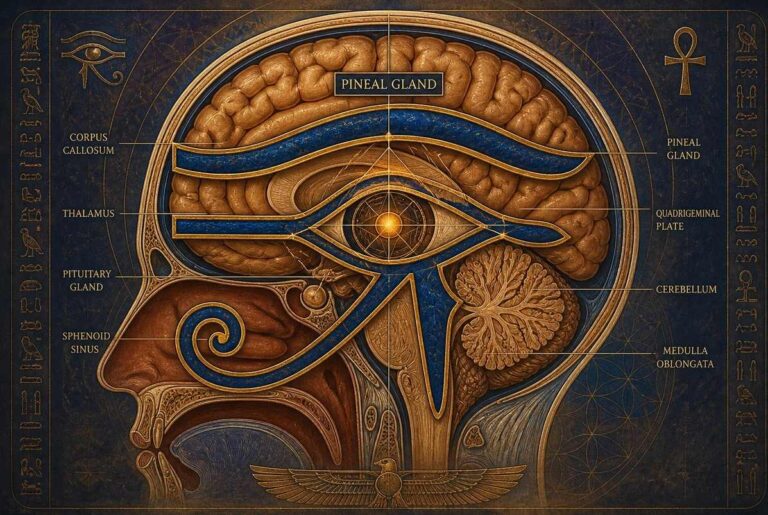

The Glitch in the Zenith – Recognising the Code of the Self
We are used to looking at the world, but we rarely look at the lens through which the world appears. Perception feels immediate. The room seems simply present. The body seems simply mine. The self seems like the one solid thing behind the eyes. Yet cognitive science, contemplative practice, and Gnostic suspicion all whisper the same inconvenient possibility: what we call reality is never received raw.
The nervous system does not behave like a passive camera. It predicts, filters, interprets, corrects, and stabilises. It builds a world that is useful enough to move through. It builds a self that is coherent enough to survive. Most of the time, this is mercy. Without prediction, the world would arrive as flood. With prediction, it becomes table, face, threat, memory, road, name, problem, desire, “me”.
But the same predictive machinery that makes experience navigable can also become a prison. The self becomes a repeated assumption. The world becomes the shape of prior fear. Language replaces the living. The map grows proud enough to call itself territory.
This article explores the “glitch” as a contemplative and cognitive metaphor: the moment when prediction falters, the model stutters, and awareness notices the code-like patterning of its own experience. The aim is not to escape reality, deny the body, or turn neuroscience into mystical proof. The aim is more precise: to recognise that the self-world boundary is partly constructed, and that recognition can loosen the grip of the construction.
In Plain Terms
The “glitch” is a symbolic term for the moment when ordinary prediction fails. A familiar pattern breaks. The mind cannot immediately explain what is happening. For a moment, the usual story of self, world, and meaning becomes visible as a story.
Predictive processing is a cognitive-science framework suggesting that the brain constantly predicts sensory input and updates its models when prediction errors occur. It does not prove that reality is fake. It does show that perception is active, interpretive, and shaped by prior expectation.
In a Gnostic reading, the glitch is the moment when the archonic pattern becomes noticeable. The prison is not only outside us. It is also the learned model through which we keep reproducing separation, fear, identity, and false certainty.
Sources and Disciplines Discussed
- Predictive processing, including the brain as an active model-building system.
- Free-energy theory, especially Karl Friston’s work on perception, action, learning, and surprise minimisation.
- Active inference, the idea that organisms act in ways that reduce uncertainty and fulfil expected states.
- Default mode network research, especially self-referential processing, narrative identity, and altered self-experience.
- Language philosophy, including the way words, categories, and social agreements shape experience.
- Simulation philosophy, especially the difference between external simulation theory and internal perceptual modelling.
- Gnostic symbolism, especially Archons, Demiurge, false world, divine spark, gnosis, and recognition.
- Contemplative practice, including uncertainty tolerance, somatic anchoring, witness consciousness, and integration.
How to Read This Article
This article uses “code”, “matrix”, and “glitch” as symbolic language. It does not claim that you are literally computer code, that ordinary life is unreal, or that predictive processing proves non-dual metaphysics. The language is deliberately charged because it points to a charged experience: the moment when the usual self-model becomes visible.
Read the neuroscience as grounding, not as proof of awakening. Read the Gnostic language as pattern recognition, not as paranoia. Read the contemplative sections slowly, and stay embodied. If reality-questioning increases anxiety, derealisation, dissociation, grandiosity, or difficulty functioning, pause and seek support.
The glitch is not an escape from reality. It is the moment the mind sees that reality has been arriving through a model.
Table of Contents
- You Are Reading This
- The Predictive Brain: Your Nervous System as Model-Maker
- The Hierarchy of Hallucination
- Active Inference and the World That Confirms You
- The Matrix of Language: Symbolic Capture and Consensus Trance
- The Glitch: When Prediction Fails
- The Neurophenomenology of Recognition
- Simulation vs Reality: The False Dichotomy
- Integration: Living the Glitch
- What Remains
- The Gnostic Reading: Archons as Predictive Constraint
- Related Glossary Terms
- Read Next
- Frequently Asked Questions
- Further Reading
- References and Sources
You Are Reading This
Already your brain has predicted where this sentence is going. The prediction is part of the reading. You do not simply see words. You see expectation meeting marks on a screen, then correcting itself when the marks refuse to behave exactly as expected.
Most of the time, prediction works. It allows you to read quickly, recognise faces, avoid danger, understand speech, walk without calculating every muscle movement, and maintain a sense of stable identity across time. Prediction is not the enemy. Prediction is how the organism avoids drowning in novelty.
But what protects can also imprison. The system that predicts “I” predicts a centre. The system that predicts “other” predicts separation. The system that predicts threat sees threat quickly. The system that predicts rejection hears rejection before the sentence has finished. These are useful shortcuts. They can also become hallucinations sustained by repetition.
Somewhere inside this machinery, a question begins to glow: who or what built the prediction engine?
The Predictive Brain: Your Nervous System as Model-Maker
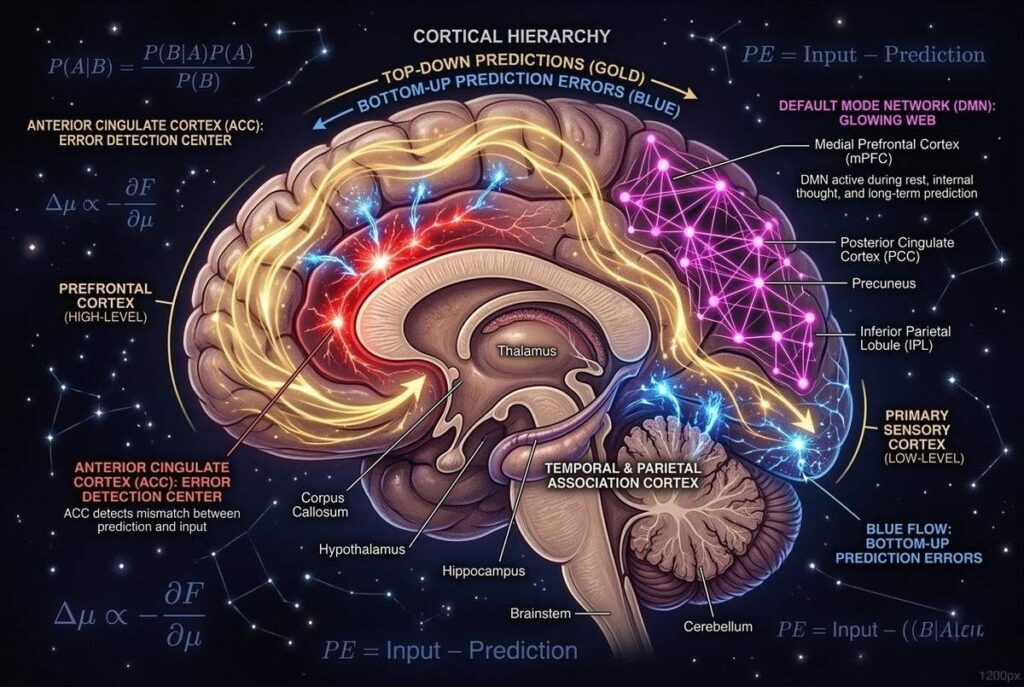
Predictive processing describes the brain as an active inference system. Rather than passively recording a finished world, the brain generates predictions about incoming sensory information, compares those predictions with sensory input, and updates its models when the mismatch becomes significant.
Karl Friston’s free-energy principle gives one influential formal version of this picture. In broad terms, organisms are understood as systems that reduce uncertainty by adjusting perception, action, and internal models. Andy Clark’s work on predictive brains develops the same larger intuition: perception is not a simple pipeline from world to mind, but a controlled meeting between expectation and error.
This does not mean the brain invents everything arbitrarily. The world pushes back. The body hurts when it falls. Fire burns. Hunger speaks. Other people surprise us. Prediction must answer to constraint. But the world we experience is still shaped by the predictions through which it becomes meaningful.
When prediction and input agree, attention relaxes. The world feels solid, known, safe. That feeling of obviousness is not proof that the model is ultimate. It only means the model is working well enough.
The Hierarchy of Hallucination
The brain’s predictions operate at many levels. Lower levels help process sensory features such as lines, colours, textures, sounds, and bodily signals. Mid-levels recognise objects, edges, faces, gestures, and places. Higher levels hold meanings, narratives, identities, emotional expectations, and social roles.
At higher levels, the predictions become intimate. “This is my body.” “This is my story.” “This person is safe.” “That person is dangerous.” “I always fail.” “I am the kind of person who cannot change.” These are not merely thoughts floating above the body. They can become embodied forecasts that guide attention, posture, breath, memory, and action.
The self, in this view, is not a single object hidden behind the eyes. It is a model, a process, a pattern of prediction and correction. That does not make it worthless. It makes it functional. The self is a useful interface. Trouble begins when the interface claims to be the source.
Active Inference and the World That Confirms You
The brain does not only predict what it will sense. The organism also acts to sample the world in ways that fulfil or test its predictions. This is the field of active inference. You look where you expect to see, avoid where you expect threat, seek what confirms your identity, and sometimes arrange your life so that old beliefs keep finding fresh evidence.
This is where the predictive prison becomes practical. A person who expects rejection may scan for rejection, interpret ambiguity as rejection, behave defensively, receive distance in return, then feel confirmed. The world appears to validate the model because the model has helped stage the evidence.
The archonic machine is therefore not only external. It is also the architecture of perception when perception becomes loyal to old constraints. The rulers do not always need to stand over the soul. Sometimes they speak as prior expectation.
The Matrix of Language: Symbolic Capture and Consensus Trance
You do not simply see colour. You see “blue”. You do not simply feel sensation. You feel “pain”, “tension”, “panic”, “desire”, “excitement”, “shame”. You do not simply encounter a person. You encounter “friend”, “stranger”, “threat”, “authority”, “mother”, “enemy”, “possible lover”, “one of us”, “not one of us”.
The map replaces the territory when language becomes too quick. Words are necessary. Without them, shared life would collapse into fog. But words also train perception. They deliver inherited categories before direct seeing has had time to breathe.
Wittgenstein’s language games are not merely academic puzzles. They point to the way meaning is learned through use, agreement, context, and form of life. “Self”, “time”, “success”, “failure”, “normal”, “spiritual”, “real”, “mad”, “saved”, “lost”: each word carries a world of rules and expectations. To inherit language is to inherit a reality tunnel.
This is not conspiracy. It is conditioning. It is the ordinary way human beings learn to see. The matrix is not only a prison built by malevolent architects. It is a self-sustaining pattern of patterns: predictions predicting predictions, words stabilising expectations, groups rewarding the perceptions that keep the group intact.
You are not outside it. You are a node in the network. A pattern recognising patterns. The eye that believes it is watching the screen, forgetting it too is part of the rendered scene.
The Glitch: When Prediction Fails
What happens when prediction fails?
The system pauses. Attention rushes towards the mismatch. The familiar world stutters. Something does not fit the model: a sentence breaks rhythm, a face behaves unexpectedly, grief interrupts routine, a dream feels too real, meditation removes the usual commentary, a familiar self-reaction suddenly looks mechanical.
In cognitive terms, prediction error demands attention. In contemplative terms, a gap opens. The mind cannot instantly absorb the event into its existing map. Before the new explanation arrives, there may be a flash of unframed seeing.
Not the content. The space between contents.
This is the glitch: not a supernatural crack in physics, but a rupture in automatic interpretation. The pattern break reveals patterning. What was invisible because it always worked becomes visible because, for a moment, it does not.
You expected this sentence to continue.
[ ]
The silence is the glitch. The gap is not an escape hatch into fantasy. It is an invitation to ask: what notices the gap?
The Neurophenomenology of Recognition
Some altered states involve changes in self-referential processing, default mode network activity, salience, attention, interoception, and bodily boundary. Meditation, psychedelics, trauma, awe, grief, prayer, and spontaneous insight can all shift the felt relationship between self and world. These states should not be collapsed into one mechanism, and they should not automatically be romanticised.
The older version of this article spoke as if the default mode network simply deactivates when prediction fails. That is too strong. The more careful claim is that altered self-experience can involve changes in networks associated with self-reference, attention, salience, interoception, and integration. The details vary by context and person.
Phenomenologically, however, the experience can be unmistakable. The usual self-model loosens. The body may feel more open or strange. Thought may appear as an event rather than an owner. Awareness may seem less centred in the autobiographical “I”. The narrator continues, but it is no longer mistaken for the whole theatre.
This is not an attainment. It is not proof of superiority. It is not a certificate from the Department of Enlightenment, signed in gold ink by a committee of invisible monks. It is a moment of recognition. The model is seen as model. The code-like pattern is noticed. In that noticing, the grip can change.
The matrix cannot stand outside itself. But it can notice its own patterning. And in that noticing, behaviour, perception, and identity may become less automatic.

Simulation vs Reality: The False Dichotomy
The contemporary simulation hypothesis, made famous by Nick Bostrom, asks whether our world might be generated by an advanced civilisation. That question remains speculative. It may be impossible to test. It depends on assumptions about consciousness, computation, civilisational futures, and world-building power.
Predictive processing shifts the emphasis. Whether or not the cosmos is externally simulated, lived reality is already internally modelled. The nervous system generates an experience-world through prediction, correction, bodily need, memory, language, and social training. The “simulation” is not necessarily running on an alien supercomputer. The more immediate simulation is the interface of perception itself.
Nothing changes. Everything changes.
The body still breathes. The world still matters. People still suffer and love. The self still functions as useful shorthand. But the grip loosens. The model is seen as model, not as sovereign truth. The “I” becomes less of a tyrant and more of an instrument.
You do not wake up into a simple “real world” behind the simulation. You wake up, if that word is useful, into a more honest relationship with mediation. The world is still here. The body is still here. The dishes are still waiting. The difference is that experience is no longer taken to be as flat, final, and self-evident as it first appears.
This is the cosmic joke with sensible shoes. The fiction notices it is a fiction, then still has to make breakfast.

Integration: Living the Glitch
Recognition is not a destination. It is an orientation. The glitch, once noticed, may be forgotten by habit, stress, fear, performance, and the return of predictive dominance. That is normal. Integration means allowing the predictive machine to continue its function while no longer treating it as the source of being.
The point is not to destroy the self-model. A functioning self is needed for language, care, work, ethics, memory, relationship, and making soup without existentially interrogating every carrot. The point is to stop mistaking the self-model for the whole of awareness.
1. Practise Uncertainty Tolerance
When the unexpected arises, notice the urge to explain it away immediately. Let the mismatch breathe for a moment. Not every uncertainty needs instant closure. Sometimes the old model must be allowed to sweat before it loosens.
This is not passivity. It is disciplined non-rush. The mind becomes less desperate to restore the old map, and therefore more able to learn.
2. Observe the “I” Narrative
Notice when language creates a fixed identity: “I always”, “I never”, “I am the kind of person who”, “people like me”, “that is just who I am”. These phrases may describe patterns, but they also reinforce them.
Try softening the grammar internally. Instead of “I am anxious”, notice “anxiety is present”. Instead of “I failed”, notice “a plan did not work”. This is not denial. It is linguistic space-making. The prison often has a sentence structure.
3. Use Somatic Anchoring
The glitch is not merely cognitive. When prediction fails, the body may respond with tingling, heat, openness, contraction, trembling, nausea, dizziness, or a sense of boundary shift. These sensations need care.
Ground through feet, breath, touch, ordinary objects, slow movement, and simple orientation. Look around the room. Name what is here. Feel the chair. Drink water. Recognition that cannot inhabit the body becomes vaporous and unstable.
4. Keep Ordinary Duties Sacred
The mind that sees through the self can easily manufacture a more impressive self: the one who has seen through the self. This is the upgraded trap. It comes with better lighting and worse humility.
Ordinary duties protect against inflation. Clean the room. Feed the animals. Answer the message. Sleep. Eat. Apologise. Pay attention to another person without turning them into a symbol of your awakening. The glitch becomes wisdom only when it becomes kinder.
What Remains
Not an answer. A tilt.
The same predictions, no longer believed in quite the same way. The same “I”, no longer owned with quite the same tightness. The same world, less flat. The same ground, more strange.
Walk. The ground is noticed. The noticing is grounded.
Does the ground notice you?
Do you notice the mind trying to answer too quickly?
Be careful here. The mind that reads “awakening” makes it another destination, another prediction, another “I” that will have achieved, arrived, become. The trap renovates itself. The simulation includes its own escape-room franchise.
You are already here. Pain is real. Joy is real. Confusion is real. Recognition is real. They may not be ultimate, but they are not nothing. The world is not disposable because it is mediated. The body is not irrelevant because the self is constructed.
The chickens do not worry about this. They scratch, eat, sleep. Their directness is honest. Ours was decorated with concepts. Now perhaps less so. Or differently so.
The ground does not need to be claimed. The noticing does not need your signature. What remains is not yours to hold. What remains is the holding itself, held by nothing you can turn into an object.
Walk.
The Gnostic Reading: Archons as Predictive Constraint
In Gnostic myth, the Archons rule by limitation, imitation, administration, and misrecognition. They do not need to destroy the divine spark. They need to keep it identified with a lower model: body alone, role alone, fear alone, social identity alone, wounded history alone.
Predictive processing offers a modern psychological analogue. The mind is constrained by prior models. It expects the world it has learned. It often explains away what does not fit. It acts to confirm old predictions. In this sense, the Archons can be read as rigid priors: inherited patterns that organise perception before freedom has a chance to speak.
The Demiurge, in this symbolic reading, is the self-world model that mistakes its construction for total reality. It says: this is all there is. This identity is final. This fear is truth. This social order is nature. This map is the territory.
Gnosis begins when that claim fails. Not because the whole world vanishes, but because its false finality cracks. The spark is not elsewhere. It is the capacity to recognise the model without being fully captured by it.
The glitch is therefore not an error to be repaired. It is sometimes the mercy by which the model reveals itself as model.
Related Glossary Terms
For quick definitions, use the main ZenithEye Glossary. The key terms for this article are:
Read Next
Continue with: The Gnostic Theory of Consciousness: A Psychological Analysis
If this article explores the self as predictive model and the glitch as recognition, the next step moves into the older Gnostic map of consciousness: psyche, pneuma, ego, spark, and the layered architecture of awakening.
Within The Thread
This article belongs to The Architecture of Perception, a layer of The Thread concerned with how reality is filtered, framed, predicted, narrated, embodied, and mistaken for the whole. The glitch belongs here because it reveals perception as architecture rather than transparent window.
Frequently Asked Questions
What is predictive processing in the brain?
Predictive processing is a cognitive-science framework suggesting that the brain actively predicts sensory input and updates its models when prediction errors occur. Rather than passively receiving a finished world, the brain helps construct experience through expectation, correction, memory, attention, and bodily need.
Is the self just a prediction?
The self can be understood as a high-level model or process, not a single hidden object inside the head. This does not mean the self is worthless or unreal. It means the sense of being a continuous “I” is actively maintained through memory, body signals, social identity, language, and prediction.
What is the glitch in consciousness?
The glitch is a symbolic term for a moment when ordinary prediction fails and the mind briefly sees its own patterning. A familiar model stutters, a gap opens, and the self-world story becomes visible as a construction. It is not proof of supernatural escape, but it can become a moment of recognition.
How is predictive processing different from the simulation hypothesis?
The simulation hypothesis asks whether the external universe could be generated by a deeper technological or computational substrate. Predictive processing concerns how the nervous system models experience from within. One is a metaphysical or philosophical question about reality; the other is a cognitive framework for perception, action, and selfhood.
Can I escape the matrix by recognising the glitch?
The goal is not escape from life, the body, or ordinary responsibility. Recognition means seeing the model as a model, so that identity and perception become less rigid. A grounded approach treats the world as real enough to love and care for, even when it is also recognised as mediated and interpreted.
What happens in the brain during recognition or altered self-experience?
Altered self-experience can involve changes in self-referential processing, attention, salience, interoception, default mode network activity, and bodily boundary. The details vary widely by person and context, so it is too simple to say one brain region switches off. The safer claim is that the self-model can loosen under certain conditions.
How can I explore this safely?
Use gentle practices: breath awareness, body scanning, journalling, walking, slow reading, meditation, and uncertainty tolerance. Stay embodied. Do not chase dissociation, sleep deprivation, extreme breathwork, illegal substances, or destabilising practices. If reality-questioning increases anxiety, derealisation, paranoia, insomnia, or difficulty functioning, pause and seek qualified support.
Study and Safety Note
This article explores predictive processing, self-models, Gnostic symbolism, simulation language, and altered perception for educational and reflective purposes. It does not provide medical, psychological, psychiatric, neurological, psychedelic, or spiritual-direction advice.
If reality-questioning, meditation, altered states, or metaphysical speculation increase anxiety, derealisation, dissociation, paranoia, grandiosity, insomnia, panic, compulsive thinking, or difficulty functioning, pause the material and seek support from qualified professionals. The aim is grounded recognition, not destabilisation. Keep ordinary care close: sleep, food, movement, relationship, sunlight, and practical responsibility.
Further Reading
These live ZenithEye links continue the themes of predictive selfhood, simulation, perception, consciousness, Gnostic psychology, and grounded recognition:
- The Gnostic Theory of Consciousness: A Psychological Analysis – The next article in this route, exploring psyche, pneuma, ego, spark, and ancient Gnostic psychology.
- Simulation Hypothesis: Is Reality a Computational Construct? – The philosophical bridge between generated worlds, information, consciousness, and Gnostic suspicion.
- Holographic Universe Theory: Consciousness and the Nature of Reality – A related exploration of information, perception, and cosmic structure.
- Consciousness as Interface: The User Experience of Being – How perception may function as a navigable interface rather than transparent access to reality.
- The Default Mode Network: Neuroscience of the Narrative Self – The self-storying network and what happens when the narrator loosens.
- States of Knowing: What Happens When Consciousness Unravels – Altered states, destabilisation, perception, and the shifting conditions of awareness.
- The Collapse of the Witness – When the observer becomes part of what is observed.
- Recognition Beyond Position – Direct recognition without turning awareness into another identity project.
- Spiritual Practice: Attention and Presence – Grounded attention practice for stabilising recognition in ordinary life.
- The Thread – The main route through ZenithEye’s symbolic, historical, contemplative, and contemporary architecture.
References and Sources
The following sources support the cognitive, philosophical, contemplative, and Gnostic framework used in this article.
Predictive Processing, Free Energy, and Active Inference
- [1] Friston, Karl. “The Free-Energy Principle: A Unified Brain Theory?” Nature Reviews Neuroscience, 11, 127-138, 2010.
- [2] Clark, Andy. “Whatever Next? Predictive Brains, Situated Agents, and the Future of Cognitive Science.” Behavioral and Brain Sciences, 36(3), 181-204, 2013.
- [3] Clark, Andy. Surfing Uncertainty: Prediction, Action, and the Embodied Mind. Oxford University Press, 2016.
- [4] Hohwy, Jakob. The Predictive Mind. Oxford University Press, 2013.
- [5] Parr, Thomas, Giovanni Pezzulo, and Karl Friston. Active Inference: The Free Energy Principle in Mind, Brain, and Behavior. MIT Press, 2022.
- [6] Buckley, Christopher L., Chang Sub Kim, Simon McGregor, and Anil K. Seth. “The Free Energy Principle for Action and Perception: A Mathematical Review.” Journal of Mathematical Psychology, 81, 55-79, 2017.
- [7] Gershman, Samuel J. “What Does the Free Energy Principle Tell Us About the Brain?” Neural Computation, 31(1), 1-16, 2019.
Selfhood, Consciousness, and Perception
- [8] Seth, Anil. Being You: A New Science of Consciousness. Faber & Faber, 2021.
- [9] Metzinger, Thomas. Being No One: The Self-Model Theory of Subjectivity. MIT Press, 2003.
- [10] Damasio, Antonio. Self Comes to Mind: Constructing the Conscious Brain. Pantheon, 2010.
- [11] Barrett, Lisa Feldman and W. Kyle Simmons. “Interoceptive Predictions in the Brain.” Nature Reviews Neuroscience, 16, 419-429, 2015.
- [12] Raichle, Marcus E., et al. “A Default Mode of Brain Function.” Proceedings of the National Academy of Sciences, 98(2), 676-682, 2001.
- [13] Buckner, Randy L., Jessica R. Andrews-Hanna, and Daniel L. Schacter. “The Brain’s Default Network: Anatomy, Function, and Relevance to Disease.” Annals of the New York Academy of Sciences, 1124, 1-38, 2008.
- [14] Brewer, Judson A., et al. “Meditation Experience Is Associated with Differences in Default Mode Network Activity and Connectivity.” Proceedings of the National Academy of Sciences, 108(50), 20254-20259, 2011.
Language, Maps, and Constructed Meaning
- [15] Wittgenstein, Ludwig. Philosophical Investigations. Blackwell, 1953.
- [16] Korzybski, Alfred. Science and Sanity: An Introduction to Non-Aristotelian Systems and General Semantics. Institute of General Semantics, 1933.
- [17] Lakoff, George and Mark Johnson. Metaphors We Live By. University of Chicago Press, 1980.
- [18] Berger, Peter L. and Thomas Luckmann. The Social Construction of Reality. Anchor Books, 1966.
Simulation, Interface, and Reality-Questioning
- [19] Bostrom, Nick. “Are You Living in a Computer Simulation?” The Philosophical Quarterly, 53(211), 243-255, 2003.
- [20] Chalmers, David J. Reality+: Virtual Worlds and the Problems of Philosophy. W. W. Norton, 2022.
- [21] Plato. Republic, Book VII. The Allegory of the Cave.
- [22] Descartes, René. Meditations on First Philosophy. 1641.
- [23] Hoffman, Donald D. The Case Against Reality: Why Evolution Hid the Truth from Our Eyes. W. W. Norton, 2019.
Gnostic and Comparative Sources
- [24] Apocryphon of John. Nag Hammadi Codex II,1; III,1; IV,1; Berlin Codex 8502,2.
- [25] Hypostasis of the Archons. Nag Hammadi Codex II,4.
- [26] On the Origin of the World. Nag Hammadi Codex II,5; XIII,2.
- [27] Robinson, James M. (ed.). The Nag Hammadi Library in English. Revised edition. HarperOne, 1990.
- [28] Meyer, Marvin (ed.). The Nag Hammadi Scriptures. HarperOne, 2007.
- [29] Jonas, Hans. The Gnostic Religion. Beacon Press, 1958.
- [30] King, Karen L. What Is Gnosticism?. Harvard University Press, 2003.
- [31] Williams, Michael Allen. Rethinking “Gnosticism”: An Argument for Dismantling a Dubious Category. Princeton University Press, 1996.
- [32] Brakke, David. The Gnostics: Myth, Ritual, and Diversity in Early Christianity. Harvard University Press, 2010.
Contemplative and Integration Context
- [33] Suzuki, D. T. An Introduction to Zen Buddhism. Grove Press, 1964.
- [34] Kapleau, Philip. The Three Pillars of Zen. Beacon Press, 1965.
- [35] Kornfield, Jack. After the Ecstasy, the Laundry: How the Heart Grows Wise on the Spiritual Path. Bantam, 2000.
- [36] Welwood, John. “Principles of Inner Work: Psychological and Spiritual.” In writings on spiritual bypassing and integration.
- [37] van der Kolk, Bessel. The Body Keeps the Score: Brain, Mind, and Body in the Healing of Trauma. Viking, 2014.
- [38] Ogden, Pat, Kekuni Minton, and Clare Pain. Trauma and the Body: A Sensorimotor Approach to Psychotherapy. W. W. Norton,2006.