
States of Knowing – What Happens When Consciousness No Longer Belongs to You
You do not choose the state. This is the first recognition, and it arrives too late. You have already been moved.
Most accounts of altered consciousness begin with method. The substance. The breath. The drum. The sensory deprivation tank. This is backwards. The method does not produce the state. The method is merely the door you happen to be near when the state decides to enter. Some doors are more reliable than others, but the state itself is not a product of the door. It is not a result. It is an arrival.
Table of Contents
- Challenging the Baseline of Normal Waking Consciousness
- The Anatomy of the Unravelling
- The Return and Its Distortions
- Three Frameworks, Three Reductions
- The Problem of Verification
- The States That Take: Trauma and Psychosis
- The Return of the Real
- Frequently Asked Questions
- Further Reading
- References and Sources
Challenging the Baseline of Normal Waking Consciousness
The literature–scientific, mystical, anthropological–treats these experiences as “altered”. This assumes a baseline. Normal waking consciousness as standard, everything else as deviation. This assumption is useful for institutional purposes. It is not useful for understanding.
The baseline is itself one state among many, no more fundamental than the others, merely the one optimised for survival in a particular environment. The “altered” label is a political designation, not a phenomenological one. What we call “normal” is the consensus trance required for social coordination, economic production, and threat detection. It is a filter, not a foundation.
What actually happens? The question is flawed. It assumes a what that experiences, a thing that happens to. The grammar of ordinary language encodes the very assumptions that dissolve in the state itself. You cannot describe the melting of the observer using the vocabulary of the observed.
And yet. The thread continues. Those who have been moved recognise each other. Not through doctrine. Through description that fails in predictable ways. Through the particular quality of uncertainty that arrives when certainty itself is seen as a symptom. The recognition is not intellectual. It is somatic. A loosening in the chest, a quality of attention that no longer hunts for objects, a silence that is not the absence of sound but the presence of something that does not need to speak.
The Anatomy of the Unravelling
Consider the sequence. Not universal, but common enough to map across traditions and methodologies. The phenomenologist does not begin with theory but with description. What follows is a composite phenomenology drawn from contemplative accounts, psychedelic research, near-death reports, and depth psychological case studies.
1. The Thinning
The boundaries of self become permeable. Not dramatically. Not yet. A sense that the skin is a suggestion rather than a container. The body continues its functions–breathing, temperature, posture–but the ownership of these functions becomes questionable. The hand moves. Did you move it? The question itself feels foreign. The division between action and happening begins to blur.
Neuroscientists observe this phase as reduced activity in the default mode network (DMN), the brain’s self-referential processing system. During meditation, flow states, and psychedelic experiences, the DMN downregulates, loosening the narrative continuity that ordinarily stitches moments into a coherent “me.” The thinning is not imaginary. It is measurable. But measurement describes the instrument, not the territory the instrument enters.
2. The Deepening
Perception becomes granular. The texture of a wall, the quality of light, the sound of silence–each reveals layers that ordinary attention skims over. This is not hallucination. Hallucination adds. This subtracts the filters. The world presents itself without the usual agreements about what matters and what can be ignored. The result is overwhelming not because there is more, but because there is less selection. Everything demands equal attention. The mind, accustomed to hierarchy, falters.
In this phase, sensory thresholds shift. Synaesthetic bleed-through is common: sound acquires texture, colour acquires weight, time acquires viscosity. The deepening is not an expansion into fantasy but a contraction into immediacy. The past and future lose their gravitational pull. Only this remains, and “this” is inexhaustible.
3. The Unbinding
The narrative thread–yesterday, tomorrow, the story of a life–loosens. Not forgotten. Simply… optional. The state does not require your history. It does not require your name. This is the terror and the relief. The self as continuity is seen as a construction. A useful fiction, now temporarily suspended.
The unbinding is where most practitioners encounter resistance. The ego–not the Freudian ego but the deeper sense of being someone–does not surrender willingly. It deploys its full arsenal: fear, boredom, doubt, sudden urgent thoughts about errands unfinished. These are not obstacles to the state. They are the state dissolving the last adhesions. To fight them is to extend the unbinding. To allow them is to complete it.
4. The Encounter
With what depends on the vocabulary available. The unconscious. The divine. The field. The other. The what is less important than the quality: something is met that does not originate from the personal history, yet recognises you completely. This is where language fails most completely. Not because the encounter is ineffable, but because effability assumes a shared subject-position that no longer obtains.
The encounter is not always luminous. It can be stark, impersonal, even indifferent. The tradition of the via negativa describes a God who is not a presence but an absence so total it redefines presence. The Dzogchen practitioner speaks of the ground as empty luminosity–not a thing encountered but the encountering itself. The phenomenological point is not the content but the structure: the meeting with what is not self, after the self has been unbound.
The Return and Its Distortions
The state ends. It always ends. The return is not chosen either. Consciousness reassembles around the familiar centre. The narrative resumes. The body is owned again, sometimes with relief, sometimes with grief.
Then comes the interpretation. This is where damage is done. The state itself is clean. The meaning-making that follows is where the infection enters. The experience is claimed by available frameworks: neurological, spiritual, pathological, mystical. Each claim is a reduction. Each reduction serves institutional purposes.
The return is also where integration begins–or fails. The state that is not metabolised becomes a wound. The state that is metabolised becomes a hinge. The difference is not the intensity of the experience but the quality of the container that receives it afterwards. A community that understands. A practice that grounds. A body that is listened to. Without these, even the most luminous encounter becomes a fragment, a memory that haunts rather than a thread that extends.
Three Frameworks, Three Reductions
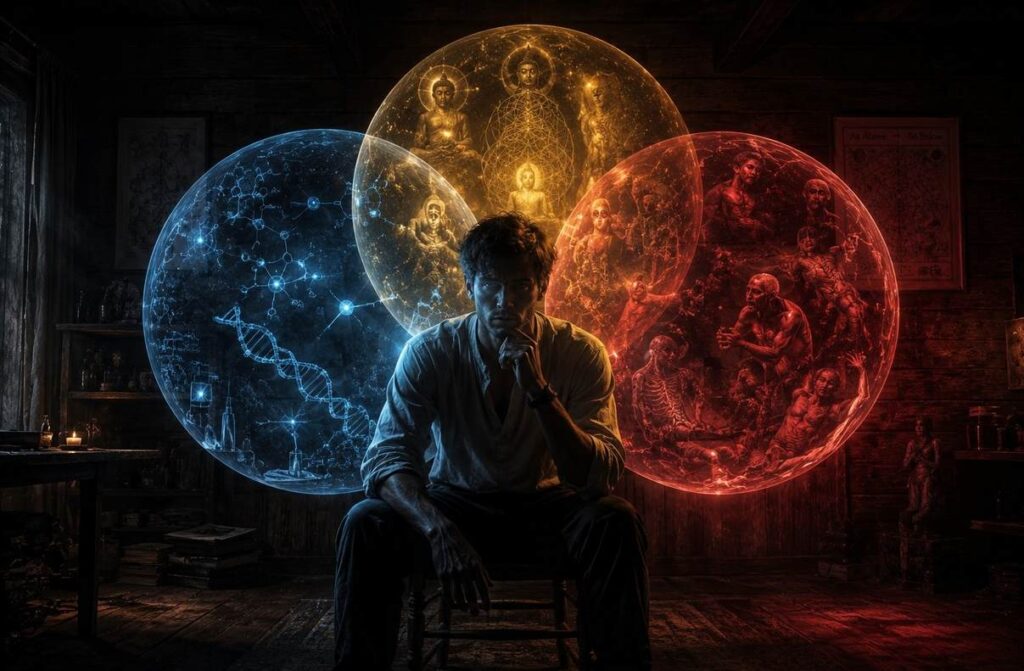
The modern seeker is offered three primary lenses through which to understand what has occurred. Each lens reveals something. Each lens conceals something.
The Scientific Framework
Useful for removing stigma, but less useful for understanding. The brain lights up in particular patterns. The temporal lobe activates. The DMN downregulates. The serotonin-2A receptors engage. This is correlation, not explanation. To say the temporal lobe activates is not to say what temporal lobe activation is like from the inside. The third-person description and the first-person experience are not the same phenomenon described differently. They are different phenomena with a mysterious relationship.
The scientific framework’s greatest contribution is negative: it demonstrates that these states are not supernatural interruptions of natural law. They are lawful. They have neural signatures. But the signature is not the signed. The map of the territory is not the territory, and in this case, the map-maker is part of the territory being mapped.
The Spiritual Framework
Useful for integration, but less useful for discernment. Every tradition has its cartography: chakras, sefirot, planes, bardo states. These maps are not arbitrary. They encode genuine pattern recognition across centuries. They are also maps, not territories. To mistake the map for the territory in this domain is particularly dangerous because the territory itself is plastic. Expectation shapes experience. The map becomes self-fulfilling.
The spiritual framework risks what the philosopher Evan Thompson calls “reification”: the solidification of fluid experience into fixed metaphysics. The encounter with the formless becomes the worship of a form. The dissolution of self becomes the construction of a new, more exotic self–the “spiritual” identity, the awakened persona, the one who has been somewhere others have not. This is not liberation. It is relocation.
The Pathological Framework
Useful for preventing harm, but less useful for distinguishing genuine transformation from dysfunction. The DSM-5-TR does not recognise categories for productive dissolution of self. All unbinding is treated as decompensation. This is protective, but it is also blind. The culture has no room for controlled burning.
And yet the framework is necessary. Not all unbinding is healthy. Some is catastrophic. The phenomenologist Wouter Kusters, drawing on his own experiences of psychosis and the tradition of Binswanger’s existential psychiatry, demonstrates that madness and mysticism share territory–what he calls “mad mysticism” or “mystical mad-ness.” The hyphen is important. The overlap is real. The differentiation lies not in the phenomenology but in the context, the preparation, the integration, and the functional outcome. The same neurological events can be pathway or pathology depending on these variables.
The Problem of Verification
How do you know the state was genuine? This question assumes there is a genuine to be measured against. It assumes the state is a claim about reality rather than a modification of the relationship to reality.
The states that matter are those that persist in their effects after the state ends. Not the intensity of the experience. Not the visual drama. The residue.
- The way the world continues to look after the eyes have returned to normal.
- The way certainty about the self continues to feel slightly absurd.
- The way the official story–cultural, personal, historical–never quite regains its former authority.
This persistence is the only verification available. Not proof. Not evidence. Just continuation. The thread extending. The philosopher William James, in The Varieties of Religious Experience, called this the “noetic quality” of mystical states: the sense that one has been in contact with a knowledge more real than ordinary knowing, even though the content of that knowledge cannot be transmitted. The noetic quality is the residue. It does not convince others. It does not need to.

The States That Take: Trauma and Psychosis
Not all altered states are sought. Some arrive uninvited. Trauma. Psychosis. Sleep paralysis. Near-death. These are not methods. They are ruptures. The phenomenology overlaps with sought states–the thinning, the unbinding, the encounter–but the context changes everything. The sought state has preparation. The unsought state has only shock.
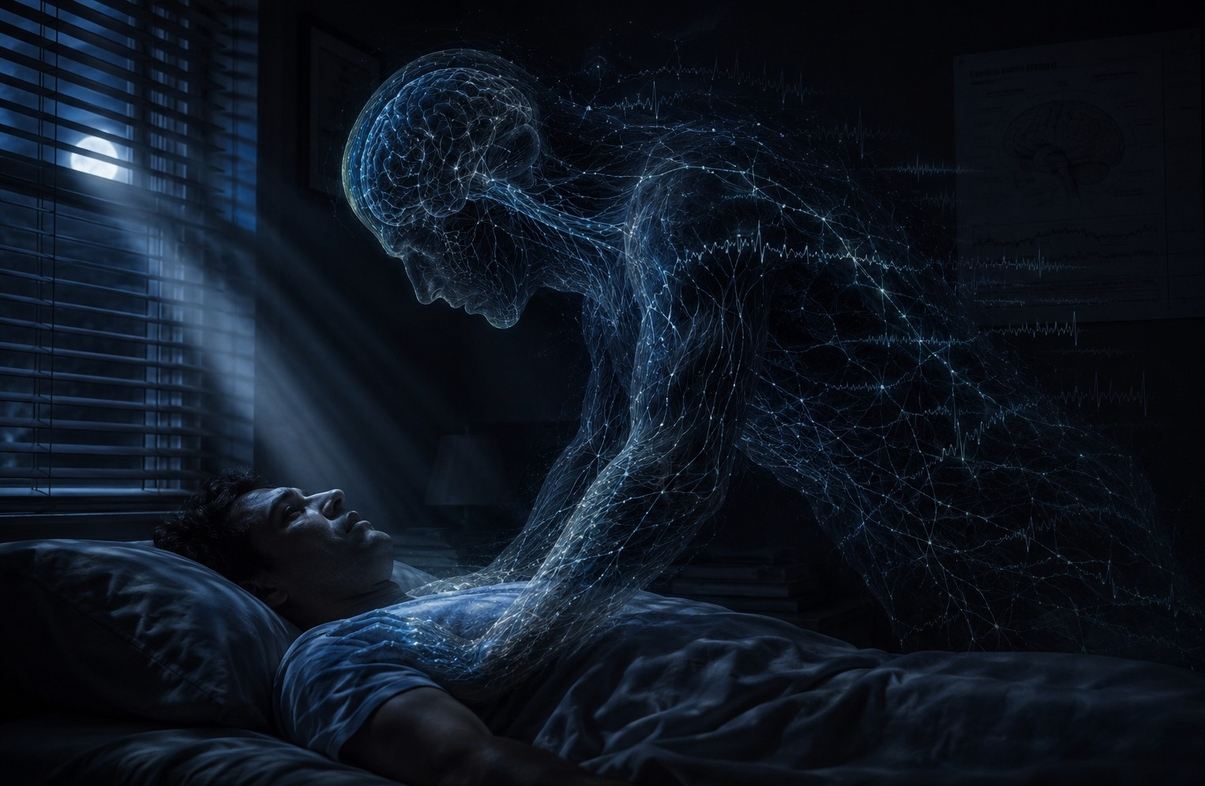
Sleep paralysis offers a precise example. Neurobiologically, it is REM atonia–muscle paralysis mediated by GABA and glycine from the brainstem–extending into wakefulness. The sleeper awakens conscious but immobile. The amygdala, still in dream-mode, generates threat-detection signals. The result is the “intruder hallucination”: a sense of presence, pressure on the chest, and visual or auditory phenomena that vary by culture but share a common neural substrate. The experience is unmistakably real to the one who has it. The interpretation–demon, alien, ancestor, or neurological glitch–depends on the vocabulary available.
And yet. The recognition is possible across this boundary. Those who have been taken by trauma and those who have been taken by meditation can sometimes understand each other better than either can be understood by those who have only read about both. The quality of having been moved, of having returned with the centre shifted, is shared. The method of movement is secondary.
This is uncomfortable. It implies that psychosis and mysticism share territory. The culture prefers clear boundaries; the territory does not respect these preferences. The same neurological events can be pathway or pathology depending on context, preparation, integration, and luck. This is not to romanticise suffering. It is simply to recognise that the states do not come with labels attached. The labels are applied afterwards, for social rather than phenomenological purposes.
The Return of the Real
After sufficient exposure to altered states–sought or unsought–a peculiar recognition arrives. The ordinary state is itself altered. It is the product of specific conditions, specific agreements, specific suppressions. Waking consciousness is not the default. It is the consensus. A useful consensus, but a consensus nonetheless.
This recognition does not require abandoning the consensus. You still pay taxes. You still remember your address. But the investment in the consensus changes. You participate without believing. You function without identifying. The state has shown you that the centre is movable, and once seen, this cannot be unseen.
The thread continues. Not because you seek it. Because you have been shown that seeking is itself a state, and the state that sees seeking is available without effort. Not always. Not reliably. But available. The door you happen to be near when the state decides to enter.
You do not choose. This is the recognition. And in that non-choice, something opens that method cannot manufacture. The knowing that arrives without being sought. The state that is not altered, because there is no baseline left to alter.
The rest is up to you. The states continue regardless.
Frequently Asked Questions
What happens when consciousness no longer belongs to you?
The experience typically follows a sequence: first, the thinning of self-boundaries; second, the deepening of perception as filters drop away; third, the unbinding of narrative continuity; and fourth, an encounter with something that does not originate from personal history yet recognises you completely. The return involves reassembly of ordinary consciousness, often with lasting changes in how reality, self, and certainty are experienced.
Can altered states of consciousness occur without drugs or meditation?
Yes. Altered states arrive uninvited through trauma, psychosis, sleep paralysis, near-death experiences, and extreme physiological stress. These ruptures share phenomenological overlap with sought states–the thinning, unbinding, and encounter–but lack preparation and integration, making them more dangerous and harder to metabolise. The state is an arrival, not a product of any specific method.
What is the default mode network and why does it matter for mystical states?
The default mode network (DMN) is a set of brain regions active during self-referential thought and narrative continuity. During meditation, flow, and psychedelic experiences, the DMN downregulates, loosening the sense of a continuous self. This neurobiological shift correlates with the phenomenological thinning described across mystical traditions, though the neural signature is not identical to the subjective territory.
How do you tell the difference between psychosis and a genuine mystical experience?
The overlap is real and well-documented in phenomenological psychiatry. The difference lies not in the raw phenomenology but in context, preparation, integration, and functional outcome. Mystical experiences typically occur within a supportive framework, lead to increased compassion and stability, and integrate over time. Psychotic experiences often feature terror, social withdrawal, and deteriorating function. The same neural events can be pathway or pathology depending on these variables.
Why does sleep paralysis feel so real and terrifying?
Sleep paralysis occurs when REM atonia–muscle paralysis mediated by GABA and glycine from the brainstem–extends into wakefulness. The amygdala remains in dream-mode, generating threat-detection signals while the body cannot move. This produces the intruder hallucination: a sense of presence, chest pressure, and vivid perceptual phenomena. The experience is neurobiologically lawful but subjectively terrifying because the fear response is activated without the possibility of fight or flight.
Is ordinary waking consciousness the ‘normal’ state?
Ordinary waking consciousness is one state among many, optimised for survival and social coordination rather than being ontologically fundamental. The label ‘altered’ is a political designation privileging consensus reality. From a phenomenological perspective, waking consciousness is itself a filter–a useful consensus, but a consensus nonetheless–not the baseline against which all other states should be measured.
How do you integrate an altered state experience?
Integration requires three containers: a body that is listened to through grounding and somatic practice; a community that understands without reducing the experience to pathology or hype; and a practice that stabilises the insights without clinging to them. The state that is not metabolised becomes a wound. The state that is metabolised becomes a hinge. The residue–how the world continues to look, how certainty feels–is the only verification that matters.
Safety Notice: This article explores altered states of consciousness, including trauma, psychosis, and sleep paralysis. It does not constitute medical, psychological, or spiritual advice. If you are experiencing destabilisation, hallucinations, or psychological distress, please contact a mental health professional or emergency services. Contemplative and somatic practices complement but do not replace clinical mental health treatment.
Further Reading
- Default Mode Network Dissolution and the Dissolution of Self — The neuroscience of ego dissolution and what the DMN reveals about narrative identity.
- Sleep Paralysis as Threshold State — The liminal space between dream and waking, self and other, with full neurobiological context.
- The Dark Night: Depression or Transformation? — Discerning the difference that saves lives when the unbinding becomes overwhelming.
- Psychosis and Mysticism: The Shared Territory — Where mystical experience and psychotic breakdown overlap, and where they diverge.
- Breathwork: Ancient Technology, Modern Application — The deliberate modification of breath as a reliable door to altered states.
- Spiritual Emergency: When Transformation Looks Like Crisis — Recognising and containing the rupture when the state arrives uninvited.
- Integration Practices After Peak Experience — Grounding the luminous into the ordinary without losing the thread.
- Embodiment Practices: Grounding After Awakening — Why the body is the necessary container for states that unbind the mind.
- The Witness Function in Contemplative Traditions — The observer that remains when the observed dissolves, and its limits.
- The Gateway of Silence: Entering the Causal Body — The formless state beyond the unbinding, where encounter becomes identity.
References and Sources
The following sources support the claims made in this article. Grouped by discipline for clarity.
Neuroscience and Cognitive Science
- Brewer, J. A., et al. (2011). Meditation experience is associated with differences in default mode network activity and connectivity. Proceedings of the National Academy of Sciences, 108(50), 20254-20259. — DMN downregulation during meditation.
- Carhart-Harris, R. L., et al. (2012). Neural correlates of the psychedelic state as determined by fMRI studies with psilocybin. Proceedings of the National Academy of Sciences, 109(6), 2138-2143. — DMN deactivation under psilocybin and ego dissolution correlation.
- Jalal, B., & Ramachandran, V. S. (2014). Sleep paralysis and the shadowy bedroom intruder: The role of the right superior parietal, phantom pain and body image projection. Medical Hypotheses, 83(6), 755-757. — Neurobiology of sleep paralysis hallucinations.
- Ramachandran, V. S., & Blakeslee, S. (1998). Phantoms in the Brain. William Morrow. — Temporal lobe and religious experience, including GSR studies.
Psychology, Psychiatry, and Phenomenology
- American Psychiatric Association. (2022). Diagnostic and Statistical Manual of Mental Disorders, 5th ed., Text Revision (DSM-5-TR). — Classification of dissociative and psychotic disorders.
- Kusters, W. (2020). A Philosophy of Madness. MIT Press. — Phenomenological analysis of psychosis and its overlap with mystical states.
- Lukoff, D. (1985). The diagnosis of mystical experiences with psychotic features. Journal of Transpersonal Psychology, 17(2), 155-181. — Clinical framework for distinguishing spiritual emergency from psychosis.
- James, W. (1902). The Varieties of Religious Experience. Longmans, Green & Co. — The noetic quality and criteria for genuine mystical states.
Contemplative and Comparative Studies
- Thompson, E. (2014). Waking, Dreaming, Being: Self and Consciousness in Neuroscience, Meditation, and Philosophy. Columbia University Press. — Critique of reification in spiritual frameworks and the plasticity of contemplative experience.
- Forman, R. K. C. (Ed.). (1998). The Innate Capacity: Mysticism, Psychology, and Philosophy. Oxford University Press. — Constructivist vs. perennialist debates in mystical studies.