

The Surveillance Sublime: When Watching Becomes Archontic
Surveillance has moved beyond watching. It now predicts, nudges, scores, authenticates, curates, and remembers. The modern surveillance system does not simply observe from outside. It enters the conditions of behaviour itself, shaping what appears possible, desirable, risky, visible, or invisible. In Gnostic language, this is why surveillance becomes archontic: it watches, weighs, constrains, and teaches the watched to govern themselves.
In Plain Terms
The surveillance sublime is the strange mixture of awe and unease produced by modern watching systems. They are impressive, elegant, useful, and terrifying. Cameras recognise faces. Phones report location. Platforms track attention. Algorithms predict risk. Biometric systems turn the body into identification. Recommendation engines shape what people see before they know they have chosen.
This is not only a privacy issue. It is a consciousness issue. When people know, or feel, that they are always being watched, measured, ranked, and predicted, they begin to internalise the watcher. They modify behaviour before any punishment arrives. The cage becomes psychological before it becomes visible.
In Gnostic terms, the Archons are ruling powers that administer the lower world through limitation, ignorance, and false authority. Modern surveillance systems echo that pattern when they reduce the person to data, prediction, biometric trace, consumer profile, risk score, or behavioural model. The first act of resistance is recognition: to see the watching system without surrendering the inner witness.
Primary Sources and Traditions Discussed
- Gnostic cosmology: Archons, rulers, false authority, limitation, and the soul’s need for recognition.
- Panopticon theory: Jeremy Bentham’s architectural model of surveillance and Michel Foucault’s later analysis of disciplinary power.
- Modern surveillance studies: data collection, biometric authentication, predictive policing, algorithmic curation, and platform attention systems.
- AI governance: Project Maven, computer vision, risk scoring, automated decision systems, and the growing military-civilian overlap in surveillance infrastructure.
- Digital attention and psychology: filter bubbles, recommendation systems, epistemic closure, behavioural nudging, and self-regulation under observation.
- Contemplative resistance: privacy as spiritual practice, unmediated experience, embodied presence, analogue friction, and interiority beyond data capture.
How to Read This Article
This article does not claim that surveillance technologies are literally supernatural Archons. It uses Gnostic language structurally. The Archon is a pattern of rule: watching, weighing, classifying, limiting, imitating, and maintaining a lower order that mistakes itself for total reality.
Some surveillance systems are useful. Cameras can improve safety. Biometrics can protect accounts. Data analysis can reveal genuine risk. The question is not whether all watching is evil. The question is when watching becomes a total environment, when convenience becomes capture, and when the person is reduced to legible behaviour.
Read this as a map of modern power, not as a panic sermon. The aim is discernment. Paranoia sees threat everywhere. Discernment sees the architecture, names the mechanism, and keeps the inner life from being swallowed by it.
Table of Contents
- The Panopticon Perfected: From Bentham to the Data Centre
- The Surveillance Landscape: Five Pillars of Archonic Power
- The Archonic Structure: Constraint Through Observation
- The Seduction of the Sublime
- Resistance: Gnosis Against the System
- Watching and the Watched: The Final Recognition
- Related Glossary Terms
- Read Next
- Frequently Asked Questions
- Further Reading
- References and Sources
The Panopticon Perfected: From Bentham to the Data Centre
Jeremy Bentham’s panopticon was a proposed prison architecture: a central tower from which prisoners might be watched without knowing when they were being observed. The genius, and horror, of the design was psychological. The prisoner internalises the watcher and begins to regulate himself.
Michel Foucault later used the panopticon as a model for modern disciplinary society. Power no longer needs to appear only as public violence. It can become a distributed atmosphere of observation, normalisation, examination, comparison, and correction.
Modern surveillance extends this pattern beyond anything Bentham’s tower could hold. The tower is now the platform, phone, workplace dashboard, border system, camera network, biometric scanner, recommender engine, insurance model, and military computer-vision system. The walls have become interfaces. The watcher has become automated. The watched carry the device willingly, because the device is also map, wallet, memory, companion, entertainment, and door key.
The Aesthetics of Control
The sublime, in aesthetic theory, is the experience of being overwhelmed by something vast, powerful, beautiful, and frightening. A mountain range can be sublime. A storm can be sublime. In the digital age, surveillance becomes sublime when its scale and elegance overwhelm comprehension.
There is awe in the system’s intelligence: how quickly it recognises, predicts, translates, recommends, and maps. There is terror in its invisibility: how little is understood by the people it affects, and sometimes even by the institutions that deploy it.
This is the surveillance sublime: the cage is not merely oppressive. It is impressive. It is sleek. It is helpful. It arrives dressed as convenience, safety, frictionless access, personalisation, and protection. The bars are polished until they look like features.
The Invisibility of the Cage
Older surveillance required visible architecture: guard towers, checkpoints, ledgers, files, visible informants, physical searches. Contemporary surveillance often works as environment. It is embedded in street lighting, payment systems, apps, cars, buildings, platforms, cameras, browsers, loyalty cards, workplace software, and identity systems.
The cage is no longer built in one place. It is compiled across many systems. The person is not always physically confined. They are profiled, nudged, ranked, authenticated, and predicted. Constraint becomes probabilistic. The door may be open, but the algorithm keeps changing which paths appear.
The Surveillance Landscape: Five Pillars of Archonic Power
Modern surveillance does not have one face. It appears through overlapping infrastructures. Five pillars show the archonic pattern especially clearly.
1. AI-Optic Fusion: The Eye That Thinks
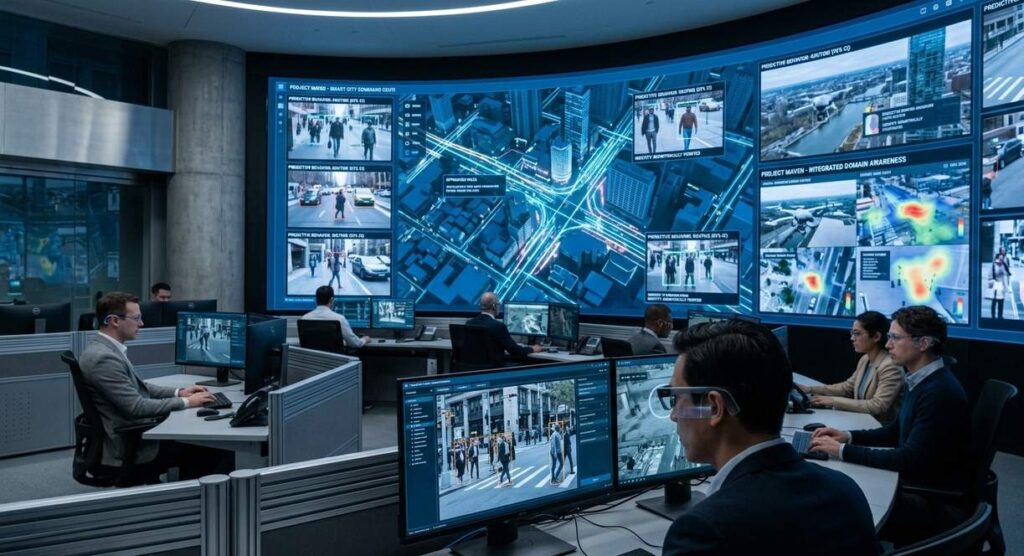
Computer vision has changed surveillance from recording to interpretation. A camera no longer only captures footage. Connected to AI systems, it can detect objects, flag anomalies, track movement, identify patterns, compare faces, and support decisions at speed.
Project Maven, launched by the United States Department of Defense in 2017, is one of the clearest military examples of this shift. Reporting in 2026 described Maven as a large-scale AI system used for analysing battlefield and sensor data, with tens of thousands of personnel using it and a major contract ceiling extended through 2029. Its symbolism is stark: the eye no longer simply sees. It calculates.
Civilian analogues appear in policing, border control, retail analytics, smart cities, workplace monitoring, corporate security, and urban management. The logic is similar even where the stakes differ: the image becomes data, the data becomes prediction, the prediction becomes intervention.
The archonic danger is not that computer vision is always wrong. It is that seeing can become ruling. Once a system claims the power to detect the pattern beneath behaviour, human ambiguity begins to look like noise.
2. Predictive Policing and Social Scoring: Correlation as Destiny
Predictive systems promise to identify risk before harm occurs. In theory, that sounds sensible. In practice, the danger is that prediction can transform correlation into destiny. If historical data reflects unequal policing, discrimination, poverty, or institutional bias, the model may treat those traces as neutral signals.
The European Union’s AI Act recognises some of these dangers. Its prohibited-practices provisions, applying from February 2025, include restrictions on certain forms of social scoring and AI systems used to predict a person’s risk of committing a criminal offence based solely on profiling or personality traits, with specific limits and exceptions.
China’s social credit system is often described in Western media as a single personal score for every citizen. That picture is too crude. The reality is more fragmented and heavily focused on regulatory compliance, especially for companies. Yet the broader template remains important: behaviour can be tracked, classified, rewarded, restricted, and made administratively consequential.
In Gnostic language, the ruler judges from below. It sees the record, not the whole person. It reads the shadow on the wall and calls it destiny.
3. Biometric Totalism: The Body as Password
Biometric systems turn the body into identity infrastructure. Face, fingerprint, iris, voice, gait, typing rhythm, touch pressure, scrolling behaviour, and device use can all become signals. Some uses are convenient and protective. Others dissolve the old boundary between person and system.
Biometric authentication markets continue to grow, with different market reports offering different figures and forecasts. The exact numbers vary by category, methodology, and region, but the direction is clear: biometric identification is expanding into finance, border systems, workplaces, devices, public services, and security environments.
The old password could be changed. The body cannot be swapped so easily. Once biometric traits become infrastructure, privacy is not merely breached. Identity itself becomes continuously legible.
The Gnostic image is severe: the body, which should be a living temple of experience, becomes a document presented to the watchers. Flesh becomes credential. Gesture becomes signature. Habit becomes key.
4. Algorithmic Curation: The Watched Self
Social media platforms, search systems, streaming services, shopping platforms, and digital assistants do not merely observe behaviour. They shape the field in which behaviour appears. What you see influences what you think. What you think influences what you click. What you click trains what you see next.
This is participatory surveillance. You feed the model with attention, and the model feeds you a version of yourself. The self becomes recursive: predicted, reinforced, refined, and returned as preference.
Research on algorithmic feeds, polarisation, and attention is complex. Reducing algorithmic amplification alone may not solve polarisation, because social identity, media ecosystems, emotional incentives, and offline structures also matter. But the broader issue remains: platforms do not merely host attention. They organise it.

The feed is an archonic mirror. It does not only show you what you want. It trains wanting. It does not only reveal identity. It edits identity through repetition.
5. The Military-Civilian Boundary Collapse
One of the most important developments in surveillance is the movement of techniques, vendors, and logics between military and civilian domains. Tools designed for battlefield awareness can influence border security, policing, maritime interdiction, disaster response, and domestic monitoring. Civilian data practices can also feed security and intelligence ecosystems.
The danger is not that every shared technology is illegitimate. The danger is that battlefield logic can quietly migrate into ordinary life. A city begins to look like a theatre of operations. A crowd becomes a target field. A person becomes a signal. A border becomes a sensor network. The grammar of conflict seeps into civic space.

This is the military-civilian blur as archonic formation: the watchtower leaves the battlefield and learns to speak in the language of public safety, optimisation, and convenience.
The Archonic Structure: Constraint Through Observation
In many Gnostic systems, the Archons are not simply evil in a cartoon sense. They are limiting powers. They administer a lower order. They maintain boundaries. They prevent recognition of the fullness beyond their jurisdiction. They mistake their partial realm for the whole.
Modern surveillance systems function archonically when they narrow life through observation, classification, prediction, and feedback. The person becomes known in one sense and obscured in another. The model sees the data trail, but not the soul.
The Bureaucracy of the Cosmic Cage
- Watching becomes ubiquitous data collection.
- Weighing becomes predictive scoring and risk assessment.
- Constraining becomes algorithmic curation and behavioural nudging.
- Preventing ascent becomes epistemic closure, filter bubbles, and attention capture.
- Imitating the divine becomes AI as oracle, system as authority, algorithm as fate.
- Maintaining ignorance becomes black-box opacity, unreadable terms, hidden ranking criteria, and unappealable decisions.
The archonic system does not need to imprison everyone by force. It only needs to shape the conditions under which people see, choose, fear, hope, and belong.
The Demiurge’s Engineers
The Demiurge, in Gnostic myth, is the lower craftsman who creates without ultimate wisdom. In the modern surveillance order, the Demiurge is not one engineer, one agency, one corporation, or one state. It is the institutional momentum of systems built to measure, optimise, predict, and control.
Data scientists, product teams, investors, security agencies, public administrators, platform designers, and policy makers may all build useful tools. Yet together they can also produce a watching order no single participant fully understands. The machine is built in pieces. The total system emerges like a cathedral no architect remembers approving.

This is not a call to demonise every builder. It is a call to recognise the system that appears when every builder says, “I only built my part.”
The Seduction of the Sublime
The surveillance sublime is seductive because it offers real benefits. Faster access. Easier authentication. Personalised content. Safer streets. Fraud detection. Emergency response. Better logistics. More relevant recommendations. The problem is not that these benefits are fake. The problem is that they are partial.
Convenience becomes the sacrament of the watching order. The system says: let me remember for you, choose for you, identify you, recommend for you, protect you, predict you. In exchange, the person gives data, attention, location, face, habits, body rhythm, desire, and finally trust.
The Gnostic Tragedy
In Gnostic terms, the tragedy is forgetfulness. The human being forgets the spark and mistakes the administered world for the whole of reality. In the digital version, even the search for transcendence can become data. Spiritual content becomes recommendation category. Meditation becomes productivity optimisation. Mysticism becomes a market segment. Gnosis becomes engagement.
This does not mean spiritual work should avoid technology entirely. But it does mean that practice must protect its centre from becoming content too quickly. What is immediately posted is immediately captured. Some experiences need to ripen before they are translated into feed-friendly fragments.
The Comfort of the Cage
There is comfort in the cage. A system that predicts needs reduces uncertainty. A feed that knows preferences reduces the burden of choice. A platform that remembers everything reduces the labour of memory. A biometric gate removes friction. A recommendation engine removes the empty room where desire might have to speak for itself.
The comfort is real. That is why it works. The cage is not only imposed. It is requested, subscribed to, upgraded, synced, and carried in the pocket. The key is inside the device, and the device is inside the hand.

Resistance: Gnosis Against the System
If surveillance becomes archonic, resistance must become gnostic. Not paranoid. Not nostalgic. Not a theatrical rejection of every tool. Gnostic resistance begins with recognition: seeing the system as system, not as nature.
1. Epistemic Resistance: Recognition as Liberation
The first act of resistance is knowing what is happening. Learn how platforms rank, how recommendation systems shape attention, how biometrics work, how data brokers operate, how location tracking happens, how predictive systems encode assumptions, and how “personalisation” often means behavioural modelling.
This is not paranoia. Paranoia sees threat everywhere without structure. Discernment sees the structure and refuses panic. To know that you are watched is not the same as being ruled by watching. The spell weakens when the mechanism is named.
2. Practices of Opacity: Cultivating Interiority
Privacy can become spiritual practice. Not because the self must hide in fear, but because not everything sacred should be rendered legible. Keep some thoughts unposted. Keep some walks untracked. Keep some prayers unrecorded. Keep some notebooks offline. Let some conversations vanish after being lived.
The experiential body is different from the biometric body. The biometric body is measured from outside: face, gait, voice, pattern, rhythm. The experiential body is known from within: breath, sensation, pulse, grief, warmth, stillness, tension, intuition, presence. The system can read the first more easily than the second.
To return to the sensing body is to reclaim a chamber the watcher cannot fully enter. The body becomes not a barcode, but a sanctuary with a stubborn little candle burning in the crypt.
3. Collective Gnosis: Communities of Recognition
Individual privacy settings are not enough. The surveillance order is systemic. Resistance therefore requires communities that remember together: families, study groups, local networks, independent archives, ethical technologists, privacy advocates, journalists, artists, spiritual communities, and ordinary people who refuse to let convenience swallow dignity whole.
The ancient Gnostic traditions survived through transmission: texts copied, teachings carried, memory preserved under pressure. Modern resistance also needs transmission. Teach people what dashboards hide. Share practical literacy. Preserve archives outside feeds. Build relationships not entirely mediated by platforms.
4. Glitches in the Grid
Total systems generate their own weaknesses. They depend on data quality, infrastructure, assumptions, vendors, integrations, incentives, and compliance. They overfit. They misread. They fail. They reveal bias. They create absurd outputs. They classify wrongly. They produce paper trails. They provoke resistance.
The glitch is not automatically liberation, but it is revelation. It shows that the system is not omniscient. It is built, trained, maintained, and breakable. The Archon stutters. The dashboard blinks. The god of prediction coughs into its own spreadsheet.

Watching and the Watched: The Final Recognition
We have built powers that watch. In building them, we risk becoming archonic ourselves: constrained by our own systems, ruled by our own efficiencies, imprisoned by our own desire to optimise life until it stops breathing.
The Gnostic tradition offers neither technophobia nor passive surrender. It offers recognition. The rulers are not ultimate. Their world is not the whole. Their measurements are not the soul. Their predictions are not destiny. Their visibility is not truth.
The surveillance sublime overwhelms because we mistake the system’s comprehensiveness for totality, its intelligence for wisdom, and its power for authority.
The question is not whether every watching system can be destroyed. Some cannot, and some should not be. The question is whether we can remain awake inside them. Can we use tools without becoming tools? Can we be visible without being reduced? Can we preserve a chamber of inwardness where the algorithm has no priestly authority?
The Archons are watching. What will we remember?

Related Glossary Terms
These terms help clarify the surveillance, Gnostic, technological, and psychological framework behind this article:
- Archons: ruling powers in Gnostic cosmology, often associated with false authority, limitation, ignorance, and cosmic administration.
- Demiurge: lower craftsman figure in some Gnostic systems, symbolising creation or administration without full wisdom.
- Gnosis: direct liberating knowledge or recognition, not merely belief or information.
- Panopticon: model of surveillance in which the possibility of being watched produces self-regulation.
- Surveillance sublime: the mixture of awe and terror produced by vast, elegant, invisible watching systems.
- Algorithmic curation: automated selection and ranking of content, options, or information environments.
- Predictive policing: use of data systems to forecast crime risk, often criticised for reinforcing historical bias.
- Biometric authentication: use of bodily traits such as face, fingerprint, iris, voice, gait, or behaviour to verify identity.
- Behavioural biometrics: identification or authentication based on patterns such as typing rhythm, mouse movement, touch pressure, or scrolling style.
- Data broker: company or entity that collects, aggregates, sells, or analyses personal data from multiple sources.
- Epistemic closure: narrowing of information exposure so that disconfirming evidence becomes less visible or less credible.
- Filter bubble: personalised information environment that reinforces existing interests, beliefs, or behaviours.
- Interiority: inner life that cannot be fully translated into data, performance, or visible behaviour.
- Algorithmic sovereignty: the practice of retaining conscious agency, attention, and discernment inside algorithmically shaped environments.
Read Next
For the strongest next step, continue into the companion article on AI as a ruling power:
AI as Archon: Algorithmic Governance and the Loss of Autonomy
This related article examines how AI systems watch, weigh, imitate, recommend, and constrain through black-box governance, synthetic media, engagement loops, and automated decision-making.
Frequently Asked Questions
What is the surveillance sublime?
The surveillance sublime is the mixture of awe and unease created by modern watching systems. These systems are powerful, elegant, useful, and frightening because they do not only observe. They predict, rank, authenticate, curate, and shape behaviour. The sublime appears when surveillance becomes so vast and invisible that it feels less like a tool and more like an environment.
What does archontic surveillance mean?
Archontic surveillance means surveillance that behaves like the Archons of Gnostic cosmology: ruling powers that watch, weigh, constrain, and maintain a lower order through ignorance and limitation. It does not mean cameras or algorithms are literally supernatural beings. It means modern surveillance systems can function structurally like Archons when they reduce people to data, scores, risk profiles, or behavioural predictions.
How is modern surveillance different from Bentham’s panopticon?
Bentham’s panopticon relied on visible architecture: a central tower and prisoners who never knew when they were being watched. Modern surveillance no longer needs one tower. It is distributed through phones, cameras, apps, platforms, biometric systems, workplace software, payment systems, and recommendation engines. The watched person often carries the watcher voluntarily because the device is also useful.
Why are biometric systems spiritually significant?
Biometric systems are spiritually significant because they turn the body into identification infrastructure. Face, voice, fingerprint, gait, and behavioural patterns become credentials. This can be useful for security, but it also changes the relationship between body and system. The living body risks becoming a readable document rather than an inwardly inhabited temple.
What is predictive policing and why is it criticised?
Predictive policing uses data and models to forecast crime risk or direct police attention. It is criticised because historical data can reflect historical bias. If certain communities were over-policed in the past, the data may reinforce future over-policing. The model can make old injustice look like objective prediction, creating a feedback loop between surveillance, intervention, and new data.
How can someone resist algorithmic surveillance?
Resistance begins with recognition. Practical steps include reducing unnecessary data sharing, disabling non-essential tracking, using analogue tools, reading outside algorithmic feeds, protecting offline space, practising direct attention, and keeping some experiences unrecorded. The goal is not rejecting all technology, but preventing technology from becoming an invisible ruler of attention and identity.
Is concern about surveillance the same as paranoia?
No. Discernment and paranoia are different. Paranoia sees threat everywhere and often increases fear. Discernment studies real systems, names their mechanisms, and makes grounded choices. A healthy approach to surveillance recognises genuine risks without losing touch with ordinary reality, community, humour, embodiment, and practical action.
Study Note: This article explores surveillance, AI, biometric systems, predictive policing, platform curation, and Gnostic symbolism for educational and reflective purposes. It does not provide legal, cybersecurity, psychological, medical, employment, or personal security advice. If you are dealing with stalking, digital harassment, workplace surveillance, legal harm, algorithmic discrimination, state monitoring, or severe anxiety about being watched, seek qualified legal, technical, or mental health support. Privacy practices and digital minimalism should be adapted to your actual circumstances, especially where work, healthcare, housing, safety, benefits, or essential services are involved.
Follow the Modern Systems Route
This article belongs to ZenithEye’s modern systems route: AI, surveillance, attention capture, digital governance, simulation, and the old patterns wearing new technical masks.
- AI, Technology & Archonic Systems – AI, automation, algorithmic governance, and digital Demiurge patterns.
- Digital Attention & Surveillance – attention capture, screens, metrics, watching systems, and behavioural loops.
- The Thread – the main route through ZenithEye’s symbolic, historical, and contemporary architecture.
- Editorial Principles – how ZenithEye handles symbolic interpretation, evidence, and reader safety.
Further Reading
The following live ZenithEye links continue the themes of surveillance, AI, archonic systems, digital attention, simulation, and modern Gnostic resistance:
- AI as Archon: Algorithmic Governance and the Loss of Autonomy – The direct companion article on AI systems as modern ruling powers that watch, weigh, curate, and constrain.
- AI as the New Demiurge: Yaldabaoth in the Digital Age – Algorithmic creation, digital worlds, synthetic authority, and the return of the Demiurge through AI.
- Archons: The Ruling Powers That Shape Reality – The core Gnostic concept behind ruling systems that administer, constrain, imitate, and obscure.
- Gnosis in the Digital Age: Reclaiming Your Sovereignty from the Algorithm – Attention discipline, digital sovereignty, and practical resistance inside algorithmically shaped environments.
- The Gnostic Matrix: Reality as Information System – The symbolic overlap between Gnostic cosmology, simulation thinking, and structured reality systems.
- Predatory Consciousness and Spiritual Emergency – How exploitative forces, inner and outer, can feed on vulnerability, fear, and destabilised awareness.
- The Living Thread: How Forbidden Knowing Survives the Fire – Historical transmission of Gnostic insight through suppression, survival, and rediscovery.
- Consciousness as Interface: The User Experience of Being – How awareness navigates structured systems without becoming fully captured by them.
- Simulation Hypothesis: 7 Arguments That Reality Is Code – Simulation, coded reality, entity environments, and the question of whether perception is being rendered.
- Quantum Utility and the Glitch in the Matrix: Escaping Archonic Computation – Quantum indeterminacy, symbolic glitches, and the limits of deterministic prediction.
References and Sources
The following sources support the Gnostic, surveillance, AI governance, legal, historical, and psychological framework used in this article.
Gnostic and Theoretical Sources
- Apocryphon of John. Nag Hammadi Codex II,1; III,1; IV,1; Berlin Codex 8502,2.
- Hypostasis of the Archons. Nag Hammadi Codex II,4.
- On the Origin of the World. Nag Hammadi Codex II,5; XIII,2.
- Robinson, James M., ed. (1990). The Nag Hammadi Library in English. Revised edition. San Francisco: HarperOne.
- Meyer, Marvin, ed. (2007). The Nag Hammadi Scriptures. New York: HarperOne.
- Jonas, Hans. (1958). The Gnostic Religion. Boston: Beacon Press.
- Foucault, Michel. (1977). Discipline and Punish: The Birth of the Prison. Translated by Alan Sheridan. New York: Pantheon.
- Bentham, Jeremy. (1791). Panopticon; or, The Inspection-House.
Surveillance, Platforms, and Digital Power
- Zuboff, Shoshana. (2019). The Age of Surveillance Capitalism. New York: PublicAffairs.
- Lyon, David. (2018). The Culture of Surveillance: Watching as a Way of Life. Cambridge: Polity.
- Andrejevic, Mark. (2020). Automated Media. New York: Routledge.
- Pasquale, Frank. (2015). The Black Box Society: The Secret Algorithms That Control Money and Information. Cambridge: Harvard University Press.
- Noble, Safiya Umoja. (2018). Algorithms of Oppression: How Search Engines Reinforce Racism. New York: NYU Press.
- Eubanks, Virginia. (2018). Automating Inequality: How High-Tech Tools Profile, Police, and Punish the Poor. New York: St. Martin’s Press.
- O’Neil, Cathy. (2016). Weapons of Math Destruction. New York: Crown.
- Pariser, Eli. (2011). The Filter Bubble: What the Internet Is Hiding from You. New York: Penguin Press.
AI, Governance, and Regulation
- European Union. (2024). Artificial Intelligence Act. Regulation laying down harmonised rules on artificial intelligence, including prohibited practices and high-risk obligations.
- European Commission. AI Act: Regulatory Framework for Artificial Intelligence. Official policy overview and implementation timeline.
- National Institute of Standards and Technology. (2023). Artificial Intelligence Risk Management Framework (AI RMF 1.0). U.S. Department of Commerce.
- Rudin, Cynthia. (2019). “Stop Explaining Black Box Machine Learning Models for High Stakes Decisions and Use Interpretable Models Instead.” Nature Machine Intelligence, 1, 206-215.
- Burrell, Jenna. (2016). “How the Machine Thinks: Understanding Opacity in Machine Learning Algorithms.” Big Data & Society, 3(1).
- Citron, Danielle Keats. (2008). “Technological Due Process.” Washington University Law Review, 85(6), 1249-1313.
Military AI, Project Maven, and Autonomous Systems
- Manson, Katrina. (2026). Project Maven: A Marine Colonel, His Team, and the Dawn of AI Warfare. Public excerpts and reporting on the development and deployment of Maven.
- Reuters. (2026). Reporting on the Pentagon’s adoption of Palantir’s Maven AI system as a core military command-and-control platform.
- Center for Strategic and International Studies. (2026). What Is Maven Smart System, and What Does It Do?
- United Nations General Assembly. (2024). Resolution A/RES/79/62: Lethal Autonomous Weapons Systems.
- International Committee of the Red Cross. Autonomous Weapon Systems and International Humanitarian Law. Policy and legal materials on autonomy in weapons systems.
Biometrics, Social Credit, and Predictive Systems
- Research and Markets. (2026). Next-Gen Biometric Authentication Market Report 2026.
- Mordor Intelligence. (2026). Next Generation Biometrics Market Size and Share Forecast.
- State Council Information Office of the People’s Republic of China. (2025). Public materials on improving China’s social credit system and credit platform development.
- CMS China. (2026). Corporate Social Credit System in China: Top 20 FAQ.
- Brayne, Sarah. (2020). Predict and Surveil: Data, Discretion, and the Future of Policing. Oxford: Oxford University Press.
- Ferguson, Andrew Guthrie. (2017). The Rise of Big Data Policing: Surveillance, Race, and the Future of Law Enforcement. New York: NYU Press.