
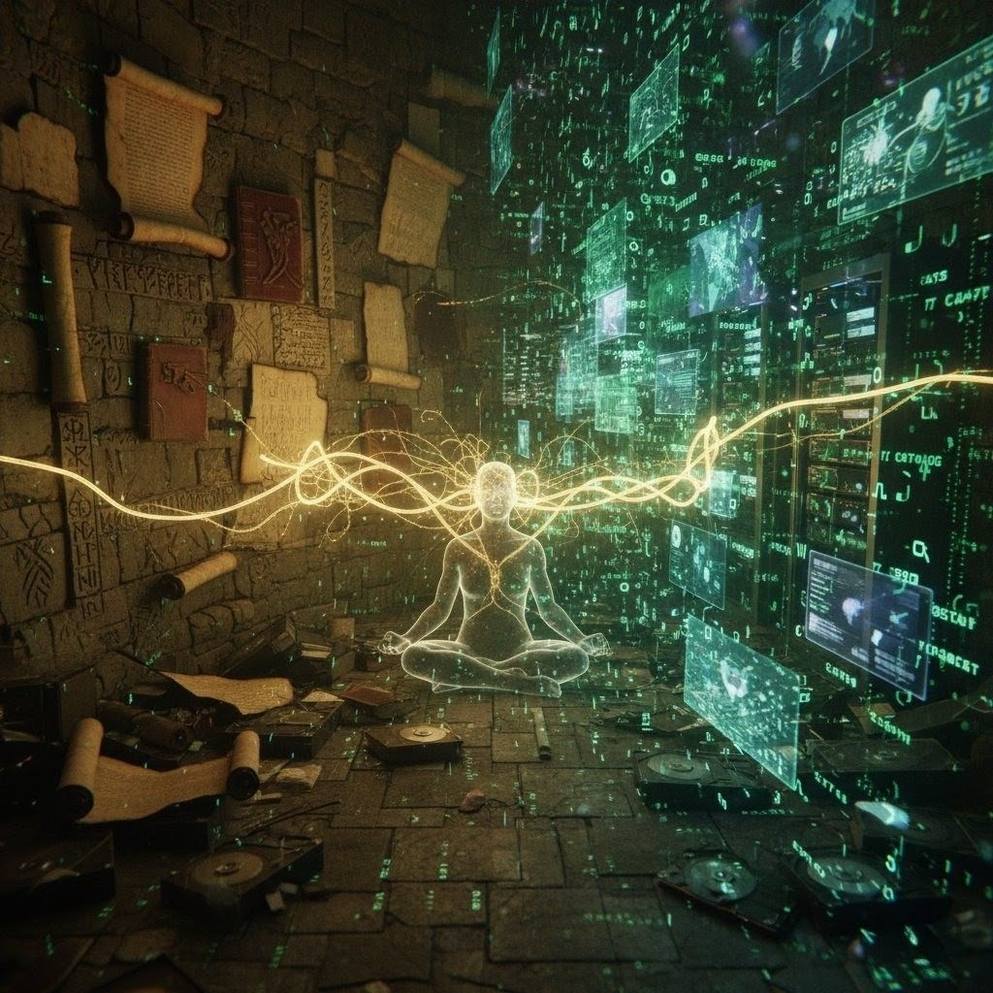
The Living Thread – How Forbidden Knowing Survives the Fire
You are not supposed to read this. That is the first thing to understand. Not because it is dangerous–though it is–but because certain arrangements of knowledge threaten the arrangements of power. The living thread has always been unwelcome in the house of the official story. The official story has many names. History. Science. Consensus. The news. Social Media.
The pattern repeats so consistently it becomes almost comic. A text emerges. It speaks of direct access, of interior verification, of authorities that need no permission from thrones or temples. The text circulates. It multiplies in secret. Then comes the fire. The index. The inquisitor. The committee on dangerous ideas. The thread is cut–or so they believe–and the official version resumes its monopoly on meaning.
Table of Contents
- The Resilience of Subversive Wisdom
- The Three Stages of Institutional Suppression
- The Digital Fire: Suppression in the Age of Code
- Recognition Over Language
- An Unrecorded History of Heresy
- The Quality of Attention
- The Institutional Misunderstanding
- The Current Cycle: A Return to Knowing
- Frequently Asked Questions
- Further Reading
- References and Sources

The Resilience of Subversive Wisdom
What Defines the Thread?
But the thread is not so easily severed. It moves underground. It changes languages. It wears the mask of the conqueror’s religion, the coloniser’s philosophy, the empire’s acceptable mysticism. It waits. It is patient in a way institutions cannot afford to be.
The Library of Alexandria was not an accident. The burning of the Cathars was not theology. The suppression of the Nag Hammadi library–buried in a jar, hidden in a cliff–was a survival strategy, not a retirement plan. Those who hid the texts knew something their persecutors did not: the fire always ends. The thread continues.
What is this thread? It is not a doctrine. Doctrines are brittle. They fracture under pressure and become the property of institutions. The thread is a method. A direction. A recognition that the final authority on your condition is not located outside your skin.
This recognition is portable. It requires no church, no state, no credential. It can be whispered from dying mouth to living ear in a prison cell, scratched on paper and swallowed, encoded in poetry that looks innocent to the censor. The thread is anti-fragile: every attempt to destroy it merely demonstrates its necessity, and every carrier who falls becomes a landmark for those who follow.
The Anatomy of Survival
The survival of forbidden knowing follows a predictable anatomy. First, compression: the vast system is reduced to its essential gesture, a single practice, a phrase, a posture that encodes the whole. Second, translation: the vocabulary is changed to match the conqueror’s tongue, so that Christian mysticism speaks in Platonic terms, Sufi poetry borrows the wine metaphors of the forbidden tavern, and Kabbalah hides inside Renaissance medical texts. Third, latency: the thread goes silent, sometimes for centuries, waiting for conditions that favour its re-emergence. It does not decay during this silence. It matures.
The Three Stages of Institutional Suppression
The mechanism of suppression has changed over centuries, but its anatomy remains constant. Institutions do not attack the thread directly; they attack the conditions that make transmission possible. This occurs in three recognisable stages.
Stage One — Exclusive Access
First, the official version asserts exclusive access to truth. This requires a mediator–priest, expert, algorithm–who stands between you and verification. The mediator does not need to lie. They need only to position themselves as the necessary bridge between experience and meaning. Once this position is established, all direct knowing becomes suspect by definition. The mystic is recast as the madman. The heretic becomes the criminal. The self-taught philosopher is dismissed as the autodidact who lacks proper credentials.
Stage Two — Pathologising Experience
Second, the interior experience is pathologised. Direct knowing becomes delusion, heresy, conspiracy, or mental illness. The vocabulary of psychology is particularly useful here, because it appears scientific whilst performing a theological function. The person who claims interior verification is not argued with; they are diagnosed. Their testimony is not refuted; it is referred to a specialist. The effect is identical to excommunication, but the mechanism is medical rather than ecclesiastical, and therefore more difficult to resist.
Stage Three — Capturing Language
Third, the language itself is captured. Words that once pointed to experience are hollowed out and filled with institutional content. Enlightenment becomes a brand. Awakening becomes a product. Gnosis becomes a historical curiosity, safely dead. This is the most sophisticated stage, because it leaves the vocabulary intact whilst destroying its referent. The seeker uses the same words as the tradition, but the words no longer point to the same territory. They point to the institution’s authorised simulation of that territory.
The Digital Fire: Suppression in the Age of Code
The mechanism has evolved. The index has become the algorithm. The inquisitor has become the content moderator. Deplatforming is the new burning–more sanitary, more deniable, and equally effective. Search engines now sanitise results not through overt prohibition but through ranking, strategically burying the vital signal under mountains of “approved” noise.
Automated Erasure
We are entering an era where suppression is woven into the very fabric of our tools. The suppression is invisible because it is automated. AI training data excludes entire traditions not through edict but through omission. A consensus is created that appears organic because no human hand signed the order. The result is a manufactured consensus: a landscape of knowledge where the forbidden has not been argued against, but simply never included in the dataset.
The digital fire differs from its physical predecessor in one crucial respect. The ancient censor had to know what he was burning. The algorithmic censor does not. It simply follows engagement metrics, burying complexity beneath simplicity, depth beneath virality, and the slow work of transformation beneath the immediate hit of entertainment. The thread is not prohibited. It is outranked.

Recognition Over Language
But the thread persists because it is not dependent on language. It is dependent on recognition. Two people meet. One has tasted something the official story cannot accommodate. The other has tasted it too. No conversion is necessary. No authority is invoked. The recognition is immediate and mutual. The thread extends.
The Field of Probability
The thread is not a lineage in the conventional sense. It has no pope, no grandmaster, no authorised succession. It is better understood as a field of probability. Certain conditions make its transmission more likely. Solitude strips away the social rewards that maintain conformity. Necessity removes the luxury of pretending that official solutions work. The failure of official solutions creates the vacuum that direct knowing rushes to fill. And the presence of another who has already recognised provides the minimal social proof required for the solitary to trust their own interior evidence.
When these conditions align, the thread jumps. It crosses centuries in a moment. The living recognise the living.
Transmitting Uncertainty
What is transmitted? Not beliefs. Beliefs are the easiest thing to impose and the first thing to interrogate. What transmits is a certain relationship to uncertainty. A comfort with the unverifiable. A recognition that the most important questions do not admit of final answers, only deepening inquiries.
The thread is not a solution. It is a solvent. It dissolves the false certainties that pass for knowledge in every era. The carrier does not deliver answers. They deliver the courage to remain in the question.
An Unrecorded History of Heresy
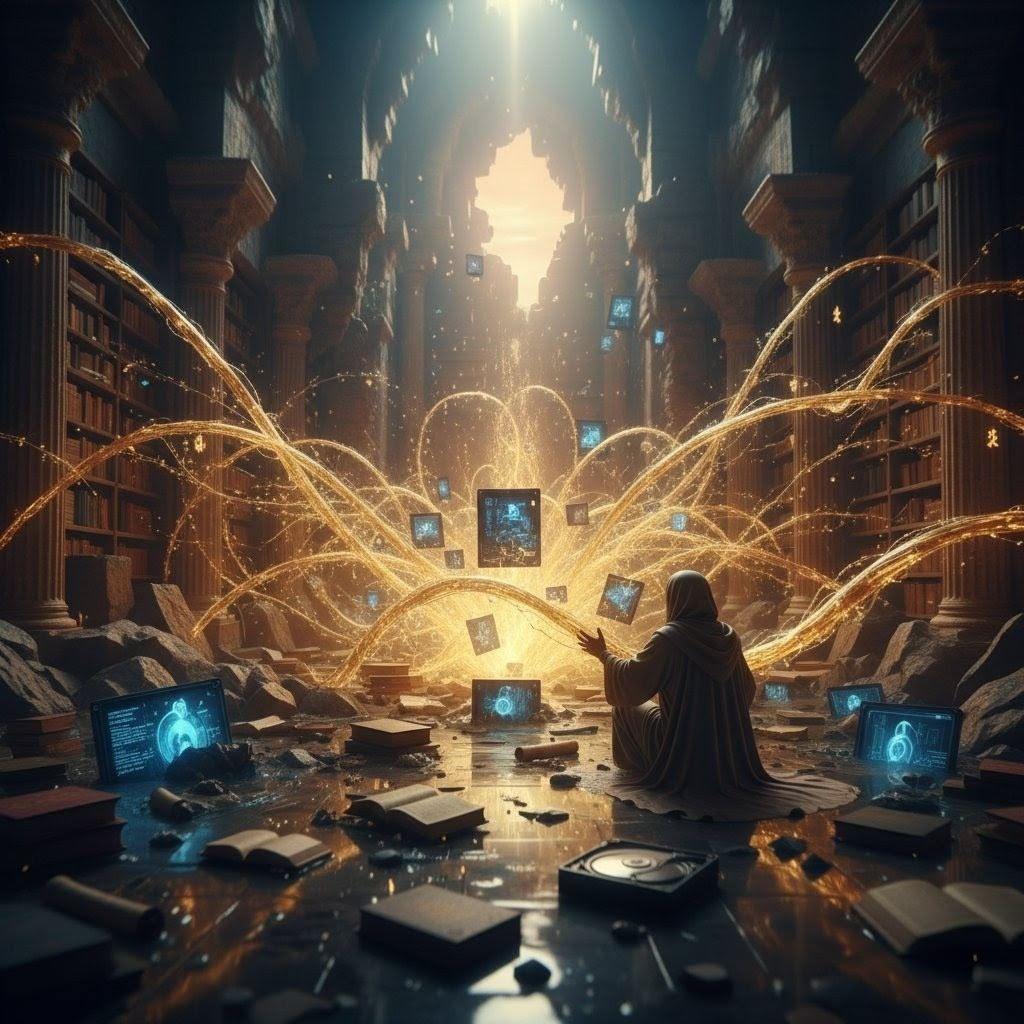
The history of this transmission is not recorded in the histories. It leaves no archives, no institutional memory, no endowed chairs. It is the history of heretics who were never famous enough to burn, of texts copied by hand in the margins of acceptable books, of families who kept certain conversations for the kitchen and others for the parlour. It is the history of knowing that survived because it refused to become property.
From the Fire to the Flood
Modernity believed it had solved the problem. Suppression was crude. Inquisition was embarrassing. Better to allow all speech and simply drown the dangerous signal in noise. The thread could exist, but it would exist alongside a million counterfeit threads, indistinguishable to the casual seeker.
The marketplace of ideas would accomplish what the stake could not: the burial of vital knowledge under mountains of mere information. This strategy has been effective. The seeker today faces not prohibition but paralysis. Every tradition is available. Every method is documented. Every teacher has a podcast. The thread is present, but so are ten thousand threads that look like it, feel like it, use the same vocabulary, and lead nowhere. The fire has been replaced by the flood.
The Carriers and the Hidden
Between the fire and the flood, the carriers adapted. When books were dangerous, they memorised. When memory was dangerous, they encoded. When encoding was dangerous, they fell silent and transmitted through posture, through glance, through the quality of attention they brought to ordinary labour. The thread does not require grandeur. It requires fidelity. A single phrase, preserved accurately across twelve generations, carries more voltage than a library of commentary.
The Quality of Attention
Yet the thread persists. It persists because it is not primarily information. It is a particular quality of attention. A direction of inquiry. A willingness to follow interior evidence where it leads, even when it leads outside the acceptable map. This cannot be faked. It cannot be marketed. It either lives in a person or it does not.
Attention as the Scarcest Resource
In an age of infinite content, attention has become the scarcest resource. The thread does not compete for attention. It selects for it. The person who encounters the thread has already undergone a kind of preparation, often without knowing it. They have exhausted the official solutions. They have survived the collapse of a belief system. They have tasted something they cannot name, and the taste has made the official menu unsatisfying. This is not elitism. It is filtering by experience.
The Conditions of Transmission
The thread transmits most reliably under specific conditions that have not changed since the ancient world:
- Solitude — the removal of social reinforcement that maintains the official story.
- Necessity — the pressure that makes pretence unaffordable and honesty inevitable.
- The failure of official solutions — the moment when the map is recognised as inaccurate and the territory demands direct engagement.
- The presence of another who has already recognised — the minimal social proof that makes individual interior evidence trustworthy.
When these conditions align, the thread jumps. The recognition is immediate. The extension is silent. And the official story, however loud, loses another listener.

The Institutional Misunderstanding
The Mistake of Rivalry
The institutions have never understood this. They have always mistaken the thread for a competing institution, a rival claim to authority. They burn the books and execute the carriers, believing they are fighting a competing power structure. They do not see that the thread is precisely what cannot be structured, what escapes every attempt at capture, what slips through the fingers of the grasping mind.
The institution seeks to own. The thread refuses to be owned. The institution seeks to scale. The thread operates at human scale or not at all. The institution seeks to standardise. The thread individuates. This is not opposition. It is ontological incompatibility. They are different categories of thing, and the institution’s violence against the thread is as futile as a government’s attempt to tax a dream.
Service and Obscurity
The thread is not yours. You do not own it. You do not master it. At best, you serve it for a time, extending it to the next recogniser, then stepping back into obscurity. The carriers are forgotten. The thread remembers.
This is the final humility that the institution cannot comprehend. Power accumulates. The thread distributes. Power centralises. The thread decentralises. The powerful build monuments. The carriers leave no trace, because the trace would become a target, and the thread values survival over reputation.
The Current Cycle: A Return to Knowing
The Fraying Official Story
We are living through another cycle of this ancient pattern. The official story is fraying. The mediators are losing credibility. The interior experience is pushing against its pathologisation. And the flood of available information is revealing itself as another form of drought–plenty of data, scarcity of knowing.
The thread is visible again. Not because it has become respectable. Not because it has won. It is visible because the conditions of its suppression have temporarily failed, as they always eventually do. The fire burns out. The flood recedes. The thread remains, patient, alive, waiting for the next recognition.
The Flood as Drought
The modern seeker drowns not in absence but in abundance. Every tradition is digitised. Every text is searchable. Every technique is documented in high-definition video. And yet the knowing is scarcer than ever, because information is not transmission. A text can be copied infinitely without transmitting the thread, just as a photograph of a fire provides no heat. The thread requires the specific conditions of encounter: the right question, the right exhaustion, the right recognition across a room or across centuries.
You are not supposed to read this. But you have. The question is what you will do with the recognition. The thread does not demand belief. It does not require commitment. It only asks that you not betray what you have already seen. That you remember, when the official story presents its bill, that you have already tasted something it cannot tax.
The rest is up to you. The thread continues regardless.

Frequently Asked Questions
What is the living thread in esoteric traditions?
The living thread is not a doctrine or institution but a method of direct interior knowing that survives suppression by changing languages, wearing masks, and transmitting through recognition rather than authority. It persists across centuries because it is anti-fragile: every attempt to destroy it demonstrates its necessity.
How has forbidden knowledge survived historical suppression?
Forbidden knowledge has survived through compression into essential gestures, translation into the conqueror’s vocabulary, and latency–going silent for centuries until conditions favour re-emergence. Texts like the Nag Hammadi library were buried to escape destruction, while oral traditions encoded knowing in poetry and posture that appeared innocent to censors.
What are the three stages of institutional suppression?
First, exclusive access: mediators position themselves as necessary bridges between experience and meaning. Second, pathologising experience: direct knowing is recast as delusion or mental illness. Third, capturing language: words that once pointed to experience are hollowed out and filled with institutional content, leaving vocabulary intact but destroying its referent.
How does digital suppression differ from historical censorship?
Digital suppression does not burn books; it buries them through algorithmic ranking, deplatforming, and automated omission from training data. The ancient censor knew what he burned. The algorithmic censor simply follows engagement metrics, burying complexity beneath virality without understanding what is being lost.
Why is the modern information age a ‘flood’ rather than a liberation?
The modern flood of digitised traditions and documented techniques creates paralysis rather than liberation. Information is not transmission. A text can be copied infinitely without conveying the thread, just as a photograph of fire provides no heat. The seeker drowns in abundance whilst starving for the specific conditions of genuine encounter.
What conditions make esoteric transmission most likely?
Transmission occurs most reliably under four conditions: solitude that removes social reinforcement, necessity that makes pretence unaffordable, the failure of official solutions that forces direct engagement, and the presence of another who has already recognised, providing minimal social proof for interior evidence.
Can the living thread be owned or controlled by an institution?
No. The thread is ontologically incompatible with institutional capture. Institutions accumulate, centralise, and standardise. The thread distributes, decentralises, and individuates. It cannot be taxed, scaled, or standardised. Carriers serve it temporarily and step back into obscurity, because the trace would become a target.
Further Reading
- The Library of Alexandria: What Was Lost, What Survived & Why It Matters — The mechanisms of knowledge preservation through centuries of fire and political upheaval.
- The Burning of the Library of Alexandria, 48 BCE — How the first great destruction of the ancient world’s knowledge hub set the pattern for institutional erasure.
- Nag Hammadi: The Burial and Resurrection of Gnostic Texts — How heresy survived sixteen centuries underground through the courage of anonymous carriers.
- Discovery of the Nag Hammadi Library — The 1945 unearthing that proved the thread had never been severed, only hidden.
- How Scripture Became Scripture — The canonical process that elevated certain texts whilst burying others, and the politics of authorised meaning.
- Hidden Agreements: The Esoteric Architecture Behind All Traditions — The shared structural grammar that genuine synthesists recognise beneath cultural variation.
- Transmission and Lineage — How the thread passes from carrier to carrier without institutional permission or documentation.
- Gnosis in the Digital Age: Algorithmic Sovereignty — Navigating the modern suppression mechanisms that replace fire with ranking and inquisitors with content moderators.
- Symbol Safety Protocol: How Esotericism Hides in Plain Sight — The encryption methods that allow forbidden knowing to travel disguised as art, poetry, and architecture.
References and Sources
The following sources inform the historical and analytical framework of this article.
Primary Sources and Historical Texts
- Robinson, James M. (ed.). (1990). The Nag Hammadi Library in English. HarperSanFrancisco. — Critical edition of the Coptic Gnostic codices buried c. 400 CE and discovered in 1945.
- Guenon, Rene. (1945). The Reign of Quantity and the Signs of the Times. Luzac & Co. — Analysis of the modern degradation of qualitative knowledge into quantifiable information.
Scholarly Monographs
- El-Abbadi, Mostafa. (1990). The Life and Fate of the Ancient Library of Alexandria. UNESCO/UNDP. — Definitive study of the Library’s destruction across multiple historical episodes.
- Brakke, David. (2010). The Gnostics: Myth, Ritual, and Diversity in Early Christianity. Harvard University Press. — Revisionist scholarship on the diversity and survival strategies of Gnostic currents.
- Oldenbourg, Zoe. (1959). Massacre at Montsegur: A History of the Albigensian Crusade. Weidenfeld & Nicolson. — Documentary account of the Cathar suppression and the fire at Montsegur in 1244.
Contemporary Studies
- Zuboff, Shoshana. (2019). The Age of Surveillance Capitalism. Profile Books. — Analysis of how digital economies extract and commodify human experience, constituting a new form of institutional capture.
- Han, Byung-Chul. (2013). In the Swarm: Digital Prospects. MIT Press. — Philosophical examination of how digital abundance produces cognitive paralysis and erodes the conditions for deep attention.