Transmission and Lineage: How the Gnosis Travels
Gnosis does not travel like ordinary information. It can be written down, copied, translated, archived, taught, and debated, but none of those acts by themselves create direct knowing. Gnosis is recognition: the moment when a teaching becomes alive inside the reader, practitioner, or community that receives it.
This is why transmission and lineage matter. Spiritual knowledge survives through books, but it does not live in books alone. It travels through teachers, communities, oral memory, symbolic codes, ritual gestures, contemplative practice, hidden chains, shared language, and the mysterious shock of recognition across time. A text may preserve the words. A living current makes those words burn.
This article explores how the Gnosis travels: through initiation, community, scripture, secrecy, symbolic concealment, direct experience, digital archives, and ethical responsibility. The aim is not to romanticise every claim of lineage. The aim is discernment. Some transmissions are living. Some are broken. Some are invented. Some are preserved quietly in plain sight, waiting for the reader who can recognise the thread.

In Plain Terms
Transmission is the passing on of spiritual knowledge, practice, orientation, and recognition from one person, community, text, or tradition to another.
Lineage is the thread of continuity that links a present teaching or practice to earlier sources, teachers, communities, texts, or ways of seeing.
Gnosis cannot be reduced to information. A person may read Gnostic texts without receiving gnosis. The text gives a map; practice, discernment, experience, and transformation make the map meaningful.
The central question is authenticity. Does a claimed transmission deepen freedom, humility, ethical clarity, direct knowing, and embodied life, or does it create dependence, fantasy, inflation, secrecy, and control?
Primary Sources and Traditions Discussed
- Nag Hammadi texts: especially the Apocryphon of John, Gospel of Thomas, Gospel of Philip, Thunder: Perfect Mind, and Allogenes, where revelation, secrecy, interpretation, and recognition all matter.
- Valentinian and Sethian traditions: early Gnostic currents where teaching, myth, sacrament, interpretation, and community shaped spiritual continuity.
- Hermetic tradition: the transmission of wisdom through teacher-dialogue, philosophical ascent, sacred mind, and texts attributed to Hermes Trismegistus.
- Apostolic and initiatory succession: institutional and esoteric models of continuity, including the difference between formal authority and living recognition.
- Oral and communal practice: the role of shared ritual, reading, interpretation, prayer, contemplative practice, and ethical embodiment.
- Symbolic and steganographic transmission: the hiding of teachings inside myth, poetry, ritual, scripture, art, alchemy, and layered language.
- Modern archives and digital access: the opportunity and danger created when once-restricted texts become available without the older contexts of preparation.
- Gnostic discernment: the need to test lineage claims by their fruit rather than by glamour, secrecy, cost, charisma, or inherited titles alone.
How to Read This Article
This article is historical, symbolic, and contemplative. It does not certify any modern lineage, organisation, teacher, occult order, church, school, or private revelation. It offers tools for thinking carefully about how spiritual knowledge survives and how claims of transmission can be tested.
Three layers should be kept distinct. Historical lineage asks whether a teaching has visible continuity with older sources. Living transmission asks whether a teaching awakens direct recognition and transformation. Ethical fruit asks whether the transmission produces humility, clarity, compassion, responsibility, and freedom.
The Gnostic task is not to collect secret credentials. It is to recognise what is true, embody it, and refuse both empty repetition and spiritual fantasy.
A lineage is not alive because it is old. It is alive because recognition still passes through it.
Table of Contents
- The Living Thread: How Knowledge Becomes Transmission
- Text and Recognition: Why Books Are Not Enough
- Seven Ways Gnosis Travels Through Time
- 1. Teacher to Student: The Direct Flame
- 2. Community of Practice: The Shared Vessel
- 3. Textual Survival: The Archive as Seed Bank
- 4. Symbolic Concealment: Hidden in Plain Sight
- 5. Ritual and Body: Knowledge Made Gesture
- 6. Inner Recognition: When the Reader Becomes the Site
- 7. Digital Transmission: Access Without Preparation
- Criteria of Authenticity: Testing Claims of Lineage
- The Invisible Order: Literal, Symbolic, or Psychological?
- The Ethics of Receiving the Thread
- The Gnostic Reading: No Chain Replaces Direct Knowing
- Related Glossary Terms
- Read Next
- Frequently Asked Questions
- Further Reading
- References and Sources
The Living Thread: How Knowledge Becomes Transmission
Transmission begins where information becomes living. A doctrine can be copied. A myth can be memorised. A ritual can be imitated. A phrase can be repeated until it becomes familiar. Yet none of this guarantees gnosis. Direct knowing is not created by possession of material. It appears when the material becomes transparent to what it points towards.
This is why ancient traditions cared so deeply about preparation. A teaching was not simply “available” or “unavailable”. It had to meet the right receiver at the right depth. The same saying could be a riddle to one person, poetry to another, and revelation to a third. The words did not change. The reader did.
Institutional religion often protects continuity through visible offices: ordination, succession, doctrine, canon, and authorised teachers. Esoteric transmission often moves differently. It may pass through marginal teachers, small communities, buried texts, coded symbols, dreamlike recognition, family memory, solitary practice, or the unexpected encounter with a book that seems to have been waiting for the reader.
Neither model is automatically pure. Institutions can preserve memory, but they can also harden living insight into control. Esoteric currents can keep the flame alive, but they can also drift into fantasy, secrecy, and self-invented authority. The living thread must be tested by what it produces.
Text and Recognition: Why Books Are Not Enough
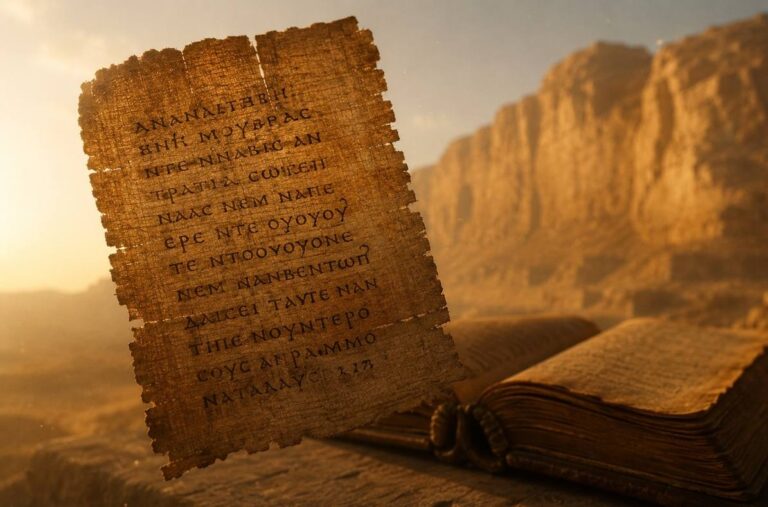
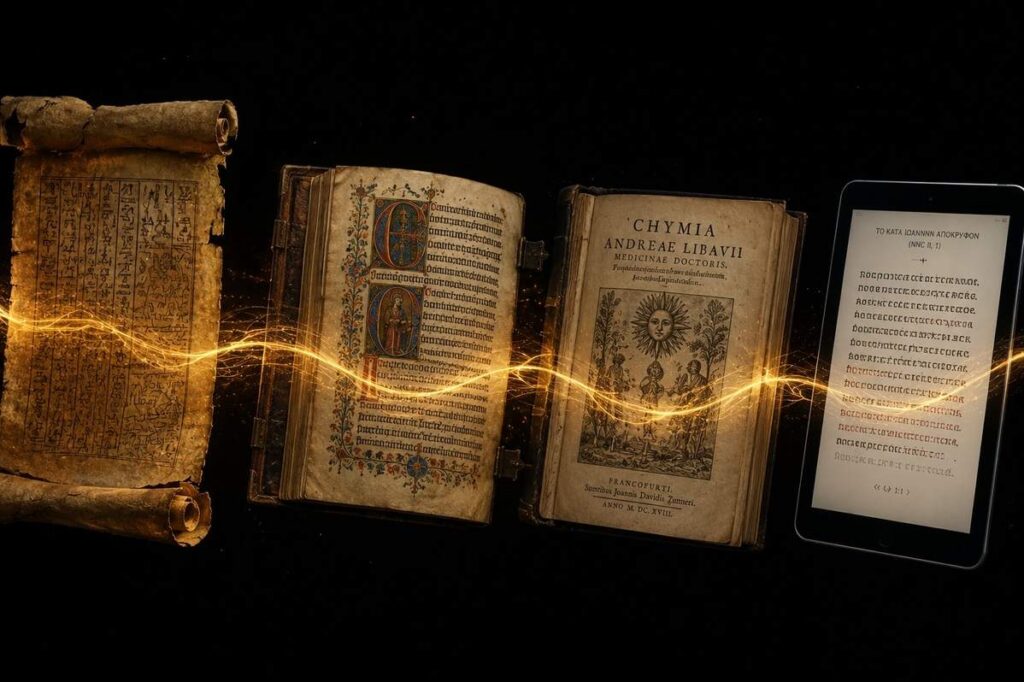
The Nag Hammadi Library presents the central paradox of esoteric transmission. Many of its texts frame revelation as restricted, difficult, or meant for the prepared. Yet those revelations were written, copied, preserved, bound, buried, rediscovered, translated, printed, digitised, and placed before modern readers across the world.

The answer is that a text can preserve the shape of revelation without automatically producing revelation in every reader. A map may show a mountain, but the map does not climb. A recipe may describe bread, but the recipe does not feed the hungry unless someone works with flour, fire, and time.
Gnostic texts often operate in this way. They do not only tell the reader what to think. They create conditions for recognition. They disturb ordinary categories. They overturn inherited authority. They speak in myth, paradox, descent, ascent, bridal chamber, divine spark, hidden Father, Sophia, archons, and remembrance. The symbols do not merely decorate an idea. They pressure the soul to remember.
This is the difference between data and gnosis. Data can be stored. Gnosis must be realised. A person may collect every translation of the Apocryphon of John and remain unchanged. Another may encounter a single line in the Gospel of Thomas and feel the world tilt open. Transmission is not quantity of material. It is activation.
Seven Ways Gnosis Travels Through Time
Gnosis travels through more than one channel. No single model explains the survival of esoteric knowledge across centuries of translation, persecution, reinterpretation, forgetting, and rediscovery. The thread has many fibres.
- Teacher to student: the direct passing of orientation, practice, correction, and recognition.
- Community of practice: shared ritual, interpretation, discipline, and mutual accountability.
- Textual survival: books, codices, fragments, translations, quotations, and buried archives.
- Symbolic concealment: teaching hidden inside myth, poetry, scripture, art, alchemy, architecture, or code.
- Ritual and body: knowledge carried through gesture, breath, song, initiation, sacrament, and embodied memory.
- Inner recognition: the moment when a seeker recognises truth directly, often across centuries of distance.
- Digital transmission: modern access to old sources, carrying both opportunity and danger.
Each channel has gifts and risks. Teacher transmission can be profound, but it can become dependency. Community can stabilise, but it can become conformity. Texts preserve, but they can become museum objects. Symbols protect, but they can become obscure games. Ritual embodies, but it can become empty performance. Inner recognition liberates, but it can inflate. Digital access opens the archive, but it can dissolve context.
The living thread survives by balance. No single fibre should pretend to be the whole cord.
1. Teacher to Student: The Direct Flame
The most familiar model of transmission is teacher to student. In this model, the teacher does not merely pass on information. They transmit orientation. They show how to read, how to practise, how to test experience, how to avoid common errors, and how to distinguish awakening from imitation.
Ancient Gnostic and Hermetic materials often appear in teaching dialogues: revealer and receiver, master and disciple, the one who has seen and the one being prepared to see. The form matters. The teaching is not delivered as an abstract essay. It is spoken into relationship.

The strength of this model is immediacy. A living guide can correct misunderstanding before it becomes doctrine. They can see whether a student is ready for a teaching, whether a symbol has been misread, whether a practice is deepening or destabilising, whether insight has become pride.
The weakness is dependence. A teacher can become a gatekeeper, performer, cult figure, or object of projection. Lineage can be used to demand obedience rather than awaken discernment. A true teacher should eventually return the student to direct knowing, not keep them permanently orbiting the teacher’s identity.
In Gnostic terms, the teacher points to the spark. They do not own it.
2. Community of Practice: The Shared Vessel
A second model is community. Traditions survive when more than one person carries the memory. A community can hold ritual, language, shared stories, songs, ethical norms, textual interpretation, practice rhythms, and mutual correction. It can prevent a teaching from collapsing into one teacher’s charisma or one seeker’s private imagination.
Early Christian, Gnostic, Hermetic, Manichaean, Mandaean, monastic, and esoteric communities all show this principle in different forms. A living tradition needs a body larger than the individual. It needs shared practice, not only private conviction.
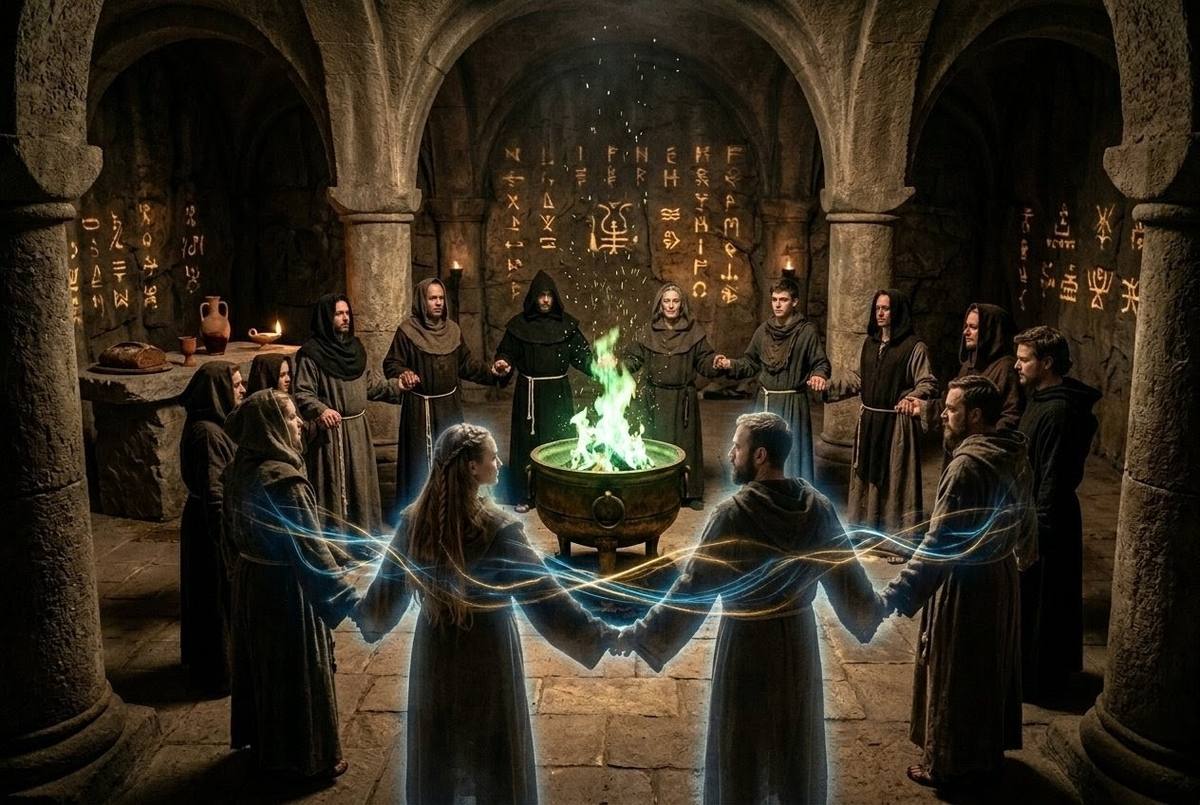
The strength of community is resilience. Teachers die. Manuscripts vanish. Political conditions change. But a practice held by many bodies has a better chance of surviving interruption. The memory is distributed.
The danger is dilution or control. Communities can become more concerned with membership than awakening. They can protect hierarchy at the expense of truth. They can exclude necessary questioning. They can repeat old forms after the living current has gone quiet.
The test is whether the community strengthens gnosis or merely protects identity. Does it make people more awake, ethical, grounded, and free, or more anxious, dependent, superior, and afraid of leaving?
3. Textual Survival: The Archive as Seed Bank
Texts are not enough, but they are not optional. Without texts, much of the Gnostic world would be known only through hostile summaries. The Nag Hammadi Library changed that. It allowed modern readers to hear lost movements in their own voice, with their own myths, prayers, dialogues, hymns, and visionary maps.
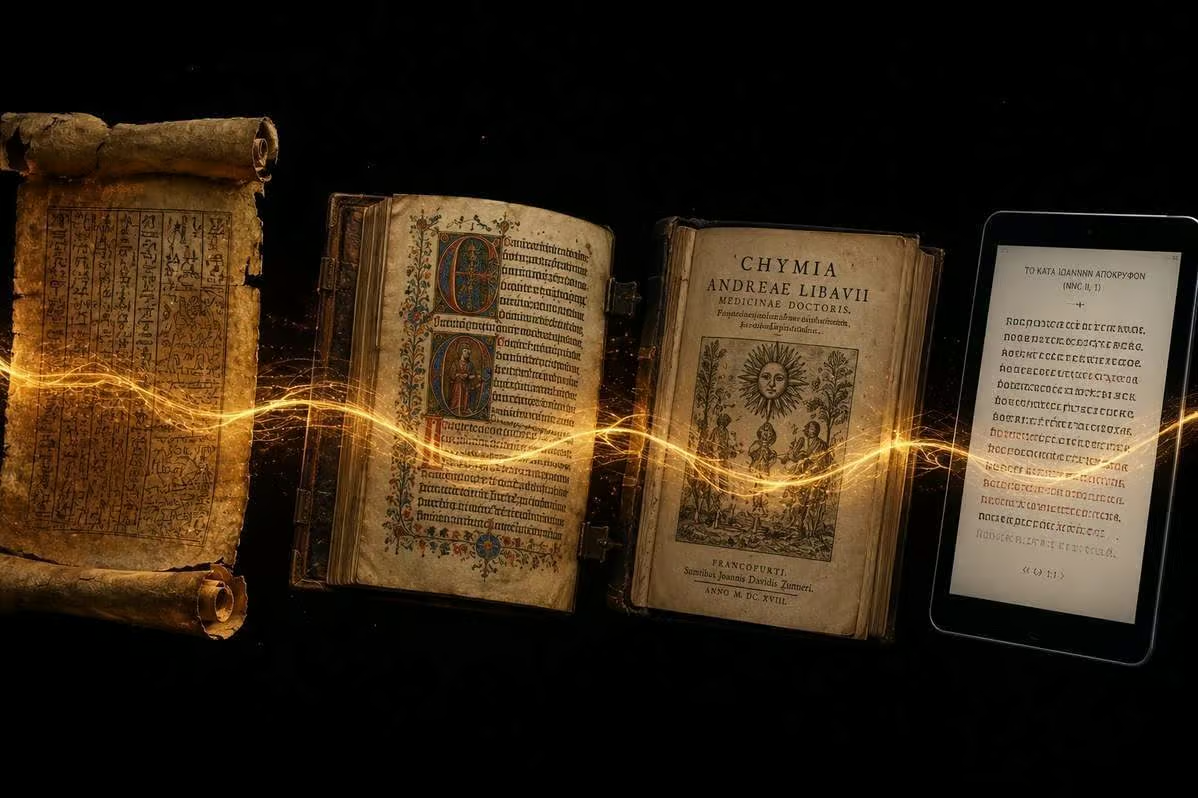
An archive is a seed bank. It does not grow the forest by itself, but it preserves possibility. A codex hidden in Egypt, a quotation preserved by an opponent, a Coptic fragment, a Hermetic dialogue, a medieval manuscript, a printed Renaissance edition, a digital scan, each can carry a future awakening inside itself.
The text also protects against fantasy. Modern seekers can invent private systems and call them ancient. The archive pushes back. It asks whether a claim has roots, whether a symbol belongs to a known tradition, whether a doctrine is being read responsibly, whether the present imagination is listening to the past or merely dressing itself in old names.
But textual survival also brings temptation. A person can confuse scholarship with transformation. They can collect references without being changed by them. The archive preserves the seed, but the reader must still plant, water, and live with what grows.
4. Symbolic Concealment: Hidden in Plain Sight
Some teachings survive by becoming difficult to recognise. They hide inside myth, poetry, allegory, ritual, architecture, alchemy, scripture, dream, icon, number, or story. The teaching is not absent. It is veiled.

This is not the same as pretending every work of art contains a secret occult code. Careless esotericism sees hidden doctrine everywhere and quickly becomes a hall of mirrors. A careful reader asks for context, pattern, source, language, historical plausibility, and the fruit of interpretation.
Still, symbolic concealment is real. Ancient and medieval texts often operate with layered meaning. A story can teach one thing to a child, another to a philosopher, another to a practitioner, and another to the reader undergoing transformation. The same text may be outer teaching, ethical instruction, ritual map, cosmology, and contemplative mirror at once.
This is why allegory mattered so deeply. A teaching hidden in plain sight can cross borders that explicit doctrine cannot. It can survive censorship, ridicule, empire, orthodoxy, and forgetfulness. It can wait inside a harmless-looking story until someone with the right hunger reads it.
5. Ritual and Body: Knowledge Made Gesture
Transmission is not always verbal. It can pass through the body: breath, posture, chant, gesture, silence, anointing, baptism, shared meal, movement, vigil, pilgrimage, hand placement, or the careful repetition of a practice received from another.
Ritual preserves knowledge by embedding it in action. A doctrine may be forgotten by the mind while the body remembers how to kneel, breathe, bless, listen, fast, wash, sing, or turn towards the light. The body becomes a library of gestures.
This matters for Gnostic traditions because direct knowing is not purely intellectual. It involves the whole person. The divine spark is not awakened by concept alone. The body, emotion, imagination, attention, voice, and ethical life must also be drawn into the work.
Ritual can also become empty. A gesture repeated without presence becomes shell. A sacrament performed without transformation becomes theatre. The question is not whether a ritual is old, beautiful, or complex. The question is whether it opens recognition and deepens freedom.
6. Inner Recognition: When the Reader Becomes the Site
Sometimes transmission occurs without visible lineage. A reader encounters a text across centuries and recognises something. A dream opens a symbol. A phrase becomes a door. A myth explains a lifelong ache. A buried pattern suddenly becomes clear. No teacher is present, yet something is transmitted.
This does not mean every private insight is reliable. Inner recognition must be tested. It can be confused with projection, longing, trauma, fantasy, or spiritual inflation. But it would be a mistake to deny the reality of recognition simply because it does not arrive through official channels.
Gnostic texts often assume that something in the reader is already capable of response. The spark recognises the call because it belongs to the same light. The text does not manufacture the spark. It reminds it.
This is the mystery of horizontal lineage. The ancient writer and the modern reader may never meet, yet recognition crosses the gap. The thread does not only move from teacher to student. It also vibrates across time.
7. Digital Transmission: Access Without Preparation
The modern seeker lives in a strange moment. Texts that were once hidden, lost, restricted, untranslated, or difficult to access can now be found in seconds. The Nag Hammadi Library, Hermetic writings, mystical commentaries, alchemical images, ritual manuals, academic papers, and digital facsimiles all circulate through the same glowing portals as advertising, outrage, distraction, and bad information.

This democratisation is precious. It breaks monopolies. It allows serious seekers to reach sources that were once locked behind institutions, geography, language, or money. It gives forgotten voices another chance to speak.
It also creates a crisis of context. The same text can be read by a careful student, a casual browser, a content collector, a distressed seeker, a conspiracy engine, an algorithm, a plagiarist, or a person looking for spiritual authority without discipline. Access does not equal readiness.
The digital archive makes discernment more necessary, not less. A seeker must learn to ask: who translated this? What tradition does it belong to? What is scholarly consensus? What is esoteric interpretation? What is speculation? What practice, grounding, community, or ethical work is needed before turning information into identity?
The thread can travel through pixels. But the reader must still become a vessel.
Criteria of Authenticity: Testing Claims of Lineage
Modern spirituality is full of lineage claims. Some are careful and rooted. Some are poetic but honest. Some are speculative. Some are marketing. Some are manipulative. The question is not whether a lineage sounds ancient or impressive. The question is what can be tested.
- Continuity with sources: Does the teaching connect recognisably with historical texts, practices, symbols, or communities?
- Transparency: Does the teacher or group explain what is known, what is uncertain, and what is interpretive?
- Experiential depth: Does the transmission lead towards practice and transformation, not only belief or identity?
- Ethical fruit: Does it produce humility, compassion, responsibility, discernment, and integration?
- Freedom from coercion: Does it avoid fear, isolation, sexual pressure, financial exploitation, secrecy abuse, and obedience tests?
- Resistance to spiritual inflation: Does it reduce grandiosity rather than feeding specialness?
- Capacity for correction: Can the lineage learn, admit error, and remain accountable?
These criteria are imperfect. History includes wounded teachers who transmitted real insight, and polished institutions that transmitted very little. Outer conduct matters, but so does inner fruit. Textual continuity matters, but so does living practice. Charisma matters least of all.
The strongest sign of authentic transmission is not mystery. It is the gradual emergence of freedom, humility, clarity, and love of truth.
The Invisible Order: Literal, Symbolic, or Psychological?
Many esoteric traditions speak of hidden masters, inner schools, invisible orders, secret chiefs, perfected beings, or guides who preserve wisdom across time. These ideas should be handled with care. They can inspire humility and service. They can also feed fantasy, dependency, and claims that cannot be questioned.

A literal reading treats the invisible order as real beings or intelligences assisting the transmission of wisdom. A symbolic reading sees it as an image of the continuity of truth beyond individual lifetimes. A psychological reading understands hidden masters as archetypal figures within the deep psyche. A historical reading asks how certain ideas resurface through texts, teachers, movements, and cultural need.
These readings do not have to cancel each other. Esoteric language often operates across levels. The important question is not only “is this literally true?” but also “does this interpretation deepen discernment, or does it create dependence on invisible authority?”
If the idea of an invisible order makes a person more humble, more responsible, more careful with truth, and more committed to practice, it may function well. If it makes a person feel chosen, unquestionable, superior, or exempt from ordinary ethics, the symbol has become dangerous.
The Ethics of Receiving the Thread
To receive a tradition is not only to benefit from it. It is to become responsible for how it lives through you. This responsibility has several parts.
Study protects the tradition from fantasy. Practice protects it from becoming mere opinion. Ethics protects it from becoming power. Community protects it from private distortion. Integration protects it from spiritual bypass. Humility protects it from becoming identity theatre.
The seeker who treats Gnostic texts as exotic content has not received the thread. They have handled the thread’s outer wrapping. The seeker who allows the teaching to change attention, action, speech, relationship, and courage has begun to receive it.
Transmission is not complete when the teaching is acquired. It becomes complete when the teaching is embodied without being possessed. The receiver becomes a temporary bearer, not an owner.
The Gnostic Reading: No Chain Replaces Direct Knowing
A Gnostic reading honours lineage but does not worship it. The chain matters because it carries memory. The text matters because it preserves testimony. The teacher matters because guidance can save a seeker from confusion. The community matters because no one sees every blind spot alone.
Yet no chain replaces gnosis. No certificate proves awakening. No institution owns the divine spark. No hidden master can do the work of recognition on behalf of the seeker. No archive, however rich, can substitute for transformation.
The archonic counterfeit of lineage is authority without awakening: titles, seals, inherited language, secret claims, and fear of questioning. The living form of lineage is different. It points beyond itself. It gives the seeker enough structure to awaken, then enough freedom to stand in direct knowing.
The Gnosis travels because it cannot be fully contained. It enters texts, communities, symbols, rituals, dreams, practices, teachers, fragments, silences, and moments of recognition. It survives not by remaining unchanged, but by remaining alive.
The thread continues when someone receives it honestly, lives it carefully, and passes on not just the words, but the fire.
Related Glossary Terms
For quick definitions, use the main ZenithEye Glossary. The key terms for this article are:
Read Next
Continue with: The Living Thread: How Forbidden Knowing Survives the Fire
If this article explains how gnosis travels, the next step is the wider survival story: how hidden knowing persists through suppression, translation, exile, symbolic disguise, rediscovery, and renewal.
Within The Living Thread
This article belongs to Transmission & Lineage, the Living Thread layer where teachers, initiatory currents, hidden chains, oral memory, textual survival, symbolic inheritance, and living transmission are read with care.
Frequently Asked Questions About Transmission and Lineage
What is Gnostic transmission?
Gnostic transmission is the passing on of direct spiritual knowing, practice, interpretation, and recognition. It may move through teachers, communities, texts, symbols, rituals, contemplative practice, or sudden inner recognition. It is not the same as simply collecting information about Gnosticism.
What is the difference between transmission and lineage?
Transmission is the act of passing something on. Lineage is the thread of continuity that links a present teaching or practice to earlier sources, teachers, communities, texts, or ways of seeing. A lineage may preserve transmission, but a lineage can also become empty if recognition and practice no longer remain alive.
Can gnosis be learned from books alone?
Books can preserve the map, language, symbols, and testimony of gnosis, but they do not automatically produce direct knowing. A text becomes transformative only when it is read with preparation, practice, discernment, and inner recognition. The archive preserves the seed; the reader must still cultivate it.
Why were some Gnostic teachings secret?
Some teachings were restricted because they were considered difficult, powerful, easily misunderstood, or dangerous when separated from preparation and interpretation. Secrecy could protect the teaching, but it could also become a form of control. The Gnostic test is whether concealment serves truth and transformation, not status or manipulation.
How does a modern seeker test a lineage claim?
A modern seeker can test lineage claims by looking for continuity with source traditions, transparency about uncertainty, meaningful practice, ethical fruit, freedom from coercion, resistance to spiritual inflation, and capacity for correction. The strongest sign is not secrecy or glamour, but humility, clarity, compassion, and integration.
What is hiding in plain sight?
Hiding in plain sight is a form of symbolic or layered transmission where deeper teaching is concealed inside public forms such as myth, poetry, scripture, ritual, art, architecture, or alchemy. The outer form remains visible, while deeper meaning becomes available only through preparation, context, and recognition.
Are hidden masters or inner schools real?
Different traditions answer this differently. Hidden masters or inner schools may be read literally as spiritual beings or secret teachers, symbolically as images of continuity, psychologically as archetypal guidance, or historically as the persistence of ideas across time. The practical test is whether the idea deepens discernment and humility or feeds fantasy and superiority.
What responsibility comes with receiving esoteric knowledge?
Receiving esoteric knowledge brings responsibility to study carefully, practise honestly, embody ethically, avoid spiritual bypass, preserve the teaching without fantasy, and pass on only what has become living and tested. The receiver is a temporary bearer of the thread, not its owner.
Study Note
This article explores transmission, lineage, initiation, hidden teachings, symbolic concealment, spiritual authority, and esoteric tradition for educational and reflective purposes. It does not certify any modern organisation, teacher, private revelation, church, occult order, or lineage claim.
Approach lineage claims with care. Healthy transmission should not require fear, isolation, secrecy abuse, sexual pressure, financial exploitation, authoritarian control, or surrender of conscience. A living tradition deepens freedom and responsibility, not dependence.
When working with powerful texts or practices, balance study with embodiment, ethics, grounding, community, and discernment. Hidden knowledge is useful only when it makes life more truthful.
Further Reading
These ZenithEye links continue the themes of transmission, lineage, textual survival, hidden knowledge, symbolic inheritance, digital access, and integration:
- The Living Thread: How Forbidden Knowing Survives the Fire – The wider route through survival, suppression, hidden continuity, and the renewal of forbidden knowledge.
- The Nag Hammadi Library: Complete Guide to the Gnostic Scriptures – The central guide to the thirteen codices, major tractates, and buried archive that changed modern Gnostic studies.
- The Archaeology of Wisdom: 5 Ancient Sources That Shaped Gnosticism – Foundation documents, discoveries, hostile witnesses, and source layers behind the Gnostic archive.
- Hermeticism vs Gnosticism: 7 Essential Distinctions – The Egyptian wisdom traditions compared through ascent, divine mind, cosmic order, and direct knowledge.
- The Hidden Agreements: 7 Esoteric Lineages That Shaped Western Spirituality – The wider network of Western esoteric currents, initiatory systems, and symbolic inheritances.
- The Steganographia: 400 Years on the Vatican’s Banned List for Hacking the Angelic Mainframe – Hidden writing, spirit language, coded transmission, and the survival of messages beneath other forms.
- The Table of Trithemius: A Bridge of Secret Codes and Angelic Spirits – A cipher table read as cryptographic tool, symbolic bridge, and meditation on hidden language.
- Gnosis in the Digital Age: Reclaiming Your Sovereignty from the Algorithm – Maintaining direct knowing and attention sovereignty in an age of digital mediation.
- Integration and Grounding: Embodying the Received Tradition – How insight becomes life through body, ethics, practice, community, and return.
- Against Spiritual Bypassing: The Refusal to Feel Masquerading as Realisation – Why authentic transmission requires emotional honesty, embodiment, and psychological integration.
References and Sources
The following sources support the historical, theological, textual, and comparative framework used in this article.
Primary Gnostic and Hermetic Sources
- Robinson, James M., ed. The Nag Hammadi Library in English. Revised edition. HarperOne, 1990.
- Meyer, Marvin, ed. The Nag Hammadi Scriptures. HarperOne, 2007.
- Layton, Bentley. The Gnostic Scriptures. Yale University Press, 1987.
- The Apocryphon of John. Nag Hammadi Codices II,1; III,1; IV,1 and Berlin Codex 8502,2.
- The Gospel of Thomas. Nag Hammadi Codex II,2.
- The Gospel of Philip. Nag Hammadi Codex II,3.
- Thunder: Perfect Mind. Nag Hammadi Codex VI,2.
- Allogenes. Nag Hammadi Codex XI,3.
- Copenhaver, Brian P. Hermetica: The Greek Corpus Hermeticum and the Latin Asclepius. Cambridge University Press, 1992.
- Dante Alighieri. Divina Commedia and Convivio. Various editions and translations.
Gnostic Scholarship and Historical Context
- King, Karen L. What Is Gnosticism?. Harvard University Press, 2003.
- Williams, Michael Allen. Rethinking “Gnosticism”: An Argument for Dismantling a Dubious Category. Princeton University Press, 1996.
- Brakke, David. The Gnostics: Myth, Ritual, and Diversity in Early Christianity. Harvard University Press, 2010.
- Pagels, Elaine. The Gnostic Gospels. Random House, 1979.
- Pearson, Birger A. Ancient Gnosticism: Traditions and Literature. Fortress Press, 2007.
- DeConick, April D. The Gnostic New Age: How a Countercultural Spirituality Revolutionized Religion from Antiquity to Today. Columbia University Press, 2016.
- Turner, John D. Sethian Gnosticism and the Platonic Tradition. Presses de l’Université Laval, 2001.
- Thomassen, Einar. The Spiritual Seed: The Church of the Valentinians. Brill, 2006.
- Rudolph, Kurt. Gnosis: The Nature and History of Gnosticism. Harper & Row, 1987.
Transmission, Esotericism, and Western Lineages
- Hanegraaff, Wouter J. Esotericism and the Academy: Rejected Knowledge in Western Culture. Cambridge University Press, 2012.
- Hanegraaff, Wouter J., ed. Dictionary of Gnosis and Western Esotericism. Brill, 2005.
- Faivre, Antoine. Access to Western Esotericism. SUNY Press, 1994.
- Yates, Frances A. Giordano Bruno and the Hermetic Tradition. Routledge, 1964.
- Yates, Frances A. The Occult Philosophy in the Elizabethan Age. Routledge, 1979.
- Couliano, Ioan P. Eros and Magic in the Renaissance. University of Chicago Press, 1987.
- Eco, Umberto. The Search for the Perfect Language. Blackwell, 1995.
- Goodrick-Clarke, Nicholas. The Western Esoteric Traditions: A Historical Introduction. Oxford University Press, 2008.
Community, Practice, and Discernment
- Herman, Judith. Trauma and Recovery. Basic Books, 1992.
- Masters, Robert Augustus. Spiritual Bypassing: When Spirituality Disconnects Us from What Really Matters. North Atlantic Books, 2010.
- Treleaven, David A. Trauma-Sensitive Mindfulness: Practices for Safe and Transformative Healing. W. W. Norton, 2018.
- Kornfield, Jack. After the Ecstasy, the Laundry. Bantam, 2000.
- Underhill, Evelyn. Mysticism: A Study in the Nature and Development of Spiritual Consciousness. Methuen, 1911.
- Eliade, Mircea. The Sacred and the Profane. Harcourt, 1959.
- Eliade, Mircea. Shamanism: Archaic Techniques of Ecstasy. Princeton University Press, 1964.