Ancient Sources: The Foundation of the Living Thread
The contemporary Gnostic revival rests upon a material foundation: papyri buried in jars, codices hidden in caves, inscriptions etched in stone, and manuscripts copied through centuries by scribes who preserved dangerous knowledge. These ancient sources constitute The Living Thread–not merely historical curiosities but the actual vehicles through which gnosis travels across millennia. Without them, we would possess only polemics from opponents, whispers from heresy hunters, and the projections of modern imagination.
This article examines the foundational sources of the Gnostic tradition: the Nag Hammadi Library and related Coptic texts, the Hermetic Corpus, the New Testament apocrypha, and the various archaeological discoveries that have revolutionised our understanding of Western spirituality. We explore how these materials survived, how they transmit authentic tradition, and how contemporary seekers might approach them with the reverence and critical discernment they demand.
Table of Contents
- The Nag Hammadi Discovery: A Library Reborn
- The Hermetic Corpus: Egyptian Wisdom in Greek Dress
- The Dead Sea Scrolls and Jewish Apocalyptic
- Mandaean and Manichaean Sources
- The New Testament Apocrypha
- Patristic Testimonies: Reading Against the Grain
- The Archaeology of Gnosis
- Approaching the Sources
- Frequently Asked Questions
- Further Reading
- References and Sources
The Nag Hammadi Discovery: A Library Reborn
The Accident at Jabal al-Tarif
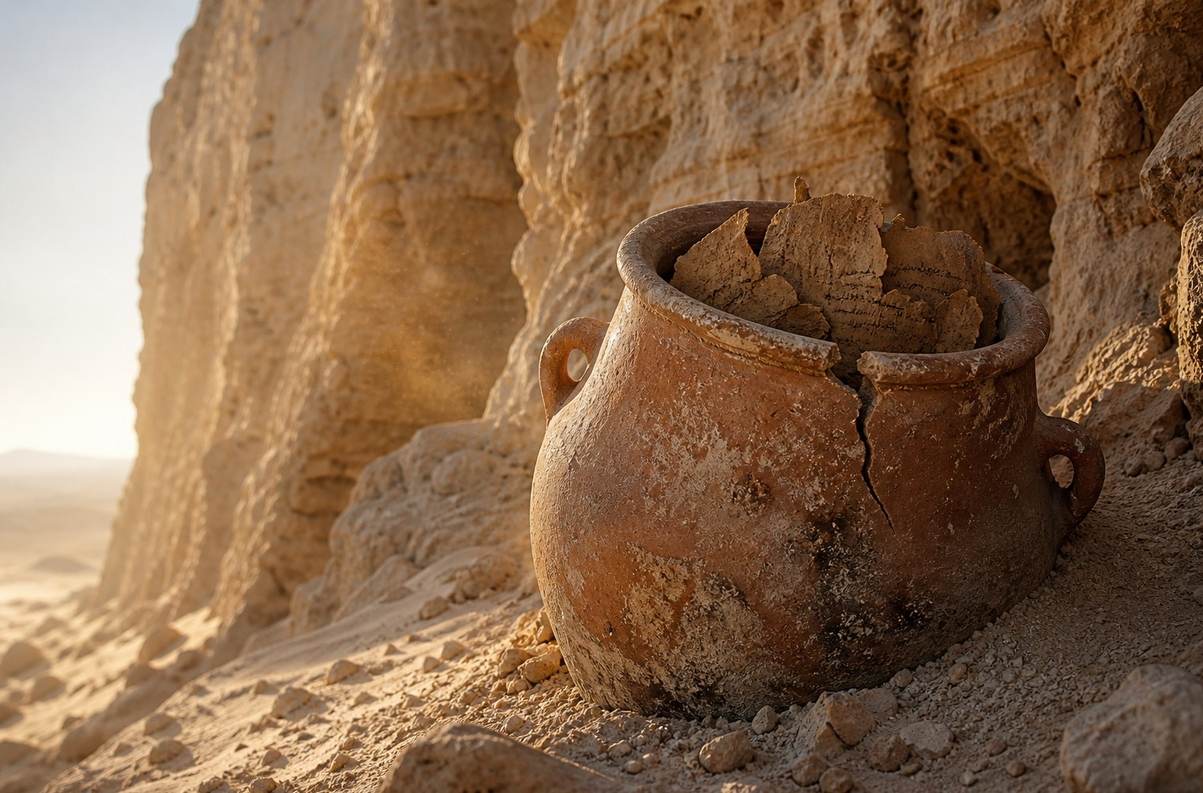
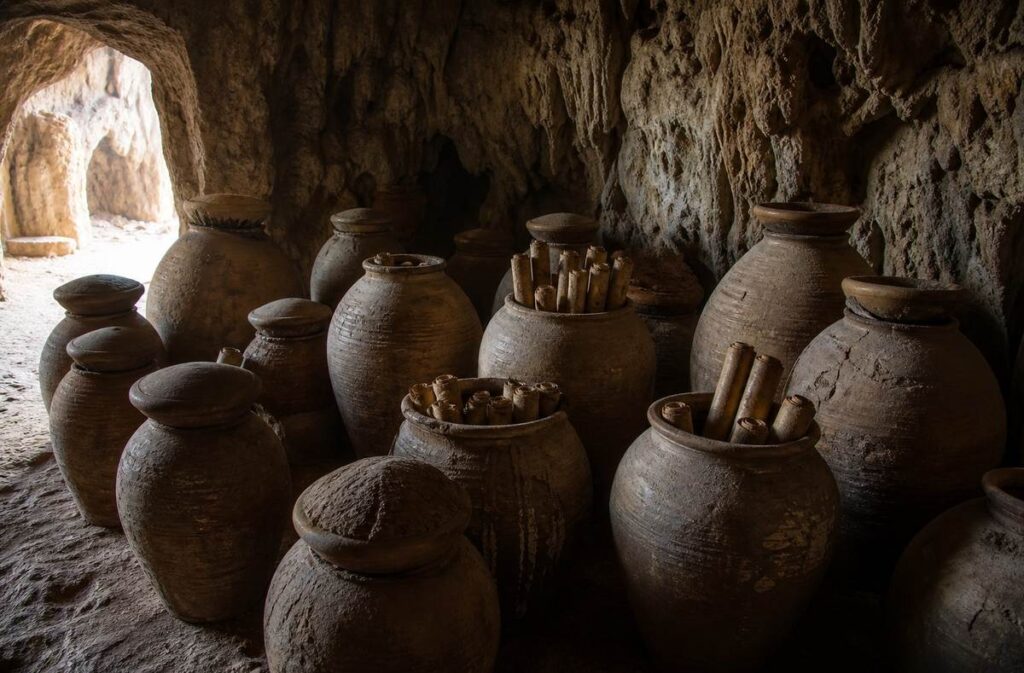
In December 1945, two Egyptian peasants–Muhammad Ali al-Sammān and his brother Khalifah–were digging for soft soil near the base of the Jabal al-Tarif cliff, roughly eleven kilometres north-east of Nag Hammadi. They tethered their camels to a boulder and struck something hard. Beneath the sand lay a sealed jar of red slip ware, approximately sixty centimetres in height, closed with a bowl fitted into its mouth. Muhammad Ali later told scholars he feared a jinn might be inside; hoping for gold, he broke it open with his mattock. Out flew particles of papyrus.
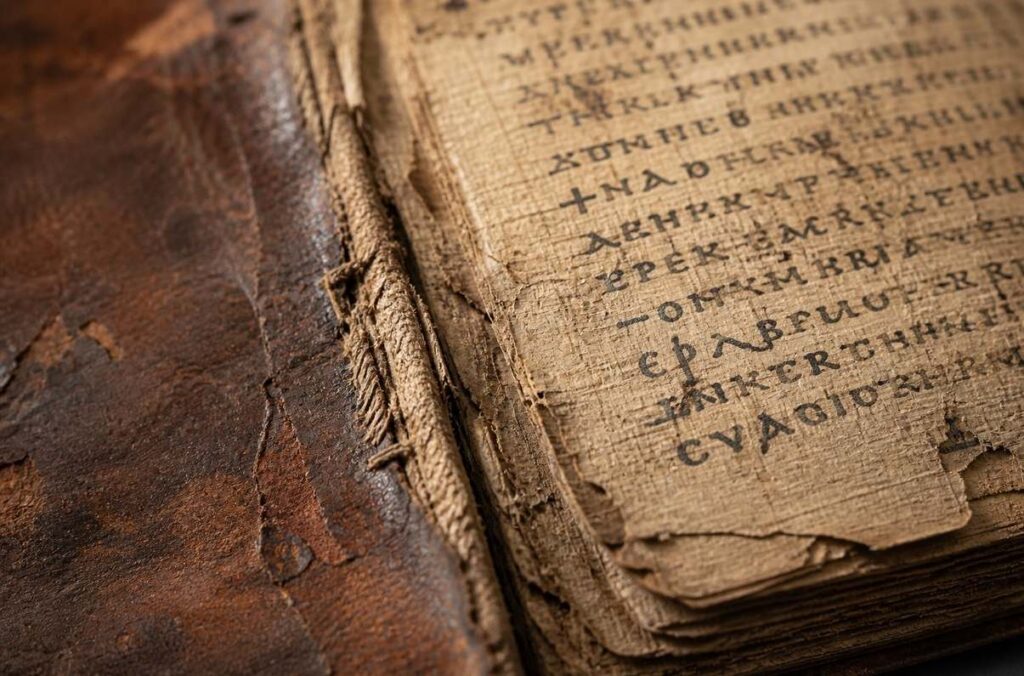
The jar contained thirteen leather-bound papyrus codices. Divided among those present, the books passed through family rivalries, black-market trading, and international intrigue. Some pages were burned by Muhammad Ali’s mother for kindling. Codex III was sold to the Coptic Museum. Codex I–later dubbed the Jung Codex–was smuggled to Belgium by the antiquities dealer Albert Eid. Yet despite this chaotic dispersal, the core collection survived. Fifty-two tractates emerged, forty of them previously unknown to scholarship, including the Gospel of Thomas, the Gospel of Philip, the Apocryphon of John, and Thunder: Perfect Mind.
Why the Texts Were Hidden
The burial likely occurred in the late fourth century CE, probably prompted by Bishop Athanasius’ Easter letter of 367 CE, which condemned heretical and non-canonical books. As Theodosian legislation against paganism and heresy intensified through the 380s and 390s, possession of such materials became dangerous. The burial site–near ancient Chenoboskion, across the Nile from a Pachomian monastery–suggests that monks or clergy may have hidden the texts, whether to protect them, suppress them, or both. Buried for sixteen centuries, they escaped the burning of libraries, the censorship of orthodoxy, and the gradual decay of papyrus in Mediterranean climates. Their rediscovery initiated a renaissance in religious studies that continues to reshape our understanding of early Christianity.
The Diversity of the Collection
The Nag Hammadi Library represents the single most significant discovery for the study of Gnosticism. Unlike the fragments preserved in Church Fathers’ polemics, these texts present Gnostic Christianity from within, revealing sophisticated theology, poetic mysticism, and ritual practice that bear little resemblance to the caricatures of “heretical” doctrine. The collection’s diversity–Sethian, Valentinian, Thomasine, Hermetic–demonstrates that Gnosticism was never a unified sect but a broad movement of spiritual seeking. The Gospel of Thomas offers cryptic sayings attributed to Jesus; the Apocryphon of John provides a detailed Sethian cosmogony; the Tripartite Tractate unfolds Valentinian sacramental theology; and the Discourse on the Eighth and the Ninth preserves Hermetic ritual ascent. Together, they reveal a landscape far more varied than orthodox heresiologists ever admitted.
The Hermetic Corpus: Egyptian Wisdom in Greek Dress
From Alexandria to Florence
Alongside the Nag Hammadi texts, the Hermetic Corpus (Corpus Hermeticum) provides essential foundation for understanding Western esotericism. These Greek and Latin dialogues, attributed to Hermes Trismegistus–the Egyptian god Thoth syncretised with Greek Hermes–preserve Egyptian religious concepts expressed through Hellenistic philosophical vocabulary. Composed in Egypt between the first and third centuries CE, the texts reflect the intellectual ferment of Alexandria, where Egyptian priestly traditions encountered Greek philosophy and Jewish mysticism.
The collection’s survival traces a different path from the Nag Hammadi burial. Preserved by Byzantine scholars and circulating in medieval manuscripts, the Greek text reached Florence in the fifteenth century via a manuscript brought from Macedonia by the monk Leonardo of Pistoia. In 1463, Cosimo de’ Medici–then elderly and eager to read the work before his death–commanded Marsilio Ficino to interrupt his translation of Plato and render the Hermetic texts into Latin first. Ficino completed the Pimander (mistaking the title of the first treatise for the name of the entire collection) within months. The translation was first printed in Treviso in 1471, without Ficino’s authorisation, and went on to influence figures from Copernicus to Newton, fuelling the Renaissance revival of ancient wisdom.
Ritual Dimensions Beyond Philosophy
For centuries, scholars treated the Hermetic Corpus as purely philosophical–a kind of Egyptian Neoplatonism. Recent discoveries have complicated this picture. The Coptic Discourse on the Eighth and the Ninth (NHC VI,6), discovered at Nag Hammadi, preserves a ritual dialogue between Hermes and his disciple Tat, culminating in a visionary ascent through the planetary spheres. Greek fragments from Oxyrhynchus reveal hymns and invocations absent from the philosophical treatises. These sources demonstrate that Hermeticism, like Gnosticism, involved not merely intellectual engagement but transformative practice: theurgical rites, spiritual ascent, and philosophical contemplation woven into a single fabric of initiation.

The Dead Sea Scrolls and Jewish Apocalyptic
Qumran and the Essene Library
The Essene library discovered at Qumran (1947-1956) illuminates the Jewish context from which Gnosticism emerged. A young Bedouin shepherd, Muhammad edh-Dhib, stumbled upon the first cave when he threw a rock into a dark opening and heard pottery shatter. Subsequent excavations revealed eleven caves containing approximately nine hundred manuscripts in Hebrew, Aramaic, and Greek, carefully preserved in clay jars and hidden for nearly two millennia.
While not Gnostic in the technical sense, the Dead Sea Scrolls reveal the apocalyptic worldview, dualistic cosmology, and esoteric exegesis that provided raw material for Christian Gnostic systems. The sectarian writings–including the Community Rule, the Damascus Document, and the Hymns–describe a community convinced that history was approaching its consummation, that angels and demons battled for human souls, and that secret knowledge was encoded within the prophets. These convictions would find new expression in the Sethian and Valentinian systems of the second and third centuries.
The Enochic Template
Particularly significant are the War Scroll (depicting cosmic battle between forces of light and darkness), the Hymns (describing human depravity and divine election), and the various pesharim (esoteric biblical commentaries). These texts demonstrate that Gnostic themes–knowledge as salvation, cosmic rebellion, angelic intermediaries–emerged from within Second Temple Judaism rather than representing purely “foreign” (Persian, Hellenistic) influence.
The Enochic literature (1 Enoch, 2 Enoch, the Book of Giants), preserved by Ethiopian Christians and discovered among the Dead Sea Scrolls, proved especially influential. The Watchers myth–rebel angels teaching forbidden knowledge to humanity–provided the narrative template for Gnostic accounts of the archons and the theft of divine sparks. When the Apocryphon of John describes the demiurge Yaldabaoth and his rebellious archontic offspring, it is drawing upon Enochic traditions already centuries old.
Mandaean and Manichaean Sources
The Mandaean Continuum
Beyond Egyptian discoveries, other ancient sources illuminate the Gnostic landscape. The Mandaeans of Iraq and Iran–descendants of Gnostic baptist sects–preserve an extensive literature in Aramaic (Mandaic), including the Ginza Rabba (Great Treasure) and numerous hymns and ritual texts. Their continuous tradition from Late Antiquity to the present offers unique insight into Gnostic practice outside Christian frameworks. Mandaean baptismal rites, cosmological hymns, and polemics against the “world of darkness” preserve a form of Gnosis that never passed through the filter of patristic refutation, remaining instead a living–if endangered–tradition.
Manichaean Texts from Central Asia and Egypt
Manichaean sources, discovered at Turpan in Central Asia and Medinet Madi in Egypt (1929), reveal the system that Augustine followed for nine years before his conversion. Though Manichaeism was never “Gnostic” in the precise sense (it lacked the Sophia myth and demiurgic creator), it shared the radical dualism, ascetic practice, and soteriological urgency characteristic of the broader movement. The Medinet Madi find alone produced seven Coptic codices–including the Kephalaia, Psalms, and Homilies–while the Turfan fragments preserved texts in Middle Persian, Parthian, Sogdian, and Uyghur, testifying to the tradition’s remarkable geographical spread from the Mediterranean to China.
The New Testament Apocrypha
The Gospel of Thomas and Oxyrhynchus
Gnostic and proto-Gnostic traditions also survive in apocryphal gospels, acts, and apocalypses excluded from the canonical New Testament. The Gospel of Thomas–discovered complete at Nag Hammadi, with Greek fragments at Oxyrhynchus–contains 114 sayings of Jesus that may preserve independent oral tradition or early mystical interpretation. Lacking a narrative framework, the collection presents Jesus as a wisdom teacher whose cryptic utterances (“Split a piece of wood; I am there”) invite the reader to recognise the divine within the ordinary.
The Gospel of Judas and the Codex Tchacos
Other significant texts include the Gospel of Mary (Magdalene), the Gospel of Judas, and various apocalypses (Peter, Paul, James) describing heavenly journeys and eschatological secrets. The Gospel of Judas, published by the National Geographic Society in 2006, comes from the Codex Tchacos, a fourth-century Coptic manuscript discovered near El Minya, Egypt, in the 1970s. Radiocarbon dated to approximately 280 CE, the text portrays Judas not as a villain but as the only disciple who truly understood Jesus’ teaching, asked by the Saviour himself to “sacrifice the man that clothes me” and thereby liberate the divine spark. These texts demonstrate that Gnostic Christianity was not marginal but widespread, producing literary works of profound spiritual insight that rivalled canonical compositions in sophistication.
Patristic Testimonies: Reading Against the Grain
While polemical, the Church Fathers’ refutations of Gnosticism preserve crucial information. Irenaeus of Lyon’s Against Heresies (c. 180 CE) provides detailed summaries of Valentinian systems; Hippolytus’ Refutation of All Heresies preserves extracts from otherwise lost texts; Epiphanius’ Panarion offers encyclopaedic (if hostile) coverage of Gnostic sects from the Basilidians to the Borborites.
Contemporary scholarship has learned to read these testimonies “against the grain”–not accepting their theological judgments but mining them for historical data. When Irenaeus describes Valentinian cosmology or Epiphanius quotes Gnostic hymns, they inadvertently preserve the very traditions they sought to destroy. These patristic sources provide essential context for interpreting the primary texts discovered at Nag Hammadi, offering names, dates, and doctrinal summaries that would otherwise be irrecoverable. The trick is to let the heresiologists tell us what the Gnostics taught, while refusing to accept their verdict on why it mattered.
The Archaeology of Gnosis
Material Culture Beyond the Texts
Beyond textual sources, archaeology illuminates the material culture of ancient Gnostics. Funerary inscriptions, magical papyri (the Greek Magical Papyri from Egypt), and amulets demonstrate that Gnostic ideas permeated popular religion. Gems engraved with Abraxas (the cock-headed god, whose name encodes the number 365), curse tablets invoking Iao and Adonai, and baptistery architecture all testify to the lived reality of these traditions beyond the literary elite who produced our surviving texts. A small bronze amulet from Roman Egypt, inscribed with a Sethian baptismal formula, confirms that the theological systems described in the Apocryphon of John were not merely speculative but operative.
Chenoboskion and the Monastic Connection
The Nag Hammadi burial site itself–near ancient Chenoboskion, across the Nile from a Pachomian monastery–suggests complex relationships between “orthodox” and “heretical” communities. Recent excavations have revealed fourth-century monastic cells containing Gnostic texts, challenging neat distinctions between canonical and apocryphal Christianity. The papyrus reused to stiffen the leather cover of Codex I mentions Chenoboskion explicitly, linking the book’s production to the very region where it was buried. Rather than two hostile camps, the archaeology suggests fluid boundaries: monks who copied both the Gospel of John and the Gospel of Thomas, ascetics who prayed to Christ and invoked Abraxas, communities where the boundaries of orthodoxy were still being negotiated rather than policed.
Approaching the Sources
Critical Discernment and Contemplative Reading
For contemporary seekers, these ancient sources present both opportunity and challenge. Opportunity: access to primary materials previously available only to scholars, revealing the sophistication and diversity of ancient Gnosticism. Challenge: the need for historical and philological competence to interpret them responsibly, avoiding both fundamentalist literalism and careless anachronism.
Authentic engagement requires multiple competencies: historical context (the Roman Empire’s religious marketplace), literary genre (apocalypse, gospel, treatise, hymn), theological background (Jewish apocalyptic, Middle Platonism, early Christian diversity), and spiritual sensitivity (recognising that these texts were written not as museum pieces but as vehicles of transformation). The reader who approaches the Apocryphon of John without understanding Middle Platonic metaphysics will miss half its meaning; the reader who approaches it merely as philosophy will miss its purpose.
The Living Thread requires both preservation and activation. We preserve these texts through scholarship, translation, and digital archiving. We activate them through contemplative reading, ritual engagement, and the willingness to be transformed by encounter with ancient wisdom. The sources are not dead relics but living voices, awaiting the reader prepared to hear. As the Gospel of Thomas declares: “Whoever finds the interpretation of these words will not taste death.” The archaeology has done its work. The rest is up to us.
Frequently Asked Questions
What is the Nag Hammadi Library?
The Nag Hammadi Library is a collection of thirteen fourth-century Coptic codices discovered in Egypt in 1945. Containing fifty-two tractates–including the Gospel of Thomas, the Apocryphon of John, and Thunder: Perfect Mind–it is the single most important source for understanding Gnostic Christianity from within, revealing sophisticated theology and ritual practice previously known only through hostile patristic summaries.
When were the Nag Hammadi texts discovered?
The texts were discovered in December 1945 by two Egyptian peasants digging near the Jabal al-Tarif cliff north-east of Nag Hammadi. The find consisted of a sealed jar containing thirteen leather-bound codices, which had been buried for approximately sixteen centuries.
What is the Hermetic Corpus?
The Corpus Hermeticum is a collection of Greek and Latin dialogues attributed to Hermes Trismegistus, composed in Egypt between the first and third centuries CE. Preserved by Byzantine scholars and translated into Latin by Marsilio Ficino in 1463, these texts fuse Egyptian religious concepts with Hellenistic philosophy and describe spiritual ascent, theurgical practice, and philosophical contemplation.
How do the Dead Sea Scrolls relate to Gnosticism?
While not Gnostic in the technical sense, the Dead Sea Scrolls (discovered 1947-1956 at Qumran) reveal the Jewish apocalyptic worldview, dualistic cosmology, and esoteric exegesis that provided raw material for later Christian Gnostic systems. The Enochic Watchers myth and the sectarian emphasis on secret knowledge both anticipate Gnostic themes.
What are the Mandaean texts?
The Mandaeans of Iraq and Iran preserve an extensive literature in Aramaic (Mandaic), including the Ginza Rabba and numerous hymns. As descendants of Gnostic baptist sects with a continuous tradition from Late Antiquity, they offer unique insight into Gnostic practice outside Christian frameworks.
Who was Irenaeus and why is he important for Gnosticism?
Irenaeus of Lyon was a second-century bishop who wrote Against Heresies (c. 180 CE), a detailed refutation of Gnostic teachings. Though polemical, his work inadvertently preserves crucial information about Valentinian and other Gnostic systems, providing essential context for interpreting the primary texts.
How should modern readers approach ancient Gnostic texts?
Modern readers should approach these texts with both critical discernment and spiritual sensitivity. This means understanding the historical context, literary genre, and theological background while recognising that the texts were written as vehicles of transformation rather than museum pieces. Responsible engagement balances scholarly rigour with contemplative openness.
Further Reading
- The Nag Hammadi Library: Complete Reader’s Guide — The central hub for all Nag Hammadi articles, codex overviews, and thematic collections.
- The Discovery of the Nag Hammadi Library — A detailed account of the 1945 discovery, the dispersal of the codices, and their eventual conservation.
- The Gospel of Thomas: The Wisdom of the Twin — An in-depth exploration of the most famous text from the Nag Hammadi collection.
- Hermeticism and Gnosticism: The Egyptian Wisdom Traditions Compared — A comparative study of the Hermetic Corpus and the Nag Hammadi texts.
- Hermetic Spirituality — An examination of the Hermetic tradition from antiquity to the Renaissance.
- Jewish Apocalyptic Roots of Gnosticism — How Second Temple Judaism provided the theological and literary foundations for Gnostic systems.
- Transmission and Lineage: How the Gnosis Travels — The mechanisms by which esoteric knowledge survives across centuries and cultures.
- The Gospel of Judas: Controversial Traditions — The story of the Codex Tchacos and its revolutionary portrait of Judas Iscariot.
- Gnostic Schools: Sethians, Valentinians, and Hermetics — A guide to the major movements represented in the Nag Hammadi Library.
- What Is Gnosticism? Defining the Undefinable — A critical examination of the category “Gnosticism” and its scholarly controversies.
References and Sources
The following sources are organised by category for ease of reference.
Primary Sources and Critical Editions
- The Nag Hammadi Library in English. (1988). J. M. Robinson (Ed.). HarperSanFrancisco.
- Corpus Hermeticum. (1995). A. D. Nock and A.-J. Festugiere (Eds.). Les Belles Lettres. (Original critical Greek edition).
- The Dead Sea Scrolls: Hebrew, Aramaic, and Greek Texts with English Translations. (1994-2005). J. H. Charlesworth (Ed.). Princeton Theological Seminary / Mohr Siebeck.
- Kasser, R., Meyer, M., and Wurst, G. (Eds.). (2006). The Gospel of Judas. National Geographic Society.
Scholarly Monographs and Archaeological Reports
- Robinson, J. M. (2014). The Nag Hammadi Story: From the Discovery to the Publication. Brill.
- Robinson, J. M. (2015). The Manichaean Codices of Medinet Madi. James Clarke & Company.
- Pearson, B. A. (2007). Ancient Gnosticism: Traditions and Literature. Fortress Press.
- DeConick, A. D. (2016). The Gnostic New Age: How a Countercultural Spirituality Revolutionised Christianity from Antiquity to Today. Columbia University Press.
- Ebeling, F. (2007). The Secret History of Hermes Trismegistus: Hermeticism from Ancient to Modern Times. Cornell University Press.
Comparative and Contextual Studies
- Irenaeus of Lyon. (c. 180 CE). Against Heresies [Adversus Haereses]. (Available in Ante-Nicene Christian Library, Vol. 1. Edinburgh: T & T Clark, 1880).
- Buckley, J. J. (2002). The Mandaeans: Ancient Texts and Modern People. Oxford University Press.
- Gardner, I., and Lieu, S. N. C. (2004). Manichaean Texts from the Roman Empire. Cambridge University Press.
- Williams, M. A. (1996). Rethinking “Gnosticism”: An Argument for Dismantling a Dubious Category. Princeton University Press.