The Discovery at Nag Hammadi: How the Gnostic Library Was Found
The Day the Earth Yielded Its Secrets: The Discovery of the Nag Hammadi Library
On a December morning in 1945, a young Egyptian farmer named Muhammad Ali al-Samman made a discovery that would transform our understanding of early Christianity, Judaism, and the religious landscape of the ancient Mediterranean [1][2]. While digging for soft sediment (sebakh) near the town of Nag Hammadi in Upper Egypt, his mattock struck something unexpected–a large earthenware jar sealed against the desert air. This “archival recovery” operation, conducted by accident rather than design, would eventually bring to light one of the most significant manuscript discoveries of the twentieth century [3].
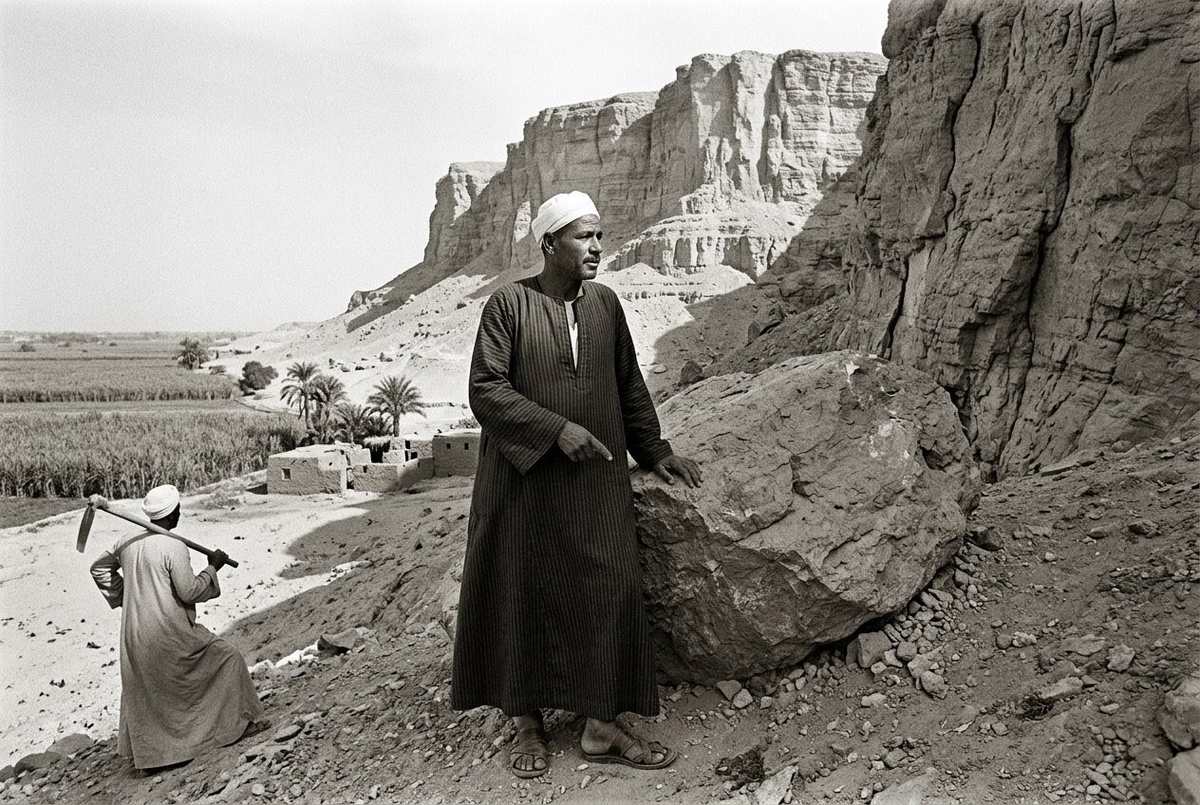
Table of Contents
- The Moment of Discovery
- The Circuitous Path to Scholarship
- The Broker and the Collector
- The Acquisition Campaign
- Who Buried the Library?
- The Conservation Challenge
- The Publication History
- The Impact on Scholarship
- The Site Today
- The Legacy of the Discovery
- Frequently Asked Questions
- Further Reading
- References and Sources
The Moment of Discovery
According to Muhammad Ali’s account, he and his brothers were working at the base of the Jabal al-Tarif, a limestone cliff honeycombed with ancient tombs [4]. The site lies approximately 500 metres from the nearest cave tombs, suggesting whoever buried the jar chose a discreet location away from obvious grave sites. The date was mid-December 1945, though Muhammad Ali provided varying accounts over the years–sometimes mentioning digging for fertiliser (sabakh), other times specifying a location near a large boulder [1][5].
The jar stood about 60 centimetres tall with a bowl-shaped lid cemented in place [6]. Fearing it might contain a jinn (spirit), Muhammad Ali hesitated before smashing it open with his mattock. To his relief, he found not a demon but leather-bound papyrus books–thirteen codices containing fifty-two separate texts. The books were divided among the seven people present (including camel-drivers), though the other drivers, fearing sorcery and Muhammad Ali himself, ultimately renounced their claims [7].
Primary Source Account: “Muhammad ‘Ali told J.M. Robinson that at first he was afraid to break the jar–the lid may have been sealed with bitumen, as a blackish substance is present on the lid–for fear a jinn might be inside, but then he thought that gold might be contained in it instead, so he broke it with his mattock.” [6]
His mother, Umm Ahmad, later claimed she burned some of the papyrus for kindling, a detail that haunts scholars contemplating what might have been lost to her cookfire [8][9]. Robinson interviewed Umm Ahmad himself, who conceded she may have burnt “ripped-up books–both papyrus and pieces of broken covers” along with the straw she used to light the fire [8]. Fortunately, Muhammad Ali recognised potential value in the remaining books, possibly as curiosities to sell in the market.
The Circuitous Path to Scholarship
The codices did not proceed directly to academic hands. Muhammad Ali divided the find among his brothers, and the books circulated through local antiquities markets for several months [10]. One codex (Codex III) reached the Coptic Museum in Cairo via the black market in October 1946, carried by a local history teacher named Raghib Andrawus [11][12].
Raghib had acquired the codex from his brother-in-law, the Coptic priest Basiliyus ‘Abd al-Masih, who had received it from Muhammad Ali’s family [13]. Recognising the strange Coptic script as potentially valuable, Raghib transported it to Cairo, where he showed it to a Coptic physician named George Sobhi, who called in the authorities from the Department of Antiquities [14].
On 4 October 1946, the codex was deposited in the Coptic Museum, where director Dr Togo Mina (1906-1949) immediately identified it as a significant religious manuscript [15][16]. Jean Doresse, a young French scholar, examined the codex in autumn 1947 and recognised its Gnostic character [17].
The Broker and the Collector
The story grows more complex with the involvement of Phokio Tano, a Cypriot antiquities dealer in Cairo, and Albert Eid, a Belgian leather merchant and collector [18]. Eid acquired several codices with the intention of smuggling them to Belgium, though he ultimately failed to secure an export licence [19].
Meanwhile, French scholars Henri-Charles Puech and Gilles Quispel had begun examining the texts that had reached the Coptic Museum. Puech, a specialist in Gnosticism, immediately recognised parallels with previously known heresiological accounts–writings the Church Fathers had condemned but which no one had read for fifteen centuries [20].
Two other volumes appeared in a Coptic bookseller’s shop in Cairo in 1947, purchased by the Dutch historian Gilles Quispel [21]. However, the bulk of the library remained hidden, passing through various hands in Nag Hammadi and Luxor.

The Acquisition Campaign
In 1948, Egyptian authorities launched a campaign to recover the dispersed codices. The Antiquities Department tracked down Muhammad Ali’s family, who still possessed several volumes [22]. Through a combination of official pressure and financial compensation, the remaining codices gradually returned to state custody.
By 1952, twelve of the thirteen codices had reached the Coptic Museum in Cairo [23]. The thirteenth (Codex I, containing the Prayer of the Apostle Paul, Apocryphon of James, Gospel of Truth, and Treatise on the Resurrection) had been smuggled to Belgium in a different acquisition chain, purchased by the Jung Institute in Zurich through the efforts of Gilles Quispel [24].
This codex became known as the Jung Codex, named after the Swiss psychologist Carl Gustav Jung, whose followers funded the purchase [25]. Jung himself resisted the codex being named after him, writing to Dr C.A. Meier on 27 October 1953: “Es war mir nie geheuer bei dem Gedanken, dass der Codex auf meinen Namen getauft werden sollte” (“It was never comfortable for me to think that the codex should be baptised with my name”) [26].
The Jung Codex remained in Switzerland until 1975, when it was returned to Egypt. On 12 October 1975, the Zurich leaves of Nag Hammadi Codex I were taken from the Leu Bank and deposited in the Coptic Museum in Cairo [27]. Only then did scholars worldwide gain full access to it.
Historical Note: “After 22 years, on October 12, 1975, the Zurich leaves of Nag Hammadi Codex I were taken from the Leu Bank on Bahnhofstrasse and deposited in the Coptic Museum in Cairo. Only then did scholars worldwide get access to it.” [27]
Who Buried the Library?
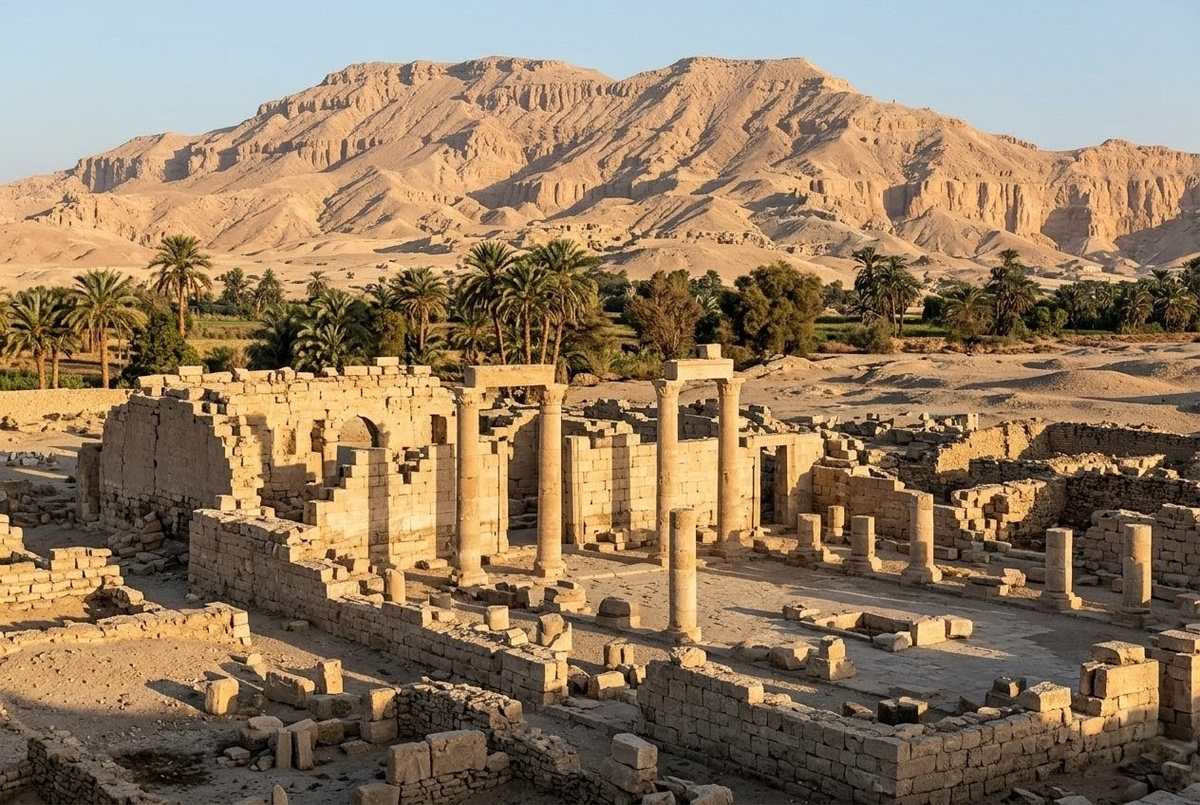
The circumstances of the library’s burial remain mysterious. The jar was buried sometime in the late fourth century CE, likely between 360 and 400 CE [28]. The site lies near the ancient Pachomian monastery of Chenoboskion (modern al-Qasr), suggesting a monastic context for the burial [29][30].
Several theories attempt to explain why someone buried these books [31]:
- The Archival Theory: The monastery maintained a library of heterodox texts for reference, later buried when Bishop Athanasius of Alexandria condemned non-canonical books in his Festal Letter of 367 CE [32].
- The Hiding Theory: Monks possessing these heretical texts feared persecution during the increasing orthodox dominance of Egyptian Christianity, burying them to avoid destruction.
- The Discard Theory: The texts were considered worthless or dangerous, buried ritually to neutralise their power or simply discarded in a convenient jar.
The presence of multiple copies of some texts (the Apocryphon of John appears in three versions) suggests deliberate collection rather than random accumulation [33]. Whoever assembled this library valued these texts highly enough to preserve them, even if they ultimately buried them.
The Conservation Challenge
When the codices reached the Coptic Museum, they presented a conservation nightmare. The papyrus had deteriorated significantly, glued together by the leather bindings’ disintegration. Pages were stuck together, crumbling, or had disintegrated entirely [34].
The first conservation efforts, undertaken in the 1950s, involved separating the leaves and pressing them between glass plates [35]. This method preserved the texts but damaged some fibres. Later, in the 1970s, more sophisticated techniques allowed conservators to unfold and flatten pages without glass pressure [36].
The sheer volume of material overwhelmed early scholars. Fifty-two separate texts, many previously unknown, required transcription, translation, and analysis. The international team assembled by UNESCO and the Coptic Museum included Coptic specialists, theologians, historians, and philologists working across multiple continents [37].
The Publication History
The first photographs of the Jung Codex circulated privately in the 1950s, allowing scholars to begin preliminary studies [38]. However, the Egyptian government restricted access to the Cairo codices, wanting to ensure Egyptian scholars participated fully in their publication.
The Coptic Gnostic Library Project, directed by James M. Robinson, began systematic photography and transcription in the 1960s [39]. Robinson negotiated unprecedented access to the codices, creating a complete photographic archive that formed the basis for the modern critical edition.
The first English translations appeared in 1977 (The Nag Hammadi Library in English), with revised editions following in 1988 and 1996 [40]. The complete scholarly edition (The Coptic Gnostic Library, published by Brill) appeared in multiple volumes between 1975 and 1995, establishing the critical text for all subsequent study [41].
The Impact on Scholarship
Before 1945, scholars knew Gnosticism primarily through the polemics of its enemies–Irenaeus, Tertullian, Epiphanius, and other Church Fathers who condemned these “heresies” while summarising their contents [42]. The Nag Hammadi discovery allowed Gnostics to speak for themselves.
The texts revealed a far more diverse movement than heresiologists had suggested. Valentinians, Sethians, Hermeticists, and unclassifiable visionary texts appeared side by side. The Gospel of Thomas offered sayings of Jesus absent from the canonical Gospels. The Gospel of Truth presented a mystical theology of remarkable sophistication [43].
The discovery forced historians to reconsider the boundaries of early Christianity. What had been considered marginal heresy proved to be a vibrant, intellectually rigorous alternative to the orthodoxy that eventually prevailed [44].
The Site Today
The Jabal al-Tarif remains largely unchanged–a desert cliff rising above sugar cane fields and the sluggish Nile [45]. No museum marks the spot where Muhammad Ali struck the jar. Local villagers know the story, but the precise burial site has been lost to agricultural expansion and shifting sands.
The original jar sits in the Coptic Museum in Cairo, a humble container that held the secrets of a lost world [46]. The codices themselves remain housed primarily in Cairo, with the Jung Codex pages now fully repatriated.
The Legacy of the Discovery
Muhammad Ali al-Samman died in 1989, having received modest compensation for his find but never the wealth he might have expected [47]. His discovery, however, earned him a permanent place in the history of religion.
The Nag Hammadi Library represents one of the three most significant archaeological discoveries for biblical studies, alongside the Dead Sea Scrolls (1947) and the Oxyrhynchus Papyri [48]. It transformed Gnosticism from a footnote in Church history into a major field of study, revealing the diversity of early Christian thought and the complexity of religious exchange in the Roman world.
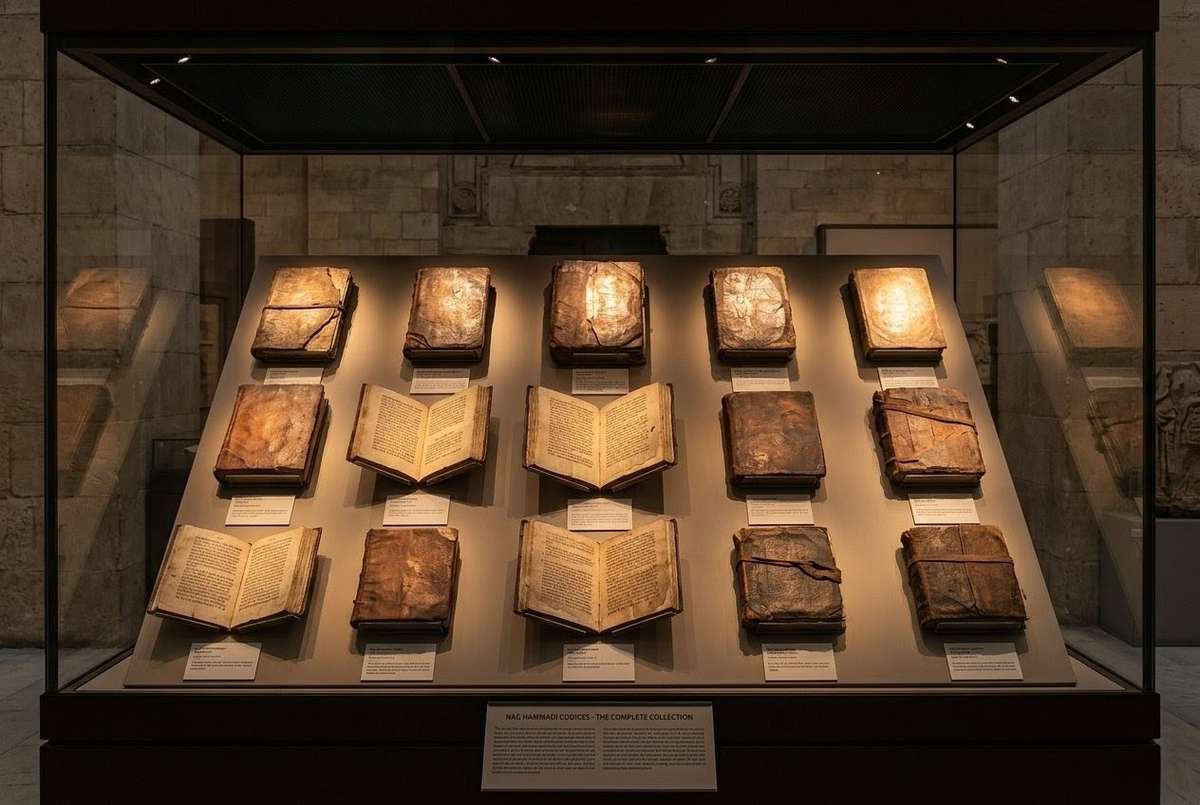
What began as a farmer’s mattock striking clay ended as the resurrection of voices silenced for sixteen centuries–a discovery that continues to reshape our understanding of the religious origins of Western civilisation [49].
Frequently Asked Questions
Who discovered the Nag Hammadi Library and when?
The Nag Hammadi Library was discovered in December 1945 by Muhammad Ali al-Samman, an Egyptian farmer from the al-Samman clan. While digging for soft sediment (sebakh or sabakh) used as fertiliser at the base of the Jabal al-Tarif cliff near Nag Hammadi, Upper Egypt, his mattock struck a large earthenware jar. Initially fearing it contained a jinn (spirit), he broke it open and found thirteen leather-bound papyrus codices containing 52 separate texts. His mother, Umm Ahmad, later claimed she burned some of the papyrus for kindling.
How did the Nag Hammadi codices reach the Coptic Museum?
The codices took a circuitous path to scholarly hands. One codex (Codex III) reached the Coptic Museum in Cairo on 4 October 1946, carried by Raghib Andrawus, a local history teacher who recognised its potential value. Dr Togo Mina, the museum’s director, immediately identified it as significant. Other codices appeared in Cairo antiquities shops in 1947, purchased by scholars like Gilles Quispel. The bulk of the library remained hidden until Egyptian authorities launched a recovery campaign in 1948. By 1952, twelve of thirteen codices reached the Coptic Museum. The thirteenth (Codex I, the Jung Codex) remained in Switzerland until its return to Cairo on 12 October 1975.
What is the Jung Codex and why was it in Switzerland?
The Jung Codex (Codex I) was smuggled to Belgium and subsequently purchased by the Jung Institute of Zurich on 10 May 1952. It was named after Swiss psychologist Carl Gustav Jung, though Jung himself resisted this naming. The codex remained in Switzerland for 23 years due to complex negotiations between the Egyptian government, the Jung Institute, and the heirs of C.G. Jung. An agreement was made granting publication rights before return. After the editio princeps was completed, the codex was returned to Egypt and united with the rest of the collection at the Coptic Museum on 12 October 1975.
Who buried the Nag Hammadi Library and why?
The library was buried near the Pachomian monastery of Chenoboskion (modern al-Qasr) sometime between 360-400 CE, likely by monks. Three theories explain the burial: (1) The Archival Theory–the monastery maintained heterodox texts for reference, burying them after Athanasius of Alexandria’s Festal Letter of 367 CE condemned non-canonical books; (2) The Hiding Theory–monks feared persecution during orthodox dominance and buried the texts to prevent destruction; (3) The Discard Theory–the texts were considered dangerous or worthless and buried ritually. The presence of multiple copies suggests deliberate collection rather than random discard.
What conservation challenges did the Nag Hammadi codices present?
When discovered, the codices presented severe conservation challenges: papyrus had deteriorated and was glued together by disintegrating leather bindings, pages were stuck together and crumbling. Initial 1950s conservation involved separating leaves and pressing them between glass plates, which preserved texts but damaged some fibres. In the 1970s, the Coptic Gnostic Library Project developed more sophisticated techniques for unfolding and flattening pages without glass pressure. Modern conservation (1980s-present) uses minimal intervention, housing fragile leaves in archival folders with polyester film windows under strict environmental controls at the Coptic Museum.
How did the Nag Hammadi discovery change scholarship?
Before 1945, Gnosticism was known primarily through hostile Church Fathers like Irenaeus and Tertullian. The Nag Hammadi discovery allowed Gnostics to speak for themselves, revealing a far more diverse movement than heresiologists suggested. The texts include Valentinian, Sethian, and Hermetic works; the Gospel of Thomas with sayings absent from canonical Gospels; and the sophisticated Gospel of Truth. This forced historians to reconsider early Christianity’s boundaries, transforming Gnosticism from a marginal footnote into a major field demonstrating the diversity and intellectual rigour of alternative Christianities.
Where are the Nag Hammadi codices preserved today?
The Nag Hammadi codices are primarily housed in the Coptic Museum in Old Cairo, Egypt. The original jar that contained them is also displayed there. The collection includes all thirteen codices containing 52 tractates (Codex XIII was actually inside Codex VI, making the traditional count of 13 codices technically 12 containers with 13 volumes). The site of discovery at Jabal al-Tarif remains unmarked, though local villagers know the story. The precise burial location has been lost to agricultural expansion and shifting sands.
Further Reading
- The Coptic Gnostic Library: Codicology and Conservation — Technical details on the material preservation and conservation of the codices.
- Timeline of Gnosticism: From Ancient Texts to Modern Discovery — The chronological trajectory from second-century origins to modern scholarship.
- Nag Hammadi for Beginners: A 10-Text Journey — An introductory path through the recovered library for new readers.
- Nag Hammadi Library: Complete Reader’s Guide — Comprehensive navigation of all 46 tractates with bibliographic guidance.
- The Apocryphon of John: A Gnostic Creation Myth — The foundational text preserved in three versions across the codices.
- The Gospel of Thomas: Ancient Wisdom Sayings — The most famous Nag Hammadi text, containing sayings of Jesus absent from canonical Gospels.
- The Gospel of Truth: Poetics of Recognition — The Valentinian masterpiece from the Jung Codex.
References and Sources
The following sources support the claims and historical narrative presented in this article. All dates and personal names follow the standard reconstruction established by James M. Robinson and subsequent scholarship.
Primary Sources and Discovery Accounts
- [1] Robinson, J.M. (1977). “The Discovery of the Nag Hammadi Codices.” Biblical Archaeologist, 42(4), 206-224.
- [2] Robinson, J.M. (1979). “The Discovery of the Nag Hammadi Codices.” In The Nag Hammadi Library in English. Harper & Row.
- [3] Linjamaa, P. (2024). “The Find Story and the Ethics of Postmodern Manuscript Archaeology.” In The Nag Hammadi Codices and their Ancient Readers. Cambridge University Press.
- [4] Goodacre, M. (n.d.). “How Reliable is the Story of the Nag Hammadi Discovery?” Journal of Biblical Literature.
- [5] Robinson, J.M. (1981). “The Discovery.” In The Nag Hammadi Library in English, 3rd ed. HarperSanFrancisco.
Archaeological and Material Evidence
- [6] Tertullian.org. “The Nag Hammadi Discovery of Manuscripts.” Manuscripts and Inscriptions.
- [7] Robinson, J.M. (2006). The Nag Hammadi Story. Vol. 1. Brill.
- [8] Robinson, J.M. (2006). The Nag Hammadi Story. Vol. 2. Brill. [Umm Ahmad interview]
- [9] Doresse, J. (1950). “A Gnostic Library from Upper Egypt.” Archaeology, 3, 69-73.
- [10] Robinson, J.M. (1988). “From Cliff to Cairo: The Story of the Discoverers and the Middlemen.” In The Nag Hammadi Library After Fifty Years. Brill.
Coptic Museum and Early Scholars
- [11] Christian History Magazine. “The Secret is Out.”
- [12] Robinson, J.M. (1977). The Nag Hammadi Library in English. Harper & Row. [Raghib Andrawus account]
- [13] Robinson, J.M. (2006). The Nag Hammadi Story. Vol. 1. Brill. [Basiliyus ‘Abd al-Masih]
- [14] Robinson, J.M. (2006). The Nag Hammadi Story. Vol. 1. Brill. [George Sobhi]
- [15] Nag Hammadi Archive, Claremont Colleges Library. “Jean Doresse and Togo Mina.”
- [16] Gabra, G. “Mina, Togo (1906-1949).” Coptic Encyclopedia.
- [17] Schenke, H.M. (2012). “Nag Hammadi.” In Textkritik der Apokryphen des Alten Testaments. Mohr Siebeck.
Antiquities Trade and the Jung Codex
- [18] Robinson, J.M. (2006). The Nag Hammadi Story. Vol. 2. Brill. [Phokio Tano]
- [19] Robinson, J.M. (2006). The Nag Hammadi Story. Vol. 2. Brill. [Albert Eid]
- [20] Turner, M. (1986). “Puech and the Nag Hammadi Discovery.” Bulletin de la Societe francaise d’egyptologie.
- [21] Quispel, G. (2008). Gnostica, Judaica, Catholica: Collected Essays. Brill.
- [22] Egyptian Antiquities Department. (1948). “Recovery of the Nag Hammadi Codices.” Internal reports.
- [23] Robinson, J.M. (1988). “Nag Hammadi: The First Fifty Years.” In The Nag Hammadi Library After Fifty Years. Brill.
- [24] Robinson, J.M. (1977). The Nag Hammadi Library in English. Harper & Row. [Jung Codex]
- [25] Codex Jung. (n.d.). Claremont Colleges Digital Library.
- [26] Jung, C.G. (1953). Letter to C.A. Meier, 27 October 1953. Jung Archive.
- [27] Robinson, J.M. (2006). The Nag Hammadi Story. Vol. 2. Brill. [1975 return]
Burial Context and Monastic History
- [28] Robinson, J.M. (1979). “The Construction of the Nag Hammadi Codices.” In Essays on the Nag Hammadi Texts. Brill. [360-400 CE dating]
- [29] Wikipedia. (2024). “Pachomian Monasteries.”
- [30] Theosophical Society. “The Apocryphon of James.” Quest Magazine. [Chenoboskion]
- [31] Williams, M.A. (1996). Rethinking “Gnosticism”. Princeton University Press. [Burial theories]
- [32] Athanasius of Alexandria. (367 CE). Festal Letter 39. Trans. in Nicene and Post-Nicene Fathers, Vol. 4.
- [33] Waldstein, M. & Wisse, F. (1995). The Apocryphon of John. Brill. [Three versions]
Conservation and Publication
- [34] Pahor Labib. (1963). “Conservation of the Nag Hammadi Papyri.” Restaurator, 1(1), 23-32.
- [35] Robinson, J.M. (1979). “From Papyrus to Print.” Biblical Archaeologist, 44(4), 238-243.
- [36] Robinson, J.M. (2016). “Liberator of the Nag Hammadi Codices.” Biblical Archaeology Review.
- [37] UNESCO. (1960s). “Coptic Gnostic Library Project Records.”
- [38] Meier, C.A. (1950s). “Jung Codex Photography.” Jung Institute Archives.
- [39] Robinson, J.M. (1979). “The Coptic Gnostic Library Project.” Restoration.
- [40] Robinson, J.M. (1977). The Nag Hammadi Library in English. Harper & Row.
- [41] Robinson, J.M. (ed.). (1975-1996). The Coptic Gnostic Library (12 vols.). Brill.
- [42] Brakke, D. (2010). The Gnostics: Myth, Ritual, and Diversity in Early Christianity. Harvard University Press.
- [43] Layton, B. (1987). The Gnostic Scriptures. Doubleday. [Gospel of Truth]
- [44] King, K.L. (2003). What is Gnosticism? Harvard University Press.
- [45] Robinson, J.M. (2006). The Nag Hammadi Story. Vol. 1. Brill. [Site today]
- [46] Coptic Museum Cairo. (2024). “Nag Hammadi Collection Display.”
- [47] Robinson, J.M. (1989). “Obituary: Muhammad Ali al-Samman.” Biblical Archaeologist.
- [48] Robinson, J.M. (1977). The Nag Hammadi Library in English. Harper & Row. [Significance]
- [49] Pagels, E. (1979). The Gnostic Gospels. Random House. [Impact]