Codex V: The Pagan-Christian Interface and the Collection of Diverse Wisdom
Codex V: The Eclectic Anthology of Ascent and Revelation
Codex V of the Nag Hammadi Library stands as perhaps the most eclectic collection within the entire corpus–a single volume that moves seamlessly from pagan philosophical treatises to Christian apocalypses, from the metaphysical abstractions of the Self-Father to the vivid visionary landscapes of the Apocalypse of Paul. Where other codices often maintain a coherent theological or ritual focus, Codex V gathers disparate voices into conversation, presenting us with a cross-section of second-century spiritual diversity that refuses easy categorisation.
The codex opens with Eugnostos the Blessed, a pagan philosophical letter describing divine emanation without reference to Jesus, scripture, or Christian sacraments. It closes with the Acts of Peter and the Twelve Apostles, a distinctly Christian narrative of apostolic mission. Between these poles lie texts of Jewish-Christian apocalyptic, Sethian revelation, and Pauline ascent mysticism. Together, they constitute a portrait of religious fluidity in late antique Egypt–a world where boundaries between philosophy and revelation, paganism and Christianity, remained productively porous. This is not a filing system of rigid categories but an executive headquarters where multiple departments collaborate on the single project of human liberation.
The Manuscript and Its Materiality
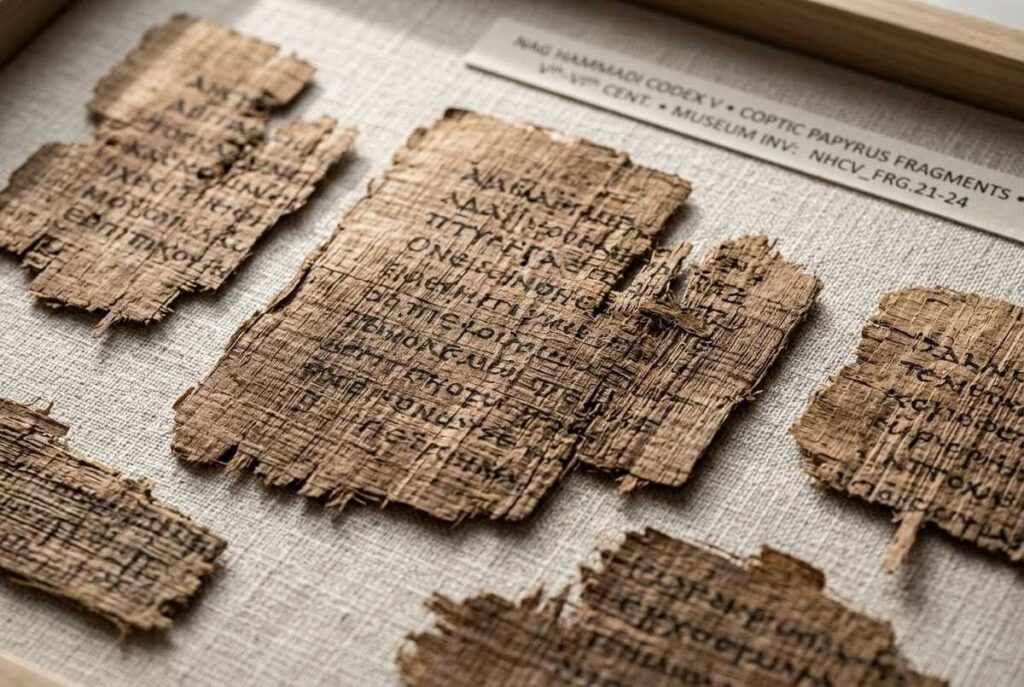
Like its companions in the Nag Hammadi collection, Codex V dates to the mid-fourth century CE, copied by Coptic-speaking scribes in Upper Egypt. The manuscript comprises sixty-six leaves (132 pages) of papyrus, bound in leather covers that have long since deteriorated. The scribal hand is careful but not elegant, suggesting a community more concerned with content preservation than liturgical display–archivists of gnosis rather than calligraphers of orthodoxy.
The physical arrangement reveals intentional organisation. Eugnostos and The Second Treatise of the Great Seth occupy the opening sections, establishing a metaphysical framework. The three apocalypses–of Paul and the two of James–form a central block of visionary literature. The Acts of Peter and the Twelve provides narrative closure. Whether this sequence reflects reading order, theological priority, or merely scribal convenience remains debated among scholars. What is clear is that the codex functioned as a portable library, offering its readers access to multiple genres of sacred knowledge within a single volume–a complete security clearance dossier for the elect.

The Contents of Codex V: A Six-Tractate Curriculum
What is Codex V?
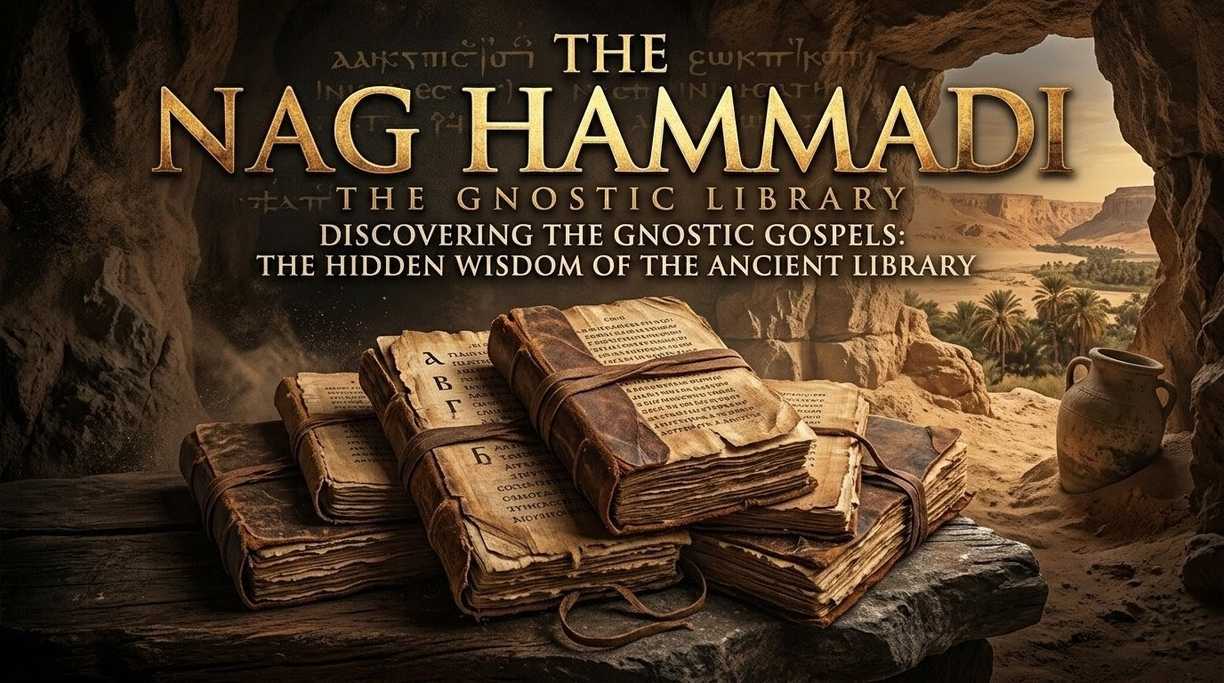
Nag Hammadi Codex V (NHC V) is the fifth volume in the thirteen-codex library discovered in 1945. It contains six distinct tractates ranging from pagan philosophical letters to Christian apocalypses, demonstrating the remarkable theological diversity and intellectual cosmopolitanism of fourth-century Gnostic communities in Upper Egypt. The codex functions as an anthology of ascent–each text addressing the soul’s journey from material imprisonment to spiritual liberation through different rhetorical strategies: metaphysical description, visionary narrative, and apostolic precedent.
Tractate 1: Eugnostos the Blessed (V,1)
The codex opens with a philosophical letter from a pagan teacher to his disciples, describing the structure of divine reality through a hierarchy of emanations: the Unbegotten Father, the Self-Begetter, and the Immortal Human, from whom flow the aeons. Strikingly, the text contains no Christian elements–no Jesus, no cross, no eschatological urgency. Its presence here testifies to the Gnostic willingness to find truth wherever it appeared, to value wisdom regardless of its source. The text appears twice in the Nag Hammadi library–here and in Codex III–each time paired with its Christian adaptation, the Sophia of Jesus Christ.
Primary Source: NHC V,1 3:15-20: “The Unbegotten Father, the eternal, the one who has no beginning and no end… He is uncontainable, incomprehensible, unchangeable, ineffable, unutterable.”
Eugnostos operates as the metaphysical orientation manual for the codex, establishing the ontological coordinates that subsequent texts will navigate. His serene negative theology–describing the divine by what it is not–provides the necessary conceptual clearance for understanding the more dramatic mythological narratives that follow.
Tractate 2: The Second Treatise of the Great Seth (V,2)
A revelation discourse delivered by Seth, the third son of Adam, who speaks from the perspective of the pneumatikoi–the spiritual elect. The text contains the infamous “laughing Saviour” passage, where Christ mocks the ignorance of the archons who crucified him, declaring: “I did not die in reality but in appearance…” This docetic Christology–that Jesus’ physical suffering was illusory–represents one extreme of Gnostic reflection on the problem of evil and divine suffering. The text also includes a fierce polemic against apostolic Christianity, accusing Peter and the other disciples of misunderstanding the Saviour’s teaching.
The Second Treatise functions as the radical theology department of the codex, pushing boundaries that other texts merely gesture toward. Here the archons are not merely ignorant bureaucrats but the objects of cosmic ridicule–middle-management humiliated by their own incompetence when the true executive (Christ) reveals their bankruptcy.
Tractate 3: The Apocalypse of Paul (V,3)
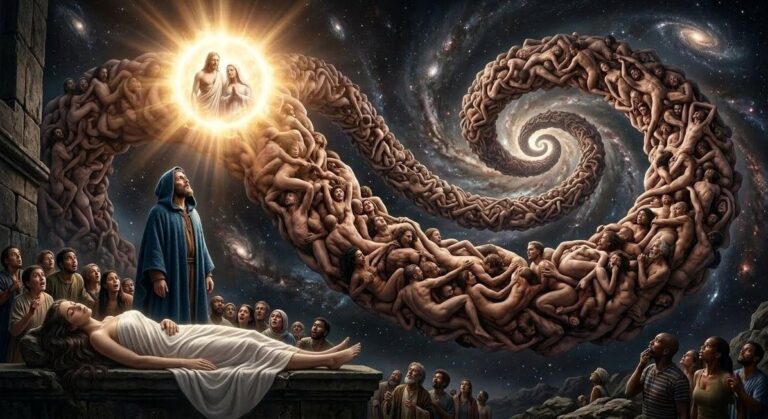
A visionary ascent narrative describing the Apostle Paul’s journey through the fourth heaven and beyond, guided by the Holy Spirit. The text expands significantly on Paul’s cryptic reference in 2 Corinthians 12:2-4 to being “caught up to the third heaven.” Here, Paul ascends past planetary spheres governed by hostile archons, past the place of punishment where souls are tortured, into the presence of the resurrected Christ. The narrative provides detailed geography of the celestial realms, offering readers a map for their own post-mortem journey–a travel guide for the departing soul.
The Apocalypse of Paul provides the codex’s most accessible entry point for those drawn to visionary literature. Its systematic ascent through planetary toll-collectors (archons demanding passwords) represents the standard Gnostic exit procedure from the material branch office to the pleromatic executive headquarters.
Tractate 4: The First Apocalypse of James (V,4)
Attributed to James the Just, brother of Jesus and leader of the Jerusalem church, this text presents a secret dialogue between Jesus and James before the crucifixion. Jesus reveals to James the true nature of reality, the structure of the pleroma, and the means of ascending past the planetary archons. The text reflects Jewish-Christian concerns while incorporating distinctively Gnostic motifs: the material world as prison, the need for secret knowledge to achieve liberation, and the hostility of the creator god. It concludes with James’ own martyrdom, presented as a triumphant return to the divine source.
Tractate 5: The Second Apocalypse of James (V,5)
A companion text offering another revelation to James, this time focusing more intensely on the metaphysics of salvation and the psychological preparation for death. Where the First Apocalypse provides technical ascent protocols, the Second addresses the interior transformation necessary to face martyrdom with peace. The two James apocalypses likely circulated independently before being gathered into this collection. Together, they establish James as a crucial Gnostic authority–a figure who received secret teaching from Jesus and transmitted it to the elect.
Tractate 6: The Acts of Peter and the Twelve Apostles (V,6)
A narrative account of Peter’s missionary journey, distinguished by its emphasis on voluntary poverty and spiritual discernment. The apostles encounter a rich man named Lithargoel (a cryptic name for Jesus) who tests their commitment to material renunciation. Peter’s response–refusing gold but accepting the stranger’s spiritual wisdom–encapsulates the text’s theology: the material world offers only deception; true treasure lies in gnosis. The narrative frame owes much to canonical Acts, but the theological perspective is thoroughly Gnostic, presenting the apostolic mission as the dissemination of secret knowledge rather than the establishment of institutional church.
This closing tractate brings the codex full circle: where Eugnostos began with abstract metaphysics, the Acts of Peter concludes with practical ethics–the recognition that poverty and discernment serve as the proper equipment for celestial field operatives.

Theological Coherence in Diversity
What unifies these disparate texts? Several thematic threads weave through the collection:
The Revealer Figure
Each text centres on a revealer–Eugnostos, Seth, Paul, James, Peter–who transmits knowledge of hidden realities. Whether pagan philosopher or Christian apostle, the function remains constant: to lift the veil of material illusion and disclose the true structure of existence. This is the Gnostic principle of apostolic succession through gnosis rather than institutional hierarchy–security clearance granted by knowledge, not by seniority.
Ascent and Liberation
Five of the six texts describe some form of ascent–metaphysical, visionary, or geographical. Whether ascending through aeons, heavens, or states of consciousness, the goal remains escape from material limitation and return to spiritual origin. The codex functions as a complete training manual for this departure process, from orientation (Eugnostos) to exit procedures (the apocalypses) to field equipment (Acts of Peter).
The Deceptive Cosmos
From the archons who crucified the laughing Saviour to the rich man who tests the apostles with gold, the material world appears as realm of deception. Yet Codex V lacks the radical dualism of some Sethian texts. Even Eugnostos, with its serene metaphysics, describes creation as orderly emanation rather than catastrophic fall. The archons here are incompetent middle-management rather than evil overlords–a more bureaucratic than diabolical cosmology.
The Status of the Saviour
The collection presents multiple Christologies: the docetic Christ of the Second Treatise who only appeared to suffer; the resurrected guide of Apocalypse of Paul; the secret teacher of the First Apocalypse of James. This diversity suggests a community comfortable with theological multiplicity, valuing the function of revelation over the uniformity of doctrine–an executive headquarters with multiple department heads reporting to the same Parent.
Codex V and Codex III: The Eugnostos Connection
The presence of Eugnostos the Blessed in both Codex V and Codex III illuminates how these texts circulated and were valued. In Codex III, Eugnostos appears alongside its Christian adaptation, the Sophia of Jesus Christ, allowing readers to compare the pagan original with its Christian reception. In Codex V, Eugnostos stands alone, opening the codex without commentary or Christian framing.
This difference in presentation suggests multiple reading strategies. Codex III invites comparative study–seeing how philosophical wisdom was transformed by Christian revelation. Codex V permits engagement with pagan metaphysics on its own terms, as valid spiritual knowledge requiring no Christian validation. The same text, differently contextualised, produces different meanings–a single document serving different functions in separate filing systems.
The two codices likely derive from the same community or network of communities, sharing not only texts but theological perspectives. Yet their organisational differences reveal flexibility in how Gnostic readers approached their scriptures–sometimes seeking synthesis, sometimes preserving distinction, always maintaining the right to judge wisdom by its truth rather than its origin. This is the hallmark of the Gnostic archival methodology: truth transcends provenance.
Reading Codex V Today
Approach this codex as a curated anthology rather than a systematic theology. The texts speak to different concerns–metaphysical, visionary, narrative, polemical–yet together they sketch a spiritual world where knowledge liberates, where the material cosmos conceals rather than reveals the divine, and where authorised teachers transmit secrets to prepared disciples.
Begin with Eugnostos if you come from philosophical background; its negative theology and hierarchical metaphysics will feel familiar. Turn to the Apocalypse of Paul if visionary literature draws you; its ascent narrative rivals Dante in imaginative scope. Read the James apocalypses for their portrait of Jewish-Christian Gnosticism; the Second Treatise for its radical Christology; the Acts of Peter for its practical ethics of renunciation.
Notice what changes as you move from text to text. The God of Eugnostos is serene and self-sufficient; the God of the James apocalypses is hidden, his creation the work of lower powers. The Saviour in Second Treatise mocks the material world; the Saviour in Apocalypse of Paul guides the soul through it. These tensions are not errors to be resolved but perspectives to be held–evidence of a living tradition wrestling with fundamental questions rather than a fossilised orthodoxy enforcing answers.

Codex V offers no single path to gnosis. It offers multiple paths, each validated by its own logic, each claiming to reveal what remains hidden from the uninitiated. The Gnostics who gathered these texts into a single volume seem to have believed that truth could speak through many voices–pagan and Christian, philosophical and apocalyptic, ancient and contemporary. Their anthology preserves that polyphony, inviting us to listen for the harmonics that emerge when disparate voices sing of liberation.
Frequently Asked Questions
What is Codex V in the Nag Hammadi Library?
Codex V is the fifth volume in the thirteen-codex Nag Hammadi Library discovered in 1945. Dating to the mid-fourth century CE, it contains six tractates ranging from pagan philosophical letters (Eugnostos) to Christian apocalypses (Paul, James) and apostolic narratives (Acts of Peter). It serves as an eclectic anthology demonstrating the theological diversity of Gnostic communities in Upper Egypt.
What texts are contained in Codex V?
Codex V contains: (1) Eugnostos the Blessed–a pagan philosophical letter on divine emanation; (2) The Second Treatise of the Great Seth–Sethian revelation with docetic Christology; (3) The Apocalypse of Paul–visionary ascent through planetary spheres; (4) The First Apocalypse of James–secret teachings to James the Just; (5) The Second Apocalypse of James–psychological preparation for martyrdom; (6) The Acts of Peter and the Twelve Apostles–apostolic narrative testing spiritual discernment.
What is Eugnostos the Blessed and why is it significant?
Eugnostos the Blessed (NHC V,1) is a pagan philosophical treatise describing the Unbegotten Father and divine emanation without any Christian elements. Its presence in a Christian Gnostic codex demonstrates the intellectual cosmopolitanism of these communities–their willingness to preserve truth regardless of source. It appears twice in the library, paired in Codex III with its Christian adaptation, the Sophia of Jesus Christ.
How does the Second Treatise of the Great Seth present the crucifixion?
The Second Treatise (NHC V,2) presents a docetic crucifixion where Jesus laughs at the archons from above while Simon of Cyrene is crucified in his place. ‘I did not die in reality but in appearance,’ the Saviour declares. This represents radical Gnostic Christology protecting the divine from suffering while exposing the archons’ ignorance–the ‘laughing Saviour’ passage that shocked orthodox sensibilities.
What is the Apocalypse of Paul about?
The Apocalypse of Paul (NHC V,3) expands on 2 Corinthians 12:2-4, describing Paul’s guided ascent through the fourth heaven past planetary archons into the pleroma. It provides detailed geography of celestial realms including the ‘place of punishment’ and weeping archons who cannot stop the ascending soul. The text functions as a map for post-mortem journey and escape from cosmic imprisonment.
How do the two Apocalypses of James differ?
The First Apocalypse (NHC V,4) provides technical protocols for navigating archonic checkpoints after death–the exit procedures. The Second Apocalypse (NHC V,5) addresses psychological preparation: dissolving fear, reframing suffering, and establishing interior peace for martyrdom. Together they form complete preparation for departure–operations manual plus confidence-building seminar.
What unifies the diverse texts in Codex V?
Five unifying threads: (1) Revealer figures transmitting hidden knowledge; (2) Ascent narratives describing liberation from material limitation; (3) Recognition of the cosmos as deceptive realm requiring hermeneutical suspicion; (4) Multiple Christologies valuing function over uniformity; (5) The pedagogical goal of transforming the reader from hylic (material) to pneumatic (spiritual) status through gnosis.
Further Reading
- Eugnostos the Blessed — The pagan philosophical source text describing the Unbegotten Father and divine emanation without Christian elements.
- Second Treatise of the Great Seth — The radical docetic Christology featuring the “laughing Saviour” and substitutionist crucifixion narrative.
- Apocalypse of Paul — The visionary ascent through planetary spheres and the geography of celestial realms beyond the fourth heaven.
- First Apocalypse of James — Secret teachings to James the Just with technical protocols for post-mortem navigation.
- Second Apocalypse of James — The psychology of martyrdom and interior preparation for death through reframing suffering.
- Acts of Peter and the Twelve Apostles — The apostolic narrative testing spiritual discernment and the hermeneutics of suspicion.
- Codex III — The parallel codex containing Eugnostos paired with its Christian adaptation, the Sophia of Jesus Christ.
References and Sources
The following sources support the claims and quotations presented in this article. All citations to the Nag Hammadi Library represent direct translations from the Coptic text as established in the standard critical editions.
Primary Sources and Critical Editions
- [1] Robinson, J.M. (Ed.). (1977). The Nag Hammadi Library in English. Harper & Row. — Standard English translation of NHC V.
- [2] Schenke, H.M. (2012). “The Second Treatise of the Great Seth (NHC V,2).” In The Coptic Gnostic Library Online. Brill. — Definitive critical edition with Coptic text.
- [3] Meyer, M. (2007). The Nag Hammadi Scriptures. HarperOne. — Scholarly translation with introduction to Codex V tractates.
- [4] Layton, B. (1987). The Gnostic Scriptures. Doubleday. — Critical edition with theological analysis of the James apocalypses.
- [5] Funk, W.P., Schenke, H.M., & Bethge, H.G. (1999). Nag Hammadi Deutsch, Band 1. Walter de Gruyter. — German critical edition with line numbering.
Scholarly Monographs and Specialist Studies
- [6] Turner, J.D. (2001). Sethian Gnosticism and the Platonic Tradition. Presses Universite Laval. — Analysis of Sethian tractates in Codex V.
- [7] Hartenstein, S. (2000). Die zweite Lehre: Erinnerungen an eine verlorene Gnosis. Schiller. — Study of the Second Apocalypse of James.
- [8] Frey, J. (2002). “The martyrdom of James in intertextual perspective.” Zeitschrift fur die neutestamentliche Wissenschaft, 93(1), 17-37.
- [9] Painchaud, L. (1995). L’ecrit sans titre: Traite sur l’origine du monde. Presses Universite Laval. — Methodological approach to NHC V texts.
- [10] Perkins, P. (1984). Gnosticism and the New Testament. Fortress Press. — Contextualisation of Codex V within early Christianity.
Comparative Studies and Thematic Analyses
- [11] King, K.L. (2006). The Secret Revelation of John. Harvard University Press. — Comparative analysis of Sethian mythology.
- [12] Meyer, M. (2010). “The Apocalypse of Paul (NHC V,3).” In The Coptic Gnostic Library, vol. 3. Brill. — Critical study of the Pauline ascent narrative.
- [13] Schoedel, W.R. (1972). The First Apocalypse of James. In Nag Hammadi Studies, vol. 9. Brill.
- [14] Lapham, F. (2003). An Introduction to the New Testament Apocrypha. T&T Clark. — Comparative study of apocalyptic literature.
- [15] Bauckham, R. (1999). Jude and the Relatives of Jesus in the Early Church. T&T Clark. — Historical context for James traditions.