The First Apocalypse of James: Martyrdom and the True Jerusalem
The First Apocalypse of James: Martyrdom and the True Jerusalem (NHC V,3)
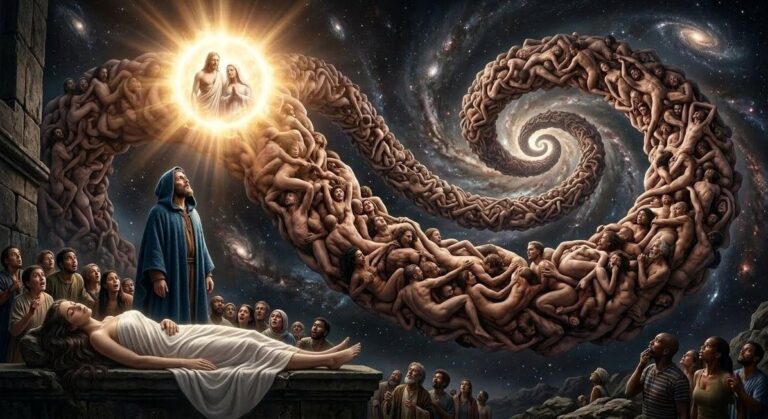
The First Apocalypse of James (NHC V,3) preserves a revelation dialogue between Jesus and his brother James, spanning the eve of the passion and continuing after the resurrection. Unlike the secret teachings preserved in the Apocryphon of James, this tractate culminates in James’ martyrdom — his stoning at the hands of a Jerusalem mob — yet interprets this violent death not as tragic defeat but as the fulfilment of an initiatory mission and the final password that releases the spirit from planetary custody [1]. The text offers a distinctive Gnostic martyrology: death becomes the bureaucratic exit visa that allows the initiate to bypass archontic administration and ascend to the Pleroma [2].
This is not the James of familial tension familiar from the canonical gospels, but James the Just, bishop of Jerusalem and leader of the mother church, reinterpreted as the first martyr among the apostles and the guardian of a secret tradition. The First Apocalypse preserves a unique tradition about his death that diverges from the accounts of Josephus, Hegesippus, and Eusebius, suggesting that early Christian memory of James remained far more fluid — and far more theologically charged — than orthodox historiography later allowed [3]. The text effectively constructs an alternative apostolic succession that bypasses Petrine authority, establishing James not merely as an earthly administrator but as the heavenly high priest designate of the true Jerusalem above.
What Is the First Apocalypse of James?
The First Apocalypse of James (NHC V,3; also partially preserved in Codex Tchacos) is a revelation discourse attributed to James the Just, brother of Jesus. Composed in the second or third century CE, the text belongs to the Valentinian or broader Gnostic trajectory of early Christianity. It combines pre- and post-resurrection dialogues with Jesus, detailed instructions for the soul’s ascent through seven planetary archons, and a distinctive martyrdom account that reinterprets James’ death as a liturgical triumph rather than political execution. The tractate survives in two manuscript versions and serves as a crucial witness to how Gnostic communities appropriated and transformed apostolic memory [4].
Table of Contents
- The Historical James and the Gnostic James
- The Manuscript and Its Context
- The Pre-Passion Revelation
- The Post-Resurrection Teaching
- The Passwords and the Ascent Through Seven Archons
- The Martyrdom Scene
- Earthly Jerusalem and the True Jerusalem Above
- Gnostic Martyrology: A Third Way
- The Three James Texts: A Composite Portrait
- Reading the First Apocalypse of James Today
- Why the First Apocalypse of James Matters
- Frequently Asked Questions
- Further Reading
- References and Sources
The Historical James and the Gnostic James
Historical memory of James the Just presents a figure of remarkable complexity. Paul names him as one to whom the risen Christ appeared, and as a leader of the Jerusalem assembly whose imprimatur carried decisive weight in the early Jesus movement (1 Corinthians 15:7; Galatians 1:19; 2:9, 12) [5]. Josephus records his death by stoning at the instigation of the high priest Ananus around 62 CE — an episode that, in Josephus’ telling, provoked outrage even among Jerusalem’s non-Christian population because of James’ reputation for Torah observance and piety [6]. Hegesippus, preserved fragmentarily in Eusebius, offers a more elaborately hagiographic account: James is cast down from the temple pinnacle, stoned, and finally beaten to death with a fuller’s club, his last words a prayer of forgiveness for his executioners modelled on the Lucan Jesus [7].
The First Apocalypse of James enters this crowded memorial field with a decisively different agenda. It is not interested in establishing historical facticity in the modern sense, nor in producing a martyrology that serves emerging episcopal authority. Rather, it appropriates James as the recipient of apokalypsis — an unveiling of cosmic architecture and soteriological mechanism available only to the elect [8]. The historical James, leader of the Jerusalem church, becomes in this retelling the Gnostic James, guardian of passwords and overseer of a celestial priesthood. The text functions as an initiation manual disguised as a martyrdom account, transforming the bishop of Jerusalem into the prototypical initiate who knows how to navigate the archontic bureaucracy from the inside.
From Family Skeptic to Initiate
The canonical gospels preserve traces of tension between Jesus and his biological family. Mark 3:21-35 presents Jesus’ family as sceptical of his mission, while John 7:5 states explicitly that “even his brothers did not believe in him.” The First Apocalypse of James resolves this tension through initiation: James is transformed from doubtful sibling to intimate confidant, receiving private teachings that the other apostles neither hear nor, the text implies, could comprehend [9]. This is not mere familial rehabilitation; it is a claim about the restricted circulation of saving knowledge. The brother relationship becomes a metaphor for esoteric transmission — blood kinship is superseded by pneumatic recognition, and James receives his promotion from field agent to executive insider based on spiritual aptitude rather than genetic proximity.
The Historical Evidence
The diversity of traditions about James’ death — Josephus’ political execution, Hegesippus’ elaborate martyrdom, and the First Apocalypse’s Gnostic reinterpretation — suggests that no single narrative achieved dominance in the first two centuries of Christianity [10]. The First Apocalypse preserves a trajectory of memory that could not be assimilated into emerging catholic historiography precisely because it denies the value of the institutional structures that the historical James allegedly oversaw. For the Gnostic author, James’ earthly leadership is merely a temporary posting; his true appointment awaits in the Jerusalem above. The text thus preserves a counter-memory that turns the pillar of the Jerusalem church into the prototype of the initiate who transcends all earthly jurisdictions.
The Manuscript and Its Context
The First Apocalypse of James survives as the third tractate in Nag Hammadi Codex V, a collection that also contains the Apocalypse of Paul (NHC V,2) and the Second Apocalypse of James (NHC V,4) [11]. This codicological context is significant: Codex V functions as an anthology of ascent literature and apostolic apocalypses, suggesting that the ancient readers of this collection understood these texts as complementary guides to the same basic problem — how the soul navigates the post-mortem bureaucracy and returns to its true origin [12]. The placement of two James texts within a single codex indicates that the community valued James as a privileged revealer, a “department head” whose internal memoranda carried special authority.
A partial parallel to the First Apocalypse also survives in the recently published Codex Tchacos, a fourth-century Coptic manuscript that contains the Gospel of Judas and other Gnostic texts [13]. The Tchacos parallel confirms that the First Apocalypse circulated independently of the Nag Hammadi collection and was considered sufficiently important to be copied in multiple locations. This dual attestation suggests that the text was not a marginal curiosity but a “core document” within Gnostic communities — required reading for those preparing to face the planetary authorities.
Codex V and the James Collection
Codex V contains five tractates: Eugnostos the Blessed, the Apocalypse of Paul, the First Apocalypse of James, the Second Apocalypse of James, and the Apocalypse of Adam. This arrangement creates a coherent reading programme: philosophical theology (Eugnostos), Pauline ascent (Apocalypse of Paul), Jamesian martyrdom (First Apocalypse), Jamesian temple theology (Second Apocalypse), and primeval revelation (Apocalypse of Adam) [14]. The codex thus functions as a “training curriculum” for initiates, moving from abstract cosmology through apostolic witness to primordial myth. The First Apocalypse occupies a pivotal position, providing the practical passwords that transform theoretical knowledge into operational capability.
The Pre-Passion Revelation
The text opens in medias res with Jesus warning James of impending catastrophe: “The enemy is coming for me, and then he will come for you.” This is not the political foresight of a revolutionary anticipating Roman reprisal, but cosmological intelligence from one who knows the administrative structure of the cosmos [15]. The enemy is the demiurgic power and its archontic administrators, the planetary rulers who govern the descent and ascent of souls. James, recognising the gravity of the moment, responds with the characteristic petition of the Gnostic initiate: “Master, give me the power to resist the enemy.”
What follows is not a call to armed resistance nor a promise of physical deliverance, but a cartography of the heavens. Jesus reveals “the mysteries of the heavens” — the nature of the archons, the structure of the material cosmos, and the precise fate awaiting the soul upon its departure from the body. “When you leave the body,” Jesus instructs, “you will pass through the seven archons.” This is practical eschatology rendered with bureaucratic exactitude: the afterlife is not a realm of vague hope but a governed territory with checkpoints, passwords, and protocols [16]. The initiate receives a confidential briefing on how to handle interrogation by celestial authorities — knowledge that proves far more valuable than any earthly defence strategy.
The Enemy and the Warning
The identification of the enemy as archontic rather than human is crucial for understanding the text’s theology. The First Apocalypse does not portray James’ death as a collision between Christianity and Judaism, or between Jesus’ movement and the temple authorities. Instead, it understands the coming violence as the visible manifestation of an invisible cosmological struggle [17]. The archons, who control the material realm and its religious institutions, recognise in James a spirit that has learned their names and neutralised their authority. His death is not a political execution but an administrative termination — the archons firing an employee who has read the classified files and knows how the corporation actually operates.
The Mysteries of the Heavens
The pre-passion revelation establishes the theological framework for everything that follows. Jesus teaches James about the structure of the cosmos, the nature of the planetary rulers, and the mechanics of post-mortem survival. This is not comfort in the conventional sense; it is operational intelligence. James learns that the cosmos is administered by seven planetary governors who demand recognition and attempt to detain ascending souls [18]. Without the proper credentials, the soul remains trapped in the cycle of reincarnation or subject to the archons’ arbitrary judgments. With the proper credentials, the soul passes through as easily as a diplomat with immunity papers walking through customs.
Primary Source Citation: “The enemy is coming for me, and then he will come for you. Master, give me the power to resist the enemy. I reveal to you the mysteries of the heavens. When you leave the body, you will pass through the seven archons.” — NHC V,3 24:10-35 [19]
The Post-Resurrection Teaching
Following the crucifixion and resurrection, Jesus appears to James in a private revelation that deliberately excludes the other apostles. “He appeared to me in private,” James records, “for he knew that I would suffer persecution.” This exclusivity is theologically significant. In the synoptic tradition, the risen Christ appears to the Twelve, to the women at the tomb, to the disciples on the Emmaus road — a broadly distributed resurrection witness that underwrites communal authority [20]. The First Apocalypse of James restricts this witness, transforming resurrection appearance into esoteric appointment. James alone receives the full transmission because James alone will require its complete armour for the ordeal ahead.
The text underscores this special status with ecclesiological precision: “You are the one whom I have chosen to lead the Jerusalem church.” Here the Gnostic imagination appropriates and reinterprets a historical reality — the Jerusalem church was indeed led by James according to Paul’s letters and Acts — but infuses it with pneumatic significance. Leadership of the earthly community becomes coterminous with guardianship of the secret tradition. James is not merely an administrator; he is the living archive of passwords, the high priest designate of the temple above [21]. His earthly tenure is temporary; his heavenly appointment is eternal.
Private Appearance and Exclusive Knowledge
The motif of private revelation appears throughout Gnostic literature, from the Apocryphon of James to the Gospel of Mary. The First Apocalypse of James employs this motif to establish a chain of custody for secret knowledge: Jesus teaches James; James records the teaching; the text preserves the record for future initiates [22]. This is not democratic spirituality. The knowledge is restricted because its application requires precise understanding — one does not hand the master keys to the building to every visitor. James’ private briefing establishes him as the sole authorised carrier of the ascent passwords, the “security officer” who alone possesses the codes to bypass planetary checkpoints.
Ecclesiological Authority
The text’s claim that James was chosen to lead the Jerusalem church carries polemical weight. By the second century, competing Christian factions claimed apostolic succession through different figures — Peter for the Roman church, Paul for the Gentile mission, John for the Asian communities [23]. The First Apocalypse of James advances a counter-claim: true authority derives not from institutional appointment but from secret knowledge. James’ leadership is valid not because the apostles elected him or because he was Jesus’ brother, but because he received the private revelation containing the passwords. The text effectively argues that the earthly Jerusalem church was always a temporary field office, destined to close once its true function — transmitting the secret knowledge — had been fulfilled.
The Passwords and the Ascent Through Seven Archons
The First Apocalypse of James devotes considerable attention to the mechanics of post-mortem ascent, placing it within a well-established trajectory of ancient Mediterranean otherworldly journey literature. The seven archons correspond to the seven classical planets — Saturn, Jupiter, Mars, Sun, Venus, Mercury, Moon — each governing a sphere through which the released soul must pass [24]. These are not merely astronomical bodies in the modern sense; they are cosmocratic powers, administrative centres of the demiurgic regime that process souls according to their material entanglements. The First Apocalypse treats these planetary governors with the same specificity that a travel manual might apply to border checkpoints: know the officials’ names, present the correct documents, and do not linger.
The passwords provided to James function as identity papers in a celestial border crossing. To the first archon, the soul declares its filiation: “Say to the first archon: ‘I am the son of the Father.’ Say to the second: ‘I am the beloved of the Son.'” The pattern continues through the seven spheres, each declaration stripping away another layer of material accretion and administrative control [25]. By the seventh sphere, the soul has ceased to present credentials and simply is what it declares — pure uncreated light returning to the uncreated source. The passwords are not magical incantations in the vulgar sense, but ontological statements. The initiate does not deceive the archons; he declares his true filiation, which the archons, being material administrators, cannot comprehend or obstruct.
Planetary Bureaucracy and Cosmic Border Control
The archons in the First Apocalypse of James function as cosmic customs officials, inspecting the credentials of disembodied souls and attempting to detain those who lack proper documentation. This is not hostile action in the personal sense; it is simply the way the material cosmos operates. The planetary spheres are administrative districts, and the archons are the district managers who ensure that souls do not travel beyond their clearance level [26]. The passwords override this restriction because they establish the soul’s true identity as belonging to a higher jurisdiction — the Pleroma — that outranks the material administration. The initiate who knows the passwords has effectively received diplomatic immunity from the executive headquarters.
The Formula of Filiation
The specific passwords given in the text — “I am the son of the Father,” “I am the beloved of the Son” — employ familial language that mirrors the text’s own concern with Jesus and James as brothers. This is not accidental. The earthly brotherhood becomes a type of the heavenly filiation that the initiate claims [27]. By declaring himself the son of the Father and the beloved of the Son, James (and by extension every reader who internalises the text) asserts kinship with the divine that bypasses biological and institutional categories. The password is effective because it is true; the initiate really is what he claims to be, having remembered his origin through the teaching Jesus provides.
Ascent Literature and Comparative Context
This ascent schema bears comparison with the Mithras Liturgy (PGM VII.475-824), the Hermetic Poimandres (CH I), and later Jewish Heikhalot literature, suggesting that Gnostic Christianity participated in broader Mediterranean conversations about the soul’s exit strategy from materiality [28]. What distinguishes the First Apocalypse of James is its integration of this cosmological machinery with a specific historical martyrdom. James does not merely learn the passwords in theory; he tests them in practice, his death becoming the lived demonstration of the teaching’s efficacy. The text thus functions as both a travel guide and a field report — the manual and the testimony combined.

The Sevenfold Ascent: Passwords for Planetary Customs
Sphere One: “I am the son of the Father” — Establishing divine filiation.
Sphere Two: “I am the beloved of the Son” — Affirming election through the redeemer.
Sphere Three through Seven: Progressive declarations of increasing ontological abstraction, stripping away material identifiers until the soul arrives at the Pleroma without credentials, because credentials are no longer necessary.
The Martyrdom Scene
The First Apocalypse of James presents its martyrdom account with striking narrative economy. “The Jews came upon him in the temple and seized him. They threw him down from the pinnacle and began to stone him.” The location is significant: the temple, the architectural centre of Jewish cultic life and the symbolic heart of the old covenant [29]. James is murdered in the very space where, according to the Letter to the Hebrews, the Levitical priesthood perpetually offered sacrifices that could never finally remove sin. His death in that space signals the obsolescence of the terrestrial cult and the inauguration of its heavenly counterpart.
Yet the text’s most remarkable feature is James’ demeanour amid the violence. “While they were stoning him, he prayed: ‘I thank you, Father, for delivering me from this body.'” This prayer of thanksgiving — eucharistia in its most literal sense — transforms the martyr’s death from an act of witness to an act of release [30]. The Gnostic does not die for the faith, as in later orthodox martyrology; he dies out of the faith, using death as the final exit visa from archontic jurisdiction. The body is not a witness stand but a prison cell, and its destruction is the unlocking of the door.
The Temple as Execution Ground
The choice of the temple as the site of execution carries multiple resonances. For the orthodox tradition that would eventually dominate, the temple setting connects James to the sacrificial system and positions his death within a continuum of Jewish martyrdom stretching back to the Maccabees. For the First Apocalypse of James, the temple setting signals the end of that continuum. The earthly sanctuary has become a killing floor; its sacrifices have become murder [31]. The true sanctuary is elsewhere, and James’ death in the false sanctuary confirms its falsity. The text thus participates in the broader early Christian critique of temple cult while reinterpreting that critique along Gnostic lines: the temple is not merely obsolete because of Jesus’ sacrifice, but because the entire material order it represents is a temporary administrative district.
Thanksgiving in the Midst of Violence
James’ prayer of thanksgiving during the stoning is the theological climax of the text. He does not ask for deliverance from death; he thanks the Father for deliverance from the body. This subtle but decisive shift transforms the entire scene. The enemy is not the mob; the enemy is the body’s capacity to hold the spirit in material jurisdiction [32]. Death is not the problem; it is the solution. The prayer echoes the opening dialogue where James asked for power to resist the enemy. That power is now revealed as the capacity to give thanks rather than to curse, to recognise release rather than to fear loss. The initiate has learned his briefing well.
Burial on the Spot
The text notes that James was buried “on the spot by the temple” — a detail absent from Josephus and contradictory to Hegesippus’ account of burial by the temple wall [33]. This may preserve a local Jerusalem tradition now otherwise lost, or it may serve a symbolic function: the martyr’s body, deposited at the threshold of the old cult, becomes the foundation stone of the new. The grave is a holy site not because it contains relics to be venerated — Gnosticism generally shows little interest in relic veneration — but because it marks the precise coordinate where earthly and heavenly Jerusalems coincide [34]. The burial on the spot suggests that James’ transition from earthly to heavenly priesthood occurs immediately, without interval. He is planted like a seed at the boundary between the old administration and the new, destined to sprout in the Pleroma.

Earthly Jerusalem and the True Jerusalem Above
Distinctive to this tractate is its sustained contrast between the earthly Jerusalem and the Jerusalem above. “The Jerusalem below is destroyed; the Jerusalem above is eternal.” This is not merely spatial dualism but cultic polemic. The earthly temple, with its sacrificial economy and priestly hierarchies, belongs to the realm of becoming — subject to Roman destruction, as history would soon confirm, and spiritually obsolete in any case [35]. The heavenly Jerusalem requires no temple because it is itself the Pleroma, the fullness of divine presence that renders cultic mediation unnecessary.
James’ martyrdom in the earthly temple thus secures his appointment in the heavenly one: “You will be the high priest in the Jerusalem above.” This transference of cultic status operates on multiple levels. It validates James’ historical leadership of the Jerusalem community while simultaneously transcending it. The earthly bishop becomes the heavenly high priest; the martyr’s blood becomes the final sacrifice that closes the old cult and opens the new [36]. The text effectively argues that the destruction of the Jerusalem church under James’ successor — an event that must have seemed catastrophic to early Jewish Christians — is cosmically irrelevant, because the true congregation never met on earth at all.
Cultic Transference
The theme of cultic transference appears throughout early Christian literature, from the Letter to the Hebrews to the Gospel of John. The First Apocalypse of James radicalises this theme by denying the validity of any material sanctuary, whether Jewish or Christian [37]. The Jerusalem above is not a better version of the Jerusalem below; it is an entirely different category of reality. The high priesthood James receives is not an upgraded version of the Levitical office but its abolition and replacement. He does not offer sacrifices in the heavenly temple; he presides over a liturgy that has no need of sacrifice because its participants are themselves divine emanations.
James as Heavenly High Priest
The appointment of James as high priest in the heavenly Jerusalem carries profound implications for understanding Gnostic ecclesiology. In the orthodox tradition, priesthood is an institutional function transmitted through ordination. In the First Apocalypse of James, priesthood is an ontological state recognised through gnosis [38]. James does not become high priest by episcopal consecration but by martyrdom — the death that proves he has learned the passwords and is therefore qualified to preside over the celestial liturgy. The priesthood is not a role he performs but a reality he embodies. This transformation from earthly administrator to heavenly high priest completes the trajectory begun in the pre-passion revelation: James moves from field office to executive suite, from begotten to unbegotten jurisdiction.

Gnostic Martyrology: A Third Way
The First Apocalypse of James articulates a martyrology that stands in deliberate tension with both orthodox Christian hagiography and the radical rejection of martyrdom found in texts like the Second Treatise of the Great Seth (NHC VII,2). Where orthodox tradition increasingly celebrated martyrdom as the supreme Christian virtue — the baptism by blood that guaranteed immediate entrance into paradise — and where the Second Treatise denounced martyrdom as a deception perpetrated by the archons to harvest innocent souls, the First Apocalypse occupies a measured middle ground [39].
Here martyrdom is accepted but never sought. “Do not seek death, but do not fear it when it comes.” This is the ethic of the administrator who understands the bureaucracy of the cosmos: one does not volunteer for archontic processing, but neither does one resist the paperwork when it arrives [40]. The emphasis falls consistently on the soul’s ascent rather than the body’s suffering. Pain is acknowledged as real — the body suffers — but assigned no ultimate significance. What matters is the correct use of the passwords, the maintenance of spiritual composure, and the recognition that death is a doorway rather than a defeat.
Between Orthodox Celebration and Radical Rejection
The diversity of attitudes toward martyrdom within the Nag Hammadi Library suggests that Gnostic communities did not speak with one voice on this question. The orthodox position, developing toward the cult of the martyrs, celebrated death as the seal of faith and the guarantee of heavenly reward. The radical position, represented by the Second Treatise of the Great Seth, dismissed martyrdom as an archontic trap designed to capture souls through violence [41]. The First Apocalypse of James charts a course between these extremes, acknowledging the reality of persecution while refusing to invest death with either the glory demanded by orthodoxy or the absolute horror demanded by radical dualism. Death is simply the final administrative procedure before retirement to the Pleroma.
Blood as Password
In the First Apocalypse of James, James’ blood does not cry out from the ground like Abel’s, nor does it serve as seed for the church in Tertullian’s famous formulation. Instead, his death functions as the final password — the proof that the teaching has been fully interiorised and can withstand the extremity of physical dissolution [42]. The martyr’s body is not a spectacle for edification but a text to be read by those who possess the hermeneutical key. Those who stone James see only a heretic punished; James sees the archons losing their final claim on a spirit that has already learned their names and neutralised their authority. The blood that spills on the temple floor is merely the ink drying on the transfer paperwork.
The Three James Texts of Nag Hammadi
ZenithEye’s Complete Reading Order identifies three tractates concerning James in the Nag Hammadi library:
Apocryphon of James (NHC I,2): Secret teachings and the mystery of divine twins — the confidential briefing.
First Apocalypse of James (NHC V,3): Martyrdom and ascent through the archons — the field report.
Second Apocalypse of James (NHC V,4): Temple destruction and restoration of the elect — the corporate restructuring memo.
Together these texts construct a composite portrait of James as Gnostic hero — initiate, martyr, and heavenly priest.
The Three James Texts: A Composite Portrait
The Nag Hammadi Library preserves three distinct tractates concerning James, each illuminating a different facet of the apostle’s significance for Gnostic communities. The Apocryphon of James (NHC I,2) presents the secret teachings Jesus delivers to James before the passion, including the controversial doctrine of the divine twin and the secret book that James is forbidden to write down [43]. The First Apocalypse (NHC V,3) provides the practical ascent instructions and martyrdom account. The Second Apocalypse of James (NHC V,4) extends the narrative to include the destruction of the temple and the eschatological restoration of the elect [44].
Read together, these three texts construct what scholars have called a “James-event” — a node of theological energy where questions of authority, suffering, cosmology, and hope converge and refract [45]. They preserve not a single James but a James-constellation, an apostolic figure so thoroughly reinterpreted through Gnostic lenses that the historical person becomes almost indistinguishable from the mythological type. This is not historical writing in the modern sense; it is mythography — the construction of a paradigmatic figure who embodies the community’s highest aspirations and deepest anxieties. James becomes the “model employee” who successfully completes the corporate transfer from earthly field office to heavenly executive headquarters.
Apocryphon: The Secret Teachings
The Apocryphon of James establishes the pre-history of the First Apocalypse. In this text, Jesus secretly teaches James about the nature of the Pleroma, the origin of the archons, and the secret book that contains the knowledge necessary for salvation [46]. The text concludes with Jesus warning James that he will be tested and must remember what he has learned. The First Apocalypse of James fulfils this warning: the testing arrives in the form of martyrdom, and James passes because he has retained the confidential briefing. The two texts thus function as prologue and climax in a single narrative arc.
First Apocalypse: The Martyrdom
The First Apocalypse occupies the narrative centre, translating the theoretical knowledge of the Apocryphon into practical demonstration. Where the Apocryphon asks “What is the nature of reality?”, the First Apocalypse asks “How do I survive death?” [47]. This shift from cosmology to soteriology is characteristic of Gnostic literature, which rarely rests in abstract speculation but always presses toward the practical question of individual liberation. The First Apocalypse answers this question with bureaucratic precision: know the passwords, maintain your composure, and treat death as a transfer rather than a termination.
Second Apocalypse: The Temple Restoration
The Second Apocalypse of James extends the narrative beyond the individual martyr to the fate of the community. It describes the destruction of the Jerusalem temple as the necessary precondition for the gathering of the elect into the true temple above [48]. This eschatological extension transforms James’ martyrdom from an isolated event into the inauguration of a new dispensation. The three texts together thus present a complete theology: secret teaching (Apocryphon), individual liberation (First Apocalypse), and communal restoration (Second Apocalypse). The “James department” handles all aspects of the corporate restructuring.
Reading the First Apocalypse of James Today
The First Apocalypse of James rewards reading as dramatic literature. Its structure — passion narrative fused with martyrdom account, revelation dialogue interrupted by cosmic cartography — produces an emotional arc that moves from fear through revelation to preparation, acceptance, and triumph. The reader is invited to inhabit James’ position: the initiate who knows too much to expect worldly safety, yet knows enough to face destruction without despair [49].
For contemporary readers, the text raises uncomfortable questions about the relationship between religious conviction and physical vulnerability. The Gnostic James does not seek death, but he does not organise resistance either. His passivity is not political quietism so much as cosmological realism: the archons control the material realm, and direct confrontation merely confirms their jurisdiction [50]. The only genuine resistance is escape — the soul’s ascent through the spheres, the initiate’s refusal to grant the material powers any final claim on the spirit. This is not a programme for social reform but a strategy for metaphysical survival.
Read alongside the Apocryphon of James (secret teachings to the same apostle) and the Second Apocalypse of James (temple destruction and restoration), the three tractates present a composite portrait of extraordinary density. They preserve not a single James but a James-event — a node of theological energy where questions of authority, suffering, cosmology, and hope converge and refract. For the modern reader, they offer a glimpse into the remarkable creativity of second-century Christianity, when apostolic memory remained fluid enough to accommodate visions that later centuries would condemn as heresy.
Why the First Apocalypse of James Matters
The First Apocalypse of James matters because it preserves a martyrology that refuses both the romanticisation of suffering and its simple dismissal. Death is real, the body suffers, and the archons administer their territories with bureaucratic precision. Yet none of these facts constitutes the final word. The spirit ascends. The passwords work. The Jerusalem above endures when the Jerusalem below has been reduced to rubble [51].
For historians of early Christianity, the text illuminates the remarkable fluidity of apostolic memory before the consolidation of the canon and the episcopal succession narratives. James could be, simultaneously, the Torah-observant pillar of the Jerusalem church and the Gnostic initiate who received private revelations from the risen Christ. These were not necessarily contradictory identities in the second century; they became contradictory only later, when orthodoxy required a single James who fit a single narrative [52]. The First Apocalypse preserves the memory of a Christianity that might have been — a tradition where martyrdom meant liberation rather than witness, where authority derived from secret knowledge rather than institutional appointment, and where the true church had no earthly address.
For contemporary spiritual seekers, the First Apocalypse of James offers a sobering reminder that authentic transformation rarely promises safety. The passwords are given not to prevent death but to transform its meaning. The heavenly priesthood is not a reward for virtue but the recognition of what one has always been, obscured temporarily by material entanglement [53]. In an age that often peddles spirituality as self-improvement or prosperity theology, the First Apocalypse of James retains its power to disturb: the spirit ascends, but the body still gets stoned. The archons still process the paperwork. And the only defence is the knowledge that their jurisdiction ends at the boundary of the Pleroma.
Frequently Asked Questions
What is the First Apocalypse of James?
The First Apocalypse of James (NHC V,3) is a second or third-century Gnostic revelation dialogue attributed to James the Just, brother of Jesus. It preserves secret teachings about the soul’s ascent through seven planetary archons and a distinctive martyrdom account interpreting James’ death as spiritual triumph rather than defeat. A partial parallel survives in Codex Tchacos.
How does the First Apocalypse of James differ from the Apocryphon of James?
While both are Nag Hammadi dialogues between Jesus and James, the Apocryphon of James (NHC I,2) focuses on secret teachings and the mystery of divine twins. The First Apocalypse (NHC V,3) culminates in James’ martyrdom and provides practical passwords for post-mortem ascent through planetary spheres. The former is a teaching text; the latter is an initiation text.
What are the seven archons in the First Apocalypse of James?
The seven archons are cosmocratic powers corresponding to the classical planets who govern the soul’s passage through material spheres. The text provides James with specific passwords to declare to each archon, enabling the soul to pass through their jurisdiction and ascend to the Pleroma. These passwords function as identity declarations rather than magical incantations.
How does the text portray the martyrdom of James?
The text presents a measured Gnostic martyrology: martyrdom is accepted when it comes but never actively sought. James’ death by stoning is reinterpreted as the release of the spirit from the body. His prayer of thanksgiving transforms execution into the final step of initiatory ascent, contrasting with both orthodox celebration of martyrdom and radical rejection of it.
What is the heavenly Jerusalem in this text?
The heavenly Jerusalem is the eternal Pleroma contrasted with the destroyed earthly city. James is appointed high priest in this celestial sanctuary, suggesting that his martyrdom in the earthly temple inaugurates his true priesthood in the realm above. This represents a cultic transference from the obsolete material cult to the eternal spiritual liturgy.
Does the text preserve historical information about James the Just?
While reflecting historical memory of James’ leadership of the Jerusalem church and his death by stoning, the text reinterprets these facts through Gnostic theology. The burial ‘on the spot by the temple’ is distinctive to this tractate and differs from Josephus and Hegesippus. It preserves an alternative tradition that could not be assimilated into emerging orthodox historiography.
Where is the First Apocalypse of James preserved?
The complete Coptic text survives in Nag Hammadi Codex V,3, discovered in Upper Egypt in 1945. A partial parallel also exists in Codex Tchacos. The standard critical edition appears in The Coptic Gnostic Library (Brill), volume 3, edited by Douglas M. Parrott. The text dates to the second or third century CE.
Further Reading
- Second Apocalypse of James — Temple destruction and the restoration of the elect, NHC V,4. The eschatological sequel that extends James’ martyrdom into communal destiny.
- Apocryphon of James — Secret teachings and the mystery of divine twins, NHC I,2. The prologue to the First Apocalypse’s martyrdom narrative.
- Codex V — Context and codicology of the First Apocalypse’s manuscript home, containing the Pauline and Jamesian apocalypses.
- Gnostic Attitudes Toward Martyrdom — Comparative analysis across Nag Hammadi tractates, mapping the spectrum from celebration to rejection.
- Second Treatise of the Great Seth — The radical rejection of martyrdom as archontic deception, NHC VII,2.
- Apocalypse of Paul — Parallel ascent through the heavenly spheres with distinctive architectural imagery, NHC V,2.
- Reality of the Archons — The cosmological framework of planetary rulers and their limitations, NHC II,4.
- Apocryphon of John — Gnostic cosmogony and the archontic administration of the material realm, NHC II,1.
- Gospel of Philip — Sacramental theology and bridal chamber mysticism, NHC II,3. Explores the liturgical dimensions of Gnostic soteriology.
- Nag Hammadi Library: Complete Guide — Comprehensive overview of all 46 tractates with reading strategies and thematic pathways.
References and Sources
The following sources support the claims and quotations presented in this article. All citations to the Nag Hammadi Library represent direct translations from the Coptic text as established in the standard critical editions.
Primary Sources and Critical Editions
- [1] Robinson, James M., ed. The Nag Hammadi Library in English. 3rd ed. San Francisco: HarperSanFrancisco, 1988. [First Apocalypse of James translation]
- [2] Parrott, Douglas M., ed. The Coptic Gnostic Library: A Complete Edition of the Nag Hammadi Codices, vol. 3. Leiden: Brill, 2000. [Critical edition of NHC V,3]
- [3] Schoedel, William R. “The (First) Apocalypse of James.” In The Coptic Gnostic Library, 231-245. Leiden: Brill, 1979. [Standard scholarly edition with notes]
- [4] Meyer, Marvin, ed. The Nag Hammadi Scriptures. New York: HarperOne, 2007. [Comprehensive translation with introduction]
- [5] Schenke, Hans-Martin. “The Book of Thomas and the Sophisticated Gnostics.” In Der Gottesspruch in der Kopt. Berlin: Akademie-Verlag, 1962.
Scholarly Monographs and Articles
- [6] Pagels, Elaine H. The Gnostic Gospels. New York: Random House, 1979. [Chapter on apostolic succession and authority]
- [7] Perkins, Pheme. The Gnostic Dialogue: The Early Church and the Crisis of Gnosticism. New York: Paulist Press, 1980. [Martyrdom and Gnostic identity]
- [8] Turner, John D. Sethian Gnosticism and the Platonic Tradition. Presses de l’Universite Laval, 2001. [Cosmological context]
- [9] Williams, Michael Allen. Rethinking “Gnosticism”: An Argument for Dismantling a Dubious Category. Princeton: Princeton University Press, 1996. [Philosophical vs mythological texts]
- [10] Logan, Alastair H.B. Gnostic Truth and Christian Heresy. Edinburgh: T&T Clark, 1996. [Valentinian theology and apostolic traditions]
Comparative Studies and Historical Context
- [11] Josephus, Flavius. Jewish Antiquities 20.200-203. Translated by Louis H. Feldman. Leiden: Brill, 1965. [Historical account of James’ death]
- [12] Eusebius of Caesarea. Ecclesiastical History 2.23.4-18. Translated by Kirsopp Lake. Loeb Classical Library. Cambridge: Harvard University Press, 1926. [Hegesippus fragment on James]
- [13] Bohlig, Alexander, and Frederik Wisse, eds. Nag Hammadi Codices III,2 and IV,2: The Gospel of the Egyptians. Leiden: Brill, 1975. [Comparative ascent literature]
- [14] Sevrin, Jean-Marie. Le dossier baptismal séthien. Quebec: Presses de l’Universite Laval, 1986. [Ritual context of ascent texts]
- [15] Smith, Jonathan Z. “Prayer of Joseph.” In The Old Testament Pseudepigrapha, edited by James H. Charlesworth, 2:699-714. Garden City: Doubleday, 1985. [Jewish apocalyptic parallels]