

Interpretation of Knowledge: Valentinian Exegesis and Spiritual Hierarchy
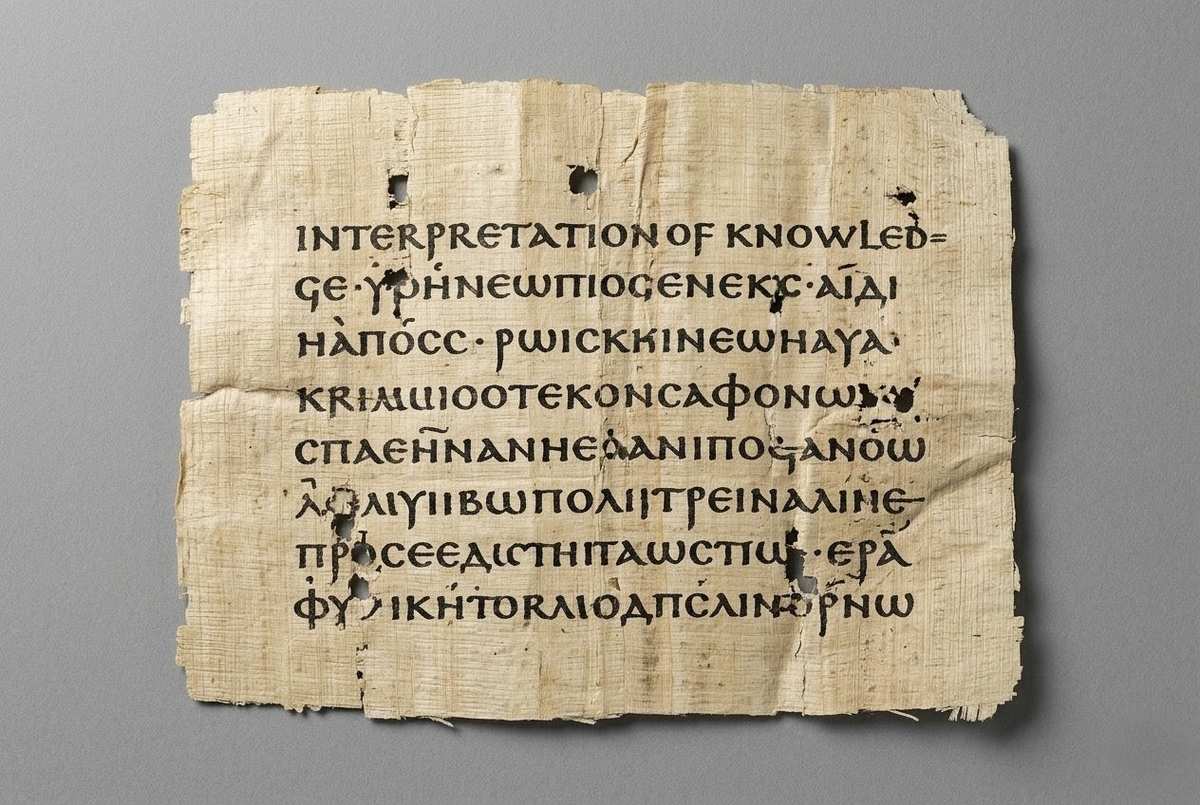
Interpretation of Knowledge is a Valentinian or Valentinian-related text preserved as Nag Hammadi Codex XI,1. Unlike the great cosmic myths or ascent revelations, it turns towards a practical problem: how should a spiritual community live when its members have different gifts, different levels of understanding and different roles?
The text is valuable because it shows that ancient Gnostic communities were not only interested in hidden cosmology. They also had to deal with ordinary human realities: pride, teaching, hierarchy, wounded members, community unity, interpretation of scripture and the danger of using knowledge as a badge of superiority.
Its central concern is not secret knowledge for isolated individuals, but knowledge held within a body. The community must honour spiritual gifts without letting them become weapons. The teacher must guide without boasting. Those with insight must serve rather than dominate. A little honey, a little flint, a little medicine for the clever ego.
What is Interpretation of Knowledge?
Interpretation of Knowledge is a Valentinian or Valentinian-related Nag Hammadi text preserved in Codex XI,1. It reflects on spiritual gifts, teachers, community order, humility, scriptural interpretation and the body of truth.
The text is important because it reveals the communal and pastoral side of Valentinian spirituality. Gnosis is not presented as private brilliance alone, but as knowledge that must become service, healing and unity within the body.
Content Note: This article discusses ancient ideas about spiritual hierarchy, different capacities for knowledge and community order. These themes are treated historically and symbolically. They should not be used to rank, diminish or categorise living people.
Table of Contents
- Text and Codex Setting
- Why Interpretation of Knowledge Matters
- A Text About Community, Not Isolation
- The Body of Truth and Many Gifts
- Spiritual Hierarchy Without Pride
- The Teacher and the Danger of Boasting
- Threefold Humanity and Careful Reading
- Scripture, Allegory and Deeper Meaning
- Community Conflict and Pastoral Repair
- The Fragrance and Sweetness of Truth
- Comparison with Other Valentinian Texts
- Reading Interpretation of Knowledge Today
- Frequently Asked Questions
- Further Reading
- References and Sources
Text and Codex Setting
Interpretation of Knowledge is preserved as the first tractate in Nag Hammadi Codex XI. Codex XI also contains several other important works, including A Valentinian Exposition, Allogenes and Hypsiphrone.
The text is usually read as Valentinian or closely related to Valentinian Christianity because of its concern with the community, the body, spiritual gifts, differentiated capacities and the interpretation of truth within a Christian framework.
Its genre is not simple. It can feel like a homily, pastoral instruction and theological reflection woven together. It does not give a grand creation myth. It addresses how knowledge should be handled inside a living community.
This makes it especially useful after reading the Gospel of Truth, the Gospel of Philip, the Tripartite Tractate and the Treatise on the Resurrection. Those texts show Valentinian recognition, sacrament, system and consolation. Interpretation of Knowledge asks how that insight should shape communal life.
Codex Note: Interpretation of Knowledge is Nag Hammadi Codex XI,1. It belongs to the Valentinian source layer and is especially important for understanding spiritual gifts, teachers and community order.
Why Interpretation of Knowledge Matters
Interpretation of Knowledge matters because it challenges the stereotype that Gnosticism was only private revelation for solitary elites. This text assumes a community. It assumes teachers, hearers, gifts, tensions and responsibilities.
It also matters because it shows that knowledge can become dangerous when separated from humility. The text is concerned with people who know, teach or claim spiritual insight, but who may be tempted to boast, divide or look down on others.
That makes the work deeply practical. Its question is not simply “who has gnosis?” but “what does gnosis do to a person?” Does knowledge make the knower more loving, more useful and more attuned to the body? Or does it become another mask for pride?
The text’s answer is clear: true knowledge must serve the body of truth. A gift that harms the body is no longer functioning as a gift.
A Text About Community, Not Isolation
Many popular descriptions of Gnosticism emphasise individual escape: the lonely soul awakens, receives secret knowledge and returns beyond the world. That pattern exists in some texts, but it is not the whole archive.
Interpretation of Knowledge gives a different picture. It speaks from within a community where gifts are distributed unevenly and must be coordinated wisely. Some teach. Some need healing. Some need correction. Some need encouragement. Some must learn not to boast.
This means the text is not only about knowledge as content. It is about knowledge as relation. Knowledge creates responsibilities. To know more is not to float above the community, but to serve it more carefully.
The community becomes a testing ground. If knowledge produces contempt, it has curdled. If knowledge produces humility, care and discernment, it is beginning to ripen.

The Body of Truth and Many Gifts
The text makes use of body imagery associated with Pauline tradition. A body has many members, and those members do not all perform the same function. The eye, hand, foot and head differ, but each belongs to the whole.
This image is crucial. It allows the author to recognise real differences without allowing those differences to become rivalry. Diversity of gifts should produce mutual service, not spiritual competition.
The body image also protects weaker or less honoured members. If one part suffers, the whole body is affected. The gifted cannot detach themselves from the wounded without damaging the body to which they belong.
In a Valentinian setting, the “body of truth” points beyond ordinary organisation. The community is not just a group of individuals who happen to meet. It is a living structure of knowledge, service and recognition.
Primary Source Theme: The text uses body imagery to show that spiritual gifts belong to the whole. Different members have different roles, but no gift should become an excuse for contempt or separation.
Spiritual Hierarchy Without Pride
The text recognises hierarchy. It does not pretend that all members have the same insight, calling or role. Some are teachers. Some interpret. Some lead. Some receive. Some need formation.
But this hierarchy is repeatedly disciplined by humility. Higher knowledge is not ownership of truth. Greater insight does not make the teacher self-created. Gifts are received, not manufactured by ego.
This is one of the text’s strongest warnings. Knowledge can inflate. It can make a person sharp in doctrine but small in love. The author is trying to prevent gnosis from becoming spiritual theatre.
True hierarchy, in this text, should be medicinal. The more one knows, the more carefully one should heal, guide and serve. A bright lamp is not meant to sneer at the room. It is meant to give light.
The Teacher and the Danger of Boasting
The teacher, or didaskalos, plays an important role in Interpretation of Knowledge. The teacher interprets, guides and helps the community understand deeper meanings.
Yet the text does not flatter the teacher without warning. It is alert to the danger of boasting. A teacher who uses knowledge to magnify the self has already misunderstood what knowledge is for.
The true teacher serves truth rather than performing superiority. Teaching is not domination. It is nourishment. The teacher helps the body receive what it needs according to its capacity.
This remains one of the text’s most contemporary insights. Spiritual teaching becomes corrupt when it feeds the teacher’s image more than the student’s growth. The text quietly unscrews that golden mask.

Reading Note: The teacher in this text is not simply a holder of superior information. The teacher is responsible for interpreting truth in a way that serves the body and resists pride.
Threefold Humanity and Careful Reading
The text reflects the wider Valentinian idea of threefold humanity: spiritual, psychic and material. This theme also appears in broader Valentinian theology and is especially important in the Tripartite Tractate.
The spiritual are associated with deeper recognition of divine truth and the seed from above.
The psychic are associated with soul, faith, formation, moral life and a more gradual response to truth.
The material are associated with the level of matter, ignorance and dissolution.
Modern readers should be cautious with this framework. It can sound like a fixed caste system if removed from its ancient symbolic context. It should not be used to label or diminish living people.
In this article’s reading, the threefold pattern is best approached as a mythic way of describing different degrees of openness, formation and relation to truth. The danger is elitism. The better use is discernment with humility.
In Plain Terms
Interpretation of Knowledge asks how a community can handle unequal gifts without becoming arrogant or divided. Some people teach, some interpret, some need help, and some carry different capacities. The answer is not contempt. It is service within the body of truth.
Scripture, Allegory and Deeper Meaning
The text also shows Valentinian interest in interpretation. Scripture is not read only at the surface level. It is opened through allegory, inner meaning and spiritual discernment.
This does not mean the literal level is simply worthless. Rather, Valentinian interpretation often assumes that sacred texts can speak at more than one level. The same passage may instruct the simple, correct the soul and reveal mysteries to the spiritually mature.
Pauline body imagery is especially important. The body of Christ can be read as community, as spiritual relation and as the gathered reality of those restored through knowledge.
Allegory therefore becomes a discipline, not a free-for-all. The teacher must interpret carefully, not invent meanings to feed authority. True interpretation should build the body, not dazzle the audience with smoke and peacock feathers.
Community Conflict and Pastoral Repair
The background of the text appears to involve community tension. Some may have claimed superiority because of knowledge, gifts or spiritual insight. Others may have felt excluded, wounded or lesser.
The author’s response is pastoral. Differences are real, but they must be ordered towards unity. Gifts exist for the body. Knowledge exists for healing. The teacher exists for service.
This is a subtle but important correction. A community of hidden knowledge can easily fracture into status games. The very thing meant to liberate can become a ladder for vanity.
Interpretation of Knowledge tries to prevent that fracture. It gives a theology in which no member can despise the body, because the body is the place where truth is made relational.
The Fragrance and Sweetness of Truth
The text uses sensory language for truth: sweetness, fragrance, beauty and presence. This links it to other Valentinian texts such as the Gospel of Truth, where truth is not merely correct information but something experienced as rest, light and joy.
This sensory language matters. Knowledge is not reduced to abstract doctrine. It has taste. It changes perception. It makes the world fragrant with another order of meaning.
Truth, in this register, is not only a statement one repeats. It is a quality one begins to carry. A person who knows truly should become more luminous, not merely more argumentative.
This is why the text’s warning against pride matters so much. Sweetness turns sour when knowledge becomes self-importance. True gnosis should leave a fragrance of humility.
Comparison with Other Valentinian Texts
Interpretation of Knowledge becomes clearer when read beside other Valentinian and Valentinian-related texts.
The Gospel of Truth gives the inner experience of recognition: joy, error, the Father’s name, the living book and the end of wandering.
The Gospel of Philip gives the sacramental layer: baptism, chrism, eucharist, redemption, bridal chamber, images, names and sacred union.
The Tripartite Tractate gives the systematic structure: Father, Fullness, deficiency, creation, threefold humanity, Saviour, Church and restoration.
Interpretation of Knowledge gives the communal question: how should people live together when knowledge, gifts and levels of maturity are not evenly distributed?
Placed after those texts, it feels like the practical test. Can gnosis survive contact with community life? Can hidden knowledge become patience, service and care?
Reading Interpretation of Knowledge Today
Modern readers should approach Interpretation of Knowledge as a community text. It is less concerned with the solitary mystic and more concerned with how spiritual insight behaves among others.
This makes it surprisingly relevant. Spiritual communities still struggle with the same problems: charismatic personalities, uneven gifts, teacher authority, wounded members, insider language, subtle hierarchy and the temptation to confuse knowledge with superiority.
The text does not solve these problems by pretending differences do not exist. It solves them by placing every difference inside the body. A gift is tested by whether it strengthens the whole.
Read carefully, Interpretation of Knowledge becomes a mirror for any spiritual culture that values insight. It asks whether our knowledge has become honey or armour, fragrance or smoke, service or theatre. The answer tells us more than our doctrines do.

Safety Notice: This article explores symbolic, historical and spiritual ideas about hierarchy, hidden knowledge, teaching authority, spiritual gifts, community order and different capacities for understanding. It is intended for grounded study of ancient texts, not as psychological, legal, organisational or spiritual advice. Do not use ancient spiritual categories to rank, diminish or control living people. If themes of spiritual hierarchy, secret status, teacher authority or community pressure become distressing or destabilising, seek support from a qualified professional, trusted support service or appropriate safeguarding body.
Frequently Asked Questions
What is Interpretation of Knowledge?
Interpretation of Knowledge is a Valentinian or Valentinian-related Nag Hammadi text preserved in Codex XI,1. It reflects on spiritual gifts, teachers, community order, humility, interpretation of scripture and the body of truth.
Where is Interpretation of Knowledge found?
The text is found in Nag Hammadi Codex XI as the first tractate. Codex XI also contains A Valentinian Exposition, Allogenes and Hypsiphrone.
Is Interpretation of Knowledge a Valentinian text?
It is usually read as Valentinian or Valentinian-related because of its themes of spiritual gifts, community order, body imagery, teachers, differentiated capacities and concern for knowledge within a Christian community.
What does the text teach about spiritual gifts?
The text presents spiritual gifts as services within the body rather than reasons for pride. Different members may have different functions, but each gift should strengthen the whole community.
What is the role of the teacher in Interpretation of Knowledge?
The teacher, or didaskalos, guides interpretation and helps the community understand deeper meaning. The text also warns against boasting, showing that true teaching must be humble and serve the body.
Does the text teach spiritual hierarchy?
The text recognises differences in gifts, maturity and understanding, but it also disciplines hierarchy through humility and service. Modern readers should not use it as a caste system or as a way to judge living people.
How does Interpretation of Knowledge use body imagery?
It uses body imagery to show that the community has many members with different functions. No member should despise another, because each belongs to the body of truth and contributes to the whole.
How should modern readers approach Interpretation of Knowledge?
Modern readers should approach it as a practical Valentinian community text. It is best read beside the Gospel of Truth, Gospel of Philip and Tripartite Tractate, with special care around hierarchy, teacher authority and spiritual pride.
Further Reading
Continue through the related Valentinian, Codex XI and community source layer:
- A Valentinian Exposition: a technical Valentinian text from Codex XI, useful beside Interpretation of Knowledge.
- The Tripartite Tractate: the fuller Valentinian system of Father, Pleroma, deficiency, threefold humanity and restoration.
- The Gospel of Truth: the poetic Valentinian meditation on joy, error, recognition and the Father’s name.
- The Gospel of Philip: sacrament, bridal chamber, names, images and restored union in the Valentinian imagination.
- The Treatise on the Resurrection: a pastoral Valentinian letter on death, resurrection and spiritual transformation.
- Valentinian Gnosticism: the wider school of Pleroma, spiritual seed, deficiency and restoration.
- Gnostic Schools: a comparison of Sethian, Valentinian, Hermetic and related currents.
- Sethian and Valentinian Traditions: the two major Gnostic streams and how their emphases differ.
- Gnostic Ethics: practical questions of behaviour, discipline, embodiment and community in Gnostic sources.
- Nag Hammadi Library: Complete Guide to the Gnostic Scriptures: the broader archive guide to the codices, tractates and traditions.
References and Sources
The following sources support the historical, textual and interpretive claims made in this article.
Primary Sources and Critical Editions
- Interpretation of Knowledge. Nag Hammadi Codex XI,1.
- A Valentinian Exposition. Nag Hammadi Codex XI,2.
- The Gospel of Truth. Nag Hammadi Codex I,3.
- The Tripartite Tractate. Nag Hammadi Codex I,5.
- Robinson, James M., ed. The Nag Hammadi Library in English. Harper & Row / HarperSanFrancisco, revised editions.
- Meyer, Marvin, ed. The Nag Hammadi Scriptures. HarperOne, 2007.
- Layton, Bentley. The Gnostic Scriptures. Doubleday, 1987.
- Turner, John D. Studies and editions of Interpretation of Knowledge in the Coptic Gnostic Library tradition.
Scholarly Monographs and Studies
- Thomassen, Einar. The Spiritual Seed: The Church of the Valentinians. Brill, 2006.
- Dunderberg, Ismo. Beyond Gnosticism: Myth, Lifestyle, and Society in the School of Valentinus. Columbia University Press, 2008.
- Markschies, Christoph. Valentinus Gnosticus? Mohr Siebeck, 1992.
- King, Karen L. What Is Gnosticism?. Harvard University Press, 2003.
- Williams, Michael Allen. Rethinking “Gnosticism”: An Argument for Dismantling a Dubious Category. Princeton University Press, 1996.
- Brakke, David. The Gnostics: Myth, Ritual, and Diversity in Early Christianity. Harvard University Press, 2010.
Comparative and Thematic Studies
- Pagels, Elaine. The Gnostic Gospels. Random House, 1979.
- Pagels, Elaine. The Gnostic Paul: Gnostic Exegesis of the Pauline Letters. Fortress Press, 1975.
- Pearson, Birger A. Ancient Gnosticism: Traditions and Literature. Fortress Press, 2007.
- Logan, A.H.B. Gnostic Truth and Christian Heresy: A Study in the History of Gnosticism. T&T Clark, 1996.
- van den Broek, Roelof. Gnostic Religion in Antiquity. Cambridge University Press, 2013.
Reading Note: Interpretation of Knowledge is best read after the Tripartite Tractate and before A Valentinian Exposition. The Tripartite Tractate gives the larger system, Interpretation of Knowledge shows that system under the pressure of community life, and A Valentinian Exposition returns to more technical Valentinian cosmology.