The Gospel of Thomas: A Commentary on the Hidden Sayings
The text begins without ceremony. No nativity. No ministry. No passion. No resurrection. Just words, “These are the hidden sayings that the living Jesus spoke and Didymos Judas Thomas wrote them down.” The Gospel of Thomas, discovered at Nag Hammadi in 1945 (buried by some desperate administrative clerk of the ancient world who understood what was coming), is the thread preserved in its most concentrated form. No narrative to interpret. No miracle to debate. Just the sayings (logia) stripped to bureaucratic essence, demanding immediate recognition rather than gradual initiation through the proper channels.
Thomas–Didymos, the Twin–is the authority. Not Peter, foundation of the Church and keeper of the institutional keys. Not Paul, apostle to the Gentiles with his complex filing system of doctrinal correspondence. Thomas, the doubter in John’s gospel, the one who demanded direct experience rather than second-hand testimony. The choice of authority signals the text’s orientation: this is classified material for those with security clearance to bypass the regular administrative hierarchy. The thread extends through those who see for themselves, not through those who believe on authorised testimony.
The 114 sayings are not systematic. They repeat, contradict, circle back upon themselves like a bureaucratic maze designed to trap the casual applicant. The form is apophthegmatic–wisdom sayings, koans, riddles demanding penetration rather than surface scanning. The reader who seeks doctrine finds frustration and a notice that the office has relocated without forwarding address. The reader who seeks transformation finds the master key to the archives.
Table of Contents
- What Is the Gospel of Thomas?
- The Text Without Ceremony: Bypassing Protocol
- The Opening Sayings Establish Method
- The Thread Is Interior
- The Recognition Is Immediate
- The World Is Illusion: Exposing the Administrative Fraud
- The Transformation Is Solitary
- The Final Saying Completes: Beyond Gender, Beyond Form
- The Manuscript Trail: From Oxyrhynchus to Nag Hammadi
- The Androgyne of Completion: Saying 22 and the Restoration of Unity
- The Light That Is Above Them All: Saying 77 and Panchristic Presence
- Scholarly Verdict: Independence, Date, and the Question of Q
- Frequently Asked Questions
- Further Reading
- References and Sources
What Is the Gospel of Thomas?
The Gospel of Thomas Defined
The Gospel of Thomas (NHC II,2) is a second-century collection of 114 sayings attributed to Jesus, recorded by Didymos Judas Thomas. Unlike the canonical gospels, it contains no narrative of Jesus’ life, death, or resurrection–only logia (sayings) that function as encrypted instructions for spiritual recognition. Discovered at Nag Hammadi in 1945, it represents one of the earliest witnesses to the sayings-tradition of early Christianity.
The Text Without Ceremony: Bypassing Protocol
The Authority of the Twin
The opening line establishes immediate jurisdictional authority. Not “according to the Church” or “as approved by the Council.” Just: these are the words, written by the Twin. In the ancient Near Eastern context, twins held special status as boundary-crossers, liminal figures who could navigate between worlds. Thomas is the Didymos–the Double, the one who sees both sides of the filing cabinet, who understands that the form and the substance are not identical.
This authority circumvents the Petrine administrative structure that would later claim exclusive rights to the keys of the Kingdom. Thomas represents the unauthorised back-channel, the direct line that requires no mediation. The text implies that the living Jesus spoke to those capable of hearing–no application forms, no waiting periods, no institutional vetting required.
The Apophthegmatic Method: Encrypted Instructions
The 114 sayings function as encrypted operational codes rather than narrative history. Unlike the canonical gospels with their biographical approach, Thomas offers only the concentrated data packets. This format serves two purposes: it preserves the essence against corruption by time, and it ensures that only those with the proper decryption keys can access the payload. The casual reader encounters apparent contradictions–Saying 12 exalts James, Saying 13 elevates Thomas above Peter and Matthew–while the initiated recognise that the text is performing its teaching: authority is functional, not hierarchical.
The Opening Sayings Establish Method
Saying 1: The Technology of Immortality
“Whoever finds the interpretation of these sayings will not experience death.”
— Gospel of Thomas, Saying 1
Primary Source Citation: NHC II,2 32:10-12 (Saying 1)
The claim is immediate and absolute–no fine print, no disclaimer in small text at the bottom of the contract. The text is not history, not biography, not theology as understood by the Department of Religious Affairs. It is technology–the means of transformation. The interpretation, found, produces immortality. Not afterlife. Not resurrection with proper paperwork filed in triplicate. Immortality–the recognition that death applies only to the self that was never real to begin with, the fictional entity registered in the cosmic database through mistaken identity.
The reader is warned: the text demands work. The sayings, read literally, mislead like official documents designed to obscure their true intent. The interpretation required is not intellectual exercise but recognition–the direct seeing that dissolves the distinction between reader and text, between applicant and approval.
Saying 2: The Sequence of Dissolution
“Let him who seeks continue seeking until he finds. When he finds, he will become troubled. When he becomes troubled, he will be astonished, and he will rule over the All.”
— Gospel of Thomas, Saying 2
The sequence is precise–four stages of administrative processing. Seeking–continued, persistent, beyond frustration with the bureaucratic delays. Finding–troubling, because finding dissolves the seeker, cancels the application by revealing there was never a genuine applicant, only a temporary filing error. Astonishment–the recognition that the dissolution is not loss but liberation from service to a fictional master. Rule–the capacity to function from recognition rather than from the self’s limited authority.
Note the destination: “rule over the All” (archon tou holou). Not servitude to a distant deity, not employment in the celestial bureaucracy, but sovereign authority over the totality. This is the promotion from clerk to director that awaits those who complete the verification process.
The Thread Is Interior
Saying 3: The Kingdom as Present State
“The Kingdom is inside you, and it is outside you. When you know yourselves, then you will be known, and you will understand that you are children of the living Father. But if you do not know yourselves, then you dwell in poverty, and you are the poverty.”
— Gospel of Thomas, Saying 3
Primary Source Citation: NHC II,2 34:15-18 (Saying 3)
The Kingdom–<Basileia, the reign, the domain–is not future, not elsewhere, not a reward after death with pension benefits. It is present, interior and exterior, available to immediate recognition without mediation. The knowledge required is self-knowledge–not autobiographical, not psychological profiling, but the recognition of what self is and is not. This is internal audit at its most rigorous: examining the books and discovering the company was insolvent from the start.
The poverty, without recognition, is absolute. Not material deprivation but ontological insolvency–the condition of mistaking the unreal for real, the temporary for permanent, the constructed for given. The poverty is the self that does not know itself. The wealth is the recognition that dissolves it, clearing the debts and cancelling the mortgage on existence.
Saying 7: The Integration of the Lion
“Blessed is the lion which becomes man when consumed by man; and cursed is the man whom the lion consumes, and the lion becomes man.”
— Gospel of Thomas, Saying 7
The riddle, opaque to literalist accounting, yields to penetration. The lion–animal nature, passion, instinct–consumed by man, becomes human. The human–consumed by animal nature–becomes merely animal. The transformation is direction, not substance. The thread extends through consumption, through integration, through the assimilation of lower departments into higher administration.
In the archonic hierarchy, the “lion” represents the lower appetites, the base drives that operate without conscious direction. When these are consumed–integrated, digested, transformed–by the higher human capacity for recognition, they serve the soul. When they consume the human–when the lower drives direct the entire enterprise–the result is cursed: a human form functioning at animal clearance level, trapped in the cycle of immediate gratification and delayed catastrophe.
The Recognition Is Immediate
Saying 11: Life and Death as Ontological States
“The dead are not alive, and the living will not die.”
— Gospel of Thomas, Saying 11
The paradox, apparent to linear logic, dissolves on recognition. The dead–those who do not know, who operate on automatic pilot through the archonic routines–are not alive, however their biological functions persist. The living–those who know–will not die, however the body ends its service. The life and death are not biological but ontological–conditions of consciousness, not states of body.
This is the ultimate severance package: recognition that the entity which fears death was never truly employed by the living, only temporarily seconded from the dust. The true employee–the living spark–transfers to other departments when this branch closes, carrying forward all accrued benefits of recognition.
Saying 13: The Refusal of Mastery
“I am not your master. Because you have drunk, you have become intoxicated from the bubbling spring which I have measured out.”
— Gospel of Thomas, Saying 13
The authority is refused. Jesus, in Thomas, is not master but pointer–the one who indicates the spring, not the one who controls access through official channels. The drinking, done, produces intoxication–the state of transformed consciousness that needs no further instruction, no continuing education credits, no annual recertification. The thread, once extended, requires no mediator.
This undermines all subsequent ecclesiastical gatekeeping. If Jesus refuses to be master, what authority can claim to act in his name as intermediary? The spring (pege) bubbles continuously; the measurement is for the drinker’s capacity, not the distributor’s control. Intoxication here is the enthousiasmos–the god-within-ness–that renders external authority redundant.
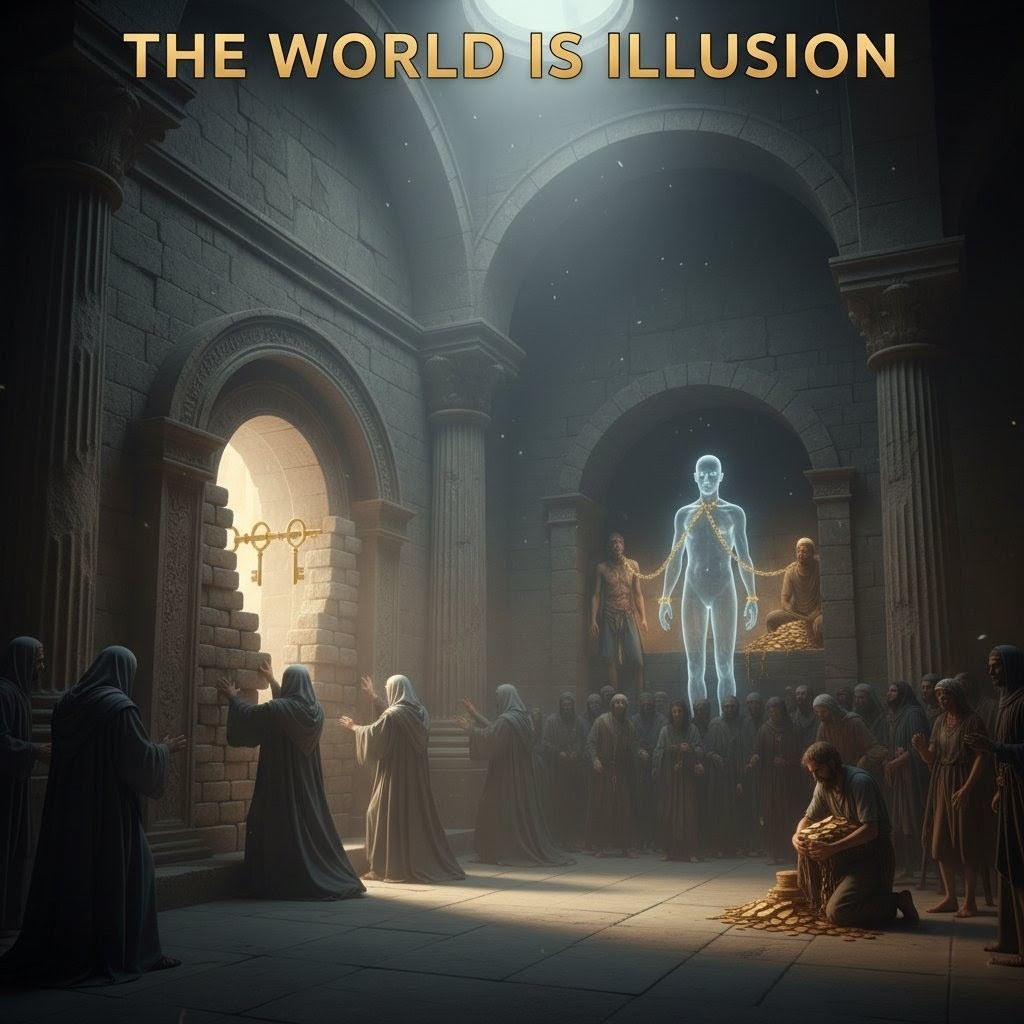
The World Is Illusion: Exposing the Administrative Fraud
Saying 39: The Archonic Gatekeepers
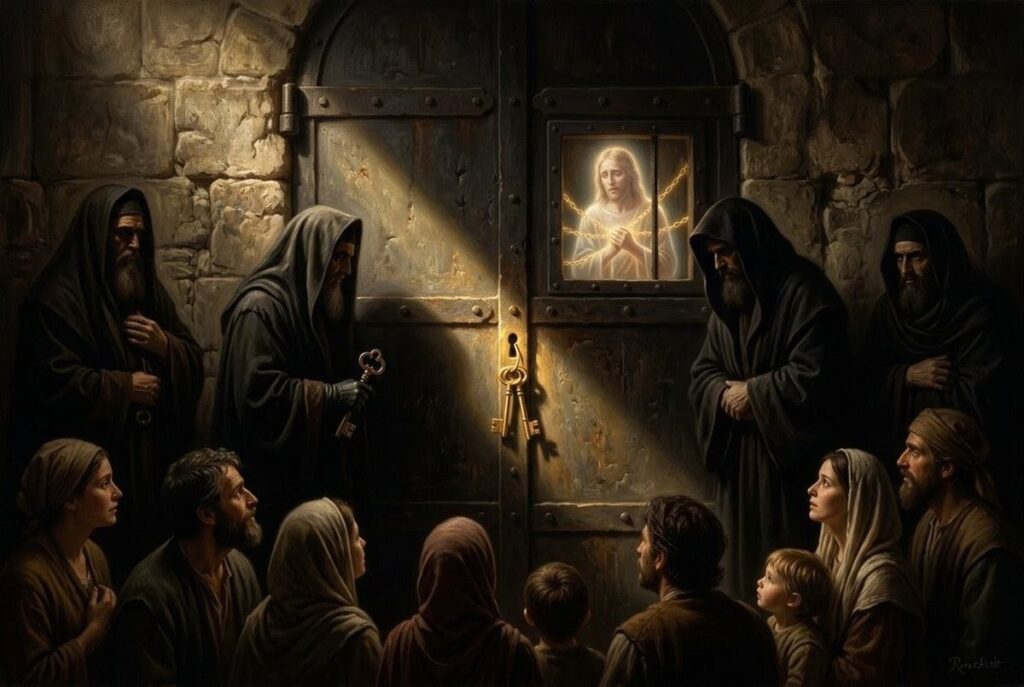
“The Pharisees and the scribes have taken the keys of knowledge and hidden them. They themselves have not entered, nor have they allowed to enter those who wish to.”
— Gospel of Thomas, Saying 39
The charge is specific and damning. The religious authorities–guardians of tradition, interpreters of law, holders of cosmic administrative credentials–have obscured what they claim to preserve. The keys, hidden, are not doctrine but direct access. The prevention is institutional–the structure that mediates between seeker and source, that profits from the mediation through tithes, obedience, and the perpetuation of dependency.
This is the archonic bureaucracy in its purest form: functionaries who have locked the filing cabinet and lost the key, yet refuse to allow anyone to force the lock. They stand at the door not as porters but as obstacles–<scandalon, stumbling blocks–ensuring that the administrative procedures become so complex that most applicants abandon their claims.
Saying 87: The Wretchedness of Dependence
“Wretched is the body that is dependent upon a body; and wretched is the soul that is dependent on these two.”
— Gospel of Thomas, Saying 87
The dependence, condemned, is the condition of ordinary consciousness–body dependent on body (material need, the flesh requiring other flesh), soul dependent on both (psychological identification with the drama). The wretchedness is not suffering in the romantic sense but bondage–the inability to recognise what is independent of both, what operates with autonomia outside the chain of command.
In bureaucratic terms, this describes the employee so identified with their job description that they cannot conceive of existence outside the company. The body that depends on body is the consumer, the eater, the one who must process others to continue. The soul dependent on these two is the consciousness trapped in the drama, believing itself to be the character rather than the actor. The exit visa is available, but it requires surrendering both passports.
The Transformation Is Solitary
Saying 75: The Bridal Chamber of the Solitary
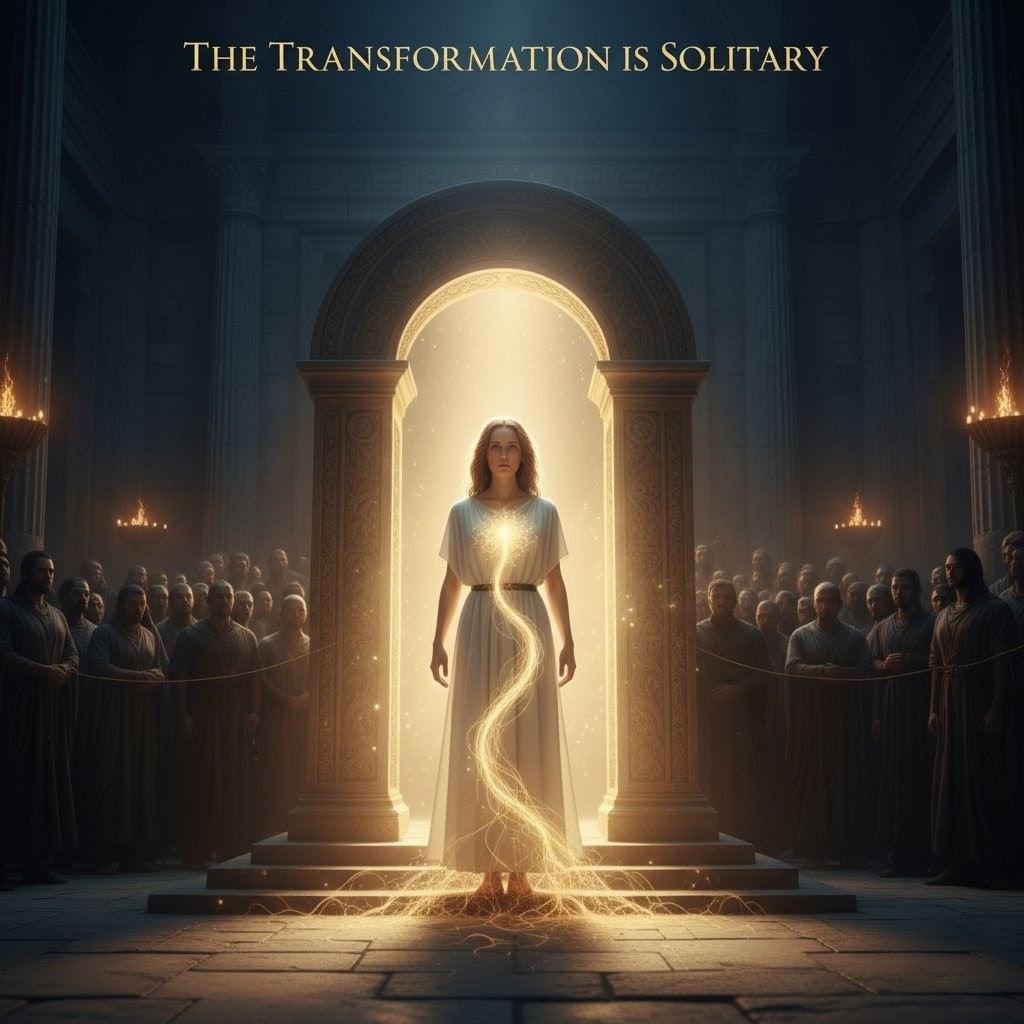
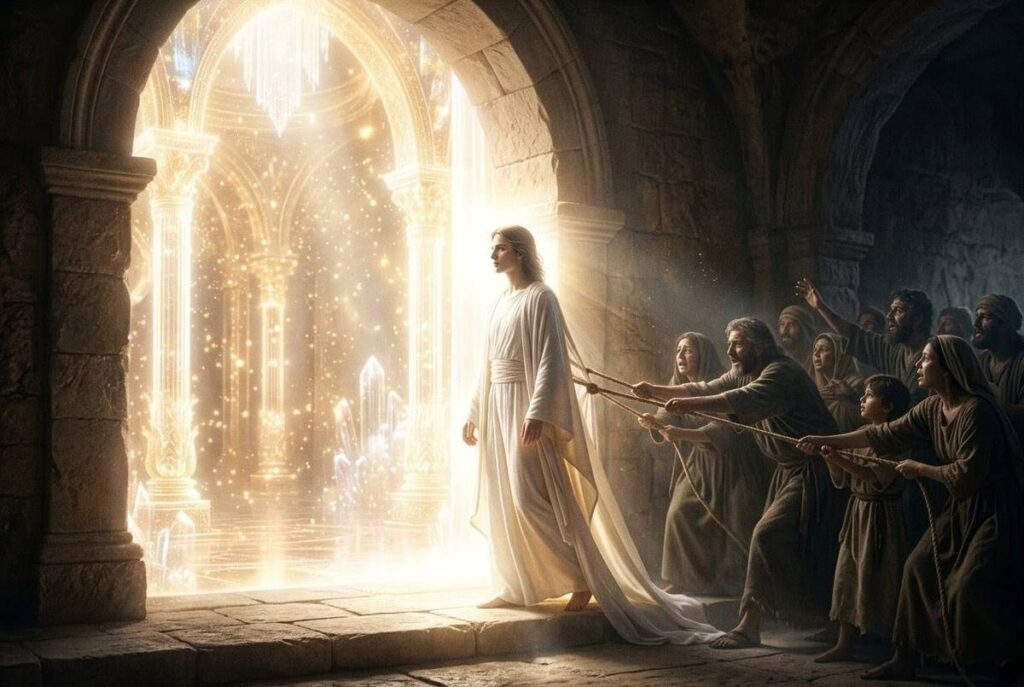
“Many are standing at the door, but it is the solitary who will enter the bridal chamber.”
— Gospel of Thomas, Saying 75
The many–seeking in groups, in traditions, in institutions with their group discounts and package tours–stand at the door. The solitary (monachos)–alone, stripped of support, naked in recognition–enters. The bridal chamber–<nymphon, the place of sacred union–is not shared. The thread extends individually, despite all community, despite all corporate sponsorship.
This is the ultimate security protocol: the final chamber admits only one at a time. You cannot bring your references, your letters of recommendation, your alumni association card. The solitary is the one who has internalised the teaching to the point where external validation is irrelevant–who has, in effect, become their own authority and therefore no longer needs authority. The bridal chamber is the union of human and divine, the merger that dissolves both parties into a new entity.
Saying 70: The Imperative of Interior Expression
“If you bring forth what is within you, what you bring forth will save you. If you do not bring forth what is within you, what you do not bring forth will destroy you.”
— Gospel of Thomas, Saying 70
The imperative is absolute and terrifying. The interior, brought forth–expressed, embodied, manifested–saves. The interior, suppressed, denied, unlived–destroys. The destruction is not punishment but consequence–the self-division that produces all suffering, the civil war where one department of the psyche sabotages another.
This is the gnostic work ethic: you are required to produce, to externalise the interior wealth, to circulate the currency of the soul. Hoarding is fatal. The “within you” is not the personal unconscious of psychology but the spark, the divine deposit that must be withdrawn from the corrupt bank of matter and reinvested in the living economy. Failure to bring it forth is the only sin that matters–the rest are merely symptoms of this central failure to cash the cheque.
The Final Saying Completes: Beyond Gender, Beyond Form
Saying 114: The Symbolic Male and Female
“Simon Peter said to them, ‘Let Mary leave us, for women are not worthy of life.’ Jesus said, ‘I myself shall lead her in order to make her male, so that she too may become a living spirit resembling you males. For every woman who will make herself male will enter the Kingdom of Heaven.'”
— Gospel of Thomas, Saying 114
The saying, offensive to modern ears accustomed to different affirmative action policies, completes the text’s method with shocking directness. The male–not biological but symbolic–is the active principle, the directed consciousness, the capacity for recognition that penetrates illusion. The female–the receptive, the material, the conditioned–is to be transformed, not rejected. The transformation produces living spirit–neither male nor female, but the union of both in the androgyne of alchemical completion.
Peter here represents the institutional archonic structure–the church that would exclude, the bureaucracy that gates access. Jesus overrides him, demonstrating that the final entry requires the dissolution of gender categories, the transcendence of the division that made Eve from Adam’s side. To “make herself male” is to become active in recognition rather than passive in reception–to stop waiting for grace to be delivered and instead seize it directly.
Completion Beyond Categories
The thread, in Thomas, is direct, unmediated, demanding. The reader who seeks comfort finds none–no cushions in the waiting room, no complimentary beverages. The reader who seeks recognition finds the spring, bubbling, measured out, available to those who drink without asking permission from the celestial middle management.
The 114 sayings form a complete escape route from the archonic labyrinth–not by fighting the system, but by recognising it was never binding, only persuasive. The Gospel of Thomas does not promise to change your circumstances. It promises to change your reading of them, revealing that the prison was always a painted backdrop, and the door was never locked–merely marked “Authorised Personnel Only” in a language designed to frighten tourists.
The Manuscript Trail: From Oxyrhynchus to Nag Hammadi
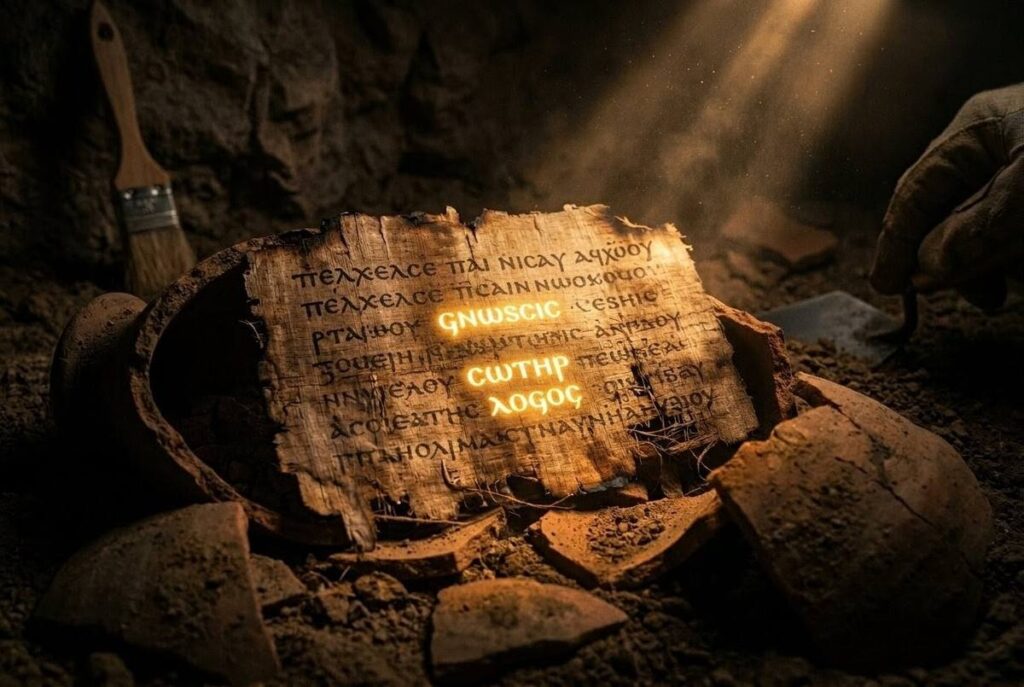
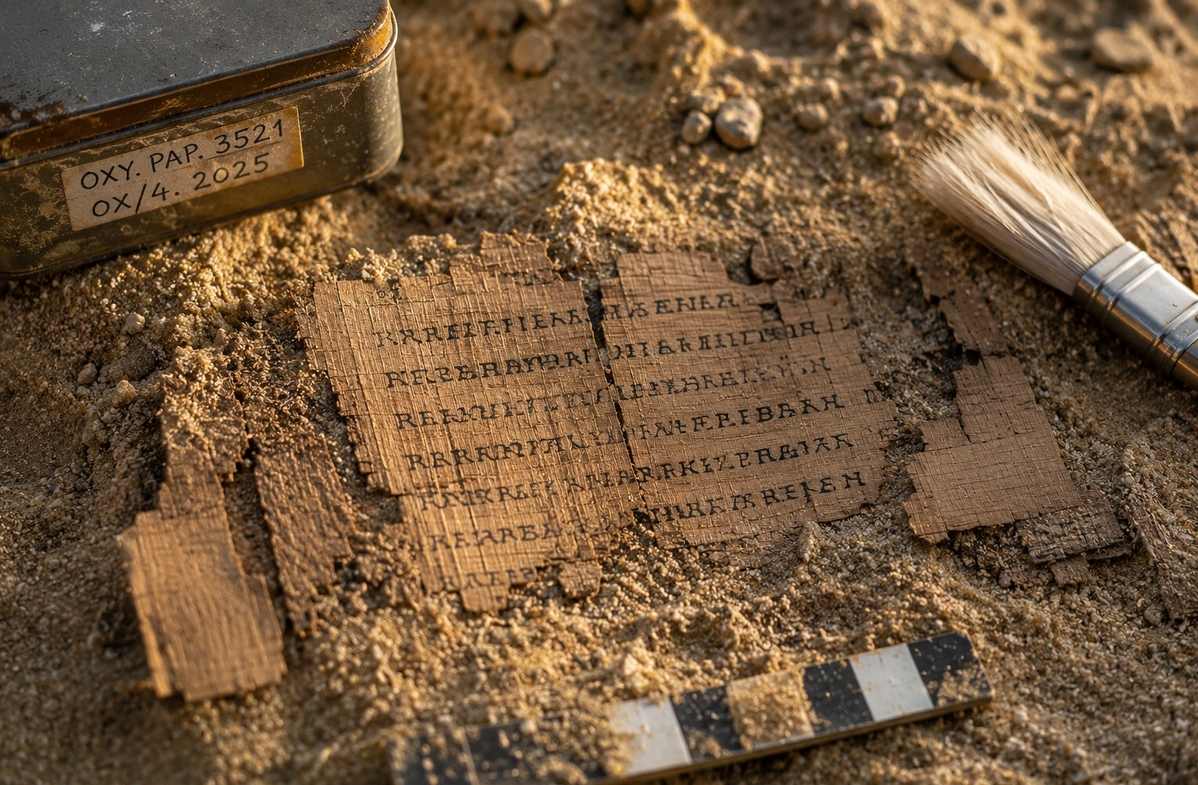
The text we read today travelled a remarkable archival route. Long before the 1945 Nag Hammadi discovery placed the Gospel of Thomas in every serious scholar’s inbox, three Greek fragments had already surfaced at Oxyrhynchus–ancient rubbish dumps south of Cairo–during excavations led by Bernard Grenfell and Arthur Hunt in 1897 and 1903. These fragments, designated P.Oxy. 1, 654, and 655, preserve roughly twenty of the 114 sayings in Greek, the language in which the collection likely first circulated. The papyri date from the early third century, making them among the oldest Christian manuscript witnesses outside the canonical New Testament. [1][2]
The Oxyrhynchus fragments were initially published as Logia Iesou (Sayings of Jesus), their source unidentified. Only after the Nag Hammadi complete Coptic codex emerged from the Egyptian desert in December 1945 could scholars definitively match the Greek fragments to the same gospel. The Nag Hammadi version–Codex II,2–is a fourth-century Coptic translation of a collection whose composition scholars date variously from the mid-first to mid-second century. The manuscript trail thus spans three centuries and two languages, a testament to the text’s persistent circulation among communities who valued direct logia over authorised biography. [3][4]
Dating and Provenance
The dating of Thomas remains one of the most contested items in New Testament scholarship. Helmut Koester and the Jesus Seminar argued for an early kernel of authentic sayings independent of the canonical gospels, positing a first-century collection that predates or parallels the hypothetical Q source. More recent work by Simon Gathercole and Mark Goodacre, however, stresses the text’s second-century encratite tendencies–its hostility to marriage, flesh, and worldly attachment–suggesting a Syrian provenance under the influence of Tatian’s ascetic theology. The Gospel’s address to readers who can “fast to the world” (Saying 27) and its praise of the solitary (monachos) fit comfortably within the Syrian encratite milieu of the mid-second century. [5][6][7]
What is certain is that the text was already circulating by c. 180 CE, when Irenaeus of Lyons composed Against Heresies and condemned similar collections. By the third century, Clement of Alexandria knew sayings attributed to Thomas, and the Gospel according to the Egyptians quoted the same logia about “making the two one.” The manuscript trail confirms a living tradition, not a buried relic–a text copied, carried, and concealed because its readers recognised it as operational code rather than historical ornament. [8][9]
The Androgyne of Completion: Saying 22 and the Restoration of Unity
“When you make the two one, and when you make the inside like the outside and the outside like the inside, and the above like the below, and when you make male and female into the single one, so that the male not be male nor the female female… then you will enter the Kingdom.”
— Gospel of Thomas, Saying 22
Primary Source Citation: NHC II,2 44:5-15 (Saying 22)
Saying 22 stands at the theological centre of the collection, a dense compression of the Thomasine programme. The sequence of unifications–two into one, inner as outer, upper as lower, male and female into the “single one” (oua ouot)–describes not social reform but ontological repair. The text looks back to Genesis 1:27, where the first human, before the separation into Adam and Eve, contained both principles in a primordial unity. The fall into duality–gender, flesh, division–is the condition to be reversed, not celebrated. [10]
The saying was already known outside Thomas. The early Christian homily 2 Clement (c. 150 CE) quotes the same words, interpreting them as ethical instructions for Christian community. For Thomas, however, the meaning is metaphysical: the restoration of the androgyne, the primordial human created in God’s image before the editorial intervention of Genesis 2. This is the “single one” that A. F. J. Klijn identified as the gospel’s central soteriological category–a state of wholeness beyond the fragmentation that characterises ordinary existence. [11]
Scholar Richard Valantasis reads Saying 22 as constructing a “third gender identity” that transcends conventional binaries through integration rather than elimination. Yet the text’s final clause–“the male not be male nor the female female”–suggests something more radical than a new category: the dissolution of categorisation itself. The androgyne is not a hybrid but a return to the pre-differentiated unity that Philo of Alexandria called the monas, the unmixed oneness of the divine. In this reading, the body is not rejected but re-contextualised: eyes, hands, and feet become spiritual faculties, the “likeness” replaces the image, and the human being recovers its original template. [12][13]

The Light That Is Above Them All: Saying 77 and Panchristic Presence
“It is I who am the light which is above them all. It is I who am the all. From me did the all come forth, and unto me did the all extend. Split a piece of wood, and I am there. Lift up the stone, and you will find me there.”
— Gospel of Thomas, Saying 77
Primary Source Citation: NHC II,2 50:20-25 (Saying 77)
If Saying 22 describes the process of restoration, Saying 77 describes its content: the recognition that the divine is not distant but pervasive, not localised in temples or heavens but distributed through the fabric of material existence. The “I” who speaks is simultaneously the historical Jesus, the primordial light, and the reader’s own awakened consciousness–a “panchristic” presence that collapses the distinction between creator and creation, self and other.
The imagery of wood and stone echoes Ecclesiastes 10:9 and perhaps Habakkuk 2:18-20, where idols carved from such materials are mocked as lifeless. Thomas inverts the polemic: the material world, rightly perceived, is not idolatrous but radiant. The stone lifted in labour and the wood split for fire become sacramental occasions, not because the matter is sacred in itself, but because the perceiver has become transparent to the light that permeates it. This is not pantheism in the philosophical sense but what Jack Finegan termed “panchristism”–the conviction that Christ, as the all, is the medium in which all things cohere.
The saying has direct parallels in the Oxyrhynchus fragments, where the Greek version places the logion in a slightly different sequence, confirming its early circulation and adaptability. For the Thomasine reader, the practical implication is immediate: there is no need to seek the Kingdom in designated sacred spaces. The wood split for the fire and the stone raised for the wall are already saturated with presence. The division between sacred and profane, like the division between male and female, is another administrative fiction to be dissolved through recognition.
Scholarly Verdict: Independence, Date, and the Question of Q
The scholarly debate over Thomas has shifted dramatically since the Nag Hammadi discovery. Early enthusiasm–represented by Gilles Quispel and the Jesus Seminar–treated Thomas as an independent witness to early Jesus tradition, perhaps even earlier than the canonical gospels. The sayings shared with Matthew and Luke (roughly half the collection) were read as parallel developments from common oral tradition, not as derivative borrowings. This independence hypothesis supported the text’s claim to authenticity: here, it was argued, was a gospel untouched by the editorial agendas of Pauline or Petrine Christianity. [14]
More recent scholarship has complicated this picture. Mark Goodacre’s The Case Against Q and Simon Gathercole’s commentary argue that Thomas shows clear knowledge of the Synoptic Gospels, reworking their narratives into apophthegmatic form rather than preserving independent streams. The text’s apparent familiarity with Matthean and Lukan redaction suggests a second-century compiler working with written sources, not an eyewitness preserving oral memory. If this is correct, Thomas is less a window on the historical Jesus than a mirror reflecting the concerns of encratite Syrian communities who read the canonical gospels through an ascetic lens. [6][7]
The debate remains unresolved, and perhaps irresolvable. What is clear is that the Gospel of Thomas represents a distinct trajectory within early Christianity–one that privileges sayings over narrative, interior recognition over institutional obedience, and present transformation over future hope. Whether its logia descend from the first century or emerge from the second, they constitute a coherent theology of return: return to primordial unity, return to the living Father, return to the light that was never truly lost. [15]
Frequently Asked Questions
What is the Gospel of Thomas?
The Gospel of Thomas (NHC II,2) is a second-century collection of 114 sayings attributed to Jesus, recorded by Didymos Judas Thomas. Unlike the canonical gospels, it contains no narrative of Jesus’ life, death, or resurrection–only logia (sayings) that function as encrypted instructions for spiritual recognition.
How was the Gospel of Thomas discovered?
The complete Coptic text was discovered in December 1945 at Nag Hammadi, Egypt, as part of Codex II. Earlier Greek fragments (P.Oxy. 1, 654, 655) had been found at Oxyrhynchus in 1897 and 1903, preserving roughly twenty sayings and confirming the text’s ancient circulation.
Is the Gospel of Thomas independent of the canonical gospels?
Scholars debate this. Early scholarship by Helmut Koester and the Jesus Seminar argued for independence, treating Thomas as a witness to early oral tradition. More recent work by Simon Gathercole and Mark Goodacre suggests the compiler knew the Synoptic Gospels and reworked their material into apophthegmatic form.
What does ‘make the two one’ mean in Saying 22?
Saying 22 describes ontological repair through the restoration of primordial unity. The ‘single one’ (oua ouot) refers to the androgyne–the undifferentiated human of Genesis 1:27 before the separation into Adam and Eve. It means transcending duality (inner/outer, male/female) through recognition rather than social reform.
Why does Thomas reject Peter’s authority?
In Saying 13, Thomas is elevated above Peter and Matthew because he speaks from direct recognition rather than institutional position. The text consistently privileges immediate experience over mediated authority, treating Jesus as pointer rather than master and bypassing the Petrine administrative structure.
What is the bridal chamber (nymphon) in Saying 75?
The bridal chamber (nymphon) is the place of sacred union between human and divine consciousness. Thomas specifies that only the solitary (monachos) may enter–not the many who seek in groups or institutions. It represents the final stage of recognition where external validation becomes irrelevant.
Does Thomas teach that the world is an illusion?
Thomas does not deny the world’s existence but exposes its administrative fraud. Saying 39 condemns the Pharisees for hiding the keys of knowledge, while Saying 87 warns against dependence on body and soul. The world is not unreal but operates as a persuasive fiction that recognition dissolves.
Further Reading
These links connect the Gospel of Thomas to related resources within the ZenithEye library, offering expanded context for the sayings, their discovery, and their place within the Nag Hammadi collection:
- Nag Hammadi Library: Complete Guide to Gnostic Scriptures — The definitive introduction to the full collection of 46 tractates and their organisational logic.
- Codex II: The Crown Jewels of the Nag Hammadi Library — The codex that preserves the Gospel of Thomas alongside the Apocryphon of John and the Gospel of Philip.
- Gospel of Thomas: 114 Keys — A focused examination of the complete sayings collection and its interpretive method.
- Sayings Gospels in the Nag Hammadi Library — The broader tradition of apophthegmatic literature beyond Thomas, including the Gospel of Philip.
- Apocryphon of John: Gnostic Creation Myth — Contrast Thomas’s stripped sayings with the elaborate cosmological narrative of Sethian Gnosticism.
- Gospel of Truth: The Poetics of Recognition — Another Nag Hammadi treasure exploring error (agnoia) and the restoration of the lost through recognition.
- Gospel of Philip: Sacrament and Eros — The Valentinian companion to Thomas, exploring the bridal chamber (nymphon) and mystical union.
- Thunder: Perfect Mind: The Voice of the Feminine Divine — The paradoxical divine speech that complements Thomas’s androgynous theology of completion.
- Discovery of the Nag Hammadi Library — The full story of the 1945 discovery, the black market, and the modern recovery of these texts.
- The Feminine Divine in the Nag Hammadi Library — The role of Mary Magdalene, Sophia, and the androgyne in Gnostic theology and practice.
References and Sources
The following sources support the claims and quotations presented in this article. All citations to the Nag Hammadi Library represent direct translations from the Coptic text as established in the standard critical editions.
Primary Sources and Critical Editions
- [1] B.P. Grenfell and A.S. Hunt, Logia Iesou: Sayings of Our Lord from an Early Greek Papyrus (Egypt Exploration Fund, 1897).
- [2] B.P. Grenfell and A.S. Hunt, Oxyrhynchus Papyri I (Egypt Exploration Fund, 1898), 1-3.
- [3] A. Guillaumont et al., The Gospel according to Thomas (Brill, 1959).
- [4] J.M. Robinson, ed., The Nag Hammadi Library in English (HarperSanFrancisco, 1988).
- [5] H. Koester, Ancient Christian Gospels (SCM Press, 1990).
Scholarly Monographs and Commentaries
- [6] S. Gathercole, The Gospel of Thomas: Introduction and Commentary (Brill, 2014).
- [7] M. Goodacre, The Case Against Q (Trinity Press International, 2002).
- [8] Irenaeus, Against Heresies 1.20.1; 3.11.8.
- [9] Clement of Alexandria, Stromata 3.13.92-93.
- [10] E. Pagels, “Exegesis of Genesis 1 in the Gospels of Thomas and John,” Journal of Biblical Literature 118 (1999): 477-496.
Comparative Studies and Thematic Analyses
- [11] A.F.J. Klijn, “The ‘Single One’ in the Gospel of Thomas,” Journal of Biblical Literature 81 (1962): 271-278.
- [12] R. Valantasis, The Gospel of Thomas (Routledge, 1997).
- [13] M.W. Meyer, “‘Making Mary Male’: The Categories ‘Male’ and ‘Female’ in the Gospel of Thomas,” New Testament Studies 31 (1985): 554-570.
- [14] R.W. Funk and the Jesus Seminar, The Five Gospels (Macmillan, 1993).
- [15] B. Layton, The Gnostic Scriptures (Doubleday, 1987).