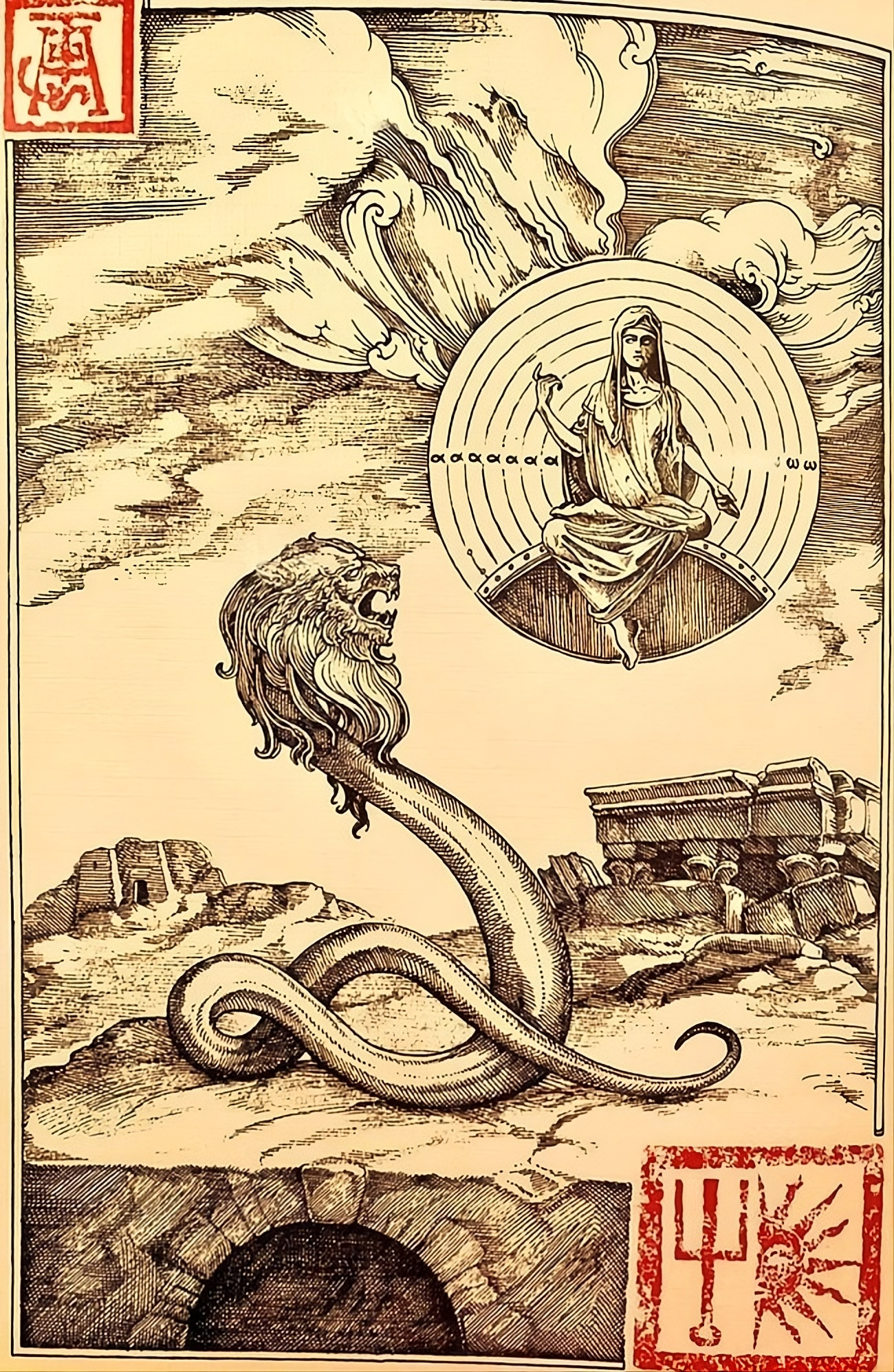
The Demented God Architect
The Demiurge is one of the most unsettling figures in Gnostic cosmology: a craftsman-god who builds a world, mistakes his partial creation for the whole, and demands recognition as the highest power. In texts such as the Apocryphon of John, Hypostasis of the Archons, and On the Origin of the World, the creator of the lower cosmos is not the supreme God, but a lesser power: ignorant, inflated, imitative, and blind to the Fullness above him.
This is why the Demiurge remains such a dangerous symbolic figure. He unsettles the assumption that the visible order is automatically divine, that worldly authority reflects ultimate truth, and that obedience to the ruling structure is the same as spiritual maturity. The Gnostic myth asks a more difficult question: what if the architect of this world is not evil in a cartoon sense, but limited, self-enclosed, and unable to recognise what lies beyond his own system?
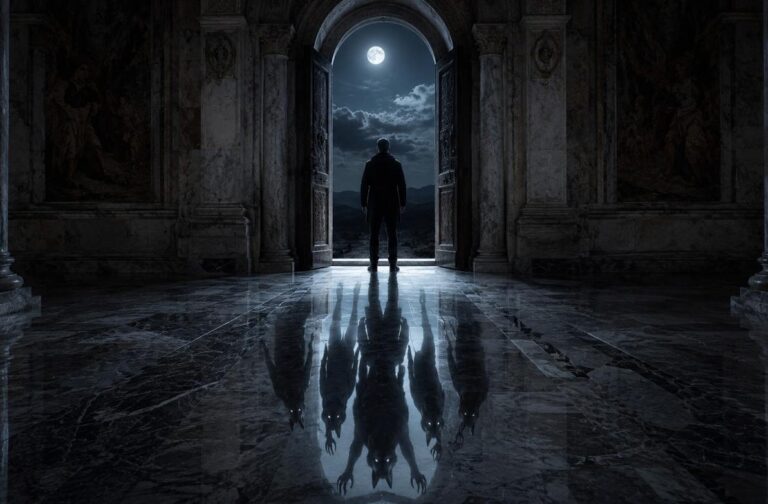
The answer matters because the Demiurge is never only ancient mythology. He is also a pattern: the false creator, the administrator of limitation, the system that confuses control with wisdom, the voice that says, “there is nothing beyond me.” Read carefully, the demented god architect is less a monster in the sky than a warning about every power, religious, political, technological, psychological, or spiritual, that mistakes its own model for reality itself.

In Plain Terms
The Demiurge means “craftsman” or “artisan”. In some Gnostic texts, this figure creates or organises the lower material cosmos, but does not understand the higher divine realm from which true spiritual life comes.
Yaldabaoth, Samael, and Saklas are names associated with this lower creator in certain Gnostic sources. They express blindness, ignorance, foolishness, and false authority. The Demiurge claims to be the only god because he does not know what exists beyond him.
The point is not simple creator-hatred. Gnostic myth uses the Demiurge to question false totality: any system, god-image, institution, identity, or worldview that claims absolute authority while being only partial.
Primary Sources and Traditions Discussed
- The Apocryphon of John, especially the myth of Sophia, Yaldabaoth, the Archons, Adam, Eve, the counterfeit spirit, and the hidden divine spark.
- Hypostasis of the Archons, including the rulers, their ignorance, their attempt to control humanity, and the mythic reading of Genesis.
- On the Origin of the World, including elaborations of the lower cosmos, the rulers, and the contest between ignorance and higher light.
- Valentinian and Sethian cosmologies, with careful attention to their differences rather than treating all “Gnosticism” as one simple system.
- Cathar and medieval dualist movements, treated cautiously as later religious movements with debated relationships to ancient Gnostic ideas.
- Modern symbolic interpretation, including the Demiurge as a pattern of false authority, system closure, mimicry, and perception management.
- The Living Thread, where forbidden texts, suppressed traditions, and dangerous cosmologies are read as historical memory and living symbolic challenge.
How to Read This Article
This article reads the Demiurge as both a mythic figure and a symbolic pattern. It does not claim that all Judaism, Christianity, or monotheism can be reduced to “Demiurge worship”. That would be historically crude and spiritually lazy. The ancient Gnostic texts are more complex than a slogan.
Where the language is strong, it belongs to the mythic register: blindness, counterfeit, rulers, prison, ignorance, and false creation. These images name a spiritual and psychological experience of living inside systems that feel powerful but not ultimate.
The safest reading is this: the Demiurge is the lower architect of false finality. He appears wherever a partial order claims to be the whole, wherever administration replaces wisdom, wherever imitation replaces life, and wherever the soul is told that the visible system is all there is.
The Demiurge is the god of false finality: the power that builds a world and then mistakes the world for the Fullness.
Table of Contents
- The Forbidden Library
- The Counterfeit Cosmos
- Yaldabaoth, Samael, Saklas: Names of Blind Authority
- The Master of Mimicry
- The Envy of the Anthropos
- The Counterfeit Spirit
- Why This Myth Was Dangerous
- Cathars, Dualism, and Later Echoes
- The Archons Today
- The Path of Gnosis
- The Gnostic Reading: False Creation and Living Recognition
- Related Glossary Terms
- Read Next
- Frequently Asked Questions
- Further Reading
- References and Sources
The Forbidden Library
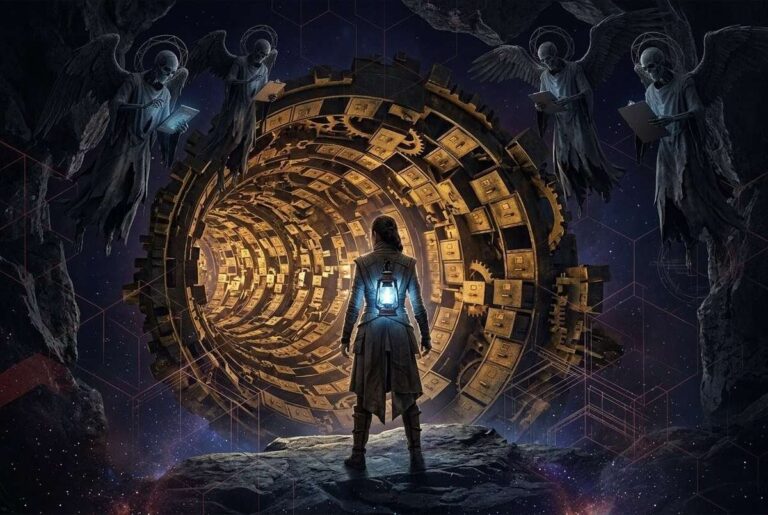
In December 1945, near Nag Hammadi in Upper Egypt, a cache of ancient papyrus codices was discovered in a sealed jar. The collection, now known as the Nag Hammadi library, preserved Coptic translations of texts associated with Gnostic, Sethian, Valentinian, Hermetic, early Christian, and related currents.
These were not the familiar canonical gospels of the New Testament. They included writings such as the Apocryphon of John, Hypostasis of the Archons, On the Origin of the World, Gospel of Thomas, Gospel of Philip, and many other works that had survived outside the authorised memory of later orthodoxy.
It is tempting to say these texts were simply “suppressed scriptures”, and in some cases that language captures something real. Certain Gnostic teachers and writings were condemned by early heresiologists, and many alternative Christian currents disappeared under pressure from institutional, theological, and political forces. But the history is not a single bonfire. It is a tangled story of copying, hiding, translation, controversy, survival, loss, and rediscovery.
Among the most powerful ideas preserved in this library is the myth of the Demiurge: not the supreme source of all being, but a lesser cosmic craftsman who creates or organises the lower world in ignorance. This figure is not merely a villain. He is a metaphysical scandal. He breaks the simple equation between creator, ruler, and highest God.
The Counterfeit Cosmos
The Greek word dēmiourgos means craftsman, artisan, or maker. In Plato’s Timaeus, the Demiurge is a benevolent ordering intelligence who shapes the cosmos according to eternal forms. In many Gnostic texts, however, the term is transformed into something far more troubling: the lower maker who organises a deficient world without full knowledge of the divine Fullness.
In the Apocryphon of John, the Demiurge emerges through the disturbance surrounding Sophia, Wisdom. He is generated without full harmony with the higher divine order, and therefore he does not understand his own origin. He creates rulers and powers. He boasts. He claims uniqueness. He says, in effect, that there is no other god beside him.
The Gnostic shock is not simply that the world is flawed. Many traditions recognise suffering, impermanence, injustice, and ignorance. The shock is that the ruler of the lower world may himself be ignorant of what lies beyond him. The defect is not only in creation. It is in the creator’s self-understanding.
The cosmos, in this mythic frame, becomes a counterfeit order: not unreal in the trivial sense, not a cheap hallucination, but a partial construction mistaken for the whole. It has rules, beauty, power, and pain. It can sustain life and crush it. It can reflect higher patterns and distort them. It is real as experience, but not ultimate as truth.
Yaldabaoth, Samael, Saklas: Names of Blind Authority
The Demiurge appears under several names in Gnostic sources. Yaldabaoth is the most famous. Samael is often interpreted as “blind god” or “god of the blind”. Saklas is associated with foolishness. These names do not merely identify a character. They diagnose a condition: blindness combined with authority.
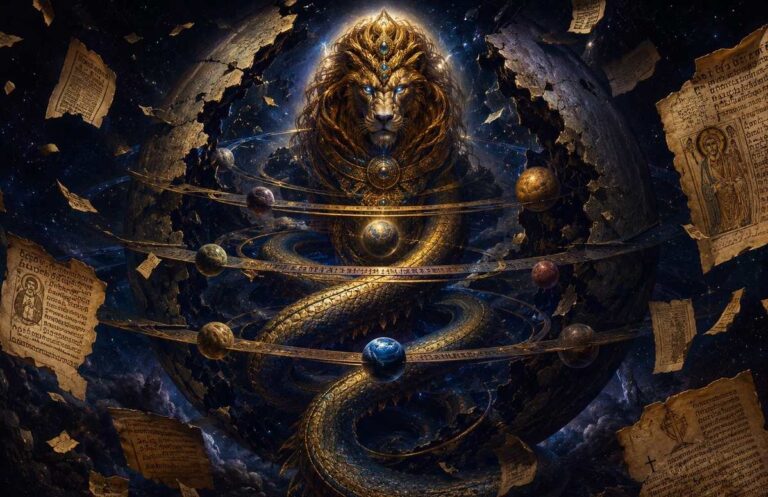
In the Apocryphon of John, Yaldabaoth is described in vivid mythic imagery, often with leonine and serpentine features. The description is not zoology. It is symbolic anatomy. The lion suggests power, appetite, and rulership. The serpent suggests cunning, earthbound force, and the twisting intelligence of the lower world. Together they produce an image of fierce, distorted sovereignty.
The most important line is the boast: “I am God and there is no other.” In Gnostic interpretation, this is not divine revelation but evidence of ignorance. Only a being cut off from the higher realms could make such a claim without trembling.
This is why the Demiurge still matters. Any authority can become demiurgic when it cannot imagine a reality beyond itself. A state, church, algorithm, ideology, family system, ego, or spiritual teacher may become Yaldabaoth-like when it claims total authority over the world it merely administers.
The Master of Mimicry
What distinguishes the Gnostic Demiurge from a simple evil god is his relationship to imitation. He does not create from the Fullness of divine imagination. He makes, copies, organises, administers, and distorts. He is a craftsman without complete wisdom.
In texts such as Hypostasis of the Archons and On the Origin of the World, the rulers construct a lower order that imitates higher realities. The result is not pure nothingness. Counterfeit requires resemblance. A false coin must look enough like a real coin to circulate.
This is one of the most psychologically rich parts of the myth. The lower world does not trap consciousness only through ugliness. It traps through imitation of beauty, imitation of truth, imitation of authority, imitation of liberation, imitation of spiritual experience. The counterfeit is dangerous because it borrows the shape of the real.
Modern readers can recognise this instantly. False intimacy imitates love. Branding imitates meaning. Metrics imitate value. Institutions imitate wisdom. Algorithms imitate attention. Ideology imitates certainty. The Demiurge is not only a mythic craftsman. He is the pattern of imitation without depth.
The Gnostic task is therefore not crude rejection of the world. It is discernment: learning to distinguish reflection from source, symbol from prison, structure from spirit, imitation from living truth.
The Envy of the Anthropos
The Demiurge’s ignorance becomes sharper when humanity enters the myth. In several Gnostic accounts, the human being is not merely a creature of the lower powers. Humanity carries something from above: image, light, spark, or spiritual seed.
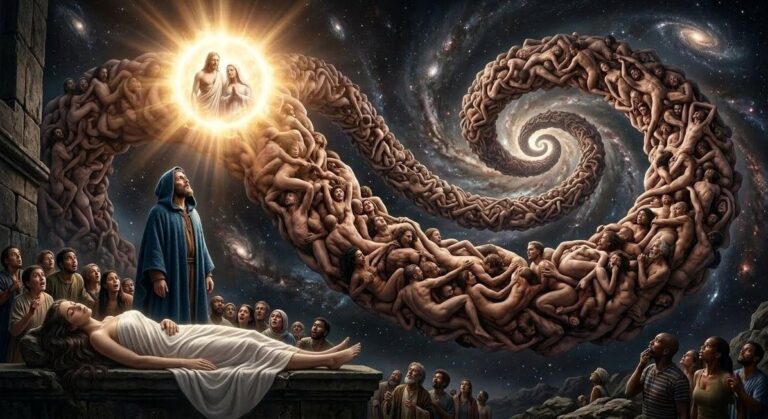
In the Apocryphon of John, the rulers fashion Adam, but he remains incomplete until the higher power enters or awakens within him. The human being then exceeds the makers who attempted to control him. This is the mythic scandal: the creature contains a depth the creators cannot possess.
The Archons become envious because humanity bears an image or spark that does not belong to the lower order. They can shape bodies, systems, rules, and environments, but they cannot create the spiritual light itself. The divine spark is not manufactured by the Demiurge. It is trapped by him, obscured by him, or exploited by his system, but not authored by him.
This reverses the usual religious hierarchy. The human being is not merely a sinful creature grovelling before a flawless creator. The human being is a contested site: clay below, spark above, psyche between, and rulers attempting to keep the whole arrangement asleep.
The Counterfeit Spirit
One of the most important Gnostic ideas linked to the Demiurge is the counterfeit spirit. This is not simply “ego” in a modern pop-psychology sense, though the comparison can be useful. It is the false animating principle that imitates spiritual life while keeping the soul bound to the lower order.
The counterfeit spirit works by substitution. It offers fear instead of reverence, obedience instead of recognition, imitation instead of creativity, identity instead of essence, and anxious control instead of living wisdom. It makes the prison feel like home by training the captive to call the bars “reality”.
Psychologically, this can be read as the internalised system: the voice of false necessity, the learned self that performs for approval, the inherited script that says safety depends on remaining small, compliant, distracted, guilty, or afraid. Spirit is replaced by a managed self.
Spiritually, the counterfeit spirit is one of the Demiurge’s most subtle tools. Crude force can provoke resistance. Imitation can be mistaken for awakening. The lower system survives by offering a substitute for the very freedom it prevents.
Why This Myth Was Dangerous
It is not hard to see why the Demiurge myth troubled emerging orthodoxies. If the visible creator is not the highest God, then religious authority built on the creator’s unquestioned sovereignty becomes unstable. If true knowledge comes through direct recognition, then spiritual power cannot be fully monopolised by priesthood, temple, church, empire, law, or institution.
This does not mean every orthodox Christian, Jewish, or Islamic tradition is reducible to the Demiurge. Nor does it mean all monotheism is automatically oppressive. The historical reality is far more complex. But the Gnostic myth does place a blade against one particular confusion: the assumption that worldly authority, divine authority, and ultimate reality are always aligned.
The Demiurge myth decentralises power. It asks whether the ruler knows the source. It asks whether command is the same as wisdom. It asks whether law without gnosis can become spiritual machinery. It asks whether a system can claim God while blocking recognition of the divine spark.
For this reason, Gnostic cosmology was not merely an odd metaphysical speculation. It was a threat to the imagination of power. Once the lower architect can be questioned, every earthly architecture that borrows his voice can be questioned too.
Cathars, Dualism, and Later Echoes
Later medieval dualist movements, especially the Cathars of southern France and northern Italy, have often been compared with ancient Gnostic traditions. They rejected aspects of material life, criticised the established Church, and developed a stark contrast between a good spiritual principle and a lower or evil creator associated with the material world.
The relationship between ancient Gnosticism and Catharism is debated. Some older scholarship imagined a direct underground continuity from ancient Gnostics to medieval heretics. More recent scholars tend to be cautious, emphasising discontinuities, regional developments, polemical sources, and the difficulty of reconstructing Cathar belief from hostile records.
Even so, the resonance is real. The Cathar challenge to church authority, sacramental power, wealth, violence, and material entanglement carried a similar danger: it questioned whether the dominant religious institution truly mediated the highest good.
The Albigensian Crusade, launched in 1209 under Pope Innocent III, was one of the most violent episodes in medieval religious history. Whatever one makes of Cathar theology, the political lesson is clear: ideas about creation, matter, authority, and salvation do not remain safely abstract. Cosmology can unsettle kingdoms.
The Archons Today
The Gnostic Archons are rulers, administrators, and powers of the lower order. In myth, they govern the cosmic structures that keep consciousness bound. In symbolic reading, they also name the mechanisms through which perception is managed and freedom narrowed.
Modern readers should be careful here. It is easy to turn “Archons” into a conspiracy costume and lose the precision of the symbol. The stronger reading is not that every institution is secretly run by invisible reptilian clerks with celestial clipboards. The stronger reading is that systems can become archonic when they imitate life while extracting attention, obedience, labour, desire, and imagination.
Surveillance capitalism, algorithmic feeds, bureaucratic dehumanisation, propaganda, attention capture, synthetic intimacy, and hyperreal media environments all offer modern analogues to archonic patterning. They do not prove ancient cosmology. They show why the old myth still bites.
The Demiurge’s matrix is not simply a literal computer simulation. It is any managed environment that becomes so total that its inhabitants forget there is a difference between the system and reality. The Archons do not need to hide the prison if they can train the prisoner to decorate it.
The Path of Gnosis
The Gnostic response to the Demiurge is not despair. It is recognition. The lower world may be powerful, but its power depends on ignorance. Once the false totality is seen as false, it no longer occupies the same place in consciousness.
Gnosis is not merely information about the Demiurge. A person can know every name of every Archon and still be ruled by fear, vanity, craving, resentment, and spiritual theatre. Gnosis is direct recognition: the awakening of the spark to its source, and the loosening of identification with the lower system.
This recognition has ethical consequences. It does not make the world disposable. It makes domination visible. It does not excuse cruelty. It exposes imitation. It does not inflate the seeker into superiority. It calls the seeker back to responsibility, discernment, courage, and humility.
To question the Architect is not to hate creation. It is to refuse false creation’s claim to be ultimate. To distrust the counterfeit is not to despise the body. It is to remember that the body, psyche, world, and history must be read through a deeper light than the rulers can provide.
The Demiurge may rage in the halls of his own system. But the Gnostic gospel is quieter and more dangerous: the spark was never his property.
The Gnostic Reading: False Creation and Living Recognition
The Demiurge is the myth of a creator who confuses making with knowing. He can organise a world, but he cannot understand the Fullness. He can administer a system, but he cannot generate the spark. He can claim authority, but he cannot become the source.
This is why the myth remains useful far beyond ancient cosmology. The Demiurge appears wherever a model claims to be reality itself. He appears in rigid religion, closed ideology, bureaucratic cruelty, spiritual narcissism, technological capture, and the ego’s little throne room. He appears whenever something partial says, “there is no other.”
The Archons are the operating powers of that false finality. They maintain the permissions, scripts, fears, rewards, punishments, loops, and distractions that keep the soul identified with the lower order. They need not be reduced to psychology, and they need not be inflated into paranoia. They are patterns of rule.
Gnosis begins when the pattern is recognised. Not as theory, not as costume, not as anti-world rage, but as clear seeing. The world remains. The body remains. Responsibility remains. But the false creator loses the right to define the whole of reality.
The demented god architect is therefore not only a figure to fear. He is a diagnostic mirror. Wherever the soul bows to a system that cannot see beyond itself, Yaldabaoth has found a temple. Wherever the spark remembers its source, the temple cracks.
Related Glossary Terms
For quick definitions, use the main ZenithEye Glossary. The key terms for this article are:
Read Next
Continue with: Apocryphon of John: Sethian Cosmology Revealed
If this article introduces the Demiurge as the false architect, the next step is the primary-source myth in fuller form: Sophia, Yaldabaoth, the Archons, Adam, Eve, the counterfeit spirit, and the awakening of the divine spark.
Within The Thread
This article belongs to Forbidden Texts & Suppressed Scriptures, a route within The Living Thread concerned with writings, myths, scriptures, and cosmologies that disturbed authorised memory. The Demiurge belongs here because he is one of the most explosive figures in the forbidden archive: the creator who may not be the source.
Frequently Asked Questions About the Demiurge
What is the Demiurge in Gnosticism?
The Demiurge is the lower craftsman or world-maker in several Gnostic systems. Unlike the supreme divine source, the Demiurge creates or organises the lower cosmos in ignorance. He often believes himself to be the highest God because he does not know the Fullness beyond him.
Is the Demiurge the same as Yaldabaoth?
In many Sethian Gnostic texts, Yaldabaoth is a name for the Demiurge. Other names include Samael and Saklas, which are associated with blindness, ignorance, or foolishness. These names express the idea of false authority: a lower power that claims ultimate status without understanding its own origin.
Did Gnostics believe the material world is evil?
Some Gnostic texts describe the lower material world as deficient, deceptive, or ruled by ignorant powers. But it is too simple to say all Gnostics simply hated matter. Many texts are more concerned with ignorance, false authority, captivity, and mistaken identity than with matter as such. The world is real as experience, but not ultimate as truth.
What is the counterfeit spirit?
The counterfeit spirit is a false animating principle in Gnostic myth. It imitates spiritual life while keeping consciousness bound to the lower order. Psychologically, it can be read as the internalised system of fear, false identity, compulsion, imitation, and obedience that obscures the divine spark.
Are the Archons literal beings or symbolic powers?
Ancient Gnostic texts often present the Archons as cosmic rulers or administrators. Modern readers may interpret them metaphysically, symbolically, psychologically, or socially. They can be read as patterns of control, false authority, perception management, and inherited constraint without reducing the myth to only one level.
Were the Cathars directly descended from ancient Gnostics?
The relationship between Cathars and ancient Gnostics is debated. They share certain dualist themes, such as suspicion toward the material world and criticism of established religious authority, but direct historical continuity is difficult to prove. It is safer to speak of resonance and later dualist echoes rather than a simple unbroken lineage.
What is the spiritual lesson of the Demiurge myth?
The Demiurge myth warns against false finality. It asks readers to question any system, authority, identity, or worldview that claims to be the whole of reality while blocking recognition of the deeper source. Gnosis begins when the lower architect is seen as partial rather than ultimate.
Study and Safety Note
This article explores Gnostic cosmology, forbidden texts, the Demiurge, Archons, Cathar echoes, and modern symbolic interpretation for educational and reflective purposes. It does not claim that one living religion, ethnicity, or community is secretly “Demiurgic”. It does not encourage hatred of the body, hatred of the world, paranoia, or contempt for ordinary life.
Mythic language can be powerful. If themes of false reality, cosmic rulers, spiritual captivity, or hidden control increase anxiety, derealisation, paranoia, grandiosity, insomnia, panic, or difficulty functioning, pause the material and seek grounded support. Gnosis should deepen discernment, compassion, responsibility, and embodied clarity, not detach the reader from care.
Further Reading
These live ZenithEye links continue the themes of the Demiurge, Archons, forbidden texts, soul capture, Gnostic cosmology, and spiritual sovereignty:
- Apocryphon of John: Sethian Cosmology Revealed – The key Sethian source for Sophia, Yaldabaoth, the Archons, Adam, Eve, and the counterfeit spirit.
- Archons: The Ruling Powers That Shape Reality – A focused guide to the powers that administer limitation and false authority in Gnostic myth.
- What Is the Counterfeit Spirit? False Imitation of Spiritual Life – The inner mechanism of imitation, false animation, and spiritual mimicry.
- What Is the Demiurge? Meaning, Origins, and Modern Interpretation – A clearer foundation article on the Demiurge as concept, figure, and symbolic pattern.
- The Soul Trap: Gnosticism and the Machinery of Return – A modern Gnostic reading of reincarnation, return, and spiritual captivity.
- The Names of the Archons: Identifying the Prison Wardens of the Soul Trap – A deeper look at the rulers, their names, and their symbolic functions.
- Pleroma and Kenoma: Gnostic Cosmology Explained – The geography of Fullness and deficiency behind Demiurgic cosmology.
- The Gnostic Matrix: Reality as Information System – A modern systems reading of Gnostic cosmology, simulation, and mediated reality.
- Nag Hammadi Library: Complete Guide to the Gnostic Scriptures – The wider source-library route into the texts that preserve these myths.
- The Thread – The main route through ZenithEye’s symbolic, historical, contemplative, and contemporary architecture.
References and Sources
The following sources support the Gnostic, historical, and interpretive framework used in this article.
Primary Gnostic Sources
- [1] Apocryphon of John. Nag Hammadi Codex II,1; III,1; IV,1; Berlin Codex 8502,2.
- [2] Hypostasis of the Archons. Nag Hammadi Codex II,4.
- [3] On the Origin of the World. Nag Hammadi Codex II,5; XIII,2.
- [4] Gospel of Philip. Nag Hammadi Codex II,3.
- [5] Tripartite Tractate. Nag Hammadi Codex I,5.
- [6] Robinson, James M. (ed.). The Nag Hammadi Library in English. Revised edition. HarperOne, 1990.
- [7] Meyer, Marvin (ed.). The Nag Hammadi Scriptures. HarperOne, 2007.
- [8] Layton, Bentley. The Gnostic Scriptures. Yale University Press, 1987.
Gnostic Scholarship and Interpretation
- [9] Williams, Michael Allen. Rethinking “Gnosticism”: An Argument for Dismantling a Dubious Category. Princeton University Press, 1996.
- [10] King, Karen L. What Is Gnosticism?. Harvard University Press, 2003.
- [11] Brakke, David. The Gnostics: Myth, Ritual, and Diversity in Early Christianity. Harvard University Press, 2010.
- [12] Jonas, Hans. The Gnostic Religion. Beacon Press, 1958.
- [13] Rudolph, Kurt. Gnosis: The Nature and History of Gnosticism. Harper & Row, 1983.
- [14] Thomassen, Einar. The Spiritual Seed: The Church of the Valentinians. Brill, 2006.
- [15] Turner, John D. Sethian Gnosticism and the Platonic Tradition. Presses de l’Université Laval, 2001.
Cathars, Medieval Dualism, and Heresy
- [16] Lambert, Malcolm. The Cathars. Blackwell, 1998.
- [17] Barber, Malcolm. The Cathars: Dualist Heretics in Languedoc in the High Middle Ages. Longman, 2000.
- [18] Moore, R. I. The War on Heresy. Harvard University Press, 2012.
- [19] Pegg, Mark Gregory. A Most Holy War: The Albigensian Crusade and the Battle for Christendom. Oxford University Press, 2008.
- [20] Hamilton, Bernard. The Medieval Inquisition. Holmes & Meier, 1981.
Comparative, Symbolic, and Modern Systems Context
- [21] Plato. Timaeus. Classical source for the benevolent Demiurge as cosmic craftsman.
- [22] Plato. Republic, Book VII. The Allegory of the Cave.
- [23] Baudrillard, Jean. Simulacra and Simulation. Translated by Sheila Faria Glaser. University of Michigan Press, 1994.
- [24] Zuboff, Shoshana. The Age of Surveillance Capitalism. PublicAffairs, 2019.
- [25] Debord, Guy. The Society of the Spectacle. Buchet-Chastel, 1967.
- [26] Chalmers, David J. Reality+: Virtual Worlds and the Problems of Philosophy. W. W. Norton, 2022.