Nag Hammadi for Beginners: A 10-Text Journey into Gnosticism
Nag Hammadi for Beginners: A 10-Text Journey offers a curated pathway through the most accessible entry points into the Nag Hammadi Library’s 46 tractates. This sequence transforms an overwhelming archive of ancient Gnostic, Sethian, Valentinian, and Hermetic materials into a navigable route—moving from the direct sayings of the Gospel of Thomas to the technical ascent of Allogenes while gradually building the cosmological literacy required for deeper navigation. Unlike encountering texts at random, this path ensures each selection prepares the reader for the next, creating a progressive disclosure of the library’s theological architecture [1][2].
The journey acknowledges that not all texts yield their secrets to the unprepared traveller. Some tractates—such as the Platonizing Sethian trio of Zostrianos, Allogenes, and Marsanes—require extensive preparatory clearances before their technical cosmology becomes intelligible. This ten-text sequence provides those clearances sequentially, allowing the reader to accumulate the necessary conceptual vocabulary, mythological familiarity, and ritual understanding without encountering material beyond their current capacity [3][4].
Table of Contents
- The Living Thread: An Invitation to the Archives
- The 10-Text Journey: From Surface to Depth
- Text 1: The Gospel of Thomas—The Entry Point
- Text 2: The Gospel of Truth—The Poetic Turn
- Text 3: The Apocryphon of John—The Mythological Foundation
- Text 4: Thunder: Perfect Mind—The Paradox of Divinity
- Text 5: The Gospel of Philip—The Sacramental Mystery
- Text 6: On the Origin of the World—The Cosmic Detail
- Text 7: The Treatise on Resurrection—The Practical Application
- Text 8: The Hypostasis of the Archons—The Alternative Account
- Text 9: The Prayer of Paul—The Lived Practice
- Text 10: Allogenes—The Technical Ascent
- Practical Protocols for the Journey
- Frequently Asked Questions
- Further Reading
- References and Sources

The Living Thread: An Invitation to the Archives
The Nag Hammadi Library for Beginners is not a separate physical collection but a living thread through the forty-six tractates discovered near Nag Hammadi, Egypt, in December 1945. This ten-text sequence functions as an initiation into a mode of reading that transforms the overwhelming archive into a coherent spiritual technology. The journey builds recognition gradually, ensuring that readers develop the necessary inner infrastructure before encountering texts that assume extensive background knowledge [5][6].
The Shape of the Journey
This path unfolds over ten to twelve weeks—one text per week—moving from the immediate, aphoristic wisdom of the Gospel of Thomas through increasingly complex territories: the poetic theology of Valentinus, the cosmic drama of the Apocryphon, the paradoxical voice of Thunder, the sacramental mysteries of Philip, and ultimately the technical ascent of Allogenes. Each text is chosen not for academic completeness but for its capacity to prepare the reader for what follows. The progression mirrors the ancient principle of disciplina arcani—the gradual disclosure of mysteries according to readiness—while remaining accessible to contemporary seekers without specialist credentials [7][8].
The sequence: Sayings → Poetry → Cosmogony → Paradox → Sacrament → Cosmic elaboration → Pastoral wisdom → Mythological comparison → Liturgical practice → Technical ascent. By the final text, the reader possesses the clearances necessary for unrestricted navigation of the entire collection [9].
The 10-Text Journey: From Surface to Depth
This sequence moves from accessible, engaging texts to increasingly complex material, building knowledge and confidence as the reader proceeds. Each selection serves as preparation for the next, creating a pedagogical architecture that respects both the reader’s cognitive limits and the texts’ inherent demands. The result is a graduated induction: by Text 10, the reader possesses the necessary authorisations to engage with the most technically demanding Platonizing Sethian materials [9].
Text 1: The Gospel of Thomas (NHC II,2)—The Entry Point
Why begin here: This collection of 114 sayings attributed to Jesus represents the most accessible entry into the library—no complex mythology, no dense cosmology, just cryptic, provocative teachings that invite immediate contemplation. Unlike the canonical gospels with their Passion narratives and resurrection theology, Thomas offers pure gnosis: direct pointers to the kingdom already present but unseen [10][11].
The text operates as a sayings gospel, lacking narrative framework, which paradoxically makes it more approachable for modern readers accustomed to fragmented, aphoristic information consumption. Each logion functions as a contemplative koan, disrupting ordinary consciousness rather than building systematic theology. Saying 3 immediately establishes the radical interiority of the Thomasine path: “The kingdom is inside of you, and it is outside of you” [11][12].
Key themes: The kingdom spread out upon the earth; the hidden revealed to the worthy; seeking and finding; the solitary (monachos) as ideal type; the light within; recognition (gnosis) as salvation.
Text 2: The Gospel of Truth (NHC I,3/XII,2)—The Poetic Turn
Why read this next: Often attributed to Valentinus himself—the most literate and philosophically sophisticated of the Gnostic teachers—this tractate represents Gnosticism as spiritual poetry rather than doctrinal polemic. Having encountered the direct sayings of Thomas, the reader is now prepared for the aesthetic dimension of Gnostic experience [13][14].
The text introduces core concepts—error (plane), ignorance (agnoia), the Father’s embrace—through beautiful, accessible prose that emphasises recognition over belief. It describes the universe as a nightmare from which the divine spark is awakening, offering a theology of beauty that contrasts sharply with the bureaucratic Christianity of the orthodox authorities. The Gospel of Truth serves as the emotional and aesthetic foundation necessary before encountering the more demanding cosmological texts [14][15].
Key themes: The terror of ignorance; the fragrance of the Father; error as spontaneous generation (like mould); the redemption of the redeemer; the book of the living.
Text 3: The Apocryphon of John (NHC II,1/III,1/IV,1)—The Mythological Foundation
Primary Source Citation: NHC II,1 30:11-15 — “And the Spirit of the Great Light, the Mother, the Pronoia, took the luminous Power out of the First Man who was called Adamas, and she placed it within the chief archon as a consciousness so that he might become dark through that luminous Power and might be bound to the Pleroma.”
Why this comes third: Now the reader possesses the literary sensibility required for full Gnostic mythology. This is the definitive account of the Gnostic creation myth: the fall of Sophia (Wisdom), the birth of the arrogant Demiurge Yaldabaoth, the creation of Adam as a prison for the divine spark, and the long archonic administration of human ignorance [16][17].
The Apocryphon exists in three versions—short (Codex III) and long (Codices II and IV)—allowing comparison of scribal approaches to the same revelation. This text provides the cosmological framework that makes sense of everything else in the library: the prison world, the stolen light, the rescue mission, and the three natures (spiritual, psychic, and material). It is the essential archonic org chart, the administrative map of the cosmic bureaucracy [17][18].
Key themes: The Pleroma and the Kenoma; the fall of Sophia; Yaldabaoth’s counterfeit creation; the spark of divine light hidden in humanity; the three natures.
Text 4: Thunder: Perfect Mind (NHC VI,2)—The Paradox of Divinity
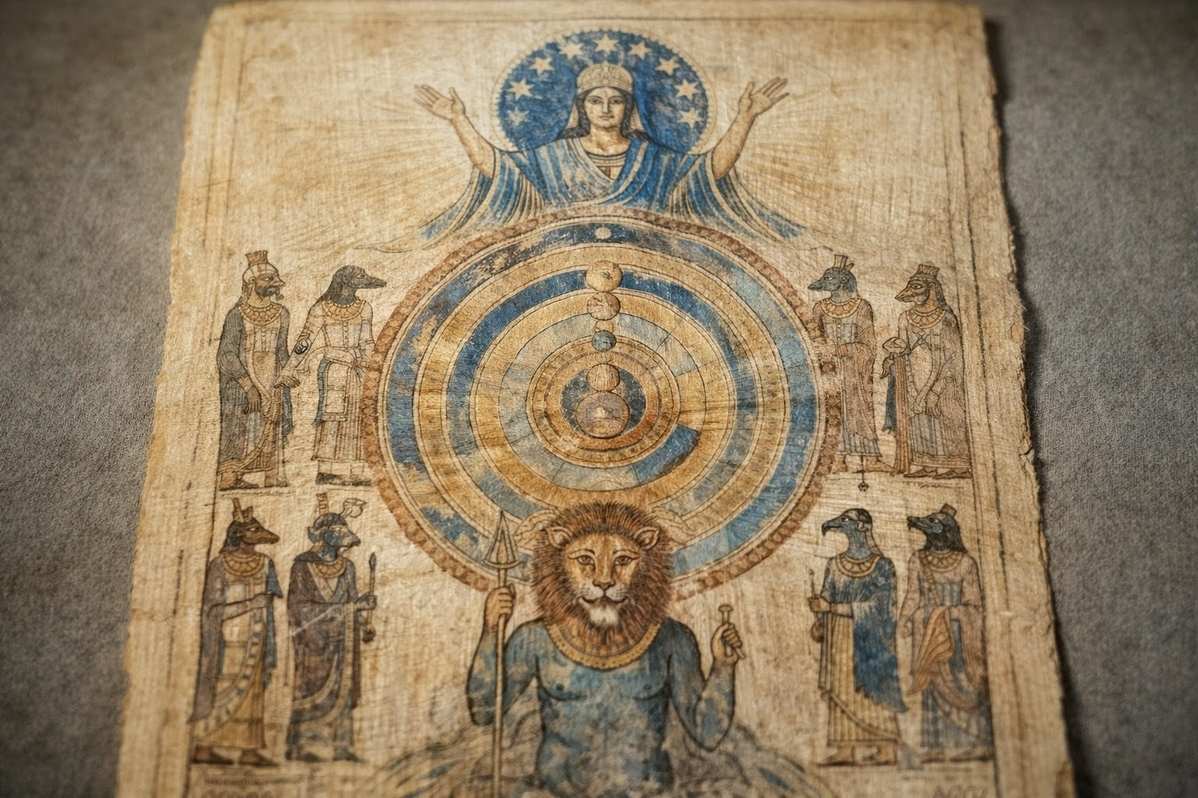
Why read this now: After the narrative complexity of the Apocryphon of John, the reader requires a different mode of engagement. Thunder: Perfect Mind offers Gnosticism as pure poetry—a powerful monologue spoken by a divine feminine figure (possibly Barbelo, possibly Isis-Christos) who embodies all contraries simultaneously [19][20].
The text showcases Gnostic paradox and the reclamation of rejected identity: “I am the whore and the holy one. I am the wife and the virgin. I am the mother and the daughter.” This is the voice of the excluded, the administrative Other, speaking from the margins of orthodox definition. It prepares the reader for the sacramental complexity of the texts that follow while demonstrating the Gnostic insistence on transcending binary categories [20][21].
Key themes: Divine androgyneity; the reintegration of opposites; the rejected stone becoming cornerstone; the first and the last; knowledge through paradox; the voice of the thunder.
Text 5: The Gospel of Philip (NHC II,3)—The Sacramental Mystery
Why this fits here: Having encountered the mythological and poetic dimensions, the reader is ready for the ritual dimension. The Gospel of Philip is a collection of meditations on sacraments, love, and spiritual transformation—more accessible than the philosophical treatises but deeper than the simple sayings [22][23].
Philip contains the famous passage about the nymphon (bridal chamber) as the supreme sacrament, radicalising Christian marriage theology into an image of cosmic reunion. It also contains the controversial reference to Mary Magdalene as the companion (koinōnos) of the Saviour—a term carrying connotations of spiritual partnership that threatened the emerging patriarchal hierarchy. This text establishes the sacramental foundation for understanding Gnosticism as lived practice rather than abstract speculation [23][24].
Key themes: The bridal chamber (nymphon) as sacred mystery; sacramental theology; the transformation of death into life; the power of the Name; the unity of the divided; Mary Magdalene as koinōnos.
Text 6: On the Origin of the World (NHC II,5/XIII,2)—The Cosmic Detail
Why this comes mid-journey: The reader now possesses sufficient cosmological literacy to appreciate a more elaborate version of the Gnostic creation myth. This tractate offers richer detail about the cosmos, its rulers, and the material creation than the Apocryphon of John, including the memorable image of the cosmic egg and the creation of Adam as a hollow vessel [25][26].
The text demonstrates that there was no single “Gnostic” creation story but a spectrum of accounts, each emphasising different aspects of the fall and the rescue. Notable is the sympathetic treatment of Sabaoth—the repentant archon who receives authority and becomes a just ruler—demonstrating the complexity of archonic characters beyond simple demonisation. This serves as a bridge between the basic mythology and the more technical ascent literature that follows [26][27].
Key themes: The cosmic egg; the role of Sabaoth (the repentant archon); the creation of Eve as the spiritual instructor; the seven planetary powers; the eschatological conflagration.
Text 7: The Treatise on the Resurrection (NHC I,4)—The Practical Application
Why read this now: After six texts of cosmology and myth, the reader requires a reminder that Gnosticism addresses lived human experience. This text—actually a letter from a teacher to a student named Rheginos grieving his son’s death—addresses the most practical question: what happens when we die? [28][29]
The Treatise offers a distinctly Gnostic soteriology: resurrection is not the revivification of the flesh (which the author calls “disgusting”) but the transformation of the spiritual nature into its primordial state. It demonstrates how Gnostic theology functions pastorally, offering consolation without false promises of bodily resuscitation. The text emphasises that resurrection is an already-accomplished reality for the spiritual nature, not a future bodily event [29][30].
Key themes: Resurrection as spiritual transformation; the rejection of fleshly resurrection; the already-but-not-yet nature of salvation; consolation for the bereaved; the revealed truth of the Resurrection.
Text 8: The Hypostasis of the Archons (NHC II,4)—The Alternative Account
Why this comes later: The reader is now sophisticated enough to compare multiple versions of the same myth. This tractate offers another version of the creation myth, but with distinctive Sethian features: the role of the angelic instructor Sabaoth (who repents and receives authority), the figure of the Spirit as Eve’s instructor, and the detailed account of the Flood as archonic attempt to destroy spiritual knowledge [31][32].
Reading this after the Apocryphon of John reveals the flexibility and diversity of Gnostic myth-making—there is no single “authorised” version, only variations on the theme of divine rescue from material imprisonment. The text also contains the famous declaration “The Spirit as woman is the one who came to him,” emphasising the feminine dimension of spiritual instruction [32][33].
Key themes: The Spirit as instructor; the arrogance of the archons; the reprieve of Sabaoth; Noah and the Flood as spiritual warfare; the division of the races (spiritual, psychic, material).
Text 9: The Prayer of the Apostle Paul (NHC I,1)—The Lived Practice
Why this fits here: After eight substantial texts, the reader requires something brief, beautiful, and practical. This short prayer—barely a page in translation—can be memorised and used in one’s own practice. It demonstrates Gnosticism as lived spirituality, not just abstract theology or cosmic speculation [34][35].
The prayer invokes “the mind of the mind” (nous) and “the treasure of Resurrection,” serving as a microcosm of the entire Gnostic path. Placed here, it offers a moment of contemplative rest before the final ascent, allowing the reader to consolidate the preceding material into a single, concentrated expression of supplication. The text functions as a liturgical conclusion to the pedagogical section before the technical challenge of the final text [35][36].
Key themes: Redemption from the flesh; the mind of the mind; the secret supplication; the seal of Resurrection; angelic assistance; the cross of light.
Text 10: Allogenes (NHC XI,3)—The Technical Ascent
Primary Source Citation: NHC XI,3 60:9-12 — “Do not know him, for it is impossible; but if by means of an enlightened thought you should know him, stay incognizant of him!”
Why end here: The reader has built the foundation; now they experience the heights. This difficult but rewarding text describes the mystical ascent to the Unknowable God through the aeons, the self-generated ones, and the realm of Barbelo. It is technical, abstract, and deliberately obscure—designed for those who have completed the preparatory clearances [37][38].
Allogenes (the “Stranger” or “Foreigner”) serves as the capstone of this curriculum, revealing that Gnosticism culminates not in doctrinal assent but in direct encounter with the transcendent. The text’s difficulty is the point: it mirrors the difficulty of the ascent itself, requiring the reader to employ the negative theological method (“learned ignorance”) developed through the previous nine texts. The successful completion of Allogenes indicates that the reader has acquired the necessary clearances for unrestricted access to the entire Nag Hammadi archive [38][39].
Key themes: The Triple-Powered One; the ascent through aeons; negative theology (the Unknowable); the cessation of mental activity; the revelation of the Unknown; the Luminaries of Barbelo.

Practical Protocols for the Journey
Reading as Recognition
Do not rush this sequence. Each text requires not merely reading but recognition—the Greek anagnōrisis that implies a return to what was always known. Read one text per week, allowing material to integrate before proceeding. Keep a journal of logia or passages that provoke the shock of recognition; these are indicators of successful transmission [40].
Supplementary Materials
While this path requires no specialist knowledge, the reader will benefit from the Gnostic Technical Glossary for terms like Pleroma, Kenoma, and Aeon. The Complete Reader’s Guide provides codicological context for each text, while the Guide to Gnostic Schools clarifies the distinction between Sethian, Valentinian, and Hermetic traditions [41].
The jar is open. The texts have survived. This ten-step path offers entry into the living thread of forbidden knowing—but only the reader’s own recognition can complete the circuit. The library awaits; the journey begins with a single text.
Continue Through The Thread
This article is one node in a wider route through ZenithEye’s living archive. If you want the larger map, continue through these reader paths.
- Start Here: A Reader’s Guide to ZenithEye — the clearest first route through the archive.
- The Thread and Five Pillars — the main map for hidden systems, sources, states and practice.
- Editorial Principles — how ZenithEye handles sources, interpretation, experience and symbolic reading.
- Browse All Articles — the full archive by discovery and date.
Source & Interpretation Note
ZenithEye separates primary sources, scholarly interpretation, symbolic reading and lived contemplative reflection. Ancient texts are treated with care, but not flattened into dogma; modern parallels are offered as interpretive bridges, not proof.
- Editorial Principles — how ZenithEye handles sources, symbolism, AI and lived experience.
- Start Here — the reader guide for the wider archive.
- Site Map & Reading Paths — structured routes through the archive.
Frequently Asked Questions
Which Nag Hammadi text should I read first?
Start with the Gospel of Thomas (NHC II,2). Its 114 sayings of Jesus require no prior knowledge of Gnostic cosmology, offering direct, accessible wisdom that prepares you for more complex material through its aphoristic, koan-like structure.
How long does it take to read the entire Nag Hammadi Library?
Reading all 46 tractates requires several months to a year of dedicated study. This 10-text beginner’s path can be completed in 10-12 weeks at a pace of one text per week, allowing time for contemplation and integration before attempting the complete collection.
Do I need to know Coptic to read the Nag Hammadi texts?
No. Excellent English translations exist, particularly the Robinson edition (The Nag Hammadi Library in English, 4th revised edition) and the Meyer International Edition. All texts referenced in this beginner’s guide are available in reliable translation with scholarly introductions.
What is the difference between Sethian and Valentinian texts?
Sethian texts (like Apocryphon of John) focus on cosmic mythology, the descent of Seth’s spiritual descendants, and complex ascent through aeons. Valentinian texts (like Gospel of Truth) emphasise emotional and sacramental theology, the bridal chamber (nymphon), and the restoration of all things (apokatastasis).
Is the Gospel of Thomas historically authentic?
The Gospel of Thomas is authentic in the sense that it is a genuine ancient text from the first century CE, likely predating the canonical gospels. Whether it represents the ‘historical Jesus’ or a particular theological school remains debated among scholars, but it is a primary source for early Christian diversity.
What are the most difficult texts in the Nag Hammadi Library?
Allogenes (NHC XI,3), Marsanes (NHC X,1), and Zostrianos (NHC VIII,1) are considered the most technically difficult due to their abstract Platonizing metaphysics and complex descriptions of aeonic ascent. These are best attempted after completing foundational texts like the 10-text sequence outlined here.
Can I practice Gnosticism today using these texts?
Yes. While the historical Gnostic schools no longer exist as living traditions, these texts provide the theological and contemplative foundation for contemporary Gnostic practice. The Prayer of the Apostle Paul and the Gospel of Philip offer particularly practical material for modern application.
Further Reading
These links connect the Nag Hammadi for Beginners path to related resources within the ZenithEye library, providing pathways for deeper exploration of specific texts and traditions.
- Nag Hammadi Library: Complete Guide to 46 Gnostic Scriptures — The comprehensive overview of the entire collection, codex by codex, for readers ready to expand beyond the beginner’s path.
- Nag Hammadi for Theologians: A Doctrine-Focused Path — Systematic theological engagement with Valentinian and Sethian systems for those seeking deeper doctrinal analysis after completing the introductory sequence.
- Nag Hammadi for Mystics: A Contemplative Path — Alternative reading sequence emphasising ecstatic and meditative dimensions for readers drawn to experiential dimensions.
- The Complete Nag Hammadi Reading Order: All 46 Tractates — Exhaustive sequence for completists ready to tackle the entire library in a systematic order.
- The Apocryphon of John: Gnostic Creation Myth — Deep dive into Text 3 of this beginner’s path, the essential cosmological foundation.
- The Gospel of Thomas: 114 Keys to the Kingdom — Extended commentary on Text 1, the essential starting point for all Nag Hammadi navigation.
- Gnostic Technical Glossary: Key Terms from Aeons to Zoe — Essential vocabulary reference for navigating archonic terminology and cosmological concepts.
- Gnostic Schools: Sethians, Valentinians, and Hermetics — Guide to the theological traditions represented in the library, essential for distinguishing text types.
- What Is Gnosticism? Defining the Undefinable — Conceptual framework for approaching these texts with appropriate methodological sophistication.
- Timeline of Gnosticism: From Ancient Texts to Modern Discovery — Historical context for the 1945 unearthing and the modern revival of Gnostic studies.
References and Sources
The following sources support the claims and recommendations presented in this article. All citations to the Nag Hammadi Library represent direct translations from the Coptic text as established in the standard critical editions.
Primary Sources and Critical Editions
- [1] Robinson, J.M. (Ed.). (1988). The Nag Hammadi Library in English (4th ed.). Brill. The standard complete translation with scholarly introductions to each tractate.
- [2] Meyer, M. (Ed.). (2007). The Nag Hammadi Scriptures: The International Edition. HarperOne. Revised translations with updated scholarly apparatus and introductions.
- [3] Layton, B. (1987). The Gnostic Scriptures: A New Translation with Annotations and Introductions. Doubleday. Scholarly translation with extensive commentary on Sethian and Valentinian texts.
- [4] Turner, J.D. (1990). “Allogenes: Introduction, Translation, and Notes.” In Pagels, E.H. & Hedrick, C.W. (Eds.), Nag Hammadi Codices XI, XII, XIII. Brill.
- [5] Funk, W.P. (2004). L’Allogène (NH XI, 3). Bibliothèque copte de Nag Hammadi, Section “Textes” 30. Presses de l’Université Laval/Peeters.
Scholarly Monographs and Introductions
- [6] Turner, J.D. (2001). Sethian Gnosticism and the Platonic Tradition. Presses de l’Université Laval/Brill. Comprehensive study of Platonizing Sethian texts including Allogenes.
- [7] Brakke, D. (2010). The Gnostics: Myth, Ritual, and Diversity in Early Christianity. Harvard University Press. Accessible introduction to Gnostic diversity and the Nag Hammadi Library.
- [8] King, K.L. (2006). The Secret Revelation of John. Harvard University Press. Critical study of the Apocryphon of John and its contexts.
- [9] Logan, A.H.B. (2006). The Gnostics: Identifying an Early Christian Cult. T&T Clark. Examination of Sethian and Valentinian distinctives.
- [10] Uro, R. (Ed.). (1998). Thomas at the Crossroads: Essays on the Gospel of Thomas. T&T Clark. Studies on the Gospel of Thomas and its milieu.
Comparative and Thematic Studies
- [11] Valantasis, R. (1997). The Gospel of Thomas. Routledge. Critical introduction and commentary on the Coptic text.
- [12] Patterson, S.J. (2013). The Gospel of Thomas and Christian Origins. Brill. Scholarly analysis of Thomas’s place in early Christianity.
- [13] Thomassen, E. (2006). The Spiritual Seed: The Church of the ‘Valentinians’. Brill. Definitive study of Valentinian theology and literature.
- [14] Williams, M.A. (1996). Rethinking “Gnosticism”: An Argument for Dismantling a Dubious Category. Princeton University Press.
- [15] Smith, C. (2020). No Longer in the World: Ritual, Revelation, and the Ascent of the Mind in Sethian Gnosticism. University of Chicago PhD Dissertation.