Timeline of Gnosticism: From Ancient Texts to Modern Discovery
The Long Arc of Gnostic History: From Second Century Origins to Modern Rediscovery
Gnosticism was not merely an ancient heresy but a persistent current of Western spirituality spanning two millennia. This timeline traces its evolution from the second-century Roman Empire through its suppression, survival, and dramatic rediscovery in the modern era. The trajectory reveals not simply a “filing error” in ecclesiastical history but an alternative administrative stream of mystical knowledge that persisted despite repeated attempts at departmental closure [1][2].
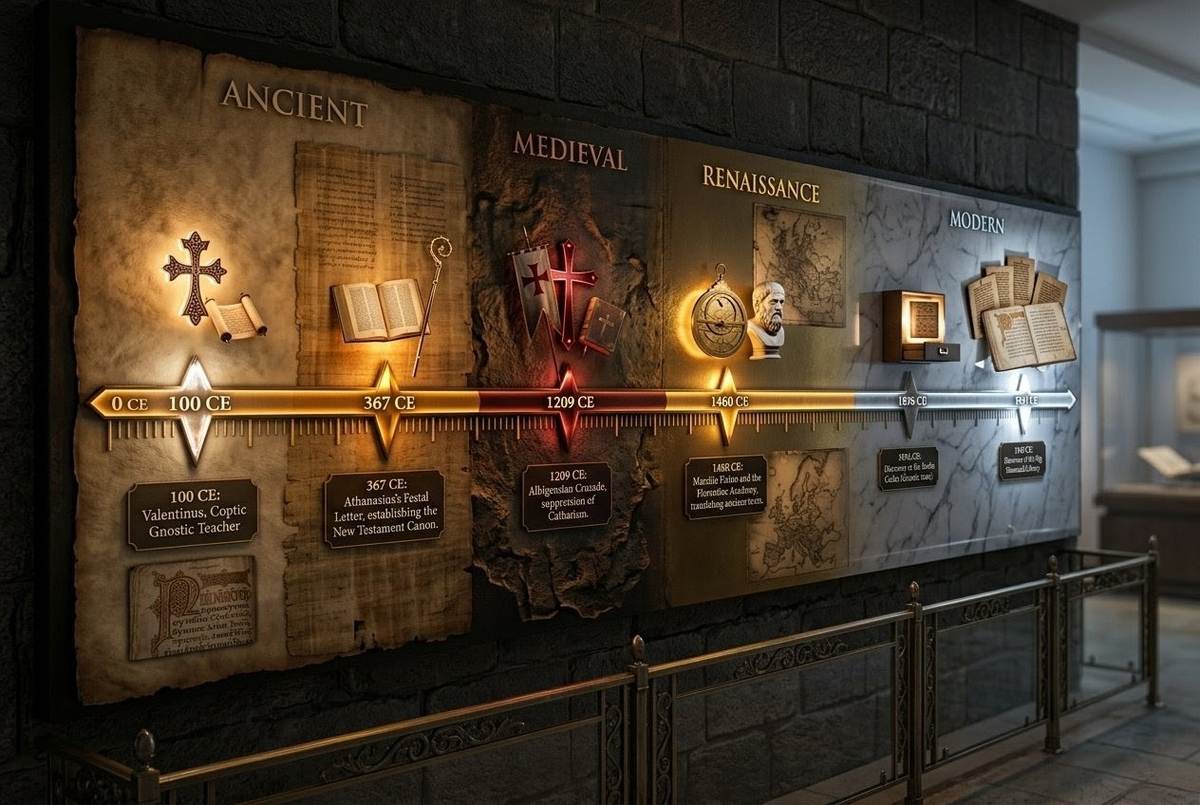
Table of Contents
- First Century CE: Pre-History
- Second Century: The Flourishing
- Third Century: Consolidation and Persecution
- Fourth Century: Suppression
- Fifth-Eighth Centuries: Survival and Transformation
- Renaissance to Enlightenment: Underground Currents
- Nineteenth Century: Reconstruction
- Twentieth Century: The Breakthrough
- Twenty-First Century: Contemporary Scholarship
- Frequently Asked Questions
- Further Reading
- References and Sources
First Century CE: Pre-History
c. 50-100 CE: The seeds of Gnostic thought appear in the Pauline letters (references to “knowledge,” “mystery,” and “principalities and powers”) and the Gospel of John (Logos theology, dualism of light/darkness) [3]. Jewish apocalyptic literature and Platonic philosophy provide conceptual frameworks that later Gnostic systems will systematise into elaborate cosmologies.
Simon Magus (according to Acts 8 and later heresiologists) works in Samaria, practicing magic and claiming divine status. Later traditions identify him as the “father of all heresies” [4]. Whether Simon represents the historical origin of Gnosticism or merely a convenient polemical target for orthodox authors remains debated. The patristic sources present him as offering to buy the Holy Spirit’s power from the apostles, establishing the paradigm of “simony” and suggesting an early concern with unauthorised access to spiritual “security clearances.”
Second Century: The Flourishing
c. 100-165 CE: Valentinus is born in Phrebonis in Upper Egypt and educated in Alexandria, where he becomes a disciple of Theudas, who claimed connection to Paul [5]. Around 120 CE, Valentinus begins teaching in Alexandria, developing a sophisticated theological system that synthesises Platonic philosophy, Christian tradition, and Jewish apocalyptic. In 136 CE, he relocates to Rome, where he nearly becomes bishop (c. 143 CE) and teaches for at least fifteen more years. His followers–Ptolemy, Heracleon, Theodotus, and others–develop his ideas into the most philosophically rigorous of all Gnostic schools [6].
The Valentinian School
Valentinus established the theological equivalent of a “corporate headquarters” for Gnostic Christianity–an elaborate hierarchy of aeons descending from the primal Father and Truth (Bythos and Aletheia). Unlike the Sethians, who operated as dispersed “franchises,” the Valentinians maintained relatively orthodox connections while preserving esoteric teachings for the pneumatic elite.
c. 140-180 CE: Marcion of Pontus establishes his church, teaching that the Old Testament God is a demiurge distinct from the Father of Jesus Christ [7]. Though often classified separately from Gnosticism proper, Marcion’s influence on Gnostic dualism is significant. His rejection of the Hebrew Bible and his edited version of Luke and Paul establish textual criteria that influence later Gnostic editing practices. Tertullian’s Against Marcion provides crucial evidence for reconstructing his teachings.
c. 150-200 CE: Sethian and other non-Christian Gnostic systems develop in Egypt and Syria. Texts later found at Nag Hammadi are composed in Greek during this period, including the earliest versions of the Apocryphon of John, Reality of the Archons, and Gospel of Thomas [8]. These texts reflect a “parallel filing system” to orthodox Christianity, preserving alternative apostolic traditions attributed to Thomas, Philip, Mary Magdalene, and other figures marginalised by the canonical hierarchy.
c. 160-180 CE: Justin Martyr writes his First Apology, briefly mentioning Gnostic teachers. Irenaeus of Lyon begins compiling material against heresies [9].
c. 180 CE: Irenaeus writes Against Heresies (Adversus Haereses), providing the first systematic refutation of Gnosticism and inadvertently preserving detailed summaries of Valentinian and other systems [10]. This work functions as a “hostile audit” of Gnostic operations, cataloguing their teachings in order to refute them but preserving information that would otherwise have been lost.

Third Century: Consolidation and Persecution
c. 200 CE: Tertullian writes against Marcion and Valentinus in North Africa, mocking Gnostic claims to secret knowledge. His polemics reveal the increasing institutional anxiety about competing “franchises” operating within the same territorial jurisdiction [11].
c. 216-276 CE: Mani is born in Mesopotamia (216 CE) and establishes Manichaeism, a universal religion synthesizing Gnostic, Zoroastrian, Buddhist, and Christian elements [12]. Manichaean missionaries spread throughout the Roman Empire and as far as China, establishing the most successful institutional transmission of Gnostic ideas prior to the modern era. The Manichaean “Church of the Pure” operates as a multinational corporation with its own hierarchies, rituals, and textual canon.
c. 220-250 CE: Origen of Alexandria develops a Christian Platonism that incorporates some Gnostic concerns (allegorical interpretation, spiritual ascent) while rejecting dualism [13]. His Contra Celsum defends Christianity against philosophical critics, establishing methods of scriptural interpretation that will influence both orthodox and esoteric traditions.
c. 250-260 CE: The persecution under Decius and Valerian affects Gnostic communities alongside orthodox churches. Some Gnostics view martyrdom as irrelevant since the body is already considered “dead” or belonging to the demiurge, leading to accusations of cowardice from orthodox polemicists [14].
c. 260-270 CE: Plotinus writes against Gnostics in his Enneads II.9 (c. 260 CE), criticizing their contempt for the material world and their multiplication of hypostases [15]. His critique specifically targets Sethian cosmological speculations, demonstrating that Neoplatonist philosophers viewed Gnostics as competitors in the “marketplace” of metaphysical ideas.
Primary Source Context: Plotinus’ Ennead II.9 represents the philosophical “performance review” of Gnostic systems, critiquing their denigration of the sensible cosmos and their doctrine of Sophia’s fall creating matter [15].
Fourth Century: Suppression
313 CE: Constantine’s Edict of Milan legalises Christianity. The Church begins consolidating power and defining orthodoxy more strictly. The “imperial franchise” requires standardised procedures, leaving little room for independent Gnostic operations [16].
325 CE: The Council of Nicaea establishes creedal orthodoxy. Gnostic groups are formally excluded from the Church’s administrative structure [17].
367 CE: Athanasius of Alexandria issues his 39th Festal Letter, listing the 27 books of the New Testament canon and condemning “apocryphal” texts [18]. This pronouncement may have triggered the burial of the Nag Hammadi Library, as monastic communities sought to preserve texts now officially declared heretical. The letter functions as an “executive memorandum” reclassifying certain documents as unauthorised.
c. 370-400 CE: The Nag Hammadi codices are buried near the Jabal al-Tarif in Upper Egypt, hidden from ecclesiastical authorities [19]. The jar containing thirteen leather-bound books was sealed sometime between 360 and 400 CE, preserving the “classified archive” for sixteen centuries.
391 CE: Theodosius I orders the destruction of pagan temples in Egypt. The Serapeum in Alexandria is destroyed, ending the last major pagan philosophical centre and further restricting the “alternative information channels” through which Gnostic ideas had circulated [20].

398 CE: Augustine of Hippo converts to Christianity from Manichaeism, becoming the Church’s most effective critic of Gnostic dualism [21]. His Confessions and anti-Manichaean writings establish the paradigm for converting from “heresy” to orthodoxy.
Fifth-Eighth Centuries: Survival and Transformation
400-500 CE: Gnostic groups survive in isolated communities. The Sethian tradition influences later Jewish mysticism (Merkavah literature), demonstrating the “cross-pollination” between ostensibly hostile traditions [22]. Mandaean communities in Mesopotamia preserve Gnostic baptist traditions, maintaining a continuous “line of succession” to the present day.
600-700 CE: Islamic conquests bring new political contexts. Some Gnostic texts are translated into Arabic or influence Sufi mysticism. The Bogomils emerge in Bulgaria, transmitting dualist ideas to Western Europe [23].
1000-1200 CE: The Cathars (Albigensians) flourish in southern France and northern Italy, teaching a dualism remarkably similar to ancient Gnosticism [24]. The Albigensian Crusade (1209-1229 CE) and the Inquisition are launched to extirpate their teachings. Despite military defeat, Catharism persists in remote regions until the fourteenth century, representing the last organised “franchise” of medieval Gnosticism [25].
1250 CE: The last Cathar strongholds fall. Gnosticism as an organised religious movement disappears from Western Europe, surviving only in esoteric traditions, alchemical literature, and Kabbalistic circles [26].
Renaissance to Enlightenment: Underground Currents
1460-1463 CE: Cosimo de’ Medici commissions Marsilio Ficino to translate the Corpus Hermeticum into Latin [27]. This reintroduction of Hermetic (Gnostic-influenced) texts influences Renaissance magic, alchemy, and philosophy. Ficino is pulled from translating Plato specifically to work on the Hermetic texts, suggesting Cosimo considered them higher priority “classified intelligence.”
1600s: Kabbalah (Jewish mystical tradition with Gnostic parallels) spreads through European esoteric circles. Rosicrucian manifestos suggest the survival of ancient wisdom in “underground” organisational structures [28].
1650s: Cambridge Platonists (Henry More, Ralph Cudworth) study Neoplatonism and write about “Gnosticism,” keeping the term alive in academic discourse [29].
1700s: Enlightenment thinkers use “Gnostic” as a term of abuse for mystics and enthusiasts. The historical reality of ancient Gnosticism is largely forgotten outside specialised scholarship [30].
Nineteenth Century: Reconstruction
1835 CE: Isaac Casaubon’s demonstration that the Corpus Hermeticum was written in the early Christian era rather than by ancient Egyptians clears the way for historical study of Gnosticism [31]. The texts lose their “ancient Egyptian” pedigree but gain significance as products of the same religious ferment that produced Christianity.
1851 CE: The Pistis Sophia (a Coptic Gnostic text bought in London) is published, proving that Gnostic texts survived beyond heresiological summaries [32].
1860s-1890s: Historians reconstruct Gnostic systems using patristic sources. Adolphe Lods, Ernest Renan, and Wilhelm Bousset develop the category of “Gnosticism” as a religious phenomenon distinct from early Christianity [33].
1896 CE: The Berlin Codex (Akhmim Codex) is discovered, containing the Gospel of Mary, Apocryphon of John, Sophia of Jesus Christ, and Act of Peter [34]. This is the first major discovery of primary Gnostic texts, though publication is delayed until 1955 due to world wars.
Twentieth Century: The Breakthrough
1945 CE: Muhammad Ali al-Samman discovers the Nag Hammadi Library. The texts remain in local circulation for several years before reaching scholarly hands [35]. The discovery represents the “archival recovery” of the century, opening access to forty-six previously unknown or poorly attested texts.
1947 CE: The Dead Sea Scrolls are discovered at Qumran, providing context for Jewish apocalyptic thought related to Gnosticism [36].
1950s-1960s: Scholars transcribe and translate the Nag Hammadi texts. The Coptic Gnostic Library Project is established under James M. Robinson [37].
1966 CE: The Messina Colloquium on the Origins of Gnosticism attempts to define “Gnosticism” and “Gnosis” for scholarly use, sparking ongoing debates about classification [38].
1977 CE: The Nag Hammadi Library in English is published, making the texts accessible to general readers for the first time [39].
1979 CE: Elaine Pagels publishes The Gnostic Gospels, bringing Nag Hammadi to mainstream attention and arguing for the political dimension of orthodoxy/heresy debates [40].
2006 CE: The Gospel of Judas is published, sparking new public interest and controversy [41].

Twenty-First Century: Contemporary Scholarship
2010s: Digital humanities projects make Nag Hammadi texts available online. High-resolution photography allows remote study of the papyri. The “archive” is now globally accessible without physical consultation [42].
2015-2020s: Revisionist scholarship questions the category of “Gnosticism” (David Brakke, Michael Allen Williams, Karen King), arguing for more precise terminology like “Sethianism” or “the biblical demiurgical tradition” [43]. This represents the “taxonomic refinement” phase of scholarly development.
Present: Nag Hammadi studies continue to flourish, intersecting with gender studies, postcolonial theory, and comparative religion. The texts are recognised as essential sources for understanding the diversity of early Christianity and the development of Western religious thought [44].
The Enduring Legacy
From second-century Alexandria to twenty-first-century academia, Gnosticism has persisted as a challenge to religious orthodoxy, a source of mystical insight, and a testament to the human search for direct knowledge of the divine. The Nag Hammadi discovery did not merely illuminate the past; it opened new possibilities for understanding the complexity of religious history. The “security clearance” once restricted to ancient initiates is now, through scholarly labour, available to all who seek it–though the transformation of gnosis from esoteric mystery to academic subject remains one of the ironies of this two-thousand-year trajectory.
Frequently Asked Questions
When did Gnosticism begin and who founded it?
Gnosticism emerged gradually in the first and second centuries CE, drawing upon Jewish apocalyptic literature, Platonic philosophy, and Christian traditions. Rather than a single founder, multiple teachers developed Gnostic systems: Valentinus in Alexandria and Rome (c. 120-160 CE), Marcion of Pontus (c. 140-180 CE), and various anonymous authors of Sethian texts. Simon Magus (first century) is identified by patristic sources as the ‘father of heresies,’ though the historical relationship between Simon and later Gnosticism remains debated. The movement represents a religious fermentation across the Mediterranean rather than a single foundation event.
What happened to the Gnostics after Christianity became the official religion of Rome?
After Constantine’s Edict of Milan (313 CE) and the Council of Nicaea (325 CE), Gnostic groups faced increasing suppression. Athanasius’ Festal Letter of 367 CE, which established the 27-book New Testament canon, condemned ‘apocryphal’ texts and may have triggered the burial of the Nag Hammadi Library (c. 370-400 CE). The Theodosian decrees (391 CE) destroyed pagan temples and philosophical centres. By the fifth century, organised Gnostic Christianity had largely disappeared, though ideas survived in Manichaeism, medieval dualist movements (Cathars, Bogomils), and esoteric traditions.
How were the Nag Hammadi texts discovered and preserved?
Muhammad Ali al-Samman discovered the Nag Hammadi Library in December 1945 near the Jabal al-Tarif in Upper Egypt. Thirteen leather-bound papyrus codices had been buried in a sealed jar since the late fourth century (c. 370-400 CE), likely by monks from the nearby Pachomian monastery of Chenoboskion. After circulating on the black market, the texts reached the Coptic Museum in Cairo. The Coptic Gnostic Library Project, led by James M. Robinson (1950s-1970s), transcribed, translated, and published the texts, with the complete English edition appearing in 1977.
What is the relationship between Gnosticism and the Cathars?
The Cathars (Albigensians) were a medieval dualist movement flourishing in southern France and northern Italy (1000-1250 CE) that taught principles remarkably similar to ancient Gnosticism: the material world was created by a lesser power, the true God is transcendent, and the soul requires liberation from material entrapment. Though direct historical continuity is uncertain, the Cathars likely inherited dualist ideas through Bogomil missionaries from Bulgaria, who may have preserved Manichaean or related traditions. The Albigensian Crusade (1209-1229 CE) and the Inquisition ultimately extirpated Catharism.
How did the Corpus Hermeticum influence the Renaissance?
Around 1460 CE, Cosimo de’ Medici obtained a Greek manuscript of the Corpus Hermeticum and commissioned Marsilio Ficino to translate it into Latin (completed 1463). Cosimo considered these texts so urgent that he pulled Ficino from translating Plato to work on them first. The Hermetic texts, though actually composed in early Christian Egypt rather than by ancient Egyptian priests, influenced Renaissance magic, alchemy, philosophy, and art. They provided a ‘alternative genealogy’ of wisdom that bypassed medieval scholasticism, contributing to the broader revival of ancient learning.
What scholarly developments have occurred since the Nag Hammadi discovery?
Since 1945, Gnostic studies have evolved through several phases: initial transcription and translation (1950s-1970s), popularisation (Elaine Pagels’ The Gnostic Gospels, 1979), critical edition publication (Brill Coptic Gnostic Library, 1975-1995), and contemporary revisionism. Recent scholars (David Brakke, Michael Allen Williams, Karen King) question the category of ‘Gnosticism’ itself, arguing for more precise terms like ‘Sethianism’ or ‘biblical demiurgical traditions.’ Digital humanities projects now provide online access to texts and high-resolution manuscript images, democratising research access.
Is Gnosticism still practiced today?
While ancient Gnosticism as an organised religion ended centuries ago, various modern movements identify with Gnostic traditions. The Mandaeans of Iraq and Iran maintain continuous baptist Gnostic practice since antiquity. The Ecclesia Gnostica and other groups explicitly revive Valentinian and Sethian sacraments. Contemporary ‘Gnostic’ churches, online communities, and esoteric organisations draw upon Nag Hammadi texts. Academic study has also created a form of ‘scholarly gnosis’–knowledge of these traditions accessible through critical research rather than initiatory transmission.
Further Reading
- The Discovery at Nag Hammadi: How the Gnostic Library Was Found — The archaeological context and recovery of the “classified archive” buried since the fourth century.
- Nag Hammadi for Beginners: A 10-Text Journey — An introductory path through the recovered library for those seeking initial “security clearance.”
- Nag Hammadi Library: Complete Reader’s Guide — Comprehensive navigation of all 46 tractates with bibliographic guidance.
- Gnostic Technical Glossary: Key Terms Explained — Definitions of theological terminology referenced throughout this timeline.
- Timeline of Gnosticism: Ancient to Modern Discovery — Alternative chronological presentation of Gnostic history.
- Nag Hammadi Library: Complete Guide to Gnostic Scriptures — Overview of the entire corpus and its scholarly apparatus.
- Sethian and Valentinian Traditions in the Nag Hammadi Library — Detailed analysis of the two major Gnostic schools.
- Creation Myths in the Nag Hammadi Library — Examination of Gnostic cosmologies from the archive.
References and Sources
The following sources support the claims and chronological data presented in this timeline. All historical dates represent scholarly consensus based on primary source analysis and archaeological evidence.
Primary Sources and Patristic Evidence
- [1] Irenaeus of Lyons. (c. 180 CE). Against Heresies (Adversus Haereses). Trans. in The Ante-Nicene Fathers, Vol. 1.
- [2] Tertullian. (c. 200 CE). Against Marcion; Prescription Against Heretics. Trans. in The Ante-Nicene Fathers, Vol. 3.
- [3] Justin Martyr. (c. 160 CE). First Apology; Dialogue with Trypho. Trans. in The Ante-Nicene Fathers, Vol. 1.
- [4] Acts of the Apostles. (c. 80-90 CE). Chapter 8 (Simon Magus). Standard critical editions.
- [5] Hippolytus. (c. 230 CE). Refutation of All Heresies (Philosophumena). Trans. in The Ante-Nicene Fathers, Vol. 5.
Nag Hammadi and Archaeological Sources
- [6] Robinson, J.M. (1977). The Nag Hammadi Library in English. Harper & Row.
- [7] Robinson, J.M. (1988). “The Discovery of the Nag Hammadi Codices.” Biblical Archaeologist 42(4), 206-224.
- [8] Robinson, J.M. (ed.). (1975-1996). The Coptic Gnostic Library (12 vols.). Brill.
- [9] Krause, M. (1981). “Die Texte von Nag Hammadi.” In Neutestamentliche Apokryphen. Mohr Siebeck.
- [10] Scholer, D.M. (1997). Nag Hammadi Bibliography 1948-1969. Brill.
Historical and Philosophical Context
- [11] Armstrong, A.H. (trans.) (1966-1988). Plotinus: Enneads (7 vols.). Loeb Classical Library. [Ennead II.9]
- [12] Gardner, I. & Lieu, S.N.C. (2004). Manichaean Texts from the Roman Empire. Cambridge University Press.
- [13] Athanasius of Alexandria. (367 CE). Festal Letter 39. Trans. in Nicene and Post-Nicene Fathers, Vol. 4.
- [14] Lamberigts, M. (2002). “Augustine and Manichaeism.” In A Companion to Augustine. Wiley-Blackwell.
- [15] Roques, R. (1998). The Cathars: Dualist Heretics in Languedoc. Boydell Press.
Renaissance to Modern Scholarship
- [16] Ficino, M. (1463). Corpus Hermeticum (Latin translation). Critical edition: Tamani, G. & Farina, A. (2019).
- [17] Casaubon, I. (1614). De rebus sacris et ecclesiasticis exercitationes. London. [On Hermetic dating]
- [18] Schmidt, C. (ed.). (1905). Pistis Sophia. C. Hinrichs.
- [19] Till, W.C. (1955). Die gnostischen Schriften des koptischen Papyrus Berolinensis 8502. Akademie-Verlag.
- [20] Pagels, E. (1979). The Gnostic Gospels. Random House.