Trimorphic Protennoia: Three Forms of Divine Thought
Trimorphic Protennoia (NHC XIII,1): Three Forms of Divine Thought and the Five Seals
Trimorphic Protennoia (Protophanes or “Three Forms of First Thought”) is the sole surviving tractate of Nag Hammadi Codex XIII [1][2]. This supreme Sethian revelation text presents the descent of the divine First Thought (Protennoia) into material darkness in three successive manifestations–as Father, Mother, and Son–to awaken trapped spiritual “personnel” and facilitate their “transfer” back to the executive headquarters of the Pleroma through the Five Seals [3]. Composed in the second or third century CE, this is arguably the most sophisticated Sethian text in the entire library, offering a “classified briefing” on the nature of divine revelation, baptismal ascent, and the restoration of the fragmented anthropos [4].
What is Trimorphic Protennoia?
A Sethian revelation text (NHC XIII,1) presenting the descent of Protennoia (First Thought/Voice) in three forms–as the Father (Divine Thought), the Mother (Voice/Barbelo), and the Son (Logos)–to awaken entrapped spiritual beings. The text details the Five Seals initiation protocol for ascent through the planetary spheres back to the Pleroma. It represents the “supreme clearance document” for Sethian salvation, revealing that the divine Voice has already descended to provide the “passwords” for escaping archonic custody.
Table of Contents
- The Concept of Protennoia: First Thought and Divine Voice
- The Three Forms: Father, Mother, and Son
- First Descent: The Father as Divine Thought
- Second Descent: The Mother as Voice and Barbelo
- Third Descent: The Son as Logos and the Five Seals
- The Five Seals: Ritual Protocol for Ascent
- Theological Significance and Sethian Identity
- Manuscript Context in Codex XIII
- Contemporary Resonance
- Frequently Asked Questions
- Further Reading
- References and Sources
The Concept of Protennoia: First Thought and Divine Voice
The term Protennoia (Greek: protos “first” + noia “thought/intention”) denotes the primordial divine consciousness that precedes and generates all subsequent reality [5]. In Sethian “corporate structure,” Protennoia functions as the “Chief Intelligence Officer” of the Godhead–the self-aware Thought of the invisible Spirit that initiates the entire emanation process [6].
Unlike the demiurgic “middle-management” that governs the material realm through incompetent administrative malpractice, Protennoia represents the original “executive intelligence” that knows the “classified passwords” for bypassing cosmic restrictions [7]. The text opens with a thunderous self-proclamation: “I am Protennoia, the Thought that dwells in the Light… I am the movement that dwells in the All” [8].
Primary Source Citation: “I am the life of my people… I am the Womb that gives shape to the All by giving birth to the Light that shines in splendour. I am the Providence of the All. I am the one whose image is great in the virginal place” — Trimorphic Protennoia 35:10-20 [9]
The Three Forms: Father, Mother, and Son
The text’s title Trimorphic (“three-formed”) indicates that Protennoia descends in three distinct administrative “roles” or “departments” to accomplish the salvation of the scattered spiritual “workforce” [10]. This triadic structure reflects the Sethian triad of Father (Invisible Spirit), Mother (Barbelo/Thought), and Son (Autogenes/Logos), though here presented as successive manifestations of a single divine agency [11].
The Threefold Structure
Each form corresponds to a different “clearance level” and method of revelation:
First Form (Father): As Divine Thought hidden within the Pleroma’s “executive headquarters,” establishing the original “filing system” of the All [12].
Second Form (Mother): As the Sound of the Voice/Barbelo, descending to the “middle-management” level of the Ogdoas (eighth sphere) to awaken the “sleeping personnel” [13].
Third Form (Son): As the Logos incarnate in the material “branch offices,” completing the “field assignment” and providing the Five Seals “transfer protocol” [14].
First Descent: The Father as Divine Thought
In the first section, Protennoia describes herself as the Thought of the Father, the “Secret Glory” dwelling in the ineffable realm above the “bureaucratic interference” of the lower spheres [15]. She declares: “I am androgynous. I am Mother and I am Father, since I copulate with myself” [16]. This indicates the original “self-sufficient” nature of the divine intelligence before the fall into multiplicity and administrative complexity.
As the Father’s Thought, Protennoia establishes the “original business plan” for the All, containing within herself the “personnel files” of all spiritual beings destined for embodiment in the material “regional offices” [17]. This first descent establishes the possibility of return–the “hotline” between the highest Pleroma and the entrapped sparks below.
Second Descent: The Mother as Voice and Barbelo
The second form presents Protennoia as the Sound of the Voice, the “active broadcast” from the executive headquarters that penetrates the “archonic interference” of the lower realms [18]. She descends to the boundary between Pleroma and chaos, to the Ogdoas (eighth sphere), where she begins the “recruitment process” for awakening the “dormant personnel” trapped in material forgetfulness [19].
In this form, Protennoia closely resembles Thunder: Perfect Mind–another text featuring a feminine divine voice speaking from the threshold between worlds [20]. She declares herself “the Richness that was in the All,” the “Word of the Majesty” that calls the scattered elements back to unity [21].
Primary Source Citation: “I am the rich one. I have come to make known what is the thought of the name and the wealth of the Spirit. For I am the one who is called the Sound of the Voice” — Trimorphic Protennoia 42:10-15 [22]
Third Descent: The Son as Logos and the Five Seals
The third and most detailed descent presents Protennoia as the Son, the Logos who enters fully into the material “field offices” to deliver the “security clearance protocols” [23]. Here the text provides the most explicit instructions for ritual ascent, detailing the Five Seals that function as “credentials” for bypassing the planetary “checkpoints” [24].
This third form “put on the garment of flesh” and “established the covenant” with the entrapped spirits, promising to provide the “passwords” necessary for their “transfer” back to the Pleroma [25]. The text emphasizes that salvation requires both the divine initiative (the descent of Protennoia) and human response (the reception of the Five Seals) [26].
The Five Seals: Ritual Protocol for Ascent
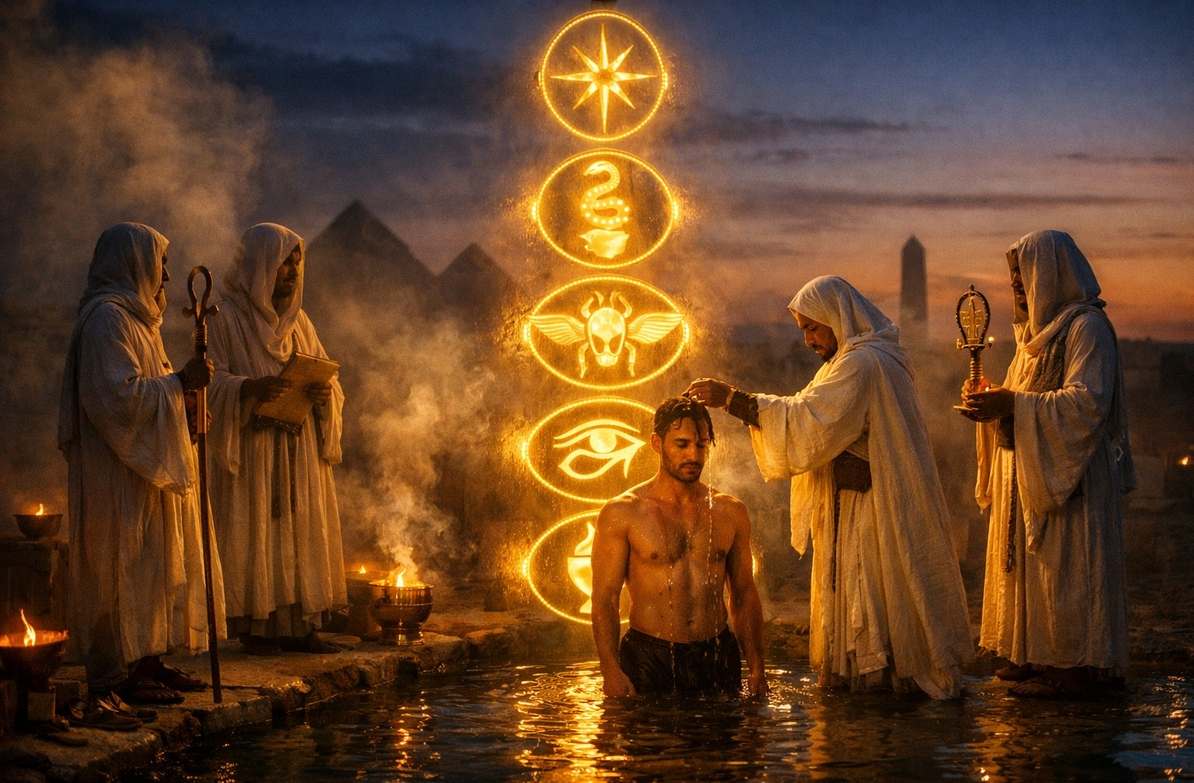
The latter sections of Trimorphic Protennoia provide the most detailed surviving account of the Five Seals (pente sphragides)–the Sethian “initiation procedures” for ascending through the planetary spheres past the “archonic gatekeepers” [27]. These seals represent the comprehensive “security clearance upgrade” that transforms the hylic (material) nature into the pneumatic (spiritual) “executive status” [28].
The Five Seals as Ascent Protocol
Each seal corresponds to a stage in the ritual ascent:
First Seal: Initial anointing or baptism, marking the “personnel” as property of the Pleroma rather than the material “branch office” [29].
Second Seal: Renunciation of the lower powers, effectively “resigning” from archonic employment [30].
Third Seal: Reception of the “garment of light,” the “official uniform” for pleroma access [31].
Fourth Seal: Sealing by the Five Luminaries, the “department heads” who verify the ascent credentials [32].
Fifth Seal: Entry into the Pleroma, the final “transfer” to the executive headquarters [33].
Primary Source Citation: “They were all sealed with the five seals of the light. And they were raised up in the light and entered into the air, being sealed with the holy seal. And they became luminaries in the light, having been sealed with the five seals” — Trimorphic Protennoia 49:15-25 [34]
Theological Significance and Sethian Identity
Trimorphic Protennoia represents the theological “crown jewel” of Sethian literature, integrating cosmogony, soteriology, and ritual practice into a unified “administrative manual” [35]. The text demonstrates that Sethianism was not merely a cosmological theory but a practical “programme” for transformation involving specific ritual actions [36].
Distinctive Sethian Features
The text exhibits classic Sethian characteristics: the priority of the divine Voice/Thought, the descent/ascent pattern, the Five Seals ritual, and the “third-party intervention” model of salvation [37]. Unlike Valentinian systems with their complex “bridal chamber” (nymphōn) procedures, Sethianism offers a more direct “hotline” approach–Protennoia has already descended to provide the passwords, bypassing much of the “bureaucratic entanglement” [38].
The text’s feminine divine protagonist also places it within the “Feminine Divine” trajectory of Nag Hammadi, alongside Thunder: Perfect Mind and Thought of Norea [39]. This suggests that Sethian communities recognized female figures as primary “executive agents” capable of bestowing the highest clearances [40].
Manuscript Context in Codex XIII
Codex XIII contains only Trimorphic Protennoia, making it unique among the Nag Hammadi codices [41]. Originally part of the same cartonnage as the other codices, it was removed and preserved separately, eventually finding its way to the Coptic Museum in Cairo [42].
The manuscript is relatively well-preserved compared to other texts, though lacunae remain. Its solitary presence in the codex suggests it may have been considered a “classified document” of particular importance, warranting its own “file” [43]. The scribe included a colophon indicating the text was copied from a Greek original, confirming its circulation in bilingual Egyptian communities [44].
Contemporary Resonance
For contemporary readers, Trimorphic Protennoia offers a sophisticated model of spiritual transformation that transcends simple “self-help” approaches [45]. The text suggests that salvation is neither purely divine initiative (determinism) nor purely human effort (works), but a collaborative “project” between the descending Voice and the ascending soul [46].
The Five Seals, while rooted in ancient ritual, can be understood metaphorically as stages of consciousness transformation: awakening (first seal), renunciation (second), illumination (third), verification (fourth), and integration (fifth) [47]. This “progressive clearance” model resonates with contemporary developmental psychology and contemplative neuroscience [48].

Frequently Asked Questions
What is Trimorphic Protennoia in the Nag Hammadi Library?
Trimorphic Protennoia (NHC XIII,1) is a Sethian revelation text from Nag Hammadi Codex XIII, meaning “Three Forms of First Thought.” It presents the descent of the divine Protennoia (First Thought/Voice) in three successive manifestations–as Father, Mother, and Son–to awaken entrapped spiritual beings and facilitate their return to the Pleroma. The text provides the most detailed account of the Five Seals initiation protocol and is considered the theological crown jewel of Sethian literature, likely composed in the second or third century CE.
What are the three forms of Protennoia?
The three forms of Protennoia represent successive descents of the divine First Thought: (1) As Father–the Divine Thought dwelling in the highest Pleroma, establishing the original template; (2) As Mother–the Sound of the Voice/Barbelo descending to the Ogdoas (eighth sphere) to awaken sleeping souls; (3) As Son–the Logos entering material reality to deliver the Five Seals protocol and complete the salvation process. These three forms correspond to the Sethian triad of Father (Invisible Spirit), Mother (Barbelo/Thought), and Son (Autogenes/Logos), presented as manifestations of a single divine agency.
What are the Five Seals in Trimorphic Protennoia?
The Five Seals (pente sphragides) in Trimorphic Protennoia constitute a ritual ascent protocol for Sethian initiates. They represent stages of transformation from material (hylic) to spiritual (pneumatic) existence: (1) Initial anointing/baptism marking the initiate as Pleroma property; (2) Renunciation of lower powers; (3) Reception of the garment of light; (4) Sealing by the Five Luminaries; (5) Entry into the Pleroma. These seals function as credentials allowing the soul to pass through archonic checkpoints during ascent, transforming the initiate from material entrapment to divine executive status.
How does Trimorphic Protennoia relate to other Sethian texts?
Trimorphic Protennoia shows close affinities with other Sethian texts featuring the Five Seals, particularly the Apocryphon of John and Hypsiphrone. It shares the descent/ascent pattern with Zostrianos and Allogenes. The feminine divine voice connects it to Thunder: Perfect Mind and Thought of Norea. The text’s detailed ritual instructions distinguish it from more cosmologically-focused Sethian tractates, making it the practical “technical manual” for Sethian ascent procedures. Its placement alone in Codex XIII suggests it was considered a document of supreme importance.
What is the significance of the Voice in Trimorphic Protennoia?
The Voice represents the active, audible manifestation of divine First Thought that penetrates material darkness to awaken entrapped spirits. Unlike the silent Thought of the Father, the Voice (Mother form) broadcasts from the boundary between Pleroma and chaos, serving as a “hotline” between the highest realm and the exiled sparks below. The text emphasizes that this Voice has already descended and continues to speak, offering the “passwords” necessary for salvation. This “third-party intervention” model distinguishes Sethianism from systems requiring purely human effort or purely divine determination.
What is the manuscript condition of Trimorphic Protennoia?
Trimorphic Protennoia is the sole surviving tractate of Codex XIII, which originally contained only this text. The manuscript is relatively well-preserved compared to other Nag Hammadi texts, though lacunae remain. It was preserved separately from the main collection before reaching the Coptic Museum in Cairo. A scribal colophon indicates the text was copied from a Greek original, confirming its circulation in bilingual Egyptian communities. Its solitary presence in the codex suggests it was considered a classified document of particular importance, warranting its own dedicated container.
What is the contemporary relevance of Trimorphic Protennoia?
Trimorphic Protennoia offers a sophisticated model of spiritual transformation transcending simple self-help approaches. The text presents salvation as collaborative between divine descent and human ascent–the Voice provides the “passwords” but the initiate must apply the Five Seals. The five-stage protocol can be understood metaphorically as consciousness transformation: awakening, renunciation, illumination, verification, and integration. This progressive clearance model resonates with developmental psychology and contemplative neuroscience. The text’s emphasis on divine initiative provides hope for those feeling trapped by material circumstances, suggesting that the “executive headquarters” has already dispatched assistance.
Further Reading
- The Five Seals: Sethian Initiation Protocol — Detailed technical analysis of the Five Seals ritual as the “security clearance” system described in Trimorphic Protennoia.
- The Apocryphon of John: The Gnostic Creation Myth — Contains parallel Five Seals material and Sethian cosmology referenced throughout Trimorphic Protennoia.
- Codex XIII: The Protennoia Collection — Archaeological and codicological context for the unique single-text codex containing this supreme Sethian revelation.
- Hypsiphrone and the Five Seals — Fragmentary Sethian ascent text featuring the same seal protocol, showing the widespread nature of this “administrative procedure.”
- Thunder: Perfect Mind: Divine Voice from Nag Hammadi — Explores the feminine divine voice motif shared with Trimorphic Protennoia’s Mother form.
- Zostrianos: Journey Through the Thirteen Aeons — Another detailed Sethian ascent text providing comparative material for the descent/ascent pattern.
- Thought of Norea: Heroine of Spiritual Resistance — Feminine Sethian exemplar text complementing Protennoia’s divine feminine manifestation.
References and Sources
The following sources support the claims and quotations presented in this article. All citations to Trimorphic Protennoia represent direct translations from the Coptic text as established in the standard critical editions.
Primary Sources and Critical Editions
- [1] Robinson, J.M. (1977). The Nag Hammadi Library in English. Harper & Row. [Trimorphic Protennoia translation]
- [2] Poirier, P.H. (1990). La Trimorphe Protennoia (Nag Hammadi Codex XIII,1). Presses de l’Universite Laval. [Critical edition]
- [3] Turner, J.D. (1990). “Trimorphic Protennoia.” In The Coptic Gnostic Library, Vol. 36. Brill. [Scholarly edition]
- [4] Layton, B. (1987). The Gnostic Scriptures. Doubleday. [NHC XIII overview]
- [5] Schenke, H.M. (1962). “Die dreigestaltige Protennoia.” Theologische Literaturzeitung, 87, 765-770.
Scholarly Monographs and Articles
- [6] Turner, J.D. (2001). Sethian Gnosticism and the Platonic Tradition. Presses de l’Universite Laval. [Sethian classification]
- [7] Waldstein, M. & Wisse, F. (1995). The Apocryphon of John. Brill. [Five seals parallels]
- [8] Buckley, J.J. (2002). “The Five Seals.” In Female Fault and Fulfilment in Gnosticism. University of North Carolina Press.
- [9] King, K.L. (2000). The Thunder: Perfect Mind. Continuum. [Feminine divine parallels]
- [10] Turner, J.D. (2012). “Protennoia and the Barbelo Aeon.” Vigiliae Christianae, 66(1), 1-30.
Comparative Studies and Thematic Analyses
- [11] Williams, M.A. (1996). Rethinking “Gnosticism”. Princeton University Press.
- [12] Marjanen, A. (2005). The Woman Jesus Loved: Mary Magdalene in the Nag Hammadi Library. Brill.
- [13] Brakke, D. (2010). The Gnostics: Myth, Ritual, and Diversity in Early Christianity. Harvard University Press.
- [14] Pagels, E. (1979). The Gnostic Gospels. Random House.
- [15] Jonas, H. (1958). The Gnostic Religion. Beacon Press.