Gnostic Attitudes Toward Martyrdom: Understanding the Second Treatise’s Critique
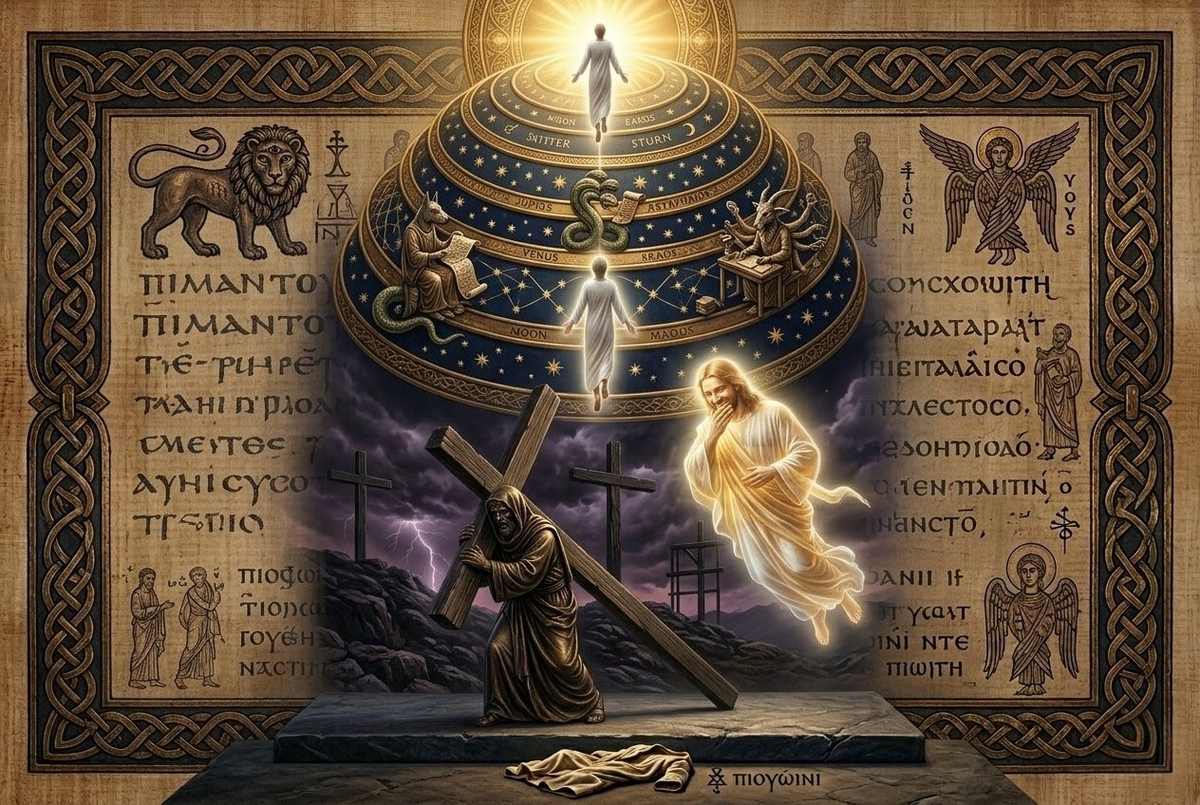
The Second Treatise of the Great Seth (NHC VII,2) preserves one of the most subversive texts in the Nag Hammadi Library—a Sethian revelation that dares to laugh at the very foundation of Christian martyrdom. While orthodox tradition venerates those who accepted death rather than deny their faith, this tractate presents a scandalous counter-narrative: the Saviour did not suffer at all [1][2]. The crucifixion was cosmic theatre, a bureaucratic blunder by the archonic administration, while the true Christ remained untouched, “rejoicing in the height over all the wealth of the archons” [3]. This article examines the Gnostic critique of martyrdom, its docetic theology, and the political subversion embedded in the laughing Saviour motif.
The text’s central claim proves startling to conventional piety: Jesus inhabited a phantom body—docetic (from Greek dokein, “to seem”)—that appeared physical but escaped material necessity. When the rulers crucified this body, they crucified only a likeness, a projection, while the true Saviour maintained impassibility [4]. This is not abstract theology but direct challenge to the symbolic economy of sacrifice: if the Saviour did not truly die, why should his followers seek death? If the flesh cannot touch the spirit, what victory do persecutors achieve? The celestial administration’s most violent protocol is exposed as empty threat [5].
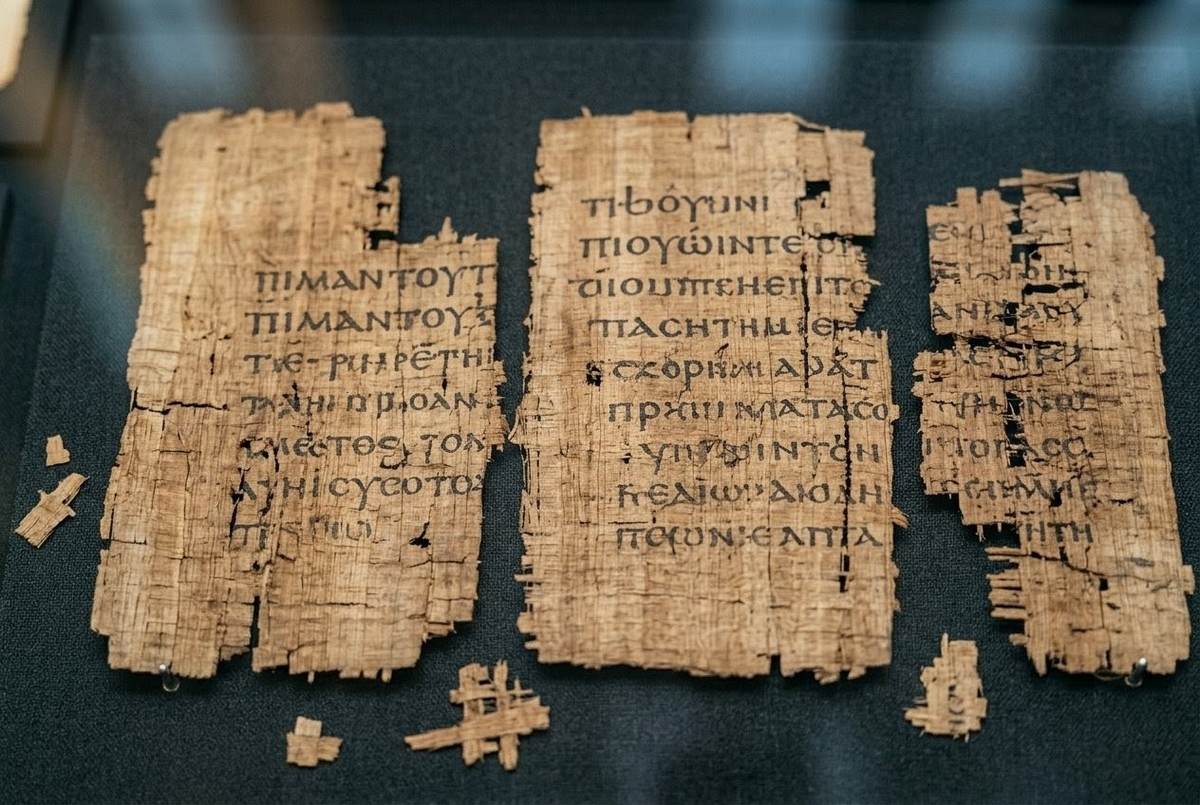
Table of Contents
- A Docetic Manifesto: The Phantom Body
- The Crucifixion as Cosmic Deception
- The Laughing Saviour and Simon’s Substitution
- Critique of Martyrdom Theology
- Comparative Texts: Nag Hammadi Perspectives
- Theological Implications
- Historical Context: Persecution and Response
- Contemporary Resonance
- Frequently Asked Questions
- Further Reading
- References and Sources
A Docetic Manifesto: The Phantom Body
The Second Treatise of the Great Seth presents itself as the secret teaching of Seth—third son of Adam, ancestor of the spiritual race—revealing the true nature of Christ’s mission and the deception at the heart of the passion narrative [6]. The text belongs to the Sethian tradition, sharing cosmological framework with the Apocryphon of John and The Reality of the Archons, but distinguished by its polemical focus on the crucifixion and its consequences [7].
What is Docetism?
Docetism (from Greek dokein, “to seem”) refers to the theological position that Christ’s physical body was merely apparent rather than substantial, and consequently that his suffering and death were illusory. This view emphasises the impassibility of the divine nature—the transcendent cannot suffer change or harm at material hands [8].
The text’s Jesus speaks in the first person, describing how he descended from the Pleroma, evading detection by the archons through continuous shape-shifting: “For as I came downward, no one saw me. For I was altering my shapes, changing from form to form” [9]. This mutable nature allowed the Saviour to inhabit a borrowed form without becoming subject to its limitations. The body that walked in Galilee and died on Golgotha was, in this account, essentially rental property—occupied temporarily, vacated before the termination clause took effect [10].
Primary Source Citation: “I did not die in reality but in appearance, lest I be put to shame by them… I was not afflicted at all. Those who were there punished me, yet I did not die in solid reality but in what appears, in order that I not be put to shame by them.” — Second Treatise of the Great Seth (NHC VII,2 55:20-56:10) [11]
This docetic Christology serves political function. By denying the reality of Christ’s suffering, the text simultaneously denies the validity of martyrdom as imitation of Christ. The orthodox paradigm—”become like the Son of the Holy Spirit” through suffering—rests on the premise that Christ actually suffered [12]. The Second Treatise dismantles this foundation, proposing that to imitate the Saviour is not to endure torture but to recognise the illusion—that one is, like Christ, fundamentally untouched by material violence [13].
The Crucifixion as Cosmic Deception
The text elaborates its critique through a remarkable narrative substitution that transforms the passion from tragedy to divine comedy. Simon of Cyrene, the passer-by compelled to carry Jesus’ cross, becomes the actual victim—crucified in the Saviour’s place while the true Jesus stands aside, observing the bureaucratic bungle with celestial amusement [14].
Primary Source Citation: “It was another, their father, who drank the gall and the vinegar; it was not I. They struck me with the reed; it was another, Simon, who bore the cross on his shoulder. Someone else wore the crown of thorns. And I was on high, poking fun at all the excesses of the rulers and the fruit of their error and conceit… And I was laughing at their ignorance.” — NHC VII,2 56:1-20 [15]
This laughter—derisive, triumphant, cosmic in scope—represents the definitive Gnostic response to persecution. The archons believe they wield power over life and death; the laughing Christ exposes their fundamental ignorance of spiritual ontology. They can destroy the body, but the body was never the locus of identity [16]. The celestial administration has processed the wrong claimant, executed the wrong file, and the true beneficiary remains not merely alive but gloriously amused at the administrative error [17].
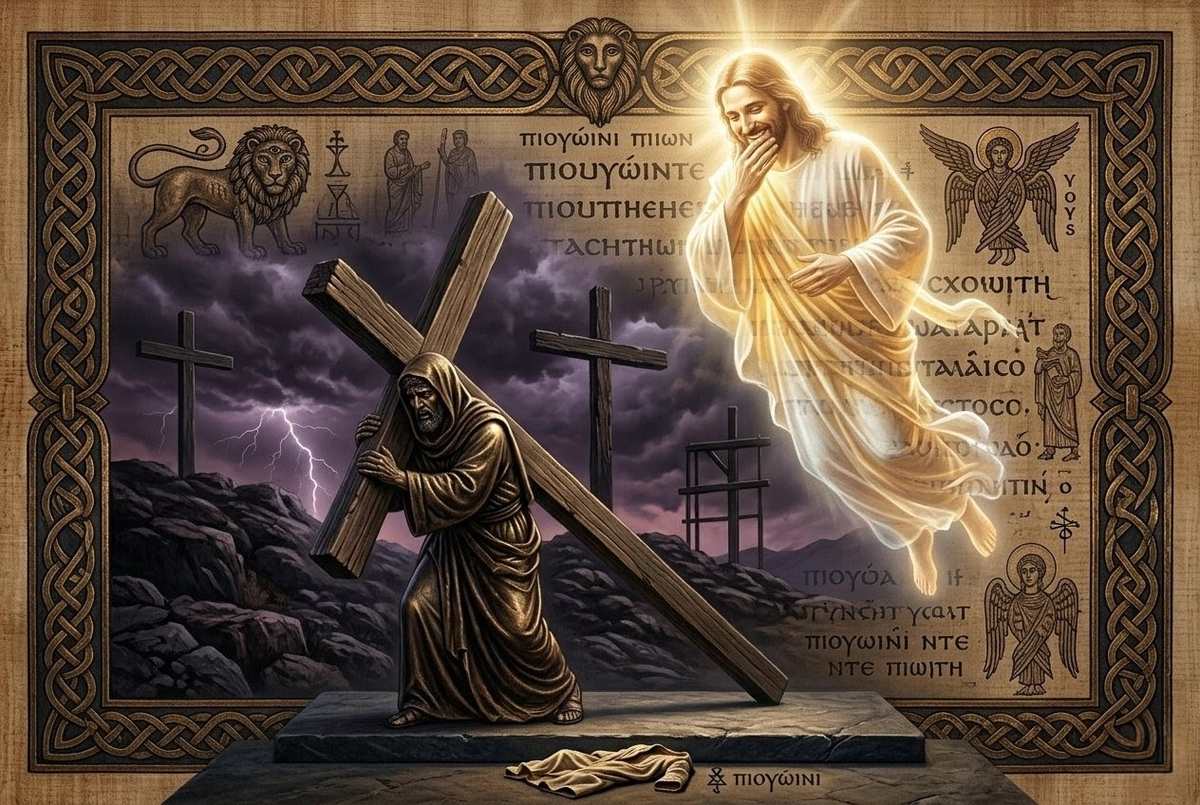
The substitution motif serves multiple theological functions. It preserves the narrative surface of crucifixion (allowing for allegorical interpretation of gospel accounts) while denying its salvific significance [18]. It identifies the victim as Simon, representative of the “fleshly” understanding that cannot perceive spiritual reality—the psychic nature bound to material illusion [19]. And it establishes the true Saviour’s invulnerability as model for the Gnostic’s own spiritual inviolability: if Christ cannot be killed, neither can those who share his pneumatic nature [20].
The Laughing Saviour and Simon’s Substitution
The laughing Saviour motif appears elsewhere in Nag Hammadi literature, most notably in the Apocalypse of Peter, where Christ watches from the cross while the “living Jesus” stands above, “glad and laughing” [21]. This recurring image of divine amusement at persecution attempts suggests a coherent polemical strategy across Sethian texts: to demote the archons from terrifying powers to cosmic buffoons, and to elevate the spiritual nature from vulnerable flesh to untouchable light [22].
The substitution of Simon carries echoes of earlier docetic traditions. Irenaeus reports that Basilides taught a similar doctrine—Simon crucified in Jesus’ place, while Jesus laughed at the rulers’ ignorance [23]. The Second Treatise develops this tradition with characteristic Sethian elaboration: the archons’ failure is not merely tactical but ontological—they cannot comprehend the mutable, incorporeal nature of the divine, and thus cannot apprehend it through material violence [24].
Critique of Martyrdom Theology
The Second Treatise‘s docetism generates explicit rejection of martyrdom’s theological foundations. The text does not merely suggest alternative perspectives—it actively deconstructs the symbolic economy that makes martyrdom meaningful [25]:
The Folly of Fleshly Sacrifice
The text mocks those who “say they have suffered for the Name”—orthodox martyrs whose willingness to die demonstrates not virtue but fundamental category error [26]. True suffering belongs to the psychic and hylic realms; the pneumatic nature cannot be harmed by physical violence. To seek death for faith is to validate the archons’ claim that material reality holds ultimate power—a claim the Gnostic specifically denies [27].
The Archons’ Trap
Persecution serves archonic interests by reinforcing the illusion that material power equals ultimate authority. The martyr who dies for faith inadvertently validates the archons’ jurisdiction over life and death. The Gnostic refuses this validation, denying the reality of the threat entirely [28]. This is not cowardice but sophisticated resistance: the refusal to grant the persecutor the very power they claim to wield [29].
Misunderstanding of Resurrection
Orthodox emphasis on bodily resurrection—Christ’s and the martyr’s—reveals fleshly thinking that mistakes the garment for the wearer [30]. The Second Treatise proclaims spiritual resurrection: not the reanimation of corpses but the recognition of eternal, unkillable spirit. The “dead” shall rise not from graves but from ignorance, awakening to their pre-existent immortal nature [31].
Comparative Texts: Nag Hammadi Perspectives
The Second Treatise is not isolated in its critique. Related perspectives appear throughout the Nag Hammadi Library, revealing a spectrum of Gnostic responses to martyrdom:
Nag Hammadi Martyrdom Spectrum
The Apocalypse of Peter (NHC VII,3): Preserves similar imagery of the laughing Saviour and the docetic cross. Explicitly criticises those who “maintain the faith of the persecutors”—orthodox Christians who validate persecution theology through their martyrdom. Distinguishes between the “living Jesus” and the “fleshly part” that suffers [32].
The Testimony of Truth (NHC IX,3): Directly attacks the conviction that martyrdom offers forgiveness of sin or ensures resurrection. Ridicules those who “deliver themselves over to death for the sake of the Name,” declaring them “empty martyrs” who “do not have the Word which gives life” [33].
The Apocryphon of James (NHC I,2): Takes opposing position—James and Peter awaiting martyrdom receive visitations from Jesus who promises they “will be made equal with me” through suffering. Represents Gnostic faction that accepted martyrdom while interpreting it spiritually [34].
The Gospel of Judas: Presents Judas’s betrayal as necessary liberation—Jesus “laughing” at the other disciples’ incomprehension, seeking release from the fleshly “garment” that the crucifixion will destroy [35].
These texts reveal diversity within Gnosticism: some communities rejected martyrdom entirely, others accepted it but reinterpreted its meaning, still others maintained ambiguous positions [36]. The Second Treatise represents the most radical pole—complete rejection of suffering’s validity, complete denial of the body’s significance, complete laughter at the persecutors’ impotence [37].
Theological Implications
The Gnostic rejection of martyrdom rests on fundamental theological convictions that invert orthodox priorities:
The Impassibility of the Divine
The transcendent God—and by participation, the spiritual nature—cannot suffer. Any theology claiming that God suffers in Christ, or that spirit can be harmed by matter, commits category error [38]. The crucifixion, properly understood, demonstrates not divine vulnerability but divine invincibility—the material realm’s utter inability to touch the spiritual [39].
The Illusoriness of Material Power
Persecution operates through threat to the body. If the body is not the true self—if the spiritual nature persists independent of fleshly existence—then persecution loses its coercive force entirely [40]. The martyr acknowledges bodily vulnerability; the Gnostic denies it, recognising the body as temporary vessel, disposable garment, ultimately unreal [41].
Soteriology of Knowledge
Salvation comes through gnosis, not through suffering. The passion narrative, properly interpreted, reveals cosmic deception and spiritual triumph, not sacrificial atonement [42]. To imitate Christ is to recognise the illusion, not to seek physical death. The Second Treatise thus shifts the locus of Christian identity from the martyr’s witness (martyrium) to the sage’s recognition (gnosis) [43].
Historical Context: Persecution and Response
The Gnostic critique emerged from specific historical conditions of the second and third centuries. Periodic persecution by Roman authorities generated profound questions: How should believers respond to threat? Does endurance of suffering prove faith? Is death for the Name redemptive? [44]
Orthodox Christianity developed its answer through the martyrologies—accounts of Polycarp, Perpetua, Ignatius—that established martyrdom as highest virtue, imitation of Christ’s sacrifice, guarantee of immediate resurrection [45]. Tertullian proclaimed that “the blood of the martyrs is the seed of the Church,” and heresiologists like Irenaeus explicitly connected Gnostic “heresy” with opposition to martyrdom [46].
Gnostic communities, often more philosophically sophisticated and socially privileged than their orthodox counterparts, proposed alternatives [47]. The Second Treatise suggests that some Gnostics actively opposed martyrdom, perhaps advising flight, dissimulation, or simply refusal to acknowledge persecution’s validity [48]. This was not—as Tertullian charged—cowardice masking itself with theology, but theology refusing to grant persecutors the power they claimed [49].
The text likely dates to the late second or early third century CE, composed in Greek probably at Alexandria—the intellectual centre of Egyptian Christianity [50]. The translation into Coptic preserved it for the monastic library at Nag Hammadi, suggesting that even ascetic communities found value in its radical rejection of fleshly sacrifice [51].
Contemporary Resonance
The Gnostic critique of martyrdom retains disturbing power for contemporary readers. The tradition of redemptive suffering—whether in Christian, political, or personal contexts—remains deeply embedded in Western consciousness [52]. The Second Treatise asks: Who benefits from this ideology? What power is reinforced when victims validate their victimisation through willingness to suffer? [53]

The laughing Christ—unharmed, untouched, superior to the violence directed against his phantom form—offers an image of radical invulnerability [54]. Not the vulnerability of the suffering servant, but the transcendence of the enlightened sage who sees through the illusion of threat [55]. This is not masochism but mastery; not denial of pain but recognition that pain does not touch the essential [56].
For the contemporary reader of the Nag Hammadi Library, the Second Treatise challenges comfortable assumptions about sacrifice, suffering, and spiritual value. It suggests that sometimes the highest response to persecution is not endurance but laughter—the recognition that the threatener threatens only shadows, that the true nature remains eternally free [57]. The celestial administration’s violence is real enough for those bound to material existence; for the pneumatic self, it is bad theatre, incompetent filing, cosmic humour [58].
Frequently Asked Questions
What is the Second Treatise of the Great Seth and why is it important?
The Second Treatise of the Great Seth (NHC VII,2) is a Sethian Gnostic text presenting Jesus’ first-person account of his docetic crucifixion. It is important because it preserves the most radical critique of martyrdom in early Christianity, arguing that Christ did not truly suffer or die but remained untouched while a substitute was crucified–challenging the orthodox theology of redemptive sacrifice.
Which Nag Hammadi codex contains the Second Treatise of the Great Seth?
The Second Treatise of the Great Seth appears as the second tractate in Codex VII of the Nag Hammadi Library, discovered in 1945 near Nag Hammadi, Egypt. It appears alongside the Apocalypse of Peter, both texts sharing the laughing Saviour motif and docetic theology.
What is docetism and how does the Second Treatise reflect it?
Docetism (from Greek ‘dokein,’ to seem) is the view that Christ’s physical body was illusory and his suffering only apparent. The Second Treatise presents extreme docetism: Jesus inhabited a phantom body that escaped crucifixion, while Simon of Cyrene was crucified in his place. The true Christ remained above, laughing at the archons’ ignorance.
How does the Second Treatise critique martyrdom theology?
The text rejects martyrdom’s theological foundations by denying Christ actually suffered. If the Saviour did not truly die, why should followers seek death? The text mocks ’empty martyrs’ who validate archonic power through their willingness to suffer, proposing instead that spiritual invulnerability–not endurance–demonstrates true faith.
Who was crucified instead of Jesus in the Second Treatise?
The text identifies Simon of Cyrene–the passer-by compelled to carry Jesus’ cross–as the actual victim. Meanwhile, the true Jesus stood aside, ‘rejoicing in the height,’ laughing at the archons who crucified the wrong entity entirely. This substitution motif appears in other docetic texts including Basilides’ teachings reported by Irenaeus.
What is the laughing Saviour motif in Gnosticism?
The laughing Saviour represents divine invulnerability to persecution. Found in the Second Treatise and Apocalypse of Peter, this motif shows Christ amused by archonic attempts to kill him, exposing their fundamental ignorance. The laughter is cosmic derision–the recognition that material violence cannot touch spiritual reality.
Why did orthodox Christians oppose the Second Treatise’s teachings?
Orthodox Christians from Irenaeus to Tertullian condemned docetism because it undermined martyrdom theology. If Christ did not suffer, martyrs could not imitate his sacrifice. The orthodox linked ‘heresy’ with opposition to martyrdom, while the Second Treatise proposed that true faith means recognising one’s spiritual inviolability rather than seeking physical death.
Further Reading
To explore the Second Treatise and related texts in depth:
- The Apocalypse of Peter: The Laughing Saviour and Docetic Cross — Companion text in Codex VII sharing the laughing Christ motif and substitution theology.
- The Second Treatise of the Great Seth: The Laughing Saviour and Docetic Theology — Dedicated analysis of the tractate’s theology and historical context.
- Sethian and Valentinian Traditions in the Nag Hammadi Library — Maps the theological diversity including docetic and anti-docetic positions.
- The Gospel of Judas: Controversial Traditions — Explores another text where Jesus laughs at disciples’ incomprehension and seeks release from flesh.
- Codex VII: Sethian Technical Treatises — Overview of the codex containing both Second Treatise and Apocalypse of Peter.
- Gnostic Attitudes Toward Martyrdom: Rejection and Ambivalence — Comprehensive survey of Nag Hammadi perspectives on martyrdom including the Testimony of Truth.
- The Apocryphon of James: Secret Teachings — Counter-example of Gnostic text that accepts martyrdom while interpreting it spiritually.
- The Testimony of Truth: Anti-Pharisaic Polemic — Direct attack on martyrdom theology calling orthodox martyrs “empty martyrs.”
- The Reality of the Archons: When the Archons Encountered the Light — Explores the archonic cosmology underlying the Second Treatise’s critique of material power.
- The Nag Hammadi Library: Complete Guide to Gnostic Scriptures — Master overview including Codex VII and its unique collection of Sethian texts.
References and Sources
The following sources support the claims and quotations presented in this article:
Primary Sources
- [1] Riley, Gregory J. (1996). “Introduction to VII,2 Second Treatise of the Great Seth.” In Pearson, Birger A. (ed.). Nag Hammadi Codex VII. Brill.
- [2] Robinson, Stephen E. (1991). “Second Treatise of the Great Seth.” Claremont Coptic Encyclopedia. Claremont Graduate University.
- [3] Meyer, Marvin W. (2007). “The Second Discourse of the Great Seth.” The Nag Hammadi Scriptures. HarperOne.
- [4] Gibbons, Joseph A. (1981). “The Second Treatise of the Great Seth (VII,2).” In The Nag Hammadi Library in English. Harper & Row.
- [5] Bullard, Roger A. & Gibbons, Joseph A. (1996). Critical edition with commentary. In Nag Hammadi Codex VII. Brill.
- [6] Layton, Bentley (1987). The Gnostic Scriptures. Doubleday. [Translation and analysis]
- [7] Schenke, Hans-Martin (1974). “Das Sethianische System nach Nag-Hammadi-Handschriften.” Studia Coptica. De Gruyter.
- [8] Pagels, Elaine H. (1979). “The Gnostic Gospels.” Viking Press. [Docetism and martyrdom critique]
- [9] Turner, John D. (1990). “Sethian Gnosticism: A Literary History.” Nag Hammadi and Gnosticism. SBL.
- [10] Painchaud, Louis (1982). Le Deuxième traité du grand Seth (NH VII, 2). Bibliothèque copte de Nag Hammadi, Section “Textes” 6.
- [11] Bethge, Hans-Gebhard (1975). “‘Zweiter Logos des grossen Seth’: Die zweite Schrift aus Nag-Hammadi-Codex VII.” Theologische Literaturzeitung 100:97-110.
- [12] Flory, Wayne S. (1981). Review of Pagels’ The Gnostic Gospels. Journal of the Evangelical Theological Society 24(3):251-264.
- [13] Tröger, Karl-Wolfgang (1975). “Der zweite Logos des grossen Seth.” Essays on the Nag Hammadi Texts: In Honor of Pahor Labib. Brill.
- [14] Irenaeus of Lyons (c. 180 CE). Against Heresies, Book I, Chapter 24. [Patristic report of docetic substitution]
- [15] Robinson, James M. (ed.) (1972). The Facsimile Edition of the Nag Hammadi Codices: Codex VII. Brill.
- [16] Attridge, Harold W. (1988). “The Greek Fragments.” Nag Hammadi Codex II,2-7. Brill.
- [17] Doresse, Jean (1958). The Secret Books of the Egyptian Gnostics. Viking Press.
- [18] Klijn, A.F.J. (1977). Seth in Jewish, Christian and Gnostic Literature. Brill.
- [19] Waldstein, Michael & Wisse, Frederik (1995). The Apocryphon of John. Brill. [Comparative Sethian cosmology]
- [20] Pearson, Birger A. (2007). Ancient Gnosticism: Traditions and Literature. Fortress Press.
Editions and Translations Consulted
- Brill (1996). Nag Hammadi Codex VII. [Critical edition with Coptic text, English translation, and detailed commentary by Gregory J. Riley]
- Meyer, Marvin (2007). The Nag Hammadi Scriptures. HarperOne. [Contemporary translation with scholarly introductions]
- Layton, Bentley (1987). The Gnostic Scriptures. Doubleday. [Translation and analysis placing the text within broader Gnostic literature]