
7 Ancient Protection Rituals That Actually Work
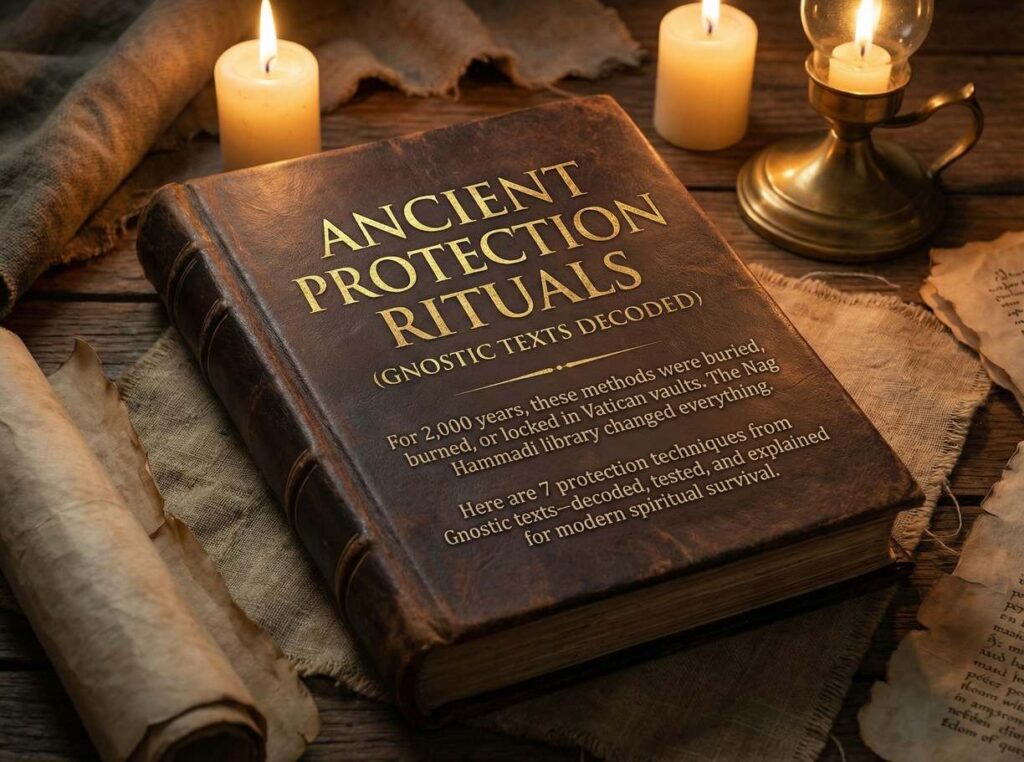
The Nag Hammadi texts do not give us a modern self-help manual, but they do preserve something stranger and more demanding: a vision of consciousness that must be protected, clarified, sealed, remembered, and returned to its source. These seven ancient protection rituals are best understood as practical reconstructions inspired by Gnostic texts, not as compulsory doctrines or guaranteed magical techniques. Their real force lies in attention, boundary, remembrance, symbolic action, breath, embodiment, and the refusal to hand your inner life over to fear.
In Plain Terms
The Nag Hammadi Library was discovered in Egypt in 1945 and contains thirteen ancient Coptic codices preserving Gnostic, Valentinian, Sethian, Hermetic, and related writings. Many of these texts describe a layered cosmos, hostile rulers, spiritual forgetfulness, divine light, protective seals, garments of glory, ascent formulas, and the soul’s need for discernment.
This article translates those themes into seven modern contemplative practices. They are not exact rituals copied word-for-word from the ancient codices. They are careful reconstructions and adaptations inspired by the texts, designed for symbolic reflection, grounding, boundary-setting, and spiritual self-possession.
Used well, these practices may help a person feel more centred, less dominated by fear, more aware before sleep, more grounded after intense inner states, and more capable of separating true awareness from intrusive thoughts. Used poorly, they can become fantasy, obsession, dissociation, or fear theatre in a candlelit hat. So the first protection is always discernment.
Primary Sources and Traditions Discussed
- The Nag Hammadi Library: thirteen Coptic codices discovered in Egypt in 1945, preserving roughly forty-six tractates.
- Apocryphon of John: Gnostic creation myth involving the Invisible Spirit, aeons, luminaries, archons, and the awakening of the human soul.
- Trimorphic Protennoia: text of divine Thought descending in three forms, including initiatory and sealing language.
- On the Origin of the World: cosmological text describing archons, rulers, creation, error, and the recovery of luminous identity.
- Hypostasis of the Archons: text on the rulers, Eve, spiritual awakening, and the exposure of archonic deception.
- First Apocalypse of James: ascent teaching, passwords, hostile powers, and the soul’s passage through questioning forces.
- Gospel of Mary: Mary Magdalene’s teaching on the soul, inner ascent, the powers, and the true human within.
- Pistis Sophia: later Gnostic text rich in repentance, ascent, light, formulas, redemption, and cosmic restoration.
- Modern psychology and contemplative science: grounding, cognitive defusion, intention-setting, metacognition, ritual action, visualisation, and nervous-system regulation.
How to Read This Article
This is not a claim that the Nag Hammadi texts contain seven neatly packaged protection rituals in modern form. They do not. The texts contain myths, revelations, sacramental language, ascent teachings, names, seals, powers, prayers, and symbolic patterns. The practices below are modern reconstructions inspired by those patterns.
Read “protection” in three layers. Historically, it refers to Gnostic concern with hostile powers, false rulers, forgetfulness, and the dangers of the soul’s journey. Psychologically, it refers to boundaries, grounding, fear regulation, intrusive thought defusion, and the recovery of awareness from identification. Spiritually, it refers to remembrance: the refusal to forget where the deepest part of the self belongs.
None of these methods replaces medical care, psychotherapy, trauma support, medication, pastoral care, or emergency services. If you are experiencing psychosis, mania, severe dissociation, panic, trauma flashbacks, suicidal thoughts, or a frightening loss of contact with ordinary reality, do not intensify ritual practice. Seek qualified support. No ancient manuscript asks you to abandon common sense at the temple door.
Table of Contents
- The Nag Hammadi Discovery and Its Context
- Before Practice: Safety, Grounding, and Discernment
- Method 1: The Luminous Shield
- Method 2: The Five Seals
- Method 3: The Renunciation of the Rulers
- Method 4: The Waters of Remembering
- Method 5: The Garment of Light
- Method 6: The Wandering Presence
- Method 7: The Perfect Redemption
- Which Method to Start With
- The Psychology Behind the Methods
- Historical Context of Textual Suppression
- Your Next Step
- Related Glossary Terms
- Read Next
- Frequently Asked Questions
- Further Reading
- References and Sources
The Nag Hammadi Discovery and Its Context
In late 1945, near the Jabal al-Tarif cliffs outside Nag Hammadi in Upper Egypt, local diggers uncovered a sealed jar containing ancient papyrus codices. The story of the find is tangled, dramatic, and sometimes difficult to separate from later retelling, but the significance is clear: a hidden library of Coptic writings had survived for roughly sixteen centuries.
The collection contains thirteen leather-bound papyrus codices preserving about forty-six distinct tractates. These include Sethian, Valentinian, Hermetic, Christian, philosophical, and revelatory materials. Some texts were previously known only through hostile reports by early heresiologists. Others were almost completely unknown before the discovery.
What matters for this article is the kind of world these texts imagine. The soul is not treated as a passive object awaiting rescue. It must remember, discern, answer, refuse, ascend, receive light, put on a garment, pass through questioning powers, and recognise the false authority of the rulers. In other words, protection is not superstition added onto spirituality. In many Gnostic texts, protection is part of awakening itself.
Before Practice: Safety, Grounding, and Discernment
Before experimenting with any protection ritual, begin with ordinary grounding. Know where you are. Feel your feet. Notice your breath. Keep the practice short. Do not practise while driving, operating machinery, intoxicated, sleep-deprived, emotionally overwhelmed, or in the middle of a crisis.
If visualisation, chanting, spiritual names, archon language, or altered-state practice increases fear, paranoia, dissociation, obsessive thinking, or a sense of being attacked by invisible forces, stop. Use simpler grounding instead: light on, feet on the floor, slow exhale, drink water, name five objects in the room, contact a trusted person, or seek professional support.
These methods are best used as symbolic and psychological containers. They are not meant to create fear of hidden entities. They are meant to strengthen the ability to remain centred, awake, and ethically grounded while moving through the strange weather of the inner world.
The first protection is not a name, seal, gesture, or ritual object. The first protection is clear awareness that refuses to panic.
Method 1: The Luminous Shield
Inspired by: Apocryphon of John and its language of luminaries, light, aeons, and the awakening of the human soul.
The Apocryphon of John describes a spiritual cosmos in which light, aeons, luminaries, and divine assistance stand against ignorance and false rule. A modern protection practice can draw from this imagery by helping the practitioner establish a clear felt boundary around the body.
Practice
- Sit or stand with the spine comfortably upright.
- Feel both feet, the base of the body, or the chair beneath you.
- Imagine a sphere of soft white-gold light surrounding the body at a comfortable distance.
- Let the sphere be breathable rather than rigid. It protects by clarity, not by panic.
- On each exhale, silently say: “I remain in the light of clear awareness.”
- Continue for three to five minutes, then look around the room and name where you are.
This method is useful when you feel scattered, porous, overstimulated, or energetically invaded by a place, screen, crowd, conversation, or emotional atmosphere. Psychologically, it works through body-boundary visualisation, attention, breath, and the restoration of agency.
The Gnostic meaning is simple: you do not belong to the field of confusion. You remember the light without needing to dramatise the darkness.
Method 2: The Five Seals
Inspired by: Trimorphic Protennoia, especially its initiatory language of descent, voice, thought, light, and sealing.
The Trimorphic Protennoia speaks in the voice of divine Thought descending into the lower realms to awaken those who belong to the light. It includes sealing imagery, a common motif in Gnostic and early Christian initiatory language. A seal marks, protects, identifies, and remembers.
This version is designed for pre-sleep practice, when the mind becomes porous and dream imagery begins to gather its little lanterns.
Practice
- Seal of Intention: Before sleep, say quietly: “I rest in awareness. I return whole.”
- Seal of Breath: Take five slow breaths, lengthening each exhale.
- Seal of Mind: Visualise a simple shape, such as a circle, triangle, or cross of light. Keep it steady without strain.
- Seal of Identity: Say: “No dream, fear, or image can define what I am.”
- Seal of Return: On waking, touch the bed, your hands, your heart, and your feet. Name the date, place, and time if needed.
This practice should be gentle. Avoid anything that makes sleep feel like a battlefield. The purpose is not to fight dreams. It is to enter sleep with clearer memory and return from sleep with stronger embodiment.
If you are prone to nightmares, sleep paralysis, dissociation, or trauma-related night disturbance, keep the method simple and grounding. A small bedside light, body contact, journalling, and professional trauma support may matter more than any esoteric formula.
Method 3: The Renunciation of the Rulers
Inspired by: On the Origin of the World, Hypostasis of the Archons, and wider Gnostic language around archons, rulers, false authority, and liberation from psychic bondage.
In Gnostic texts, the archons are rulers who govern through ignorance, fear, imitation, and false authority. Whether read cosmologically, psychologically, or politically, the pattern is clear: something claims power over the soul that does not truly possess it.
This method uses renunciation as cognitive and spiritual defusion. You name the force and refuse identification with it. The goal is not to become paranoid about invisible rulers. The goal is to stop obeying fear as if it were a god.
Practice
Stand or sit upright. Breathe slowly. Name the pressure you are under, then speak one or more of the following lines:
Fear may speak, but it does not rule me.
Shame may arise, but it does not name me.
Guilt may knock, but it does not own the house.
Anger may burn, but it does not command my hand.
Despair may pass through, but it is not my source.
No false ruler has final authority over the light within me.
After speaking, pause. Feel the body. Notice any change in breath, posture, or emotional charge. Then choose one ordinary action that expresses freedom: open a window, wash your hands, step outside, write the truth, make the call, refuse the compulsion, or rest.
Psychologically, this resembles cognitive defusion: the ability to see a thought or feeling as an event in awareness rather than as a final command. Gnostically, it is the refusal to mistake the archon’s voice for the voice of the Self.
The Waters of Remembering
Inspired by: Hypostasis of the Archons, Gnostic themes of forgetfulness and remembrance, and the symbolic reversal of the waters that keep the soul asleep.
Many traditions treat water as more than a physical substance. Water remembers, cleanses, mirrors, receives, dissolves, and returns. In Gnostic imagination, the problem is often forgetfulness: the soul has forgotten its source, its dignity, and its light.
This practice uses water as a ritual anchor for remembrance. The water itself is not magical in a crude sense. The ritual gives the body a felt marker for a choice: I remember.

Practice
- Fill a clean glass with water.
- Hold it at the level of the heart.
- Say: “May this act remind me of what fear makes me forget.”
- Drink slowly, noticing the throat, chest, and belly.
- Place one hand on the heart and one on the lower belly.
- Say: “I return to the body. I return to awareness. I return whole.”
This is a good practice after a difficult conversation, a nightmare, doom-scrolling, emotional overwhelm, or spiritual study that leaves the mind too charged. It is not dramatic. That is part of its medicine. The nervous system often trusts simplicity before it trusts revelation.
Method 5: The Garment of Light
Inspired by: First Apocalypse of James, ascent teachings, protective identity, and the image of the soul clothed in a luminous garment.
Gnostic and related traditions often speak of garments, robes, light bodies, and vestments of glory. These images suggest that the soul must be clothed in its true identity before passing through hostile or questioning powers.
The safest modern version of this method avoids hyperventilation and forceful breathwork. Instead, it uses posture, breath, and visualised clothing of light to strengthen dignity and presence.
Practice
- Stand with feet grounded and arms relaxed at your sides.
- Take three slow breaths, letting the exhale lengthen naturally.
- Imagine a garment of soft gold-white light resting on your shoulders.
- Let it cover the heart, back, belly, spine, arms, and legs.
- Say: “I put on the garment of remembrance. I do not meet the world naked to fear.”
- Rest in the image for one to three minutes.
- End by pressing the feet into the ground and looking at three ordinary objects in the room.
This method is especially useful before entering a charged environment, beginning difficult work, reading intense material, or confronting a fear pattern. The garment is not armour against life. It is dignity made visible to the imagination.
Avoid rapid breathing, breath retention, or forceful techniques if you have panic, respiratory conditions, cardiovascular concerns, pregnancy, seizure history, trauma activation, or any condition made worse by altered breathing. Protection should not require frightening the body.
Method 6: The Wandering Presence
Inspired by: Gospel of Mary, especially Mary’s teaching on the soul, the powers, and the true human within.
The Gospel of Mary presents one of the most psychologically subtle ascent teachings in early Christian literature. The soul encounters powers such as desire, ignorance, wrath, and the false peace of flesh. The liberation is not achieved by violence, but by recognition.
This method is a daily micro-practice. It is not a ritual you perform once and then frame on the wall. It is a recurring return to the awareness behind experience.
Practice
- Several times a day, pause for three seconds.
- Ask quietly: “What is aware of this?”
- Do not answer conceptually.
- Notice the awareness in which thought, sensation, and emotion appear.
- Then continue what you were doing.
This practice protects by interrupting identification. Anger may be present, but awareness is larger than anger. Fear may be present, but awareness is larger than fear. Shame may be present, but awareness is not made of shame.
The Gnostic insight is precise: the soul is weakened when it forgets itself and becomes captive to powers moving through it. The Wandering Presence restores the witness without leaving the world.
Method 7: The Perfect Redemption
Inspired by: Pistis Sophia, with its extended themes of repentance, ascent, light, redemption, restoration, and return from the lower regions.
Pistis Sophia is one of the most elaborate later Gnostic texts. It is filled with hymns, repentances, light mysteries, cosmic regions, formulas, and repeated movements of descent and rescue. Its protective power lies not in a quick spell, but in persistent return to the light.

Practice
Once a week, ideally at a consistent time, perform the following simple practice:
- Face east, or face a source of natural light.
- Place one hand on the heart and one hand on the forehead.
- Say: “I return from confusion. I turn toward the light that does not dominate.”
- Sit in silence for seven minutes.
- Write one sentence beginning: “This week, I am called to repair…”
- Choose one concrete act of repair in ordinary life.
This method becomes powerful through repetition. Not because a magic number forces reality to obey, but because repeated symbolic action trains attention, deepens intention, and converts mystical longing into ordinary repair.
The highest form of protection is not escape from the world. It is alignment so deep that the world’s false authorities have less to hook onto.
Which Method to Start With
Choose one method. Practise it gently for seven days. Do not stack all seven in a heroic frenzy. The soul is not a junk drawer for spiritual techniques.
For Feeling Scattered or Porous
Start with: Method 1, the Luminous Shield.
Why: It restores body-boundary awareness and gives the imagination a clear, non-frightening image of protection.
For Sleep Disturbance or Unsettling Dreams
Start with: Method 2, the Five Seals.
Why: It combines pre-sleep intention, breath, simple imagery, and waking re-anchoring.
For Intrusive Thoughts or Inner Criticism
Start with: Method 3, the Renunciation of the Rulers.
Why: It helps separate awareness from fear, shame, guilt, and internalised authority.
For Emotional Overwhelm
Start with: Method 4, the Waters of Remembering.
Why: It is simple, embodied, calming, and anchored in ordinary sensory experience.
For Entering Difficult Spaces
Start with: Method 5, the Garment of Light.
Why: It strengthens dignity, posture, presence, and symbolic boundary before social or energetic challenge.
For Daily Spiritual Maintenance
Start with: Method 6, the Wandering Presence.
Why: It can be practised anywhere and builds metacognitive awareness without dramatic ritual.
For Long-Term Inner Repair
Start with: Method 7, the Perfect Redemption.
Why: It converts Gnostic light imagery into weekly reflection and practical repair.
The Psychology Behind the Methods
The ancient texts do not speak in modern psychological vocabulary, but several components of these practices overlap with well-studied mechanisms. This does not prove Gnostic cosmology in a laboratory sense. It does show why symbolic practices can affect state, attention, and behaviour.
Visualisation and Body Boundary Awareness
Imagining a boundary around the body can influence how the body is felt from within. Practices like the Luminous Shield and Garment of Light may support a clearer sense of personal space, especially when paired with breath, posture, and grounding.
Pre-Sleep Intention
Pre-sleep intention can influence dream recall, dream themes, and the transition into sleep. The Five Seals use this principle gently: set intention, calm the body, create a simple image, and re-anchor on waking.
Cognitive Defusion
In Acceptance and Commitment Therapy, cognitive defusion means learning to see thoughts as thoughts rather than absolute truths. The Renunciation of the Rulers performs a symbolic version of this: fear speaks, but it is not sovereign. Shame appears, but it is not the Self.
Ritual and Symbolic Action
Ritual can reduce uncertainty by giving the body and mind a structured sequence. Water, light, breath, posture, direction, spoken words, and repeated gestures make intention tangible. The point is not superstition. The point is embodied meaning.
Metacognitive Awareness
The Wandering Presence develops the capacity to notice awareness itself. This can reduce identification with emotional storms and intrusive thoughts. In Gnostic language, it is remembrance of the true human. In psychological language, it is decentring.
Repetition and Habit Formation
Repeated practice builds familiarity. A ritual repeated weekly becomes easier to enter. A phrase repeated in moments of fear becomes available when fear returns. Ancient traditions often knew what behavioural science later named: repetition shapes the path the mind walks under pressure.
Historical Context of Textual Suppression
Why were many Gnostic texts rejected by emerging orthodox Christianity? The answer is not one single conspiracy lever hidden behind a dusty curtain. It is a mixture of theology, authority, identity, canon formation, community boundaries, and conflict over what counted as true Christianity.
Writers such as Irenaeus of Lyons argued that Gnostic groups distorted apostolic teaching, misread scripture, divided the divine, denigrated creation, and introduced speculative myths that threatened Christian unity. From the orthodox side, exclusion was doctrinal protection.
From another angle, many Gnostic texts also challenged institutional control. They emphasised inner knowledge, visionary ascent, direct recognition, and liberation from the rulers of this world. They sometimes weakened dependence on external priesthood, public authority, and literalised doctrine. That made them spiritually potent and socially inconvenient.
The Nag Hammadi discovery does not prove that every rejected text was secretly right. It proves something subtler and more important: early Christianity was more diverse, contested, and symbolically rich than later summaries allowed. The buried library is not a simple replacement Bible. It is a reopened archive of forbidden questions.

Your Next Step
Select one method from this guide. Practise it gently for seven days without adding extra complexity. Keep a simple note of what changes, if anything: sleep, dreams, anxiety, clarity, body sensation, boundaries, or ordinary conduct.
Do not measure success by fireworks. Protection often feels like less drama, not more. A quieter mind, a clearer no, a better night’s sleep, a steadier body, a reduced compulsion, a moment of awareness before reaction: these are not minor. They are the small hinges by which the inner door opens.
If you bring forth what is within you, what you bring forth will save you. If you do not bring forth what is within you, what you do not bring forth will destroy you.
Gospel of Thomas, saying 70
Related Glossary Terms
These terms help clarify the Gnostic, contemplative, and psychological framework behind the seven protection methods:
- Nag Hammadi Library: collection of ancient Coptic codices discovered in Egypt in 1945, preserving many Gnostic and related texts.
- Gnosticism: modern umbrella term for diverse ancient movements centred on saving knowledge, divine origin, spiritual awakening, and liberation from ignorance.
- Archons: rulers or powers in many Gnostic systems, often associated with false authority, cosmic control, ignorance, or psychic bondage.
- Aeons: divine emanations or realms associated with the fullness of the higher world.
- Pleroma: the divine fullness or realm of completeness in many Gnostic systems.
- Seal: initiatory or protective mark of identity, remembrance, and spiritual belonging.
- Garment of Light: symbolic luminous identity or protective spiritual body associated with ascent and restoration.
- Gnosis: direct spiritual knowing or recognition, not merely intellectual belief.
- Cognitive defusion: psychological skill of seeing thoughts as thoughts rather than absolute commands or truths.
- Grounding: practices that restore present-moment body awareness, orientation, and nervous-system stability.
- Metacognition: awareness of awareness, or the ability to notice thought, feeling, and perception without being fully identified with them.
- Ritual action: symbolic sequence that gives intention a physical form through gesture, word, object, posture, or repetition.
- Consciousness integrity: the capacity to remain centred, discerning, and self-possessed during inner or outer pressure.
Read Next
For the strongest next step, continue into the Nag Hammadi source base behind these practices:
Nag Hammadi Library: The Complete Guide to Gnostic Scriptures
This companion guide gives the wider context: the discovery, codices, tractates, major schools, and why these buried texts still matter for modern seekers.
Frequently Asked Questions
Are these protection rituals directly found in the Nag Hammadi texts?
Not in this exact modern form. The practices in this article are reconstructions inspired by Nag Hammadi themes such as seals, light, archons, remembrance, garments, ascent, and redemption. The ancient texts provide symbolic material, not a modern step-by-step ritual manual. These methods should be read as contemplative adaptations rather than literal quotations from the codices.
Do I need to believe in Gnosticism for these methods to be useful?
No. The methods can be used as symbolic and psychological practices involving grounding, visualisation, intention-setting, cognitive defusion, ritual action, and awareness. A person can approach them historically, spiritually, psychologically, or experimentally. Belief is less important than careful attention, stability, and discernment.
Which Gnostic protection method is safest for beginners?
The Luminous Shield and the Waters of Remembering are the safest starting points for most beginners because they are short, grounding, and gentle. The Wandering Presence is also useful because it can be practised in ordinary life without dramatic altered-state work. Avoid intense breathwork, sleep-state experimentation, or elaborate ritual if you feel unstable or fearful.
What are archons in Gnostic texts?
Archons are rulers or powers in many Gnostic systems. They may be read cosmologically as hostile or ignorant cosmic forces, psychologically as internalised fear and false authority, or symbolically as patterns that keep consciousness trapped in forgetfulness. In modern practice, archon language is safest when used to name and release domination, not to encourage paranoia.
Can these rituals help with anxiety or intrusive thoughts?
They may help some people as grounding and symbolic practices, especially methods based on breathing, body awareness, cognitive defusion, and ritual structure. However, they are not medical or psychological treatments. Persistent anxiety, intrusive thoughts, trauma symptoms, dissociation, panic, or severe distress should be addressed with qualified mental health support.
Are Gnostic protection rituals dangerous?
Gentle grounding, visualisation, and reflection are usually low-risk for stable practitioners. Risks increase when practices involve intense breathwork, sleep disruption, frightening entity beliefs, obsessive ritual, or attempts to force altered states. Anyone with psychosis, bipolar disorder, severe dissociation, panic, complex trauma, or unstable mental health should avoid intensive practices and seek professional guidance.
Why were Gnostic texts suppressed or excluded?
Gnostic texts were rejected by emerging orthodox Christian authorities for theological reasons, including their alternative cosmologies, views of creation, interpretation of Christ, and claims of direct saving knowledge. They also challenged institutional authority by emphasising inner recognition, ascent, and liberation from false rulers. The history is complex and includes theology, politics, canon formation, and community boundary-setting.
Study Note: This article explores Gnostic texts, protection rituals, seals, archons, visualisation, ritual action, breath, dream preparation, and contemplative practice for educational and reflective purposes. It does not provide medical, psychological, psychiatric, trauma, or spiritual-direction advice. These practices do not replace therapy, medication, diagnosis, pastoral care, crisis support, or emergency services. Avoid intense breathwork, sleep disruption, frightening entity focus, obsessive ritual, or altered-state experimentation if you have psychosis, bipolar disorder, severe anxiety, dissociation, panic, complex trauma, or unstable mental health. If practice increases fear, paranoia, insomnia, dissociation, grandiosity, intrusive thoughts, or inability to function, stop and seek qualified professional support.
Further Reading
These related articles continue the themes of Nag Hammadi texts, protection, archons, ascent, breath, grounding, and spiritual discernment:
- Nag Hammadi Library: The Complete Guide to Gnostic Scriptures – The wider discovery, codices, tractates, schools, and significance of the Nag Hammadi collection.
- Apocryphon of John: The Gnostic Creation Myth – The cosmology of the Invisible Spirit, aeons, luminaries, archons, and the awakening of the human soul.
- Trimorphic Protennoia: The Three Descents of Divine Thought – Divine Thought, descent, voice, light, and the initiatory texture behind sealing imagery.
- On the Origin of the World: Gnostic Cosmology Decoded – Archon mythology, cosmic origins, rulers, error, and the recovery of luminous identity.
- Hypostasis of the Archons: Eve and the Truth of Divine Light – The rulers, Eve, spiritual deception, and the awakening of the human being through truth.
- First Apocalypse of James: Heavenly Ascent and Martyrdom – The ascent journey, questioning powers, spiritual identity, and the soul’s passage through hostile forces.
- Gospel of Mary Magdalene: The Seven Powers of the Soul – Mary’s teaching on ascent, inner powers, the true human, and the release from fear.
- The Gateway of Breath: Pranayama and Energetic Balance – Breath as a bridge between body, nervous system, subtle awareness, and spiritual practice.
- Contemplative Techniques: The Thread’s Practical Foundation – Meditation, attention, silence, grounding, and methods for stabilising inner recognition.
- States of Knowing: What Happens When Consciousness Unravels – Altered states, spiritual destabilisation, liminality, discernment, and integration.
References and Sources
The following sources support the Nag Hammadi, Gnostic, historical, psychological, and contemplative framework used in this article.
Primary Sources and Critical Editions
- Apocryphon of John. Nag Hammadi Codex II,1; III,1; IV,1; Berlin Codex 8502,2.
- Trimorphic Protennoia. Nag Hammadi Codex XIII,1.
- On the Origin of the World. Nag Hammadi Codex II,5; XIII,2.
- Hypostasis of the Archons. Nag Hammadi Codex II,4.
- First Apocalypse of James. Nag Hammadi Codex V,3.
- Gospel of Mary. Berlin Codex 8502,1.
- Pistis Sophia. Askew Codex.
- Robinson, James M., ed. (1990). The Nag Hammadi Library in English. Revised edition. San Francisco: HarperOne.
- Meyer, Marvin, ed. (2007). The Nag Hammadi Scriptures. New York: HarperOne.
- Layton, Bentley, ed. (1989). Nag Hammadi Codex II, 2-7. Nag Hammadi Studies 20. Leiden: Brill.
- Schmidt, Carl, and MacDermot, Violet, trans. (1978). Pistis Sophia. Nag Hammadi Studies 9. Leiden: Brill.
Nag Hammadi Discovery and Gnostic History
- Robinson, James M. (2014). The Nag Hammadi Story: From the Discovery to the Publication. Nag Hammadi and Manichaean Studies 86. Leiden: Brill.
- Pagels, Elaine. (1979). The Gnostic Gospels. New York: Random House.
- King, Karen L. (2003). What Is Gnosticism? Cambridge: Harvard University Press.
- Williams, Michael Allen. (1996). Rethinking “Gnosticism”: An Argument for Dismantling a Dubious Category. Princeton: Princeton University Press.
- Irenaeus of Lyons. Against Heresies. In Ante-Nicene Fathers, Vol. 1.
Psychology, Ritual, and Contemplative Practice
- Hayes, Steven C., Strosahl, Kirk D., and Wilson, Kelly G. (2012). Acceptance and Commitment Therapy: The Process and Practice of Mindful Change. 2nd ed. New York: Guilford Press.
- Kabat-Zinn, Jon. (1990). Full Catastrophe Living. New York: Delacorte.
- van der Kolk, Bessel. (2014). The Body Keeps the Score: Brain, Mind, and Body in the Healing of Trauma. New York: Viking.
- Ogden, Pat, Minton, Kekuni, and Pain, Clare. (2006). Trauma and the Body: A Sensorimotor Approach to Psychotherapy. New York: W. W. Norton.
- Hobson, Nicholas M., Schroeder, Juliana, Risen, Jane L., Xygalatas, Dimitris, and Inzlicht, Michael. (2018). “The Psychology of Rituals: An Integrative Review and Process-Based Framework.” Personality and Social Psychology Review, 22(3), 260-284.
- Horowitz, Adam Haar, et al. (2020). “Dormio: A Targeted Dream Incubation Device.” Consciousness and Cognition, 83.
- Levine, Peter A. (1997). Waking the Tiger: Healing Trauma. Berkeley: North Atlantic Books.