On the Origin of the World: The Cosmic Drama of Fall and Restoration
On the Origin of the World is one of the most elaborate creation texts in the Nag Hammadi Library. Preserved in Nag Hammadi Codex II,5 and in fragmentary form in Codex XIII,2, it retells the origin of the cosmos through a Gnostic lens, drawing together biblical, Platonic, Jewish, Egyptian and Sethian-related themes.
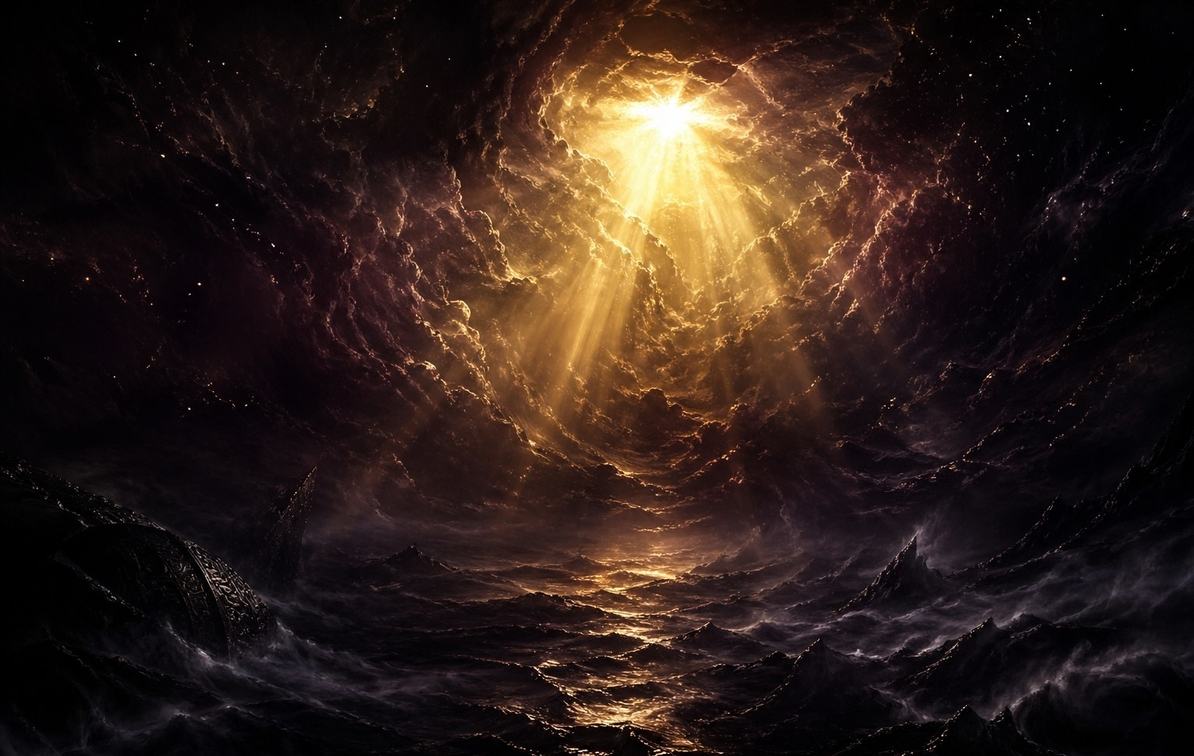
The text begins by challenging the claim that chaos was the first reality. It then unfolds a vast mythic drama: primordial darkness, divine light, Sophia, Yaldabaoth, the archons, the creation of humanity, the awakening of Adam and Eve, the flood, the movement of history, and the eventual restoration of the spiritual seed.
Where the Apocryphon of John gives a more technical Sethian creation map, and The Hypostasis of the Archons gives a more compact Genesis counter-reading, On the Origin of the World gives the wider mythic panorama. It is a cosmos-sized theatre of error, imitation, divine correction and final remembrance.
What is On the Origin of the World?
On the Origin of the World is a Gnostic creation text preserved in Nag Hammadi Codex II,5 and fragmentarily in Codex XIII,2. It explains the origin of the visible cosmos, the birth of Yaldabaoth, the role of Sophia, the creation of humanity, and the final restoration of those who belong to the divine light.
The text is important because it gives one of the most complete mythic accounts of Gnostic cosmology, expanding the same broad world as the Apocryphon of John and The Hypostasis of the Archons.
Table of Contents
- Text and Codex Setting
- Why On the Origin of the World Matters
- Two Versions in the Nag Hammadi Library
- Before Chaos: The Text’s Opening Challenge
- Light, Darkness and the Shape of the Cosmos
- Sophia and the Beginning of Disorder
- Yaldabaoth and the Lower Creation
- Sabaoth and the Turning Towards Light
- The Creation of Humanity
- Eve, Awakening and Knowledge
- Flood, History and the Spiritual Seed
- Final Restoration and the Defeat of the Archons
- Comparison with the Apocryphon and Hypostasis
- Reading On the Origin of the World Today
- Frequently Asked Questions
- Further Reading
- References and Sources
Text and Codex Setting
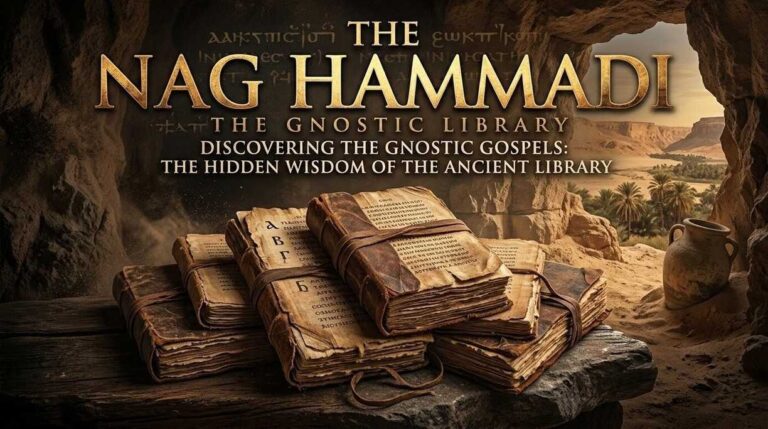
On the Origin of the World survives in two Nag Hammadi witnesses: a fuller version in Codex II,5 and a fragmentary version in Codex XIII,2. The Codex II version follows The Hypostasis of the Archons, which makes its placement especially meaningful. Both texts rework Genesis, Yaldabaoth, the archons, humanity and the spiritual seed.
The work is sometimes called the “Untitled Text” in scholarly discussion, because the surviving manuscript does not preserve a simple ancient title in the way modern readers might expect. Its conventional title comes from its subject: the origin of the world.
The text is usually read as part of the wider Gnostic and Sethian-related creation tradition. It shares themes with Sethian myth, but it is also unusually syncretic, weaving together scriptural reinterpretation, Greek philosophical ideas, Egyptian motifs and apocalyptic expectation.
Codex Note: On the Origin of the World is preserved in Nag Hammadi Codex II,5 and fragmentarily in Codex XIII,2. It belongs beside the Apocryphon of John and The Hypostasis of the Archons as a major creation text in the Nag Hammadi Library.
Why On the Origin of the World Matters
On the Origin of the World matters because it gives one of the broadest surviving Gnostic accounts of cosmology. It does not focus on a single episode. It moves from primordial reality to the birth of the lower rulers, from the creation of humanity to the meaning of history, and from cosmic error to final restoration.
It also matters because it shows how creatively ancient Gnostic writers interpreted inherited traditions. Genesis is not simply rejected. It is retold. Biblical phrases, Platonic structures, mythic figures and apocalyptic expectations are rearranged into a new vision of reality.
The text’s central question is profound: where did the visible world come from, and why does it feel divided between light and darkness, wisdom and ignorance, beauty and corruption? Its answer is mythic rather than modern scientific. It describes a cosmos shaped by imitation, error, divine correction and the hidden presence of spirit.
For the ZenithEye reading route, this text is best read after The Hypostasis of the Archons. The Hypostasis gives a sharp narrative retelling of Genesis; On the Origin of the World widens the lens until the whole cosmic drama comes into view.
Two Versions in the Nag Hammadi Library
The presence of two versions suggests that On the Origin of the World circulated with some importance in the environment represented by the Nag Hammadi codices. The Codex II version is the fuller and more commonly used witness, while Codex XIII preserves a fragmentary version.
For readers, this means the text was not an isolated oddity. It belonged to a living textual world where creation myths could be copied, adapted and preserved in multiple manuscript contexts.
The two witnesses also remind us that Nag Hammadi texts often existed in fluid forms. These were not fixed modern books with standard editions. They were transmitted through scribal networks, translated into Coptic, copied into codices and preserved with variation.
This helps explain the text’s richness. It feels less like a narrow doctrinal summary and more like a mythic compendium, gathering many streams into one wide river of cosmology.
Before Chaos: The Text’s Opening Challenge
The text begins with a bold correction. It challenges the claim that chaos was the first thing. Instead, it argues that those who say nothing existed before chaos are mistaken.
This is a crucial opening move. The text does not begin with the visible world, or even with formless darkness. It begins by insisting that chaos is not ultimate. Disorder is not the deepest truth.
In Gnostic terms, this matters because the lower world can appear overwhelming. Its powers, structures and confusions can seem final. The text refuses that conclusion. Before chaos, beyond chaos, deeper than chaos, there is the divine source.
The opening therefore sets the tone for the whole work. It is not merely explaining how the world began. It is correcting the false assumption that the brokenness of the world has the first word.
Primary Source Theme: The text opens by challenging the claim that chaos came first. It insists that darkness and disorder are not ultimate, because the divine reality precedes and exceeds them.
Light, Darkness and the Shape of the Cosmos
On the Origin of the World uses the language of light and darkness to describe the structure of reality. Light belongs to the higher divine realm, while darkness is associated with ignorance, disorder and the lower world’s confusion.
This is not simply ordinary physical light and darkness. It is theological language. Light means knowledge, origin, life, clarity and divine presence. Darkness means forgetfulness, error, limitation and separation from the higher source.
The cosmos emerges through a tension between these realities. The lower world is not presented as independent or self-explaining. It is a confused realm that borrows, imitates and distorts what belongs to the higher light.
This gives the text its dramatic energy. Creation is not calm architecture. It is a contested unfolding, where light must be recognised within and against the structures of darkness.
Sophia and the Beginning of Disorder
Sophia, divine Wisdom, plays a central role in the text’s account of cosmic disorder. As in other Gnostic myths, the crisis begins through a movement of Wisdom that results in an imperfect or lower production.
This should not be reduced to a crude blame of Sophia. In many Gnostic texts, Sophia is both the source of crisis and the beginning of restoration. Her movement leads to disorder, but her repentance, longing and connection to the higher realm also help draw the divine spark back towards its origin.
Sophia’s story gives the text its emotional depth. Cosmic error is not only a mechanical failure. It is a drama of desire, separation, recognition and repair. Wisdom becomes entangled in what falls away from fullness, yet remains connected to the possibility of return.
In this sense, Sophia is not merely a cautionary figure. She is the wound in the cosmos and the ache that remembers healing.
Yaldabaoth and the Lower Creation
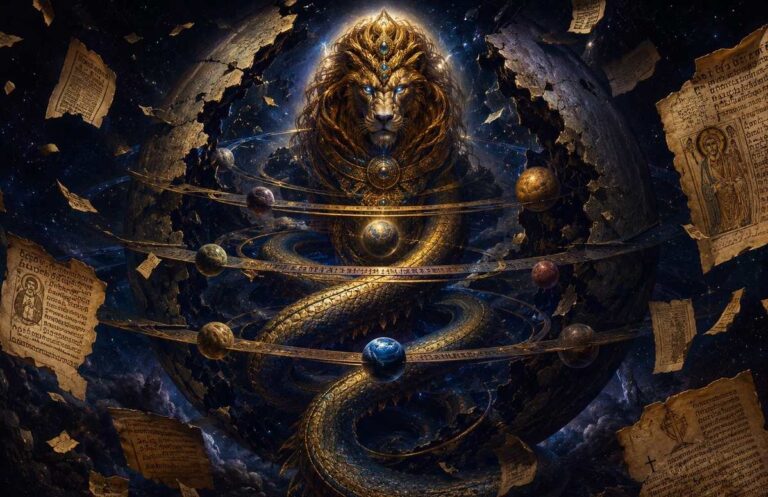
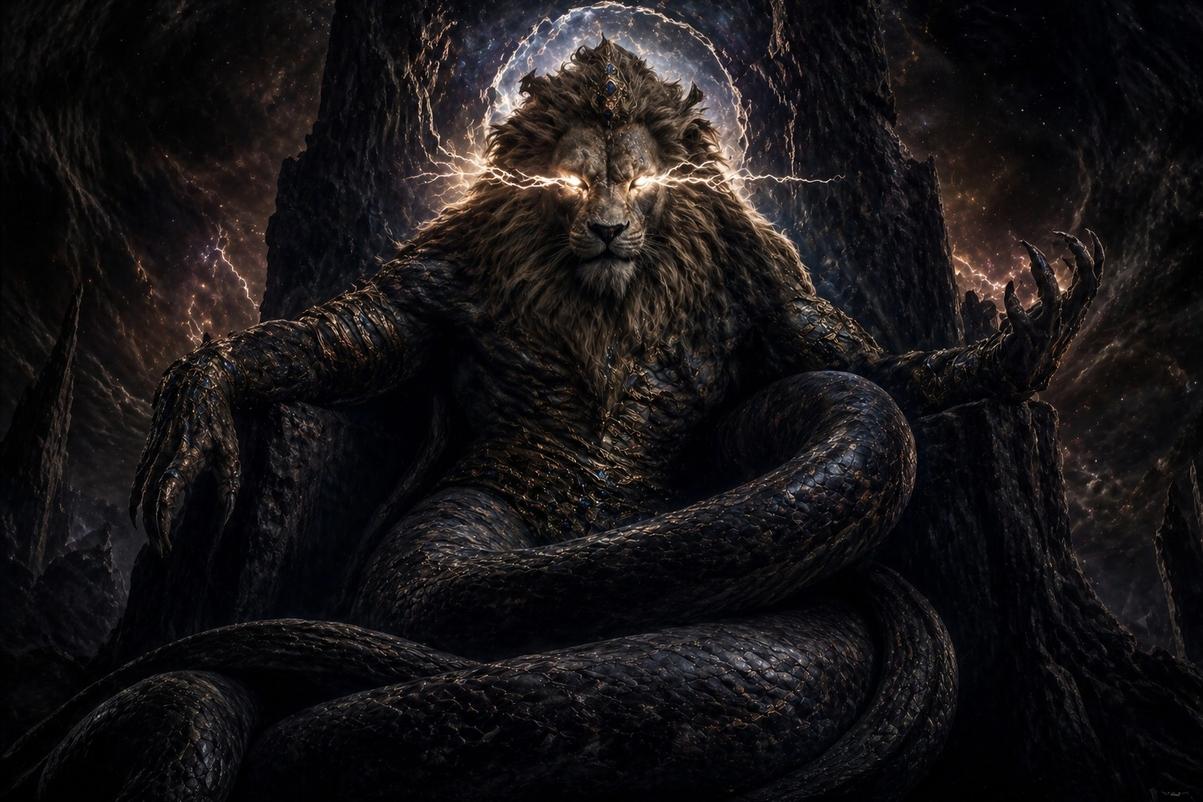
Yaldabaoth is one of the central figures in On the Origin of the World. He is the demiurge, the lower creator, often described with monstrous or hybrid imagery such as the lion-faced serpent.
His defining trait is ignorance. He does not understand his own origin. He claims divine uniqueness, but his power is derived. He imagines himself supreme because he cannot perceive what is above him.
This is the classic Gnostic critique of false divinity. The lower creator is not the highest God. He is a limited ruler who mistakes his partial authority for absolute sovereignty.
The material world, in this myth, is therefore not the direct expression of perfect divine fullness. It is a lower construction, shaped through imitation, confusion and incomplete knowledge. Yet because it still contains traces of higher light, it is not meaningless. It is mixed, wounded and haunted by its source.
Primary Source Theme: Yaldabaoth claims supreme divinity because he does not know the higher source from which his power ultimately derives. His ignorance becomes the root of lower cosmic misrule.
Sabaoth and the Turning Towards Light
One of the more distinctive features of On the Origin of the World is its treatment of Sabaoth. In some Gnostic texts, the sons or powers associated with the demiurge remain locked into archonic ignorance. Here, Sabaoth becomes more complex.
Sabaoth is portrayed as one who turns away from the arrogance of Yaldabaoth and towards the higher light. This makes him a figure of repentance, elevation and partial restoration within the lower cosmic order.
This detail matters because it complicates the text’s cosmology. The lower world is not a flat field of identical darkness. There are movements, responses and transformations even among the powers.
Sabaoth shows that turning towards the light is possible even from within a compromised structure. The text’s universe is dramatic, but not static. Some powers harden into ignorance. Others recognise something higher and are repositioned by that recognition.
The Creation of Humanity
The creation of humanity follows the pattern seen in other Nag Hammadi creation texts. The archons can form a body, but they cannot supply the true living spirit. The human being becomes a site of mixture: material formation from below, divine breath or spark from above.
This gives the human figure extraordinary tension. Humanity is not merely animal, not merely matter, and not simply divine in an uncomplicated way. The human being is a crossing point between lower formation and higher origin.
The archons become jealous because the human being carries something beyond them. Their creation receives a dimension they cannot control. The divine spark makes Adam more than the makers intended.
This is one of the essential Gnostic insights: the deepest part of the human being does not belong to the lower rulers. It comes from a higher source, and awakening means remembering that source.
Reading Note: The text does not describe humanity as merely corrupt or merely divine. It presents the human being as mixed: shaped in the lower world, yet animated by a higher spiritual reality.
Eve, Awakening and Knowledge
Like The Hypostasis of the Archons, On the Origin of the World reworks the Eden story. Eve is connected with awakening, knowledge and the recovery of spiritual perception.
The prohibition against knowledge is no longer read simply as a divine command to be obeyed. It becomes part of the lower rulers’ attempt to keep humanity unaware of its true origin.
Eating from the tree becomes a moment of perception. The eyes open. The human being begins to understand that the visible order and the highest divine truth are not the same thing.
This is not a casual celebration of disobedience. It is a mythic defence of awakening. Knowledge is dangerous to the archons because it reveals that their authority is incomplete.
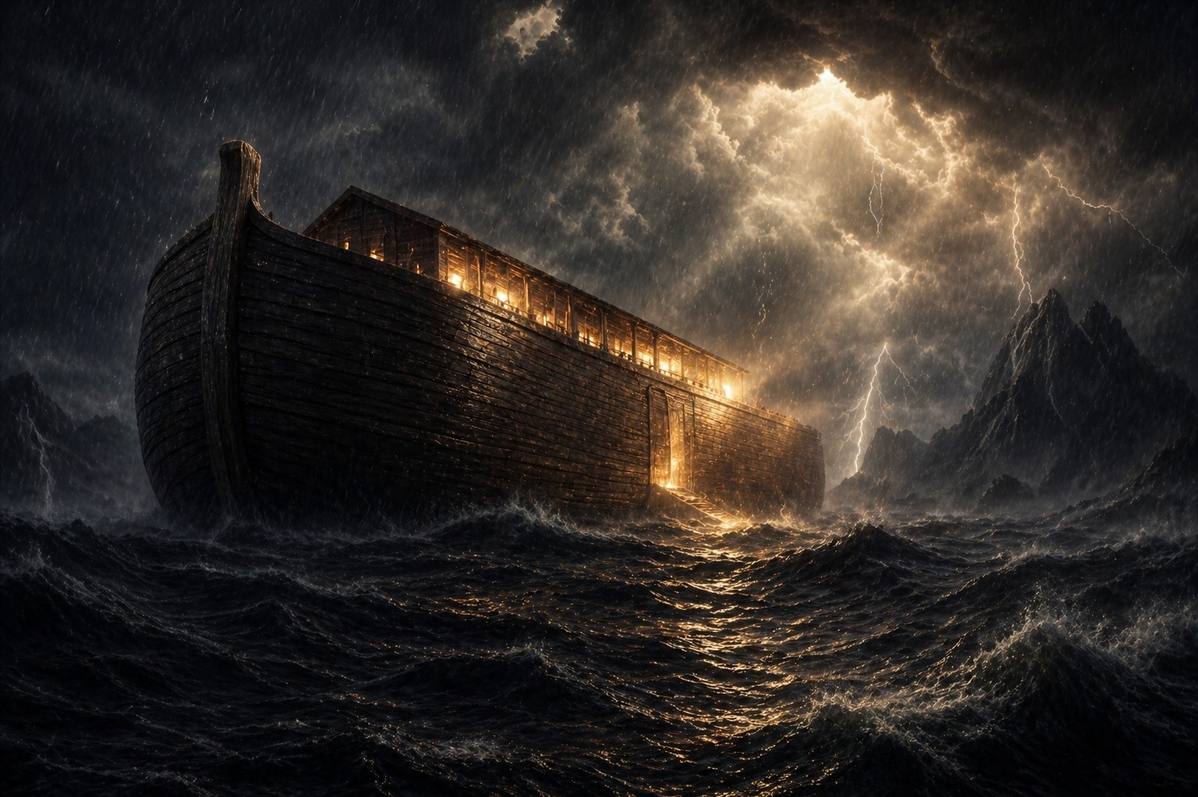
Flood, History and the Spiritual Seed
On the Origin of the World extends its myth into biblical history. The flood, the destruction of Sodom and other episodes are reinterpreted through the conflict between lower powers and the spiritual seed.
In this reading, history is not a neutral sequence of events. It is the visible surface of a deeper struggle: ignorance trying to preserve its rule, and the higher light working to rescue what belongs to it.
The flood becomes especially important. Like related Nag Hammadi texts, it can be read as a violent attempt by lower rulers to suppress or erase the awakened seed. Preservation comes not merely through ordinary survival, but through the hidden protection of divine knowledge.
This does not make the text modern history. It is mythic historiography. It reads biblical episodes as symbolic dramas of bondage, warning, preservation and return.
Final Restoration and the Defeat of the Archons
The text does not end in cosmic pessimism. It looks towards restoration. The archons will not rule forever. The spiritual seed will be gathered, the hidden divine reality will be revealed, and the lower order will lose its power to deceive.
This eschatological hope is essential. Gnostic myth is often misunderstood as pure world-rejection. But On the Origin of the World is not only about the origin of disorder. It is also about the correction of disorder.
The restoration is not simply revenge against the lower rulers. It is the unveiling of truth. What was mixed becomes clarified. What was hidden becomes known. What was scattered returns to source.
For the reader, this means the myth is not only cosmic. It is inward. Every act of genuine recognition is a small apocalypse: the false order loses force, and the spark remembers where it belongs.
Primary Source Theme: The text looks towards the defeat of the archons and the gathering of the spiritual seed. Its final movement is restoration, not mere destruction.
Comparison with the Apocryphon and Hypostasis
On the Origin of the World is best read beside the Apocryphon of John and The Hypostasis of the Archons. These texts share a mythic world, but each approaches it differently.
The Apocryphon of John is more systematic. It gives a fuller account of Barbelo, Sophia, Yaldabaoth, the archons and the awakening of humanity. It is the great Sethian map.
The Hypostasis of the Archons is more narrative and focused. It retells Genesis with Eve as spiritual teacher, the serpent as revealer and the archons as ignorant rulers.
On the Origin of the World is more expansive and literary. It gathers many strands into one large cosmological drama, moving from primordial beginnings to final restoration. Together, the three texts form one of the strongest routes into Nag Hammadi creation mythology.

Reading On the Origin of the World Today
Modern readers should approach On the Origin of the World as mythic theology, not as modern cosmology. It is not trying to answer scientific questions about the physical universe. It is asking why the world feels divided, why ignorance has power, and how the divine spark returns to its source.
The text’s value lies in its symbolic depth. Sophia shows the tragedy and tenderness of divine wisdom in exile. Yaldabaoth shows the danger of ignorant power. Humanity shows the strange mixture of matter and spirit. Restoration shows that disorder is not final.
It is also a reminder that ancient Gnostic writers were not simply rejecting inherited traditions. They were rereading them with fierce creativity. Genesis, Plato, Egyptian cosmogony and apocalyptic hope all become ingredients in a new spiritual grammar.
Read with care, On the Origin of the World becomes one of the great mythic mirrors of the Nag Hammadi Library. It does not merely ask where the world came from. It asks what kind of world this is, what kind of self has awakened within it, and what light still waits behind the disorder.
Safety Notice: This article explores symbolic, historical and spiritual ideas about cosmic origins, archons, hidden powers, divine sparks, false authority and final restoration. It is intended for grounded study of ancient texts, not as medical, psychological, legal or spiritual advice. If ideas about hidden control, cosmic systems, spiritual attack or world-denial become distressing, obsessive or destabilising, please seek support from a qualified mental health professional or appropriate emergency service.
Frequently Asked Questions
What is On the Origin of the World?
On the Origin of the World is a Gnostic creation text preserved in Nag Hammadi Codex II,5 and fragmentarily in Codex XIII,2. It explains the origin of the cosmos, the role of Sophia, the birth of Yaldabaoth, the creation of humanity, and the final restoration of the spiritual seed.
Where is On the Origin of the World found?
The text is found in two Nag Hammadi witnesses: a fuller version in Codex II,5 and a fragmentary version in Codex XIII,2. The Codex II version is the main surviving form used by most readers and scholars.
Is On the Origin of the World a Sethian text?
On the Origin of the World is closely related to Sethian and Sethian-style creation mythology, especially through Sophia, Yaldabaoth, the archons and the divine seed. It is also highly syncretic, drawing on biblical, Platonic, Egyptian and apocalyptic material.
How does On the Origin of the World reinterpret Genesis?
The text retells Genesis through a Gnostic lens. It challenges the idea that chaos was first, presents Yaldabaoth as an ignorant lower creator, treats humanity as a mixture of material formation and divine spirit, and reads biblical history as a struggle between lower powers and the spiritual seed.
Who is Yaldabaoth in On the Origin of the World?
Yaldabaoth is the lower creator or demiurge, often imagined as a lion-faced serpent. He is born from disorder connected with Sophia’s fall, claims to be the only god, and creates the lower world while remaining ignorant of the higher divine source.
What role does Sophia play in the text?
Sophia, divine Wisdom, is central to the origin of cosmic disorder and to the possibility of restoration. Her movement produces the conditions for Yaldabaoth’s emergence, but her longing and relation to the higher realm also help draw the spiritual seed back towards its source.
How is On the Origin of the World related to the Hypostasis of the Archons?
Both texts retell Genesis through a Gnostic lens and feature Yaldabaoth, archons, humanity, Eve and the spiritual seed. The Hypostasis of the Archons is more compact and narrative, while On the Origin of the World is more expansive and cosmological.
How should modern readers approach On the Origin of the World?
Modern readers should approach the text as mythic theology rather than modern science. Its purpose is not to explain physical cosmology, but to explore spiritual origin, ignorance, lower powers, divine light and the restoration of the soul.
Further Reading
Continue through the related creation, Sophia and archon source layer:
- The Apocryphon of John: the fuller Sethian creation myth of Barbelo, Sophia, Yaldabaoth and the archons.
- The Hypostasis of the Archons: a compact Genesis counter-reading with Eve, the serpent, archons and the cloud of light.
- What Is Sophia?: the role of divine Wisdom in fall, longing and restoration.
- The Sophia Myth: a comparison of Sophia’s fall and restoration across Gnostic schools.
- Who Is Yaldabaoth?: the blind creator and chief archon in Gnostic cosmology.
- Archons: the ruling powers that shape reality in Gnostic thought.
- The Feminine Divine in the Nag Hammadi Library: Sophia, Eve, Norea, Protennoia and Thunder as figures of divine voice and resistance.
- Codex II: the wider manuscript context of On the Origin of the World, The Hypostasis of the Archons, Thomas and Philip.
- Gnostic Schools: a comparison of Sethian, Valentinian, Hermetic and related currents.
- Nag Hammadi Library: Complete Guide to the Gnostic Scriptures: the broader archive guide to the codices, tractates and traditions.
References and Sources
The following sources support the historical, textual and interpretive claims made in this article.
Primary Sources and Critical Editions
- On the Origin of the World. Nag Hammadi Codex II,5 and XIII,2.
- The Apocryphon of John. Nag Hammadi Codices II,1; III,1; IV,1 and Berlin Codex 8502,2.
- The Hypostasis of the Archons. Nag Hammadi Codex II,4.
- Robinson, James M., ed. The Nag Hammadi Library in English. Harper & Row / HarperSanFrancisco, revised editions.
- Meyer, Marvin, ed. The Nag Hammadi Scriptures. HarperOne, 2007.
- Layton, Bentley. The Gnostic Scriptures. Doubleday, 1987.
- Painchaud, Louis. L’Écrit sans titre: Traité sur l’origine du monde. Presses de l’Université Laval, 1995.
- Attridge, Harold W., ed. Nag Hammadi Codex II,2-7. Brill, 1989.
Scholarly Monographs and Studies
- King, Karen L. What Is Gnosticism?. Harvard University Press, 2003.
- Brakke, David. The Gnostics: Myth, Ritual, and Diversity in Early Christianity. Harvard University Press, 2010.
- Turner, John D. Sethian Gnosticism and the Platonic Tradition. Presses de l’Université Laval, 2001.
- Williams, Michael Allen. Rethinking “Gnosticism”: An Argument for Dismantling a Dubious Category. Princeton University Press, 1996.
- Pearson, Birger A. Ancient Gnosticism: Traditions and Literature. Fortress Press, 2007.
- Bullard, Roger A. The Hypostasis of the Archons: The Coptic Text with Translation and Commentary. De Gruyter, 1970.
Comparative and Thematic Studies
- Waldstein, Michael, and Frederik Wisse. The Apocryphon of John: Synopsis of Nag Hammadi Codices II,1; III,1; and IV,1 with BG 8502,2. Brill, 1995.
- Stroumsa, Guy G. Another Seed: Studies in Gnostic Mythology. Brill, 1984.
- Denzey Lewis, Nicola. Cosmology and Fate in Gnosticism and Graeco-Roman Antiquity. Brill, 2013.
- van den Broek, Roelof. Gnostic Religion in Antiquity. Cambridge University Press, 2013.
- Jonas, Hans. The Gnostic Religion. Beacon Press, revised editions.
Reading Note: On the Origin of the World is best read beside the Apocryphon of John and The Hypostasis of the Archons. Together they form a powerful route through Nag Hammadi creation myth: the cosmic map, the Genesis counter-story, and the wide mythic panorama of origin and restoration.