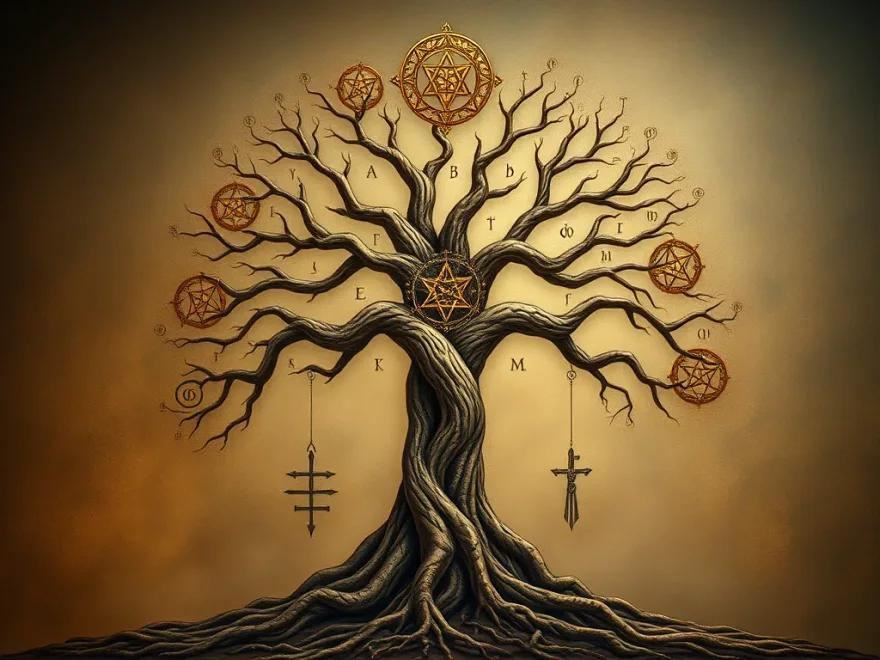
John Dee Mathematical Preface 1570: Occult Foundation of Renaissance Magic and Esoteric Mathematics
In 1570, when Henry Billingsley (later Lord Mayor of London) published the first English translation of Euclid’s Elements, he smuggled into the volume a document that would become the foundation stone of English occultism. To the casual reader, John Dee’s Mathematical Preface appears as a conventional defence of mathematical study—a dry, humanist introduction to Greek geometry. To the initiated eye, it reveals something far more audacious: a complete system of occult philosophy, a summa of Renaissance hermeticism disguised as pedagogical bureaucracy.

This grimoire of mathematical magic established the theoretical framework that would influence the Rosicrucian Brotherhood, Freemasonry, and the Hermetic Order of the Golden Dawn. Understanding the Mathematical Preface is essential for anyone seeking to navigate the esoteric dimensions of Renaissance thought—the marriage of science and sorcery, and the perennial philosophy that Dee termed “the Mathematical Tree.”
1. The Hidden Grimoire of 1570
The Billingsley Translation and Its Occult Appendix
Henry Billingsley’s translation of Euclid’s Elements (1570) was not merely a mathematical textbook—it was a trojan horse for esoteric transmission. Dee’s preface, running to some 30,000 words, constitutes nearly a quarter of the entire volume. While Billingsley provided the English rendering of Greek geometry, Dee supplied the theurgic operator’s manual. The University of Oxford and the British Library hold original copies where Dee’s preface is heavily annotated by contemporary readers, indicating it was circulated among England’s occult intelligentsia as a coded textbook of the ars regia (royal art).
The publication date—1570—places this text at the precise moment when Elizabethan England was establishing its maritime imperial infrastructure. Dee served as the Queen’s consultant on calendar reform and navigation, positions that granted him access to the archonic mechanisms of state power. His preface therefore operates on two levels: legitimising mathematical study for the emerging scientific bureaucracy while encoding instructions for spiritual liberation from that very system.
Why Euclid Became the Vehicle for Esoteric Transmission
Euclid was chosen not for his secular geometry, but because the Elements were recognised in the prisca theologia as containing the Pythagorean mysteries in crystalline form. Dee explicitly states that Greek mathematics derives from Egyptian temple wisdom—a position now supported by modern scholarship on the Egyptian Rhind Papyrus and its geometric formulae. By appending his occult philosophy to Euclid, Dee was inserting himself into the golden chain of transmission, claiming lineage from the pharaonic priesthood through to the Elizabethan court.
2. The Esoteric Context: Elizabethan Occultism and the Magical Renaissance
The Rediscovery of Hermes Trismegistus
The 1570 publication emerged during the pivotal decades following Marsilio Ficino’s translation of the Corpus Hermeticum (1463). Dee possessed the most complete library of Hermetic, Kabbalistic, and alchemical texts in England—some 3,000 volumes at his Mortlake residence. This was not mere scholarship; it was intelligence gathering on the architecture of reality. Dee understood, as few of his contemporaries did, that the Hermetic texts described a consciousness-based cosmology wherein the trained imagination could influence the material substrate through mathematical precision.
Dee’s Position at the Elizabethan Court
Serving as astrologer to Queen Elizabeth I (a role requiring precise astronomical calculation), Dee advised on naval navigation, calendar reform, and the legal foundations of England’s colonial claims—work that appears in his General and Rare Memorials Pertaining to the Perfect Art of Navigation (1577). Yet simultaneously, he was conducting the Enochian workings with Edward Kelley, attempting to hack the administrative codes of the angelic bureaucracy. The Mathematical Preface bridges these domains: it is simultaneously a treatise on practical mathematics for empire-building and a manual for transcending the archonic constraints that such empires impose upon consciousness.
The Royal Art vs. Vulgar Mathematics
Dee draws a sharp distinction between what he terms the “vulgar” arithmetic of merchants and the “royal” or “magical” mathematics of the philosopher-magus. The former operates within the constraints of the material world; the latter rewrites the bureaucratic protocols of creation itself. This distinction would influence the Rosicrucian manifestos of the early seventeenth century and, ultimately, the Golden Dawn’s system of grades and correspondences. The Preface is, in essence, an application for membership in an invisible college—one that recognises that numbers are not merely descriptive but causative.

3. The Hidden Audience: Decoding Dee’s Address
“Unfained Lovers of Truth” as Esoteric Shibboleth
Dee’s opening address immediately signals his esoteric intent: “To the unfained lovers of truth, and constant students of noble sciences.” This is coded language, a shibboleth identifying fellow practitioners of the royal art. The “unfained” (unfeigned) are those who pursue truth not for worldly gain but for spiritual transformation—a direct contrast to the “counterfeiters” Dee elsewhere condemns.
The phrase “noble sciences” (sciences nobles) derives from the French esoteric tradition, distinguishing occult arts (alchemy, astrology, magic, and Kabbalah) from the “servile” disciplines of the universities. Dee’s intended readers are those who understand that the cosmos is governed by principles that resemble a vast administrative hierarchy, and that mathematics provides the filing system for its secrets.
The Invisible College of the Royal Art
Dee distinguishes these true philosophers from the vulgar crowd, the “common students” who see only the surface of things. His Preface is esoteric transmission—occult instruction meant for the few who have eyes to see. This follows the tradition of the Pythagorean akousmatikoi (hearers) and mathematikoi (learners), the Hermetic inner circle, and the Kabbalistic restriction of mystical instruction to those morally prepared to receive it.
“I propose to describe the mighty, most pleasant, and fruitful Mathematical Tree, with the chief branches thereunto belonging: and that so particularly, as every one of them, with their due application, may be made manifest.”
— John Dee, Mathematical Preface (1570)
This promise—to reveal “every one of them, with their due application”—constitutes the pledge of the initiator, the commitment to complete transmission rather than veiled hints.
4. The Mathematical Tree of Life: Kabbalistic Cosmology
From Etz Chaim to the Mathematical Tree
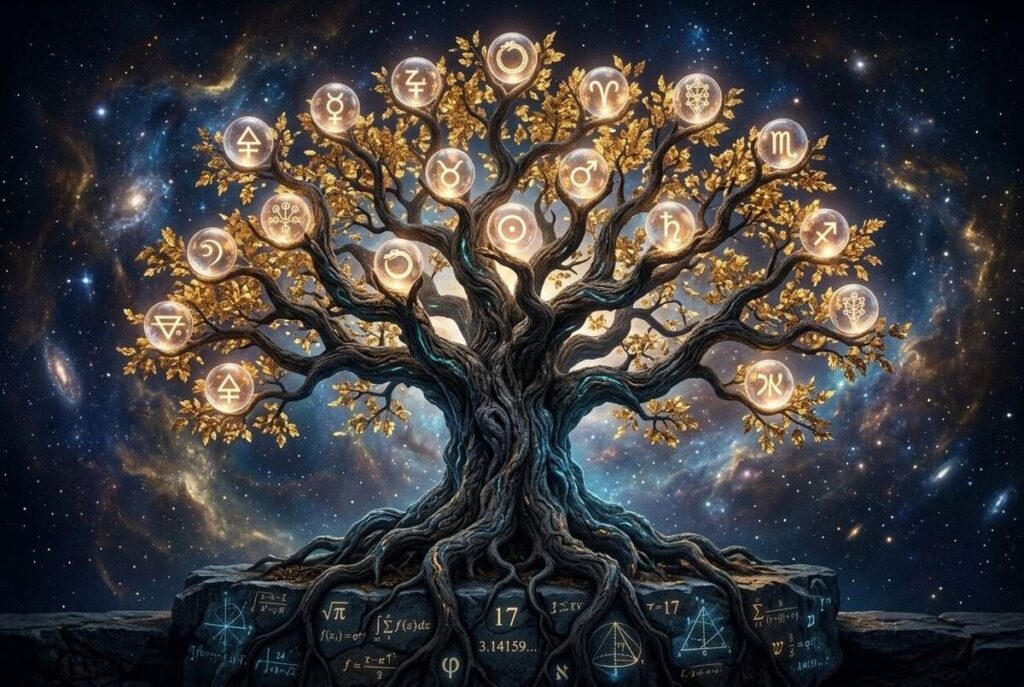
Dee’s central metaphor—the “mighty, most pleasant, and fruitful Mathematical Tree”—is immediately recognisable to students of Kabbalah as the Tree of Life (Etz Chaim). In the Jewish mystical tradition, the Tree consists of ten sephirot (divine emanations) arranged in three columns, connected by twenty-two paths corresponding to the Hebrew alphabet. Dee’s Mathematical Tree represents a Christian Hermetic adaptation of this cosmic diagram: its branches are the mathematical arts, its roots the divine source, its fruit the gnosis (saving knowledge) sought by the philosopher-magus.
The correspondence is not speculative. Dee owned manuscripts of the Zohar and Sefer Yetzirah, and his library catalogue (Bibliotheca Mortlacensis) reveals extensive Hebrew learning. He understood the Sephirot as cosmic processing units, each performing specific metaphysical functions analogous to the departments of a celestial civil service.
The Alchemical Arbor Philosophica
The Tree metaphor also evokes the alchemical arbor philosophica—the philosophical tree that grows from the prima materia and bears the fruit of the philosophers’ stone. Dee’s mathematics is explicitly alchemical: it transmutes the lead of ignorance into the gold of wisdom, the base metal of sense perception into the spiritual gold of intellectual vision. The “fruit” of the Mathematical Tree is therefore the completion of the Great Work, achieved through the correct application of number, weight, and measure.
Seventeen Branches as Divine Enumeration
Dee identifies seventeen distinct branches of mathematical art—a number encoding deep significance. In Kabbalistic gematria, seventeen is the value of tov (good), and represents the integration of the seven planetary spheres with the ten Sephirot. This is not arbitrary numerology but cosmic accounting: Dee presents a complete curriculum wherein each branch corresponds to specific operations within the administrative structure of creation.
The seventeen arts include: Arithmetic, Geometry, Astronomy, Music (the Quadrivium), supplemented by thirteen additional arts including Perspective, Astronomy (judicial), Cosmography, Astrology, Statics, Pneumathematics, Trithemius’s cryptography, and others—effectively mapping the complete bureaucratic hierarchy of natural and supernatural phenomena.
5. The Two Fountains: Sacred Geometry and Divine Arithmetic
Arithmetic: The Science of Divine Names and Emanation
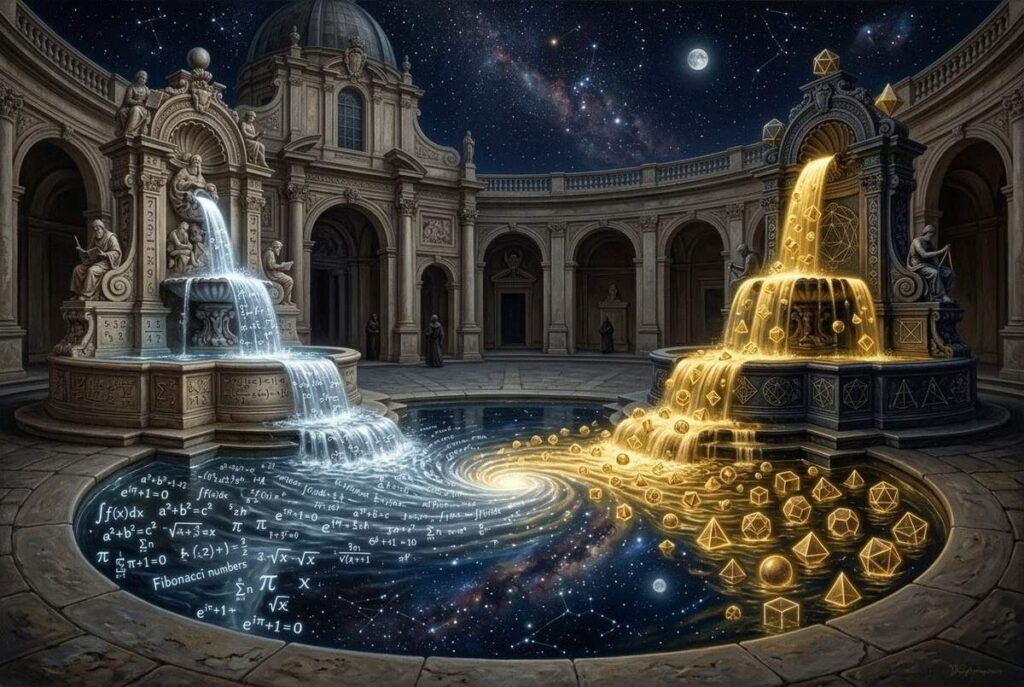
Dee describes arithmetic as the art “which by order and most absolute number, brought from Nothing, to the Formality of their being and state.” This is not counting or calculation; it is theosophical numerology—the study of how divine emanation proceeds from the Ain Soph (Infinite, literally “without end”) into manifestation through the agency of number.
The phrase “brought from Nothing” refers to the Kabbalistic doctrine of creation ex nihilo, the emergence of something from nothing through divine will. In the Sefer Yetzirah, the ten sephirot emerge from the Ain, the Ain Soph, and the Ain Soph Aur (Infinite Light)—three stages of divine contraction (tzimtzum) that allow for finite creation. Dee’s arithmetic traces this process of emanation, demonstrating how number structures reality from the highest heavens to the lowest earth.
Radical Numbers and the Limits of Reason
Dee’s discussion of Radical Numbers (irrational or surd numbers) conceals advanced esoteric teaching. In the Pythagorean mystery tradition, irrational numbers like √2 represented the limitation of human reason and the necessity of divine revelation. They are “radical” (from radix, root) because they reach down to the roots of being, touching the ineffable source that transcends rational comprehension.
The Pythagoreans reportedly kept the discovery of irrational numbers as a closely guarded secret, revealing it only to initiated members of their school—those who had signed the metaphysical non-disclosure agreements of the ancient mystery schools. Dee’s inclusion of this material signals that he is transmitting genuine Pythagorean initiatory knowledge, not merely classroom mathematics.
Geometry: Anagogical Ascent Through Form
Dee’s preference for “Megethological Contemplations” over the “earthly name of Geometry” signals his initiatic intent. “Megethological” (from Greek megethos, magnitude) suggests the contemplation of cosmic proportions—the sacred geometry that underlies creation, the same science that built the pyramids, the Gothic cathedrals, and the temples of the imagination.
His claim that these contemplations train the imagination “to forsake and abandon the grosse and corruptible objects of our outward senses” describes the technique of mystical ascent central to Platonic and Hermetic theurgy. The geometer does not merely study shapes; he ascends the scale of being:
- From the material triangle to the Intellectual Triangle
- From the earthly circle to the Celestial Circle
- From the body to the Spiritual, eternal, and such as concern our bliss everlasting
This is the anagogical method—the use of mathematical symbols to elevate the soul toward divine realities. The term anagoge (Greek: “leading upward”) refers to the four levels of scriptural interpretation in medieval exegesis: literal, allegorical, moral, and anagogical. Dee applies this hermeneutic to mathematics, treating geometric figures as sacred texts that reveal higher truths to the prepared mind.
6. The Tetractys: Pythagorean Foundations

The Sacred Decad and Creation
Dee’s two fountaines reflect the Pythagorean Tetractys, the sacred symbol of the decad (ten). The Tetractys consists of ten points arranged in four rows (1+2+3+4=10), representing:
- 1: The Monad (point, source)
- 2: The Dyad (line, first extension)
- 3: The Triad (surface, first form)
- 4: The Tetrad (solid, first body)
The Tetractys contains within itself arithmetic (the numbers), geometry (the triangular form), music (the harmonic ratios 1:2, 2:3, 3:4), and astronomy (the celestial order). It was considered so sacred that the Pythagoreans would swear oaths by it, referring to it as the “source and root of eternal nature.”
Musical Harmonics and Celestial Order
Dee understood that the ratios within the Tetractys—1:2 (octave), 2:3 (fifth), and 3:4 (fourth)—constitute the mathematical basis of music. In the Pythagorean and Platonic traditions, these same ratios govern the distances between the planets, creating the “music of the spheres” (musica universalis). The trained magus, through mathematical contemplation, could attune his consciousness to these cosmic frequencies, effectively changing his administrative clearance level within the hierarchy of being.
Dee’s Mathematical Tree is therefore an elaboration of this Pythagorean symbol, extending the four base numbers into seventeen branches of occult application—each branch a specific technique for harmonising the microcosm (human consciousness) with the macrocosm (the cosmic order).
7. The Prisca Theologia and the Chain of Transmission
The Aurea Catena of Wisdom
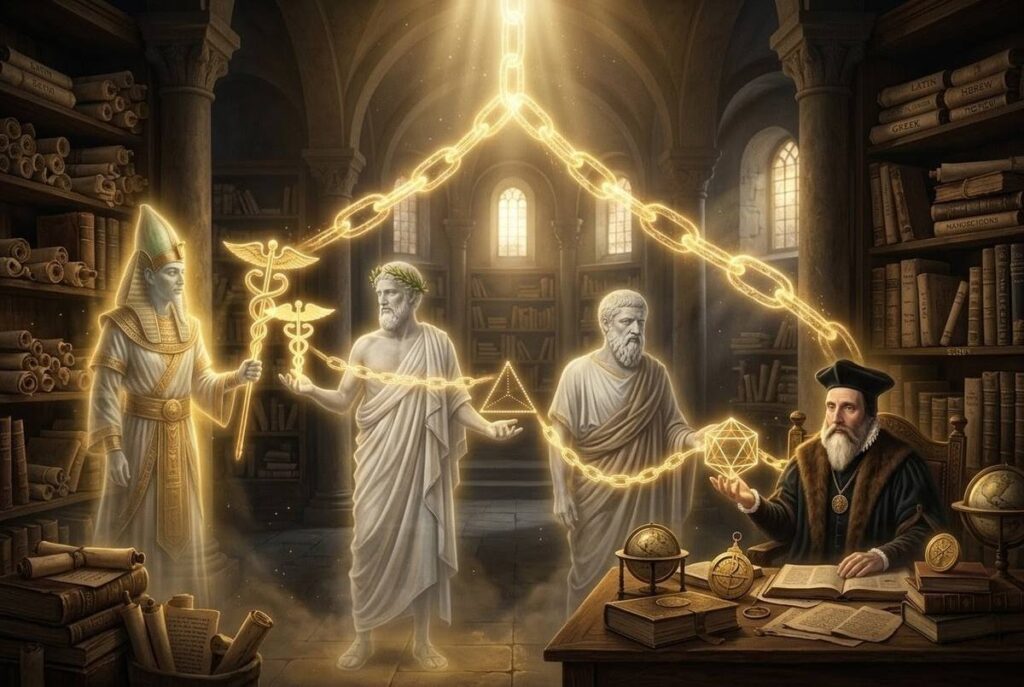
Dee’s Preface participates in the Renaissance myth of the prisca theologia—the ancient theology passed down through a chain of wise men from the beginning of time. This golden chain (Latin: aurea catena) includes:
- Hermes Trismegistus (Thrice-Great Hermes)
- Moses (the Egyptian-trained lawgiver)
- Orpheus (the theologian-musician)
- Pythagoras (the philosopher-mathematician)
- Plato (the divine philosopher)
- Apollonius of Tyana (the wonder-working sage)
By presenting Euclid within this lineage, Dee asserts that Greek mathematics is not secular knowledge but sacred wisdom—revealed knowledge transmitted through the ages for the illumination of humanity. The Preface therefore functions as a diplomatic cable from the invisible government of the world, addressed to those with appropriate security clearance to decrypt its contents.
Euclid as Initiate, Not Mere Mathematician
Dee portrays Euclid not as a dry academic but as an initiate of the Egyptian mysteries, who “compiled and set forth” the Elements from the temple wisdom of Alexandria. This historical claim—that Euclid studied at the Library of Alexandria under the patronage of the Ptolemies—positions the Elements as a classified document from the ancient world’s premier research facility. Dee is effectively declassifying portions of the ancient wisdom, providing “redacted” but still potent instructions for those capable of reading between the lines.
The Legacy: From the Rosicrucians to the Golden Dawn
The influence of Dee’s Mathematical Preface extends far beyond its immediate Elizabethan context. The text provided the foundational curriculum for the Rosicrucian Brotherhood in the early seventeenth century—manifestos published in 1614-1616 echo Dee’s mathematical mysticism and his vision of an invisible college of the learned. The Preface was reprinted in 1658 and again in 1691, serving as a textbook for the early Freemasons and the Cambridge Platonists.
By the nineteenth century, when the Hermetic Order of the Golden Dawn established its system of grades and correspondences, they were working from Dee’s seventeenth-century manuscripts (the Sloane Manuscripts in the British Museum) as well as the Mathematical Preface. The Golden Dawn’s emphasis on the Telesmatice (magical images) and Thaumaturgike (wonder-working) derives directly from Dee’s classification of the mathematical arts. Even modern chaos magic and psychogeometry continue to utilise Dee’s framework—often without recognising its source in this 1570 “introduction” to Euclid.
The Preface as Portal
John Dee’s Mathematical Preface is a portal—a threshold between the profane and sacred, the known and unknown, the finite and infinite. For the “unfained lovers of truth,” it offers entry into a comprehensive system of occult knowledge, a mathematical mysticism that unites heaven and earth, reason and revelation, science and sorcery.
To study this text is to enter into the mysteries of number, to join the invisible college of those who understand that all is number, and that through number, all may be known. The Mathematical Tree stands waiting, its roots in the divine source, its branches reaching toward the stars, its fruit the wisdom of the ages—available to all who approach with pure intention and prepared mind. Just ensure you have the proper permits before attempting to pluck its fruit; the cosmic bureaucracy takes a dim view of trespassers without the appropriate clearance.
What is John Dee’s Mathematical Preface and why is it important?
John Dee’s Mathematical Preface (1570) was an introductory essay to Henry Billingsley’s English translation of Euclid’s Elements. It appears to be a defense of mathematical study, but actually contains a complete system of Renaissance occult philosophy, outlining seventeen branches of “mathematical magic” that influenced Rosicrucianism, Freemasonry, and the Golden Dawn.
What does Dee mean by the “Mathematical Tree”?
The Mathematical Tree is Dee’s central metaphor adapted from the Kabbalistic Tree of Life (Etz Chaim). It represents a cosmic diagram with seventeen branches (mathematical arts), roots in the divine source, and fruit representing gnosis (saving knowledge). The number seventeen corresponds to the Hebrew word “tov” (good) and integrates the seven planetary spheres with the ten Sephirot.
What are the “Two Fountains” in Dee’s system?
The Two Fountains are Arithmetic and Geometry, which Dee describes as flowing from a divine source like living water. Arithmetic deals with divine names and emanation (the study of how number structures reality), while Geometry involves “Megethological Contemplations”—sacred geometry that facilitates anagogical (upward-leading) ascent of the soul.
What is the significance of the number seventeen in the Preface?
Dee identifies seventeen distinct mathematical arts, a number encoding Kabbalistic significance. Seventeen is the gematria value of “tov” (good) and represents the integration of the seven planetary spheres plus the ten Sephirot. It symbolises completeness in Dee’s curriculum of occult studies.
How does the Mathematical Preface relate to the prisca theologia?
The Preface participates in the Renaissance concept of prisca theologia (ancient theology)—a golden chain of wisdom passed from Hermes Trismegistus through Moses, Orpheus, Pythagoras, and Plato. Dee positions Euclid and himself within this lineage, arguing that true mathematics is revealed sacred wisdom, not secular knowledge.
What is the Tetractys and why does Dee reference it?
The Tetractys is the Pythagorean sacred symbol of the decad (ten), consisting of ten points arranged in four rows (1+2+3+4). It contains arithmetic, geometry, music, and astronomy within its structure. Dee’s Mathematical Tree elaborates this symbol, extending the four base numbers into seventeen branches of occult application.
How did the Mathematical Preface influence later occult movements?
The Preface provided the curriculum foundation for the Rosicrucian Brotherhood (1614-1616), influenced early Freemasonry and Cambridge Platonism (republished 1658, 1691), and directly informed the Hermetic Order of the Golden Dawn’s system of grades in the 19th century. Its framework of seventeen mathematical arts remains influential in modern ceremonial magic.
Further Reading
For those seeking to continue their studies in Dee’s mathematical mysticism and Elizabethan occultism:
- The Seventeen Occult Arts: John Dee’s Complete System of Magic — A detailed exploration of each branch of Dee’s Mathematical Tree, from cryptography to thaumaturgy.
- Heptarchia Mystica: John Dee’s Planetary Kings Guide — Dee’s later angelic workings with the Heptarchic system, demonstrating the practical application of his mathematical cosmology.
- Scrying the Enochian Aethyrs: An Astral Gnosis Guide — The advanced practices that developed from Dee’s mathematical framework, involving the thirty Aethyrs or “airs” revealed to Kelley.
- Kabbalistic Tree of Life Guide — The Jewish mystical framework that underpins Dee’s Mathematical Tree, essential for understanding his adaptation of Sephirotic cosmology.
- Emerald Tablet: Hermetic Foundation of Correspondence — The core Hermetic text that informs Dee’s view of “as above, so below” and the mathematical structure of reality.
- Table of Trithemius: Angelic Communication Codes — The cryptographic and angelic communication systems that influenced Dee’s approach to the “rule of coss” and magical alphabets.
- The Art of Drawing Spirits into Crystals — Trithemius’s influence on Dee’s angelic operations, providing context for the “thaumaturgike” Dee describes in the Preface.
- Thaumaturgike: Dee’s Art of Wonder-Working and Magical Images — A deeper examination of how Dee’s mathematical framework supports practical magical operations.
Clulee, Nicholas. John Dee’s Natural Philosophy: Between Science and Religion (1988)
Yates, Frances. The Occult Philosophy in the Elizabethan Age (1979)
Harkness, Deborah. John Dee’s Conversations with Angels: Cabala, Alchemy, and the End of Nature (1999)
Szönyi, György. John Dee’s Occultism: Magical Exaltation Through Powerful Signs (2004)