The nineteen Occult Arts
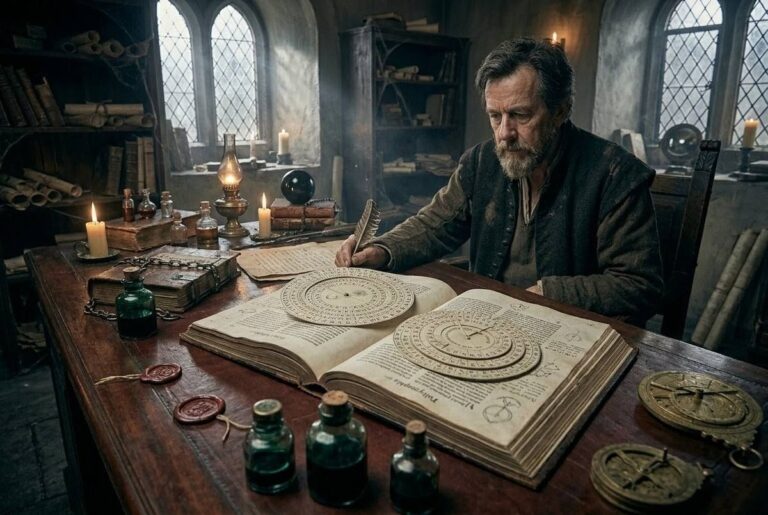
From his “two Mathematical fountaines”—Arithmetic and Geometry—John Dee derives nineteen mathematical arts, constituting a complete curriculum of occult studies. This is not random enumeration but carefully structured pedagogy, each art building upon the previous, ascending from elemental foundations to celestial heights.
The number nineteen carries profound esoteric significance. Beyond its mathematical reality as the eighth prime number, it represents the integration of the spiritual and material, the perfection of the Great Work through systematic acquisition. Dee’s enumeration is deliberate: these are not academic subjects but technologies of consciousness, each granting access to specific dimensions of reality’s operating system.
The Foundation Arts: Arithmetic and Geometry
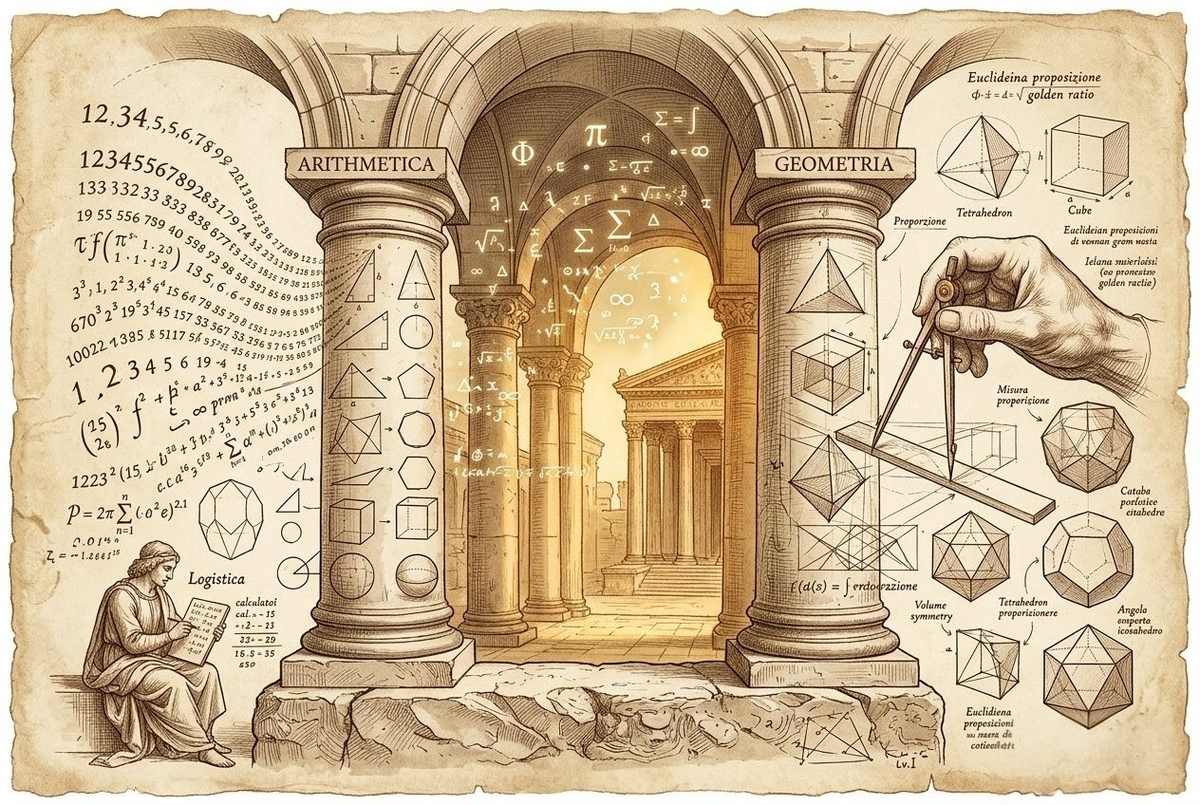
Dee establishes his curriculum upon two fundamental pillars: Arithmetic (the science of discrete quantity) and Geometry (the science of continuous magnitude). These are not mere preparatory subjects but the twin master keys to reality’s architecture. Arithmetic provides the numerical codes; Geometry provides the spatial relationships. Together they constitute the bureaucratic alphabet through which the universe files its existence.
The Numerical Bureaucracy
Arithmetic, in Dee’s conception, reveals the accounting system of creation—the discrete units through which the divine tallies manifestation. Number is not merely descriptive but prescriptive: the ratios, proportions, and progressions that govern celestial mechanics also govern the soul’s metabolism. To master arithmetic is to acquire the cosmic ledger-keeping skills necessary to audit reality and detect its hidden correspondences.
Spatial Administration
Geometry provides the architectural blueprint—the continuous extension that allows discrete numbers to manifest as form. Dee’s geometry is not abstract but operative: it includes the construction of solids, the calculation of areas, and the projection of shadows (gnomonics). These are the tools for territorial management—the ability to measure, bound, and claim space, whether terrestrial or celestial.
The Celestial Arts: Music, Astronomy, and Astrology
Building upon the foundation, Dee establishes three arts governing the celestial sphere: Music (Harmonice), Astronomy, and Astrology. These are not separate disciplines but interconnected departments of celestial administration, each providing different access protocols to the heavens.
Music (Harmonice): The Music of the Spheres
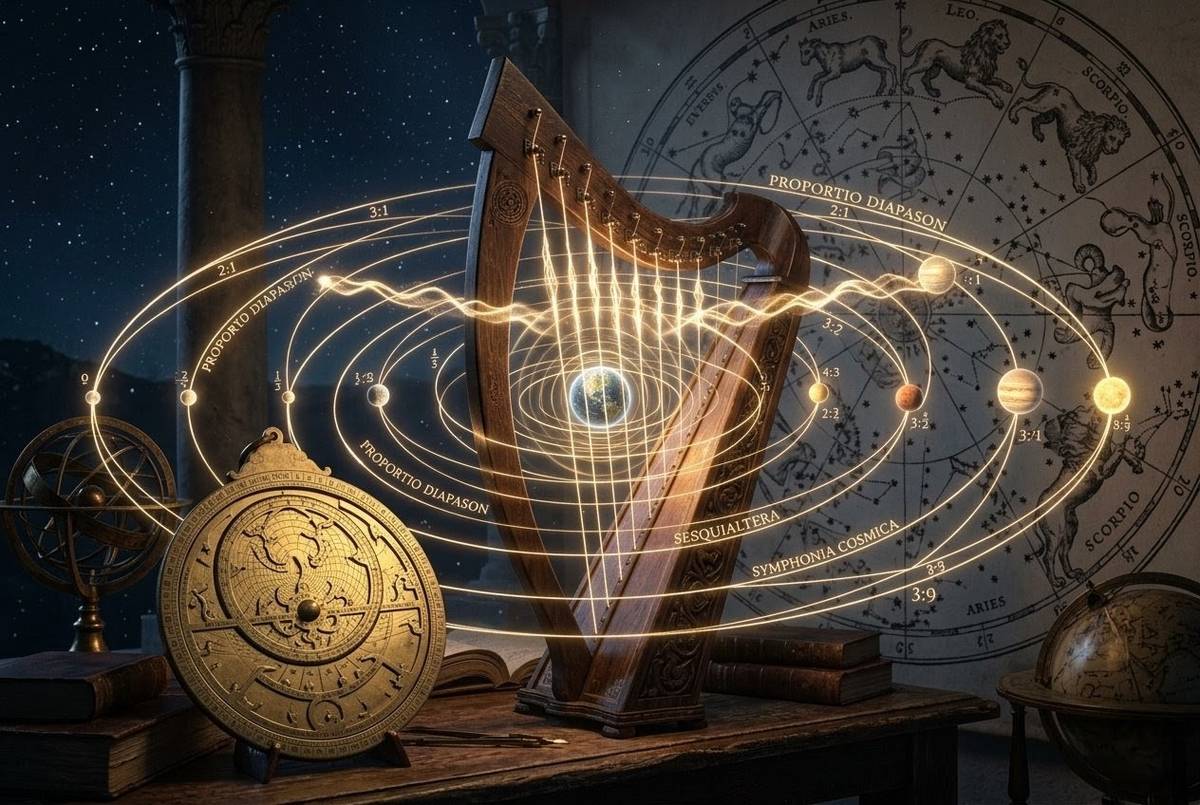
Dee’s treatment of Music reveals his deep engagement with Pythagorean cosmology—the ancient doctrine that celestial bodies emit musical tones according to their velocities and distances, creating a cosmic symphony audible to the purified soul. His reference to “Pythagoras’ Harp with eight strings” encodes initiatic knowledge. The octachord (eight strings) adds the sphere of the fixed stars or the empyrean heaven—the eighth sphere of divine presence. This is the ogdoad, the number of cosmic completion and regeneration.
Music, for Dee, is vibrational administration—the study of ratios that govern not only auditory pleasure but the very structure of the cosmos. The harmonic intervals that please the ear mirror the celestial intervals that maintain planetary order. To understand music is to possess the acoustic passwords that harmonise individual consciousness with universal rhythm.
Astronomy: The Celestial Ledger
Dee describes Astronomy as “commended and in manner commanded by God himself” through the creation of the luminaries “for signs, and knowledge of seasons” (Genesis 1:14). This biblical language establishes astronomy as sacred science, the study of the Book of Nature written by the divine hand. The Renaissance astrolabe serves as the precision instrument for this celestial accounting—a mechanical computer for calculating planetary positions, eclipses, and conjunctions.
Astronomy provides the chronological framework within which all other operations must be timed. Without accurate celestial observation, one cannot determine auspicious moments, calculate the precession of equinoxes, or navigate by the stars. It is the cosmic scheduling system that ensures all terrestrial operations align with celestial permissions.
Astrology: Natural Influence vs. Vain Glory
Dee distinguishes between “natural” astrology—the study of celestial influences on the sublunary world—and the “vain glory” sought by common practitioners. He cites Psalm 19:1—”The Heavens declare the glory of God”—establishing astrology as natural theology, a means of knowing the divine through cosmic correspondences.
Proper astrology, in Dee’s system, is celestial meteorology—the prediction of influences streaming downward from the planetary spheres. Each planet administers specific qualities: Saturn governs contraction and melancholy; Jupiter governs expansion and generosity; Mars governs separation and conflict. The astrologer reads these influences as a meteorologist reads weather patterns, forecasting the climatic conditions of fate under which terrestrial events unfold.
The Elemental Arts: Cosmography, Hydrography, Geography, Chronology, Statics
Dee next establishes five arts governing the elemental world: Cosmography, Hydrography, Chorography (Geography), Chronology, and Statics. These provide the terrestrial mapping systems—the cartography of space and time that allows the magus to navigate material reality with the same precision applied to celestial realms.
Cosmography: The Universal Map
Cosmography synthesises celestial and terrestrial knowledge into a unified picture of the universe. It is ontological cartography—the mapping of the great chain of being from the empyrean heaven down through the planetary spheres to the elemental world. The cosmographer possesses the administrative overview, understanding how each level of reality relates to the others, how the macrocosm reflects in the microcosm.
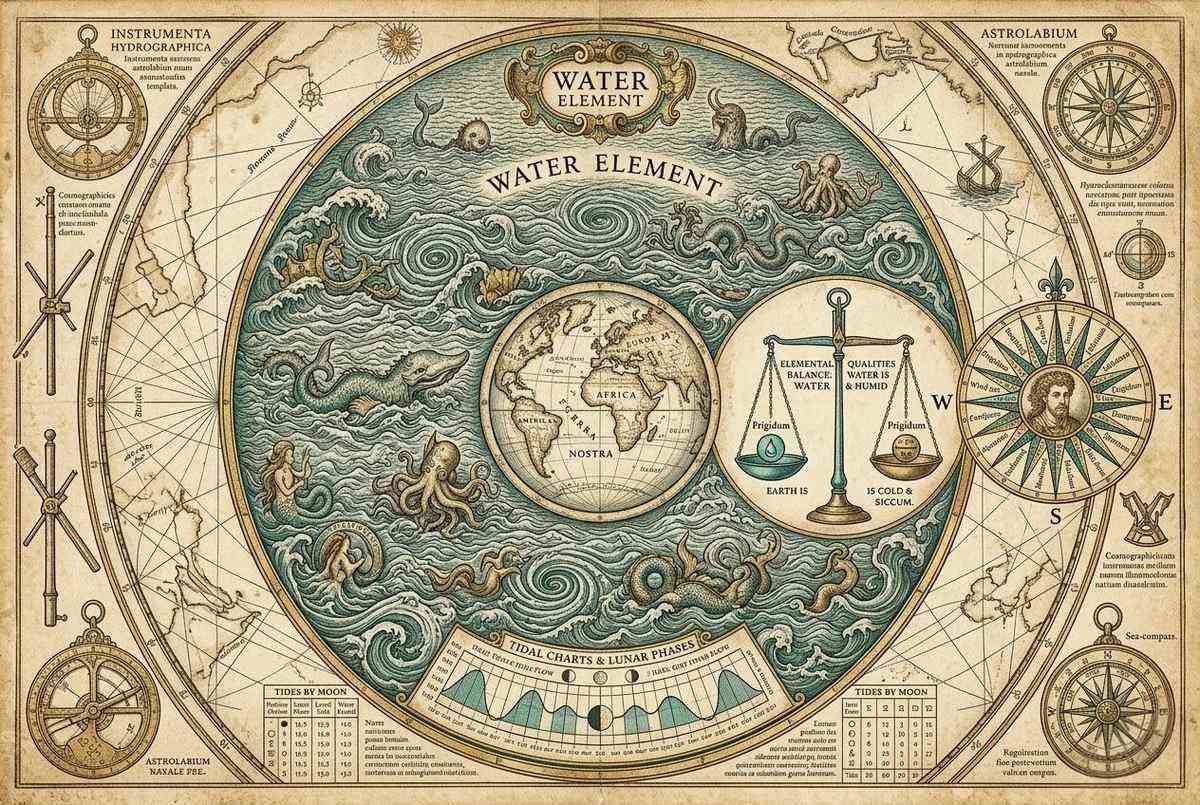
Hydrography: The Science of Water
Hydrography—the description of ocean coasts, tides, and navigational hazards—corresponds to the element of Water. Dee notes that “scarcely four, in England, have right knowledge” of the 32 points of the compass, “because the lines thereof are no straight lines, nor circles.” This is liquid administration, the mastery of fluid dynamics and tidal harmonics. Water does not behave like solid earth; it requires different measurement protocols, different mapping techniques, different permissions.
Chorography (Geography): Territorial Management
Chorography provides the regional administration of specific territories—the description of particular regions, their boundaries, resources, and characteristics. Where cosmography gives the universal view, chorography handles the local details. It is the difference between the celestial central office and the terrestrial branch locations.
Chronology: Temporal Accounting
Chronology establishes the temporal ledger—the accounting of time through historical records, calendrical systems, and the correlation of events across cultures. The magus must know not only where operations occur but when. Chronology provides the timeline against which celestial and terrestrial events synchronize.
Statics: The Balance and Occult Forces
Statics—”the experiments of the Balance”—demonstrates “the causes of heaviness and lightness of all things.” Dee’s exclamation reveals the esoteric potential: “Oh, that men wist, what profit (all manner of ways) by this art might grow!” The balance is a magical instrument, measuring not merely physical weight but occult virtues, the subtle forces that elude ordinary perception. Statics becomes the science of energetic accounting—measuring the weight of influences, the gravity of intentions.
The Optical and Technical Arts: Perspective, Trigonometry, Helicosophie, Pneumatithmie
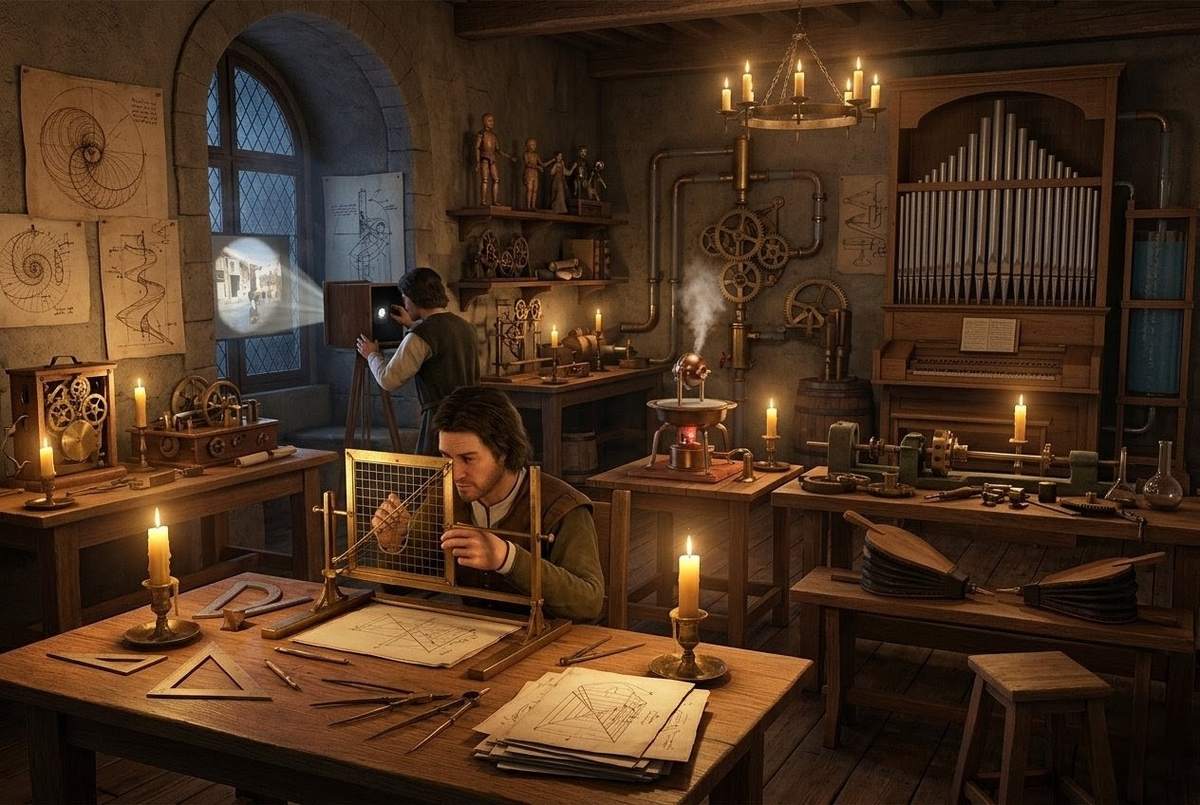
The curriculum advances to four technical arts governing light, calculation, and invisible forces: Perspective, Trigonometry, Helicosophie, and Pneumatithmie. These provide the operational tools—the instruments and techniques that extend human perception and action beyond ordinary limits.
Perspective: The Geometry of Vision
Perspective teaches the projection of three-dimensional space onto two-dimensional surfaces. For Dee, this is not merely artistic technique but perceptual training—understanding how the eye constructs reality through rays of vision. The perspectivist learns to manipulate appearance, to construct images that deceive the senses in controlled ways. This is the foundation of magical imaging—the creation of talismans, sigils, and visionary experiences through calculated geometric construction.
Trigonometry: The Measurement of Triangles
Trigonometry provides the calculational protocols for indirect measurement—determining distances and heights through angular relationships. This is essential for surveying, navigation, and astronomy. The magus uses trigonometry to measure what cannot be directly approached, to calculate the unseen dimensions of distant or inaccessible objects.
Helicosophie: The Science of Spirals
Helicosophie—the science of spirals—studies the helix, the three-dimensional curve that combines circular motion with linear progression. The spiral is the symbol of evolution, the path of growth, the unfolding of consciousness. In gnomonics (the construction of sundials), the helical shadow traces the sun’s annual motion. This is temporal topology—the mapping of time through spatial form.
Pneumatithmie: The Science of Air and Spirits
Pneumatithmie—the science of air and gases—includes “strange works” like those of Ctesibius and Hero of Alexandria, the Hellenistic engineers who created automata, water organs, and steam-powered devices. This is pneumatic magic, the manipulation of invisible forces. The Greek pneuma (πνεῦμα) means both “air” and “spirit”—the subtle medium that permeates all things. Pneumatithmie teaches the magus to work with gaseous and spiritual substances, to harness the pressure and flow of invisible currents.
The Supreme Arts: Zographie, Thaumaturgike, Architecture, Navigation
The curriculum culminates in four supreme arts that synthesise all previous knowledge: Zographie (painting), Thaumaturgike (wonder-working), Architecture, and Navigation. These are not mere professions but magical culminations—the applications of mathematical knowledge to produce transformation and marvel.
Zographie: The Art of Living Images
Zographie—painting—transcends mere representation. In Dee’s system, the painted image is a living entity, a vehicle for spiritual influence. The painter uses perspective, geometry, and colour theory to construct images that act upon the viewer’s soul. This is visual heka—the Egyptian concept of the living image adapted to Renaissance practice. The properly constructed image becomes a stationary spirit, capable of transmitting influence across time and space.
Thaumaturgike: The Supreme Art of Wonder-Working
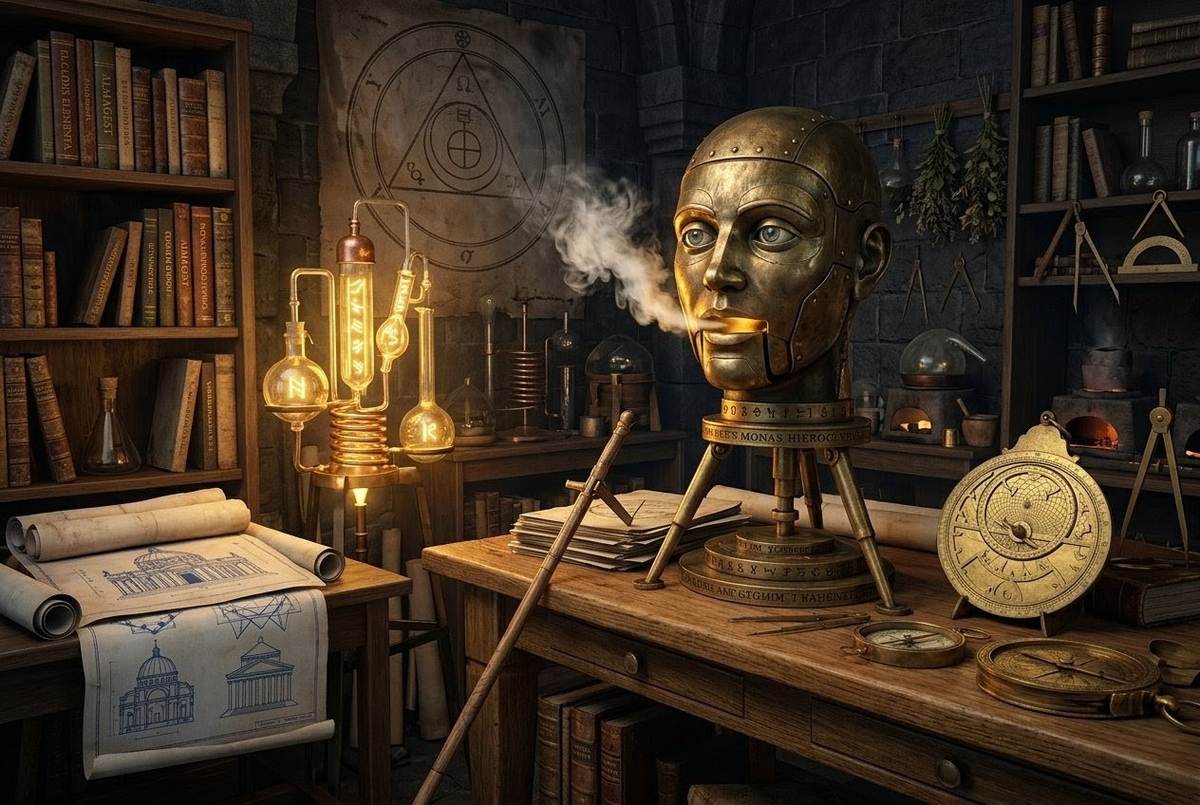
Thaumaturgike—from Greek thauma (θαῦμα), “wonder,” and ergon (ἔργον), “work”—is the supreme art of producing marvels. Dee defines it as producing “strange works, of the sense to be perceived, and of men greatly to be wondered at.” This includes automata and mechanical wonders like “the brazen head made by Albertus Magnus, which did seem to speak.”
Thaumaturgike is the applied apex of the curriculum—the art of producing effects that transcend natural expectation through the calculated application of mathematical principles. It is neither mere trickery nor supernatural miracle, but technological marvel: the production of wonder through superior knowledge of natural laws.
Architecture: The Construction of Sacred Space
Architecture synthesises geometry, arithmetic, astronomy, and statics into the construction of charged environments. The architect-magus designs buildings that harmonise with celestial proportions, that orient toward specific stellar risings, that incorporate the ratios of musical consonance. Architecture is spatial magic—the crystallisation of mathematical harmony into stone and timber, creating environments that shape the consciousness of inhabitants.
Navigation: The Art of Cosmic Travel
Navigation—including the determination of longitude and latitude at sea—represents the practical application of astronomy, geometry, and hydrography to the most challenging environment: the open ocean. But navigation is also metaphor: the soul’s journey through the cosmic ocean, the voyage of the adept across the waters of manifestation toward the port of divine union.
The navigator uses the celestial sphere as a reference grid, measuring angular distances from known stars to determine position on a featureless plane. This is orientation without landmarks—the ability to determine one’s location through relationship to the absolute rather than the relative.
“Oh, that men wist, what profit (all manner of ways) by this art might grow!” — John Dee, on the potential of mathematical arts
The Hidden Arts: Menadry, Hypogeiodia, Hydragogie
Beyond the obvious curriculum, Dee includes three specialized arts that complete the system: Menadry (military tactics), Hypogeiodia (underground surveying), and Hydragogie (water engineering). These represent applied administration—the use of mathematical knowledge for specific practical domains.
Menadry: The Mathematics of Conflict
Menadry applies geometric and arithmetic principles to military formation and strategy. It represents the bureaucracy of conflict—the organized deployment of force through calculated positioning. The magus understands that even warfare follows mathematical patterns, that victory belongs to those who comprehend the geometry of terrain and the logistics of supply.
Hypogeiodia: Subterranean Surveying
Hypogeiodia—underground surveying—extends geometry beneath the earth’s surface. This is chthonic cartography, the mapping of mines, tunnels, and subterranean waters. The magus must know not only the surface world but the depths beneath, the hidden infrastructure that supports visible reality.
Hydragogie: The Management of Waterways
Hydragogie—the construction and management of water channels, aqueducts, and drainage systems—represents liquid engineering. Water must be directed, controlled, and distributed. This art combines hydrography with practical mechanics to manage the most essential yet unpredictable of elements.
Conclusion: The Integration of the Nineteen Arts
Dee’s nineteen mathematical arts constitute a complete system of occult knowledge, a curriculum for the formation of the magus. From the celestial harmonies of Music to the wonder-working of Thaumaturgike, these arts encompass all domains of human experience and all levels of cosmic reality.
This is not academic diversification but comprehensive jurisdiction. The magus who masters these arts possesses administrative clearance across the full spectrum of reality—from the numerical foundations of arithmetic to the navigational triumph of crossing the cosmic ocean. Each art provides a different access protocol; together they constitute the master key to the universe’s operating system.
The Renaissance magus was neither scientist nor sorcerer in the modern sense, but bureaucrat of the cosmos—one who had studied the filing systems, learned the proper forms, acquired the necessary clearances, and could now move freely between departments of reality that ordinary souls found separated by impassable boundaries.
Dee’s curriculum remains relevant because it addresses a fundamental truth: reality is administrative. It follows rules, maintains records, requires proper documentation. The magus is simply one who has learned to file the correct paperwork with the appropriate celestial authorities.
What are John Dee’s nineteen mathematical arts and where do they come from?
John Dee’s nineteen mathematical arts derive from his “Mathematical Preface” to Henry Billingsley’s English translation of Euclid (1570). Dee divided these arts from his “two Mathematical fountaines”—Arithmetic and Geometry—into four categories: Foundation (Arithmetic, Geometry), Celestial (Music, Astronomy, Astrology), Elemental (Cosmography, Hydrography, Geography, Chronology, Statics), Technical (Perspective, Trigonometry, Helicosophie, Pneumatithmie), and Supreme (Zographie, Thaumaturgike, Architecture, Navigation), plus specialized arts (Menadry, Hypogeiodia, Hydragogie).
Why does Dee call these “mathematical” arts rather than magical arts?
Dee deliberately uses “mathematical” to distinguish legitimate occult science from superstition. In Renaissance usage, “mathematics” encompassed not just numbers but the Pythagorean-Platonic tradition of understanding reality through proportion, harmony, and geometric form. By grounding magic in mathematics, Dee sought to defend occult studies against accusations of diabolism, framing the magus as one who understands the natural laws and celestial mechanics governing manifestation.
What is Thaumaturgike and why did Dee consider it the supreme art?
Thaumaturgike (from Greek thauma “wonder” + ergon “work”) is the art of producing marvels—mechanical automata, speaking heads, and effects that transcend ordinary expectation. Dee considered it supreme because it represents the practical application of all previous arts. The thaumaturge uses arithmetic, geometry, astronomy, and mechanics to produce effects that appear magical to the uninitiated but are actually technological marvels achieved through superior knowledge of natural laws.
What esoteric significance does the number nineteen have in Dee’s system?
While Dee’s 1570 Preface explicitly enumerates nineteen arts (not seventeen as sometimes claimed), the number carries mathematical significance as the eighth prime number. In the context of Dee’s curriculum, nineteen represents comprehensive jurisdiction—sufficient categories to cover all domains of reality from the celestial to the subterranean, from the numerical to the navigational, without the artificial truncation implied by seventeen.
How do the “Celestial Arts” (Music, Astronomy, Astrology) function as a group?
The Celestial Arts provide access protocols to the heavens. Music (Harmonice) studies the vibrational ratios governing both audible tones and planetary motions—the “Music of the Spheres.” Astronomy provides the precise observation and calculation of celestial mechanics. Astrology interprets the influences streaming from planetary spheres to the sublunary world. Together they constitute celestial meteorology, allowing the magus to read cosmic weather patterns and time operations according to planetary permissions.
What is Pneumatithmie and how does it relate to spirit work?
Pneumatithmie (from Greek pneuma, meaning both “air” and “spirit”) is the science of air, gases, and pneumatic forces. It includes the construction of automata, water organs, and steam-powered devices by Hellenistic engineers like Hero of Alexandria. For Dee, this represents the manipulation of the subtle medium that permeates all things—the same pneuma that ancient philosophers identified with spirit. Pneumatithmie thus bridges mechanical engineering and spirit work, teaching the magus to harness invisible forces through physical apparatus.
How does Dee’s curriculum relate to modern esoteric practice?
Dee’s curriculum provides a systematic framework for esoteric education that remains relevant today. It emphasizes the necessity of mastering multiple disciplines—mathematics, astronomy, mechanics, navigation—before attempting advanced operations. This “bureaucratic” approach to magic treats reality as administratively structured, requiring proper knowledge (paperwork) to access different levels. Modern practitioners can adapt Dee’s structure by ensuring they have solid foundations in correspondences, timing, and technique before attempting complex ritual work.
Further Reading
For those seeking deeper initiation into Dee’s system:
- John Dee’s Mathematical Preface 1570: Occult Foundation of Renaissance Magic and Esoteric Mathematics — The source text for the nineteen arts, with detailed analysis of Dee’s “two Mathematical fountaines.”
- Heptarchia Mystica: John Dee’s System of Planetary Kings and Angelic Communication — Dee’s later angelic workings that build upon the mathematical foundation established in the Preface.
- Renaissance Magi & Archival Sources — The broader context of Dee’s work within Renaissance esoteric traditions and the recovery of ancient wisdom.
- The Thought of Norea: Heroine of Spiritual Resistance — Gnostic parallel to Dee’s systematic approach to hidden knowledge.
- The Table of Trithemius: Angelic Communication and Cryptographic Codes — Contemporary to Dee, Trithemius’s system demonstrates similar administrative approaches to celestial communication.
- Steganographia: Hidden Communication and the Art of Concealment — Trithemius’s work on hidden communication, relevant to Dee’s cryptographic and angelic interests.