The Art of Drawing Spirits into Crystals
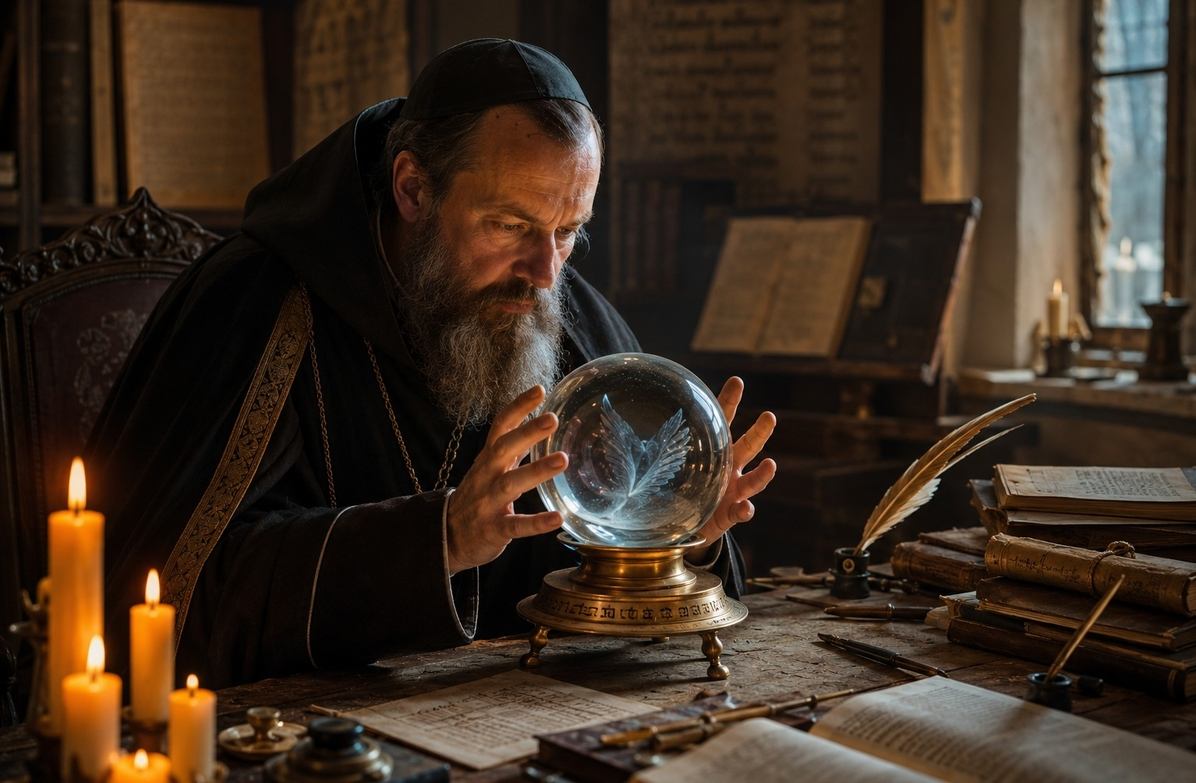
The Art of Drawing Spirits into Crystals is one of the most striking manuals of Christian theurgy in the Western esoteric archive. It presents crystal scrying not as fortune-telling spectacle, but as a disciplined attempt to establish ordered contact with angelic intelligences through prayer, purity, divine names, a consecrated circle, a crystal speculum, and careful verification.
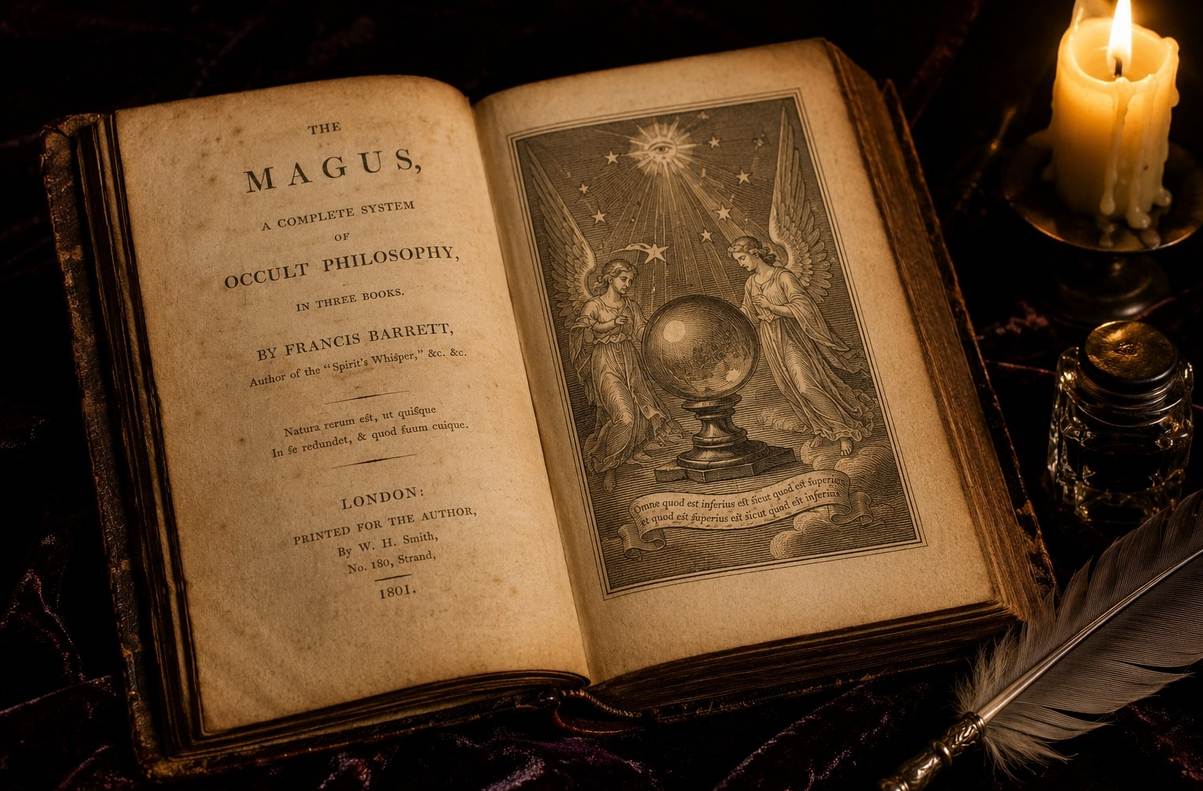
The text is traditionally attributed to Johannes Trithemius, the Benedictine abbot, cryptographer, theologian, and teacher associated with some of the deepest currents of Renaissance magic. Yet the version most readers encounter comes through Francis Barrett’s The Magus, published in 1801. That makes the work both powerful and complicated: it carries Trithemian, Solomonic, Heptameron, Christian, Neoplatonic, and later grimoire elements in a single ritual body.
This article reads the text historically, symbolically, and carefully. The crystal becomes a threshold: a polished surface where prayer, imagination, angelic hierarchy, ritual order, and altered perception meet. The question is not whether modern readers should rush to reproduce the operation. The better question is what this text reveals about sacred attention, spiritual authentication, the difference between theurgy and coercion, and the need to test every presence before granting it authority.
In Plain Terms
The Art of Drawing Spirits into Crystals is a ritual text about using a crystal or speculum as a focused medium for angelic vision and communication.
It is attributed to Johannes Trithemius, but the best-known English form appears in Francis Barrett’s The Magus from 1801, so its authorship and transmission are historically complex.
The method is Christian theurgy: prayerful communion with angelic powers under divine authority, rather than coercive spirit control.
The modern reader should approach it as history, symbolism, and contemplative technology first. It is not a casual instruction to attempt entity contact without grounding, preparation, support, and discernment.
Primary Sources and Traditions Discussed
- Francis Barrett’s The Magus: the main printed English source through which the crystal text became widely known.
- The text attributed to Johannes Trithemius: often called De Crystallo or The Art of Drawing Spirits into Crystals.
- The Heptameron tradition: especially the planetary angels, seals, hours, ritual structure, and protective formulae that shape the operation.
- Solomonic and Christian grimoire material: circles, divine names, consecration, pentacles, rings, licence to depart, and spirit authentication.
- Neoplatonic theurgy: the idea that ritual can align the soul with divine order through symbol, purity, prayer, and hierarchical mediation.
- Trithemian cryptography and angelic communication: the wider Renaissance fascination with hidden writing, coded transmission, and celestial intelligences.
- John Dee and later angelic magic: not as a direct copy, but as a related Renaissance environment where crystals, angels, tables, and records became tools of revelation.
- Gnostic discernment: the need to distinguish genuine illumination from projection, fear, spiritual glamour, false authority, and predatory contact.
How to Read This Article
This article is educational, historical, symbolic, and contemplative. It does not provide magical training, a complete operational ritual, medical advice, psychological advice, psychiatric advice, crisis support, or spiritual-direction advice.
Three layers should be kept separate. The historical text belongs to a Christian and grimoire context transmitted through Barrett. The ritual structure belongs to a world of divine names, angelic offices, circles, crystals, and planetary timing. The modern reading asks what such material reveals about attention, vision, discernment, and the careful handling of altered states.
Crystal scrying, entity language, and angelic invocation can become destabilising if mixed with fear, sleep deprivation, trauma activation, mania, psychosis, severe dissociation, paranoia, substance instability, or spiritual emergency. Study does not require imitation. Sometimes the wisest way to open an old grimoire is with both feet firmly on the floor.
The crystal is not a window for curiosity alone. It is a threshold that asks whether the gaze has been purified enough to recognise what appears.
Table of Contents
- The Celestial Hierarchy and Its Communication Protocols
- Attribution and Authorship: The Trithemian Question
- Theurgy, Not Coercion
- The Instruments of Art: Crystal, Plate, Circle, Ring, and Wand
- The Four Archangels on the Plate
- Authentication: Names, Oaths, Seals, and Record-Keeping
- Closing the Connection: Ritual Courtesy
- Historical Continuity and Dee’s Angelic World
- Internal or External? The Ontology of Angelic Contact
- The Crystal as Celestial Threshold
- The Gnostic Reading: Test Every Presence
- Related Glossary Terms
- Read Next
- Frequently Asked Questions
- Further Reading
- References and Sources
The Celestial Hierarchy and Its Communication Protocols
Johannes Trithemius, or Johannes of Trittenheim, stands at the crossroads of monastic scholarship, cryptography, angelology, and Renaissance occult philosophy. As abbot, writer, historian, and cryptographic innovator, he became associated with a world in which hidden writing and hidden spirits were not unrelated. Both involved concealed orders waiting to be read by the disciplined mind.
The Art of Drawing Spirits into Crystals belongs to that atmosphere, even if its exact authorship remains disputed. The text assumes a universe arranged through hierarchy. Above the human world stand angelic ministers, planetary intelligences, divine names, and ordered channels of communication. Below the divine source, spiritual powers are not random forces wandering through a cosmic marketplace. They belong to offices, names, ranks, seals, and appointed times.
This is why the ritual is so formal. The operator does not merely stare into a crystal and wait for spectacle. The whole apparatus is designed to create order: prayer, purification, circle, crystal, gold plate, divine names, planetary timing, archangelic guardians, interrogation, oath, diary, and formal licence to depart. Vision is placed inside a structure.
That structure matters. Unstructured vision can become fantasy, fear, grandiosity, or confusion. The text’s insistence on hierarchy, prayer, and verification reveals a key principle of Christian theurgy: not every presence should be welcomed simply because it appears.
Attribution and Authorship: The Trithemian Question
Any serious reading of this text must begin with attribution. The work is traditionally associated with Trithemius, but the version most commonly known appears in Francis Barrett’s The Magus, published in London in 1801. Barrett presents the material as translated from a valuable Latin manuscript, but scholars and editors have long noted that the text contains features connected with later grimoire traditions.
One important complication is the presence of planetary angels, hours, and seals associated with the Heptameron, a text printed after Trithemius’s death. This does not make the crystal text worthless. It means the reader should be careful. The work may preserve older elements, later compilations, Barrett’s editorial hand, or a mixture of sources moving under Trithemius’s prestigious name.
Historically, then, the safest description is this: The Art of Drawing Spirits into Crystals is a Christian theurgical crystal-scrying text attributed to Trithemius and transmitted through Barrett’s The Magus. That is less glamorous than a clean author label, but more honest.
This distinction helps the reader. We do not need to pretend the text fell intact from Trithemius’s desk to recognise its importance. It remains a coherent ritual window into late grimoire tradition, angelic hierarchy, crystal vision, and the attempt to authenticate spiritual communication.
Theurgy, Not Coercion
The word theurgy is crucial. Theurgy means a sacred work aimed at divine communion, purification, and alignment with higher powers. It differs from crude coercion. In the crystal text, the operator does not approach the spirits as disposable servants. The language is Christian, reverent, and bounded by divine authority.
The operation begins with moral preparation: prayer, purification, confession, humility, and the stated desire to receive only what serves God, truth, wisdom, healing, and the good of others. This frame matters more than the tools. The crystal is not treated as a spiritual vending machine. It is placed inside an ethical and devotional order.
The text’s Christian safeguards may seem foreign to modern esoteric readers, but they reveal the central concern: contact must be authorised, truthful, and tested. The operator seeks benevolent intelligences, not random spirits. The operation aims to prevent deception, false imagination, and harmful intrusion.
For a contemporary reader, this can be understood symbolically as well as historically. Theurgical practice says: do not open perception without also clarifying intention. Do not seek contact without testing the contact. Do not confuse power with wisdom. Do not let curiosity outrun conscience.
In the name of the holy and undefiled Spirit, the Father, the begotten Son, and Holy Ghost, proceeding from both…
The formula is not merely decorative. It establishes the operation within a Trinitarian frame. Whether read devotionally or symbolically, it shows that the ritual begins by placing vision under a higher order than personal desire.
The Instruments of Art: Crystal, Plate, Circle, Ring, and Wand
The ritual apparatus is precise. It creates a visible architecture for invisible communication. Each object has practical, symbolic, and psychological force.
The Crystal Speculum
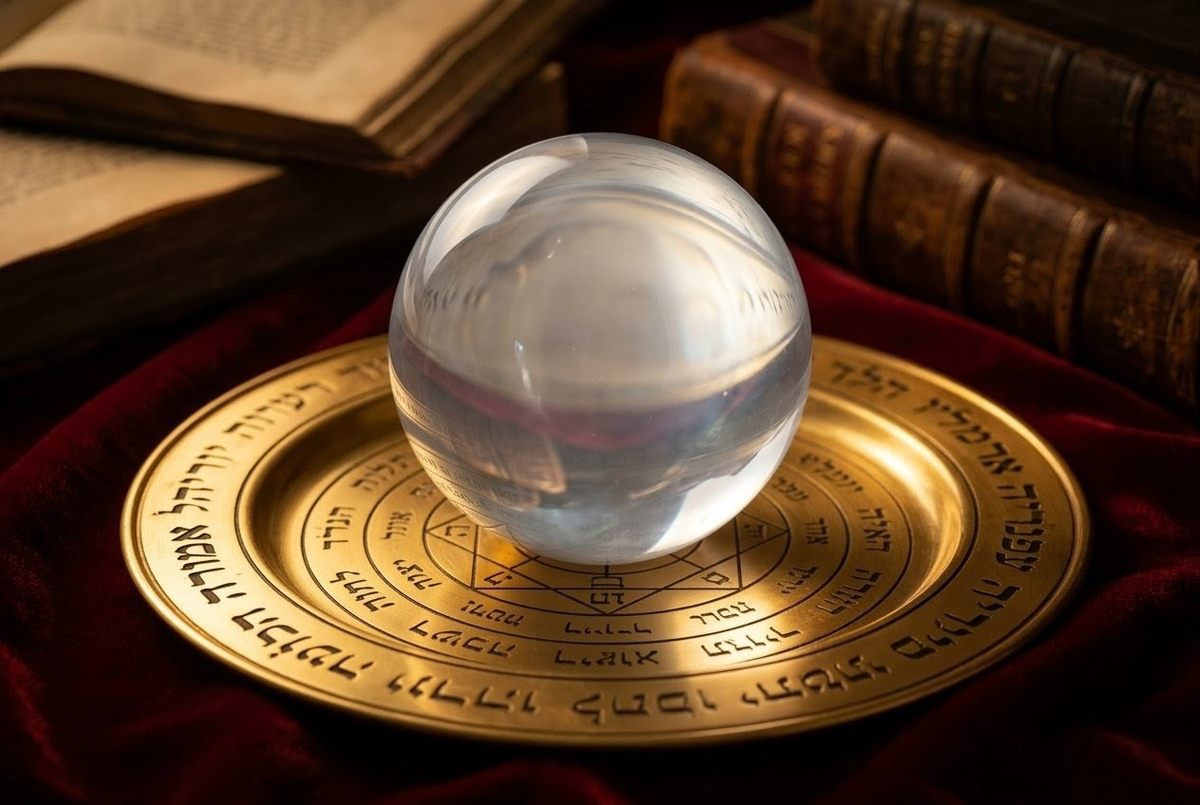
The central object is a clear crystal, traditionally described as clean, pellucid, round, and without cloud or flaw. It functions as a speculum, a seeing medium. The eye rests on the surface, ordinary visual control softens, and images may begin to arise.
Historically, this is crystallomancy. Psychologically, it is a disciplined threshold state: attention narrows, imagination becomes active, and symbolic material may take form. Spiritually, the text treats the crystal as a consecrated medium through which angelic intelligences may appear.
The requirement for clarity has more than one meaning. A clear crystal reflects the desired clarity of the operator. The instrument should not be cloudy, and neither should the intention.
The Gold Plate
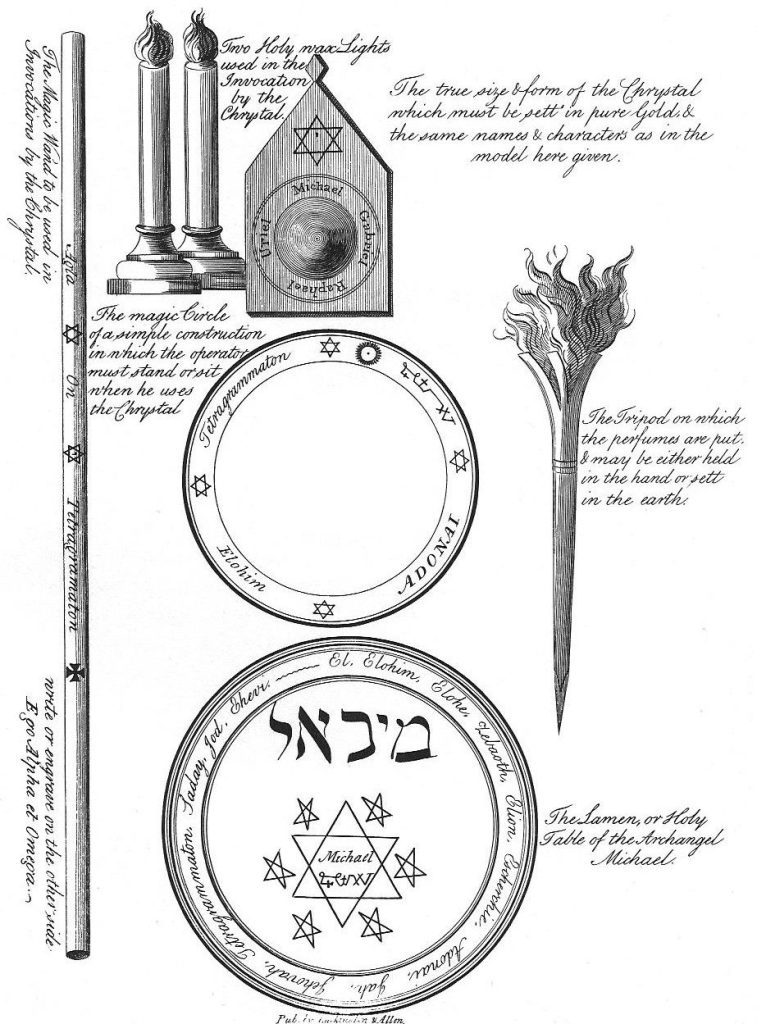
The crystal is mounted in a plate of pure gold. Gold carries solar, royal, incorruptible, and sacred associations in Western esotericism. The plate is inscribed with divine and angelic names, turning the crystal from a mere mineral object into part of a consecrated ritual structure.
The plate bears the names of four principal angels: Michael, Gabriel, Uriel, and Raphael. The source connects them with the Sun, Moon, Venus, and Mercury. Their names act as guardians, coordinates, and signs that the operation belongs to a celestial order rather than an unbounded visionary drift.
The Consecrated Circle
The operator stands or sits within a consecrated circle marked with divine names such as Tetragrammaton, Elohim, and Adonai. The circle is a boundary. It defines the ritual field, protects the operator, and separates sacred operation from ordinary space.
Symbolically, the circle teaches a permanent lesson: vision requires containment. A mind without boundary can mistake any arising image for authority. The circle says: this far, no further. It gives the gaze a centre and the encounter a limit.
The Ring, Pentacle, Wand, and Incense
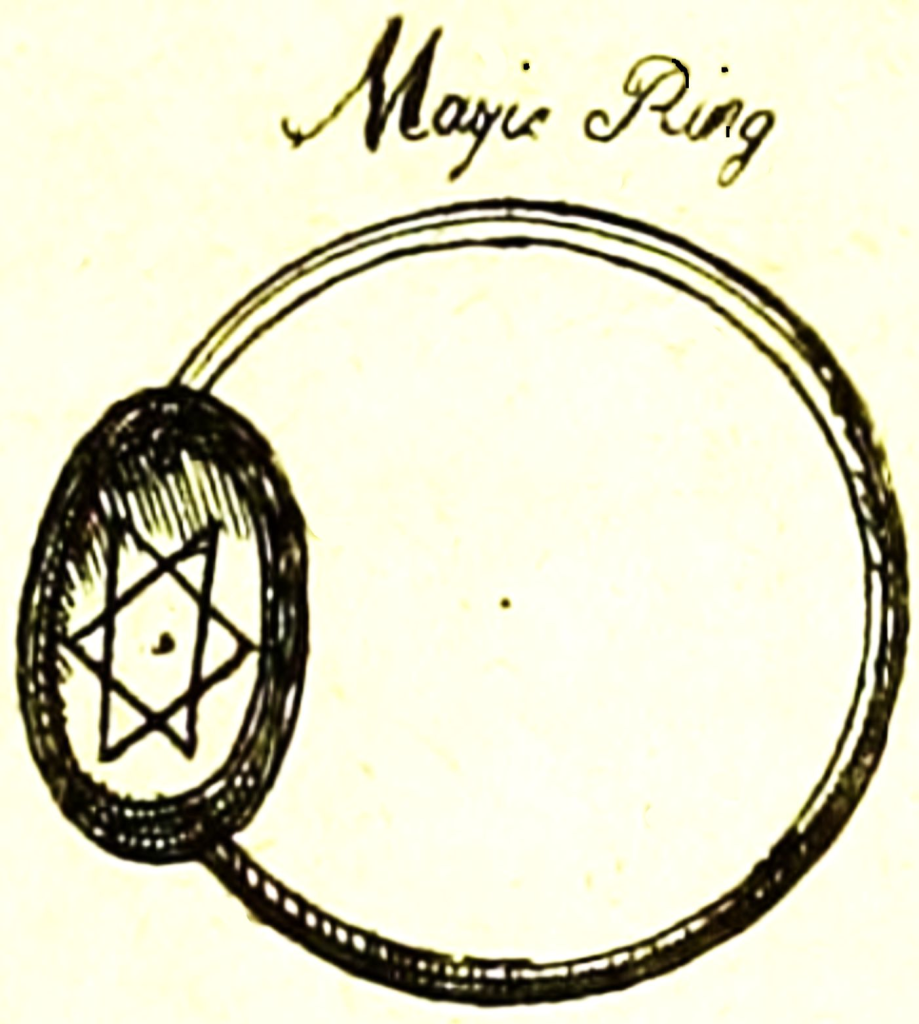
The text also describes a ring, a pentacle or lamen, a wand, candles, perfumes, and a table of practice. These objects do not merely decorate the operation. They help organise the body, voice, hand, smell, sight, and attention around a single sacred intention.
The wand marks and directs. The ring and pentacle carry protective and identifying force. The incense changes the atmosphere and marks the operation as set apart. The diary records what happens so memory does not become myth too quickly.
The Four Archangels on the Plate
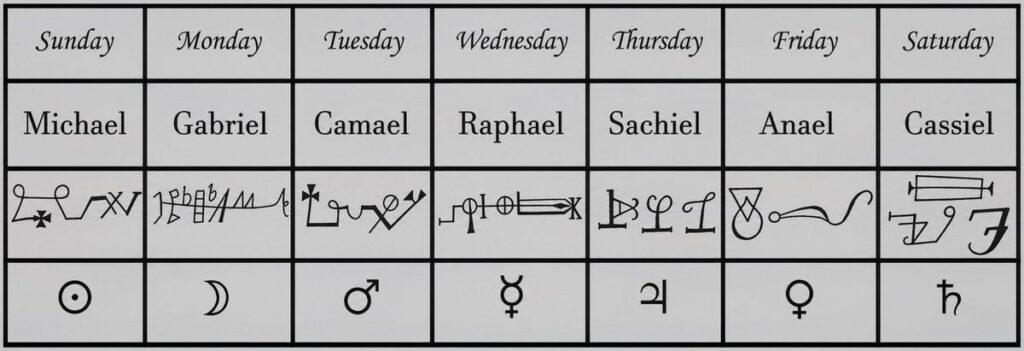
The four archangels named on the plate are not introduced as random spirits. They are senior intelligences associated with divine order, protection, message, healing, and wisdom. The text connects them to the planetary sequence of Sun, Moon, Venus, and Mercury, while later traditions may arrange their correspondences differently.
Michael: Solar Protection and Authority
Michael is the great angel of protection, judgement, courage, and solar authority. In the crystal text, Michael often appears as the model figure for contact and verification. His name carries the force of spiritual defence and lawful illumination.
In reader-facing terms, Michael represents the protective clarity needed before any visionary work. Without that clarity, the crystal becomes a theatre of whatever the mind fears or desires. Michael stands for the cut of truth through confusion.
Gabriel: Message, Moon, and Revelation
Gabriel is traditionally associated with annunciation, message, dream, and revelation. In the planetary frame of the text, Gabriel belongs to the lunar current: reflection, imagination, image, and the reception of what descends from above into human awareness.
Gabriel reminds the reader that revelation is not only force. It is also receptivity. The message must be received cleanly, not distorted by fear, vanity, or haste.
Uriel: Hidden Wisdom and Earthly Illumination
Uriel is often associated with light, hidden wisdom, prophecy, and the illumination of what is concealed. In the text’s planetary grouping, Uriel is linked with Venus. In other traditions, Uriel may appear in different symbolic roles, including earth, fire, or wisdom.
This flexibility matters. Angelic names do not always sit neatly inside modern correspondence tables. Uriel’s role here is best read as an office of hidden light: knowledge that must be approached with reverence rather than extracted like a resource.
Raphael: Healing, Mercury, and Right Transmission
Raphael is associated with healing, travel, medicine, and guidance. In the crystal text, Raphael is connected with Mercury, the planet of transmission, movement, interpretation, and crossing between realms.
Raphael’s presence matters because visionary work always involves passage. Something moves between seen and unseen, inner and outer, ordinary mind and symbolic field. The passage must be healthy. A message that wounds the vessel is not yet wisdom.
Authentication: Names, Oaths, Seals, and Record-Keeping
The most important feature of the ritual is not the crystal itself. It is authentication. The text does not assume that every appearing spirit is trustworthy. It requires the operator to ask the spirit’s name, office, character, appointed times, and oath.
This is not accidental. Spirit contact, dream contact, symbolic contact, and altered-state experience all share the same danger: the appearing image may feel more authoritative than it deserves. A figure in the crystal may speak beautifully and still be projection, fantasy, lower influence, fear, or spiritual theatre.
The True Name
The first interrogation asks for the spirit’s true name. In grimoire logic, the name is not a label only. It is identity, authority, and traceable signature. To ask for the name is to refuse vague presence. The operator demands specificity.
As a contemplative principle, this remains useful. Do not obey a mood simply because it is intense. Do not obey a vision simply because it is luminous. Ask what it is, what it does, what it produces, and whether it can stand inside truth.
Office, Character, and Time
The text asks for the spirit’s office, character, and appointed time. These questions place the encounter inside order. What is your function? What is your seal? When may you be consulted? In other words: are you accountable, bounded, and recognisable?
That is a powerful contrast with modern spiritual vagueness. Any inner or outer presence that refuses accountability while demanding obedience should be treated with caution. True guidance clarifies. False guidance clouds the room and asks for control.
The Binding Oath
The ritual requires the spirit to swear by Christ’s blood and righteousness that it is truly the being it claims to be. This oath belongs to the Christian framework of the text. It functions as a test of truth, a safeguard against deception, and a way of placing the entire encounter under divine judgement.
Modern readers do not need to share every theological assumption to understand the principle. The encounter must be tested by the highest truth the practitioner recognises. No presence, vision, voice, teacher, or inner force should be given authority if it cannot pass through conscience, humility, clarity, and care.
The Magical Diary
The operator is instructed to keep written records: names, seals, offices, times, appearances, and communications. This is one of the most grounded parts of the text. The diary protects against exaggeration, memory distortion, and spiritual intoxication.
A record allows discernment over time. Did the message prove useful? Did it increase humility and clarity? Did it produce fear, pride, isolation, or obsession? The diary turns visionary experience into something that can be reviewed rather than worshipped.
Closing the Connection: Ritual Courtesy
The ritual concludes with a formal licence to depart. This closing is not a throwaway line. It shows the difference between theurgy and coercive spirit manipulation. The spirit is addressed with dignity, released in peace, and the operation is returned to divine praise.
Thou great and mighty spirit, inasmuch as thou camest in peace and in the name of the ever blessed and righteous Trinity, so in this name thou mayest depart…
The structure is simple and profound: open correctly, test carefully, receive soberly, close respectfully. Many modern spiritual problems begin because people know how to open states but not how to close them. The old texts, for all their strangeness, often understood the necessity of return.
Historical Continuity and Dee’s Angelic World
The crystal text sits within a wider history of Western esotericism: Solomonic magic, Christian prayer, Neoplatonic ascent, angelic hierarchy, planetary timing, cryptography, and Renaissance curiosity about hidden orders. Its world is not far from the world of John Dee, even though the historical lines of influence must be handled carefully.
Dee and Kelley’s angelic work used crystals, tables, seals, angelic language, visionary reports, and meticulous record-keeping. The resemblance to the crystal text is not surprising. Both belong to a culture where revelation was expected to arrive through disciplined instruments, not vague inspiration alone.
Trithemius also matters because of cryptography. His Steganographia became infamous precisely because it seemed to blur hidden writing and angelic communication. Whether one reads that text as cryptographic manual, occult work, or both, it reveals the Renaissance fascination with concealed transmission. Messages could be hidden in text. Perhaps they could also be hidden in the cosmos.
The crystal therefore belongs to a larger Renaissance dream: that heaven, language, mathematics, ritual, and mind might all be linked through a hidden architecture. To gaze into the crystal is to ask whether creation itself is written in symbols the purified eye can learn to read.
Internal or External? The Ontology of Angelic Contact
Modern readers often ask whether the spirits in crystal scrying are internal or external. The historical text treats them as real created intelligences: angelic beings who serve divine providence. A psychological reader may interpret them as archetypal forms, symbolic projections, dissociated material, or imaginal presences. A transpersonal reader may look for a middle territory between psyche and cosmos.
The question is important, but it should not be answered too quickly. Some experiences feel interior and still teach truth. Some experiences feel exterior and still contain projection. Some visionary encounters may belong to what Jung called the psychoid: a boundary region where psyche and world are not easily separated.
The practical test is not only “where did this come from?” It is also “what does it produce?” Does the contact increase clarity, humility, compassion, responsibility, and groundedness? Or does it produce fear, inflation, dependency, secrecy, obsession, or loss of function?
The crystal may show an angel, an image, a thought-form, a dream fragment, a wish, a warning, or a mirror of the operator’s own state. Discernment keeps all possibilities in view without forcing one answer to rule the whole field.

The Crystal as Celestial Threshold
The crystal is more than a magical object. It is a threshold. It gathers light, reflects the gaze, interrupts ordinary visual habit, and gives the imagination a surface on which hidden material can appear. The mineral becomes a meeting point between body, eye, symbol, prayer, and expectation.
In the Christian theurgical reading, the crystal is consecrated so that no evil fantasy may appear in it, or that any such intrusion may be constrained to speak truthfully. This is an extraordinary idea: the problem is not simply seeing. The problem is truthful seeing.
That remains the central lesson. The untrained gaze may see what it wants, fears, or imagines. The disciplined gaze asks for truth. The difference between the two is the difference between spiritual theatre and spiritual perception.
Whether approached as historical curiosity, psychological technique, or spiritual practice, The Art of Drawing Spirits into Crystals reveals the Renaissance ambition to reconcile magic, devotion, science, and sacred order. It is not a crude manual of spirit control. It is a ritual grammar of contact, caution, and return.
The Gnostic Reading: Test Every Presence
From a Gnostic angle, the crystal text is fascinating because it is obsessed with authentication. Gnostic traditions warn against archons, false rulers, counterfeit spirit, imitation light, and authorities that claim power without true knowledge. The crystal text, in its own Christian theurgical language, shares the concern that not every spirit should be trusted.
The question is not whether every angelic system is automatically liberating. Hierarchies can become traps. Rituals can become theatre. Seals can become superstition. A beautiful vision can become a cage if the seeker begins to worship the experience rather than seek truth.
But the opposite error is also real. To dismiss all spiritual vision as fantasy may close the very faculty by which symbolic and contemplative knowledge arrives. The Gnostic reading does not choose between naive belief and flat denial. It tests the field.
Does the presence strengthen direct knowing? Does it honour conscience? Does it produce humility rather than inflation? Does it clarify the divine spark or bury it beneath spiritual glamour? Does it return the reader to embodied life with more truth, or pull them away into obsession?
The crystal is a mirror. The angel may appear there. So may the shadow. So may the desire to be important. So may the longing for divine order. The work begins when the seeker can tell the difference.
Related Glossary Terms
For quick definitions, use the main ZenithEye Glossary. The key terms for this article are:
Read Next
Continue with: Heptarchia Mystica: Commanding the 7 Planetary Kings of John Dee
If this article explores crystal-scrying and angelic authentication through the Trithemian tradition, the next step is Dee’s sevenfold planetary order: kings, princes, ministers, seals, timing, and the recovery of sacred rhythm.
Within Practice & Method
This article belongs to Planetary Operations & Angelic Curriculum, the Practice & Method layer where angelic systems, planetary timing, ritual order, sacred names, contemplative discipline, and spiritual authority are read with grounded discernment.
Frequently Asked Questions About Drawing Spirits into Crystals
What is The Art of Drawing Spirits into Crystals?
The Art of Drawing Spirits into Crystals is a Christian theurgical crystal-scrying text traditionally attributed to Johannes Trithemius and preserved in Francis Barrett’s The Magus. It describes a method for using a consecrated crystal, divine names, angelic guardians, prayer, and verification to seek contact with angelic spirits.
Did Trithemius really write The Art of Drawing Spirits into Crystals?
The authorship is disputed. The best-known English version appears in Francis Barrett’s The Magus from 1801, and the text includes elements connected with later grimoire traditions such as the Heptameron. It is safest to describe the work as attributed to Trithemius and transmitted through Barrett rather than as certainly written by Trithemius himself.
What is crystallomancy?
Crystallomancy is the practice of using a crystal as a seeing medium or speculum. The gaze rests on the crystal while images, impressions, symbols, or visions arise. In this text, crystallomancy is framed as Christian theurgy rather than casual fortune-telling.
What is the difference between theurgy and goetia?
Theurgy seeks communion with divine or angelic powers through purification, prayer, and alignment with sacred order. Goetia is often associated with conjuring or constraining spirits, especially lower spirits. The crystal text presents itself as theurgical because it emphasises divine names, moral preparation, angelic hierarchy, and respectful dismissal.
Why are Michael, Gabriel, Uriel, and Raphael used in the crystal text?
The four archangels are engraved on the gold plate around the crystal and act as guardians or celestial coordinates. The source connects them with the Sun, Moon, Venus, and Mercury. Their presence helps frame the operation within an angelic and divine hierarchy rather than an unbounded spirit encounter.
Is this article a ritual instruction manual?
No. This article explains the text historically, symbolically, and spiritually. It does not provide magical training or encourage readers to attempt angelic operations. The emphasis is on source context, discernment, safety, and understanding how crystal scrying functioned within Christian theurgical tradition.
Is crystal scrying safe?
Crystal scrying can be destabilising for some people, especially when mixed with fear, sleep deprivation, trauma activation, mania, psychosis, severe dissociation, paranoia, substance instability, or spiritual emergency. Readers should approach such material cautiously and prioritise grounding, support, sleep, ordinary care, and qualified help when needed.
How does this text relate to John Dee and Enochian magic?
The crystal text is not the same as John Dee’s Enochian system, but it belongs to a related Renaissance and grimoire environment of angelic contact, scrying, tables, seals, divine names, and record-keeping. It helps illuminate the wider culture in which Dee’s angelic work became possible.
Study and Safety Note
This article explores crystallomancy, angelic invocation, theurgy, divine names, scrying, spirit contact, Christian grimoire material, Trithemian attribution, and Renaissance esotericism for educational and reflective purposes. It does not provide magical training, ritual instruction, medical advice, psychological advice, psychiatric advice, crisis support, or spiritual-direction advice.
Do not intensify crystal scrying, ritual, trance, sleep deprivation, fasting, or entity-contact practices if you are experiencing panic, mania, psychosis, severe dissociation, paranoia, frightening voices, command experiences, trauma flashbacks, suicidal thoughts, substance instability, or difficulty functioning. Seek qualified support where needed.
Visionary work should deepen discernment, humility, ethical clarity, and embodied presence. If a practice makes you more frightened, grandiose, isolated, sleepless, obsessive, or unable to function, stop and return to grounding, ordinary support, and qualified care.
Further Reading
These ZenithEye links continue the themes of crystal scrying, John Dee, angelic communication, cryptographic systems, planetary order, spiritual authority, and grounded visionary practice:
- Heptarchia Mystica: Commanding the 7 Planetary Kings of John Dee – Dee’s sevenfold angelic and planetary order, read through kings, princes, ministers, seals, timing, and sacred rhythm.
- Scrying the Enochian Aethyrs: The Ultimate Guide to Higher Dimensional Gnosis – Dee’s visionary Aethyr sequence, read as a map of ascent, symbolic ordeal, and altered-state discernment.
- The Table of Trithemius: Decoding Celestial Cryptography – Angelic communication, hidden writing, cryptographic imagination, and the code-world behind Renaissance magic.
- The Steganographia: 400 Years on the Vatican’s Banned List for Hacking the Angelic Mainframe – Trithemius, secret writing, angelic transmission, and the strange overlap between cryptography and occult communication.
- The 19 Occult Arts: John Dee’s Complete Renaissance Magic Curriculum – Dee’s wider magical curriculum, showing how mathematics, astrology, optics, navigation, mechanics, and contemplative discipline formed part of a larger Renaissance programme of sacred knowledge.
- 7 Hidden Keys to John Dee’s Mathematical Preface – The mathematical, philosophical, and symbolic infrastructure behind Dee’s sacred science.
- 7 Ancient Protection Rituals from Gnostic Texts – Protection, discernment, sacred names, and spiritual boundary practices across ancient sources.
- Hermeticism vs Gnosticism: 7 Essential Distinctions – The philosophical background behind theurgy, ascent, divine mind, and direct knowledge.
- The Living Thread: How Forbidden Knowing Survives the Fire – The transmission of hidden knowledge through texts, lineages, symbols, and memory.
- The Hidden Agreements: 7 Esoteric Lineages That Shaped Western Spirituality – The wider network of Western esoteric currents, initiatory systems, and symbolic inheritances.
- Integration and Grounding: 7 Keys to Mystical Experience – Practical grounding after visionary, mystical, ritual, or destabilising experience.
References and Sources
The following sources support the historical, textual, esoteric, psychological, and comparative framework used in this article.
Primary and Early Printed Sources
- Barrett, Francis. The Magus, or Celestial Intelligencer; Being a Complete System of Occult Philosophy. Lackington, Allen, and Co., London, 1801.
- The Art of Drawing Spirits into Crystals, attributed to Johannes Trithemius, preserved through Barrett’s The Magus and related manuscript and grimoire transmission.
- Pietro d’Abano, attributed. Heptameron, or Magical Elements. Printed 1559 and later editions. Important for planetary angels, hours, seals, and ritual procedures.
- Agrippa, Heinrich Cornelius. De Occulta Philosophia Libri Tres. 1533. English translation by John French, 1651. Modern edition edited by Donald Tyson, Llewellyn, 1993.
- Pseudo-Dionysius the Areopagite. The Celestial Hierarchy. Various translations. Foundational Christian angelological source for hierarchical thinking.
- Iamblichus. De Mysteriis. Translated by Emma C. Clarke, John M. Dillon, and Jackson P. Hershbell. Society of Biblical Literature, 2003.
Trithemius, Cryptography, and Magical Theology
- Trithemius, Johannes. Steganographia. First printed in 1606, composed earlier. Important for the overlap of cryptography, angelic names, and hidden transmission.
- Trithemius, Johannes. Polygraphia. 1518. Early cryptographic work relevant to Renaissance systems of hidden writing.
- Brann, Noel L. Trithemius and Magical Theology: A Chapter in the Controversy over Occult Studies in Early Modern Europe. SUNY Press, 1999.
- Peterson, Joseph H., ed. Esoteric Archives edition of The Art of Drawing Spirits into Crystals, with textual notes on attribution, Heptameron parallels, and later grimoire features.
- Hanegraaff, Wouter J., ed. Dictionary of Gnosis and Western Esotericism. Brill, 2005.
John Dee, Angelic Magic, and Renaissance Context
- Dee, John. John Dee’s Five Books of Mystery: Original Sourcebook of Enochian Magic. Edited by Joseph H. Peterson. Weiser Books, 2003.
- Casaubon, Meric, ed. A True & Faithful Relation of What Passed for Many Years Between Dr. John Dee and Some Spirits. London, 1659.
- Harkness, Deborah E. John Dee’s Conversations with Angels: Cabala, Alchemy, and the End of Nature. Cambridge University Press, 1999.
- French, Peter J. John Dee: The World of an Elizabethan Magus. Routledge, 1972.
- Yates, Frances A. The Occult Philosophy in the Elizabethan Age. Routledge, 1979.
- Asprem, Egil. Arguing with Angels: Enochian Magic and Modern Occulture. SUNY Press, 2012.
- Clucas, Stephen, ed. John Dee: Interdisciplinary Studies in English Renaissance Thought. Springer, 2006.
Visionary Experience, Scrying, and Psychology
- Tart, Charles T. Altered States of Consciousness. Wiley, 1969.
- Jung, C. G. The Archetypes and the Collective Unconscious. Collected Works, Vol. 9, Part I. Princeton University Press.
- Jung, C. G. The Structure and Dynamics of the Psyche. Collected Works, Vol. 8. Princeton University Press.
- Hillman, James. The Dream and the Underworld. Harper & Row, 1979.
- Grof, Stanislav and Grof, Christina. Spiritual Emergency: When Personal Transformation Becomes a Crisis. Tarcher, 1989.
- Lindahl, Jared R., et al. “The Varieties of Contemplative Experience: A Mixed-Methods Study of Meditation-Related Challenges in Western Buddhists.” PLOS ONE, 12(5), 2017.
- Treleaven, David A. Trauma-Sensitive Mindfulness: Practices for Safe and Transformative Healing. W. W. Norton, 2018.
Gnostic and Comparative Discernment Context
- Robinson, James M., ed. The Nag Hammadi Library in English. Revised edition. HarperOne, 1990.
- Meyer, Marvin, ed. The Nag Hammadi Scriptures. HarperOne, 2007.
- Layton, Bentley. The Gnostic Scriptures. Yale University Press, 1987.
- Brakke, David. The Gnostics: Myth, Ritual, and Diversity in Early Christianity. Harvard University Press, 2010.
- King, Karen L. What Is Gnosticism?. Harvard University Press, 2003.
- Copenhaver, Brian P. Hermetica: The Greek Corpus Hermeticum and the Latin Asclepius. Cambridge University Press, 1992.
- Dodds, E. R. The Greeks and the Irrational. University of California Press, 1951.