
Egyptian Wisdom for Modern Seekers: Anubis, the Tongue, and the Power of Sacred Speech
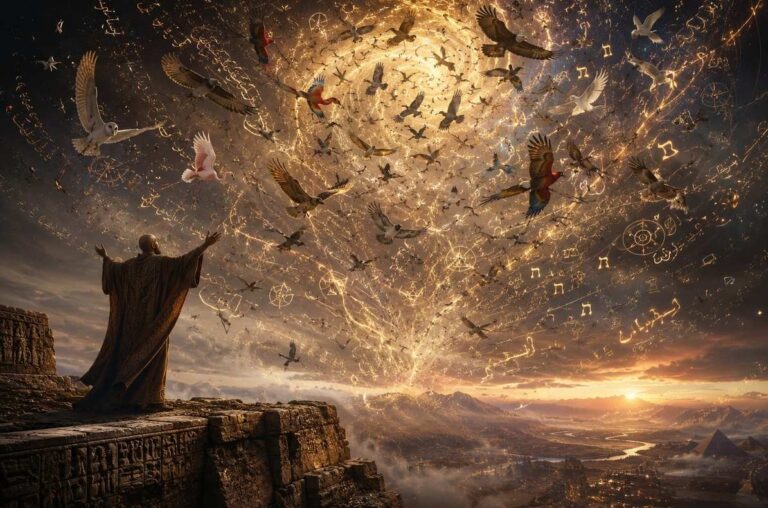
Ancient Egyptian religion treated speech as power. Words were not merely sounds in the air or labels placed upon things. They could bless, bind, protect, restore, guide the dead, summon divine presence, and bring hidden order into visible form. In this world, the tongue was not just an organ of communication. It was a threshold where breath, intention, memory, and sacred force entered the world.
In Plain Terms
Ancient Egyptian sacred speech was based on the idea that words have real force. This force was called heka, often translated as magic, but better understood as a creative power woven into the structure of the world. Gods used heka. Priests used heka. Rituals, names, hymns, spells, temple recitations, and funerary texts all depended on the right use of sacred speech.
Anubis belongs to this world because he guards thresholds. He is associated with embalming, the dead, burial grounds, protection, and the journey through the Duat, the Egyptian underworld. In funerary ritual, speech had to be restored to the deceased through the Opening of the Mouth ceremony. Without the ability to speak, name, answer, recite, and identify, the soul could not safely continue its journey.
The deeper lesson is not that modern readers should imitate ancient Egyptian ritual. It is that speech matters. Words shape relationships, memory, identity, ritual, imagination, and moral order. Ancient Egypt gives one of the world’s most powerful models of language as sacred responsibility.
Primary Sources and Traditions Discussed
- Anubis: jackal-headed guardian of burial, embalming, thresholds, and the soul’s passage through death.
- Heka: Egyptian creative force, sacred speech, ritual power, and the divine energy through which words act.
- Opening of the Mouth: funerary ritual restoring the senses, especially speech, to the deceased or to a sacred statue.
- Ptah and Memphite Theology: creation through heart and tongue, thought and speech, intention and utterance.
- Thoth and Seshat: divine powers of writing, measurement, memory, wisdom, and sacred record-keeping.
- True names: the belief that a name contains access to the essence, power, and identity of a being.
- Maat: truth, justice, right order, and the ethical dimension of speech.
- The Book of the Dead: funerary texts, spells, declarations, names, and formulas for the soul’s journey through the afterlife.
- Ba, ka, and akh: Egyptian soul-aspects and the role of ritual language in sustaining, guiding, and transfiguring them.
How to Read Egyptian Sacred Speech
Egyptian sacred speech should be read neither as primitive superstition nor as a modern self-help technique in ancient costume. It belongs to a religious world where language, ritual, image, body, temple, deity, and cosmic order were tightly woven together. A word did not work alone. It worked because it was spoken within a meaningful structure: correct context, correct role, correct name, correct gesture, correct intention, correct relationship to maat.
This is why the Egyptians cared so deeply about names, recitations, inscriptions, funerary texts, and ritual restoration of the mouth. Speech was not only personal expression. It was participation in order. Words could maintain the world or disturb it. They could open a gate or fail at the threshold.
For modern readers, the safest and strongest approach is contemplative rather than imitative. The question is not “how do I perform Egyptian heka?” The better question is: what would change if speech were treated as sacred, consequential, embodied, and morally accountable?
Table of Contents
- The Tongue as Threshold
- The Opening of the Mouth
- Heka: The Word as Creative Force
- Thoth and Seshat: The Divine Scribes
- The True Name: Knowledge as Power
- Maat: Speech in Accordance with Cosmic Order
- Sound, Breath, and Sacred Presence
- The Book of the Dead: Words for the Journey
- The Duat: The Landscape of Transformation
- Ba, Ka, and Akh: Speech and the Soul
- The Temple as Architecture for Sacred Speech
- Modern Reflections: Recovering Reverence for Speech
- The Invitation: Speaking as Sacred Act
- Related Glossary Terms
- Read Next
- Frequently Asked Questions
- Further Reading
- References and Sources
The Tongue as Threshold
The tongue stands between inner and outer worlds. Before speech, thought remains private, silent, and unformed. Through the tongue, breath becomes sound, sound becomes word, and word enters the shared world where others can hear, remember, obey, resist, bless, or be changed by it.
Ancient Egyptian religion understood this threshold with unusual seriousness. Speech was not treated as harmless noise. It could create obligation, restore life, transmit identity, preserve memory, invoke gods, and support the order of maat. In sacred contexts, the tongue became an instrument through which the invisible entered the visible.
Anubis belongs at this boundary. As guardian of burial and guide of the dead, he presides over transitions where ordinary identity is unstable. The living become dead. The body becomes mummy. The person becomes traveller. In such states, correct speech matters. Names, formulas, declarations, and ritual words help the soul cross from one condition into another.
Anubis and Speech at the Boundary
The jackal was associated with cemeteries, deserts, burial grounds, and the margins of settled life. Jackals move where human order thins and the unknown begins. This made the jackal an ideal image for a guardian of thresholds. Anubis watches the border between life and death, form and dissolution, body and afterlife.
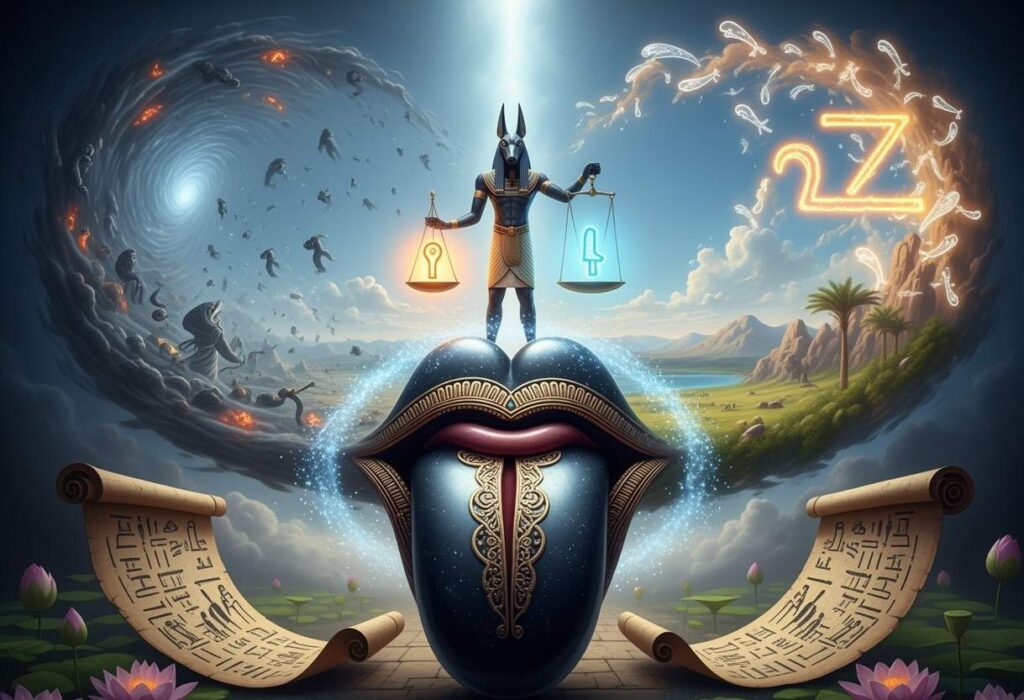
In that role, Anubis is not only a god of death. He is a god of correct passage. He protects the vulnerable dead, oversees embalming, and appears in the judgment scene where the heart is weighed against the feather of maat. His world is full of names, formulas, ritual precision, and truthful declaration.
Speech at the threshold must be clear because the threshold is dangerous. Confusion, false naming, forgetting, and silence can all become obstacles. The soul must know who it is, where it is going, and what words open the way.
In ancient Egyptian religion, sacred speech was not merely communication. It was a force of passage, protection, restoration, and creation, especially in rituals surrounding death and the afterlife.
The Opening of the Mouth
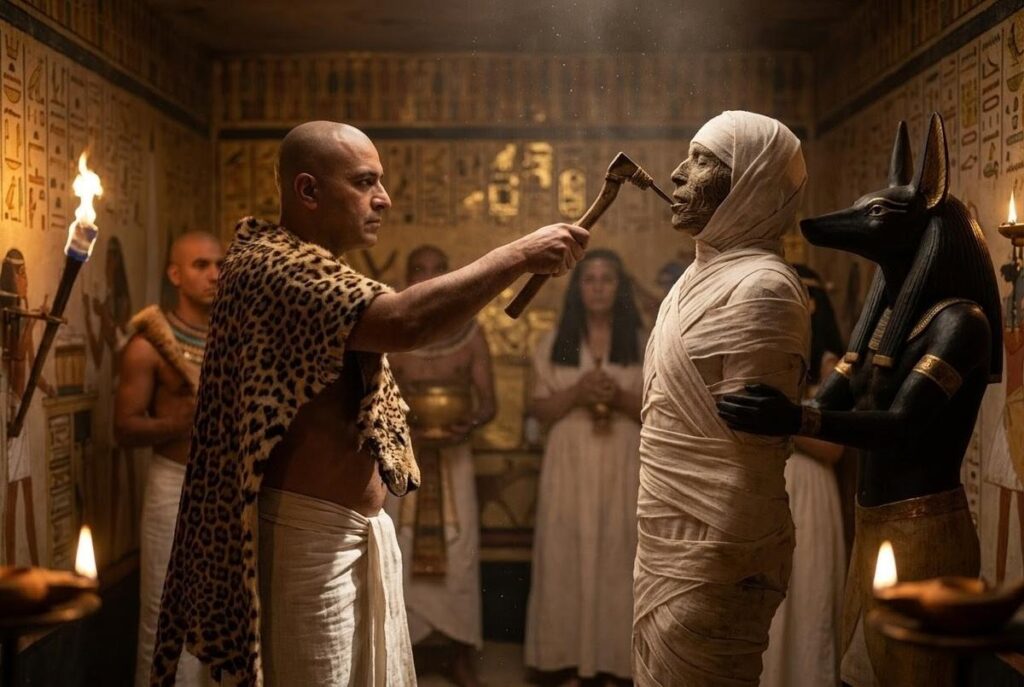
The Opening of the Mouth ceremony reveals how central speech was to Egyptian ideas of life, death, and spiritual continuity. This ritual was performed on mummies and statues to restore or activate their senses. The mouth, eyes, ears, and nose were touched with ritual instruments so the deceased or divine image could speak, see, hear, breathe, receive offerings, and participate in sacred life.
The name of the ceremony gives the clue: the mouth must be opened. Without speech, the deceased cannot recite necessary formulas, answer divine beings, identify themselves, receive nourishment, or move safely through the afterlife. Death threatens silence. Ritual restores voice.
The Ritual Toolkit
The ceremony used specialised implements, including tools associated with cutting, opening, touching, and restoring function. The peseshkaf, often linked with birth and ritual opening, and the adze, used in the ceremonial touching of the mouth, both show how physical gesture and sacred speech worked together.
The ritual does not simply “pretend” that the dead can speak. It enacts a religious truth: the person must be made capable of relationship again. To speak is to participate. To name is to locate oneself. To answer is to survive the encounter with divine order.
Speech as Restored Agency
The Opening of the Mouth can be read as the restoration of agency. The dead person is not a mute object. Through ritual, they become able to speak, eat, breathe, see, and move into the next phase of existence. The ceremony insists that voice belongs to life, and that spiritual continuity requires more than preservation of the body.
For modern readers, this is one of the most striking Egyptian insights: speech is not secondary to identity. It is part of how identity acts. To lose the power of speech is to lose a form of participation in reality. To restore speech is to restore the person’s ability to meet the world.
Heka: The Word as Creative Force
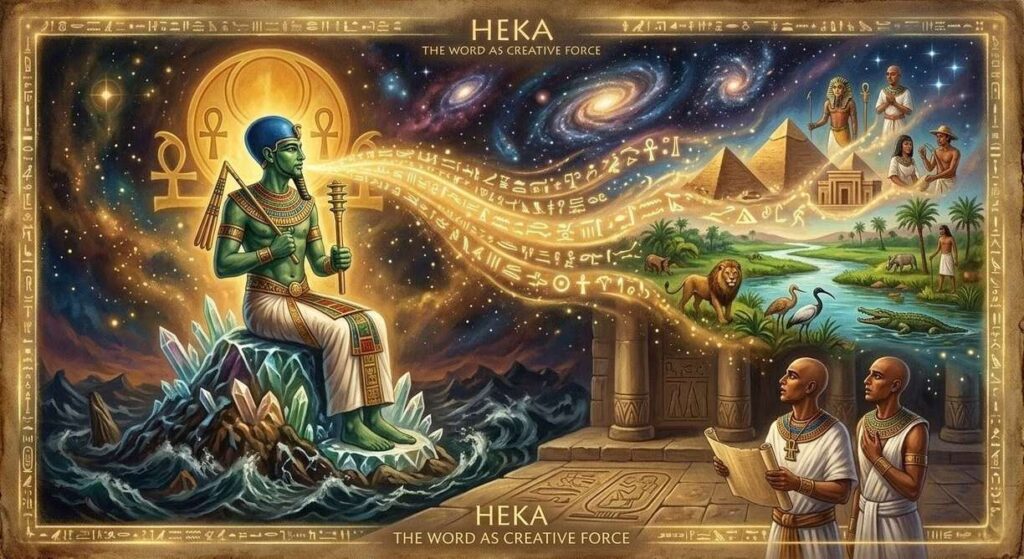
Heka is often translated as magic, but the word carries a deeper and wider meaning. Heka is creative force, sacred power, ritual effectiveness, and the capacity of words and actions to participate in reality’s formation. It was not merely human sorcery. It was part of the divine order itself.
In Egyptian thought, the gods themselves used heka. Creation, protection, healing, transformation, and ritual restoration all depended on this power. Words were not empty signs. When properly spoken within the right sacred framework, they could act.
Ptah and the Memphite Theology
The Memphite Theology gives one of the clearest Egyptian visions of creation through thought and speech. Ptah conceives the world in the heart and brings it forth through the tongue. Heart and tongue together become the pattern of creation: inner knowing and spoken manifestation.
This does not mean speech works like a mechanical spell detached from ethics or context. In Egyptian religion, sacred speech is bound to order, ritual, divine relationship, and maat. The word creates because it is aligned with the deeper structure of reality. Speech has force when it participates in truth.
This is why heka is not merely “magic” in the modern stage-performance sense. It is closer to sacred efficacy: the power by which a rightly formed word, image, gesture, or ritual action becomes effective within a living cosmos.
Priests, Formulae, and Sacred Precision
Heka was preserved and administered through ritual knowledge. Priests, scribes, temple specialists, and funerary practitioners carried the formulas, gestures, names, and procedures through which sacred speech could be used properly. This was not casual improvisation. It was disciplined tradition.
That discipline matters. In a worldview where words can act, careless speech is dangerous. Sacred speech requires preparation, memory, ethical orientation, and precision. The Egyptians did not separate power from responsibility. The word that can heal can also harm. The word that can open can also mislead.
Thoth and Seshat: The Divine Scribes
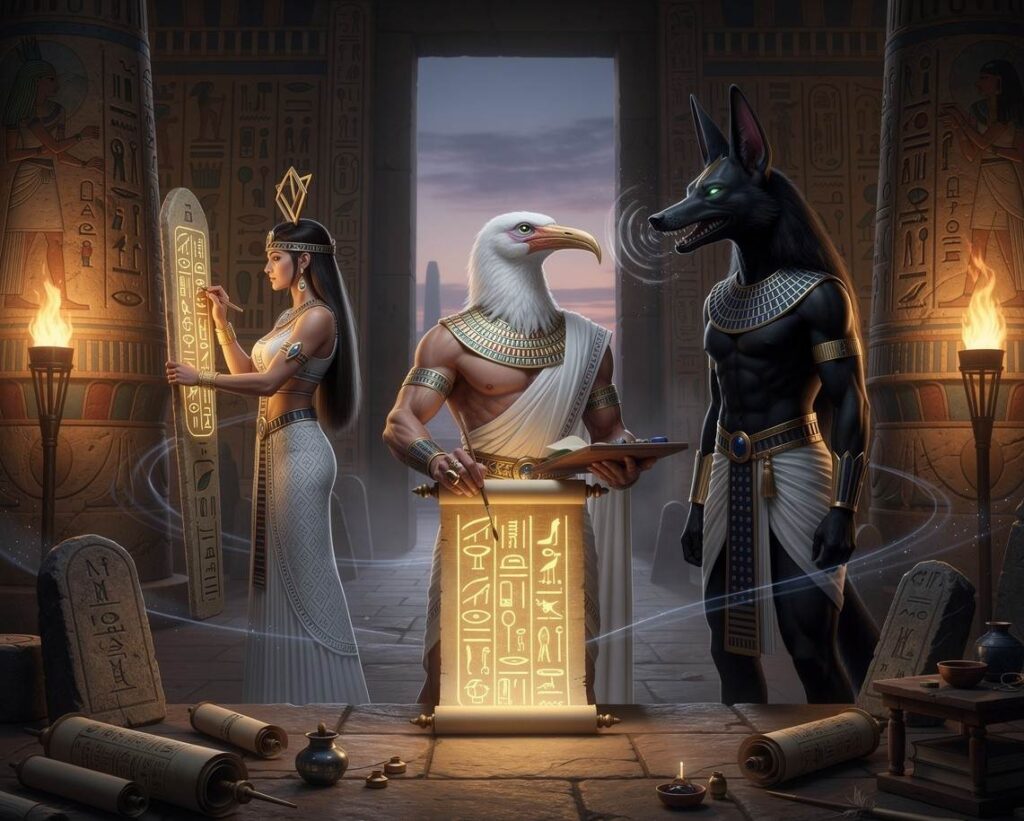
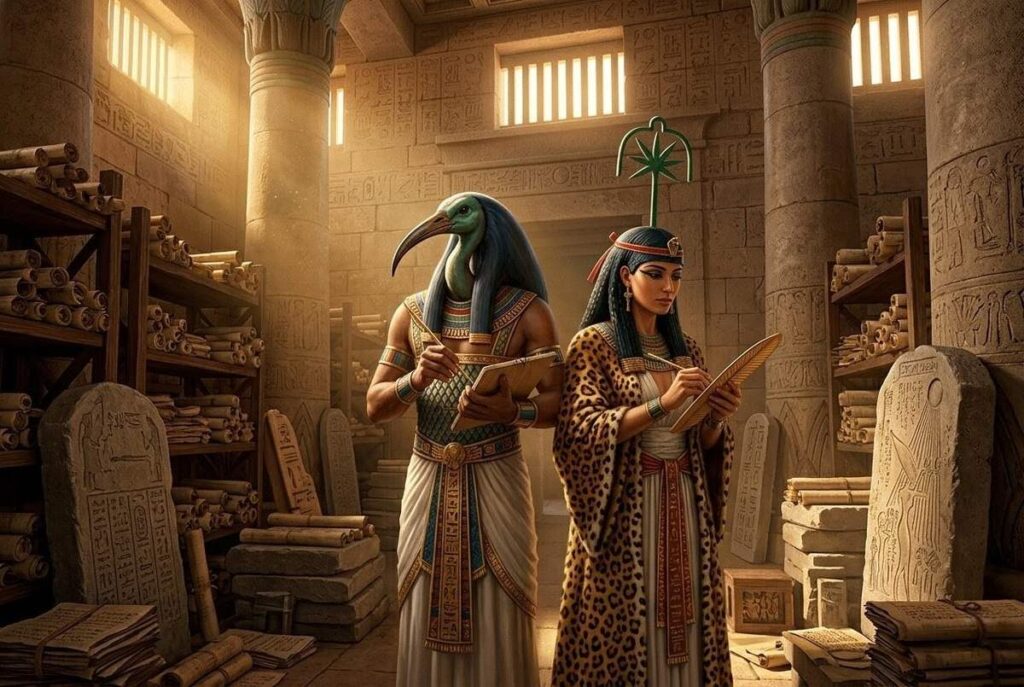
If Anubis guards speech at the threshold of death, Thoth and Seshat preserve the wider world of sacred writing, measurement, record, and wisdom. Together, they show that Egyptian sacred language was both spoken and written, audible and inscribed, breathed and preserved.
Thoth, often depicted with the head of an ibis, is associated with writing, wisdom, calculation, magic, the moon, divine judgment, and the recording of truth. Seshat, goddess of writing, measurement, architecture, and record-keeping, appears with her distinctive emblem and is linked with the foundation and alignment of temples.
The House of Life
The Per-Ankh, or House of Life, was associated with temple learning, scribal activity, ritual texts, healing knowledge, and sacred preservation. It was not merely a library in the modern sense. It was a place where knowledge was copied, studied, protected, and transmitted within a religious context.
For Egypt, writing was not just storage. It was continuity. A name written correctly could preserve memory. A spell copied carefully could guide the dead. A temple inscription could keep ritual presence active. The scribe worked with signs that were both practical and sacred.
Seshat and the Measuring of Sacred Space
Seshat’s role in the “stretching of the cord” ceremony links writing, measurement, astronomy, and temple foundation. Sacred architecture had to be aligned, measured, and established according to order. The act of building a temple was therefore close to the act of writing: both arranged signs and structures so divine order could be made present.
This is a key Egyptian insight. Writing, ritual, architecture, and cosmic order are not separate departments of meaning. They belong to one symbolic world. A temple can be read. A text can become a dwelling. A correctly placed sign can stabilise a relationship between earth and sky.
The True Name: Knowledge as Power
Ancient Egyptian religion gave extraordinary importance to names. A name was not merely a label. It carried identity, presence, and power. To know the true name of a person, deity, or being was to gain access to something essential about them.
This is why names had to be preserved after death. If the name vanished, memory and identity were threatened. Tomb inscriptions, offering formulas, and repeated names helped sustain the dead within the world of the living and the divine. To speak the name was to keep relationship alive.
Isis and the Secret Name of Ra
The myth of Isis and the secret name of Ra expresses this principle with great force. Ra’s hidden name contains a power not available through his public names. Isis gains power by learning what is concealed. The story is not merely about trickery. It is about the relation between identity and knowledge.
In many ancient traditions, the true name is the deeper access point to a being. Public names describe. True names disclose. A public name may indicate a role, but a hidden name touches essence. This is why divine names, funerary names, throne names, and protective names mattered so deeply in Egyptian religious life.
Naming, Memory, and Survival
Egyptian practices surrounding names also show how sacred speech connects memory with survival. To erase a name was to attack identity. To preserve a name was to extend life beyond death. The written and spoken name acted as a bridge between the living, the dead, and the gods.
This gives Egyptian name-mysticism a serious ethical weight. Names should not be handled carelessly. To name something is to enter relationship with it. To speak a name is to call presence. To distort a name can distort the relationship it carries.
Maat: Speech in Accordance with Cosmic Order
Maat is truth, justice, balance, right order, and the harmony by which the world is sustained. It is not merely a moral rule. It is the structure that allows life to remain liveable. Speech, therefore, must be measured against maat.
To speak falsely is not only to make an error. It is to disturb order. To speak truthfully is not merely to report facts. It is to help maintain the world. The Egyptian concern with speech is inseparable from this moral and cosmic framework.
The Negative Confession as Speech Audit
In the Book of the Dead, the deceased makes declarations of innocence before divine judges. These include statements concerning lying, falsehood, anger, and wrongdoing through speech. The soul’s words are examined because a life is partly made of utterances.
This gives the judgment scene a linguistic dimension. The heart is weighed, but the mouth is also implicated. What did the person say? How did they use speech? Did their words support truth, or did they spread disorder? Did they align with maat, or did they fracture it?
The Egyptian view is severe and beautiful: speech leaves traces. Words are not weightless. They enter the moral atmosphere of the world.
Truthful Speech as Spiritual Practice
To speak in accordance with maat is not simply to avoid obvious lies. It means bringing speech into harmony with truth, proportion, justice, restraint, and responsibility. It asks whether words create clarity or confusion, repair or harm, order or distortion.
This is where Egyptian wisdom becomes sharply relevant. In a world saturated with noise, propaganda, performative outrage, empty branding, and casual distortion, the ancient discipline of speech feels less archaic than urgent. The tongue is still a threshold. What crosses it still matters.
Sound, Breath, and Sacred Presence
Egyptian ritual involved sound: recitation, chant, hymn, naming, lamentation, invocation, and formula. Sacred speech was not only about semantic meaning. Its sound, rhythm, breath, repetition, and placement within ritual all mattered.
Modern readers should be cautious about claiming too much. We do not need to turn Egyptian temple sound into exaggerated pseudoscience. But it is clear that Egyptian ritual life treated spoken and sung words as effective, embodied, and sacred. Sound organised attention. Repetition preserved memory. Recitation linked the human voice with divine pattern.
Breath as Carrier of Speech
Speech depends on breath. The mouth shapes it, but breath carries it. This makes spoken language more than a mental act. It is bodily, respiratory, rhythmic, and alive. Sacred speech is therefore never only an idea. It is a full event of body, breath, intention, memory, and sound.
Egyptian funerary and ritual texts often understand life as something breathed, animated, sustained, and ritually renewed. To speak is to send breath into form. To chant is to discipline breath into sacred pattern. To recite a formula is to make the body participate in the ritual order.
Temples and Sacred Sound
Egyptian temples were designed for ritual action, procession, image, offering, inscription, light, darkness, enclosure, and sound. Their architecture shaped how voices moved through space. Inner sanctuaries, hypostyle halls, stone surfaces, and ritual chambers all contributed to an atmosphere where sacred speech felt set apart from ordinary speech.
The temple was not a neutral room. It was a sacred environment in which words were framed, amplified, contained, and made solemn. The architecture trained perception. A phrase spoken in the street is one thing. A phrase spoken in a consecrated chamber before a divine image becomes something else.
The Book of the Dead: Words for the Journey
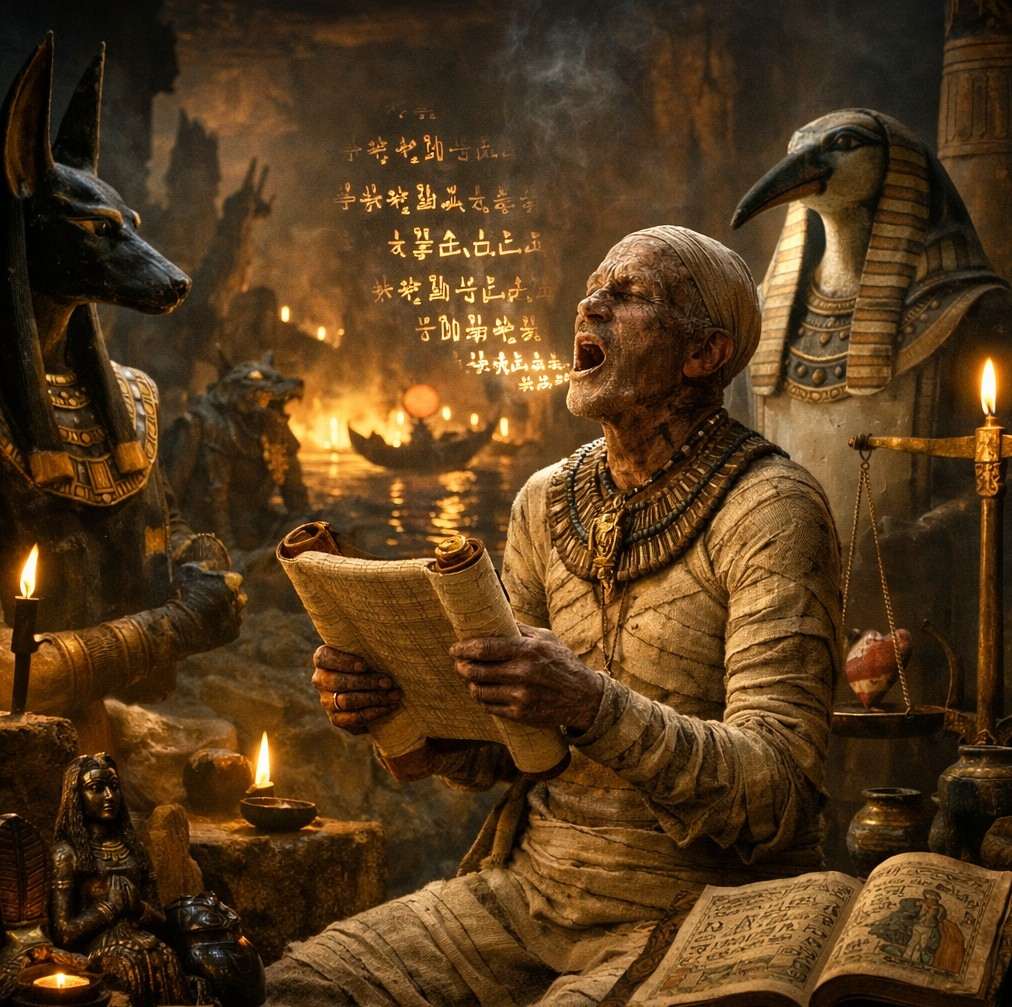
The text commonly called the Book of the Dead is more accurately known as the Book of Coming Forth by Day. It is a collection of funerary spells, hymns, declarations, names, and instructions intended to help the deceased navigate the afterlife and join the blessed dead.
These texts are practical within their religious world. They provide words for dangerous encounters, formulas for protection, names of beings and gates, declarations of purity, and ways of identifying oneself correctly before divine powers. The afterlife is not a vague cloudscape. It is a structured journey requiring knowledge.
Words as Passage
In the Book of the Dead, speech helps the deceased move. A formula may protect the heart. A declaration may answer a judge. A name may open recognition. A spell may prevent dissolution. The journey depends on remembered and inscribed words.
This gives Egyptian funerary texts a strongly gnostic quality in the broad sense: salvation, passage, or transfiguration depends on knowing. Not abstract belief alone, but knowledge of names, routes, dangers, formulas, identity, and right order.
The Precision of Recitation
Correct recitation mattered because sacred speech was understood as effective. A formula was not casual poetry. It belonged to a ritual and cosmological system. The words had to be preserved, copied, remembered, and spoken with care.
The modern reader may not share the same ritual assumptions, but the underlying insight remains powerful: when crossing difficult thresholds, the words we carry matter. What we can name, remember, declare, and refuse may shape the passage.
The Duat: The Landscape of Transformation
The Duat, the Egyptian underworld, is not simply a place of punishment. It is a complex realm of passage, testing, danger, regeneration, divine encounter, and transformation. The dead do not merely disappear into it. They travel through it.
This journey requires knowledge. The soul must know names, gates, beings, declarations, and protective words. The Duat is filled with powers that must be recognised and addressed properly. Ignorance is perilous because the realm is structured by sacred order.
The Duat as Inner Landscape
The Duat can be read religiously as the realm through which the deceased travels after death. It can also be read symbolically as a landscape of transformation. Darkness, gates, guardians, tests, dangers, and rebirth are not only afterlife images. They also describe passages the soul undergoes in crisis, initiation, grief, and deep change.
This does not mean reducing Egyptian religion to modern psychology. The ancient texts meant what they meant within their own world. But their images endure because they speak to recurring human thresholds: loss, fear, judgment, identity, passage, and renewal.
Guardians, Gates, and Names
The guardians of the Duat are not random monsters. They belong to a system of sacred order. The soul must know how to address them. Names matter because recognition matters. A being whose name is known is no longer merely terrifying. It has a place in the structure of the journey.
This is one of the great lessons of Egyptian afterlife literature: terror is often transformed by knowledge. The unknown devours. The named can be met. The word becomes a lamp in the corridor.
Ba, Ka, and Akh: Speech and the Soul
Egyptian thought did not treat the human soul as a single simple unit. It spoke of several aspects of personhood, including the ba, ka, and akh. These terms are complex and should not be flattened into exact modern equivalents, but they show how subtle Egyptian ideas of identity were.
The ba is often depicted as a human-headed bird and is associated with mobility, individuality, and the ability to move between worlds. The ka is linked with life force, vitality, and the sustaining power that receives offerings. The akh is the transfigured or effective spirit, the blessed state toward which the deceased moves.
Speech, Offering, and Continuity
Sacred speech helps maintain relationship among these dimensions. Names preserve identity. Offerings sustain the ka. Funerary texts guide the ba. Rituals support the transformation of the deceased into an akh. Speech is not decorative. It participates in the ongoing work of keeping the person connected, nourished, remembered, and guided.
This is why the dead needed words from the living and words for themselves. A tomb inscription, offering formula, or recited name could continue the relationship across the boundary of death. The voice of the living helped the dead remain present within the sacred order.
The Bird-Soul and the Power of Passage
The ba as a human-headed bird is one of Egypt’s most suggestive images. It combines human identity with avian mobility. It can leave, return, descend, ascend, and travel between realms. Here the bird becomes more than a symbol of flight. It becomes a form of soul movement.
This links Egyptian thought with the wider esoteric symbolism of birds as messengers between worlds. The ba travels because the soul is not locked into one condition forever. It can move, but it must be sustained by name, offering, ritual, and memory.
The Temple as Architecture for Sacred Speech
The Egyptian temple was not simply a public meeting place. It was a sacred environment designed for divine presence, ritual maintenance, offering, procession, inscription, image, and controlled access. Speech inside the temple belonged to this architecture of sacred order.
Temple walls were covered with texts and images. Rituals were performed according to carefully preserved patterns. Priests recited hymns and formulas. Sacred images were awakened, clothed, fed, praised, and protected. The temple was a world where word, image, gesture, offering, and stone worked together.
Material Support for Invisible Work
Egyptian religion did not treat spirit as something detached from matter. Stone, pigment, incense, oil, linen, statue, offering table, writing surface, and architectural alignment all mattered. The invisible required material support.
This is one reason Egyptian sacred speech feels so grounded. It is not vague abstraction. It is spoken in places, by bodies, before images, with tools, gestures, offerings, and texts. The word becomes effective within a world of form.
The House of Life as Living Memory
The House of Life preserved the textual and ritual knowledge that made this world possible. Scribal training, copying, study, healing texts, religious compositions, and ritual expertise all contributed to the living memory of the temple.
In this sense, Egyptian sacred speech was not only spoken in a moment. It was cultivated across generations. The voice of the priest depended on the hand of the scribe. The ritual formula depended on the archive. The living word depended on preserved memory.
Modern Reflections: Recovering Reverence for Speech
Modern readers do not need to adopt Egyptian religion in order to learn from its seriousness about speech. The deeper invitation is to recognise that words shape the world we live in: not magically in the shallow sense, but relationally, psychologically, morally, ritually, and culturally.
The Power of Pronunciation
Egyptian sacred practice reminds us that how words are spoken matters. Tone, breath, rhythm, care, and intention all shape meaning. A truthful phrase can be made cruel by tone. A simple blessing can become powerful through presence. A name spoken with attention carries different force from a name tossed away carelessly.
This is not a call for theatrical solemnity. It is a call for embodied speech. The voice should not be severed from the body, the heart, or responsibility.
The Discipline of Memory
The Egyptian reliance on memorised and written sacred texts also raises a modern question: what words do we carry inside us? In a world where nearly everything is searchable, fewer things are internalised. Yet at moments of crisis, grief, fear, or transition, the words already rooted in the body may matter most.
A prayer, poem, vow, ethical principle, mantra, psalm, or simple grounding phrase can function as an inner text. It does not replace practical help. But it can give the mind something ordered to hold when the threshold becomes unstable.
The Ethics of Speech
Maat makes speech ethical. The question is not only whether a word is effective, but whether it is true, proportionate, necessary, and aligned with order. Modern speech often values speed, performance, outrage, persuasion, and visibility. Egyptian wisdom asks a quieter question: does this utterance support life and truth?
Everyday speech may not look sacred, but it still builds worlds. A family is shaped by repeated words. A culture is shaped by slogans. A self-image is shaped by inner speech. A community is strengthened or damaged by what it allows language to do.


The Invitation: Speaking as Sacred Act
The Egyptian invitation is simple and demanding: take speech seriously. The tongue is small, but it opens worlds. It can wound, bless, preserve, distort, restore, remember, bind, release, and guide. It can speak in accordance with maat, or it can scatter disorder into the field of life.
Anubis still offers a powerful image for this work. He stands at the threshold, where careless speech is no longer enough. At every major passage, grief, death, initiation, ending, confession, apology, vow, prayer, naming, and farewell, words become heavier. They must be chosen with care.
To recover sacred speech does not mean becoming solemn all the time. It means noticing that the everyday mouth is already a ritual instrument. What we say repeatedly becomes part of the world we inhabit. What we name becomes easier to meet. What we bless becomes less abandoned. What we refuse to lie about becomes a doorway into freedom.
The tongue remains a threshold. The question is what kind of world crosses through it.
Related Glossary Terms
These terms help clarify Egyptian sacred speech, Anubis, heka, and the afterlife journey:
- Anubis: jackal-headed Egyptian deity associated with embalming, burial, protection, and the guidance of the dead.
- Heka: sacred creative force, often translated as magic, through which words, rituals, and divine action become effective.
- Maat: truth, justice, balance, and cosmic order; the principle by which speech and action are judged.
- Opening of the Mouth: Egyptian funerary ritual restoring the senses and speech of the deceased or activating a sacred statue.
- Duat: the Egyptian underworld or afterlife realm through which the deceased travels and is transformed.
- Ba: mobile aspect of the soul, often depicted as a human-headed bird capable of movement between realms.
- Ka: life force or vital double requiring nourishment, offering, and remembrance.
- Akh: transfigured spirit, the blessed and effective state of the deceased after successful transformation.
- Thoth: ibis-headed deity of writing, wisdom, calculation, magic, and divine record.
- Seshat: goddess of writing, measurement, architecture, records, and sacred alignment.
- True name: the hidden or essential name of a being, understood as carrying access to identity and power.
- Book of Coming Forth by Day: the more accurate name for the collection commonly called the Book of the Dead.
Read Next
For the strongest next step, continue into sacred language across traditions:
The Power of Words: Etymology, Conscious Language, and the Magic of Speech
This companion article widens the question beyond Egypt, exploring how words shape consciousness, identity, interpretation, and spiritual practice.
Frequently Asked Questions
What is heka in ancient Egyptian religion?
Heka is the Egyptian concept of sacred creative force, often translated as magic. It refers to the power through which gods, priests, rituals, words, names, and images act within the world. Heka was not merely illusion or trickery. It was part of the divine order and was central to creation, protection, healing, ritual, and funerary practice.
Why was speech so important in ancient Egypt?
Speech was important because words were believed to carry real power when used within the right sacred and ethical framework. Names, spells, hymns, declarations, and ritual recitations could protect, restore, identify, guide, and transform. In funerary religion, the deceased needed speech to recite formulas, answer divine powers, and navigate the afterlife.
What was the Opening of the Mouth ceremony?
The Opening of the Mouth was an Egyptian ritual performed on mummies and statues to restore or activate the senses, especially speech. The ceremony allowed the deceased or sacred image to speak, breathe, see, hear, receive offerings, and participate in sacred life. It shows how closely speech, identity, and life were connected in Egyptian ritual thought.
How is Anubis connected with sacred speech?
Anubis is connected with sacred speech through his role as guardian of thresholds, embalming, burial, and the soul’s passage into the afterlife. The dead needed correct words, names, formulas, and declarations to move safely through the Duat. Anubis presides over this boundary-world where speech helps the soul remain protected, recognised, and properly guided.
What is the Egyptian idea of the true name?
In Egyptian religion, a name was not merely a label. It carried identity, presence, and power. To know a true name was to gain deep access to the being named. This is why names were preserved in tombs and rituals, and why myths such as Isis learning Ra’s secret name show name-knowledge as a profound form of power.
What is maat and how does it relate to speech?
Maat means truth, justice, balance, and cosmic order. Speech should align with maat by being truthful, responsible, proportionate, and life-supporting. False or harmful speech was not merely a private mistake; it disturbed the order of the world. The Negative Confession in the Book of the Dead shows that speech was part of the soul’s moral account.
Can modern readers practise Egyptian sacred speech?
Modern readers should approach Egyptian sacred speech with respect and caution. Rather than imitating ancient rituals without context, the stronger approach is contemplative: recover reverence for speech, speak truthfully, use words with responsibility, remember the power of names, and treat breath, sound, and language as meaningful forces in spiritual and ethical life.
Study Note: This article explores ancient Egyptian sacred speech, heka, funerary symbolism, Anubis, and ritual language for historical and contemplative understanding. It is not a manual for Egyptian ritual practice, magical operation, breathwork, or psychological self-treatment. Readers should approach ancient religious material with respect for its cultural context. If vocal, breath, or contemplative practices produce anxiety, dissociation, panic, or destabilisation, pause the practice and seek grounded support from a qualified professional or trusted person in ordinary life.
Further Reading
These related articles continue the themes of sacred speech, Egyptian wisdom, hidden language, heka, symbols, and spiritual transformation:
- The Power of Words: Etymology, Conscious Language, and the Magic of Speech – A wider exploration of speech, meaning, etymology, and the shaping power of language.
- The Language of the Birds: 7 Traditions on Divine Speech – Cross-cultural perspectives on sacred language, symbolic speech, divine sound, and hidden meaning.
- The Shem HaMeforash: God’s Explicit Name and the 72-Fold Secret – Jewish sacred-name tradition, divine speech, Kabbalah, Exodus, and the power of letters.
- The All-Seeing Eye Decoded: From Ancient Egypt to Freemasonry – Egyptian eye symbolism, sacred perception, Horus, and later esoteric reception.
- The Hidden Language of the Bible and Esoteric Christianity – Scriptural symbolism, hidden meaning, and the sacred use of language in Christian esoteric traditions.
- The Mental Plane Explained: Where Thoughts Become Reality – Thought, image, intention, and the subtle relationship between mind and manifestation.
- Hermeticism and Gnosticism: The Egyptian Wisdom Traditions Compared – How Egyptian, Hermetic, and Gnostic streams overlap and diverge.
- The Goddess Isis and Her Various Other Names and Symbols – Isis, secret names, divine power, and the survival of Egyptian goddess symbolism.
- Contemplative Techniques: The Thread’s Practical Foundation – Grounded methods for attention, silence, voice, and conscious practice.
- The Living Thread: How Forbidden Knowing Survives – The survival of esoteric knowledge through loss, translation, suppression, and renewal.
References and Sources
The following sources support the historical, Egyptological, and comparative framework used in this article.
Primary Texts and Egyptian Sources
- The Book of Coming Forth by Day, commonly known as the Book of the Dead. Various translations and editions consulted for funerary formulas, judgment scenes, and afterlife language.
- The Pyramid Texts. Old Kingdom funerary texts containing early Egyptian afterlife formulas and ritual speech.
- The Coffin Texts. Middle Kingdom funerary texts expanding afterlife spells and transformative speech for a wider range of the dead.
- The Shabaka Stone, also known as the Memphite Theology. British Museum. Source for Ptah, heart, tongue, and creation through thought and speech.
- The myth of Isis and the secret name of Ra, preserved in Egyptian magical and mythological tradition.
Egyptology and Ancient Egyptian Religion
- Lichtheim, Miriam. (1975). Ancient Egyptian Literature, Volume I: The Old and Middle Kingdoms. Berkeley: University of California Press.
- Assmann, Jan. (2001). The Search for God in Ancient Egypt. Ithaca: Cornell University Press.
- Assmann, Jan. (2005). Death and Salvation in Ancient Egypt. Ithaca: Cornell University Press.
- Hornung, Erik. (1999). The Ancient Egyptian Books of the Afterlife. Ithaca: Cornell University Press.
- Pinch, Geraldine. (1994). Magic in Ancient Egypt. London: British Museum Press.
- Teeter, Emily. (2011). Religion and Ritual in Ancient Egypt. Cambridge: Cambridge University Press.
- Wilkinson, Richard H. (2003). The Complete Gods and Goddesses of Ancient Egypt. London: Thames & Hudson.
- Taylor, John H. (2001). Death and the Afterlife in Ancient Egypt. Chicago: University of Chicago Press.
Comparative and Symbolic Studies
- Faulkner, Raymond O., trans. (1994). The Egyptian Book of the Dead: The Book of Going Forth by Day. Chronicle Books.
- Allen, James P. (2005). The Ancient Egyptian Pyramid Texts. Atlanta: Society of Biblical Literature.
- Robins, Gay. (1994). “Egyptian Mathematics and the Eye of Horus.” Mathematics in School, 23(2), 12-14.
- Szpakowska, Kasia. (2008). Daily Life in Ancient Egypt: Recreating Lahun. Oxford: Wiley-Blackwell.
- Ritner, Robert K. (1993). The Mechanics of Ancient Egyptian Magical Practice. Chicago: Oriental Institute of the University of Chicago.