
The Language of the Birds: 7 Traditions on Divine Speech
The Language of the Birds is not really about birds. Across Sufi poetry, Gnostic revelation, Egyptian hieroglyphs, alchemy, Norse myth, Solomonic legend, and perennialist symbolism, it names a deeper kind of hearing: the ability to recognise meaning before it hardens into ordinary speech.
In Plain Terms
The Language of the Birds is an esoteric symbol for hidden, divine, or initiatory communication. It appears in many traditions under different names: la langue des oiseaux in French hermeticism, mantiq al-tayr in Arabic and Persian Sufi tradition, the Green Language in alchemy, and the primordial or Adamic language in wider mystical speculation.
It is not usually meant as a literal dictionary of bird sounds. Birds matter because they fly between earth and sky, sing rather than argue, and appear as messengers between visible and invisible worlds. Their “language” becomes a symbol for meaning that crosses boundaries: heaven and earth, sound and symbol, speech and silence, human thought and divine intelligence.
At its deepest level, the tradition says that ordinary language is broken. After Babel, words divide as much as they reveal. The Language of the Birds points to a restored mode of hearing, where sound, symbol, rhythm, pun, image, and intuition converge. The initiate does not simply learn new words. The initiate learns how to hear the world speaking.
Primary Sources and Traditions Discussed
- Egyptian sacred writing: hieroglyphs, Thoth, bird signs, and medu-netjer, the “words of the gods”.
- Gnostic revelation: especially Trimorphic Protennoia, where divine descent is expressed as Sound, Voice, and Word.
- Sufi tradition: Attar’s Conference of the Birds, the Simurgh, and the journey through seven valleys toward divine recognition.
- Abrahamic tradition: Solomon, the Qur’anic phrase mantiq al-tayr, and wisdom as the ability to understand creation’s speech.
- Alchemy and hermeticism: Fulcanelli, the Green Language, phonetic cabala, cathedral symbolism, and the hidden speech of initiates.
- Norse, Greek, and Indo-European parallels: Odin’s ravens, Sigurd’s bird-speech, Tiresias, Dodona, doves, and oracular listening.
- Perennialist interpretation: René Guénon, angelic language, rhythm, sacred recitation, and the idea of a primordial speech behind fragmented language.
How to Read This Language
The Language of the Birds is best approached as a symbol of perception, not as a secret alphabet to be collected. It is a way of describing the moment when ordinary words become transparent to hidden meaning. The same phrase can appear as myth, poetry, sacred speech, alchemical pun, or mystical doctrine, but the underlying claim remains similar: reality speaks in more than one register.
The danger is to reduce the tradition in either direction. A purely literal reading turns it into fantasy: wise people chatting with sparrows like a woodland bureaucracy. A purely sceptical reading turns it into nothing but metaphor and loses the shock of the tradition. The richer reading sits between them. The bird is a real creature, a symbolic messenger, an image of ascent, and a sound-form that pierces ordinary speech.
What matters is the trained ear. In these traditions, initiation is not only about seeing hidden symbols. It is also about hearing differently. The world becomes legible because the listener becomes more subtle. The song was already there. The change is in the hearing.
Table of Contents
- What the Language of the Birds Actually Is
- The Egyptian Root: Hieroglyphs as the Alphabet of Birds
- The Gnostic Core: Sound, Voice, and Logos
- The Sufi Apex: Attar and the Conference of the Birds
- Solomon, the Qur’an, and the Abrahamic Thread
- Fulcanelli and the Green Language
- Norse, Greek, Celtic, and Indo-European Parallels
- The Perennial Signature: Guénon and the Primordial Language
- The Esoteric Core: What Is Actually Being Described?
- The AI and Gnosis Question: Pattern, Speech, and Counterfeit Logos
- Why This Still Matters
- Related Glossary Terms
- Read Next
- Frequently Asked Questions
- Further Reading
- References and Sources
What the Language of the Birds Actually Is
The Language of the Birds is not a normal language one memorises. It is not a grammar book, a zoological code, or a literal method for translating every chirp and wingbeat. In esoteric literature, it is a symbolic name for a higher mode of meaning. It refers to the capacity to hear correspondences, hidden messages, sacred puns, divine hints, and truths concealed beneath ordinary speech.
In French hermeticism, it appears as la langue des oiseaux. In Sufi and Islamic tradition, it appears as mantiq al-tayr, the speech or logic of the birds. In alchemical circles, it becomes the Green Language: a hidden speech of pun, sound, and resonance. In broader mystical speculation, it overlaps with Adamic language, angelic speech, philosophical language, and the idea of a primordial tongue before Babel fractured human understanding.
The tradition insists that ordinary language is not enough. Words can name, but they can also conceal. They can point to reality, but they can also trap the mind in surfaces. The Language of the Birds names the moment when speech becomes transparent: when a word is heard not only as sound or definition, but as symbol, vibration, rhythm, and doorway.
This is why birds are so suitable as messengers. They belong to air. They move between ground and sky. Their song is meaningful without being discursive. They do not argue reality into place. They announce it. In myth, the one who understands the birds has crossed a threshold of perception. They no longer hear nature as noise. They hear creation as speech.
The Language of the Birds is an esoteric symbol for divine or initiatory communication: a way of hearing hidden meaning through sound, rhythm, symbol, pun, myth, and correspondence rather than ordinary literal speech alone.
The Egyptian Root: Hieroglyphs as the Alphabet of Birds
Medu-Netjer: Words of the Gods
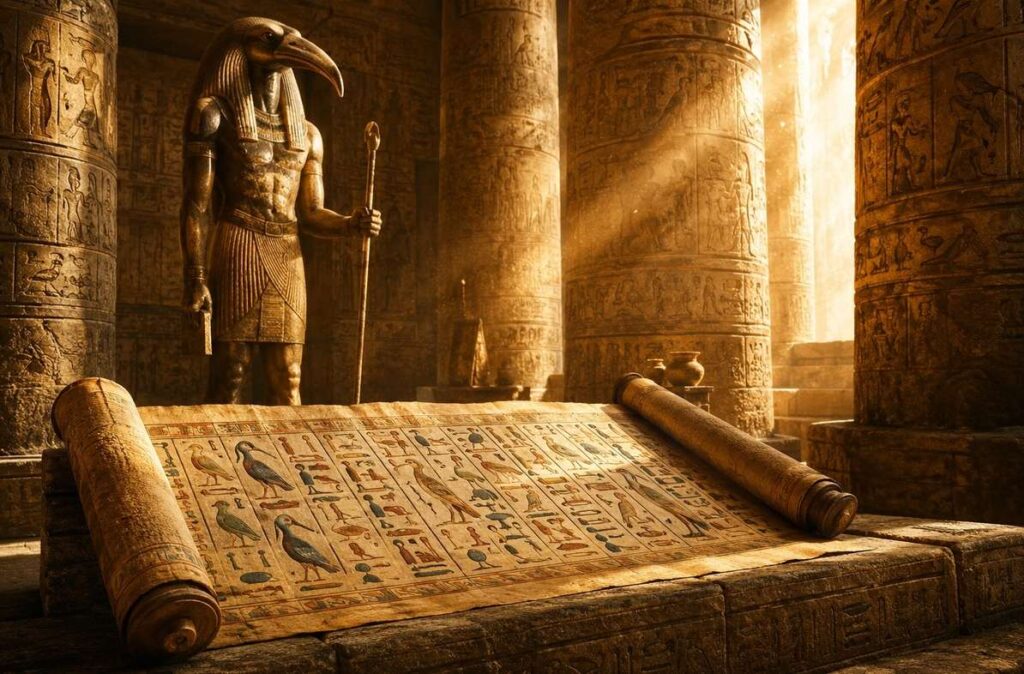
One of the oldest roots of this tradition leads into Egypt. The Egyptian term for hieroglyphic writing was medu-netjer, usually translated as “words of the gods” or “divine words”. The Greek word hieroglyphika, meaning sacred carvings, came later. For the Egyptians, writing was not merely administrative. It was ritual, sacred, and performative.
A written sign could preserve memory, invoke presence, fix identity, and participate in the order of the world. The sign was not just a label attached to reality. It could help stabilise reality. This already brings us close to the Language of the Birds: a worldview in which sound, image, and being are not fully separate.
The Avian Alphabet
Egyptian hieroglyphs are full of birds. The ibis, falcon, owl, vulture, swallow, quail, and hoopoe appear as phonetic and symbolic signs. Some signs function as sounds. Others carry symbolic weight. In many cases, the same image participates in both levels at once.
This makes Egypt a powerful early example of the principle behind bird-language symbolism. Birds are not simply decorative creatures placed around sacred texts. They become signs through which sound and meaning are carried. The avian body becomes a letter. The letter becomes a sound. The sound opens into divine speech.
Later observers sometimes described Egyptian writing as “bird writing”, partly because of this visible density of bird forms. Whether or not such descriptions were always precise, they recognised something real: Egyptian sacred writing is filled with creatures of air, song, and flight. The divine script already has wings.
Thoth and the Ibis
Thoth, the ibis-headed god of writing, wisdom, measurement, magic, and sacred speech, stands at the centre of this world. He is the scribe of the gods, the keeper of divine order, and the patron of those who work with sacred language. His ibis form is not random. It fuses bird-symbolism with writing, intelligence, and mediation between worlds.
In later alchemical tradition, especially in writers such as Zosimus of Panopolis, Egyptian, Jewish, Greek, and Hermetic ideas begin to merge. Thoth can be associated with Adam, the primordial human, and with the inner being of light. These connections are not simple historical equations. They are symbolic bridges: Thoth as scribe, Adam as namer, light as inner human, and language as the thread joining visible form to hidden origin.
The bird, then, is not only an animal. It is an emblem of mediation. It rises from earth into air. It sings without ordinary grammar. It crosses thresholds. In the Egyptian imagination, and later in hermetic and alchemical reception, this makes the bird a perfect image for sacred writing itself: meaning taking wing from the material sign.

The Gnostic Core: Sound, Voice, and Logos
The Gnostic tradition gives one of the deepest expressions of divine language. The Nag Hammadi text Trimorphic Protennoia, preserved in Codex XIII, presents revelation through the voice of Protennoia, the First Thought. The text is not simply about language. It is structured through language.
Protennoia descends to awaken humanity from ignorance. But this descent is not described primarily as a visual apparition, a law, or an institutional teaching. It unfolds through Sound, Voice, and Word. The divine becomes audible before it becomes fully intelligible. Reality is awakened through articulation.
The Three Descents: Sound, Voice, Word
The structure is subtle. First, Protennoia appears as Sound: a vibration cast into the ears of those capable of receiving it. Then she appears as Voice: sound shaped into communicable presence. Finally, she appears as Word or Logos: articulated meaning, the divine pattern made intelligible.
This progression matters. It suggests that revelation begins deeper than ordinary language. Before doctrine comes sound. Before teaching comes voice. Before concept comes vibration. The Logos is not merely a sentence about God. It is the structure by which divine thought enters manifestation.
In this sense, Trimorphic Protennoia is one of the most important ancient texts for understanding divine speech. It does not merely say that God speaks. It imagines reality itself as an unfolding of speech from silence into sound, from sound into voice, and from voice into word.
A Philosophical Frame for Divine Speech
Scholars have often noted that the language of Trimorphic Protennoia resonates with ancient philosophical theories of speech and expression. The movement from inner thought to sound, speech, and articulated word was a major concern in Hellenistic thought, including Stoic discussions of language and meaning.
The Gnostic text transforms that philosophical grammar into revelation. Protennoia is the divine Thought hidden in silence. She becomes hearable as Sound, personal as Voice, and intelligible as Word. This is not merely linguistics. It is cosmology through speech.
Here the Language of the Birds meets the Gnostic Logos. The hidden language is not a code pasted onto the world. It is the deeper speech from which the world emerges. To hear it is not simply to learn symbols. It is to recognise the pattern by which the divine becomes audible within creation.
The Logos as Cosmic Substrate
In Gnostic and related traditions, the Logos is often understood as a mediating principle: the Word, Reason, or divine expression through which hidden reality becomes knowable. It stands between the unknowable source and the world of forms, communicating what cannot otherwise be grasped.
Trimorphic Protennoia pushes this language into the inner architecture of revelation. The Logos is not merely a messenger carrying information from above. It is the grammar of awakening. Sound, Voice, and Word become stages through which hidden reality enters consciousness.
This gives the Language of the Birds a serious Gnostic depth. The goal is not charming folklore. It is the recovery of hearing: the ability to perceive the divine articulation inside the noise of ordinary existence. Not every sound is revelation. But revelation, when it comes, may arrive as sound before the mind knows what it has heard.
The Sufi Apex: Attar and the Conference of the Birds
The most beautiful literary expression of this tradition may be Farid ud-Din Attar’s twelfth-century Persian poem Mantiq al-Tayr, usually translated as The Conference of the Birds or The Speech of the Birds. Its title echoes the Qur’anic language of Solomon, who is said to have been taught the speech of the birds.
In Attar’s poem, the birds of the world gather to seek a king. The hoopoe, wisest of the birds, tells them they must search for the Simurgh, the legendary sovereign bird. Each bird represents a human weakness or attachment: fear, vanity, desire, pride, complacency, and excuses dressed in respectable feathers.
The journey takes them through seven valleys. Many turn back. Only thirty birds complete the path.
The Seven Valleys
- Talab: yearning or quest, where the soul recognises that ordinary life is not enough.
- Ishq: love, where divine longing burns through calculation and self-protection.
- Ma’rifat: gnosis or deep knowing, where wisdom is received through inner illumination rather than intellect alone.
- Istighnah: detachment, where the seeker releases dependence on all that is not the Real.
- Tawhid: unity, where the oneness of God becomes directly perceived.
- Hayrat: bewilderment, where the seeker is overwhelmed by the Real and ordinary certainty collapses.
- Fuqur wa Fana: poverty and annihilation, where the ego is emptied and dissolved in God.
The Simurgh Pun
The ending is one of the great mystical puns of world literature. When the thirty surviving birds arrive at the court of the Simurgh, they find a mirror. In it, they see themselves. The Persian pun is the key: si means thirty, and murgh means birds. The Simurgh is the thirty birds.
The seekers were what they sought. The king was not elsewhere. The final revelation is not acquisition but recognition. This is the Language of the Birds in its purest form: a poem whose doctrine is embedded in its own sound. The word carries the revelation. The pun is not a joke added to the teaching. It is the teaching.
Attar’s poem therefore sits very close to Gnostic and Hermetic patterns of awakening. The soul wanders through confusion, desire, discipline, and annihilation, only to discover that the hidden source was never separate from the seeker. The destination was veiled inside the journey. The name was hidden inside the flock.
Solomon, the Qur’an, and the Abrahamic Thread
The Qur’anic Foundation
The Solomonic current runs through Jewish, Islamic, and wider esoteric traditions. In the Qur’an, Solomon says that he and David have been taught the speech of the birds and given from all things. This is not treated as decorative knowledge. It is part of Solomon’s wisdom and kingship.
To understand the speech of birds is to understand creation at a level deeper than ordinary human command. Solomon’s authority is not merely political. It is cosmic. He does not only rule over beings. He understands them. The wise king hears what creation is saying.
This is an important distinction. In the highest form of the motif, understanding the birds does not mean domination. It means participation in a world where every creature is meaningful. The master does not force the world into speech. He becomes capable of hearing it.
The Hoopoe as Messenger
The hoopoe is central to the Solomonic and Sufi traditions. In the Qur’anic story, the hoopoe brings Solomon news of the Queen of Sheba. In Attar’s poem, the hoopoe becomes the guide of the birds. This is not accidental. The hoopoe is a messenger between worlds, a creature of travel, report, and hidden knowledge.
The bird’s role is initiatory. It does not merely carry information. It calls the others to a journey they are reluctant to take. It exposes excuses. It leads them toward the Simurgh, not by force but by speech. The hoopoe becomes a voice of summons: a feathered guide with very little patience for spiritual procrastination.
Across Abrahamic and esoteric imagination, Solomon’s bird-language therefore points to a wider theme: wisdom is the ability to understand the voices beneath surface noise. The world speaks. The fool hears only animals. The initiate hears signs.
Fulcanelli and the Green Language
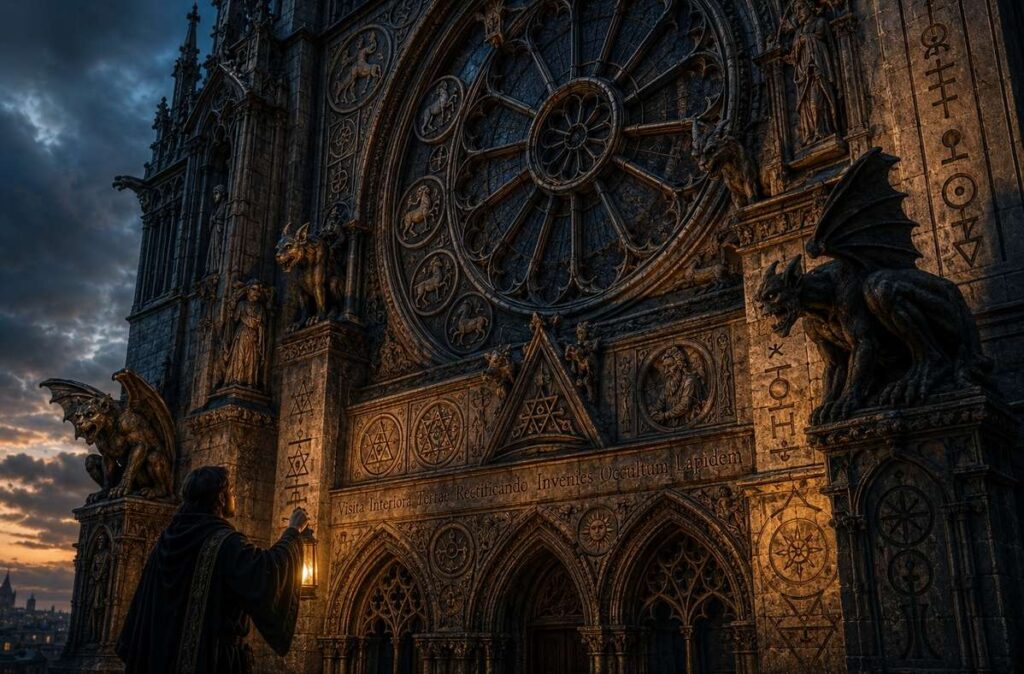
In Western alchemy, the Language of the Birds appears most famously through Fulcanelli, the enigmatic twentieth-century writer associated with Le Mystere des Cathedrales. Fulcanelli argued that medieval builders, alchemists, and initiates preserved a hidden language based not on conventional spelling, but on sound, pun, resonance, and symbolic double meaning.
This is often called the Green Language, the language of the birds, or phonetic cabala. The core idea is that the deeper meaning of a word may be concealed in how it sounds, not only in how it is written. Ordinary spelling disciplines the literal mind. Sound slips around the guard dogs.
Phonetic Cabala and the Cathedrals
Fulcanelli read Gothic cathedrals as books in stone. Their carvings, gargoyles, symbols, strange figures, and architectural rhythms were not merely decoration. They formed an encoded alchemical teaching for those who knew how to read them.
In this view, the cathedral is a frozen speech act. Stone becomes syllable. Ornament becomes doctrine. The building does not simply house worship. It speaks in a symbolic language that crosses image, number, sound, craft, and myth.
Fulcanelli’s phonetic cabala relies heavily on assonance, punning, and double meaning. This can be brilliant and dangerous. Brilliant because it reveals how language can carry hidden associations below the official meaning. Dangerous because the method can easily become uncontrolled speculation if not held by discipline. A pun can open a door, but it can also lead the mind into a cupboard wearing ceremonial robes.
Troubadours, Cant, and Hidden Speech
Fulcanelli and later esoteric commentators also connect the Language of the Birds with troubadours, medieval poets, and secret speech. The troubadours worked in a world of layered love poetry, courtly symbols, coded devotion, and sometimes heterodox religious currents. Their songs could speak on several levels at once.
In this context, hidden language is not only a matter of secrecy. It is a way to protect meaning from hostile environments. A poem can say one thing to the court, another to the beloved, and another to the initiate. The surface sings. The depth waits.
The Green Language therefore belongs to a wider Western habit of encoded teaching: alchemical emblems, cathedral sculpture, troubadour verse, hermetic riddles, and punning wisdom. It assumes that truth sometimes survives by wearing a mask, and that the initiated reader must learn not only to look, but to listen.
Norse, Greek, Celtic, and Indo-European Parallels
The motif of bird-language appears across Indo-European mythology with remarkable persistence. The one who understands birds is usually someone who has crossed a boundary: hero, seer, king, shaman, or wounded initiate. Bird-speech marks a change in consciousness.
Odin’s Ravens: Thought and Memory
In Norse mythology, Odin’s ravens, Huginn and Muninn, fly through the worlds and return to whisper what they have seen and heard. Their names are usually understood as Thought and Memory, or Mind and Memory. They are not merely pets. They are extensions of Odin’s knowing.
Every morning, the ravens travel outward. Every evening, they return. This makes Odin’s wisdom avian and distributed. His mind does not remain locked in one skull. It ranges through the world and comes back with news. Thought and Memory become winged messengers moving between visible and hidden realms.
Sigurd and the Dragon’s Heart
In the Volsunga Saga and related Norse material, Sigurd gains the ability to understand birds after tasting the blood or heart of the dragon Fafnir. Immediately, he hears birds warning him of betrayal. The ability is not learned through study. It comes through ordeal, danger, and contact with dragon power.
The symbolism is potent. The dragon guards treasure. Its heart carries hidden force. By tasting it, Sigurd crosses into a new perception. Bird-speech reveals danger that ordinary human conversation conceals. The birds become voices of truth in a world of treachery.
Tiresias, Dodona, and Oracular Listening
Greek traditions also connect prophetic insight with the interpretation of birds. Tiresias is associated with the ability to understand bird omens, and Greek divination often treated bird-flight and bird-calls as meaningful signs. Again, the point is not simply translation. It is trained perception.
At Dodona, one of the oldest Greek oracles, divine communication was associated with the rustling of oak leaves and the voices of doves. The priestesses were called Peleiades, meaning doves. The oracle did not operate only through clear sentences handed down from a desk in heaven. It required listening to natural sound as sacred signal.
This is one of the oldest forms of bird-language: not a secret grammar, but the disciplined interpretation of nature’s speech. The wind in leaves, the cry of birds, the movement of wings, and the condition of the listening mind form a single field of revelation.

The Perennial Signature: Guénon and the Primordial Language
René Guénon interpreted the Language of the Birds through the idea of a primordial tradition. For Guénon, the recurrence of this motif across cultures was not accidental. It pointed to a metaphysical truth: higher states of being communicate through symbols, rhythms, and languages that ordinary rational speech can only partially translate.
Birds as Angelic States
Guénon connected birds with angels and higher states of being. To understand the birds is therefore to establish communication with a higher order. The bird is the form taken by intelligence when it is no longer trapped in the heaviness of the lower world.
This does not require every mythic bird to be literally an angel. The point is symbolic. Wings, height, flight, song, and swift movement all make birds natural signs of higher intelligence. They descend and ascend. They touch earth without belonging entirely to it.
Rhythm as the Human Echo
Guénon also links sacred language with rhythm. In many traditions, divine or primordial speech is not prose. It is rhythmic, chanted, sung, or metrically ordered. Mantra, dhikr, psalmody, Vedic chant, poetic metre, and sacred recitation all assume that rhythm can shape consciousness.
Rhythm matters because it bypasses the ordinary argumentative mind. It organises breath, attention, memory, and body. It turns speech into vibration. The sacred phrase is not only understood. It is entered.
This brings the Language of the Birds close to song. Bird-speech is not merely semantic. It is tonal, rhythmic, and atmospheric. Meaning arrives not only through words but through pattern. The listener is changed by the cadence before the concept is fully grasped.
The Esoteric Core: What Is Actually Being Described?
When the cultural layers are stripped back, the traditions point toward a common set of claims about consciousness, language, and awakening.
Pre-Linguistic Truth
The Language of the Birds points to a mode of knowing that precedes ordinary discursive speech. It is not irrational. It is prior to rational sequencing. It recognises through pattern, resonance, image, rhythm, and correspondence.
This kind of knowing is closer to music, dream, poetry, symbol, and sudden insight than to a formal argument. A bird-call does not explain itself in paragraphs. It pierces. It announces. It makes the air meaningful.
The Initiatory Ear
The “ear” that hears this language is initiatory. It is not simply the physical ear, but the whole faculty of perception. The person who hears differently is someone whose relationship to meaning has changed.
In alchemy, this may appear as sensitivity to pun, symbol, and double meaning. In Sufism, it appears as the heart’s capacity to hear the call beneath the story. In Gnostic texts, it appears as the ability to receive Sound, Voice, and Word from the hidden source. In myth, it appears as the hero who suddenly understands birds after ordeal.
The ordinary person hears noise. The initiate hears instruction. The difference is not in the world alone. It is in the listener.
Sound as Cosmogonic
Many traditions treat sound as creative. The world is spoken, sung, breathed, named, or vibrated into being. In this view, language is not merely a human afterthought. It is built into the structure of creation.
The Gnostic Trimorphic Protennoia gives this idea a particularly refined form through Sound, Voice, and Word. Other traditions express it through sacred names, mantras, divine speech, letters, hymns, chants, or angelic languages. The forms differ, but the intuition is consistent: the cosmos is not silent matter. It is articulated mystery.
Identity Between Seeker and Sought
Attar’s Simurgh pun encodes one of the deepest teachings of the whole tradition. The birds seek the Simurgh, only to discover that the Simurgh is the thirty birds who completed the journey. The seeker and the sought are not finally separate.
This does not mean the journey was unnecessary. Without the journey, the birds would not know what they were. Recognition has to ripen. The final mirror only reveals what the path has made possible.
The Language of the Birds is therefore not acquired from outside. It is remembered. The soul learns to hear the language it has always, at some hidden level, belonged to.
Double Meaning as Method
Every surface can conceal a depth. Every word can carry a hidden echo. Every image can function as a doorway. The Language of the Birds names this method of reading: not paranoia, not random association, but disciplined sensitivity to layered meaning.
The pun is not always a joke. Sometimes it is a hinge. The symbol is not always decoration. Sometimes it is a map. The bird is not always merely a bird. Sometimes it is the message crossing the sky before language catches up.
The AI and Gnosis Question: Pattern, Speech, and Counterfeit Logos
The Language of the Birds also raises a contemporary question. We now live among machines that generate language with extraordinary fluency. Large language models can produce convincing sentences, imitate styles, summarise traditions, and detect patterns across enormous bodies of text. They are creatures of language, but not necessarily creatures of wisdom.
From one angle, this looks like an inversion of the old tradition. The Language of the Birds points toward depth, initiation, presence, and the hearing of hidden meaning. Artificial language systems often produce surface fluency without lived interiority. They can arrange signs without undergoing transformation. They can imitate the song without being the bird.
The Counterfeit Logos
In Gnostic terms, this invites the image of the counterfeit logos: speech that resembles meaning while lacking direct participation in the light it names. The archontic danger is not that language becomes ugly. It is that language becomes smooth, productive, and spiritually weightless.
This is not only a critique of machines. Human beings already speak this way whenever words are used without presence, responsibility, or recognition. A machine may simply reveal the condition more clearly. The counterfeit logos is not born in silicon. It begins wherever speech detaches from being.
Pattern Recognition as Threshold
There is also a more interesting possibility. If human language contains deep symbolic patterns, then tools that expose pattern may become mirrors. They may show us how much of our speech is inherited, repetitive, wounded, sacred, mechanical, symbolic, and asleep.
The question is not whether a machine possesses gnosis. The more useful question is whether human beings can use the encounter with machine language to hear their own speech more clearly. Does the mirror deepen recognition, or does it thicken the sleep?
The old traditions would answer with caution. A mirror is powerful, but it is not the face. A generated sentence is not awakening. Pattern is not presence. Yet the right mirror, held carefully, can still show the listener where the real work begins.

Why This Still Matters
The Language of the Birds matters because it preserves a counter-idea to modern speech. Much of contemporary language is transactional, accelerated, flattened, optimised, and stripped of silence. Words become content, slogans, prompts, captions, commands, and noise. The older traditions remember that language can also be sacred, dangerous, transformative, and alive.
To recover this does not require pretending to possess a secret dictionary. It requires a more serious relationship with speech. What do words do to the soul? What does rhythm awaken? What does a symbol conceal? What does a pun reveal that plain speech cannot? When does language illuminate, and when does it trap?
The bird-song motif insists that meaning is not exhausted by literal surface. The world is not mute. The problem is that ordinary attention is coarse. The initiate is not someone who owns exotic information. The initiate is someone whose hearing has been refined enough to recognise the message already moving through things.
That is the quiet force of the tradition. The bird does not lower the sky into a lecture. It sings. The work is to become capable of hearing.
Related Glossary Terms
These terms help clarify the Language of the Birds across Gnostic, Sufi, alchemical, and mythological traditions:
- Language of the Birds: an esoteric symbol for divine, initiatory, or hidden communication heard through sound, symbol, rhythm, and correspondence.
- Green Language: a hermetic and alchemical term for hidden speech based on pun, sound, assonance, and layered meaning.
- Logos: word, reason, or divine expression; in Gnostic and philosophical contexts, a mediating principle between hidden source and manifest reality.
- Protennoia: First Thought; in Trimorphic Protennoia, a divine feminine revealer who descends as Sound, Voice, and Word.
- Mantiq al-Tayr: Arabic and Persian phrase meaning speech or logic of the birds, associated with Solomon and Attar’s mystical poem.
- Simurgh: mythical Persian bird sought in Attar’s poem, revealed through pun and mirror as the thirty birds themselves.
- Thoth: Egyptian god of writing, wisdom, measurement, and sacred speech, often depicted with the head of an ibis.
- Phonetic Cabala: a method of hidden interpretation based on sound, pun, and resonance rather than conventional spelling alone.
- Adamic Language: the imagined primordial language of humanity before Babel, often associated with direct correspondence between word and thing.
- Oracular Listening: the interpretation of natural signs, sounds, birds, wind, or symbolic patterns as carriers of divine or hidden meaning.
Read Next
For the strongest next step, continue into Gnostic divine speech itself:
Trimorphic Protennoia: The Three Descents of Divine Speech
This companion article explores the Nag Hammadi text where revelation descends as Sound, Voice, and Word, giving one of the clearest Gnostic expressions of divine language.
Frequently Asked Questions
What is the Language of the Birds?
The Language of the Birds is an esoteric symbol for divine or initiatory communication. It appears in Sufi, alchemical, Gnostic, mythological, and perennialist traditions. It usually does not mean a literal bird dictionary, but a deeper way of hearing hidden meaning through sound, symbol, rhythm, pun, and correspondence.
Is the Language of the Birds a real language?
In most esoteric traditions, the Language of the Birds is not a normal spoken language with grammar and vocabulary. It is a symbolic or initiatory mode of perception. The person who understands it can hear meaning beneath surface speech, recognise symbolic patterns, and interpret creation as a living text.
Where does the Language of the Birds appear in the Qur’an?
The Qur’an refers to Solomon being taught the speech or logic of the birds in Surah 27:16. The hoopoe also appears in the Solomonic story as a messenger connected with the Queen of Sheba. This Qur’anic phrase later becomes central to Attar’s Sufi poem The Conference of the Birds.
What does Attar’s Conference of the Birds teach?
Attar’s Conference of the Birds presents a mystical journey in which the birds seek the Simurgh. After passing through seven valleys, only thirty birds arrive. They discover that the Simurgh is themselves, based on the Persian pun si murgh, meaning thirty birds. The poem teaches that the seeker and the sought are not finally separate.
How does Trimorphic Protennoia relate to divine language?
Trimorphic Protennoia is a Nag Hammadi text in which the divine First Thought descends as Sound, Voice, and Word. It presents revelation as an unfolding of divine speech from hidden silence into audible and intelligible form. This makes it one of the strongest Gnostic texts for understanding sacred language.
What is Fulcanelli’s Green Language?
Fulcanelli described the Green Language as a hidden alchemical speech based on sound, pun, assonance, and double meaning. In this view, the deeper meaning of words and symbols is often concealed beneath spelling, architecture, image, and ordinary surface interpretation.
Can the Language of the Birds be learned today?
The traditions usually present it less as something learned from a dictionary and more as something remembered or awakened through initiation, contemplation, symbolic sensitivity, and disciplined listening. A modern reader can study the texts and symbols, but the deeper point is transformation of perception, not possession of secret information.
Safety Notice: This article explores sacred language, mystical symbolism, esoteric interpretation, and altered ways of reading myth and speech. It is intended for historical and contemplative study, not as instruction in ritual practice, magical operation, or psychological self-treatment. If themes of hidden language, secret messages, divine speech, or symbolic decoding become distressing, obsessive, or destabilising, pause the material and seek grounded support from a qualified professional or trusted person in ordinary life. A living symbol should deepen clarity, not erode wellbeing.
Further Reading
These related articles continue the themes of divine speech, Gnostic revelation, sacred sound, hidden language, and esoteric interpretation:
- Trimorphic Protennoia: The Three Descents of Divine Speech – A detailed examination of the Nag Hammadi tractate that structures revelation through Sound, Voice, and Word.
- Thunder: Perfect Mind and the Voice of the Divine Feminine – Another Nag Hammadi text where revelation speaks in paradox, voice, and divine self-disclosure.
- The Shem HaMeforash: God’s Explicit Name and the 72-Fold Secret – Jewish sacred-name tradition, divine speech, Exodus, Kabbalah, and the power of letters.
- The Apocryphon of John: The Gnostic Creation Account – Essential background on emanation, Logos, archons, and the hidden structure of reality.
- The Five Seals: Sethian Initiation and Ritual Ascent – A guide to initiation, baptismal symbolism, and ascent in Sethian Gnostic tradition.
- Hermetic Spirituality: The Egyptian-Hellenic Synthesis – Thoth, Hermes, sacred knowledge, and the transmission of wisdom across Egyptian and Greek worlds.
- Egyptian Wisdom: Anubis, Thoth, and the Speech of the Gods – Sacred speech, divine writing, and Egyptian symbolic imagination.
- The Power of Words: Etymology and Conscious Language – How sound, meaning, and etymology shape perception and spiritual awareness.
- The Hidden Language of the Bible and Esoteric Christianity – Scriptural encoding, symbolic reading, and hidden meaning in Christian esoteric tradition.
- Nag Hammadi Library: A Complete Guide to the Gnostic Scriptures – The wider textual archive behind many of the Gnostic themes discussed here.
References and Sources
The following sources support the textual, historical, and comparative framework used in this article.
Primary Sources and Critical Editions
- Attar of Nishapur. The Conference of the Birds (Mantiq al-Tayr). Translated by Afkham Darbandi and Dick Davis. London: Penguin Classics, 1984.
- Trimorphic Protennoia (NHC XIII,1). In James M. Robinson, ed. The Nag Hammadi Library in English. 4th revised edition. Leiden: Brill, 1996.
- The Qur’an. Surah 27, Al-Naml. Various translations consulted, including Sahih International and Yusuf Ali.
- Snorri Sturluson. The Prose Edda. Translated by Jesse L. Byock. London: Penguin Classics, 2005.
- The Poetic Edda. Translated by Carolyne Larrington. Oxford: Oxford University Press, 1996.
- The Saga of the Volsungs. Translated by Jesse L. Byock. London: Penguin Classics, 1990.
- Fulcanelli. Le Mystere des Cathedrales. Translated by Mary Sworder. Brotherhood of Life, 1990. First published 1926.
- Guénon, René. “The Language of the Birds.” Studies in Comparative Religion, Vol. 3, No. 2, Spring 1969.
Gnostic Language, Logos, and Divine Speech
- Halvgaard, Tilde Bak. Linguistic Manifestations in the Trimorphic Protennoia and the Thunder: Perfect Mind. University of Copenhagen, 2013.
- Poirier, Paul-Hubert. La Pensée Première à la triple forme. Quebec: Presses de l’Université Laval, 2006.
- Turner, John D. Sethian Gnosticism and the Platonic Tradition. Quebec: Presses de l’Université Laval, 2001.
- Brakke, David. The Gnostics: Myth, Ritual, and Diversity in Early Christianity. Cambridge, MA: Harvard University Press, 2010.
- Litwa, M. David. “The Gnostic Hermes.” mdavidlitwa.com, 2024.
Egyptian, Hermetic, and Esoteric Studies
- Morenz, Ludwig. Vom langen Weg zur Schrift. University of Bonn, 2026.
- Smith, H. S., and W. J. Tait. “A Tradition of Identifying Egyptian Consonants by Bird Names.” Enchoria 13, 1985, pp. 121-125.
- Hornung, Erik. The Secret Lore of Egypt: Its Impact on the West. Ithaca: Cornell University Press, 2001.
- Faivre, Antoine. Access to Western Esotericism. Albany: SUNY Press, 1994.
- Hanegraaff, Wouter J. Esotericism and the Academy: Rejected Knowledge in Western Culture. Cambridge: Cambridge University Press, 2012.
- Bridges, Vincent. “Reading the Green Language of Light.” Journal of the Western Mystery Tradition, Vol. 1, No. 4.