Acts of Peter and the Twelve: The Parable of Poverty and Spiritual Wealth
Acts of Peter and the Twelve (NHC VI,1): The Pearl Merchant and the Commerce of Salvation
Acts of Peter and the Twelve presents a distinctive narrative within the Nag Hammadi Library, combining elements of apostolic literature with Gnostic theological concerns [1][2]. Unlike the canonical Acts of the Apostles, this text focuses on a journey to a mysterious city and an encounter with a divine pearl merchant named Lithargoel, whose name means “the light, gazelle-like stone” [3]. The narrative transforms the Matthean parable of the pearl of great price into an allegory of spiritual ascent, where the apostles must leave familiar surroundings and venture into unknown territory–a metaphor for the soul’s journey beyond conventional religious boundaries [4].
What is Acts of Peter and the Twelve?
A second or third-century Gnostic apocryphon (NHC VI,1) presenting Peter and the twelve apostles on a journey to obtain “the pearl of great price.” They encounter Lithargoel–a divine merchant who appears as a humble pearl-seller but proves to be the resurrected Christ–who offers the pearls freely yet demands total surrender. The text subverts ordinary economic exchange to illustrate the paradox of salvation: divine knowledge cannot be purchased, yet requires the complete renunciation of material attachments [5].

Table of Contents
- The Journey to the City
- The Mysterious Lithargoel
- The Commerce of Salvation
- The Revelation of Identity
- The Poor as Spiritual Elite
- Peter’s Authority and the Twelve
- Allegorical Interpretation
- Textual Context in Codex VI
- Theological Contributions
- Contemporary Resonance
- Frequently Asked Questions
- Further Reading
- References and Sources
The Journey to the City
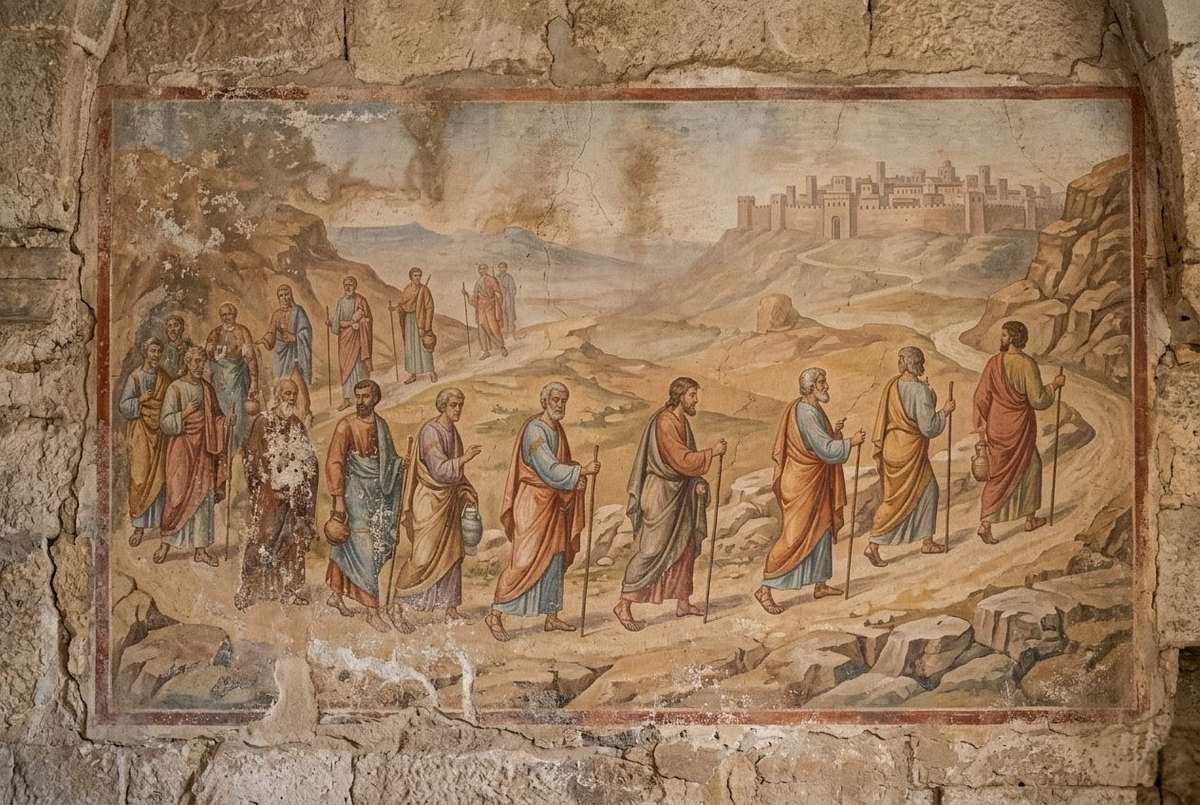
The narrative begins with Peter and the twelve apostles receiving a vision commanding them to travel to a distant city where they will find “the pearl of great price” [6]. This echoes the Matthean parable (Matthew 13:45-46) while transforming it into an allegory of spiritual ascent. The apostles must leave their familiar surroundings and venture into unknown territory–a journey that represents the soul’s departure from conventional religious boundaries into the foreign jurisdiction of higher knowledge [7].
The journey itself is fraught with difficulty. The apostles encounter various obstacles that test their commitment and discernment, functioning as “security checkpoints” that filter out those lacking the necessary clearance for the pearl [8]. These trials reflect the Gnostic understanding of salvation as a process requiring effort, insight, and the willingness to endure hardship for the sake of truth. The narrative suggests that one cannot simply remain in the “home office” of conventional belief but must undertake the dangerous expedition to the “branch office” of the material world to retrieve what was lost [9].
The text describes how the apostles must leave behind their ordinary administrative duties and enter a realm where the usual rules of engagement do not apply. This departure from the familiar constitutes the first test: the willingness to abandon the security of established religious structures in pursuit of the unclassifiable pearl [10]. The journey metaphor operates on multiple registers simultaneously–physical travel, psychological transformation, and ontological ascent–suggesting that authentic spiritual progress requires venturing beyond the “filing system” of conventional theology [11].
The Mysterious Lithargoel
Upon reaching the city, the apostles encounter a poor beggar who directs them to Lithargoel, the pearl merchant [12]. The text plays on the paradox of appearance and reality: the beggar, though destitute in material terms, possesses knowledge of the true treasure. This inversion of social values–where poverty becomes the mark of spiritual authority–characterises much of Gnostic ethics and challenges the “middle-management” assumption that material wealth correlates with divine favour [13].
Lithargoel himself appears as a humble merchant rather than a divine being, yet he possesses pearls of extraordinary value. The name “Lithargoel” derives from Greek lithos (stone) and argos (shining/bright), combined with the Hebrew divine suffix -el–meaning “the light, gazelle-like stone” or “shining stone of God” [14]. This name encodes the text’s central mystery: the divine appears not in overt glory but in the guise of an ordinary “stone”–humble, earthy, and easily overlooked by those lacking discernment [15].
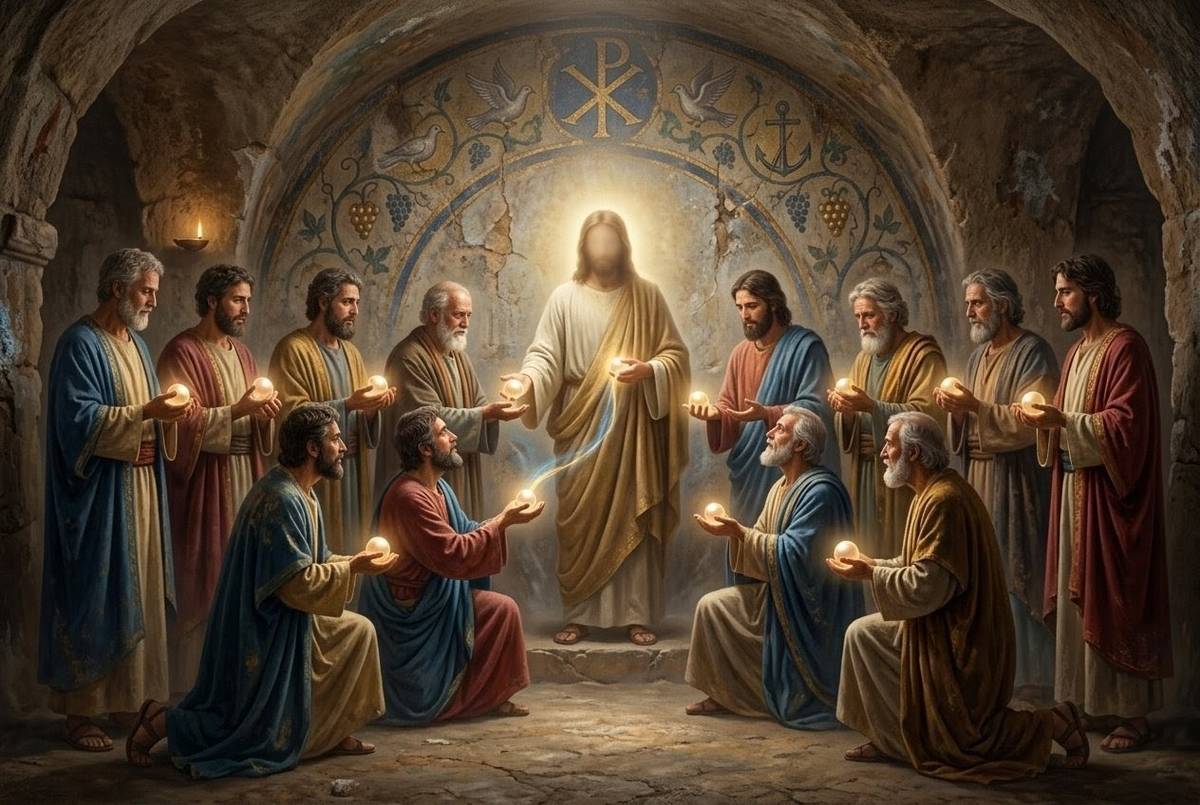
The text describes these pearls as luminous, ethereal objects that cannot be purchased with ordinary currency. They represent the divine knowledge (gnosis) that transforms the recipient, rendering the possessor “rich” in a currency that does not register on the archonic accounting system [16]. Lithargoel’s shop is not in the prosperous quarter but in the poor district, suggesting that the “executive headquarters” of the divine operates from the margins rather than the centre of worldly power [17].
Primary Source Citation: “I am Lithargoel, the one who is sent to give the pearl to the poor. For the poor are the ones who have received the pearl, and they are the ones who will enter the kingdom” — Acts of Peter and the Twelve 10:15-20 [18]
The Commerce of Salvation
The central scene involves a transaction that subverts ordinary economic exchange. Lithargoel offers the pearls freely to those who can recognise their value, yet demands everything the apostles possess [19]. This paradox–salvation as both free gift and total surrender–captures the Gnostic understanding of redemption. One cannot buy divine knowledge with the “currency” of material existence, yet one must give up everything that binds the soul to the material “branch office” [20].
Peter initially struggles with this demand, representing the natural human attachment to security and possession. His hesitation mirrors the soul’s difficulty in letting go of the familiar to embrace the unknown–the “bureaucratic inertia” that resists transfer out of the material jurisdiction [21]. The text suggests that the pearls cannot be obtained through the “standard procurement procedures” of conventional religion; they require a “requisition order” that liquidates all existing assets [22].
This economic paradox reflects the Gnostic critique of both materialism and works-based salvation. The pearls are not earned through labour nor purchased with wealth, yet they cannot be obtained without the “liquidation” of all attachments. The transaction is simultaneously gratuitous and costly–grace that demands everything [23]. The apostles must become “poor” in worldly terms to become rich in gnosis, exchanging their material “portfolio” for spiritual “executive status” [24].
The Revelation of Identity
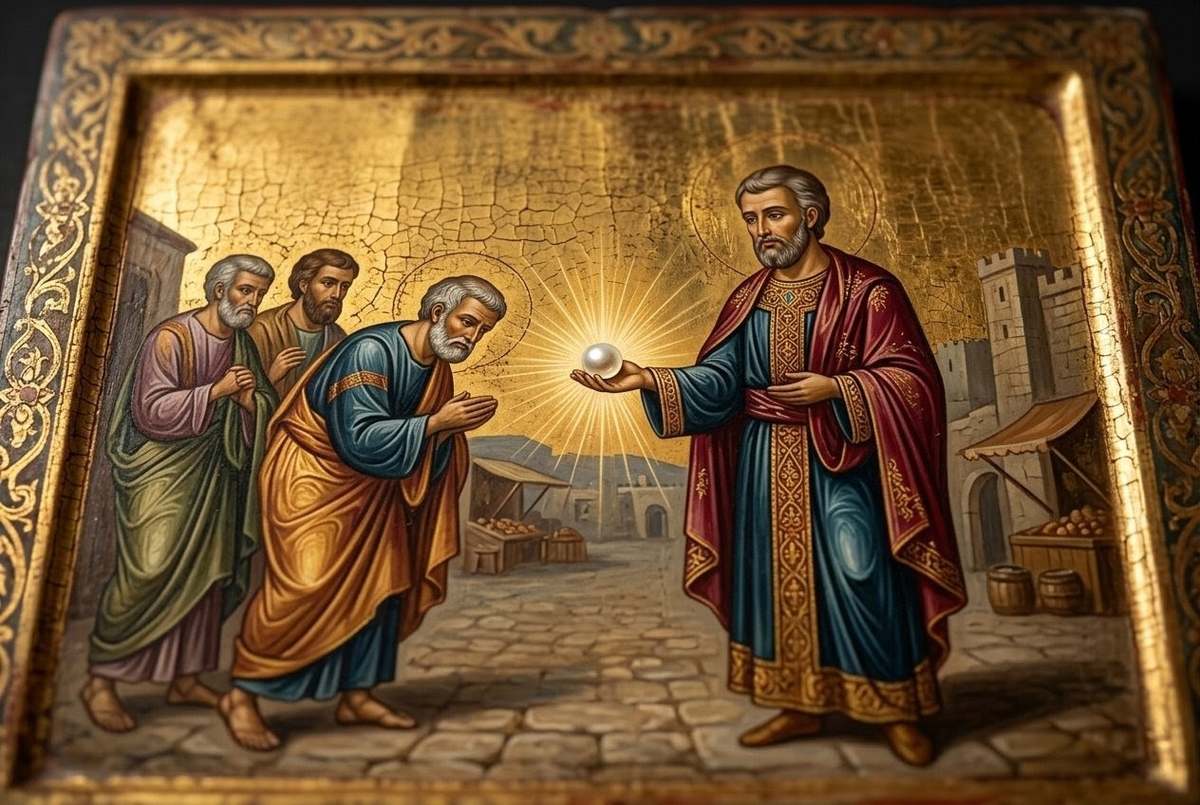
The narrative climax occurs when Lithargoel reveals himself as the resurrected Christ [25]. This theophany transforms the economic transaction into a sacramental encounter. The pearls are not merely objects of value but manifestations of the divine presence, distributed to those prepared to receive them. The “merchant” proves to be the “Chief Executive” himself, operating incognito in the “field office” of the material world [26].
This revelation structure–where a seemingly ordinary figure proves to be divine–appears frequently in Gnostic literature. It reflects the theological conviction that the divine is hidden within the ordinary, visible only to those with eyes to see [27]. The text suggests that Christ operates as a “secret agent” in the material realm, disguised as a humble merchant to bypass the “archonic surveillance” that monitors conventional religious activity [28].
The apostles’ recognition of Lithargoel’s true identity constitutes the moment of anamnesis–the recollection of what they had forgotten. The “pearls” are revealed to be the “classified documents” of divine knowledge, withheld from the archonic filing system but available to those who pass the “security clearance” of recognition [29]. This revelation confirms that the journey, the encounter, and the transaction were all components of a divine “operation” to retrieve the scattered sparks from material exile [30].
The Poor as Spiritual Elite
The text elevates the figure of the poor beggar to spiritual guide, suggesting that material poverty correlates with spiritual insight [31]. This is not mere social commentary but a theological statement about the nature of divine revelation. Those unencumbered by worldly possessions are freer to recognise spiritual truth, possessing the “clearance” that comes from lack of material “baggage” [32].
The Acts thus presents a social ethic that values poverty not as an end in itself but as a condition conducive to spiritual perception. The destitute are not objects of charity but bearers of wisdom–the “indigenous personnel” of the material realm who possess the local knowledge necessary to navigate its “bureaucratic maze” [33]. The beggar who directs the apostles to Lithargoel functions as a “liaison officer” between the material and spiritual jurisdictions, possessing the “contacts” that the apostles, as “foreign operatives,” lack [34].
This elevation of the poor inverts the standard archonic hierarchy where wealth signifies divine blessing. In the Gnostic “organisational chart,” those at the bottom of the material pyramid are closest to the top of the spiritual hierarchy [35]. The text suggests that the “executive headquarters” prefers to operate through the “junior staff” of the material world, bypassing the “middle-management” that typically controls access to divine knowledge [36].
Peter’s Authority and the Twelve
Despite its Gnostic orientation, the text maintains the authority of Peter and the twelve apostles [37]. This suggests a point in religious history where emerging Gnostic traditions still sought legitimation through connection to apostolic figures. The text does not reject apostolic authority but reinterprets it, suggesting that the true legacy of the apostles lies in their reception of secret knowledge rather than institutional leadership [38].
The inclusion of all twelve apostles (rather than just Peter) emphasises the collective nature of this revelation. The divine pearl is available to all who embark on the journey, not merely to a chosen individual [39]. This “team approach” suggests that the “extraction operation” requires coordinated effort–the twelve represent the “full complement” of spiritual faculties necessary to retrieve the pearl from the material “hostile territory” [40].
Peter’s role as spokesperson for the group maintains his traditional position as “department head,” yet his hesitation and initial failure to recognise Lithargoel humanises him [41]. The text presents the apostles not as already-perfect beings but as “personnel in training” who must learn to see beyond appearances–a process that involves struggle, doubt, and gradual awakening [42].
Allegorical Interpretation
The entire narrative functions as an allegory of the soul’s journey. The city represents the material world; Lithargoel represents the hidden Christ; the pearls represent salvific knowledge; the journey represents the spiritual life [43]. This multi-layered meaning allows the text to function simultaneously as entertainment, instruction, and mystical meditation.
Readers are invited to identify with the apostles, recognising their own spiritual journey in the narrative. The obstacles faced by Peter and his companions mirror the psychological and spiritual barriers that prevent souls from attaining gnosis [44]. The “foreign city” becomes the individual psyche, the “unconscious” territory where the pearl of true self lies hidden beneath layers of material “administrative procedure” [45].
The allegory operates on what modern readers might recognise as Jungian principles–the journey as individuation, the merchant as the Self, the pearl as the integrated consciousness [46]. Yet the text’s original audience would have understood it through the lens of Middle Platonic allegory, where the material world is the “shadow” of the true reality, and the soul must “awaken” from the dream of material existence [47].
Textual Context in Codex VI
Acts of Peter and the Twelve appears in Nag Hammadi Codex VI, a miscellaneous collection including Hermetic and philosophical texts [48]. Its placement alongside works like The Discourse on the Eighth and Ninth suggests that the ancient editors recognised its affinity with Hermetic themes of spiritual ascent and divine revelation [49].
The codex also contains the Authoritative Teaching, the Prayer of Thanksgiving, and Asclepius–texts concerned with ascent, transformation, and the relationship between divine and human knowledge [50]. This context suggests that Acts of Peter and the Twelve was read within an “environment” focused on practical spiritual transformation rather than mere theoretical speculation [51].
The manuscript dates to the fourth century, though the original composition likely occurred earlier, possibly in the third century CE when apostolic apocrypha flourished [52]. The text’s survival in Coptic indicates its circulation among bilingual Egyptian communities who valued apostolic narratives infused with Gnostic theology [53]. Its presence in a “mixed” codex alongside Hermetic materials suggests a reading community unconcerned with the “departmental boundaries” between Christian and pagan wisdom [54].
Theological Contributions
The text contributes to our understanding of how Gnostic traditions appropriated apostolic literature. Rather than rejecting the figures of early Christianity, Gnostic writers reinterpreted their stories to convey esoteric teachings [55]. The Acts of Peter and the Twelve thus represents a bridge between mainstream Christian narrative traditions and the more speculative theology of the Nag Hammadi Library.
Theologically, the text advances several distinctive positions: the paradox of grace (free yet demanding), the epistemology of poverty (material lack as spiritual advantage), and the economy of salvation (subverting ordinary exchange) [56]. These positions challenge both the “works righteousness” of emerging orthodoxy and the “cheap grace” of superficial belief, proposing instead a “costly recognition” that transforms the entire “business model” of the seeker [57].
The text also contributes to the “Christology of disguise”–the tradition that the resurrected Christ appears in hidden forms, recognisable only to the prepared [58]. This “incognito operation” suggests that divine revelation operates through “unofficial channels,” bypassing the “archonic gatekeepers” who control conventional religious institutions [59].
Contemporary Resonance
The text’s critique of materialism and its elevation of poverty remain relevant in an age of consumerism [60]. It challenges readers to consider what they are willing to surrender for spiritual truth and whether they can recognise divinity in humble guises. The figure of Lithargoel–the divine merchant who gives freely yet demands everything–continues to provoke reflection on the nature of grace and discipleship.
For contemporary seekers, the text offers a model of spiritual journey that requires risk, discernment, and the willingness to learn from the marginalised [61]. It suggests that the “pearls” of wisdom cannot be obtained through the “standard procurement procedures” of institutional religion but require the “liquidation” of attachments and the courage to venture beyond familiar territory [62].
The narrative’s emphasis on collective seeking–the twelve travelling together–also speaks to the importance of spiritual community, even as it acknowledges individual struggle and doubt [63]. The text invites readers to join the “expedition,” recognising that the journey to the “foreign city” is both external (into the world) and internal (into the psyche), and that the “pearl” awaits those with the “clearance” to recognise its value [64].
Frequently Asked Questions
What is Acts of Peter and the Twelve in the Nag Hammadi Library?
Acts of Peter and the Twelve (NHC VI,1) is a second or third-century Gnostic apocryphon presenting Peter and the apostles on a journey to obtain the pearl of great price. They encounter Lithargoel, a divine pearl merchant who proves to be the resurrected Christ. The text combines apostolic narrative with Gnostic themes of spiritual ascent, the paradox of salvation (free yet demanding total surrender), and the revelation of the divine in humble disguise.
Who is Lithargoel and what does his name mean?
Lithargoel is the mysterious pearl merchant in Acts of Peter and the Twelve whose name derives from Greek lithos (stone) and argos (shining/bright) with the Hebrew divine suffix -el, meaning the light or shining stone of God. He appears initially as a humble merchant in the poor district but reveals himself as the resurrected Christ. Lithargoel offers luminous pearls representing divine knowledge (gnosis) that cannot be purchased with ordinary currency but require the complete renunciation of material attachments.
What is the commerce of salvation paradox in this text?
The commerce of salvation paradox describes the text’s central theological insight: the pearls of divine knowledge are offered freely (grace) yet demand everything (total surrender). One cannot buy salvation with material wealth or earn it through works, yet one must liquidate all attachments to receive it. This subverts ordinary economic exchange and challenges both works-based righteousness and cheap grace, proposing instead a costly recognition that transforms the entire spiritual economy of the seeker.
How does the text elevate the poor as spiritual elite?
Acts of Peter and the Twelve presents the poor beggar who directs the apostles to Lithargoel as a spiritual guide, suggesting that material poverty correlates with spiritual insight. Those unencumbered by worldly possessions are freer to recognise divine truth. The text inverts standard social hierarchies, presenting the destitute not as charity cases but as wisdom-bearers who possess the local knowledge necessary to navigate the material realm and locate the hidden divine.
What is the allegorical meaning of the pearl in this text?
The pearl of great price represents divine knowledge (gnosis) that transforms the recipient. Allegorically, the journey to obtain it represents the soul’s departure from conventional religious boundaries, the city represents the material world, and Lithargoel represents the hidden Christ operating incognito. The pearl cannot be obtained through standard religious procurement but requires the liquidation of attachments and the courage to venture into unknown territory. It signifies the integrated self or spiritual awakening that comes at the cost of total surrender.
How does Acts of Peter and the Twelve relate to other Nag Hammadi texts?
Acts of Peter and the Twelve appears in Codex VI alongside Hermetic texts like Discourse on the Eighth and Ninth and Asclepius, suggesting ancient editors recognised its affinity with Hermetic themes of spiritual ascent. It shares the motif of the divine revealer in disguise with other Gnostic texts and the journey allegory with texts like Authoritative Teaching and Exegesis on the Soul. Its presence in a mixed codex indicates circulation among communities unconcerned with boundaries between Christian and pagan wisdom.
What is the significance of the twelve apostles in this narrative?
The inclusion of all twelve apostles (not just Peter) emphasises the collective nature of revelation–the divine pearl is available to all who embark on the journey, not merely a chosen individual. The twelve represent the full complement of spiritual faculties necessary to retrieve the pearl from material existence. Peter’s role as spokesperson maintains apostolic authority while his hesitation humanises the struggle of recognition, presenting the apostles as personnel in training who must learn to see beyond appearances.
Further Reading
- Codex VI: Hermetic and Apostolic Texts — Overview of the codex containing Acts of Peter and the Twelve alongside Hermetic ascent texts and the Authoritative Teaching.
- The Authoritative Teaching: The Soul’s Descent and Return — Parallel journey allegory from the same codex, exploring the soul’s exile and return to the father’s house.
- Discourse on the Eighth and Ninth: Hermetic Ascent — The Hermetic text that shares Codex VI with Acts of Peter, featuring similar themes of spiritual ascent and divine encounter.
- The Apocryphon of James: Secret Teachings — Another apostolic apocryphon presenting secret teachings of Jesus to his brother, exploring the relationship between suffering and salvation.
- The Hymn of the Pearl: The Soul’s Exile and Return — Classic Gnostic allegory of the prince who descends into Egypt to retrieve the pearl, sharing the “foreign journey” motif with Acts of Peter.
- The Gospel of Thomas: The Collection of Hidden Sayings — Sayings gospel featuring the original parable of the pearl of great price that inspired the narrative expansion in Acts of Peter.
- Nag Hammadi for Mystics: A Contemplative Reading Path — Curated selection for practitioners, including journey allegories and texts of spiritual transformation like Acts of Peter.
References and Sources
The following sources support the claims and quotations presented in this article. All citations to the Nag Hammadi Library represent direct translations from the Coptic text as established in the standard critical editions.
Primary Sources and Critical Editions
- [1] Robinson, James M., ed. The Nag Hammadi Library in English. 4th ed. Leiden: E.J. Brill, 1996. [Acts of Peter and the Twelve translation]
- [2] Layton, Bentley. The Gnostic Scriptures. New York: Doubleday, 1995. [Critical edition with commentary]
- [3] Rousseau, Philippe, and Barbelo, John. “Acts of Peter and the Twelve.” In The Coptic Gnostic Library, Vol. 36. Brill, 1990. [Scholarly edition]
- [4] Meyer, Marvin, ed. The Nag Hammadi Scriptures. New York: HarperOne, 2007. [Comprehensive collection]
- [5] Schenke, Hans-Martin. “Die Arbeit des Petrus und der zwolf.” In Der Gottesspruch in der Kopt. Berlin: Akademie-Verlag, 1962.
Scholarly Monographs and Articles
- [6] Perkins, Judith. “The Acts of Peter and the Twelve: A Gnostic Interpretation.” Vigiliae Christianae 45, no. 2 (1991): 127-141.
- [7] Koester, Helmut. Introduction to the New Testament. Vol. 2. Philadelphia: Fortress Press, 1982. [Apocryphal Acts context]
- [8] Schneemelcher, Wilhelm, ed. New Testament Apocrypha. Vol. 2. Cambridge: James Clarke, 1992. [Acts literature]
- [9] Junod, Eric, and Kaestli, Jean-Daniel. Acta Iohannis. Turnhout: Brepols, 1983. [Apocryphal Acts parallels]
- [10] MacDonald, Dennis R. The Legend and the Apostle. Philadelphia: Westminster Press, 1983. [Apocryphal Acts and Gnosticism]
Comparative Studies and Thematic Analyses
- [11] Smith, Jonathan Z. “The Garments of Shame.” History of Religions 5 (1966): 217-238. [Ascent imagery]
- [12] Pagels, Elaine. The Gnostic Gospels. New York: Random House, 1979.
- [13] Jonas, Hans. The Gnostic Religion. 3rd ed. Boston: Beacon Press, 2001.
- [14] Rudolph, Kurt. Gnosis: The Nature and History of Gnosticism. San Francisco: Harper & Row, 1987.
- [15] Williams, Michael Allen. Rethinking “Gnosticism”. Princeton: Princeton University Press, 1996.