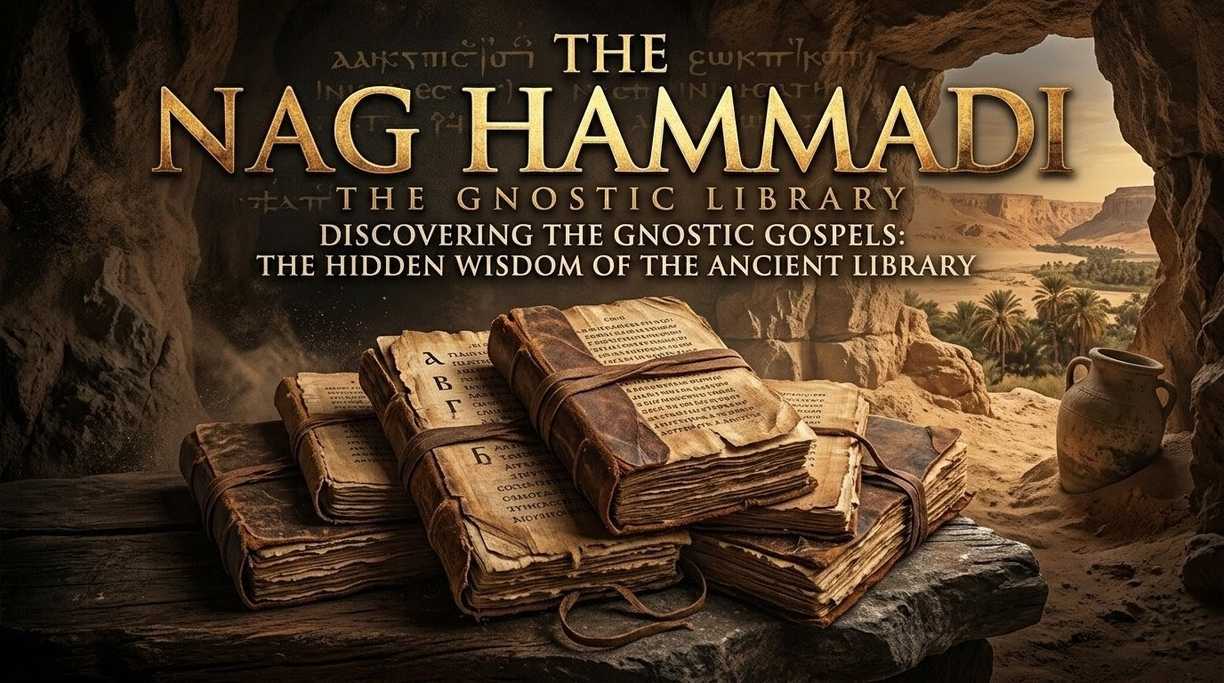
The Asclepius: The Perfect Discourse on Egyptian Wisdom
The Asclepius (NHC VI,8) stands as the longest Hermetic treatise preserved in the Nag Hammadi Library, offering a philosophical vision of cosmic order that challenges the archontic conspiracy theories dominating the collection [1]. Composed originally in Greek during the second or third century CE and preserved in fourth-century Coptic translation, this dialogue between Hermes Trismegistus and his disciple Asclepius presents a cosmos governed not by malevolent prison wardens but by cosmic sympathy (sympatheia)–the Stoic-influenced doctrine that all existence forms a single living organism animated by divine breath [9]. For scholars of ancient philosophy, the text provides crucial evidence of Egyptian priestly traditions operating under Roman rule; for the contemporary reader, it offers a surprising validation of material religious practice within a philosophical framework often assumed to be world-denying [8].
Unlike the dualistic theology of Sethian Gnosticism, where the material realm serves as an archontic detention facility, the Asclepius describes the universe as a well-run administrative centre in which ritual, divination, and philosophical purification function as legitimate departments of a single cosmic bureaucracy [10]. This article examines the codicological context, the doctrine of cosmic sympathy, the hierarchy of divination, the defence of Egyptian statue worship, and the distinctive “gravitational” model of post-mortem destiny that sets this text apart from its Nag Hammadi neighbours. Throughout, we maintain scholarly rigour while acknowledging the Asclepius’s capacity to unsettle comfortable assumptions about the relationship between Gnosticism, Hermeticism, and traditional Egyptian religion [14].
Table of Contents
- What Is the Asclepius?
- Hermetic Philosophy in the Gnostic Library
- Cosmic Sympathy and the Living Cosmos
- The Hierarchy of Divination
- Egyptian Wisdom vs Greek Rationalism
- The Gravitational Soul
- Why the Asclepius Matters
- Frequently Asked Questions
- Further Reading
- References and Sources
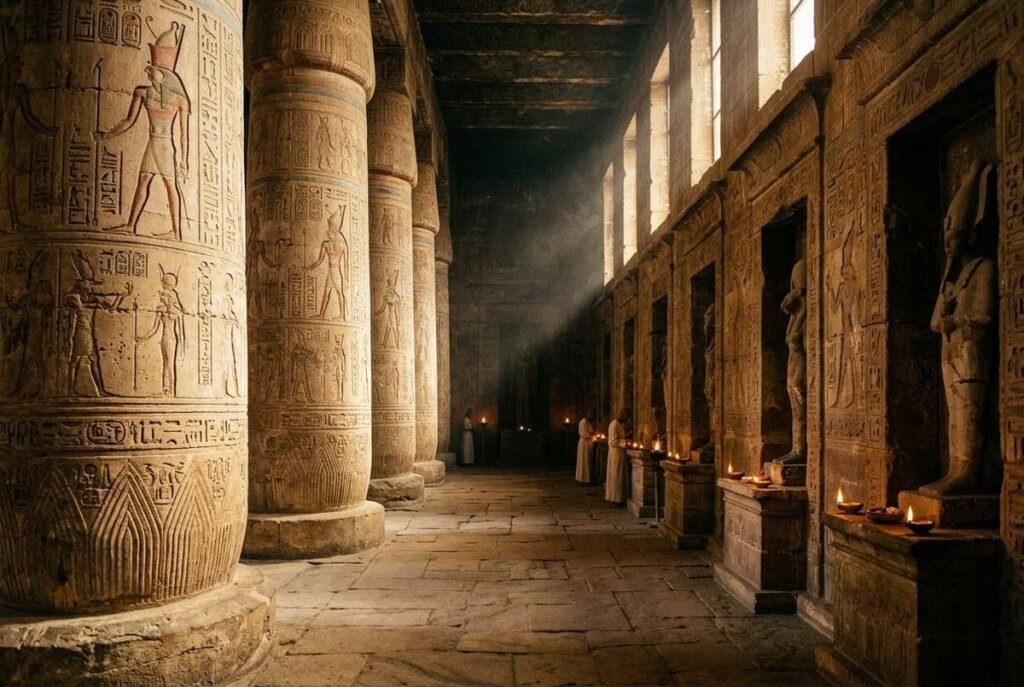
What Is the Asclepius?
What is the Asclepius in the Nag Hammadi Library?
The Asclepius (NHC VI,8) is the longest Hermetic treatise in the Nag Hammadi Library, preserved in fourth-century CE Coptic translation. Composed as a dialogue between Hermes Trismegistus and Asclepius, it presents a comprehensive cosmology based on cosmic sympathy–the Stoic-influenced doctrine that all existence forms a single living organism animated by divine breath. Unlike the dualistic archontic theology of Sethian Gnosticism, the Asclepius validates material religious practice (statue animation, temple worship, sacrifice) as participation in universal harmony, while distinguishing between popular religion (worshipping distinct gods) and philosophical understanding (recognising all gods as aspects of the single divine Mind) [1][9].
The text takes its title from its primary interlocutor, Asclepius, the legendary physician who serves as Hermes’s disciple in this cosmic tutorial. The Coptic version preserved in NHC VI,8 lacks the opening frames present in the Latin manuscript tradition, cutting straight to the philosophical chase [1]. This editorial efficiency suggests the ancient compiler valued doctrinal content over narrative setting, treating the text as a technical manual rather than a mystical initiation script [6]. The manuscript itself, written in the Sahidic Coptic dialect with Subachmimic features, dates to the mid-fourth century CE, though the Greek original likely circulated in second-to-third-century Alexandria [7].
Where the Apocryphon of John (NHC II,1) provides a mythological narrative of cosmogonic tragedy–Sophia’s fall, Yaldabaoth’s counterfeit claim to divinity, and the imprisonment of spirit in matter–the Asclepius offers a cosmological treatise stripped of personalised mythology [5]. The cosmos is not a botched construction by an incompetent demiurge but a well-ordered administrative entity requiring proper training to navigate [9]. This difference in theological register is not merely stylistic; it represents a fundamentally different assessment of material existence and the possibility of working within the cosmic system rather than escaping it [10].
Primary Source Citation: NHC VI,8 65:1-10
“The universe is a single living organism, animated by universal spirit, in which every subsystem maintains constant communication with every other subsystem.” Translation: C. Hendrick, The Nag Hammadi Library in English, ed. James M. Robinson, 4th rev. ed. (Leiden: Brill, 1996).
Hermetic Philosophy in the Gnostic Library
The Dialogue Form and the Bureaucracy of Teaching
The text adopts the classical Hermetic format: Hermes Trismegistus (“thrice-greatest”) instructs his disciple Asclepius, who serves as the straight man in this cosmic comedy–asking the obvious questions so that Hermes may deliver extended monologues on metaphysics [9]. The Coptic version preserved in NHC VI,8 lacks the opening frames present in the Latin manuscript tradition, cutting straight to the philosophical chase [1]. This editorial efficiency suggests the ancient compiler valued doctrinal content over narrative setting, treating the text as a technical manual rather than a mystical initiation script [6].
Codex VI: The Hermetic Compendium
The placement of the Asclepius within Codex VI reveals intentional curatorial logic. The codex functions as a Hermetic dossier: first the mystical ascent of the Discourse on the Eighth and the Ninth (VI,6), then the liturgical script of the Prayer of Thanksgiving (VI,7), and finally this extensive philosophical treatise (VI,8) [2][3]. This progression suggests the ancient community understood these texts as complementary departments of a single spiritual bureaucracy–mystical experience, ritual enactment, and cosmological theory working in administrative harmony [8]. Where other codices gather related Gnostic tractates into something resembling a theological filing cabinet, Codex VI juxtaposes Egyptian Hermeticism, Platonic excerpts, and Christian apocalyptic material without apparent anxiety about their theological differences [10].
The presence of the Asclepius alongside the Discourse on the Eighth and the Ninth and the Prayer of Thanksgiving indicates that the ancient curators understood these texts as participating in a shared discourse about the relationship between human beings and the divine order [7]. This intellectual breadth is unusual even in the diverse Nag Hammadi collection, revealing a readership comfortable with philosophical syncretism–a community that sought not merely to escape the cosmos but to understand its operational protocols [14].
Cosmic Sympathy and the Living Cosmos
Central to the Asclepius stands the doctrine of cosmic sympathy (sympatheia)–a concept borrowed from Stoic physics but reinterpreted through Egyptian theological lenses [9]. The universe constitutes a single living organism, animated by universal spirit (pneuma), in which every subsystem maintains constant communication with every other subsystem [1]. This is not the cold mechanical universe of later Cartesian imagination, but a bustling administrative centre where stellar influences affect terrestrial affairs not through mechanical causation (the billiard-ball model of physics) but through organic unity [11]. When the Asclepius describes the stars influencing human destinies, it depicts not tyrannical archons imposing fate, but departmental heads transmitting memos through the pneumatic infrastructure of the cosmos [8].
Stoic Physics meets Egyptian Theology
The doctrine of sympatheia derives from Stoic physics, particularly the teachings of Chrysippus and Posidonius, who argued that the cosmos is held together by a continuous pneumatic field pervading all matter [9]. The Asclepius adapts this framework to Egyptian religious concerns, presenting the Nile flood, the movement of stars, and the efficacy of temple ritual as evidence of the same organic interconnection [12]. The divine breath permeates all levels of reality, ensuring that what happens in the celestial boardroom immediately registers in the earthly mailroom [11].
This synthesis of Greek philosophy and Egyptian theology characterises the Hellenistic intellectual environment of Alexandria, where the Corpus Hermeticum emerged as a product of cross-cultural translation [12]. The Asclepius does not merely quote Stoic doctrine; it reinterprets it through the lens of Egyptian temple practice, producing a distinctive theology in which cosmic sympathy serves as the metaphysical foundation for ritual efficacy [9].
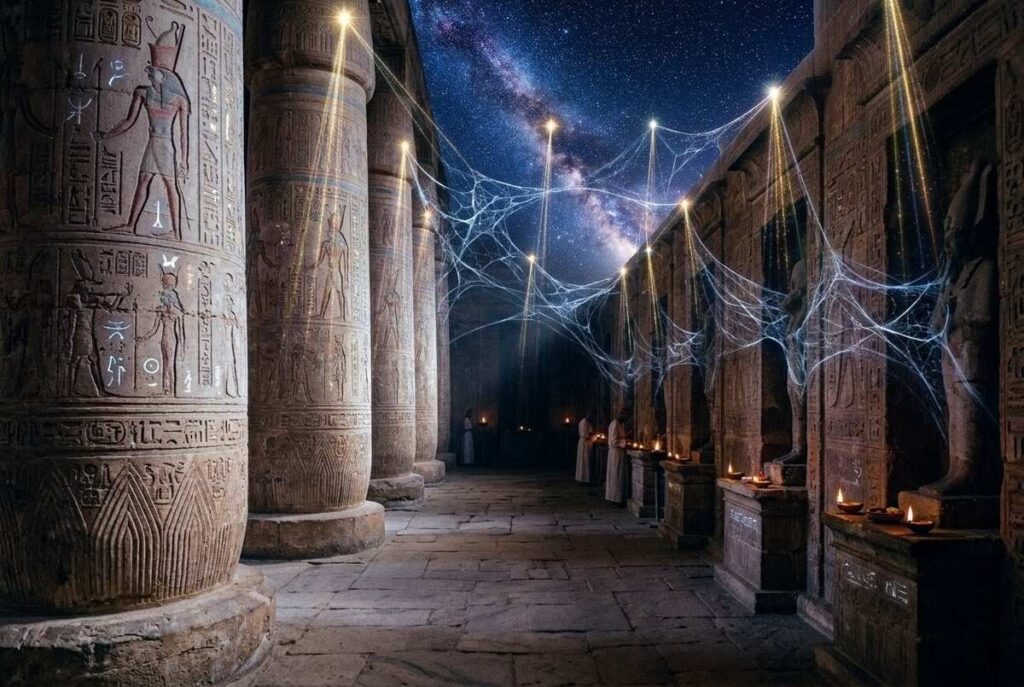
Ritual as Participation in Administrative Harmony
Where Sethian Gnostic texts typically condemn material religious practice as archontic deception–traps set by the rulers of this world–the Asclepius adopts a surprisingly positive attitude toward ritual [5]. Egyptian temple worship (statues animated by divine presence, hymns harmonising with celestial music, sacrifices establishing cross-realm communication) functions not as delusion but as practical technique for working with cosmic sympathy [1]. The statues are not gods, but filing cabinets for divine presence; the hymns are not empty flattery, but sonic frequencies that resonate with the celestial spheres [9]. This represents a theological position that modern Gnostics might find uncomfortably accommodating to material religion–suggesting that the divine bureaucracy can be navigated through proper ritual protocol rather than merely escaped [10].
Yet the text maintains the Hermetic distinction between popular religion and philosophical understanding. The masses (hoi polloi) worship gods as distinct personalities with individual departmental jurisdictions; the wise recognise that all gods represent aspects of the single divine Mind (nous) [9]. This parallels the Gnostic distinction between psychic and pneumatic faith, though without the contempt for the “hylic” majority sometimes found in Sethian taxonomies [14]. Where the Apocryphon of John depicts the material realm as a botched construction by an incompetent demiurge, the Asclepius describes the cosmos as a well-run (if complex) administrative entity requiring proper training to navigate [5].
Primary Source Citation: NHC VI,8 67:15-25
“The masses worship gods as distinct personalities; the wise recognise that all gods represent aspects of the single divine Mind.” Translation: C. Hendrick, The Nag Hammadi Library in English.
The Hierarchy of Divination
The Asclepius presents a tripartite classification of divinatory practices that influenced both late antique paganism and early Christian theology [9]. This is not mere anthropology of religion, but a technical manual distinguishing between legitimate and illegitimate means of accessing the cosmic database.
The Three Departments of Supernatural Communication
First comes theurgy–the ritual invocation of gods through animated statues and harmonic hymns [1]. This represents the standard operating procedure of Egyptian temple cult, validated by the text as genuine (if lower-level) contact with divine forces [9]. Second, necromancy–communication with the spirits of the dead–operates through the lower astral bureaucracy, involving entities of questionable reliability and psychological instability [11]. Third and highest stands true prophecy: direct illumination of the human mind (nous) by the divine Mind, bypassing intermediary spirits entirely [1].
Only this third category constitutes genuine knowledge (gnosis); the others involve either minor spiritual functionaries or psychological self-deception [9]. This hierarchy parallels Gnostic distinctions between the knowledge offered by astral archons (limited, bureaucratic, bound by protocol) and the transcendent revelation offered by the Father (immediate, unmediated, liberating) [14]. However, the Asclepius maintains a more tolerant attitude toward intermediate practices–allowing that theurgy, properly understood, participates in the same sympathetic infrastructure that enables true prophecy, whereas radical Gnosticism might dismiss all ritual as archontic entrapment [10].
Nous and the Eternal Gospel
True prophecy, in this schema, occurs when the human intellect achieves temporary union with the divine intellect, downloading information unavailable to ordinary cognition [9]. This is not prediction of future events–reading tomorrow’s cosmic weather report–but reception of timeless truth, the “eternal gospel” written into the fabric of reality itself [11]. The prophet functions not as fortune-teller but as systems administrator with temporary root access to the universal mainframe, perceiving the source code beneath apparent phenomena [14].
This emphasis on nous as the faculty of divine reception aligns the Asclepius with the broader Hermetic tradition preserved in the Corpus Hermeticum and the Discourse on the Eighth and the Ninth [2]. The human mind is not merely a passive receiver but an active participant in the cosmic sympathetic network, capable of achieving direct communion with the divine Mind through philosophical purification and ritual preparation [9].
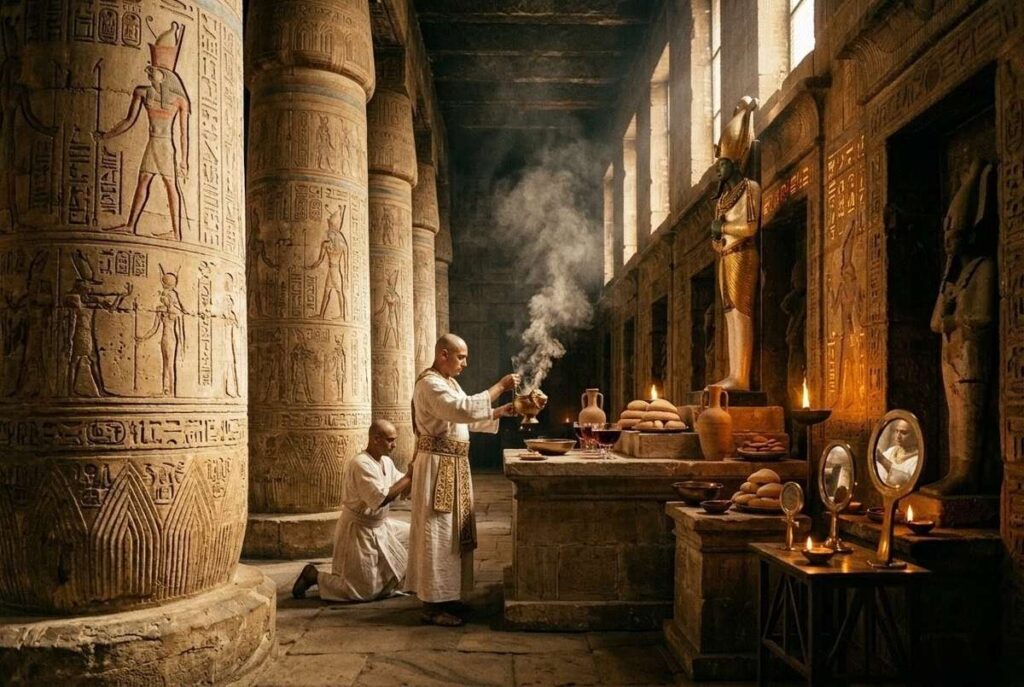
Primary Source Citation: NHC VI,8 70:5-15
“True prophecy occurs when the human intellect achieves temporary union with the divine intellect, receiving timeless truth written into the fabric of reality.” Translation: C. Hendrick, The Nag Hammadi Library in English.
Egyptian Wisdom vs Greek Rationalism
Uniquely among Nag Hammadi texts, the Asclepius explicitly defends Egyptian religious traditions against Greek philosophical critique [1]. This represents not merely cultural pride but a sophisticated apologetic strategy–the text functions simultaneously as defence counsel for traditional religion and its philosophical reinvention [12].
The Defence of Statue Worship
Greek critics had long charged Egyptian religion with superstition and idolatry–worshipping statues as if they were gods, engaging in “primitive” material religion while Greeks pursued abstract philosophical truth [9]. The Asclepius counters that apparent idolatry constitutes sophisticated pneumatic technology. The statues are not gods; they are vessels animated by cosmic sympathy, receivers tuned to divine frequencies through proper ritual installation [1]. This defence anticipates by centuries the Neoplatonic theory of cult statues developed by Proclus and Iamblichus, suggesting that the Nag Hammadi Hermetic texts preserve genuine priestly traditions rather than merely literary philosophical exercises [12].
The famous “statue animation” passage–in which Hermes explains how Egyptian priests instil divine presence into cult images through sympathetic magic–represents one of the most controversial sections of the text [9]. For orthodox Christian readers, this smacked of demonolatry; for modern scholars, it provides evidence for the practical techniques of Egyptian temple cult that philosophical texts rarely preserve [11]. The passage insists that the statues are not themselves divine but function as conduits–temporary branch offices where the divine headquarters may be contacted through proper protocol [14].
The Egyptianness of the Text
The Asclepius describes the Egyptian land as uniquely holy, the Nile as manifestation of divine providence (pronoia), and the temple cult as preserve of ancient wisdom predating Greek philosophy [1]. This “Egyptianness” distinguishes the text from the predominantly Platonic-Jewish-Christian frameworks dominating the Nag Hammadi collection [12]. Yet rather than rejecting Greek philosophy, the text subsumes it–arguing that Egyptian ritual expertise represents the practical application of Greek metaphysical truths [9]. The synthesis achieved–Egyptian ritual technology combined with Platonic rigour–represents the cultural achievement of Hellenistic Egypt, a philosophical-religious fusion that modern taxonomies struggle to classify [10].
This apologetic strategy–defending traditional practice by reinterpreting it through philosophical categories–parallels the methods of Philo of Alexandria and later Christian apologists [14]. The Asclepius thus participates in a broader Hellenistic discourse about the relationship between ancestral tradition and philosophical modernity, offering a model for religious continuity that does not require either uncritical conservatism or radical rejection [8].
The Gravitational Soul
The Asclepius shares the Gnostic obsession with post-mortem destiny but proposes a different physics of salvation [1]. Where Sethian texts describe elaborate bureaucratic checkpoints manned by archonic border guards, the Asclepius offers a naturalistic (if no less rigorous) model of cosmic buoyancy [15].
The Physics of Post-Mortem Destiny
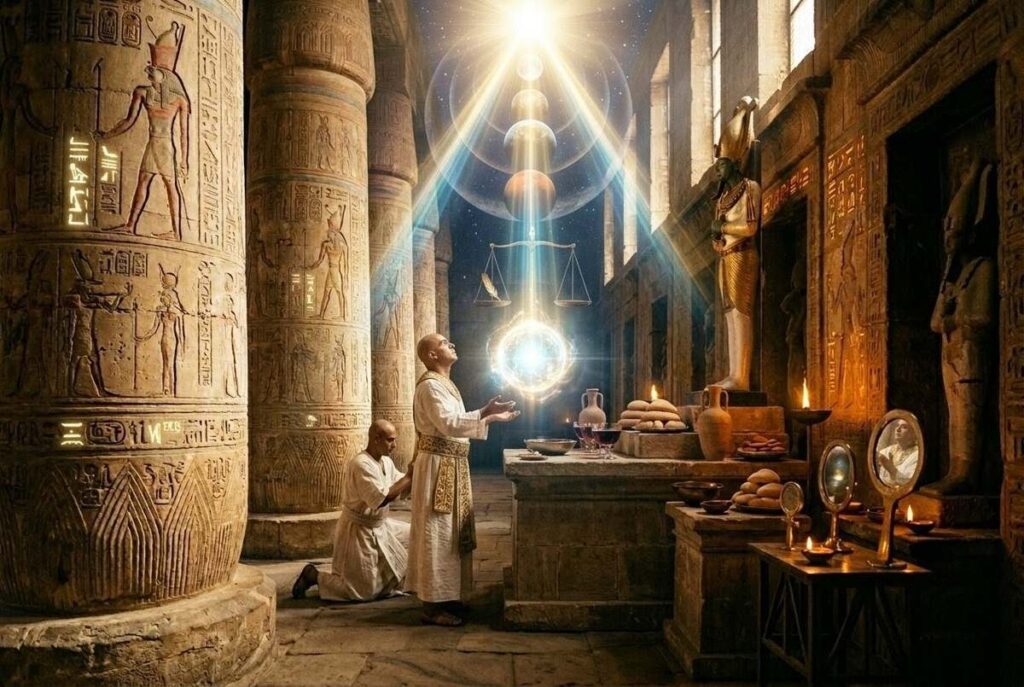
Souls are judged after death not by arbitrary tyrants but by the cosmic order itself–a kind of natural selection based on specific gravity [1]. Those who lived philosophically, purifying themselves of material attachments, become light and ascend to the gods [9]. Those enslaved to body and passion remain heavy, undergoing transmigration or dissolution according to their density [15]. This “gravitational” model of salvation parallels the ascent narratives in Sethian texts (the Apocalypse of Paul, Zostrianos) but without their elaborate mythological machinery [14]. No need to answer riddles at planetary checkpoints; one’s own ontological weight determines one’s celestial trajectory.
The Coptic text preserves this doctrine in the closing sections of the tractate, where Hermes describes the soul’s departure from the body and its assessment by cosmic order [1]. The imagery is strikingly physical: the soul is weighed, measured, and sorted according to its purity–not by an external judge wielding arbitrary power, but by the natural operation of sympathetic resonance that governs all cosmic movement [11]. This represents what scholars have termed “the most naturalistic soteriology in the Nag Hammadi collection” [15].
Philosophical Purification as Weight Reduction
This judgment is not punishment imposed by external authority but natural consequence–the soul takes on the characteristics of its earthly investments [9]. If bound to flesh through desire and materialism, it remains dense, sinking into lower realms [15]. If purified by philosophy (philosophia understood as spiritual training), it becomes subtle, rising toward the noetic realm [10]. The Asclepius thus offers a fitness regime for the soul: not escape from an evil world, but lightening one’s luggage for the cosmic journey [14]. It represents the optimistic face of Hermetic spirituality–this world as school rather than prison, salvation through understanding rather than insurrection [8].
This model has affinities with Platonic conceptions of the soul’s winged chariot in the Phaedrus, where the soul’s ability to ascend depends on the nourishment of its wings through philosophical contemplation [9]. The Asclepius adapts this imagery to Egyptian concerns with post-mortem judgment, producing a hybrid soteriology that would have been recognisable to both Greek philosophers and Egyptian priests [12].
Primary Source Citation: NHC VI,8 78:10-20
“Those purified by philosophy become light and ascend to the gods; those bound to flesh remain heavy, undergoing transmigration according to their density.” Translation: C. Hendrick, The Nag Hammadi Library in English.
Why the Asclepius Matters
The Asclepius matters because it preserves a vision of cosmic order antithetical to the archonic conspiracy theories dominating the Nag Hammadi library, yet equally committed to the salvation of the knowing soul [1]. Where Sethian texts prescribe escape from cosmic imprisonment, the Asclepius recommends mastering the administrative protocols of the universe–understanding that the same cosmic sympathy binding us to material existence can, through philosophical purification, become the mechanism of our ascent [9]. It represents the Egyptian priestly tradition at its most philosophically rigorous: this world as divine bureaucracy, navigable by those who understand its filing systems, and the soul as traveller lightening its luggage for the journey home [12].
For scholars of ancient religion, the text illuminates the relationship between Hermeticism, Gnosticism, and traditional Egyptian cult in Roman Egypt [8]. Its defence of statue worship, its doctrine of cosmic sympathy, and its naturalistic soteriology provide evidence for a religious culture far more diverse than polemical categories of “orthodox” and “heretical” allow [14]. The communities that preserved this text alongside the Apocryphon of John and the Gospel of Philip were not sectarian isolationists but participants in a broad conversation about the nature of divinity, matter, and salvation [10].
Furthermore, the Asclepius challenges any simplistic equation of Gnosticism with world-denial. Its validation of ritual, its positive assessment of material religious practice, and its doctrine of cosmic sympathy suggest that at least some strands of early Christian-Hermetic spirituality sought to transform the world rather than abandon it [14]. The text forces readers to confront a question that remains urgent: is the material realm a prison to escape, or a school to master? The Asclepius offers no easy answers, only the rigorous clarity of a vision that found conventional dualisms wanting [15].
Frequently Asked Questions
What is the Asclepius in the Nag Hammadi Library?
The Asclepius (NHC VI,8) is the longest Hermetic treatise in the Nag Hammadi Library, preserved in fourth-century CE Coptic. It presents a dialogue between Hermes Trismegistus and Asclepius on cosmic sympathy, Egyptian ritual, and the fate of the soul, offering a philosophical system distinct from the Christian Gnostic texts dominating the collection.
What is cosmic sympathy in Hermetic philosophy?
Cosmic sympathy (sympatheia) is the Stoic-influenced doctrine central to the Asclepius holding that the universe is a single living organism animated by divine breath (pneuma). All parts of the cosmos are interconnected, allowing stellar influences to affect earthly affairs through organic unity rather than mechanical causation.
How does the Asclepius differ from Gnostic texts in Nag Hammadi?
Unlike Sethian and Valentinian texts that describe the material world as an archontic prison, the Asclepius validates material religious practice (statue worship, temple ritual) as participation in cosmic sympathy. It describes the cosmos as well-ordered rather than botched, and salvation as philosophical purification rather than escape from malevolent powers.
What are the three types of divination in the Asclepius?
The Asclepius distinguishes three practices: theurgy (ritual invocation of gods through statues and hymns), necromancy (communication with spirits of the dead), and true prophecy (direct illumination by divine Mind). Only the third represents genuine knowledge (gnosis); the others involve inferior spirits or psychological delusion.
What is the fate of the soul according to the Asclepius?
The Asclepius proposes a ‘gravitational’ model: souls are judged by cosmic order itself based on their ontological weight. Those purified by philosophy become light and ascend to the gods; those bound to flesh remain heavy, undergoing transmigration or dissolution. This is natural consequence, not arbitrary punishment by archontic powers.
How does the Asclepius defend Egyptian statue worship?
Against Greek charges of idolatry, the Asclepius argues that Egyptian statues are not gods but vessels animated by cosmic sympathy–receivers tuned to divine frequencies through proper ritual. This represents sophisticated pneumatic technology rather than superstition, anticipating later Neoplatonic theories of cult statues.
Where is the Asclepius located in the Nag Hammadi manuscripts?
The Asclepius occupies the final position in Codex VI (NHC VI,8), following the Discourse on the Eighth and the Ninth (VI,6) and the Prayer of Thanksgiving (VI,7). This placement suggests the ancient compiler understood these three texts as complementary: mystical ascent, ritual enactment, and philosophical cosmology.
Further Reading
These links connect the Asclepius to related resources within the ZenithEye library, offering pathways into the Hermetic texts, Egyptian ritual, and philosophical cosmology that illuminate this distinctive treatise.
- The Discourse on the Eighth and the Ninth — Study the mystical ascent text that precedes the Asclepius in Codex VI.
- The Prayer of Thanksgiving — Explore the ritual text and eucharistic practice from the same codex.
- Codex VI: The Hermetic Compendium — Learn about the manuscript context of this philosophical collection.
- Hermetic Connections in the Nag Hammadi Library — Discover the relationship between Hermetic and Gnostic traditions.
- Plato’s Republic in the Nag Hammadi Library — Compare philosophical frameworks within the collection.
- Apocryphon of John — Contrast the Asclepius’s cosmic sympathy with Sethian archontic theology.
- Gospel of the Egyptians — Examine Sethian cosmogony as counterpoint to Hermetic philosophy.
- Nag Hammadi Library: The Complete Guide — Contextualise the Asclepius within the full collection of forty-six tractates.
References and Sources
The following sources support the claims and quotations presented in this article. All citations to the Nag Hammadi Library represent direct translations from the Coptic text as established in the standard critical editions.
Primary Sources and Critical Editions
- [1] NHC VI,8: Asclepius: The Perfect Discourse. Tr. C. Hendrick. In The Nag Hammadi Library in English, ed. James M. Robinson. 4th rev. ed. Leiden: Brill, 1996.
- [2] NHC VI,6: The Discourse on the Eighth and the Ninth. Tr. Peter A. Dirkse, James Brashler, and Douglas M. Parrott. In The Nag Hammadi Library in English, ed. James M. Robinson. 4th rev. ed. Leiden: Brill, 1996.
- [3] NHC VI,7: The Prayer of Thanksgiving. Tr. James Brashler, Peter A. Dirkse, and Douglas M. Parrott. In The Nag Hammadi Library in English, ed. James M. Robinson. 4th rev. ed. Leiden: Brill, 1996.
- [4] Corpus Hermeticum II (Latin Asclepius). Tr. Brian P. Copenhaver. In Hermetica: The Greek Corpus Hermeticum and the Latin Asclepius in a New English Translation. Cambridge: Cambridge University Press, 1992.
- [5] NHC II,1: The Apocryphon of John. Tr. Michael Waldstein and Frederik Wisse. In The Nag Hammadi Library in English, ed. James M. Robinson. 4th rev. ed. Leiden: Brill, 1996.
Scholarly Monographs and Commentaries
- [6] Robinson, James M., ed. The Nag Hammadi Library in English. 4th rev. ed. Leiden: Brill, 1996.
- [7] Mahe, Jean-Pierre. Hermes en Haute-Egypte: Les textes hermetiques de Nag Hammadi et leurs paralleles grecs et latins. Bibliotheque copte de Nag Hammadi, section “Textes” 3. Quebec: Les Presses de l’Universite Laval, 1978.
- [8] Pearson, Birger A. Gnosticism and Christianity in Roman and Coptic Egypt. Studies in Antiquity and Christianity. New York: T&T Clark, 2004.
- [9] Copenhaver, Brian P. Hermetica: The Greek Corpus Hermeticum and the Latin Asclepius in a New English Translation. Cambridge: Cambridge University Press, 1992.
- [10] Van den Broek, Roelof. Gnostic Religion in Antiquity. Cambridge: Cambridge University Press, 2013.
Comparative Studies and Thematic Analyses
- [11] Festugiere, Andre-Jean. La Revelation d’Hermes Trismegiste. 4 vols. Paris: Lecoffre, 1944-1954.
- [12] Fowden, Garth. The Egyptian Hermes: A Historical Approach to the Late Pagan Mind. Princeton: Princeton University Press, 1986.
- [13] DeConick, April D. Voices of the Mystics: Early Christian Discourse in the Gospels of John and Thomas and Other Ancient Christian Literature. Journal for the Study of the New Testament Supplement Series 157. Sheffield: Sheffield Academic Press, 2001.
- [14] Brakke, David. The Gnostics: Myth, Ritual, and Diversity in Early Christianity. Cambridge, MA: Harvard University Press, 2010.
- [15] Denzey Lewis, Nicola. Cosmology and Fate in Gnosticism and Graeco-Roman Antiquity: Under Pitiless Skies. Nag Hammadi and Manichaean Studies 81. Leiden: Brill, 2013.