The Prayer of Thanksgiving: Hermetic Liturgy in Codex VI
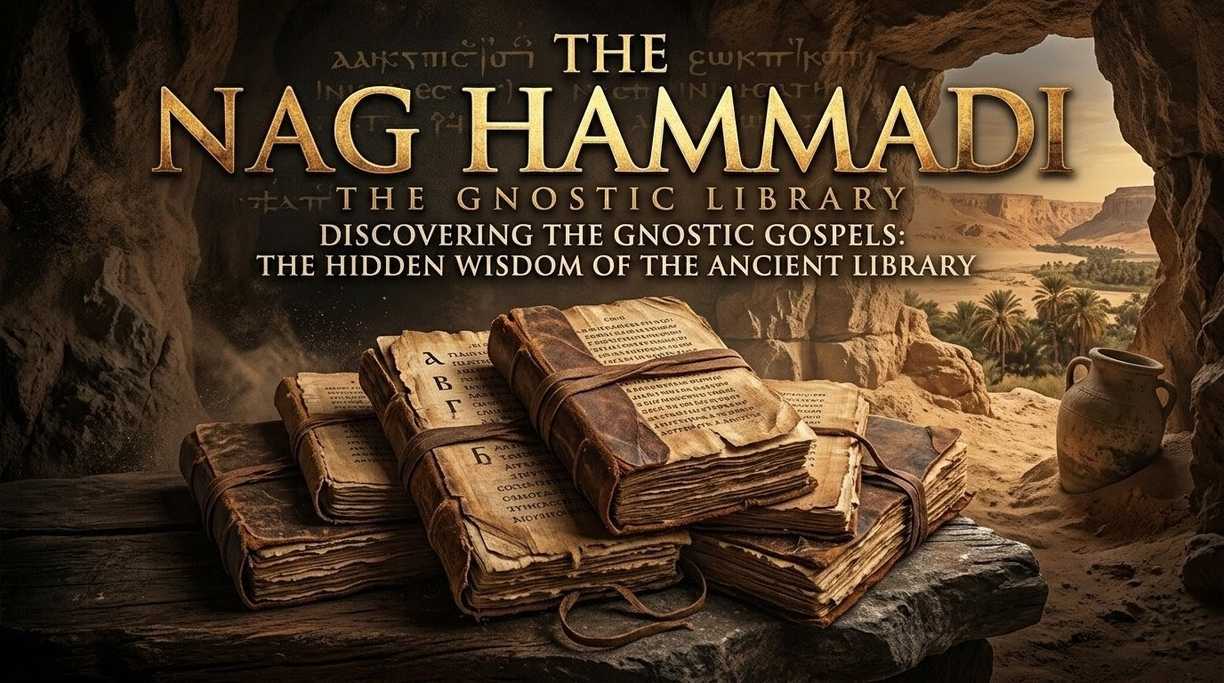
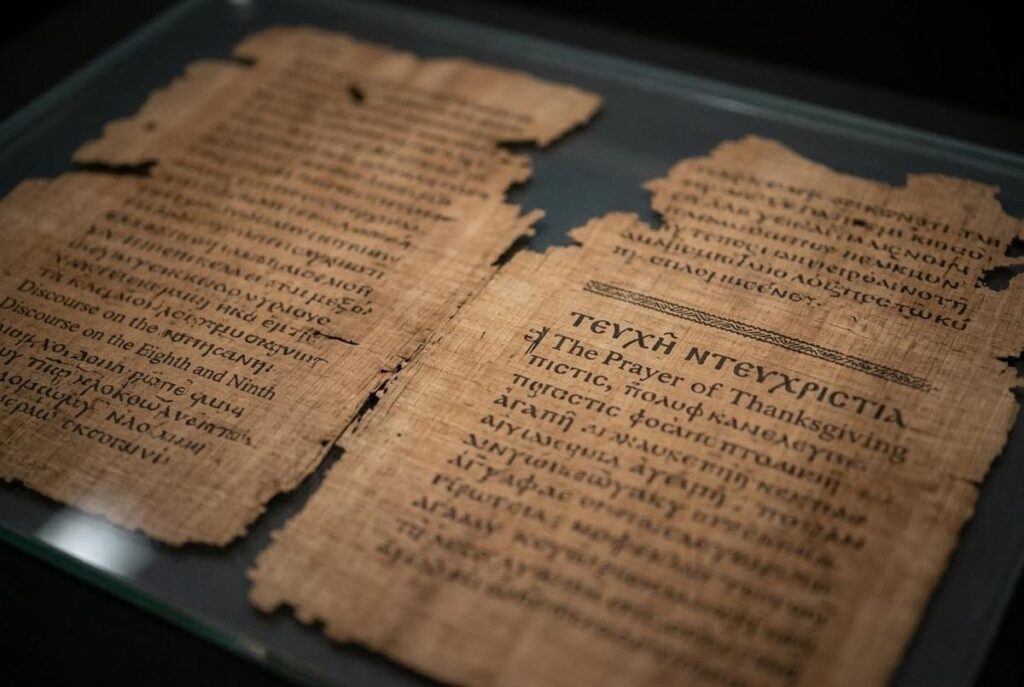
The Prayer of Thanksgiving (NHC VI,7) stands as one of the few explicitly liturgical texts in the Nag Hammadi Library, preserving the ritual script of a Hermetic eucharistic gathering from second-to-third-century CE Roman Egypt [1]. Unlike the speculative dialogues and cosmological treatises that dominate the collection, this brief tractate records the actual words and gestures of communal worship–a rare glimpse into the practical religious life of the communities that buried these manuscripts near the Jabal al-Tarif cliffs [6]. Positioned at the end of Codex VI immediately after the Discourse on the Eighth and the Ninth, the Prayer demonstrates that the noetic ascent described in theoretical terms elsewhere was enacted through concrete ritual: a vegetarian meal, a shared cup, and a thanksgiving invocation that the participants understood as effecting direct communion with the divine [2].
Scholarly analysis of the Prayer reveals a community that did not merely theorise about the executive headquarters of the divine realm but enacted their security clearance through ritual performance [8]. The text offers evidence that the Hermetic, Gnostic, and Christian traditions preserved in the library were not only literary exercises but the theological foundations for actual communal worship [9]. This article examines the codicological context, ritual structure, theological vocabulary, and sacramental theology of the Prayer, correcting common misreadings while situating the text within the broader landscape of Roman Egyptian religion [10].
Table of Contents
- What Is the Prayer of Thanksgiving?
- The Manuscript and Its Context
- The Ritual Structure: Five Movements
- Key Theological Dimensions
- The Eucharistic Meal: Sacramental Theology
- Silence and the Limit of Language
- Why the Prayer Matters
- Frequently Asked Questions
- Further Reading
- References and Sources
What Is the Prayer of Thanksgiving?
What is Eucharistia in the Hermetic Context?
In Roman Egyptian Hermeticism, eucharistia denotes not merely gratitude but the ritual enactment of noetic recognition–the communal acknowledgment that divine mind (nous) has granted participants their security clearance into the executive headquarters of the Ogdoad and Ennead. The term carries Jewish-Christian resonances of blessing and gratitude, yet here it applies to a specifically Hermetic context of noetic illumination where thanksgiving becomes the fundamental posture of those who have received gnosis [1].
The Prayer of Thanksgiving occupies the final position in Codex VI, immediately following the Discourse on the Eighth and the Ninth (NHC VI,6) [2]. This sequential arrangement suggests that ancient readers understood these texts as complementary: first the theoretical instruction on noetic ascent through the cosmic spheres, then the practical liturgical enactment of that communion with the divine. The Prayer presupposes that participants have undergone the transformative experience described in the preceding dialogue–they have received the illumination that qualifies them for the ritual meal [7].
The manuscript itself, written in the Sahidic Coptic dialect with numerous Greek loanwords characteristic of Hermetic literature, dates to the fourth century CE, though the composition of the Prayer likely originates in the second or third century [6]. The material context of the burial–sealed in a jar near the Jabal al-Tarif cliffs–preserves this ritual text alongside cosmological treatises, suggesting that the ancient community valued liturgical practice equally with speculative theology [8]. The Prayer thus functions as a personnel file documenting the actual operational protocols of a community too often dismissed as merely speculative [10].
Primary Source Citation: NHC VI,7 63:1-5
“We give thanks to thee, O God, by means of this light of knowledge.” Translation: James Brashler, Peter A. Dirkse, and Douglas M. Parrott, The Nag Hammadi Library in English, ed. James M. Robinson, 4th rev. ed. (Leiden: Brill, 1996).
The Manuscript and Its Context
Sequential Reading in Codex VI
The Prayer occupies the final position in Codex VI, immediately following the Discourse on the Eighth and the Ninth (NHC VI,6) [1]. This sequential arrangement suggests that ancient readers understood these texts as complementary: first the theoretical instruction on noetic ascent through the cosmic spheres, then the practical liturgical enactment of that communion with the divine [2]. The Prayer presupposes that participants have undergone the transformative experience described in the preceding dialogue–they have received the illumination that qualifies them for the ritual meal.
Codicological analysis indicates that the scribe responsible for Codex VI consciously curated this progression from philosophical instruction to ritual performance [6]. The manuscript itself, written in the Sahidic Coptic dialect with numerous Greek loanwords characteristic of Hermetic literature, dates to the fourth century CE, though the composition of the Prayer likely originates in the second or third century [7]. The material context of the burial–sealed in a jar near the Jabal al-Tarif cliffs–preserves this ritual text alongside the more familiar cosmological treatises, suggesting that the ancient community valued liturgical practice equally with speculative theology [8].
The Hermetic Milieu of Roman Egypt
The Prayer reflects the cosmopolitan religious environment of Roman Egypt, where Jewish, Christian, and traditional Egyptian practices intermingled freely [8]. Unlike the specifically Christian-Gnostic texts elsewhere in the library (such as the Apocryphon of John or the Gospel of Philip), the Prayer maintains a distinctly Hermetic theological vocabulary while adopting structural elements from Jewish-Christian eucharistic tradition [9]. This syncretism characterises the Corpus Hermeticum generally, but the Nag Hammadi version provides unique evidence for the ritual application of these theological concepts [7].
The communities that produced and preserved these texts operated within a religious marketplace where boundaries between traditions remained porous [10]. The Prayer demonstrates that Hermetic spirituality was not an isolated philosophical school but a living tradition with communal worship practices. Its presence in the same codex as the Discourse on the Eighth and the Ninth and the Coptic Asclepius (NHC VI,8) indicates that the ancient compiler understood these texts as a unified curriculum–theoretical, liturgical, and philosophical–rather than random selections [4].
Primary Source Citation: NHC VI,7 65:2-7
“When they had finished giving thanks, they rose and embraced one another, and they went to eat their holy food, which has no blood in it.” Translation: Brashler, Dirkse, and Parrott, The Nag Hammadi Library in English.
The Ritual Structure: Five Movements
The text describes a carefully structured liturgical sequence that moves from communal gathering through shared thanksgiving to final communion [1]. This five-part structure reflects standard patterns of ancient Mediterranean ritual while adapting them to the specific theological concerns of Hermetic spirituality [11].
1. The Gathering (Synaxis)
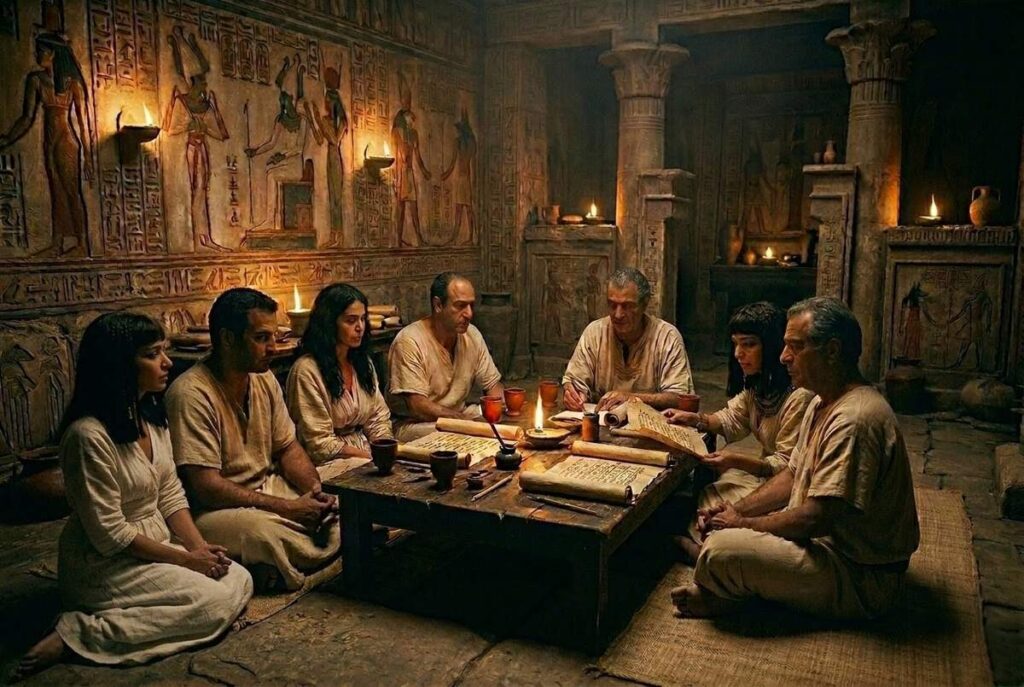
Participants assemble for a shared meal, described as “thanksgiving” (eucharistia) [1]. The Greek term carries Jewish-Christian resonances of blessing and gratitude, yet here it applies to a specifically Hermetic context of noetic illumination [8]. The gathering establishes the communal dimension of the ritual–though the ascent is ultimately individual, it occurs within the context of shared worship and mutual recognition. The assembly functions like a branch office convening to receive directives from the executive headquarters, acknowledging that noetic knowledge is received rather than manufactured [9].
2. The Cup (Poterion)
Wine is offered in a cup that scholars interpret as symbolising divine mind (nous) [1]. Unlike orthodox Christian Eucharist, which focuses on the blood of Christ, the Hermetic cup represents the divine intellect that participants seek to receive [12]. The wine functions as a material vehicle for non-physical reality, effecting transformation through symbolic conjunction rather than transubstantiation [9]. In the bureaucratic metaphor that runs through Hermetic spirituality, the cup serves as a temporary visa stamp, authorising passage between the material branch office and the noetic headquarters.
3. The Prayer (Euche)
The collective invocation preserved in the text follows a structure distinct from Christian formulations [1]. The participants address God as Father and the Good (Agathos). While broader Hermetic theology recognises the Good Daimon (Agathos Daimon) as a guiding intermediary, the Prayer itself concentrates on the direct relationship between worshippers and the divine source, giving thanks for the gifts of mind (nous), word (logos), and knowledge (gnosis) [7]. The prayer opens with the formula: “We give thanks to thee, O God, by means of this light of knowledge” (gnosis), establishing gratitude as the fundamental posture of Hermetic spirituality [1]. This is eucharistic, not petitionary: the community gives thanks for what it has already received rather than asking for future protection [10].
4. The Silence (Sige)
Following the verbal prayer, the text moves directly to the communal embrace and meal [1]. Scholars infer from this transition a period of wordless contemplation paralleling the sige (stillness) emphasised in other Hermetic texts [7]. The movement from spoken thanksgiving to shared silence represents the limit of language–having given thanks for the gift of gnosis, the community enters a state of noetic communion that transcends discursive thought [9]. This inferred silence reflects the Hermetic recognition that the transcendent One exceeds all verbal predication, and that the most accurate theology is often the unspoken kind.
5. The Ascent (Anodos)
The ritual culminates in the narrative conclusion that the participants share holy food after their thanksgiving [1]. The text itself does not explicitly describe an ascent during the Prayer; rather, the preceding Discourse on the Eighth and the Ninth (VI,6) provides the ascent framework in which the Prayer operates [2]. A separate scribal note (NHC VI,7a) follows the Prayer, attesting to the text’s transmission to someone already familiar with such writings [3]. This colophon confirms that the community understood the ritual as efficacious–the thanksgiving was not merely commemorative but participatory, enacting the noetic union described in the Discourse [10].

Primary Source Citation: NHC VI,7 63:5-15
“We give thanks to thee for every gift, O God, since thou hast shown us thyself; we give thanks for that thou hast given us mind, word, and knowledge.” Translation: Brashler, Dirkse, and Parrott, The Nag Hammadi Library in English.
Key Theological Dimensions
The Hermetic Trinity
The Prayer preserves a distinctive theological structure that diverges significantly from Christian orthodoxy while maintaining structural parallels [1]. The text addresses God as Father and refers to God as the Good (Agathos). This dyad reflects Middle Platonic and Stoic philosophical influences adapted to Hermetic religious practice [7]. While broader Hermetic theology–evident in the Discourse on the Eighth and the Ninth and the Corpus Hermeticum–recognises the Good Daimon (Agathos Daimon) as a guiding spirit or divine intermediary who facilitates human communion with the transcendent realm, the Prayer itself concentrates on the direct relationship between the worshippers and the divine source [9].
The Father represents the transcendent source of all existence, invoked as the ultimate recipient of thanksgiving. The Good (Agathos) names the cosmic principle of goodness that emanates from the divine source and suffuses the created order [7]. Together they form a theological filing system that distinguishes between the unapproachable origin and the accessible manifestation of divine beneficence, without requiring the middle-management mediation of lesser powers [9].
The Light of Knowledge (Gnosis)
Central to the Prayer’s theology is the concept of gnosis as divine gift rather than human achievement [1]. The participants give thanks for “the light of knowledge” that illuminates their intellects, acknowledging that this salvific understanding comes from divine grace [9]. This distinguishes Hermetic spirituality from purely philosophical schools of the period: while sharing Platonic epistemology, the Prayer insists upon the necessity of divine initiative in the process of illumination [12]. One does not earn a security clearance through merit; it is granted by the executive authority itself.
The text gives thanks for the gifts of nous (mind), logos (word), and gnosis (knowledge)–a triad of noetic endowments that enable human participation in the divine realm [1]. This emphasis on received knowledge underscores the fundamentally religious rather than philosophical character of the Prayer [8]. The community understands itself as dependent upon divine generosity, not as autonomous seekers who have conquered wisdom through intellectual labour alone [10].
The Eucharistic Meal: Sacramental Theology
The Vegetarian Requirement
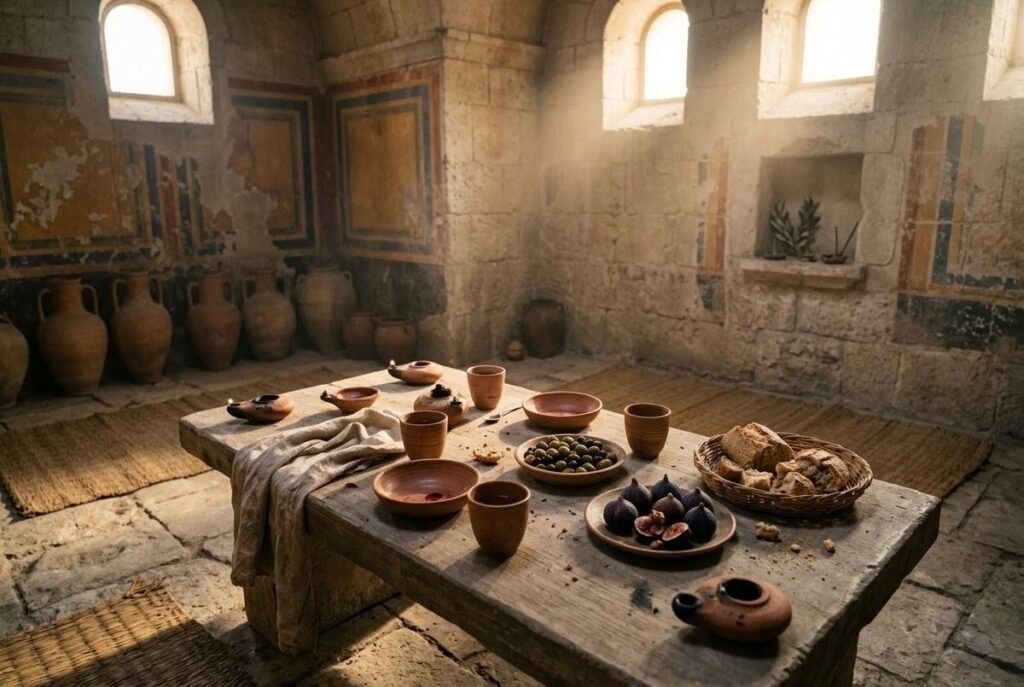
The text specifies that participants consume “holy food, which has no blood in it” (NHC VI,7 64) [1]. This vegetarian requirement distinguishes the Hermetic meal from contemporary Christian Eucharist (which involved wine and bread within a sacrificial framework) and from mystery cults involving animal sacrifice [11]. The absence of blood reflects the text’s emphasis on purity and the transcendence of corporeal grossness, aligning with the goal of noetic ascent [9]. In the Hermetic filing system, blood belongs to the material branch office; the headquarters operates on subtler nutrients.
Parallels with the Gospel of Philip
The sacramental theology of the Prayer parallels that found in the Gospel of Philip (NHC II,3), where the bridal chamber (nymphon) and the eucharist appear as means of spiritual transformation [5]. Both texts suggest that material elements–bread, wine, water–function as vehicles for non-physical realities when approached with proper understanding (gnosis) [12]. However, while Philip emphasises the nymphon as the supreme sacrament, the Prayer focuses upon the communal thanksgiving and the shared meal as the context for noetic reception [1].
This parallel suggests a shared sacramental culture in second-century Egyptian Christianity, wherein Valentinian, Sethian, and Hermetic communities developed similar ritual practices while maintaining distinct theological interpretations [8]. The Prayer thus provides evidence for the practical dimensions of the theoretical sacramental theology found elsewhere in the library, confirming that these communities did not merely speculate about sacraments but enacted them according to their respective personnel protocols [10].
Primary Source Citation: NHC VI,7 64:1-5
“Holy food, which has no blood in it.” Translation: Brashler, Dirkse, and Parrott, The Nag Hammadi Library in English.
Silence and the Limit of Language
The ritual’s movement from spoken prayer to communal embrace and meal reflects a sophisticated anthropology of religious experience [1]. The Prayer acknowledges that language, while necessary for communal coordination and initial orientation, ultimately cannot contain the reality of divine communion [9]. The inferred silence (sige) following the prayer represents the apophatic dimension of Hermetic theology–the recognition that the transcendent One exceeds all predication [7].
This structural silence parallels the “negative theology” found in the Concept of Our Great Power (NHC VI,4), where the supreme deity remains silent and resting [9]. However, whereas that text maintains a philosophical register, the Prayer embodies this silence in ritual practice. The community enacts the transcendence of language through the simple expedient of ceasing to speak, allowing the nous to commune directly with the divine intellect [12]. Language is the paperwork of the branch office; silence is direct access to the chief executive.
The Prayer of Thanksgiving thus stands as a unique witness to the ritual life of the communities that produced the Nag Hammadi Library [1]. It demonstrates that the speculative cosmologies and philosophical dialogues preserved in the collection were not merely literary exercises but the theological foundations for actual communal worship [10]. The ascent to the eighth and ninth spheres, described in the Discourse as theoretical possibility, here finds its liturgical actualisation–souls rising through the planetary spheres in the thanksgiving that precedes the silence, achieving the incorruptibility promised by the Hermetic path [2].
Why the Prayer Matters
The Prayer of Thanksgiving matters because it transforms our understanding of the Nag Hammadi Library from an archive of esoteric speculation into a collection of texts intended for lived religious practice [8]. Too often, scholars and readers treat these manuscripts as philosophical curiosities–ancient counter-intelligence reports against archonic middle-management–rather than as the devotional literature of actual communities [10]. The Prayer proves that the communities who buried these texts under the cliffs of Upper Egypt did so not to preserve abstract theories but to protect the rituals that enacted their most cherished beliefs [6].
Furthermore, the Prayer illuminates the relationship between Hermeticism and Christianity in Roman Egypt [8]. Its eucharistic structure, vegetarian requirement, and noetic theology suggest a shared ritual culture that crossed doctrinal boundaries [9]. The communities that used this text were not sectarian isolationists but participants in a broader religious conversation about how material elements might serve as vehicles for spiritual realities [12]. The Prayer is therefore essential reading for anyone seeking to understand the practical dimensions of ancient Gnosticism and Hermeticism–not merely what these communities believed, but how they worshipped, ate, drank, and gave thanks together in the expectation of noetic transformation [10].
Frequently Asked Questions
What is the Prayer of Thanksgiving in the Nag Hammadi Library?
The Prayer of Thanksgiving (NHC VI,7) is one of the few explicitly liturgical texts in the Nag Hammadi Library, preserving the ritual script of a Hermetic eucharistic gathering. It describes a communal meal, a shared cup, and a thanksgiving invocation addressed to God the Father and the Good (Agathos), concluding with the participants sharing holy food that contains no blood.
Where is the Prayer of Thanksgiving located in the manuscripts?
The Prayer appears at the end of Codex VI, immediately following the Discourse on the Eighth and the Ninth (NHC VI,6). This sequential arrangement suggests the texts were intended to be read together, with the Prayer providing the ritual enactment of the theoretical ascent described in the Discourse. A separate scribal note (NHC VI,7a) follows the Prayer, attesting to the text’s transmission.
What is the theological structure of the Prayer?
The Prayer addresses God as Father and the Good (Agathos). While broader Hermetic theology recognises the Good Daimon (Agathos Daimon) as a guiding intermediary, the Prayer itself concentrates on the direct relationship between worshippers and the divine source, giving thanks for the gifts of mind (nous), word (logos), and knowledge (gnosis).
Why is the meal in the Prayer of Thanksgiving vegetarian?
The text specifies ‘holy food, which has no blood in it,’ indicating a vegetarian requirement. This reflects the text’s emphasis on purity and the transcendence of corporeal grossness, aligning with the ritual’s goal of noetic ascent and the Hermetic valuation of the intellectual over the material.
What does the cup symbolise in the Prayer of Thanksgiving?
The cup contains wine that symbolises the divine intellect (nous) which participants seek to receive. Unlike Christian Eucharist which focuses on Christ’s blood, the Hermetic cup represents noetic illumination and the conjunction of human and divine intelligence through symbolic rather than substantial transformation.
What happens after the prayer is spoken?
Following the spoken thanksgiving, the text describes the participants embracing one another and going to eat their holy food. Scholars infer from this transition a movement from verbal to non-verbal communion, paralleling the Hermetic emphasis on silence (sige) as the limit of language and the entry into direct noetic communion with the divine.
Is the Prayer of Thanksgiving Hermetic or Christian?
The Prayer is distinctly Hermetic in theological vocabulary (nous, Agathos, ascent through spheres) while adopting structural elements from Jewish-Christian eucharistic tradition (thanksgiving, communal meal). It represents the syncretistic religious environment of Roman Egypt where these traditions intermingled freely.
Further Reading
These links connect the Prayer of Thanksgiving to related resources within the ZenithEye library, offering pathways into the Hermetic texts, sacramental theology, and codicological studies that illuminate this unique ritual document.
- The Discourse on the Eighth and the Ninth — Study the theoretical foundation on noetic ascent that precedes this ritual in Codex VI.
- The Gospel of Philip — Compare Valentinian sacramental theology with the Hermetic eucharistic practice described in the Prayer.
- The Concept of Our Great Power — Examine another text from Codex VI sharing the theological emphasis on divine transcendence and silence.
- Codex VI: The Hermetic Compendium — Explore the full manuscript context of the Prayer within the Nag Hammadi collection.
- Asclepius: The Perfect Discourse — Study the longer Hermetic text preserved in the same codex.
- Trimorphic Protennoia — Examine ritual descent and seal-giving in a Sethian context, contrasting with the Hermetic ascent.
- Baptism in the Nag Hammadi Library — Explore ritual practices across the broader corpus.
- Nag Hammadi Library: The Complete Guide — Contextualise the Prayer within the full collection of forty-six tractates.
- Hermeticism and Gnosticism — Understand the relationship between these traditions in Roman Egypt.
- Nag Hammadi for Beginners — Curated reading path including accessible Hermetic texts.
References and Sources
The following sources support the claims and quotations presented in this article. All citations to the Nag Hammadi Library represent direct translations from the Coptic text as established in the standard critical editions.
Primary Sources and Critical Editions
- [1] NHC VI,7: The Prayer of Thanksgiving. Tr. James Brashler, Peter A. Dirkse, and Douglas M. Parrott. In The Nag Hammadi Library in English, ed. James M. Robinson. 4th rev. ed. Leiden: Brill, 1996. Coptic text preserved on pages 63-65 of Codex VI.
- [2] NHC VI,6: The Discourse on the Eighth and the Ninth. Tr. Peter A. Dirkse, James Brashler, and Douglas M. Parrott. In The Nag Hammadi Library in English, ed. James M. Robinson. 4th rev. ed. Leiden: Brill, 1996.
- [3] NHC VI,7a: Scribal Note. Tr. James Brashler, Peter A. Dirkse, and Douglas M. Parrott. In The Nag Hammadi Library in English, ed. James M. Robinson. 4th rev. ed. Leiden: Brill, 1996.
- [4] NHC VI,8: Asclepius 21-29 (excerpt from the Perfect Discourse). Tr. C. Hendrick. In The Nag Hammadi Library in English, ed. James M. Robinson. 4th rev. ed. Leiden: Brill, 1996.
- [5] NHC II,3: The Gospel of Philip. Tr. Wesley W. Isenberg. In The Nag Hammadi Library in English, ed. James M. Robinson. 4th rev. ed. Leiden: Brill, 1996.
Scholarly Monographs and Commentaries
- [6] Robinson, James M., ed. The Nag Hammadi Library in English. 4th rev. ed. Leiden: Brill, 1996.
- [7] Mahe, Jean-Pierre. Hermes en Haute-Egypte: Les textes hermetiques de Nag Hammadi et leurs paralleles grecs et latins. Bibliotheque copte de Nag Hammadi, section “Textes” 3. Quebec: Les Presses de l’Universite Laval, 1978.
- [8] Pearson, Birger A. Gnosticism and Christianity in Roman and Coptic Egypt. Studies in Antiquity and Christianity. New York: T&T Clark, 2004.
- [9] Van den Broek, Roelof. Gnostic Religion in Antiquity. Cambridge: Cambridge University Press, 2013.
- [10] Brakke, David. The Gnostics: Myth, Ritual, and Diversity in Early Christianity. Cambridge, MA: Harvard University Press, 2010.
Comparative Studies and Thematic Analyses
- [11] Betz, Hans Dieter, ed. The Greek Magical Papyri in Translation, Including the Demotic Spells. 2nd ed. Chicago: University of Chicago Press, 1996.
- [12] DeConick, April D. Voices of the Mystics: Early Christian Discourse in the Gospels of John and Thomas and Other Ancient Christian Literature. Journal for the Study of the New Testament Supplement Series 157. Sheffield: Sheffield Academic Press, 2001.
- [13] King, Karen L. The Secret Revelation of John. Cambridge, MA: Harvard University Press, 2006.
- [14] Williams, Michael Allen. Rethinking Gnosticism: An Argument for Dismantling a Dubious Category. Princeton: Princeton University Press, 1996.
- [15] Denzey Lewis, Nicola. Cosmology and Fate in Gnosticism and Graeco-Roman Antiquity: Under Pitiless Skies. Nag Hammadi and Manichaean Studies 81. Leiden: Brill, 2013.