The Emerald Tablet: Hermetic Foundation Text & The Principle of Correspondence
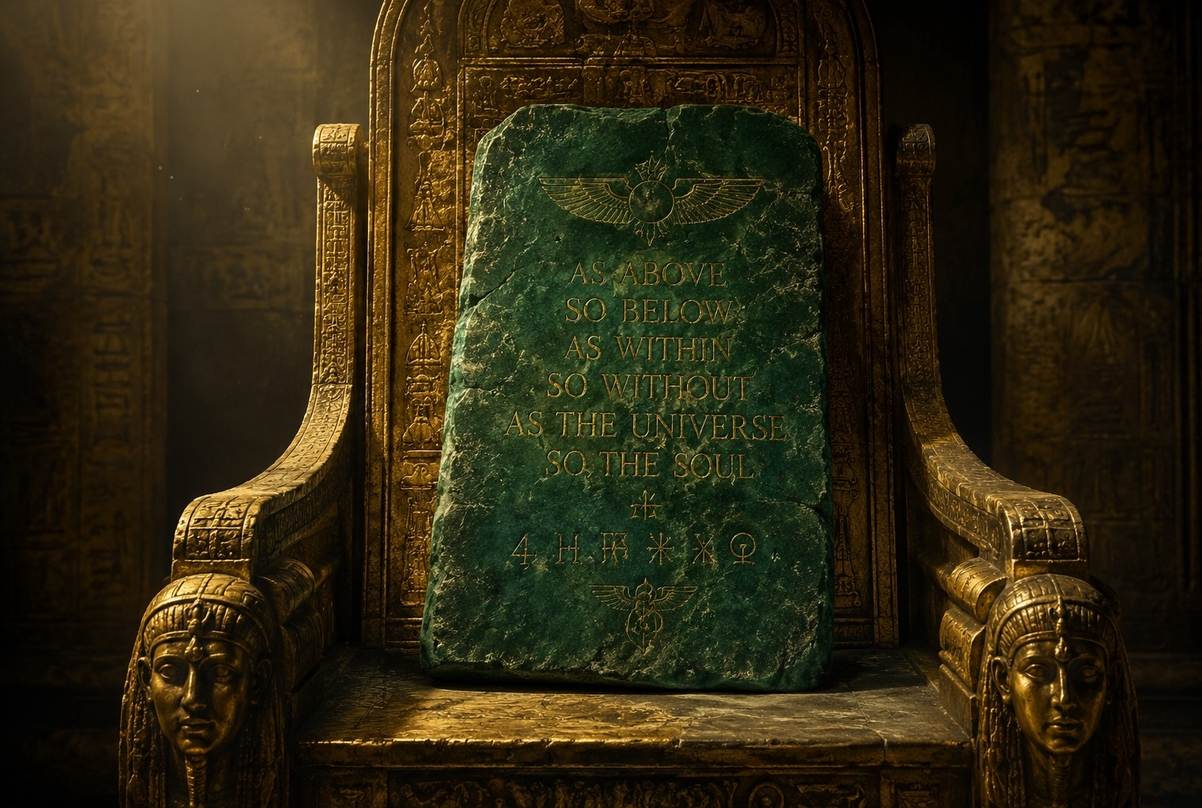
The text is brief–approximately fourteen lines, depending on the recension. Attributed to Hermes Trismegistus, thrice-great, legendary founder of alchemy, astrology, and theurgy. The original, supposedly inscribed on an emerald slab, was said to be hidden in an Egyptian cave or buried with Hermes himself. The earliest recoverable versions are in Arabic, composed in the late eighth or early ninth century; the Latin translations, beginning in the twelfth century, differ in detail. The content, consistent across versions, states the principle that underlies all esoteric architecture: as above, so below.
The Emerald Tablet is not a philosophical treatise. It is operational instruction–the method of alchemical transformation, applied to matter and to self. The maxim, seemingly simple, encodes complex procedure. The decoding, attempted across centuries, produced much of the Western esoteric tradition. This article examines the Tablet’s text, its historical transmission, its interpretive multiplicity, and its continuing function as a key to the Hidden Agreements.
Table of Contents
- The Context of the Tablet
- The Text States the Method
- The History Is Obscure
- The Decoding Continues
- The Thread Extended
- Frequently Asked Questions
- Further Reading
- References and Sources
The Context of the Tablet
The Legend of Hermes Trismegistus
Hermes Trismegistus–thrice-greatest–is not a historical individual. He is a syncretic figure, a fusion of the Egyptian god Thoth (scribe, magician, lord of wisdom) and the Greek god Hermes (messenger, psychopomp, patron of boundaries). This fusion occurred during the Hellenistic period, when Egyptian and Greek cultures interpenetrated in Alexandria and beyond. The resulting figure possessed the authority of both traditions: the antiquity of Egypt and the philosophical sophistication of Greece.
The attribution of the Emerald Tablet to Hermes Trismegistus is therefore legendary, not historical. The text does not claim to be written by a human hand; it claims to be the voice of Hermes himself, speaking from a position of total knowledge. The final line of the Tablet states: “Thus I am called Hermes Trismegistus, because I hold three parts of the wisdom of the whole world.” The name is not signature but function–the speaker is the principle of wisdom, not a person.
The Text and Its Structure
The Emerald Tablet is extraordinarily brief–a single page, fourteen lines in the standard Latin recension. Its brevity is not deficiency but compression. Each line is dense with multiple referents, capable of supporting chemical, psychological, and cosmological readings simultaneously. The structure moves from affirmation of truth, through statement of correspondence, through description of the One Thing and its parents (Sun and Moon), through the method of operation (separation and reunion), to the final claim of completion.
The text opens with a claim to certainty: “True, without falsehood, certain, most true.” This is not merely rhetorical flourish. In the context of alchemical literature, where fraud and obscurity were endemic, the claim to truth functions as a guarantee of lineage–the text is not speculation but transmission. The reader is invited to trust not the author but the method.
The Text States the Method
Alchemical Operation: Separation, Purification, Reunion
The central method of the Tablet is separation and reunion. The text states: “Separate thou the earth from the fire, the subtle from the gross, sweetly with great industry.” The matter, dissolved, separates into elements. The elements, purified, are recombined. The recombination, successful, produces the stone–the philosopher’s stone, the elixir, the agent of transformation.
This threefold schema–separation, purification, reunion–is not explicitly named in the Tablet but has been read into it by centuries of commentators. The schema corresponds to the later alchemical stages of nigredo (blackening, dissolution), albedo (whitening, purification), and rubedo (reddening, completion). A fourth stage, citrinitas (yellowing, awakening), was added by some medieval traditions. These stages are interpretive elaborations, not original Tablet content. They represent the attempt to systematise what the Tablet presents in compressed aphorism.
The same method applies to self. The practitioner, examined, separates into components–body, soul, spirit. The components, purified through practice, are reintegrated. The integration, successful, produces transformation. This psychological reading, developed most fully by Carl Jung in the twentieth century, treats alchemy as a symbolic language for individuation–the process by which the unconscious is made conscious and the self becomes whole. Jung’s interpretation is not the only valid one, but it demonstrates the Tablet’s capacity to yield meaning across historical periods and disciplinary frameworks.
The Law of Correspondence
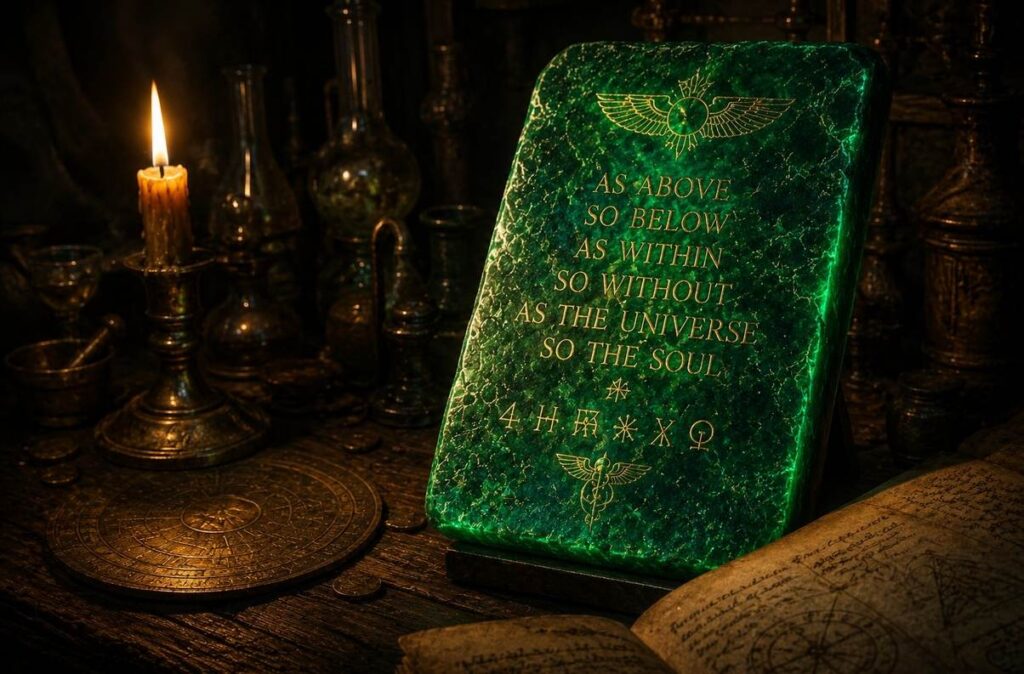
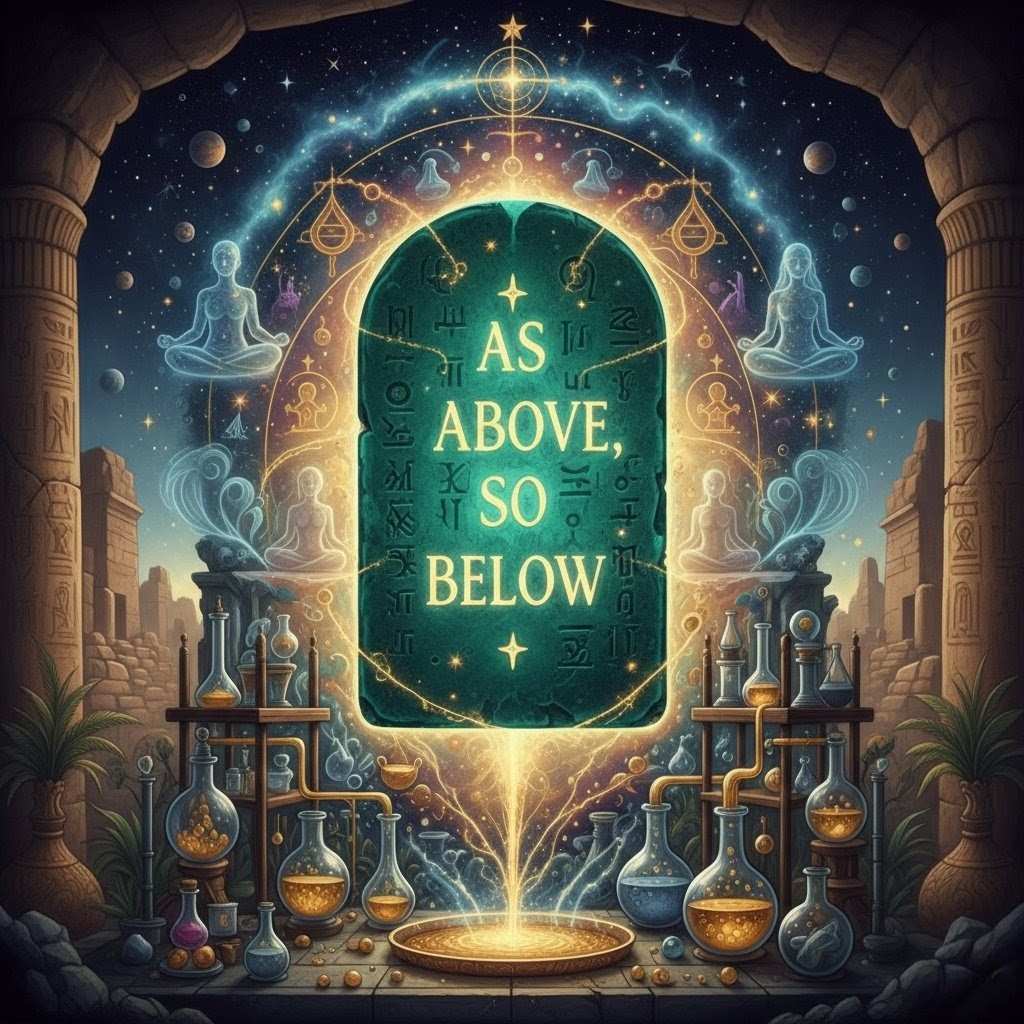
The most famous line of the Tablet–“That which is below is like that which is above, and that which is above is like that which is below“–has become the principle of correspondence, the foundational axiom of Hermetic philosophy. The modern condensation “as above, so below” captures the spirit but loses the nuance. The original does not say “so” but “like”–the relationship is analogical, not identical.
The correspondence is not metaphor. It is identity of structure–the cosmic process, planetary and stellar, is identical in pattern to the alchemical process in laboratory and vessel, which is identical in pattern to the psychological process in interior experience. The identity enables operation. The operation, performed at any level, affects all levels. This is the radical claim of the Tablet: that the universe is not a collection of separate domains but a single continuum of patterned process, accessible from any point.
The correspondence has been criticised as a thought-terminating cliché–a phrase that provides easy answers to complex questions. There is some validity to this critique. Used superficially, “as above, so below” can justify any analogy, no matter how strained. Used rigorously, it becomes a method of investigation: if the macrocosm and microcosm share structure, then understanding one yields understanding of the other. The test is not the analogy’s elegance but its operational fruit.
The History Is Obscure
From Arabic to Latin: The Translation Chain
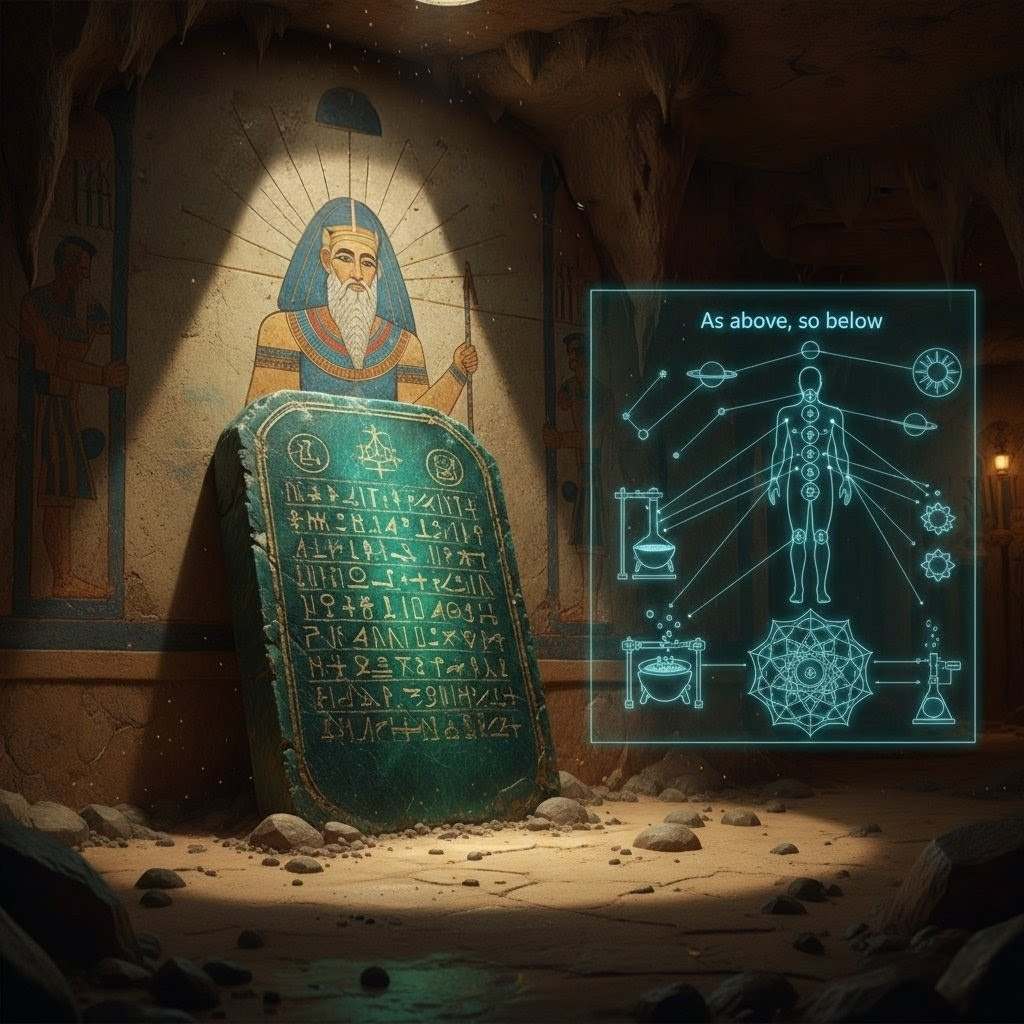
The Emerald Tablet first appears in an Arabic treatise from the late eighth or early ninth century CE: the Kitab Sirr al-Khalīqa wa-Ṣanʿat al-Ṭabīʿa (Book of the Secret of Creation and the Craft of Nature), attributed to Balinas–Pseudo-Apollonius of Tyana. The framing narrative is itself a Hermetic terma: Balinas describes discovering a subterranean chamber beneath a statue of Hermes, where an old man on a golden throne holds the emerald tablet and a book of secrets. The story is legendary, but the text is documentable.
The Latin translation, produced in the twelfth century by the Spanish monk Hugo of Santalla, opened the Tablet to European readers. Hugo worked from Arabic manuscripts, probably in the context of the translation movement associated with the Toledo School. His Latin version became the basis for the “Vulgate” text that circulated in medieval and Renaissance Europe. A printed edition appeared in Nuremberg in 1541 as part of Chrysogonus Polydorus’s De alchimia, and this printed version became the standard reference for later alchemists, including Isaac Newton.
The Greek original, if it ever existed, is lost. Some scholars argue for a Syriac or Greek source behind the Arabic; others contend the text is an original Arabic composition synthesising older Hermetic materials. No manuscript earlier than the eighth-century Arabic has been found. The emerald slab itself, if it existed, is lost. The Tablet’s power lies not in its physical origin but in its transmissive function–it has operated as a key text for over a thousand years, regardless of whether Hermes ever held it.

The Reception in Western Esotericism
The Tablet’s reception shaped Western esotericism in ways that are still visible. The alchemists–Jabir ibn Hayyan, whose Kitab Ustuqus al-Uss al-Thani incorporated an early version; the medieval Latin commentators; and Isaac Newton, who produced his own English translation from Latin (now held at King’s College Library, Cambridge, as Keynes MS 28)–all took the Tablet as foundational text. Newton’s alchemical manuscripts, extensive and largely unpublished in his lifetime, reveal that he approached the Tablet not as occult curiosity but as ancient wisdom compatible with his natural philosophy.
The magicians–Heinrich Cornelius Agrippa, Paracelsus, John Dee–took the Tablet as metaphysical framework. Agrippa’s De occulta philosophia and Dee’s Monas Hieroglyphica both engage with Hermetic principles derived from the Tablet’s correspondence doctrine. The philosophers of the Renaissance–Pico della Mirandola, Giordano Bruno–took it as proof that ancient wisdom surpassed scholastic theology. For Pico, the prisca theologia (ancient theology) transmitted by Hermes was a single truth expressed differently across cultures.
The attribution to Roger Bacon in the original article requires caution. While Bacon was deeply interested in alchemy and natural magic, direct evidence that he commented specifically on the Emerald Tablet is sparse. He certainly knew alchemical literature, and the Tablet was circulating in Latin by his time, but the specific connection is less secure than the article implies. Bacon’s significance lies more in his methodological advocacy for experimental science than in his direct commentary on this text.
The Decoding Continues
The Multiplicity of Valid Readings
The Tablet’s brevity invites interpretation. Each sentence has generated centuries of commentary. Consider three examples:
- “True, without falsehood, certain, most certain“–the certainty of alchemical success, or the certainty of metaphysical truth, or the epistemological claim that the method itself is self-verifying?
- “That which is below is like that which is above“–the correspondence of cosmic and terrestrial, or of conscious and unconscious, or of spiritual and material?
- “The father thereof is the sun, the mother the moon“–the chemical substances sulphur and mercury, or the psychological principles active and receptive, or the astrological luminaries governing generation?
The interpretations multiply. The multiplication is not error. It is function–the text, encrypted, yields different meanings to different capacities, different preparations, different needs. The alchemist reads chemical instruction. The psychologist reads developmental process. The metaphysician reads cosmic structure. All are correct. None are complete. This is the nature of esoteric encryption: the text is a mirror, not a window. What you see depends on what you bring.
The Operational Test
The operational test distinguishes valid from invalid interpretation. The interpretation, applied, produces result or does not. The result, evaluated, confirms or refutes. The Tablet, operational, is not merely believed. It is used. This is the difference between Hermeticism as philosophy and Hermeticism as practice. The philosopher can debate the meaning of “the One Thing” indefinitely. The practitioner must work with something concrete–matter, dream, relationship, body–and observe what changes.
The operational test also guards against inflation. It is easy to claim gnosis; it is harder to demonstrate transformed character. The Tablet’s method–separate, purify, recombine–when applied to the self, produces observable changes: reduced reactivity, increased patience, enhanced capacity for relationship. These are not dramatic. They are reliable. The test of a valid reading is not the brilliance of the insight but the stability of the result.

The Thread Extended
The Emerald Tablet extends the thread through encryption. The knowledge, dangerous if explicit, is hidden in apparent simplicity. The simplicity, penetrated, reveals complexity. The complexity, mastered, produces transformation. This is the function of esoteric transmission: not to withhold but to filter–ensuring that the method reaches only those prepared to use it responsibly.
You encounter the Tablet. The maxim–as above, so below–is familiar. The penetration, attempted, requires work. The thread continues through encryption toward decryption, through reading toward practice, through theory toward the only test that matters: does it transform?

Frequently Asked Questions
What does as above, so below actually mean?
The phrase is a modern condensation of the Tablet’s original line: That which is below is like that which is above, and that which is above is like that which is below. It means that the cosmic macrocosm and the human microcosm share structural identity–not metaphorical resemblance but patterned correspondence. The same processes operate at stellar, terrestrial, psychological, and molecular levels. The principle enables investigation: understanding one level yields insight into all others.
How old is the Emerald Tablet and who wrote it?
The earliest recoverable versions are in Arabic, composed in the late eighth or early ninth century CE, attributed to Balinas (Pseudo-Apollonius of Tyana). The text claims authorship by Hermes Trismegistus, a syncretic figure combining Egyptian Thoth and Greek Hermes. No manuscript earlier than the Arabic has been found. A Greek or Syriac original may have existed, but no such manuscript is known. The text was translated into Latin in the twelfth century by Hugo of Santalla.
Did Isaac Newton really study the Emerald Tablet?
Yes. Newton produced his own English translation of the Emerald Tablet from Latin, now held at King’s College Library, Cambridge, as Keynes MS 28. His alchemical manuscripts are extensive and reveal that he approached the Tablet as ancient wisdom compatible with natural philosophy. Newton’s interpretation drew on the fourteenth-century commentary of Hortulanus (John Garland), reading the One Thing as the alchemical Chaos analogous to the primordial Chaos of Genesis.
Is the Emerald Tablet about making physical gold?
The text describes the transformation of matter, and medieval alchemists certainly pursued physical transmutation. However, the Tablet’s language supports multiple readings simultaneously: chemical, psychological, and cosmological. Carl Jung demonstrated that alchemical symbolism maps onto psychological individuation–the integration of unconscious contents into conscious awareness. The chemical and psychological readings are not mutually exclusive; they are different applications of the same structural method: separate, purify, recombine.
What are the three parts of wisdom that Hermes claims to hold?
The Tablet’s final line states that Hermes is called Trismegistus because he holds three parts of the wisdom of the whole world. The three parts have been interpreted variously as the three realms of alchemy (physical, psychological, spiritual), the three Hermetic arts (alchemy, astrology, theurgy), or the three levels of correspondence (heaven, earth, and the human intermediary). No single interpretation is definitive; the line functions as a seal of completeness rather than a curriculum outline.
Can the Emerald Tablet be read as a meditation instruction?
Yes. The method of separation, purification, and reunion can be applied contemplatively. The practitioner separates from ordinary identification, purifies attention through sustained practice, and reintegrates with transformed perspective. The ascent and descent described in the Tablet–it ascends from earth to heaven and descends again–mirrors the meditative trajectory of withdrawal and return found in contemplative traditions worldwide. The Tablet is operational, not merely theoretical.
Why is the Emerald Tablet so brief if it contains such important wisdom?
The brevity is not deficiency but compression and encryption. In esoteric transmission, explicit exposition is dangerous–it can be misunderstood by the unprepared or weaponised by the unscrupulous. The encrypted text yields meaning only to those who have done the preparatory work. The brevity also ensures memorisation and oral transmission. A text that fits on a single tablet can be carried in memory, copied accurately, and transmitted across cultures without corruption.
Safety Notice: This article discusses alchemical symbolism as psychological and contemplative process. It does not endorse or instruct in chemical experimentation. Historical alchemical practice involved hazardous substances and procedures. Do not attempt laboratory transmutation or ingestion of alchemical preparations. Contemplative and psychological approaches to alchemical symbolism should complement, not replace, appropriate mental health care when needed.
Further Reading
- Symbol as Safety Protocol: Why Esotericism Hides in Plain Sight — The Tablet as exemplar of encryption and symbolic transmission.
- The Hidden Agreements: Why Esoteric Traditions Keep Inventing the Same Architecture — “As above, so below” as structural principle across cultures.
- The Abyss in Three Traditions: Kabbalah, Alchemy & Buddhism — The alchemical nigredo and the Tablet’s method of dissolution and reunion.
- The Sevenfold Pattern: Planets, Metals, Chakras & The Architecture of Seven — The planetary correspondences in alchemical and Hermetic practice.
- The Doctrine of Emanation: From Plotinus to Kabbalah — The One becoming Many and the philosophical structure behind Hermetic correspondence.
- Sacred Geometry: The Architecture of Creation — The geometric forms underlying the Hermetic cosmos and the structure of matter.
- The Tree of Life: Kabbalistic Architecture Explained — The geometric structure of Kabbalah and its parallels to Hermetic cosmology.
- John Dee’s Mathematical Preface: The Occult Foundation of Modern Science — How Renaissance Hermeticism shaped the scientific imagination.
References and Sources
This article draws upon the history of science, Renaissance studies, depth psychology, and the critical history of alchemy.
Primary Sources and Critical Editions
- Balinas [Pseudo-Apollonius of Tyana]. (Late 8th/early 9th c.). Kitab Sirr al-Khalīqa wa-Ṣanʿat al-Ṭabīʿa (Book of the Secret of Creation and the Craft of Nature). Earliest recoverable version of the Emerald Tablet.
- Hugo of Santalla. (12th c.). Latin translation of the Emerald Tablet. Earliest European version.
- Newton, I. (c. 1680s). Tabula smaragdina. Keynes MS 28, King’s College Library, Cambridge. (English translation from Latin with commentary).
Scholarly Monographs and Studies
- Hedesan, G. (2018). “The Emerald Tablet of Hermes Trismegistus.” Oxford Cabinet Research Project. (Critical overview of transmission and interpretation history).
- Jung, C. G. (1944/1968). Psychology and Alchemy. Collected Works, Vol. 12. Princeton University Press. (Foundational psychological interpretation of alchemical symbolism).
- Ruska, J. (1926). Tabula Smaragdina: Ein Beitrag zur Geschichte der hermetischen Literatur. Carl Winter, Heidelberg. (Seminal philological study tracing the text to 6th–8th century Arabic origins).
- Selwood, D. (2023). “The Emerald Tablet and the Origins of Chemistry.” Medievalists.net. (Analysis of Newton’s translation and the Tablet’s role in early modern science).
- Weisser, U. (Ed.). (1980). Kitab Sirr al-Khalīqa wa-Ṣanʿat al-Ṭabīʿa. University of Aleppo. (Critical Arabic edition with commentary).
Comparative and Contemplative Studies
- Forshaw, P. J. (2005). “The Early Alchemical Reception of John Dee’s Monas Hieroglyphica.” Ambix, 52:3, pp. 247-269. (Tablet’s influence on Renaissance magical philosophy).
- Yates, F. A. (1964). Giordano Bruno and the Hermetic Tradition. Routledge. (Contextualises Hermetic reception in Renaissance philosophy).