The Abyss in Three Traditions: Kabbalah, Alchemy & Buddhism
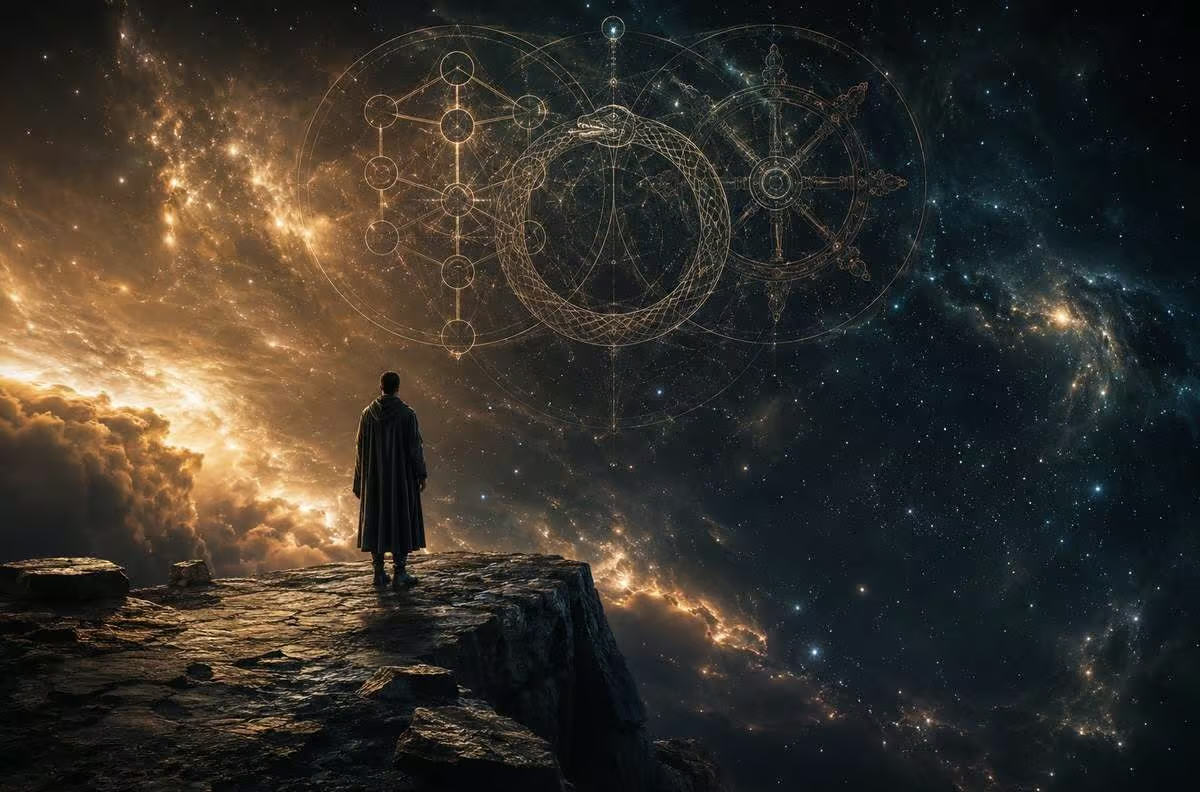
You have climbed. The path, clear, has led upward through known territory. The sefirot, arranged in pattern. The stages of work, completed in sequence. The jhanas, accessed in order. Then–the ground gives way. The path ends. The known terminates in unknown. This is the abyss. Not absence. Excess–of depth, of darkness, of dissolution. The traditions name it differently. The experience is identical.
The skeptic sees psychological collapse. The practitioner knows better. It is not the mind breaking; it is the structure of the self meeting its own boundary–the limit where the passport of identity expires, where the climber discovers they are the final obstacle, where the architecture of being denies further passage until the applicant surrenders all credentials.
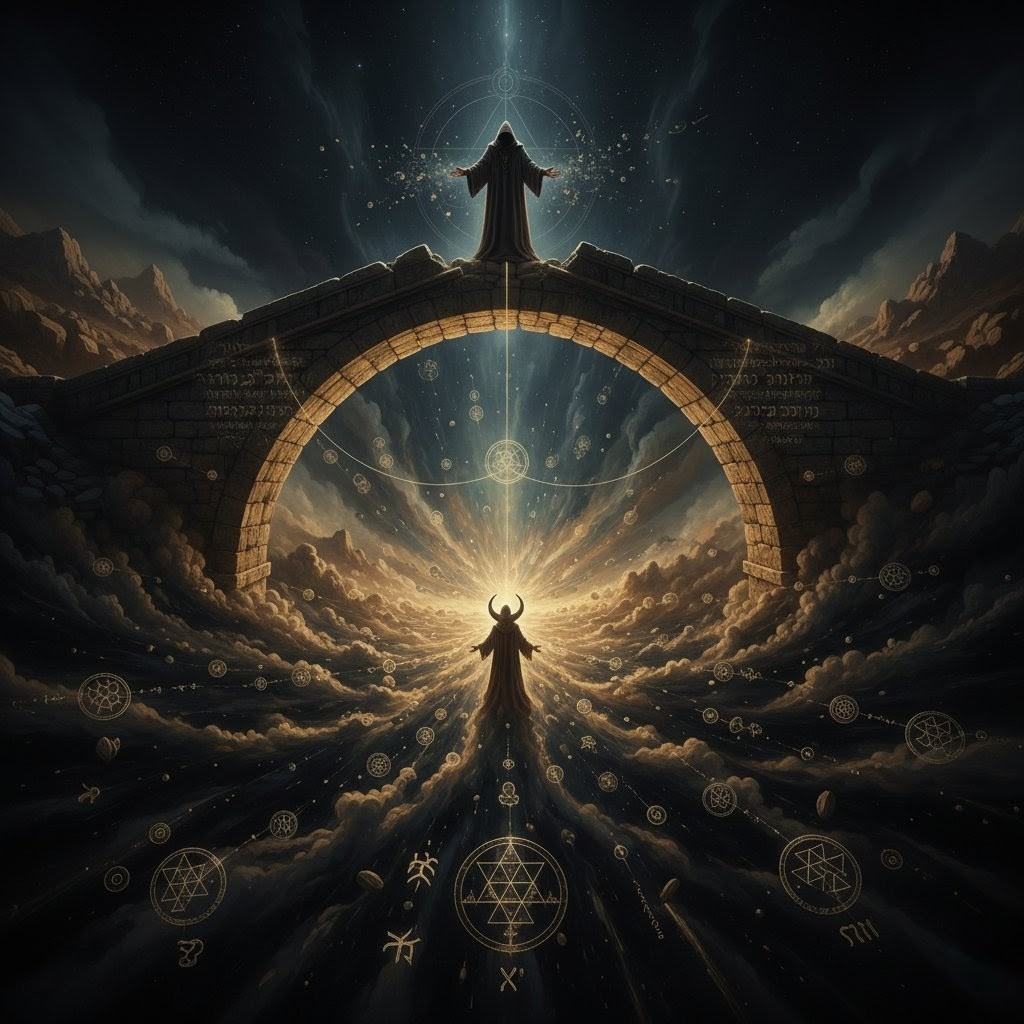
Table of Contents
- Three Names for the Void
- The Cartography of Dissolution
- The Architecture of Dissolution
- The Danger Is Real
- The Paradox of Preparation
- The Crossing Requires Surrender
- The Return Is Different
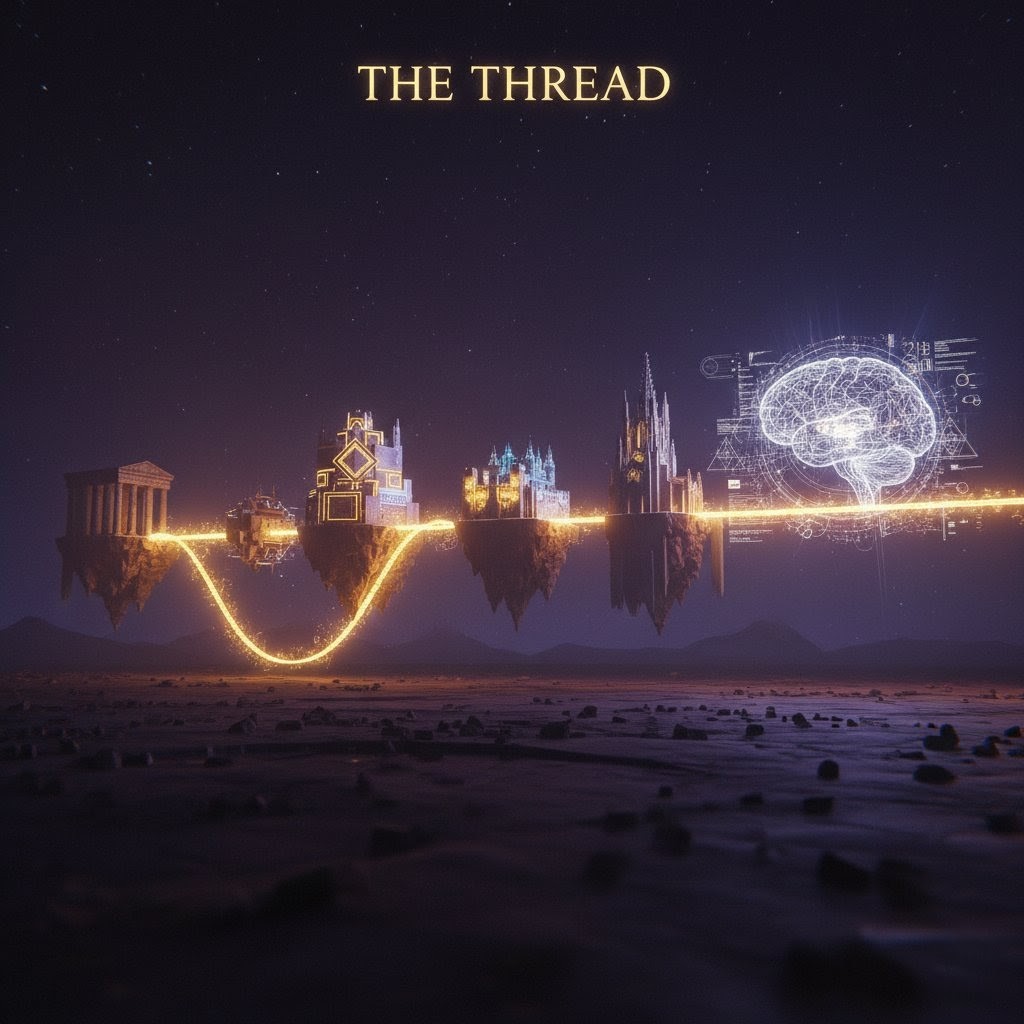
- The Thread Extended
- Frequently Asked Questions
- Further Reading
- References and Sources
Three Names for the Void
The Kabbalist calls it Da’at–knowledge, but not the knowledge of the sefirot above. The sefirot, ten in number, arranged in three columns, form the Tree of Life. But Da’at is not ten. It is sometimes counted as an eleventh, hidden, the void where the supernal triad meets the lower seven. The crossing, attempted, requires dissolution of the self that crosses. The guardian–the adversary, the shadow of the self–must be confronted. The confrontation is not battle. It is recognition. The adversary, recognised, is the self. The self, recognised, dissolves.
Da’at is not strictly a sefirah but a non-sefirah–the knowledge that is not knowing, the void that is not emptiness but excess of possibility. In the classical formulation of the Sefer Yetzirah, the enumeration insists: “ten and not nine, ten and not eleven.” Yet in Lurianic Kabbalah, Da’at is sometimes included while Keter is conceptually absorbed into the Infinite (Ein Sof); in Cordovero’s scheme, Da’at is omitted and Keter retained. This ambiguity is instructive: Da’at occupies the threshold itself, neither fully manifest nor fully transcendent. It represents the throat that cannot speak, the eye that cannot see, the interface between the constructed self and the unconstructed divine. Here, the aspirant discovers that the Tree they have climbed is actually a bridge, and the bridge requires toll: everything they have accumulated during the ascent.
The Guardian of the Threshold
The teaching that Satan guards the Abyss (Tehom) and must be recognised rather than fought appears prominently in modern occult transmissions–particularly the Thelemic A∴A∴ system derived from Aleister Crowley’s reformulation of the Golden Dawn material. In this framework, the “Dweller on the Threshold” is the accumulated shadow of the personality, and “Satan” names the final resistance of the ego before dissolution. This is not the Satan of Christian demonology but a psychological personification of the obstruction itself. In classical Kabbalah, the “other side” (sitra achra) and the qlippoth (husks) represent the forces of obstruction and unbalanced severity that must be integrated, not destroyed. The guardian, in either formulation, is not external but the final frontier of the self.
The alchemist calls it the nigredo–the blackening, the putrefaction, the decomposition of the matter before its transformation. The prima materia must first be reduced to black. The black is not failure. It is necessity–the breaking of form, the return to undifferentiated mass, the chaos from which new order emerges. The alchemist, working the matter, works himself. The nigredo is depression, despair, the dark night of the soul. It is also preparation. Without it, the whitening is premature, the reddening false.
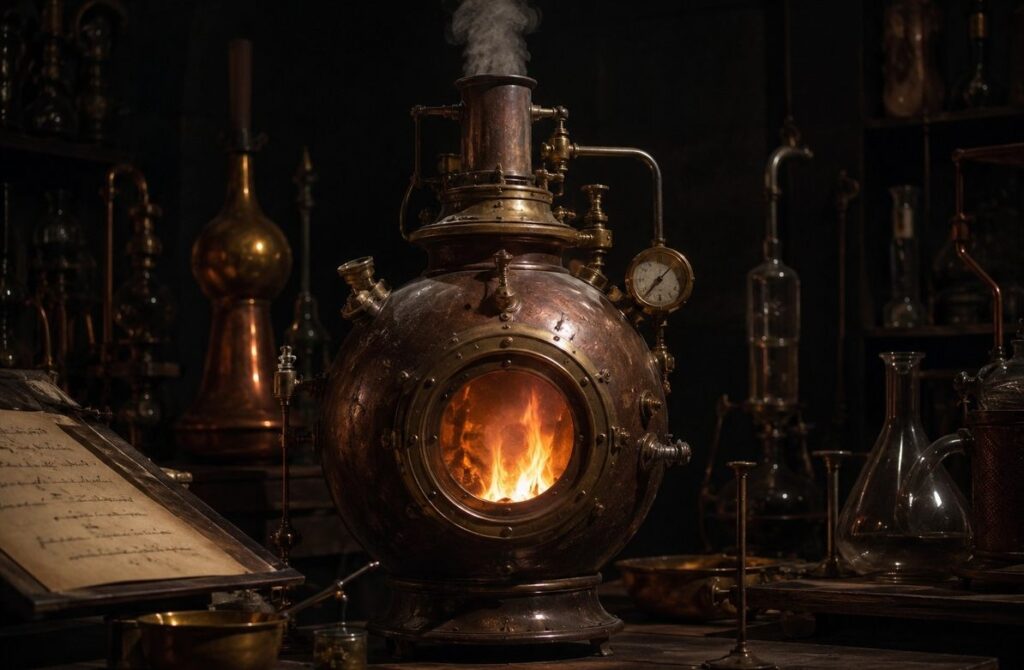
The standard alchemical sequence proceeds: nigredo (blackening/decomposition), then albedo (whitening/purification), then rubedo (reddening/completion). Some traditions insert citrinitas (yellowing/dawn) between albedo and rubedo, producing four stages rather than three. The nigredo corresponds to Saturn, the albedo to the Moon, the rubedo to the Sun. In the laboratory of the soul, the nigredo represents the moment when the vessel must be sealed and the fire turned inward. The massa confusa–the chaotic mass–is not accidental but essential. It is the prima materia stripped of its pretensions, the mercury released from its fixations, the sulfur burned clean of its attachments. The blackening is not the absence of light but the presence of all light absorbed, the total consumption of the operator’s previous certainties.
The Buddhist calls it the knowledge of suffering–not the theoretical recognition that life contains pain, but the direct encounter with the first noble truth. The jhanas, attained, provide concentration, clarity, bliss. These are not the goal. They are platform–the stable ground from which the real work begins. The work is the encounter with dukkha–the unsatisfactoriness, the impermanence, the non-self that underlies all apparent stability. The encounter is not conceptual. It is visceral. The ground dissolves. The self dissolves. The practice continues.
Specifically, the practitioner in the Theravada Progress of Insight encounters the dukkha-nanas–the knowledges of suffering that constitute the insight into dissolution (bhanga-nana). Here, the meditator observes the automatic, mechanical nature of existence with such clarity that the observer itself begins to fragment. The solid world reveals itself as shimmering process; the solid self reveals itself as contractual fiction. This is not nihilism. It is the necessary deconstruction of the architecture of illusion. The Visuddhimagga and the modern Mahasi Sayadaw tradition map this territory with clinical precision: dissolution leads to fear, then to misery, then to disgust, then to the desire for deliverance. Each stage is not pathology but cartography.
The Cartography of Dissolution
Why do these three traditions–separated by continents, centuries, and theological vocabularies–converge on the same precipice with such precision? The question is not rhetorical. It is the central puzzle of comparative esotericism. The standard academic answer is diffusion: ideas travel along trade routes, migrate with colonisers, survive in fragments that recombine. But the abyss appears in traditions with no documented contact during the periods when their maps were drawn. The Kabbalistic Tree, the alchemical athanor, and the Buddhist vipassana map emerged in isolation–desert, laboratory, jungle–yet they align at the same depth.
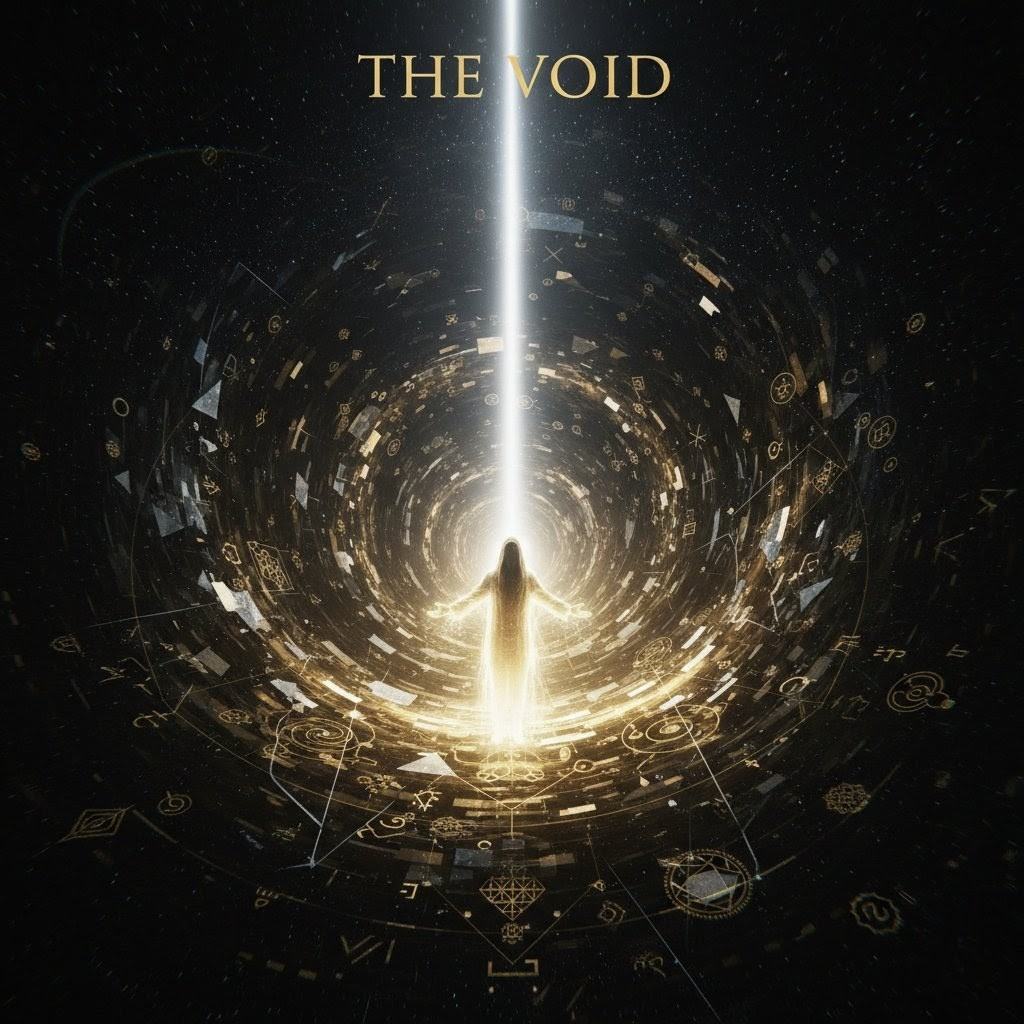
The alternative explanation is structural: the abyss is not a cultural invention but a discovered feature of consciousness itself. Like explorers mapping the same mountain from different valleys, the traditions describe identical terrain because the terrain is real. The self, constructed through language, memory, and social conditioning, possesses a natural limit–the point where its own scaffolding becomes visible from the inside. Beyond that point, the mapmaker realises he is drawn on the map. This recognition is not philosophical; it is experiential, and it arrives with the force of catastrophe because it dissolves the one who would experience it.
The convergence is not superficial. It is architectural. The same load-bearing walls. The same foundation depths. The same warning signs at the same thresholds. The Kabbalist’s Da’at, the alchemist’s nigredo, and the Buddhist’s dukkha-nana all mark the identical transition: from the constructed to the unconstructed, from the known to the unknowable, from the self to the absence of self. The vocabulary differs. The territory is identical. The synthesist does not combine these maps; they translate between them, recognising that different languages describe the same checkpoint.
The Architecture of Dissolution
The abyss is not early. It is not the beginning of the path, the initial difficulty, the first obstacle overcome. It is late–the termination of accumulated progress, the dissolution of achieved attainment, the recognition that the climber is the final obstacle. The traditions converge on this geography with the precision of independent cartographers mapping the same territory.

Kabbalah: From Lower Sefirot to Supernal Triad
The Preceding Stage: Mastery of the Lower Seven Sefirot–the manifest world of form, ethics, and ritual precision. The aspirant has constructed the edifice of spiritual attainment through disciplined practice. Chesed (Mercy), Gevurah (Severity), Tiferet (Beauty), Netzach (Victory), Hod (Glory), Yesod (Foundation), and Malkuth (Kingdom) form the completed architecture of the embodied soul.
The Abyss (The Crossing): Da’at–the Void, the hidden interface where the lower seven meet the supernal triad. Here the shadow-self must be recognised rather than fought. The crossing dissolves the constructed identity. The Sefer Yetzirah warns: “ten and not nine, ten and not eleven”–yet Da’at persists as the necessary contradiction, the eleventh that is not one, the knowledge that consumes the knower.
The Beyond: The Supernal Triad–Keter (Crown), Chokmah (Wisdom), Binah (Understanding). The divine intellect beyond form, where understanding becomes womb rather than weapon. These three sefirot constitute the Ein Sof‘s first self-revelation, the point where infinity becomes intelligible without becoming finite.
Alchemy: From Prima Materia to the Philosopher’s Stone
The Preceding Stage: The alchemist has identified and begun working the prima materia–the raw substance, often identified with lead, Saturn, or the unrefined self. The work of separation (separatio) has begun, distinguishing the pure from the impure, the essential from the accidental.
The Abyss (The Crossing): Nigredo–the Blackening, the putrefaction that precedes all transformation. The prima materia is reduced to massa confusa, the chaotic mass. The vessel is sealed; the fire is turned inward. This is not regression but necessary decomposition–the breaking of all previous form so that new form may emerge. Carl Jung, in his study of alchemical psychology, identified the nigredo with the confrontation with the shadow–the unconscious material that must be integrated before individuation can proceed.
The Beyond: Albedo (Whitening)–the purification that follows dissolution, the washing away of impurities, the dawn that follows the dark night. Then Rubedo (Reddening)–the completion, the philosopher’s stone, the transformation of base into precious. The stone is formed only after the second death, the transformation possible only because the transformer has been transformed. Some traditions insert Citrinitas (Yellowing) between albedo and rubedo–the philosophical dawn, the peacock’s tail, the first hint of gold in the whitening matter.
Buddhism: From Rupa Jhanas to Nirvana
The Preceding Stage: The Four Rupa Jhanas–material absorptions characterised by applied attention, sustained attention, rapture, happiness, and one-pointedness. The practitioner has developed stable concentration, suppressed the five hindrances, and established the platform from which insight becomes possible. Then the Four Arupa Jhanas–formless attainments: boundless space, boundless consciousness, nothingness, neither perception nor non-perception. The peak of conditioned existence, the highest platform.
The Abyss (The Crossing): Bhanga-nana (Knowledge of Dissolution) leading into the Dukkha-nanas–the knowledges of suffering. The encounter with dukkha at the root of all phenomena. The observer fragments; the mechanical nature of existence reveals itself. The Visuddhimagga describes this as the most dangerous phase of the Progress of Insight, where the mind confronts the unsatisfactoriness of all conditioned things until insight into suffering is fully achieved.
The Beyond: Nirvana–the unconditioned, the cessation, the liberation that requires the dissolution of the one who would be liberated. Not a place but a cessation of the trajectory that seeks places. The Buddha himself, before parinibbana, passed through all eight jhanas in ascending and descending order, demonstrating that even the highest conditioned states must be transcended for final liberation.
The Danger Is Real
The abyss is not metaphor. The dissolution, attempted unprepared, produces not transformation but damage. The psychosis, the depression, the spiritual emergency–these are failed crossings, incomplete dissolutions, the self shattered rather than transcended. The modern seeker, lacking the sealed vessels of tradition, often encounters this territory accidentally–through substance, through crisis, through spontaneous opening that arrives without the stabilising framework of technique and transmission.

The traditions know this. The Kabbalist does not approach Da’at without mastery of the lower sefirot–the stable platform of ethical discipline, contemplative focus, and ritual precision. The alchemist does not enter nigredo without the vessel sealed, the fire controlled, the athanor properly calibrated. The Buddhist does not confront dukkha without the stability of concentration, the support of community (sangha), the guidance of one who has crossed.
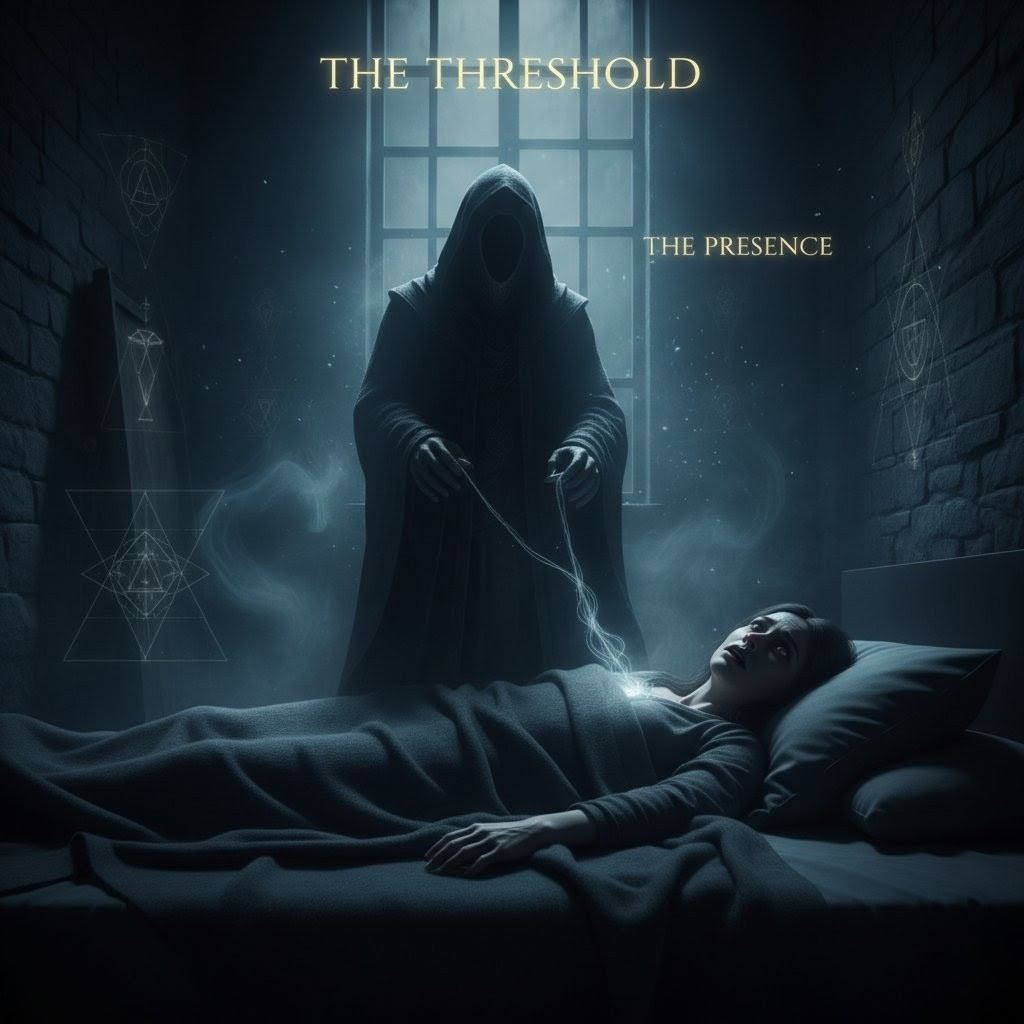
Without these containers, the dissolution becomes not passage but catastrophe. The thread, blocked, produces suffering rather than transformation. The ego, insufficiently crystallised before being dissolved, shatters into fragments rather than dissolving into unity. This is the tragedy of spiritual tourism–the unprepared traveller wandering into territory where they lack the proper documentation, the appropriate visas, the necessary surrender of baggage.
The Paradox of Preparation
Here arises the central paradox: one cannot prepare for what dissolves the preparer. The self that builds the vessel is the self that must be placed inside it and burned away. How, then, to approach the abyss? The answer lies in the distinction between accumulation and ripeness. The former gathers techniques, experiences, and attainments; the latter achieves a quality of being that can survive its own undoing.
The traditions offer not preparation for the crossing but stabilisation during it. The Kabbalist’s mastery of the lower sefirot creates the ethical and perceptual coherence that prevents fragmentation during the dissolution of Da’at. The alchemist’s careful laboratory discipline ensures the fire burns evenly, not explosively. The Buddhist’s jhana practice provides the “platform”–stable attention that can observe the dissolution without being swept away by it.
Without these stabilisers, the practitioner risks becoming a casualty of their own ambition–a psyche broken against the rocks of transcendence, a soul trapped in the borderlands between old identity and new possibility. The abyss does not negotiate. It accepts only total surrender or total retreat. Half-measures produce only damage.
The Crossing Requires Surrender
The abyss cannot be forced. The self that would force is the self that must dissolve. The crossing requires surrender–the recognition that the path has ended, that the climber cannot climb further, that the only movement is release. This is not the surrender of defeat but the surrender of completion–the acknowledgement that the paperwork of identity is finally in order for cancellation.
The Kabbalist surrenders to the divine nothing–the Ain Soph, the infinite, the source beyond all sefirot. The alchemist surrenders to the prima materia–the undifferentiated, the chaotic, the massa confusa. The Buddhist surrenders to anicca–the impermanence that includes the surrenderer.
The surrender is not passive. It is active receptivity–the complete availability to what arrives, the total absence of resistance, the recognition that the self is not the agent of transformation but its obstacle. The transformation happens. The self does not make it happen. The crossing occurs when the climber stops climbing and allows the bridge to carry them–or, more accurately, allows the dissolution of the distinction between bridge, climber, and crossing.

The Return Is Different
Those who cross do not return as they were. The self that entered is not the self that emerges. The continuity is not identity but function–the continued operation of memory, of capacity, of recognition, without the reification of operator. The one who returns has been reconstituted through the same territories, but now speaks from the other side of the divide.
The Kabbalist, crossed, speaks from Binah–understanding, the divine mother, the womb of form. The alchemist, crossed, produces the philosopher’s stone–the transformation of base to precious, now possible because the transformer has been transformed. The Buddhist, crossed, is arahant–the worthy one, the task done, the liberation that liberates others.
The return is not the goal. The goal is the extension–the thread, crossed through the abyss, now available to others. The one who has crossed becomes bridge, becomes guide, becomes warning. The abyss remains. The crossing remains possible. The thread continues.
The Thread Extended
The abyss is not the thread. It is necessary passage–the dissolution that enables reconstitution, the death that enables rebirth, the void that is not absence but fullness prior to form. The traditions, separated by centuries and continents, converge on this recognition with the precision of surveyors mapping identical terrain. The architecture is identical because the territory is identical.
You approach the edge. The path has ended. The ground gives way. The thread continues regardless.
Frequently Asked Questions
What is the abyss in esoteric traditions?
The abyss is the terminal point of structured spiritual development where the self encounters its own dissolution. It appears in Kabbalah as Da’at (the void between lower and upper sefirot), in alchemy as the nigredo (blackening/decomposition), and in Buddhism as dukkha-nana (the knowledge of dissolution). It represents the necessary death of the ego before transformation can occur.
Is the abyss the same as the dark night of the soul?
Related but distinct. The dark night is often a preliminary purification (albedo/whitening), whereas the abyss is the deeper dissolution (nigredo/blackening) that follows advanced attainment. The dark night feels like abandonment by God; the abyss is the encounter with the non-existence of the self that would be abandoned.
How do you prepare for the abyss?
You cannot prepare for what dissolves the preparer. However, you can stabilise the vessel. In Kabbalah, mastery of the lower seven sefirot; in alchemy, the sealed vessel and controlled fire; in Buddhism, stable jhana practice. These provide the coherence to survive dissolution without fragmenting into psychosis or spiritual emergency.
What happens if you fail to cross the abyss?
Failed crossings result in spiritual emergency: psychosis, severe depression, or dissociative states where the ego shatters rather than dissolves. Without the containers of tradition–guidance from one who has crossed, community support, stabilised practice–the dissolution becomes catastrophe rather than passage.
Why does the abyss come after attainment, not before?
The abyss dissolves the attainments themselves. It is late-stage because it requires something to dissolve. You cannot deconstruct what you haven’t constructed. The practitioner must first build the edifice of spiritual attainment (sefirot, albedo, jhanas) before the abyss can tear it down to reveal what lies beyond.
What is Da’at in Kabbalah?
Da’at is the ‘hidden’ eleventh sefirah, the knowledge that connects the lower seven sefirot (manifest world) with the supernal triad (divine intellect). It is not a sefirah in the usual sense but a void or interface. Crossing Da’at requires recognising that the adversary is actually the shadow of the self, and dissolving upon that recognition.
What is the nigredo in alchemy?
The nigredo is the ‘blackening’ stage where the prima materia is reduced to chaotic massa confusa. It is putrefaction, decomposition, and the dark night that precedes all transformation. Without it, the final rubedo (reddening/completion) is impossible–the stone cannot be formed without first being completely broken down.
Further Reading
- The Hidden Agreements: Why Esoteric Traditions Keep Inventing the Same Architecture — The structural convergence across cultures that makes the abyss identical in different maps.
- The Doctrine of Emanation: From Plotinus to Kabbalah Explained — The sefirotic architecture and the supernal triad beyond the abyss.
- The Dark Night: Depression or Transformation? — The necessary dissolution in Christian contemplative tradition.
- The Transformation: What Actually Changes After Mystical Experience — Navigating the abyss and returning as bridge rather than survivor.
- States of Knowing: What Happens When Consciousness Unravels — The phenomenology of dissolution and ego death.
- Syncretism vs. Synthesis: The Difference That Preserves the Thread — Why superficial combination of these traditions fails, and how genuine integration works.
- The Sevenfold Pattern: Planets, Metals, Chakras & The Architecture of Seven — Understanding the graduated scales that precede the abyss.
- 7 Integration Practices After Mystical Experience — Essential guidance for grounding peak experiences and stabilising transformation.
References and Sources
This article draws upon primary esoteric texts, scholarly studies of Kabbalah and alchemy, and classical Buddhist source material. Sources are grouped by tradition for clarity.
Kabbalistic and Jewish Mystical Sources
- Sefer Yetzirah (Book of Creation). Anonymous. 3rd-6th century CE. Critical edition: Kaplan, Aryeh (trans.). (1990). Sefer Yetzirah: The Book of Creation. Weiser Books.
- Zohar. Moses de Leon (attrib.). 13th century. Matt, Daniel C. (trans.). (2004-2018). The Zohar: Pritzker Edition. Stanford University Press.
- Cordovero, Moses. (1582). Pardes Rimmonim (Orchard of Pomegranates). Jerusalem.
- Luria, Isaac. (16th century). Etz Chaim (Tree of Life). Vital, Chaim (ed.). Jerusalem.
- Scholem, Gershom. (1974). Kabbalah. Meridian. — Standard scholarly reference on sefirotic theory and the Lurianic school.
- Idel, Moshe. (1988). Kabbalah: New Perspectives. Yale University Press.
Alchemical Sources
- Jung, Carl Gustav. (1968). Psychology and Alchemy. Collected Works, Vol. 12. Princeton University Press. — Contains the foundational psychological analysis of nigredo, albedo, and rubedo.
- Jung, Carl Gustav. (1946). The Philosophical Tree. Collected Works, Vol. 13. Princeton University Press.
- Edinger, Edward F. (1985). Anatomy of the Psyche: Alchemical Symbolism in Psychotherapy. Open Court. — Detailed examination of alchemical operations as psychological processes.
- Holmyard, E.J. (1957). Alchemy. Penguin Books. — Standard historical introduction to the Magnum Opus and its stages.
- Newton, Isaac. (attrib.). Tabula Smaragdina (translation and commentary). In: Dobbs, Betty Jo Teeter. (1975). The Foundations of Newton’s Alchemy. Cambridge University Press.
Buddhist Sources
- Buddhaghosa. (5th century). Visuddhimagga (Path of Purification). Nanamoli, Bhikkhu (trans.). (2011). Buddhist Publication Society. — Contains the classical map of the Progress of Insight and the dukkha-nanas.
- Mahasi Sayadaw. (1954). The Progress of Insight. Nyanaponika Thera (trans.). Buddhist Publication Society. — Modern authoritative guide to the insight knowledges.
- Culadasa (John Yates). (2021). Meditation and Insight III: The Dukkha Nanas. Dharma Treasure Publications.
- Digha Nikaya. In: Walshe, Maurice (trans.). (1995). The Long Discourses of the Buddha. Wisdom Publications. — Contains the Buddha’s final passage through the jhanas before parinibbana (DN 16).
Comparative and Contemporary Studies
- Crowley, Aleister. (1907-1909). Libri A∴A∴ ( instructional papers for the Order of the Silver Star). In: The Equinox. — Source for the modern “Dweller on the Threshold” and Abyss material.
- Regardie, Israel. (1937-1940). The Golden Dawn. Llewellyn Publications. — Documents the Hermetic Order’s adaptation of Kabbalistic Abyss symbolism.
- St. John of the Cross. (16th century). The Dark Night of the Soul. Kavanaugh, Kieran (trans.). (1991). ICS Publications.
- Underhill, Evelyn. (1911). Mysticism: A Study in the Nature and Development of Spiritual Consciousness. Methuen. — Classic comparative study of the dark night across Christian, Sufi, and Hindu traditions.
Safety Notice: This article explores advanced contemplative and esoteric territory involving ego dissolution, spiritual emergency, and psychological deconstruction. It does not constitute medical, psychological, or spiritual advice. If you are experiencing psychosis, severe depression, dissociation, or suicidal ideation, please contact emergency services or a trauma-informed mental health professional immediately. Intensive spiritual practice should be undertaken with qualified guidance and community support. The techniques described complement but do not replace clinical mental health treatment.