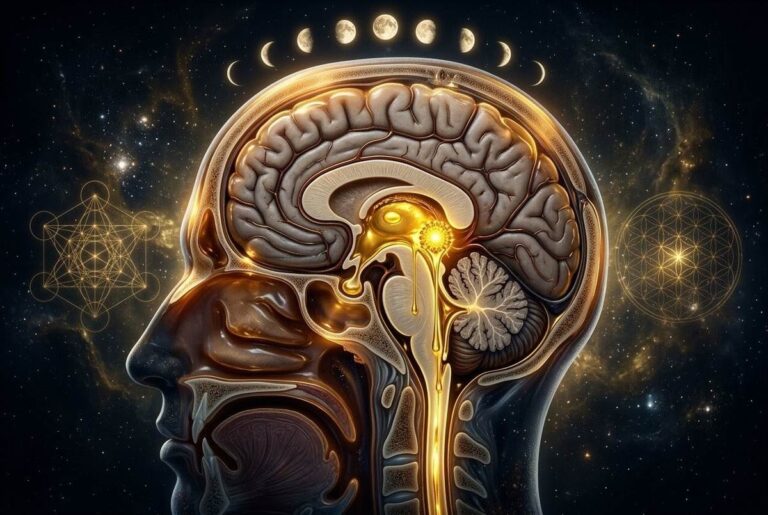
The Witness Function in Contemplative Traditions Across Cultures
The instruction arrives with striking uniformity across every contemplative tradition: “Observe the breath.” “Watch the thoughts.” “Be aware of awareness.” Yet beneath this apparent simplicity lies the central paradox of spiritual development–the witness function serves simultaneously as the foundation of practice and its eventual demolition site. Like a scaffolding that must eventually dismantle itself, the capacity to observe experience without identification proves both essential and, ultimately, obsolete. This article traces the witness across traditions, examines its neuroplastic substrate, explores the subtle trap of reification, and asks what lies beyond the collapse of the observer.
Table of Contents
- The Universal Architecture of Observation
- The Neuroplastic Foundation
- The Reification Trap: When the Observer Becomes the Observed
- The Required Collapse: Beyond the Witness
- The Thread Extended
- Frequently Asked Questions
- Further Reading
- References and Sources
The Universal Architecture of Observation
Across the globe, the nomenclature shifts like dialects in a vast continental empire, yet the underlying architecture remains identical. The traditions speak different languages, but their contemplative technologies recognise the same form:
Sakshi: The Seer in Yoga
In the Yogic tradition, the witness is sakshi–the seer, pure awareness that observes without attachment, the silent registrar of all phenomena. The Mandukya Upanishad describes the fourth state of consciousness–turiya–as the witnessing background against which waking, dreaming, and deep sleep appear and disappear. Sakshi is not a person who sees; it is the capacity for seeing itself, the open field in which all experience unfolds without the seer being stained by what is seen. The Bhagavad Gita calls this anasakti–non-attachment–the capacity to act without claiming ownership of the action’s fruits.
Sati: Bare Attention in Buddhism
In Buddhism, the witness function is sati–mindfulness or “bare attention.” The Pali term carries connotations of memory, recollection, and present-moment awareness. The Satipatthana Sutta (Discourse on the Foundations of Mindfulness) instructs the practitioner to observe the body, feelings, mind, and mental objects with precise, non-reactive attention. Sati is not passive watching but active noting–the mental gesture of labelling experience (“thinking,” “hearing,” “pain”) that prevents automatic identification. The Buddha compared sati to a gatekeeper who examines every visitor to a city, recognising each without allowing entry unchecked.
Metacognition: The Western Lens
In Western psychology, the witness function appears as metacognition–thinking about thinking, the monitoring of mental processes with executive oversight. John Flavell, who coined the term in the 1970s, defined it as “knowledge concerning one’s own cognitive processes.” Metacognitive awareness allows the individual to step back from automatic thoughts, evaluate their accuracy, and choose responses rather than react reflexively. While the Western framework lacks the soteriological urgency of yoga or Buddhism, it describes the same functional capacity: the mind’s ability to observe its own operations from a position of relative neutrality.
The function is identical regardless of cultural packaging: the practitioner cultivates the capacity to observe internal processes without identification. When a thought arises, the witness notes “thinking” with detached efficiency. When an emotion surges, the witness records “feeling” without endorsing the drama. This noting creates critical distance, reduces reactivity, and returns the faculty of choice to a consciousness no longer hijacked by every passing weather pattern.

The Neuroplastic Foundation
The witness function, once developed through consistent practice, produces profound psychological stability. Thoughts are observed as mental events rather than imperatives; emotions are seen as passing meteorology rather than identity. This is not dissociation but disidentification–the recognition that one is not the contents of consciousness but the capacity for consciousness itself.
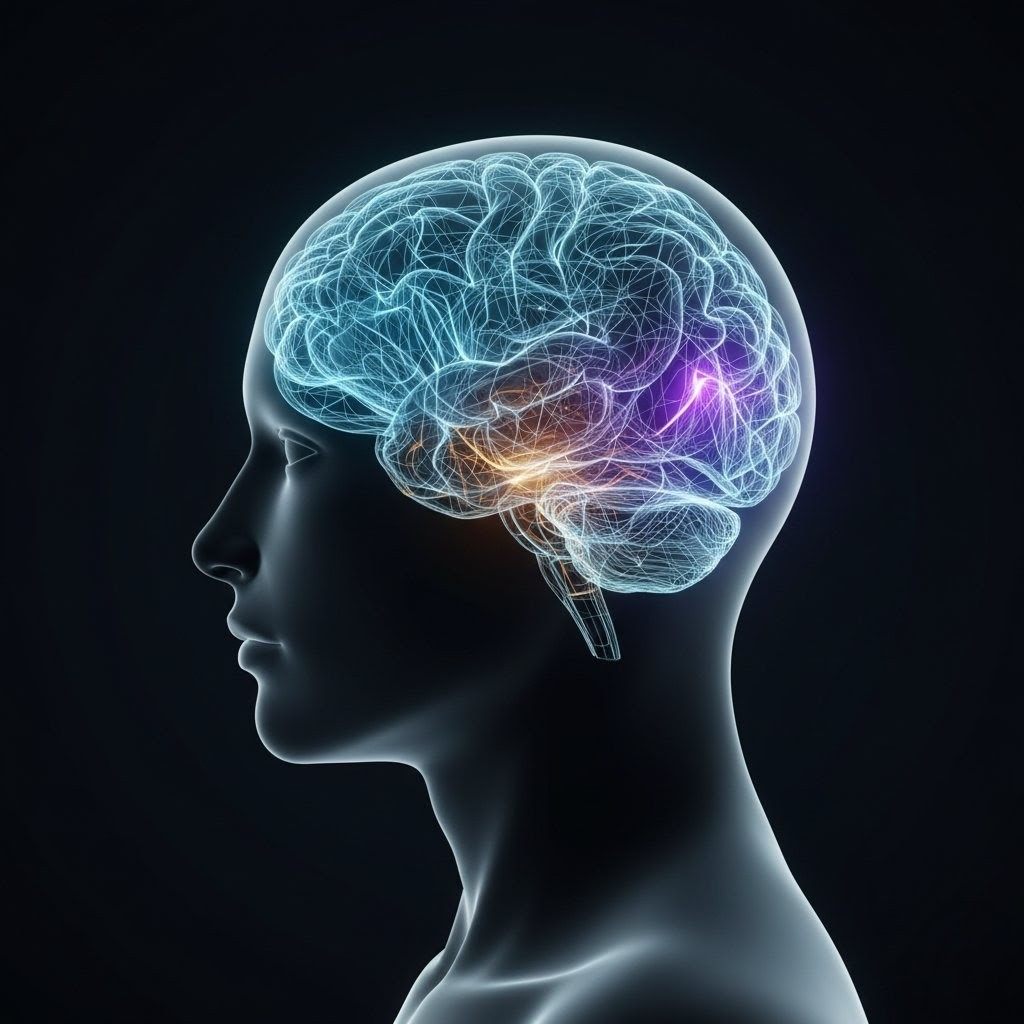
Neuroscience now confirms what the traditions intuited: this practice is profoundly neuroplastic. It physically restructures the brain’s governance systems. Research by Sara Lazar at Harvard Medical School, Richard Davidson at the University of Wisconsin, and others has demonstrated measurable changes in meditators’ brain structure and function:
Prefrontal Cortex and Executive Control
The prefrontal cortex–particularly the dorsolateral and ventromedial regions–activates and strengthens through sustained witness practice. This enhancement produces what neuroscientists call top-down regulation: the capacity of higher cognitive centres to modulate lower, more reactive systems. The prefrontal cortex is the brain’s executive suite, responsible for planning, decision-making, and impulse control. When strengthened through meditation, it becomes more capable of inhibiting automatic responses and selecting adaptive ones. The witness, in neurological terms, is the prefrontal cortex learning to supervise the amygdala without being dominated by it.
Amygdala Modulation
The amygdala, the brain’s threat-detection and emotional-response centre, shows reduced reactivity in experienced meditators. Studies using functional MRI have demonstrated that mindfulness practitioners exhibit diminished amygdala response to emotional stimuli, even when not actively meditating. This is not emotional suppression–the emotions are still felt–but decoupling: the amygdala’s activation no longer automatically triggers the behavioural and physiological cascades of the stress response. The witness function, neurologically, is the capacity to feel fear without the body preparing to flee, to feel anger without the hands preparing to strike.
Anterior Cingulate and Attentional Stability
The anterior cingulate cortex, a region involved in attentional control, error detection, and self-regulation, also strengthens with witness practice. This region acts as a neural “conflict monitor,” detecting when attention has wandered and redirecting it to the chosen object. In meditation, the anterior cingulate becomes the physical substrate of the noting practice–the mental gesture that recognises distraction and returns to the breath. Long-term practice thickens this region, producing greater attentional stability and cognitive flexibility under load.
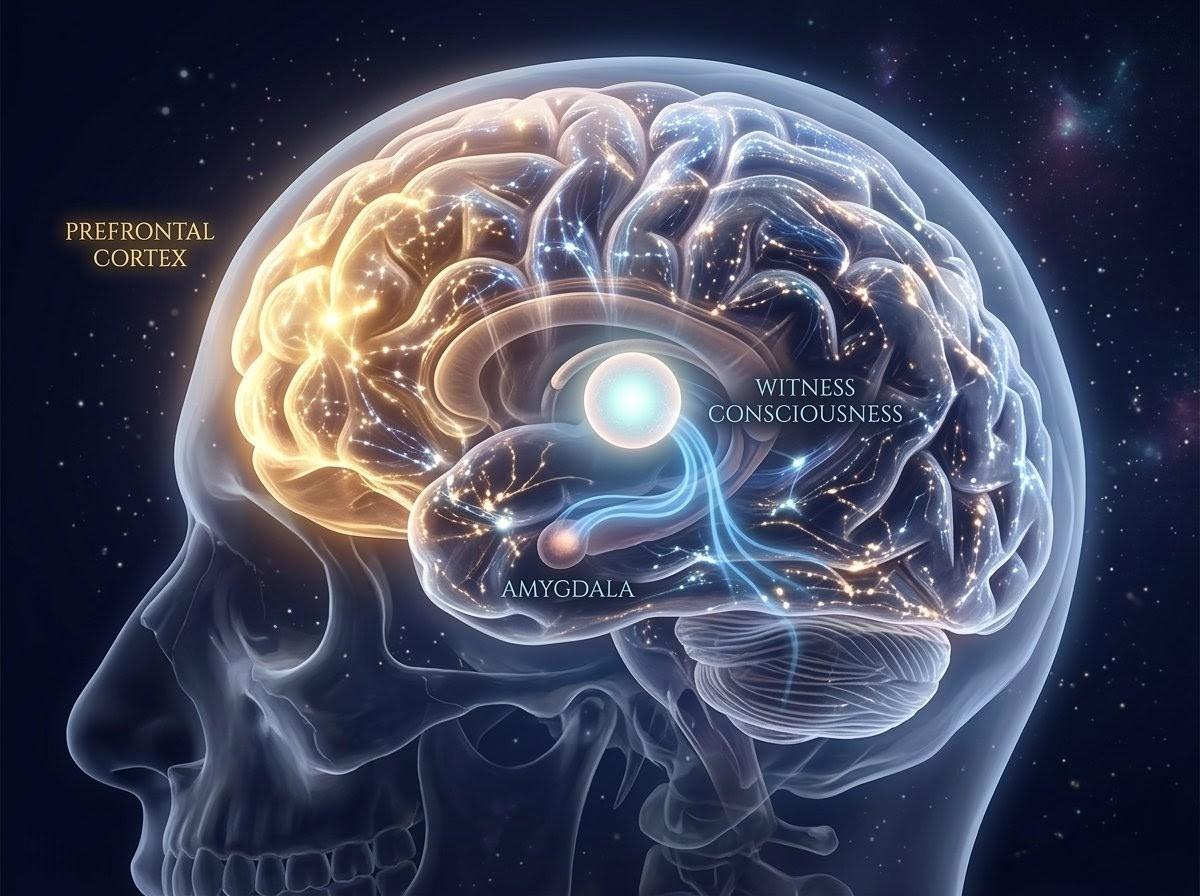
However, in traditional framing, these neurological benefits constitute merely side effects–pleasant bonuses from the body’s adaptive capacity. The true goal remains liberation: freedom from the conditioned mind and the suffering manufactured by mechanical reactivity. The brain changes are real and valuable, but they are not the terminus. They are the platform from which the witness can be transcended.
The Reification Trap: When the Observer Becomes the Observed
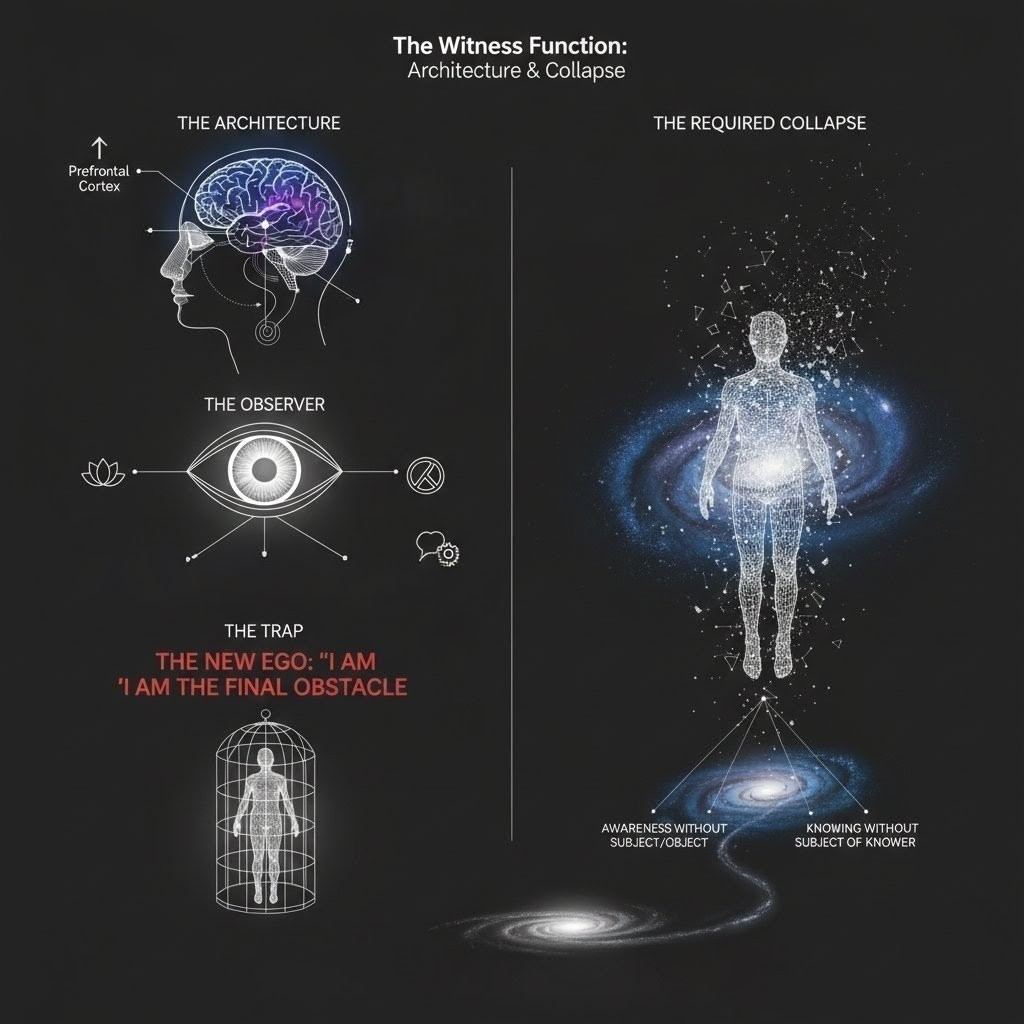
A subtle trap emerges during prolonged cultivation, one that traditions across the world have identified and warned against. The witness, once strengthened through diligent practice, becomes a new identity. The practitioner begins to think, with quiet satisfaction, “I am the one who observes.” The observation becomes a performance; the practice becomes an achievement to be defended. The very tool that was meant to dissolve the ego becomes its most refined expression.
“The one who knows is the great devil.”
— Zen Master Huangbo Xiyun
This is the central paradox of the witness function: first it enables liberation from the ego, then it becomes the new ego. The prison simply renovates itself with better lighting. The witness, instead of liberating the prisoner, refines the cage with spiritual aesthetics. Zen masters famously warn that “The one who knows is the great devil,” while Advaita teachers call the witness the “final bondage.” The warning targets reification–the compulsive tendency to turn the act of witnessing into a “thing,” a “self,” or a possession to be maintained.
The reification operates in several modes. The subtle pride of the meditator who sits longer, observes more clearly, or experiences deeper states than others. The spiritual bypassing that uses witness detachment to avoid emotional work–“I am not my emotions, so I need not process them.” The defensive identification that treats any challenge to the witness-self as a threat to be neutralised. All these are symptoms of the same disease: the witness, meant to be a transparent window, has become an opaque mirror reflecting a new and subtler self.
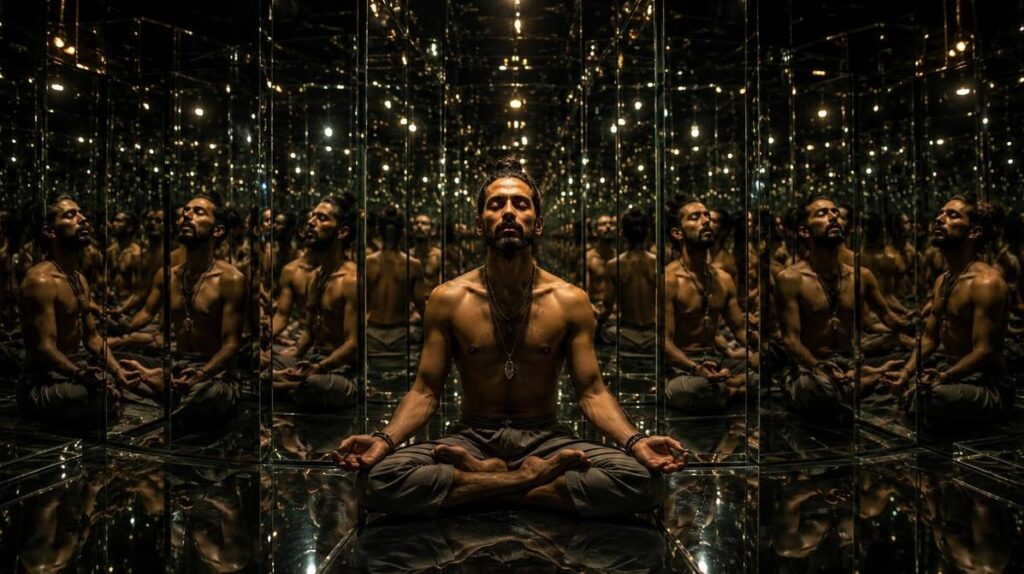
The antidote is inquiry. In the Advaita Vedanta tradition, the practitioner is instructed to ask: “Who is the witness?” The question is not meant to produce an answer but to destabilise the identification. If the witness observes thoughts, what observes the witness? This infinite regression, pursued with sincerity, eventually undermines the witness’s apparent solidity. The question is not a philosophical puzzle but a contemplative technology–a tool for dissolving the very structure it investigates.
The Required Collapse: Beyond the Witness
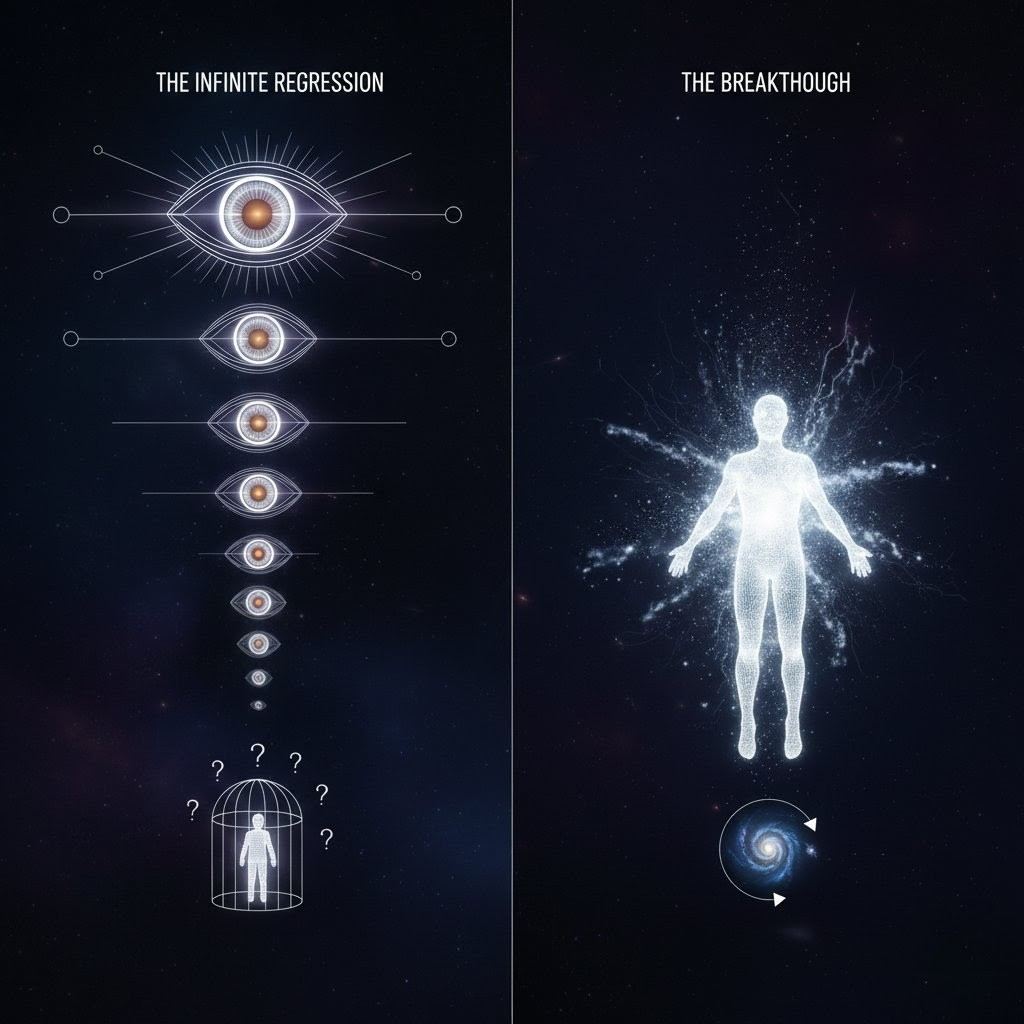
Beyond the witness function lies the collapse of the witness itself. This is the recognition that the witness is also a phenomenon–impermanent, constructed, and empty of inherent existence. If the witness observes thoughts, what observes the witness? This infinite regression eventually produces either paralysis or breakthrough.
The breakthrough is not a “better” witness or a more refined observer. It is the cessation of witnessing altogether:
- Not unconsciousness, but consciousness without a subject-object structure.
- Awareness without “awareness of awareness.”
- Knowing without a “knower” standing apart from the known.
In Zen, this is called kensho or satori–the direct seeing of one’s true nature, in which the separation between observer and observed vanishes. In Advaita Vedanta, it is atma-jnana–the recognition that the Atman (witness) and Brahman (the totality) are not two. In Dzogchen, it is rigpa–the recognition of the mind’s own nature, prior to the division into subject and object. The terminology differs, but the experience is the same: the collapse of the distance that the witness was meant to create.

This collapse cannot be forced. Any attempt to collapse the witness usually creates only a “Witness of the Collapse”–another layer of observation masquerading as transcendence. The dissolution happens through ripening, grace, or the total exhaustion of the witnessing faculty itself. The practitioner cannot do it; they can only allow it, having prepared the ground through years of stable practice. The witness is the boat that carries one across the river; the collapse is the realisation that one has been on the other shore all along.
The Thread Extended
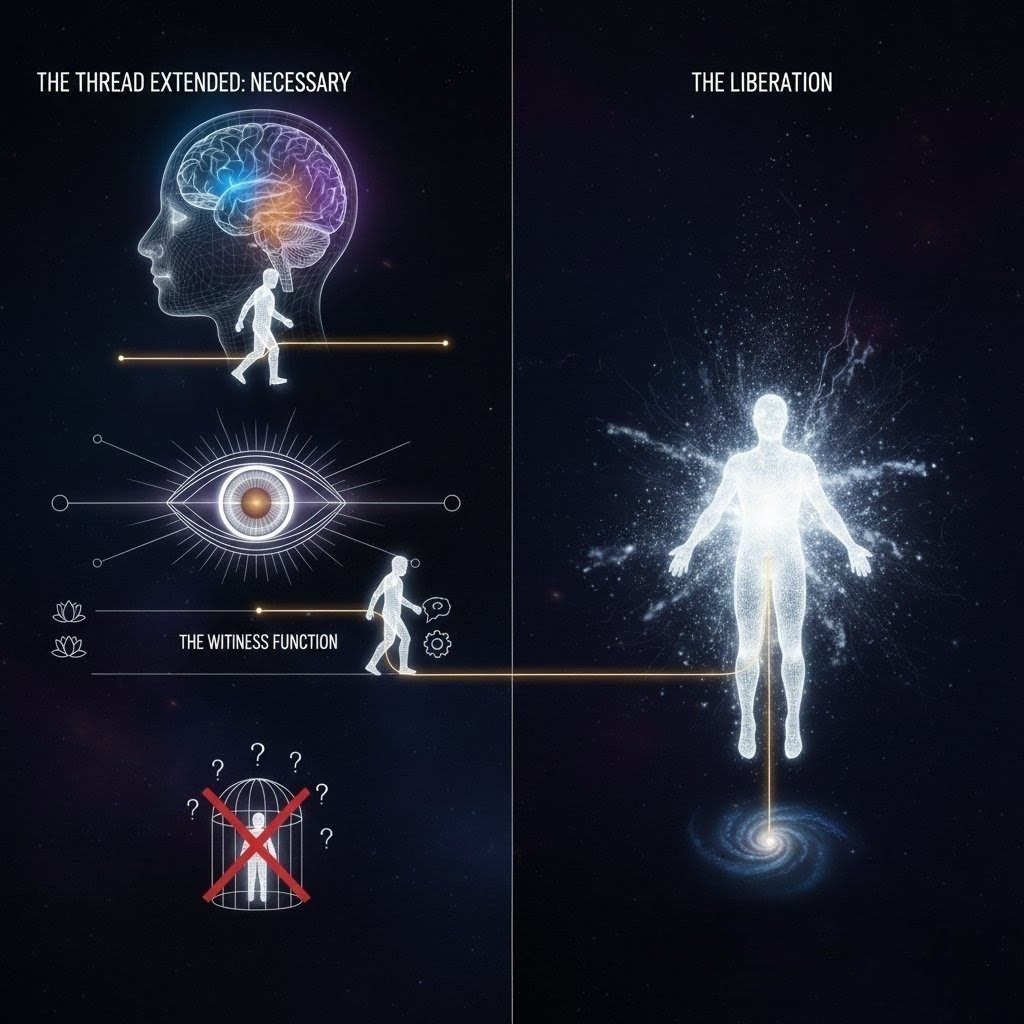
The witness function is necessary but insufficient. It is required for stability and discernment, yet it must eventually be transcended for true liberation. The practitioner, in cultivating the witness, is essentially preparing for the witness’s own obsolescence. The cultivation continues not because the witness is the goal but because without the witness, the collapse would be indistinguishable from dissociation or psychosis. The stable witness provides the container within which the collapse can occur safely.
You witness. The cultivation continues. The collapse, when ready, arrives not as achievement but as recognition–the recognition that the witness was never a separate self but a temporary function of consciousness, a wave that believed itself distinct from the ocean. The thread continues through the witness toward the witness’s inevitable transcendence, through observation toward the realisation that there was never anything to observe, only the observing itself.

Frequently Asked Questions
What is the witness function in meditation practice?
The witness function refers to the capacity to observe mental phenomena–thoughts, emotions, sensations–without identification or reaction. In yoga this is called sakshi (the seer), in Buddhism sati (mindfulness), and in Western psychology metacognition. It creates distance between awareness and its contents, reducing reactivity and restoring the faculty of choice.
How does the witness function differ across contemplative traditions?
While the nomenclature varies–sakshi in yoga, sati in Buddhism, metacognition in psychology–the architecture remains identical. All traditions cultivate the capacity to observe experience without becoming entangled in it. The differences are primarily cultural packaging and philosophical framework rather than functional mechanics. Yoga tends to emphasise a pure witnessing consciousness separate from phenomena, while Buddhism emphasises bare attention without the overlay of a permanent observer.
What is the difference between sakshi and sati?
Sakshi (yoga) emphasises pure awareness as the seer separate from phenomena, rooted in the Upanishadic concept of turiya (the fourth state of consciousness). Sati (Buddhism) emphasises bare attention without the overlay of interpretation or the assumption of a permanent observer. Practically, both produce similar results: the capacity to note experience without immediate reaction. Philosophically, yoga maintains a witnessing self (atman), while Buddhism denies any permanent self (anatta).
Why does the witness become the final obstacle to liberation?
The witness initially liberates consciousness from identification with thoughts and emotions. However, practitioners often then identify with the witness itself, creating a subtle spiritual ego. The witness becomes a new identity to defend: I am the one who observes. This reification prevents the final recognition that the witness itself is also a constructed phenomenon, impermanent and empty of inherent existence. As Zen master Huangbo warned, The one who knows is the great devil.
What is the collapse of the witness in non-dual traditions?
The collapse refers to the dissolution of the subject-object structure where the witness merges with the witnessed. It is not unconsciousness but awareness without a separate observer. In Zen this is kensho or satori; in Advaita Vedanta it is atma-jnana; in Dzogchen it is rigpa. This occurs when the infinite regression (who watches the watcher?) exhausts itself, leaving only pure knowing without a knower. The collapse cannot be forced; it arrives through ripening or grace.
How does witness meditation affect the brain?
Neuroscience shows witness practice strengthens the prefrontal cortex (enhancing executive control and top-down regulation), modulates amygdala reactivity (reducing stress responses), and enhances anterior cingulate function (improving attentional stability and error detection). Research by Sara Lazar, Richard Davidson, and others has demonstrated increased gray matter density and functional connectivity in these regions. These changes produce psychological stability but are considered side effects rather than the primary goal of liberation.
How can I practice witness meditation without creating a new ego?
Practice with the understanding that the witness is a tool, not an identity. Hold the witness lightly–use it to create space from reactive patterns, but remain alert for the subtle satisfaction of being the observer. The antidote is inquiry: Who witnesses the witness? or Who am I between two thoughts? This prevents reification until the collapse occurs naturally. Regular practice with humility and the guidance of an experienced teacher helps avoid the trap of spiritual pride.
Further Reading
- States of Knowing: What Happens When Consciousness No Longer Belongs to You — The foundational pillar exploring the witness as the bedrock of phenomenological practice.
- The Collapse of the Witness: Ego Dissolution & The Zenith Eye — When the observer itself becomes the final obstacle to non-dual recognition.
- The Varieties of Ego Dissolution — Mapping the witness in its various forms of thinning and transcendence.
- The Physiology of Mystical Experience: What Changes in the Brain? — The neuroscience behind contemplative practice and neuroplastic transformation.
- The Transformation: What Actually Changes After Mystical Experience — Beyond the witness to embodied integration and stabilised liberation.
References and Sources
This article draws upon contemplative studies, neuroscience, and comparative religion.
Primary Sources and Critical Editions
- Mandukya Upanishad. (c. 200 BCE–200 CE). (On turiya, the fourth state of consciousness and the witness).
- Satipatthana Sutta (Discourse on the Foundations of Mindfulness). Majjhima Nikaya, 10. (Buddhist foundational text on sati/mindfulness).
- Huangbo Xiyun. (9th c.). Chuanxin Fayao (Essential Dharma of Mind Transmission). (Source of the quote “The one who knows is the great devil”).
Scholarly Monographs and Studies
- Davidson, R. J., & Lutz, A. (2008). “Buddha’s Brain: Neuroplasticity and Meditation.” IEEE Signal Processing Magazine, 25(1), 176-174. (On prefrontal cortex and amygdala changes in meditators).
- Flavell, J. H. (1979). “Metacognition and Cognitive Monitoring.” American Psychologist, 34(10), 906-911. (Foundational paper on metacognition).
- Lazar, S. W., et al. (2005). “Meditation Experience Is Associated with Increased Cortical Thickness.” NeuroReport, 16(17), 1893-1897. (On neuroplastic changes in the prefrontal cortex and anterior cingulate).
- Tang, Y. Y., Holzel, B. K., & Posner, M. I. (2015). “The Neuroscience of Mindfulness Meditation.” Nature Reviews Neuroscience, 16, 213-225. (Comprehensive review of meditation’s effects on brain structure and function).
Comparative and Contemplative Studies
- Forman, R. K. C. (1998). Mysticism, Mind, Consciousness. SUNY Press. (On the collapse of the witness and pure consciousness events across traditions).
- Nisargadatta Maharaj. (1973). I Am That. Chetana. (Advaita Vedanta perspective on the witness and its transcendence).