The Sacred Secretion: Internal Alchemy and the Christ Oil Within
The Sacred Secretion, often called the Christ Oil or internal chrism, is an esoteric teaching about inner anointing, spiritual conservation, bodily refinement, and the ascent of consciousness through the human form. It sits where esoteric Christianity, the Gospel of Philip, yogic subtle anatomy, internal alchemy, breath practice, sexual transmutation, and speculative neurophysiology meet. Handled carefully, it is a powerful symbolic map of transformation. Handled carelessly, it becomes physiology theatre with a halo.
In Plain Terms
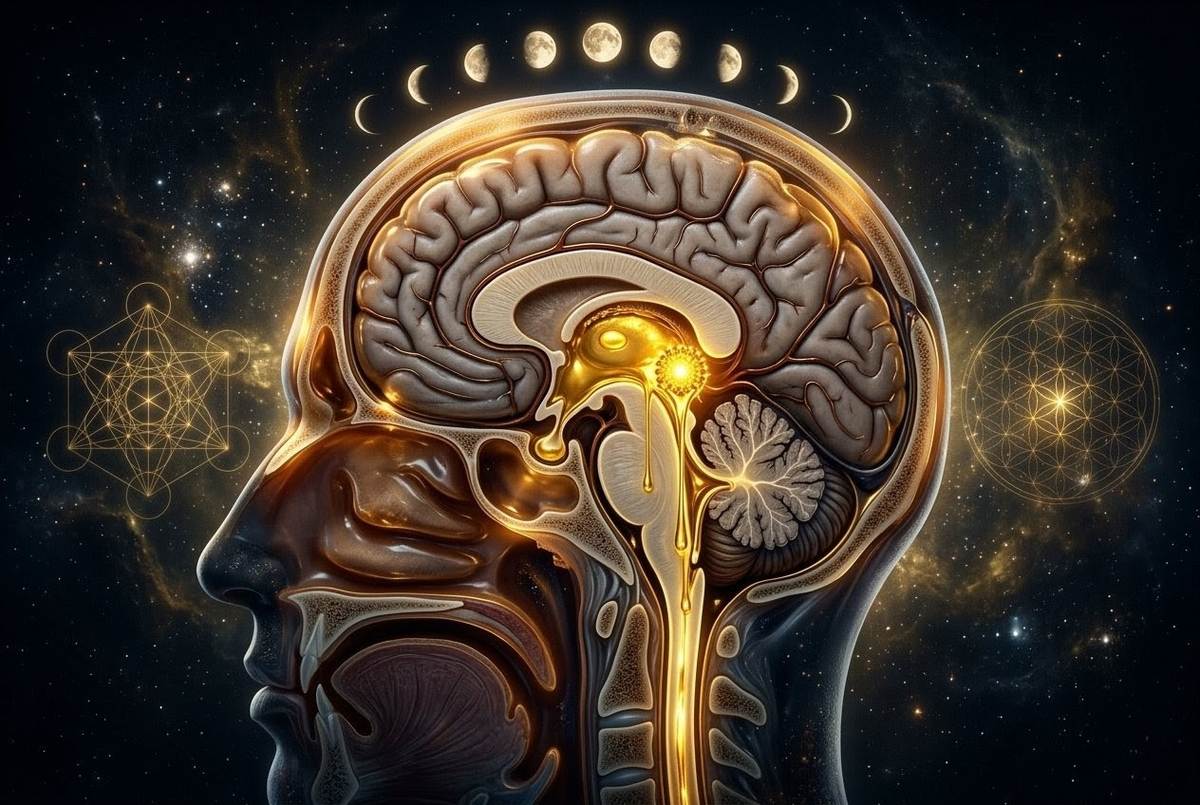
The Sacred Secretion teaching claims that the human body contains an internal anointing process: a refined essence, symbolically called Christ Oil, chrism, sacred secretion, or internal unction. In some modern esoteric interpretations, this is linked with the pineal gland, pituitary gland, cerebrospinal fluid, the spine, lunar cycles, sexual conservation, breathwork, meditation, and spiritual awakening.
There is a genuine ancient foundation for the importance of chrism and anointing in early Christian and Gnostic texts. The Gospel of Philip, a Valentinian text from the Nag Hammadi Library, gives special importance to chrism and treats anointing as more than ordinary ritual. However, the modern claim that the body literally produces a monthly “Christ Oil” that must be raised through the spine is not established by mainstream medical science or by Nag Hammadi scholarship.
The best way to read this teaching is as symbolic physiology: a map of how spiritual life becomes embodied through attention, restraint, breath, desire, nervous-system refinement, inner work, and the transmutation of ordinary energy into clearer awareness. It should not be treated as medical fact, biological certainty, or a reason to force extreme practices.
Primary Sources and Traditions Discussed
- The Gospel of Philip: Valentinian sacramental language around chrism, anointing, light, image, union, and transformation.
- Early Christianity: anointing, Christos, sacrament, baptism, chrism, and the language of inner renewal.
- Gnostic and Valentinian Christianity: symbolic sacraments, inner recognition, bridal chamber, anointing, and restoration of the divine image.
- Yogic subtle anatomy: kundalini, sushumna, chakras, prana, sexual conservation, and energetic ascent.
- Internal alchemy: refinement, sublimation, conservation, spiritual heat, bodily vessel, and transformation through disciplined practice.
- Western esotericism: chrism, sacred secretion, occult physiology, Jacob’s Ladder, the spine, and the body as temple.
- Modern physiology: pineal gland, pituitary gland, melatonin, cerebrospinal fluid, endocrine regulation, nervous-system effects of breath and meditation.
How to Read This Article
This article separates three things that are often tangled together: ancient sacramental language, modern esoteric interpretation, and medical physiology. The Gospel of Philip does speak strongly of chrism. Early Christianity does use anointing as a profound ritual and theological symbol. The body does contain endocrine glands, cerebrospinal fluid, and nervous-system processes affected by sleep, light, breath, stress, sex, fasting, and meditation.
But those facts do not prove every modern sacred secretion claim. The pineal gland produces melatonin and helps regulate circadian rhythm. The pituitary helps regulate major endocrine functions. Cerebrospinal fluid supports and circulates around the central nervous system. These are real. The claim that they generate a specific hidden Christ Oil under lunar timing is interpretive and speculative.
So the useful path is neither gullible nor dismissive. Read the Sacred Secretion as a symbolic and contemplative teaching about inner anointing. It asks: how can desire be refined? How can the body become a temple rather than a battleground? How can breath, discipline, sexuality, attention, and devotion become part of awakening? The gold here is not sensational biology. It is embodied transformation.
Table of Contents
- The Oil of Anointing: Chrism in the Gospel of Philip
- Christ, Chrism, and the Meaning of Anointing
- The Anatomy of the Sacred Secretion
- Monthly Cycles and the Window of Opportunity
- The Spinal Column as Jacob’s Ladder
- Scientific Correlations and the Unmapped Territory
- The Practice of Conservation and Sublimation
- The Transformation of Consciousness
- Risks, Inflation, and Grounding
- Related Glossary Terms
- Read Next
- Frequently Asked Questions
- Further Reading
- References and Sources
The Oil of Anointing: Chrism in the Gospel of Philip
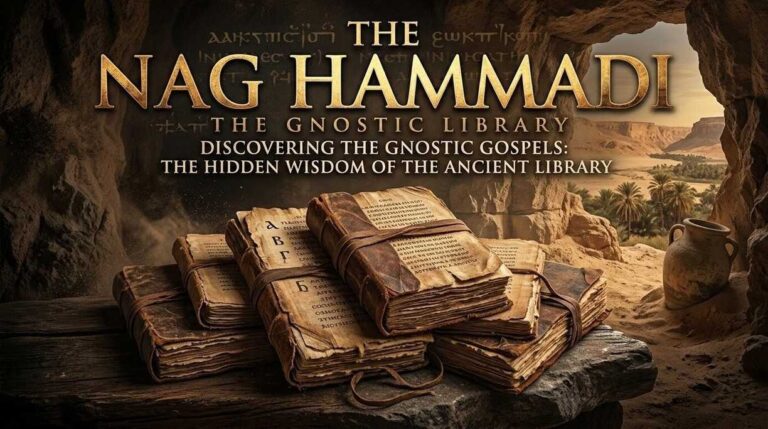
The Gospel of Philip is one of the most important Valentinian texts preserved in the Nag Hammadi Library. It is not a narrative Gospel like Matthew, Mark, Luke, or John. It is a collection of sayings, reflections, sacramental teachings, symbolic contrasts, and mystical interpretations. Among its most striking themes is the importance of chrism: sacred anointing.
In the Gospel of Philip, chrism is treated as a mystery of light, image, restoration, and spiritual identity.
Gospel of Philip, Nag Hammadi Codex II,3
The text places chrism in a sacramental world that also includes baptism, eucharist, redemption, and the bridal chamber. It does not present these merely as external ceremonies. It uses them as symbolic technologies of transformation: ways the divided self is restored to its divine image.
In Valentinian Christianity, sacraments are not only public markers of belonging. They are mysteries of recognition. To be anointed is to be marked by light, to recover the lost image, to pass from ignorance into gnosis, and to become capable of seeing what the unawakened state cannot perceive.
This is the genuine ancient root beneath the modern Sacred Secretion teaching. The Gospel of Philip does not offer a modern endocrine manual. It offers a sacramental and symbolic vision in which anointing changes the state of the person. The inner reading begins there.
Christ, Chrism, and the Meaning of Anointing
The word Christ comes from Greek Christos, meaning the Anointed One. It corresponds to Hebrew Messiah, also meaning anointed. Chrism is sacred anointing oil used in Christian sacramental traditions. The language is not incidental. Anointing means consecration, setting apart, empowerment, healing, royal or priestly designation, and spiritual transformation.
In external religion, oil is applied to the body. In esoteric reading, the deeper question becomes: what is the inner oil? What is being anointed within consciousness? What does it mean for the human being to become Christed, not by claiming superiority, but by becoming transparent to divine life?
This is where sacred secretion language becomes powerful. It turns sacrament inward. The body is no longer merely a passive recipient of ritual. It becomes the altar, vessel, temple, and laboratory. The anointing is not only something done to you. It is something awakened in you.
But this inward turn must be held with humility. To speak of internal Christ Oil is not to declare oneself Christ in an inflated or exclusive sense. It is to contemplate the Christ pattern as realised humanity: the body, heart, mind, and spirit brought into alignment with divine presence.
The Anatomy of the Sacred Secretion
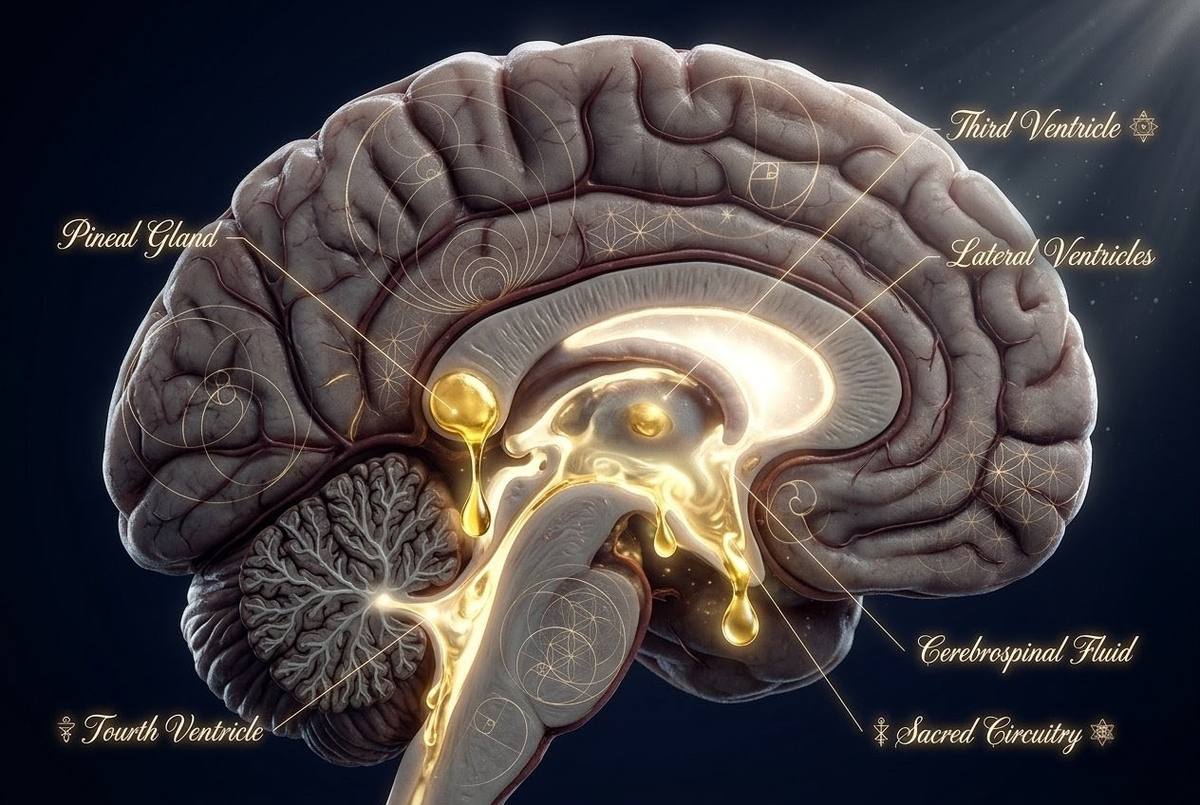
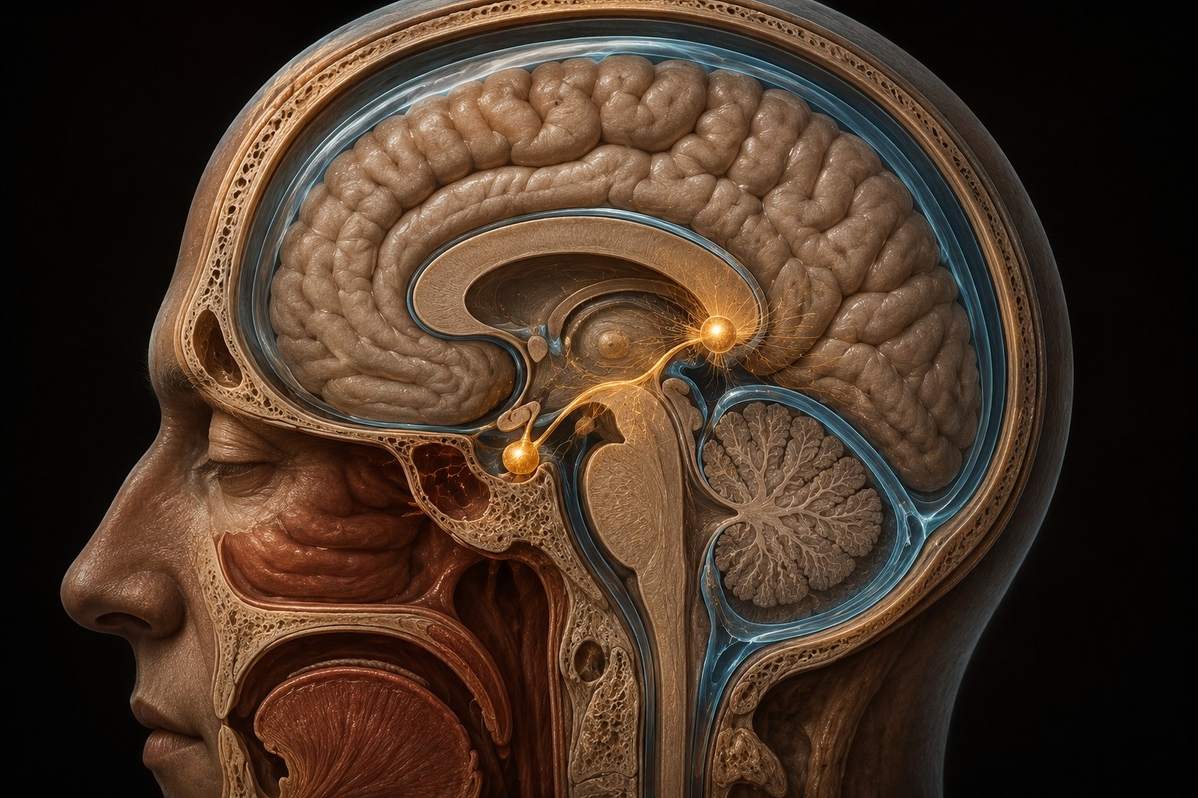
Modern sacred secretion teachings often describe a precise inner anatomy: pineal gland, pituitary gland, cerebrospinal fluid, spine, sacrum, vagus nerve, endocrine system, and brain ventricles. The language sounds scientific, and some parts refer to real anatomy. But the overall theory belongs to esoteric physiology, not established medical science.
This does not make it useless. Many spiritual systems use body imagery to express inner transformation. The heart becomes a sun. The spine becomes a ladder. Breath becomes spirit. The skull becomes a temple chamber. The glands become symbolic guardians of subtle states. The body becomes scripture written in fluid, nerve, rhythm, and light.
The Pineal-Pituitary Axis
The pineal gland is a small endocrine gland associated with melatonin production and circadian rhythm. It is sensitive to light-dark cycles and has long fascinated philosophers, mystics, and esoteric writers. Descartes famously called it the seat of the soul, though modern neuroscience does not support that claim in the way Descartes imagined.
The pituitary gland, located beneath the brain, plays a major role in endocrine regulation. It influences growth, stress response, reproductive hormones, thyroid function, lactation, and other bodily processes through hormonal signalling.
Esoteric sacred secretion teachings often imagine these two glands as an alchemical pair: pineal as luminous sensor, pituitary as master regulator, their symbolic union producing an inner chrism. Read cautiously, this is a beautiful image of spiritual integration: light and regulation, vision and embodiment, insight and distribution. Read literally, it becomes a claim that needs evidence it does not yet possess.
Cerebrospinal Fluid as Vehicle
Cerebrospinal fluid, or CSF, circulates around the brain and spinal cord. It cushions the central nervous system, helps maintain chemical balance, supports waste clearance, and participates in neural health. Esoteric writers often treat CSF as the inner water of life, the hidden river, the sacred current running through the axis of the body.
That symbolism has force. The brain and spine are not dry wires. They are bathed in fluid. Consciousness, perception, memory, sleep, dream, and movement depend on a delicate inner sea. It is understandable that traditions of inner alchemy would imagine awakening as something carried through those hidden waters.
Yet no recognised medical model identifies CSF as carrying a secret Christ Oil that must be raised through the spine. The contemplative value lies in the image: refine the body, quiet the nervous system, conserve scattered energy, and allow awareness to ascend through the whole axis of being.
Monthly Cycles and the Window of Opportunity
Some sacred secretion teachings speak of a monthly cycle, often linked with the moon, in which a refined internal essence is produced and either conserved, sublimated, or lost. The language varies: Christ Oil, seed, oil, chrism, sacred secretion, lunar essence, or spiritual fluid.
Biologically, many human processes are rhythmic. Sleep follows circadian cycles. Hormones fluctuate. Reproductive cycles exist. Mood, energy, appetite, libido, temperature, and attention can vary across days and weeks. The moon affects tides and has deep symbolic force across traditions, though claims about precise lunar control over human spiritual fluids should be treated with caution.

As practice, the monthly cycle teaching can still be useful if treated as self-observation rather than doctrine. Track energy. Track sleep. Track desire. Track mood. Track creative charge. Track appetite, dreams, meditation depth, and bodily signals. The point is not to force your body into an occult calendar. The point is to discover how your actual life moves.
When the teaching says there is a window of opportunity, read it inwardly: there are moments when energy is available for refinement. There are moments when desire can be transformed rather than discharged automatically. There are moments when the body quietly offers fuel for a higher fire. Learn to recognise them without becoming superstitious.
The Spinal Column as Jacob’s Ladder
The spine is the central axis of the body. Anatomically, it supports posture, protects the spinal cord, enables movement, and links the brain with the body through the nervous system. Symbolically, it becomes a ladder, pillar, tree, staff, serpent-path, or axis mundi.
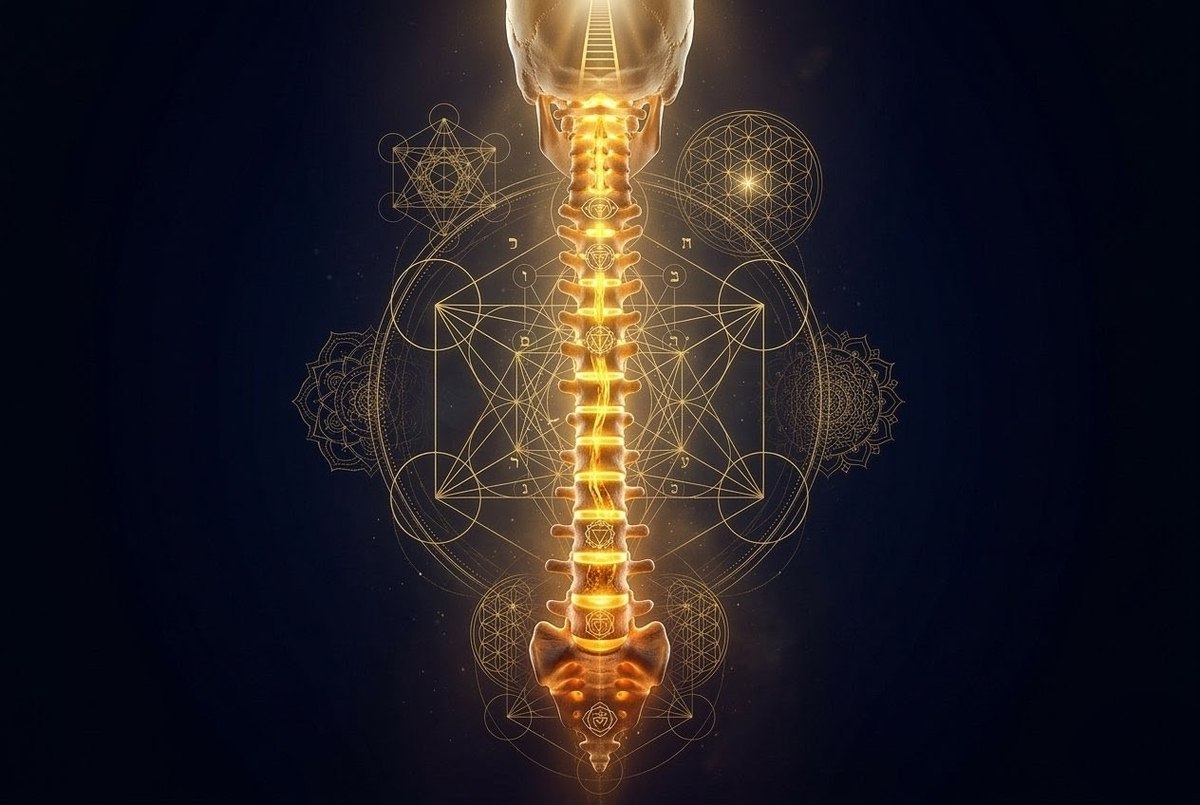
In the biblical image of Jacob’s Ladder, heaven and earth are connected by a vertical pathway. In yogic subtle anatomy, kundalini rises through the central channel, sushumna. In Western esotericism, the spine may become the path of chrism, the ascent of sacred oil, the ladder of inner anointing.
Thirty-Three Vertebrae and Symbolic Ascent
The human vertebral column is commonly described as having thirty-three vertebrae in total, including fused sacral and coccygeal segments. Esoteric writers often connect this number with the thirty-three years traditionally associated with Jesus’s life, the thirty-three degrees of Scottish Rite Freemasonry, and other sacred number patterns.
These correspondences are symbolic resonances, not proof. Their value lies in contemplation. The spine becomes the inner ladder through which instinct, desire, breath, heart, speech, vision, and crown are brought into alignment. The ascent of Christ Oil, read symbolically, is the ascent of conserved and refined life force through the whole human being.
In this sense, the spinal teaching says something simple and severe: awakening is vertical integration. It is not enough to have a bright idea in the head. The body must be included, the heart must be included, the sexual force must be included, the breath must be included, the nervous system must be included. The oil rises only when the whole temple cooperates.
Scientific Correlations and the Unmapped Territory
The Sacred Secretion teaching often borrows scientific language, especially around pineal chemistry, DMT, melatonin, endocrine function, and cerebrospinal fluid. This is where discernment matters most. A teaching may be spiritually meaningful without being scientifically established. It may contain symbolic truth without containing literal biochemistry.
The Pineal Gland, Melatonin, and DMT Claims
The pineal gland is known for producing melatonin, a hormone involved in sleep-wake regulation and circadian timing. It responds to signals related to light and darkness. That much is well established.
DMT claims require more caution. Research has detected DMT in mammalian systems, and some studies have explored its presence in animal brains, including rat pineal-related research. However, claims that the human pineal gland produces large amounts of DMT during mystical states, death, dreams, or sacred secretion cycles remain unproven. They should not be presented as settled fact.
This does not remove the symbolic value of the pineal as an image of inner vision. It simply prevents the article from walking into the swamp wearing a lab coat made of incense smoke.
CSF, Signalling, and Consciousness
Cerebrospinal fluid is increasingly recognised as more than passive cushioning. It participates in the central nervous system’s internal environment and is involved in circulation, clearance, signalling, and neural support. Sleep, posture, respiration, vascular rhythms, and other physiological factors can influence fluid dynamics.
It is reasonable to say that brain fluids, endocrine function, sleep, breath, and nervous-system states matter for consciousness. It is not yet reasonable to say science has confirmed a monthly Christ Oil travelling through CSF. That belongs to esoteric interpretation.

Where Science and Symbol Can Meet
There are grounded meeting points. Breathwork can influence autonomic regulation. Meditation can alter attention and stress response. Sexual behaviour, sleep, diet, and stress can affect hormones and mood. Fasting changes metabolism. Trauma affects the body. Posture and breathing affect state. These facts support the general importance of embodied practice.
But they do not prove the full Sacred Secretion theory. The honest position is more interesting: ancient esoteric systems recognised that spiritual life is bodily, rhythmic, sexual, fluid, hormonal, breath-shaped, and nervous-system dependent. Modern science is still mapping these relationships, but it has not validated every occult anatomy claim. The mystery remains open, not captured.
The Practice of Conservation and Sublimation
The practical side of Sacred Secretion teaching is not about chasing secret fluids. It is about conservation and sublimation. Conservation means not wasting life force through compulsion, distraction, overstimulation, addiction, and unconscious discharge. Sublimation means allowing raw energy to become attention, creativity, devotion, clarity, service, and spiritual heat.
This is where the teaching becomes useful. It says that the body contains fuel. Desire contains fuel. Breath contains fuel. Attention contains fuel. The question is whether that fuel burns downward into habit, sideways into distraction, or upward into transformation.
Observation of Cycles
Begin with observation. Track sleep, dreams, sexual energy, mood, bodily charge, meditation depth, digestion, emotional sensitivity, creativity, and fatigue. Do this without obsession. You are not trying to become a bureaucrat of your glands. You are learning the weather patterns of your own temple.
Over time, patterns may appear. Certain days may bring more clarity, desire, dream activity, inwardness, restlessness, or creative force. Treat these as invitations to attention, not as proof of cosmic scheduling.
Sexual Continence and Sexual Wisdom
Many internal alchemy traditions teach some form of sexual conservation. The idea is that sexual energy can be refined rather than automatically discharged. This does not require hatred of sexuality or moral shame. In its healthy form, continence is not repression. It is conscious stewardship of desire.
For some people, short periods of continence may increase vitality, clarity, discipline, or devotional force. For others, rigid continence may produce anxiety, shame, obsession, irritability, or dissociation. The difference matters. A practice that makes someone less grounded, less kind, and more inflated is not spiritual refinement. It is pressure trapped in ceremonial plumbing.
Sexual wisdom includes consent, embodiment, honesty, moderation, tenderness, boundaries, and freedom from compulsion. The aim is not to despise sexual energy. The aim is to understand it as one of the strongest currents in the human system.
Dietary Simplicity
Traditional teachings often recommend simple, clean, moderate eating to support clarity. This may include whole foods, hydration, reduced alcohol, reduced stimulants, less processed food, and attention to how different foods affect sleep, mood, and practice.
Fasting appears in many spiritual traditions, but it is not safe or appropriate for everyone. People with eating disorders, diabetes, pregnancy, medical conditions, medication needs, trauma histories around food, or unstable mental health should be cautious and seek qualified guidance. Purity language can become poison when it turns against the body.
Breath Control
Breath practices are central because breath links voluntary and involuntary systems. Slow breathing, lengthened exhale, gentle alternate nostril breathing, chanting, prayer breath, and simple breath awareness can all support nervous-system regulation and subtle body awareness.
Intense pranayama, long retentions, hyperventilation practices, and forceful breathwork can destabilise some people. Breath is powerful because it works quickly. Treat it as fire in a small room. Useful, luminous, and not something to swing around for drama.
Meditation and Inner Work
The Sacred Secretion teaching makes little sense without inner work. If conserved energy rises through unresolved trauma, grandiosity, fear, repression, or fantasy, the result may not be awakening. It may be destabilisation.
Meditation, prayer, shadow work, therapy, embodiment, journalling, confession, forgiveness, grief work, ethical repair, and relational honesty all matter. The vessel must be strengthened before it is filled. New wine in cracked vessels is still a mess, even when the label says “mystical vintage”.
The Transformation of Consciousness
The goal of Sacred Secretion teaching is not fluid fascination. It is transformation of consciousness. The oil is a symbol of refinement. The ascent is a symbol of integration. The anointing is a symbol of consecrated identity. The Christ pattern is a symbol of awakened humanity.
In its healthiest form, this teaching says that the body can participate in awakening. Spiritual life is not a thought floating above the neck. It involves desire, glands, breath, sleep, posture, sex, food, emotion, discipline, imagination, and nervous-system capacity. The temple is not made of marble. It is made of flesh that trembles, rests, wants, heals, and learns.

The “Christ Oil” can therefore be read as the consecrated life force that rises when the lower energies are not despised but refined. Sexual energy becomes creative energy. Breath becomes prayer. Desire becomes devotion. Discipline becomes freedom. The body becomes not a prison to escape, but an instrument tuned toward gnosis.
This is the internal anointing: not a claim of spiritual superiority, but a transformation in how the human being is inhabited. The ordinary self is softened, clarified, and offered upward. The result should be more humility, more steadiness, more compassion, more discernment, and more responsible embodiment. Anything else is just ego in a golden cloak.
Risks, Inflation, and Grounding
The Sacred Secretion teaching carries real risks when interpreted too literally or practised too intensely. It can lead to fear of “wasting” energy, sexual shame, obsessive cycle tracking, spiritual inflation, medical misinformation, or attempts to force kundalini-like experiences before the nervous system is ready.
One major danger is spiritual grandiosity. If someone believes they have activated Christ Oil and are therefore superior to others, the teaching has already failed. Inner anointing should deepen humility, not crown the ego as pope of the pineal gland.
Another danger is bypassing. Sexual continence, breathwork, meditation, and fasting can all be used to avoid grief, trauma, intimacy, anger, ordinary responsibility, or medical care. The body keeps score. It also keeps receipts.
Grounding practices are essential: sleep, food, hydration, walking, nature, honest work, friendship, therapy when needed, simple prayer, body awareness, and daily responsibilities. Advanced practice that makes ordinary life collapse is not advanced. It is unintegrated.
Related Glossary Terms
These terms help clarify the symbolic, Christian, physiological, and esoteric framework of the Sacred Secretion teaching:
- Sacred Secretion: modern esoteric teaching about an internal spiritual essence or anointing process associated with bodily refinement and ascent.
- Christ Oil: symbolic name for the refined inner chrism or sacred essence said to participate in spiritual awakening.
- Chrism: consecrated anointing oil used in Christian sacramental traditions; in esoteric reading, a symbol of inner anointing.
- Christos: Greek for Anointed One, root of the title Christ.
- Gospel of Philip: Valentinian Nag Hammadi text with important teachings on chrism, sacraments, image, union, and spiritual identity.
- Valentinianism: early Christian Gnostic movement associated with symbolic sacraments, restoration, gnosis, and the return to divine fullness.
- Pineal gland: endocrine gland involved in melatonin production and circadian rhythm, often symbolically linked with inner vision.
- Pituitary gland: endocrine gland involved in regulating several hormonal systems.
- Cerebrospinal fluid: fluid surrounding the brain and spinal cord, symbolically linked with inner waters in esoteric anatomy.
- Jacob’s Ladder: biblical image of vertical connection between heaven and earth, often used symbolically for spiritual ascent.
- Sushumna: central channel in yogic subtle anatomy through which kundalini is said to rise.
- Kundalini: latent spiritual power symbolised as a coiled serpent, associated with ascent through the central channel.
- Sublimation: transformation of raw desire or vital energy into creativity, devotion, clarity, service, or spiritual awareness.
- Sexual continence: intentional conservation of sexual energy, practised in some spiritual traditions with varying degrees of strictness.
- Internal alchemy: practice tradition centred on refining the body, breath, energy, and consciousness into higher states of integration.
Read Next
For the strongest next step, continue into the parallel framework of kundalini and energy ascent:
Kundalini Phenomena: Physiology and Spiritual Awakening
This companion article explores the yogic language of energy rising through the body, the signs and risks of intense awakening, and the need for grounding, discernment, and integration.
Frequently Asked Questions
What is the Sacred Secretion?
The Sacred Secretion is a modern esoteric teaching about an internal anointing process sometimes called Christ Oil, chrism, or sacred oil. It links spiritual transformation with the body, especially the pineal gland, pituitary gland, cerebrospinal fluid, spine, breath, sexual conservation, and inner alchemy. It is best read as symbolic physiology rather than established medical science.
Does the Gospel of Philip teach the Christ Oil?
The Gospel of Philip gives great importance to chrism and anointing within Valentinian sacramental Christianity. It treats chrism as spiritually significant and connected with light, image, and transformation. However, it does not provide a modern endocrine theory of a monthly Christ Oil. The Sacred Secretion is a later esoteric interpretation built around ancient chrism symbolism.
Is the Sacred Secretion scientifically proven?
No. Modern science recognises the pineal gland, pituitary gland, melatonin, endocrine regulation, and cerebrospinal fluid, but it does not confirm a specific sacred secretion or Christ Oil that rises through the spine. Some practices associated with the teaching, such as meditation, breathwork, sleep regulation, and sexual behaviour, can affect physiology, but the full esoteric model remains speculative.
What is the difference between chrism and Christ Oil?
Chrism is consecrated oil used in Christian anointing rites. Christ Oil is a modern esoteric term for an inner or symbolic chrism believed to arise within the body through spiritual refinement. Chrism belongs to established sacramental language; Christ Oil belongs to internal alchemy and esoteric physiology. The two are related symbolically, but not identical historically.
Is the Sacred Secretion the same as kundalini?
They are not the same tradition, but they describe similar symbolic patterns. Kundalini uses yogic language: serpent power, chakras, nadis, and the central channel. Sacred Secretion teaching uses Christian and alchemical language: chrism, anointing, Christ Oil, the spine, and internal ascent. Both concern the refinement and upward movement of life force, but each belongs to a different symbolic framework.
What practices are associated with the Sacred Secretion?
Common practices include meditation, breathwork, sexual conservation, dietary simplicity, cycle observation, inner work, prayer, and grounding. These should be approached gradually and safely. The goal is not to force mystical chemistry, but to refine desire, attention, body, and spirit into clearer awareness and more ethical embodiment.
Can Sacred Secretion practices be risky?
Yes. Intensive breathwork, strict continence, fasting, sleep disruption, obsessive cycle tracking, or attempts to force energy upward can destabilise some people. Risks include anxiety, insomnia, sexual shame, dissociation, grandiosity, emotional volatility, or worsening mental health. Anyone with trauma, bipolar disorder, psychosis history, panic, eating disorder history, or severe distress should seek qualified support and avoid extreme practice.
Study Note: This article explores the Sacred Secretion, Christ Oil, chrism, internal alchemy, esoteric Christianity, sexual conservation, breathwork, kundalini parallels, and speculative neurophysiology for educational and reflective purposes. It does not provide medical, psychological, sexual-health, psychiatric, endocrine, neurological, or spiritual-direction advice. Do not use this teaching to replace healthcare, therapy, medication, diagnosis, trauma support, or emergency services. Avoid extreme breathwork, fasting, sleep deprivation, forced continence, or attempts to induce kundalini-like states without appropriate grounding and guidance. If practice produces panic, insomnia, dissociation, mania, psychosis, obsessive fear, sexual shame, involuntary movements, or inability to function, pause the practice and seek qualified professional support.
Further Reading
These related articles continue the themes of inner anointing, subtle anatomy, breath, kundalini, embodiment, Gnostic sacraments, and spiritual integration:
- Kundalini Phenomena: Physiology and Spiritual Awakening – A parallel framework for energy ascent, subtle body activation, signs, risks, and integration.
- The Subtle Body: Mapping the Energy Anatomy of Human Consciousness – Koshas, chakras, nadis, prana, aura, and subtle body practice.
- The Gateway of Breath: Pranayama and Energetic Balance – Breath as the bridge between body, nervous system, attention, and energetic practice.
- The Gateway of Sensation: Body Scan and Somatic Awareness – Somatic awareness, interoception, grounding, and the ability to listen to subtle bodily signals.
- Embodiment Practices for Grounding Awakening – Stabilising expanded awareness through the body, ordinary life, and nervous-system regulation.
- Contemplative Techniques: The Thread’s Practical Foundation – Meditation, attention, prayer, silence, and methods for stabilising recognition.
- The Gospel of Philip: Bridal Chamber, Sacrament, and Sacred Union – Valentinian sacramental symbolism, chrism, image, union, and the mystery of restoration.
- Nag Hammadi Library: The Complete Guide to Gnostic Scriptures – Context for the Gospel of Philip and other texts on gnosis, sacraments, and spiritual transformation.
- Hermeticism and Gnosticism: The Egyptian Wisdom Traditions Compared – Internal alchemy, sacred speech, transformation, and the wider Mediterranean esoteric background.
- The Four Elements of Consciousness: Earth, Water, Fire, Air and the Fifth – Elemental transformation as a symbolic map of body, psyche, and spiritual refinement.
References and Sources
The following sources support the Gnostic, Christian, esoteric, anatomical, and contemplative framework used in this article.
Nag Hammadi and Gnostic Sources
- The Gospel of Philip. Nag Hammadi Codex II,3. Valentinian text with important sacramental language around chrism, baptism, bridal chamber, image, and union.
- Wilson, R. McL. (1962). The Gospel of Philip: Translated from the Coptic Text with an Introduction and Commentary. London: Mowbray.
- Robinson, James M., ed. (1990). The Nag Hammadi Library in English. Revised edition. San Francisco: HarperOne.
- Meyer, Marvin, ed. (2007). The Nag Hammadi Scriptures. New York: HarperOne.
- Thomassen, Einar. (2006). The Spiritual Seed: The Church of the Valentinians. Nag Hammadi and Manichaean Studies 60. Leiden: Brill.
- Pagels, Elaine. (1979). The Gnostic Gospels. New York: Random House.
- King, Karen L. (2003). What Is Gnosticism? Cambridge: Harvard University Press.
Christian Anointing, Chrism, and Sacramental Context
- Holy Bible. Exodus 30:22-33; Psalm 23:5; Isaiah 61:1; Luke 4:18; 2 Corinthians 1:21-22; 1 John 2:20, 27.
- Yarnold, Edward. (1971). The Awe-Inspiring Rites of Initiation: The Origins of the R.C.I.A.. Collegeville: Liturgical Press.
- Bradshaw, Paul F. (2002). The Search for the Origins of Christian Worship. 2nd ed. Oxford: Oxford University Press.
- Online Etymology Dictionary. Entries for Christ and chrism, for the Greek roots of anointing language.
Physiology and Neuroscience
- Guyton, Arthur C., and Hall, John E. (2021). Textbook of Medical Physiology. 14th ed. Philadelphia: Elsevier.
- Standring, Susan, ed. (2020). Gray’s Anatomy: The Anatomical Basis of Clinical Practice. 42nd ed. London: Elsevier.
- Cleveland Clinic. Pineal Gland; Pituitary Gland; Cerebrospinal Fluid; Spine: Anatomy, Function, Parts, Segments and Disorders.
- Barker, S. A., Borjigin, J., Lomnicka, I., and Strassman, R. (2013). “LC/MS/MS analysis of the endogenous dimethyltryptamine hallucinogens, their precursors, and major metabolites in rat pineal gland microdialysate.” Biomedical Chromatography, 27(12), 1690-1700.
- Dean, J. G., et al. (2019). “Biosynthesis and extracellular concentrations of N,N-dimethyltryptamine in mammalian brain.” Scientific Reports, 9, 9333.
- Herculano-Houzel, Suzana. (2016). The Human Advantage: A New Understanding of How Our Brain Became Remarkable. Cambridge: MIT Press.
Subtle Body, Kundalini, and Internal Alchemy
- Hatha Yoga Pradipika. Classical text on breath, nadis, kundalini, and subtle body practice.
- Shiva Samhita. Classical hatha yoga text on subtle anatomy and yogic transformation.
- Gheranda Samhita. Classical hatha yoga text on purification, posture, mudra, breath, meditation, and samadhi.
- Feuerstein, Georg. (1998). The Yoga Tradition: Its History, Literature, Philosophy and Practice. Prescott: Hohm Press.
- Samuel, Geoffrey. (2008). The Origins of Yoga and Tantra: Indic Religions to the Thirteenth Century. Cambridge: Cambridge University Press.
- Mallinson, James, and Singleton, Mark. (2017). Roots of Yoga. London: Penguin Classics.
- Avalon, Arthur, Sir John Woodroffe. (1919). The Serpent Power. London: Luzac.
- Leadbeater, C. W. (1927). The Chakras. Wheaton: Theosophical Publishing House.
Breath, Meditation, Trauma, and Grounding
- Brown, Richard P., and Gerbarg, Patricia L. (2012). The Healing Power of the Breath. Boston: Shambhala.
- Kabat-Zinn, Jon. (1990). Full Catastrophe Living. New York: Delacorte.
- Goleman, Daniel, and Davidson, Richard J. (2017). Altered Traits: Science Reveals How Meditation Changes Your Mind, Brain, and Body. New York: Avery.
- van der Kolk, Bessel. (2014). The Body Keeps the Score: Brain, Mind, and Body in the Healing of Trauma. New York: Viking.
- Ogden, Pat, Minton, Kekuni, and Pain, Clare. (2006). Trauma and the Body: A Sensorimotor Approach to Psychotherapy. New York: W. W. Norton.
- Levine, Peter A. (1997). Waking the Tiger: Healing Trauma. Berkeley: North Atlantic Books.