
The Four Elements of Consciousness: Earth, Water, Fire, Air and Your Spiritual Evolution
The four elements are not primitive chemistry. They are symbolic languages for consciousness. Earth, water, fire, and air describe the ways human beings become grounded, emotional, active, thoughtful, embodied, inspired, imbalanced, healed, and transformed. Read literally, they belong to ancient cosmology. Read psychologically, they become a map of human development. Read spiritually, they become a grammar of inner alchemy.
In Plain Terms
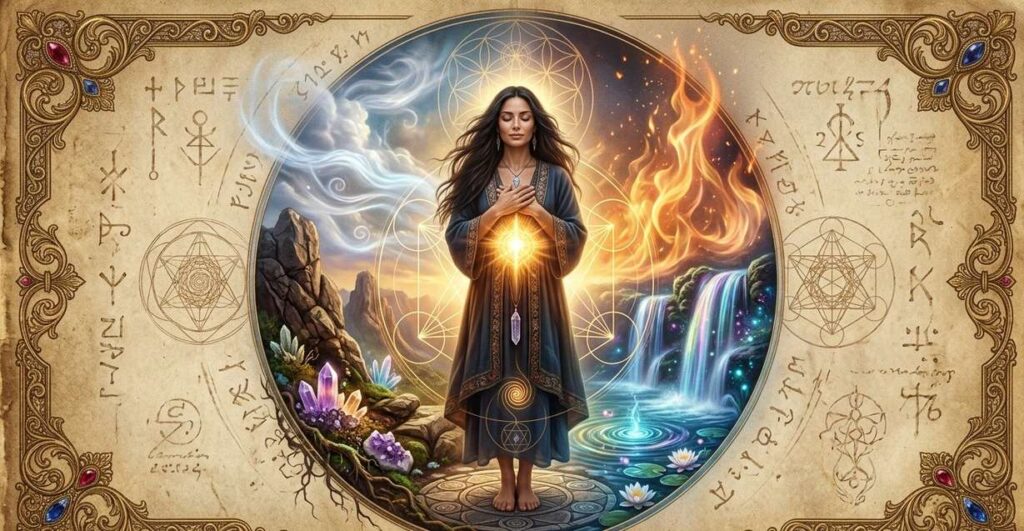
The four elements are a traditional way of understanding the world through qualities rather than chemical substances. Earth means form, body, stability, patience, and structure. Water means emotion, relationship, imagination, and flow. Fire means will, transformation, passion, courage, and intensity. Air means thought, speech, breath, clarity, and perspective.
Many ancient systems used elemental language: Greek philosophy, astrology, alchemy, Western medicine, Ayurveda, Hermeticism, ritual magic, and symbolic psychology. They did not all use the same system in exactly the same way. Some used four elements. Some used five. Some linked elements to humours, temperaments, planets, directions, seasons, organs, chakras, or stages of transformation.
For modern readers, the elements work best as a reflective map. They help ask practical questions: Am I grounded enough? Am I emotionally open without being flooded? Do I have enough fire to act without burning out? Is my mind clear without becoming detached from the body? What element is missing, and what element has taken over the room?
Primary Sources and Traditions Discussed
- Greek philosophy: Empedocles, Aristotle, the four roots, aether, Love and Strife, and the classical elemental imagination.
- Western medicine: Hippocratic and Galenic humours, temperaments, and the historical use of elemental balance in diagnosis.
- Alchemy: earth, water, fire, air, quintessence, nigredo, albedo, citrinitas, rubedo, and the Great Work.
- Astrology and Hermeticism: elemental correspondences, temperament, symbolic diagnosis, and the relation between cosmos and psyche.
- Ayurveda: the five elements, doshas, and the traditional language of elemental constitution.
- Yoga and chakra systems: modern esoteric mappings of elements to subtle centres, handled as symbolic frameworks rather than medical doctrine.
- Depth psychology: elements as archetypal qualities, developmental tendencies, relationship patterns, and modes of transformation.
How to Read the Elements
The elements should not be read as a replacement for science. Modern chemistry describes matter through atoms, molecules, bonds, elements, compounds, and physical processes. The classical elements describe experience through qualities: solidity, fluidity, heat, movement, breath, clarity, cohesion, volatility, and transformation.
This distinction matters. Earth is not literally the same thing as soil in every context. Water is not only liquid. Fire is not only flame. Air is not only atmosphere. Each element names a mode of consciousness. Earth is what stabilises. Water is what flows. Fire is what transforms. Air is what moves, thinks, speaks, and clarifies.
The elements are most useful when they are treated as symbolic tools, not rigid labels. No person is only one element. No relationship is doomed because two elements “clash”. No illness should be treated only by symbolic balancing. The elements help us notice patterns. Wisdom begins when the pattern is then tested against the body, the situation, the evidence, and ordinary life.
Table of Contents
- Earth: The Foundation That Grounds
- Water: The Flow That Relates
- Fire: The Force That Transforms
- Air: The Clarity That Communicates
- The Fifth Element: Quintessence and Integration
- The Elemental Journey: A Spiral, Not a Ladder
- Elemental Balance: Deficiency and Excess
- The Elements in Practice
- The Elements and the Body
- The Elements in Relationship
- The Great Work: From Lead to Gold
- The Invitation: Knowing Your Elemental Pattern
- Related Glossary Terms
- Read Next
- Frequently Asked Questions
- Further Reading
- References and Sources
Earth: The Foundation That Grounds
Earth is the element of form, weight, structure, endurance, boundary, body, and practical reality. It is the ground beneath the feet, the bone beneath the flesh, the routine that keeps life from dissolving into intention without incarnation.
In consciousness, earth is the capacity to remain present in the body and in the actual conditions of life. It is the ability to cook food, pay attention to money, keep promises, sleep, clean, build, repair, garden, organise, and do the unglamorous work that lets spiritual insight survive contact with Tuesday afternoon.
The Gifts of Earth
Healthy earth gives patience, discipline, reliability, steadiness, craft, and rootedness. It allows a person to finish what they begin. It honours repetition. It understands that transformation must eventually become habit, schedule, muscle, soil, money, food, shelter, and body.
Without earth, spiritual life becomes airy theatre. Ideas multiply, visions sparkle, practices begin with great fanfare, and nothing lands. Earth says: where is the body in this? Where is the practice? Where is the structure that will carry the insight tomorrow?
The Shadow of Earth
Unbalanced earth becomes rigidity, possessiveness, materialism, fear of change, dead routine, hoarding, and obsession with security. What should ground begins to imprison. The person clings to what is known because the unknown feels like annihilation.
Too much earth mistakes survival for life. It may build strong walls and then forget to open windows. It may confuse having with being, caution with wisdom, and permanence with peace.
Earth and the Root
In many modern yoga and Western esoteric systems, earth is associated with the root chakra, muladhara, at the base of the spine. This mapping is common in contemporary chakra teaching, though such systems combine traditional Indian material with later Theosophical and modern esoteric interpretation.
Symbolically, the association is clear. The root concerns survival, belonging, body, ground, fear, and basic trust in life. A person who cannot inhabit the body cannot safely build higher states. Earth does not block spirit. It gives spirit a place to stand.
Earth is not the enemy of spirit. It is the place where spirit learns whether it can become real.
Water: The Flow That Relates
Water is the element of feeling, imagination, memory, intimacy, adaptation, grief, pleasure, creativity, and relationship. It softens what earth hardens. It connects what form separates. It carries life through channels the eye may not see.
In consciousness, water is the capacity to feel and respond. It allows empathy, tenderness, mourning, beauty, sensuality, and creative flow. It is the part of the soul that knows through resonance rather than argument.

The Gifts of Water
Healthy water brings emotional intelligence, compassion, artistic sensitivity, adaptability, and the ability to bond. It helps a person feel what is happening beneath the words. It enters the atmosphere of a room and notices what the argument is really about.
Water is necessary for healing because pain rarely releases through analysis alone. It must be felt, witnessed, named, and allowed to move. Tears are not failure. They are one of the body’s oldest forms of truth-telling.
The Shadow of Water
Unbalanced water becomes flooding, codependency, moodiness, fantasy, addiction, collapse of boundaries, and confusion between compassion and self-erasure. The person may feel everything but know little about what belongs to them and what belongs to another.
Too much water can drown discernment. It may mistake intensity for truth, longing for love, and emotional fusion for intimacy. Water needs banks. Without boundary, the river becomes flood.
Water and the Sacral Centre
In many modern chakra systems, water is associated with the sacral chakra, svadhisthana, linked with creativity, sexuality, pleasure, desire, and emotional flow. Again, this is best read symbolically rather than as a medical claim.
The association makes intuitive sense. The sacral region belongs to generation, movement, sensuality, and fluid life. Balanced water allows feeling to move without taking over the whole vessel. Blocked water may appear as numbness, creative stagnation, shame, or difficulty receiving pleasure.
Fire: The Force That Transforms
Fire is the element of heat, will, courage, passion, digestion, anger, purification, vision, and transformation. It burns, illuminates, warms, destroys, cooks, refines, and reveals. Fire is dangerous because it is powerful, and powerful because it is dangerous.
In consciousness, fire is the capacity to choose, act, risk, defend, change, and become. It is the force that says yes with the whole body, or no with enough heat to set a boundary. Without fire, life remains potential.
The Gifts of Fire
Healthy fire gives vitality, motivation, confidence, courage, discernment through heat, and the power to transmute experience. It helps a person leave what is dead, confront what is false, protect what is precious, and endure the discomfort of growth.
Fire also illuminates. It shows what was hidden in the dark. This can make it uncomfortable, because illumination does not ask whether the furniture of the psyche is ready to be seen. Fire enters and the shadows begin giving up their names.
The Shadow of Fire
Unbalanced fire becomes aggression, domination, burnout, impatience, rage, obsession with achievement, and the tendency to consume relationships, projects, and bodies in the name of intensity. Fire can purify, but it can also scorch.
Too much fire mistakes force for truth. It may confuse exhaustion with devotion, conflict with honesty, and conquest with transformation. Fire needs water to soften it, earth to contain it, and air to guide it.
Fire and the Solar Plexus
In modern chakra systems, fire is commonly associated with the solar plexus chakra, manipura, linked with will, confidence, digestion, self-definition, and personal power. The symbolic relationship is direct: the belly is furnace, engine, appetite, courage, and the heat of becoming.
Balanced fire supports action without domination. Deficient fire may appear as passivity, avoidance, low motivation, or difficulty asserting oneself. Excess fire may appear as control, irritability, competitiveness, or burnout.
Air: The Clarity That Communicates
Air is the element of breath, thought, movement, speech, perspective, intelligence, exchange, and spaciousness. It carries scent, sound, pollen, weather, prayer, song, and argument. It is invisible until it moves something.
In consciousness, air is the capacity to think clearly, communicate, compare, symbolise, question, imagine alternatives, and gain distance from immediate feeling. Air gives the mind room to see the pattern rather than drown inside the event.
The Gifts of Air
Healthy air gives discernment, language, humour, objectivity, intellectual freedom, and the ability to communicate what has been understood. It helps a person name the pattern, explain the difference, ask the sharper question, and open the window when a room has become too heavy.
Air is also linked with the ethics of speech. Breath becomes word. Word becomes relationship. Relationship becomes culture. Clear air is not merely cleverness. It is communication that serves truth.
The Shadow of Air
Unbalanced air becomes detachment, dissociation, overthinking, intellectual arrogance, clever avoidance, and the habit of analysing life instead of living it. The person may turn every wound into a concept and every relationship into a theory.
Too much air floats away from the body. It may mistake explanation for integration, commentary for wisdom, and vocabulary for transformation. Air needs earth to land, water to feel, and fire to act.
Air, Heart, and Throat
In many modern esoteric mappings, air is associated with the heart and throat, because it connects breath, relationship, and speech. Some traditional Indian correspondences place air with the heart centre, anahata, while ether is more commonly associated with the throat, vishuddha. Western adaptations often blend these systems.
Symbolically, the blend is useful. Air enters the lungs, moves through the heart-space, rises through the throat, and becomes speech. Thought without breath remains private. Breath shaped by attention becomes communication. The invisible becomes audible.
The Fifth Element: Quintessence and Integration
Many traditions include a fifth element. Aristotle used aether to describe the celestial element distinct from the four terrestrial elements. Indian systems speak of akasha, often translated as ether or space. Alchemy speaks of quintessence, the fifth essence, the refined principle extracted from the four.
The fifth element should not be imagined as merely one more item in the row. It is not earth, water, fire, air, and then a decorative spiritual garnish. Quintessence is the integrating field, the subtle unity through which the four elements become whole.

Spirit Does Not Escape the Elements
A common spiritual mistake is to treat the fifth element as escape from the four. But genuine integration does not reject body, feeling, will, or thought. It gathers them. Spirit without earth becomes ungrounded. Spirit without water becomes cold. Spirit without fire becomes weak. Spirit without air becomes mute.
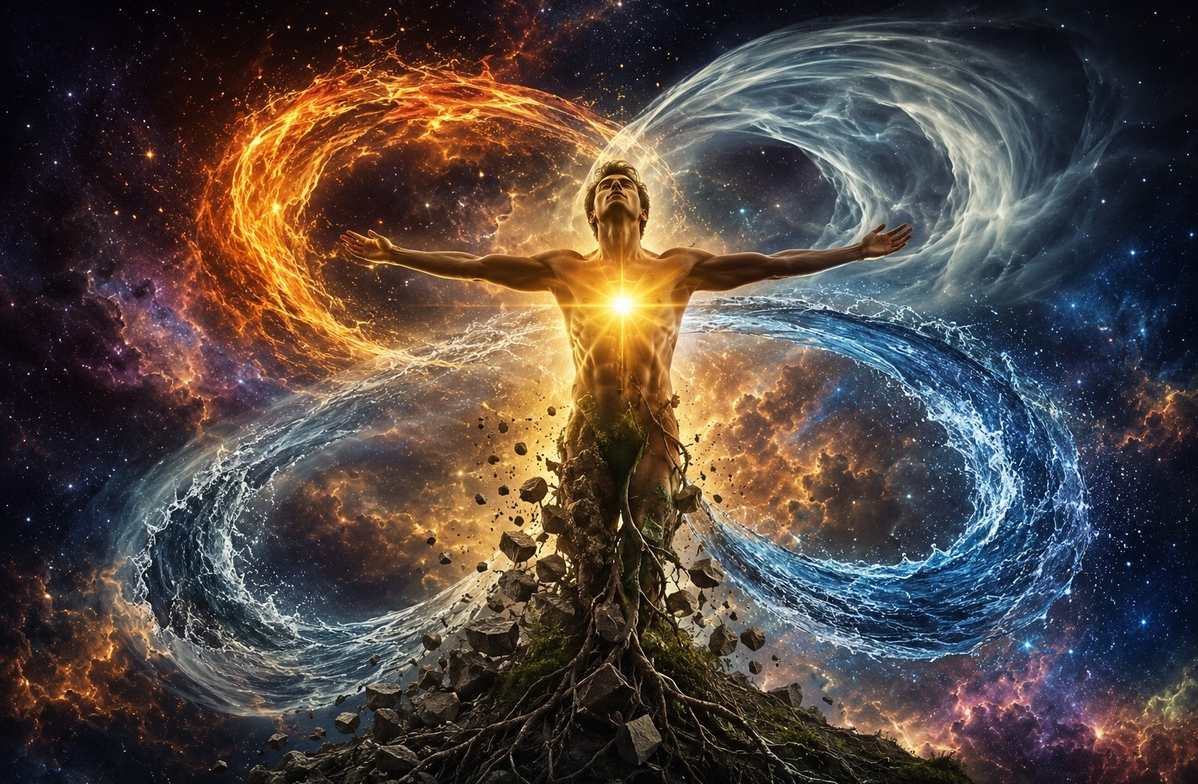
Quintessence is the state in which the elements are no longer fighting for control. Earth gives form. Water gives flow. Fire gives transformation. Air gives clarity. Spirit gives coherence. The orchestra begins to hear the conductor.
Ether, Space, and Subtle Awareness
In yogic and esoteric contexts, ether or space is associated with subtle awareness, sound, openness, and the field in which phenomena arise. Contemporary chakra systems often link ether to the throat and higher centres, though different traditions map these correspondences differently.
As a contemplative image, ether is the spaciousness that allows experience to come and go without possession. It is the sky behind weather, the silence beneath speech, the open field in which all elements appear.
The Elemental Journey: A Spiral, Not a Ladder
The elements are not a ladder that is climbed once and abandoned. They are a spiral. A person returns to earth, water, fire, and air at different stages of life, each time at a new depth. A crisis may demand earth. A grief may demand water. A decision may demand fire. A confusion may demand air.
Spiritual development often fails when one element is worshipped and another rejected. Some seekers love air and avoid earth, living in beautiful ideas while practical life collapses. Others cling to earth and fear water, building stability but avoiding feeling. Some chase fire and burn out. Some dissolve into water and lose the boundary needed for mature compassion.
Developmental Patterns
Elemental language can describe developmental patterns, though not rigidly. Childhood may emphasise water through emotional formation and attachment. Adolescence often activates fire through identity, desire, rebellion, and will. Adulthood may require air through responsibility, communication, planning, and discernment. Elderhood may return to earth through simplicity, embodiment, consolidation, and wisdom.
But life is untidy. A child may need earth because their world is unstable. An adult may need water because they have become emotionally dry. An elder may need fire because they have confused age with resignation. The elements do not obey neat age charts. They answer need.
The question is therefore not “what stage am I in?” but “what element is life asking me to develop now?”
Elemental Balance: Deficiency and Excess
Elemental balance does not mean having equal amounts of everything all the time. Balance means the right element is available at the right moment. A funeral requires water. A contract requires earth. A boundary may require fire. A misunderstanding requires air. A mystical opening requires space.
Imbalance appears when one element is missing, excessive, or used in the wrong place.
Signs of Deficiency
- Too little earth: anxiety, disorganisation, poor boundaries, difficulty with money, body neglect, unfinished plans, lack of routine.
- Too little water: emotional numbness, creative dryness, fear of intimacy, difficulty grieving, lack of empathy, relational distance.
- Too little fire: passivity, low motivation, fear of conflict, weak boundaries, difficulty acting, resentment hidden beneath politeness.
- Too little air: confusion, poor communication, mental fog, inability to reflect, difficulty naming patterns, lack of perspective.
Signs of Excess
- Too much earth: rigidity, hoarding, stubbornness, over-control, fear of change, material fixation, emotional heaviness.
- Too much water: emotional flooding, codependency, porous boundaries, escapism, fantasy, addictive attachment, mood domination.
- Too much fire: aggression, burnout, impatience, domination, drama, compulsive striving, inability to rest.
- Too much air: overthinking, detachment, intellectual arrogance, dissociation, avoidance of feeling, endless analysis without embodiment.

Elemental Remedies
The traditional remedy for elemental imbalance is not always to add the opposite in a crude way. Sometimes the missing element is needed. Sometimes the excessive element needs containment. Sometimes the person needs rest, support, food, therapy, medicine, or ordinary practical help before any symbolic work is useful.
- For deficient earth: grounding, routine, sleep, body awareness, walking, gardening, decluttering, budgeting, physical repair.
- For deficient water: journalling, music, grief work, therapy, creative practice, compassionate conversation, time near rivers, sea, or rain.
- For deficient fire: sunlight, movement, boundary practice, small decisive actions, martial discipline, creative risk, honest anger safely expressed.
- For deficient air: study, writing, breath awareness, dialogue, reading, naming patterns, asking better questions.
The elements are not personality boxes. They are diagnostic mirrors, showing which forces are present, absent, excessive, or waiting to be integrated.
The Elements in Practice
Elemental practice turns the symbols into lived experience. It asks the body, breath, imagination, will, and attention to participate. The aim is not theatrical ritual for its own sake. The aim is balance, embodiment, clarity, and transformation.
Earth Practices
Earth practices include walking slowly, gardening, cooking, cleaning, body scans, strength training, financial order, working with clay or stone, repairing something physical, and keeping a promise repeatedly until it becomes reliable.
Earth practice is especially useful when a person feels scattered, anxious, dissociated, unstructured, or full of ideas with no landing strip. Earth says: return to the body, the room, the task, the next necessary thing.
Water Practices
Water practices include journalling, emotional naming, grief ritual, bathing, swimming, listening to music, painting, dreamwork, therapy, compassionate conversation, and allowing tears without turning them into a courtroom.
Water practice is useful when the heart is dry, the imagination blocked, the body tense from unwept feeling, or relationship has become mechanical. Water says: soften without dissolving.
Fire Practices
Fire practices include physical exercise, sunlight, candle meditation, decisive action, disciplined challenge, honest boundary-setting, creative risk, fasting where medically appropriate, and the safe expression of anger through movement, art, or clear speech.
Fire practice is useful when motivation is low, courage has gone underground, or resentment has replaced action. Fire says: move, choose, burn cleanly, do not smoulder.
Air Practices
Air practices include breath awareness, study, writing, contemplation, conversation, debate without cruelty, reading philosophy, naming patterns, simplifying language, and creating enough distance to see clearly.
Air practice is useful when feeling has become fog, conflict lacks words, or the mind needs perspective. Air says: breathe, name, distinguish, communicate.
The Ayurvedic Connection
Ayurveda uses a five-element system: earth, water, fire, air, and ether. These combine into the three doshas: vata, often associated with air and ether; pitta, often associated with fire and water; and kapha, often associated with earth and water. These are traditional constitutional categories, not modern biomedical diagnoses.
Ayurveda shows how elemental thinking can become a detailed system of diet, season, behaviour, body, temperament, and health. Modern readers should approach it respectfully and consult qualified practitioners when applying it to health. Symbolic self-reflection is not the same as medical treatment.
The Elements and the Body
Traditional systems often map elements onto body systems. These correspondences are symbolic and historical, not replacements for modern anatomy. Still, they can help the body be read as a living field of qualities.
- Earth: bones, muscles, skin, teeth, structure, weight, posture, and the sense of physical presence.
- Water: blood, lymph, tears, saliva, reproductive fluids, cerebrospinal fluid, moisture, flow, and emotional release.
- Fire: digestion, metabolism, temperature, inflammation, cellular energy, appetite, drive, and transformative processes.
- Air: breathing, nerves, movement, exchange, speech, sensory communication, and the subtle rhythm of attention.
- Ether or space: cavities, openness, resonance, subtle perception, silence, and the space in which bodily processes occur.
These correspondences become most valuable when they deepen embodiment rather than replace evidence-based care. A person may use earth language to remember grounding, water language to honour grief, fire language to regulate intensity, and air language to recover breath. But persistent symptoms require qualified medical support.
Humours and Temperaments
Western medicine once mapped the four elements through the four humours: black bile, phlegm, yellow bile, and blood. These were linked with temperaments: melancholic, phlegmatic, choleric, and sanguine. The medical theory has been superseded, but the temperament language remains historically and psychologically interesting.
Melancholic earth gives depth, seriousness, and structure, but may become heaviness. Phlegmatic water gives calm and receptivity, but may become inertia. Choleric fire gives drive and command, but may become domination. Sanguine air gives sociability and movement, but may become distraction. The old map is not medicine now, but it remains a mirror.
The Elements in Relationship
Elemental language can illuminate relationship dynamics without turning them into fate. People are not fixed substances. They are living mixtures. Still, certain patterns recur.
- Earth and water: earth offers container; water offers feeling and flow. Together they can create nourishment, home, and emotional steadiness.
- Fire and air: fire offers energy; air offers direction and communication. Together they can create movement, vision, and inspired action.
- Earth and fire: earth may slow fire; fire may disturb earth. The challenge is to turn friction into productive transformation.
- Water and air: water may feel air as detached; air may feel water as overwhelming. The challenge is to let feeling and clarity speak to each other.
- Two fire types: strong passion and movement, with risk of conflict or burnout.
- Two water types: deep empathy and intimacy, with risk of emotional flooding or unclear boundaries.
- Two earth types: stability and endurance, with risk of stagnation or resistance to change.
- Two air types: conversation and idea-flow, with risk of overthinking or lack of embodiment.
Love and Strife
Empedocles described the elements as moved by Love and Strife. Love joins; Strife separates. These are not simply good and bad. Relationship needs both union and distinction. Love without difference becomes fusion. Strife without love becomes fragmentation.
Healthy relationship learns when to blend and when to differentiate. Water may teach intimacy. Air may name the pattern. Fire may set the boundary. Earth may keep the promise after the dramatic conversation ends.
The Great Work: From Lead to Gold
Alchemy uses elemental language to describe transformation. At one level, alchemy concerns substances, operations, vessels, heat, and matter. At another level, especially in later spiritual and psychological readings, it describes the transformation of the human being.
The Great Work is not a single mood of enlightenment. It is a process: breakdown, purification, clarification, integration. The elements move through it like hidden teachers.

The Four Stages and Their Elements
Nigredo, the blackening, is the stage of descent, dissolution, shadow, and confrontation. It has earthy and watery qualities: heaviness, darkness, decomposition, and the flooding of unconscious material. It is not pleasant, but it begins the work.
Albedo, the whitening, is the stage of washing, purification, reflection, and emotional clarification. Water becomes central here. The substance is cleansed. The soul begins to see what was previously hidden beneath darkness and projection.
Citrinitas, the yellowing, is associated with dawn, solar awakening, understanding, and the emergence of clearer consciousness. Air and fire become more visible here: insight, illumination, discrimination, and renewed orientation.
Rubedo, the reddening, is the stage of embodiment, completion, heat, union, and integration. Fire does not merely destroy here. It ripens. The work becomes life, not theory.
In this symbolic reading, the elements do not simply describe personality. They describe the alchemical weather of transformation.
The Invitation: Knowing Your Elemental Pattern
You may have a native element: the mode that feels most natural. Perhaps you build like earth, feel like water, blaze like fire, or think like air. That native element is a gift, but it can also become a hiding place.
The work is not to abandon your native element. Nor is it to become perfectly equal in all directions, a spiritual spreadsheet with sandals. The work is integration. Can earth support without hardening? Can water feel without drowning? Can fire act without consuming? Can air understand without floating away?
The elements ask for availability. Life will not always need your favourite strength. Sometimes the fiery person must learn patience. Sometimes the watery person must learn boundary. Sometimes the airy person must wash dishes. Sometimes the earthy person must risk the unknown.
Elemental mastery is not domination over nature. It is participation in nature with enough consciousness to know which force is needed now.
Related Glossary Terms
These terms help clarify the symbolic, philosophical, and esoteric use of the four elements:
- Four elements: earth, water, fire, and air as symbolic qualities of matter, psyche, ritual, and consciousness.
- Earth: stability, form, embodiment, structure, patience, and practical reality.
- Water: emotion, flow, imagination, relationship, memory, and sensitivity.
- Fire: will, passion, transformation, courage, heat, and purification.
- Air: thought, breath, speech, communication, movement, and perspective.
- Quintessence: the fifth essence or integrating principle beyond and within the four elements.
- Aether or ether: the subtle fifth element associated with space, celestial realms, sound, or spiritual field in various traditions.
- Akasha: Sanskrit term often translated as space or ether, used in Indian philosophical and esoteric systems.
- Humours: historical Western medical theory linking bodily fluids, temperaments, and elemental balance.
- Doshas: Ayurvedic constitutional principles formed from combinations of the five elements.
- Alchemy: transformative art concerned with matter, spirit, purification, integration, and the Great Work.
- Nigredo, albedo, citrinitas, rubedo: symbolic stages of alchemical transformation.
Read Next
For the strongest next step, continue into the body as a mirror of the cosmos:
The Divine Architecture Within: How Your Body Mirrors the Universe
This companion article extends the elemental theme into esoteric anatomy, embodiment, and the symbolic relationship between the human body and the wider cosmos.
Frequently Asked Questions
What are the four elements in spiritual traditions?
The four elements are earth, water, fire, and air. In spiritual, philosophical, and esoteric traditions, they usually describe qualities rather than modern chemical substances. Earth represents form and stability, water represents emotion and flow, fire represents will and transformation, and air represents thought, breath, communication, and perspective.
Are the four elements meant to be taken literally?
They can be read historically as ancient cosmology, but modern readers usually gain most from reading them symbolically and psychologically. The elements are not a replacement for chemistry or physics. They are a language of qualities, helping describe patterns in body, mind, emotion, relationship, ritual, and spiritual transformation.
Where did the four elements theory come from?
In the Western tradition, the four-element theory is associated especially with Empedocles, who described earth, water, air, and fire as four roots of reality. Aristotle later developed the system and added aether as a celestial fifth element. Elemental thinking then influenced Greek philosophy, medicine, astrology, alchemy, Hermeticism, and later esoteric traditions.
What is the fifth element or quintessence?
The fifth element is known as aether, ether, spirit, akasha, or quintessence in different traditions. It represents space, subtle field, celestial substance, or the integrating principle that gathers the four elements into unity. In alchemy, quintessence is the refined essence produced through purification and integration.
How do the elements relate to personality?
Elemental language can describe tendencies. Earth types may seek stability and structure. Water types may emphasise emotion and relationship. Fire types may be driven, passionate, and transformative. Air types may be intellectual, communicative, and perspective-oriented. These are reflective patterns, not fixed labels or destiny.
How do I know which element is imbalanced?
Look for excess or deficiency. Too little earth may appear as anxiety or lack of structure. Too much water may appear as emotional flooding. Too much fire may appear as burnout or aggression. Too much air may appear as overthinking or detachment. The goal is not equal amounts of every element, but access to the right quality when life requires it.
Can elemental practices replace medical or psychological treatment?
No. Elemental practices such as grounding, journalling, movement, breath awareness, or contemplative work can support wellbeing, but they do not replace medical care, therapy, emergency support, or qualified treatment. Persistent physical or psychological symptoms should be discussed with appropriate professionals.
Study Note: This article explores the four elements as symbolic, philosophical, psychological, and esoteric frameworks. It does not present elemental language as a replacement for modern science, medicine, therapy, or emergency care. Elemental practices can support reflection, embodiment, and spiritual integration, but persistent physical symptoms, mental distress, trauma, or health concerns should be discussed with qualified professionals. The elements are best used as mirrors, not cages.
Further Reading
These related articles continue the themes of elemental symbolism, esoteric anatomy, consciousness, transformation, and spiritual integration:
- The Divine Architecture Within: How Your Body Mirrors the Universe – Esoteric anatomy, embodiment, and the symbolic relationship between body and cosmos.
- The Kabbalistic Tree of Life: A Complete Guide to Spiritual Ascension – Another major framework for spiritual development, balance, ascent, and integration.
- The Mental Plane Explained: Where Thoughts Become Reality – Thought, imagination, belief, and the subtle level where patterns begin to organise experience.
- The Hidden Agreements: Why Esoteric Traditions Keep Inventing the Same Architecture – Shared patterns across traditions, including recurring elemental and symbolic frameworks.
- The Transformation: What Actually Changes After Mystical Experience – How spiritual experience becomes embodied change rather than passing intensity.
- Planes of Consciousness: The Complete Guide to Higher Dimensions – The wider cosmology of subtle planes, from physical experience to spiritual awareness.
- The Power of Words: Etymology, Conscious Language, and the Magic of Speech – Air, language, breath, speech, and the responsibility of conscious communication.
- Contemplative Techniques: The Thread’s Practical Foundation – Grounded methods for attention, embodiment, silence, and inner stability.
- States of Knowing: What Happens When Consciousness Unravels – Altered knowing, perception, and the shifting conditions of awareness.
- The Living Thread: How Forbidden Knowing Survives – How hidden knowledge survives through symbol, practice, language, and transmission.
References and Sources
The following sources support the historical, philosophical, esoteric, and comparative framework used in this article.
Classical and Historical Sources
- Empedocles of Akragas. On Nature. Fragments preserved through later classical authors including Simplicius.
- Aristotle. On the Heavens. Classical source for aether and the distinction between terrestrial and celestial elements.
- Aristotle. On Generation and Corruption. Discussion of elemental qualities and transformation.
- Hippocratic Corpus. On the Nature of Man. Classical humoral theory and bodily balance.
- Galen. On the Temperaments. Later development of humoral medicine and temperament theory.
Alchemy, Esotericism, and Comparative Traditions
- Jung, C. G. (1968). Psychology and Alchemy. Collected Works, Vol. 12. Princeton: Princeton University Press.
- Jung, C. G. (1963). Mysterium Coniunctionis. Collected Works, Vol. 14. Princeton: Princeton University Press.
- Principe, Lawrence M. (2012). The Secrets of Alchemy. Chicago: University of Chicago Press.
- Linden, Stanton J., ed. (2003). The Alchemy Reader: From Hermes Trismegistus to Isaac Newton. Cambridge: Cambridge University Press.
- Burckhardt, Titus. (1967). Alchemy: Science of the Cosmos, Science of the Soul. Louisville: Fons Vitae.
- Copenhaver, Brian P., trans. (1992). Hermetica: The Greek Corpus Hermeticum and the Latin Asclepius. Cambridge: Cambridge University Press.
Ayurveda, Yoga, and Elemental Correspondence
- Lad, Vasant. (1984). Ayurveda: The Science of Self-Healing. Twin Lakes: Lotus Press.
- Frawley, David. (2000). Yoga and Ayurveda: Self-Healing and Self-Realization. Twin Lakes: Lotus Press.
- Feuerstein, Georg. (1998). The Yoga Tradition: Its History, Literature, Philosophy and Practice. Prescott: Hohm Press.
- Johari, Harish. (2000). Chakras: Energy Centers of Transformation. Rochester: Destiny Books.
- Leadbeater, C. W. (1927). The Chakras. Adyar: Theosophical Publishing House.