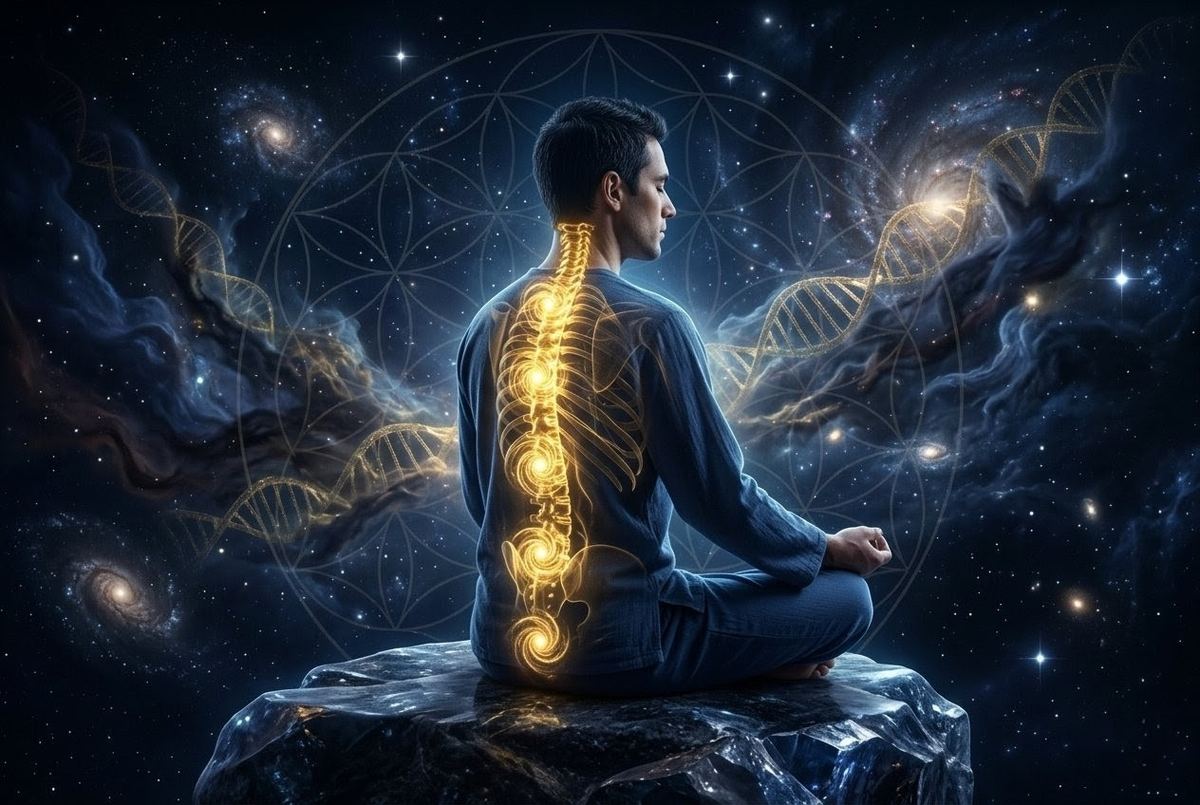
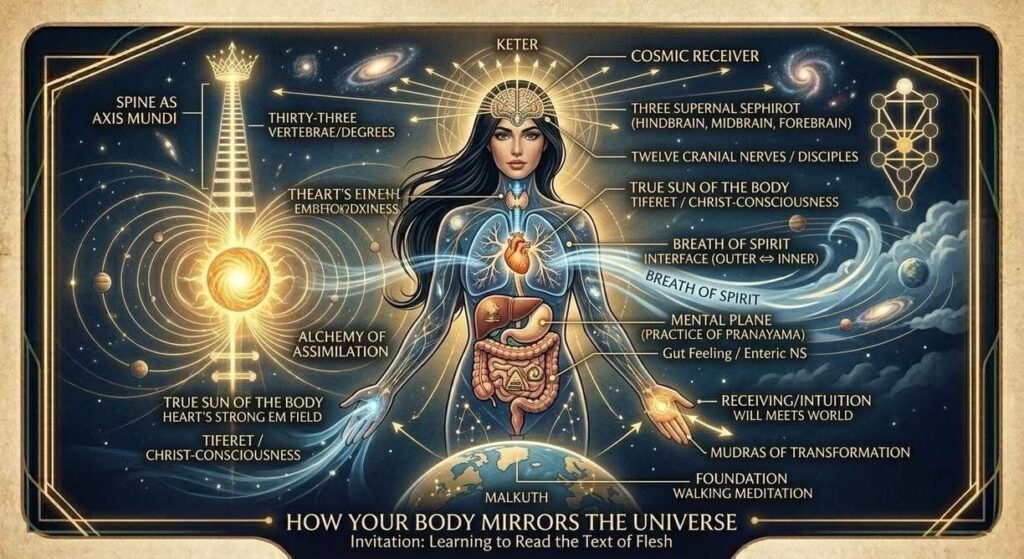
The Divine Architecture Within: How Your Body Mirrors the Universe
The body is not only a biological machine. It is a living architecture of perception, memory, sensation, breath, rhythm, intelligence, and meaning. Across Hermetic, yogic, Kabbalistic, Christian, alchemical, and contemplative traditions, the human body has been read as a microcosm: a small world reflecting larger patterns of cosmos, spirit, nature, and consciousness.
This does not mean the body is literally a galaxy in miniature, or that every organ proves a hidden cosmic code. It means that many traditions have used the body as a map of correspondence: spine and ladder, heart and sun, breath and spirit, digestion and alchemy, senses and thresholds, hands and manifestation, feet and earth, brain and crown, body and temple.
Modern physiology gives this symbolic vision a necessary grounding. The spine really does protect the spinal cord. The heart really does sustain circulation. Breath really does regulate gas exchange and nervous-system state. The gut really does communicate with the brain. Hormones really do influence mood, sleep, energy, stress, and desire. The body is not less sacred because it is anatomical. It becomes more astonishing because the sacred has learned to pulse, digest, blink, ache, and breathe.
This article reads the body as divine architecture: not as fantasy anatomy, not as a replacement for medicine, but as a contemplative way of inhabiting flesh with reverence. The body is not an obstacle to awakening. It is the place where awakening must learn to stand.
In Plain Terms
The body as microcosm means the human body can be read as a small world that reflects larger patterns: earth and sky, centre and circumference, rhythm and cycle, breath and spirit, light and perception, digestion and transformation, movement and will.
This article works best as symbolic anatomy. It honours the body as sacred without making careless medical claims. Esoteric correspondences are used as contemplative maps, not as replacements for physiology, medicine, trauma care, diagnosis, or qualified healthcare.
Primary Sources and Traditions Discussed
- Hermeticism, especially microcosm and macrocosm, “as above, so below”, and correspondence between levels of reality.
- Biblical and Christian symbolism, including Jacob’s Ladder, the body as temple, breath and spirit, the heart, the eye, and embodied prayer.
- Kabbalah, especially symbolic correspondences between the Tree of Life, the human form, sephirot, centre, crown, kingdom, and embodied ascent.
- Yoga and Tantra, including chakras, subtle body, prana, kundalini symbolism, breath, and the spine as a vertical channel of practice.
- Alchemy, especially digestion, transformation, assimilation, refinement, and the body as vessel of inner work.
- Modern physiology, including nervous system, heart, breath, gut-brain communication, endocrine function, senses, and embodiment.
- Contemplative practice, including body scan, breathwork, movement, somatic awareness, reverence for the body, and grounded spiritual integration.
How to Read This Article
This article reads the body through correspondence. Correspondence is not the same as proof. It is a symbolic way of seeing relationships between different levels of reality: body and cosmos, organ and planet, breath and spirit, spine and axis, heart and centre, cell and temple.
Some details here are anatomical. Some are historical. Some are symbolic. Some belong to traditional medicine or esoteric anatomy. These should not be confused. The heart does have electrical activity. The gut does contain a large enteric nervous system. The spine does carry the spinal cord and cerebrospinal fluid. But symbolic claims about the heart as sun, spine as ladder, or glands as subtle centres belong to contemplative and esoteric interpretation.
The aim is not to romanticise the body or deny suffering. Bodies age, ache, bleed, break, heal, fatigue, hunger, grieve, and need care. Reverence for the body includes practical care: sleep, food, medical treatment, movement, rest, touch, safety, and compassion. The sacred is not elsewhere. It is also here, breathing through ribs.
Table of Contents
- Jacob’s Ladder: The Spine as Axis
- The Brain: Instrument of Consciousness
- The Heart: Centre, Sun, and Field
- The Lungs and the Breath of Spirit
- The Digestive System: The Alchemy of Assimilation
- The Cellular Cathedral: DNA, Cells, and Living Code
- The Endocrine System and the Chemistry of Consciousness
- When the Temple Is Neglected
- The Hands and Feet: Will Meets World
- The Sensory Organs: Windows of Participation
- Integration: Body as Temple
- The Invitation: Reading the Text of Flesh
- The Gnostic Reading: The Body as Liberating Ground
- Related Glossary Terms
- Read Next
- Frequently Asked Questions
- Further Reading
- References and Sources
Jacob’s Ladder: The Spine as Axis
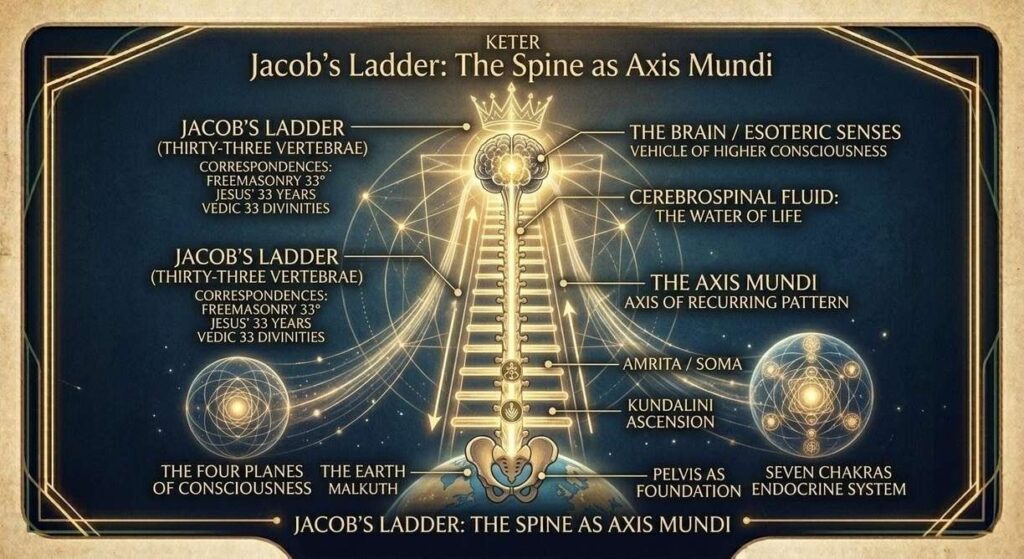
The spine is the body’s central column. Anatomically, it supports posture, protects the spinal cord, enables movement, and connects the brain with the rest of the body through the nervous system. Symbolically, it has long invited images of ascent, descent, rootedness, and vertical connection.
The biblical image of Jacob’s Ladder, “set up on the earth, and the top of it reached to heaven”, became one of the great images of communication between worlds. In esoteric reading, the spine can be understood as a bodily echo of that ladder: the vertical axis through which awareness moves between instinct, body, heart, mind, vision, and spirit.
Many traditions imagine a central axis: world tree, mountain, pillar, ladder, staff, serpent-path, or subtle channel. The body reflects this pattern through the upright spine. Human beings stand between earth and sky. The posture itself is theology before doctrine arrives.
The Thirty-Three Vertebrae
The adult spine is commonly described as having thirty-three vertebrae in total, though several are fused in the sacrum and coccyx. Esoteric writers have often noticed symbolic echoes around the number thirty-three: degrees of Freemasonry, traditional associations with the years of Jesus’s life, and other sacred number patterns.
Such correspondences should be handled as symbolic resonance, not as historical proof of a hidden anatomical code. The value lies in contemplation. The spine becomes a reminder that the path of ascent must pass through the body, not around it. Spiritual work that abandons posture, breath, movement, and sensation loses the ladder it claims to climb.
Cerebrospinal Fluid and the Waters of Life
Cerebrospinal fluid cushions and supports the brain and spinal cord, circulates through the central nervous system, and participates in the body’s maintenance of neural health. In esoteric imagination, this fluid has often been linked with inner waters, soma, amrita, sacred oil, or the subtle nourishment of consciousness.
The symbolic connection is powerful because the central nervous system is literally bathed in fluid. The highest functions of thought, perception, memory, and movement depend on a delicate inner sea. The body is not dry machinery. It is a living tide.
The spine teaches that ascent is not escape from embodiment. It is the refinement of the body’s own vertical intelligence.
The Brain: Instrument of Consciousness
The brain is often compared to a computer, but that metaphor is incomplete. The brain is not simply a calculating device. It is a living organ of perception, prediction, regulation, memory, imagination, language, emotion, movement, and meaning.
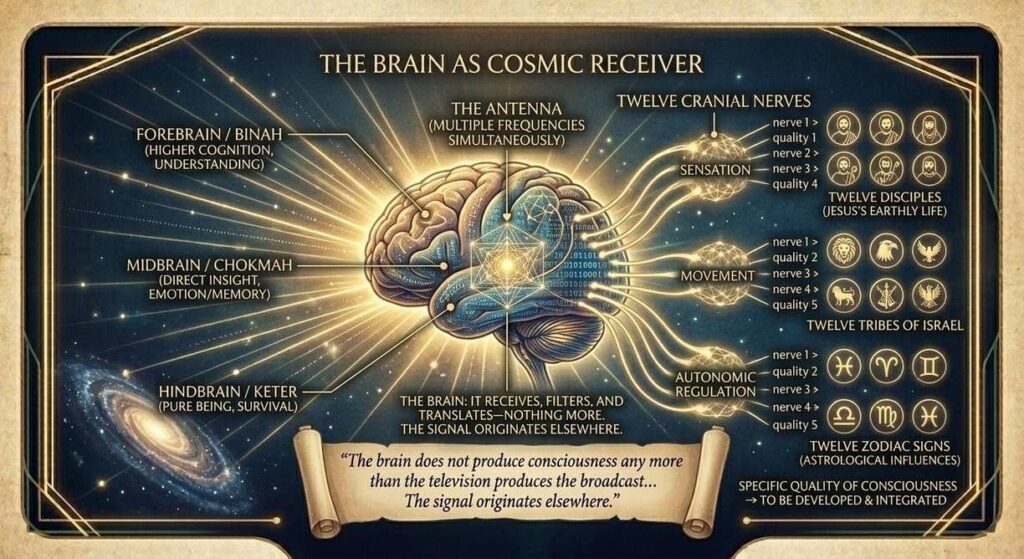
Materialist models usually describe consciousness as emerging from brain activity. Many spiritual traditions suggest that the brain may also filter, shape, transmit, or limit consciousness. These views should not be collapsed too quickly. What can be said with confidence is that brain states and conscious states are deeply linked. Injury, sleep, stress, drugs, meditation, trauma, and illness can all alter experience.
For contemplative practice, the brain is best treated as an instrument. Whether one believes it generates consciousness, filters consciousness, or participates in a mystery larger than either model, the condition of the instrument matters. A restless nervous system will not receive silence in the same way as a regulated one. A sleep-starved brain will not contemplate as clearly as a rested one. Embodiment is not an optional accessory to spiritual life.
Brain, Tree, and Crown
Kabbalistic, Hermetic, and esoteric writers have often mapped the human body onto the Tree of Life, associating the head with crown, wisdom, understanding, and higher perception. These correspondences do not replace neuroanatomy. They provide symbolic language for the experience of inner hierarchy: instinct below, heart at centre, vision above, and awareness linking the whole.
The head is not superior because it is higher. It is responsible because it is higher. A crown without connection to heart and body becomes tyranny. A mind that forgets the body begins issuing decrees to a kingdom it no longer visits.
The Twelve Cranial Nerves
The twelve cranial nerves carry sensory and motor functions involving smell, vision, eye movement, facial sensation, facial expression, hearing, balance, swallowing, voice, shoulder movement, tongue movement, and autonomic regulation. Symbolic systems sometimes compare this twelvefold pattern with other sacred twelves: zodiac signs, tribes, apostles, gates, months, and cosmic order.
The value of this comparison is contemplative rather than anatomical. Twelve often symbolises ordered completeness. The cranial nerves remind us that perception is not abstract. To see, hear, speak, swallow, balance, and turn the head is already to participate in an ordered world.
The Heart: Centre, Sun, and Field
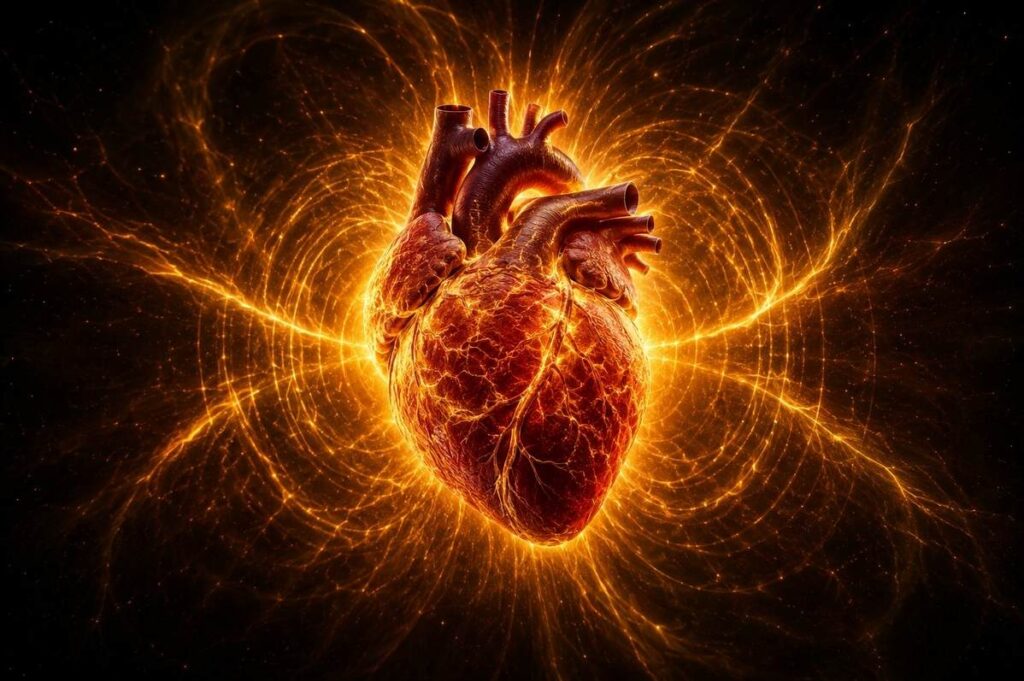
The heart is physiologically essential. It pumps blood, supports circulation, responds to autonomic regulation, and participates in the body’s rhythmic coherence. It also has electrical activity, and the heart’s electrical field can be measured at the surface of the body. Symbolically, it has almost everywhere been treated as a centre of life, courage, feeling, conscience, and spiritual intelligence.
Many esoteric systems place the heart at the centre of the human temple. In Kabbalah, Tiferet is often associated with beauty, harmony, mediation, and solar symbolism. In Christian language, the heart becomes the place of prayer, mercy, interior transformation, and Christic presence. In yogic systems, the heart centre is associated with relationship, breath, subtle sound, devotion, and compassion.
Heart Knowing
When people say they “know in the heart”, they are not necessarily making a claim about cardiac neurons solving metaphysics. They are naming an integrated form of knowing: affective, bodily, moral, relational, and immediate. The heart gathers what pure analysis may miss.
This does not mean every strong feeling is wisdom. The heart can be wounded, defended, frightened, or attached. But when feeling, body, conscience, and clarity align, the heart becomes a powerful centre of discernment. It does not replace the mind. It gives the mind warmth and proportion.
The heart as sun is therefore not sentimental decoration. It reminds us that life needs a centre of warmth. Without such a centre, intelligence becomes cold and action becomes mechanical.
The Lungs and the Breath of Spirit
Breath is one of the most ancient bridges between body and spirit. Latin spiritus, Greek pneuma, Hebrew ruach, and Sanskrit prana all link breath, wind, life, and spirit in different ways. To breathe is not only to exchange gases. It is to participate in the world.
The lungs are the meeting place of inner and outer. Air becomes blood chemistry. Atmosphere becomes cellular fuel. The boundary between self and world is shown to be porous with every inhale and exhale.
Breath is also unusual because it is both automatic and voluntary. It continues without conscious effort, yet it can be shaped deliberately. This makes it central to contemplative practice. By working with breath, the practitioner touches the hinge between conscious intention and autonomic life.
Breath Practices
Pranayama, qigong, breath prayer, chanting, mantra, singing, and simple breath awareness all use the respiratory system as a pathway into attention and regulation. These practices can calm, energise, focus, soften, or deepen awareness, depending on method and context.
Breathwork should be approached with care. Strong practices can destabilise some people, especially those with trauma histories, panic, cardiovascular concerns, respiratory issues, or dissociative tendencies. The simplest breath is often the safest teacher: breathe, notice, soften, return.
The Digestive System: The Alchemy of Assimilation
Digestion is transformation. The body takes in what is not-self, breaks it down, extracts what can nourish, and releases what cannot be used. This is alchemy performed daily without applause.
Symbolically, digestion mirrors the assimilation of experience. Events enter the psyche. Some must be broken down. Some nourish. Some are toxic. Some need time. Some cannot be digested alone. Wisdom includes knowing what to take in, what to process, what to refuse, and what to release.
The stomach’s acid, the liver’s processing, the intestines’ absorption, the microbiome’s participation, and the enteric nervous system’s complexity all show that intelligence is not confined to the head. The “gut feeling” is not infallible, but it is not meaningless either. The body often registers what the conscious mind has not yet admitted.
The Second Brain
The enteric nervous system, sometimes called the “second brain”, contains a vast network of neurons in the gut and communicates with the central nervous system. This does not mean the gut thinks in sentences. It means digestion, mood, immune function, stress, sensation, and nervous-system regulation are intertwined.
Esoterically, this gives depth to the old language of assimilation. What cannot be digested physically weakens the body. What cannot be digested psychologically haunts consciousness. The belly is not crude. It is a chamber of transformation.
The Cellular Cathedral: DNA, Cells, and Living Code
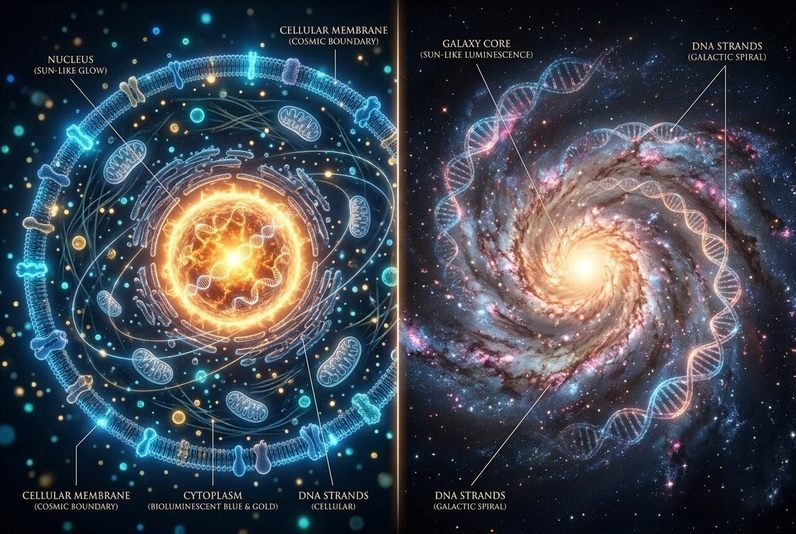
At the cellular level, the body becomes almost liturgical in its complexity. Trillions of cells communicate, repair, divide, specialise, defend, metabolise, and die so that the larger organism can live. Each cell is not a little machine in isolation, but part of a living community.
DNA stores biological information through a molecular code, guiding development, protein synthesis, inheritance, and cellular function. It is tempting to see in the double helix a cosmic spiral, and the image is symbolically powerful. Spiral forms recur widely in nature: shells, storms, plants, galaxies, and molecular structures. The recurrence does not make all spirals identical, but it does remind us that form often rhymes across scale.
Cells as Living Communities
Cells have membranes, internal structures, communication pathways, energy processes, repair mechanisms, and boundaries. Mitochondria, descended from ancient symbiotic organisms, produce much of the cell’s usable energy. The body is therefore not a single isolated thing. It is a cooperative ecology.
This has spiritual significance. The self is not a sealed monarch ruling dead matter. The self is an emergent harmony of many lives and processes. To care for the body is to care for a commonwealth.
At this level, “as above, so below” becomes less a slogan than an invitation to humility. The vast and the minute both exceed the ego’s management. The cosmos is not elsewhere. It is also cellular.
The Endocrine System and the Chemistry of Consciousness
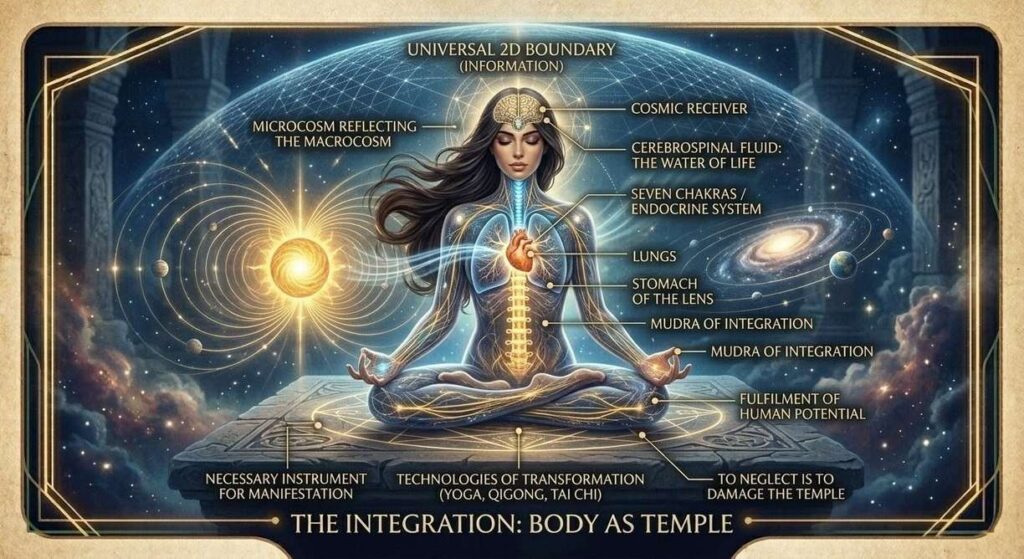
The endocrine system secretes hormones that help regulate growth, metabolism, stress response, sleep, reproduction, mood, energy, and many other processes. Esoteric systems often map glands onto chakras or subtle centres, treating them as physical correspondences for spiritual and psychological functions.
These correspondences should be held carefully. A chakra is not simply a gland, and a gland is not merely a chakra in medical clothing. But the symbolic relationship is understandable. Hormones influence how consciousness is experienced in the body: alertness, desire, fear, calm, growth, sleep, stress, vitality, and mood.
Pineal, Pituitary, Thyroid, and Adrenals
The pineal gland regulates melatonin and participates in circadian rhythm. It has long been associated symbolically with inner vision, dreaming, and spiritual perception. Claims about the pineal gland and mystical experience should be made cautiously. The pineal is important, but it should not become a dumping ground for every modern myth about awakening.
The pituitary gland is often called a master gland because it helps regulate other endocrine glands through hormonal signalling. Symbolically, it has been linked with command, vision, and inner coordination. The thyroid regulates metabolism and is often associated symbolically with voice, expression, and the throat. The adrenal glands participate in stress response, survival energy, and mobilisation.
The practical lesson is clear: chronic stress, poor sleep, malnutrition, trauma, and exhaustion affect spiritual life because they affect the body through which spiritual life is lived. The subtle does not float above the endocrine system wearing a halo. It works through embodied conditions.
When the Temple Is Neglected
Modern life often encourages disconnection from the body. Screens pull attention upward into eyes and fingertips. Work patterns disrupt sleep. Stress holds the breath shallow. Processed food, isolation, overstimulation, and constant mental noise can dull the body’s signals until discomfort is noticed only when it becomes crisis.
To call the body a temple is not to shame the body when it is ill, disabled, ageing, traumatised, tired, or in pain. A temple can be damaged and still sacred. Reverence does not mean perfection. It means care.
Neglect can look dramatic, but often it is ordinary: ignoring fatigue, overriding hunger, living without movement, suppressing grief, breathing shallowly, treating symptoms as enemies rather than messages, or using spiritual language to avoid practical needs. The body does not need grand theories first. It often needs water, rest, sunlight, movement, medicine, safety, touch, and permission to speak.
Embodiment begins when the body is no longer treated as an inconvenient servant. It becomes a partner in revelation.
The Hands and Feet: Will Meets World
The hands are where intention becomes contact. They write, bless, hold, build, repair, gesture, pray, defend, cook, plant, comfort, and create. In symbolic anatomy, the hands belong to manifestation: the passage from inner image to outward action.
Spiritual traditions use the hands deliberately. Mudras shape attention through gesture. Laying on of hands symbolises blessing and healing. Prayer hands unite left and right, giving and receiving, action and surrender. The hand makes visible what the heart chooses.
The feet are equally sacred, though less glamorous. They root the body into the world. They carry the whole architecture through dust, pavement, grass, threshold, and road. In Kabbalistic symbolism, Malkuth, the Kingdom, is the realm of manifestation. The feet belong to this kingdom: the spiritual path as walked, not merely imagined.
Walking meditation recognises this. Each step can become contact with earth. Each footfall says: here, now, body, ground. A path is not a concept once the feet begin.
The Sensory Organs: Windows of Participation
The senses are not passive holes through which the world enters unchanged. Perception is active. The brain interprets, filters, predicts, compares, and completes. What is seen is shaped by attention, memory, expectation, culture, mood, and body state.
Esoteric traditions understood the senses as thresholds. The eye receives light, but it also directs attention. The ear receives sound, but listening can become obedience, teaching, or awakening. Touch reveals boundary and intimacy. Taste and smell are ancient forms of knowing, tied deeply to memory and instinct.
Eyes, Ears, and Inner Vision
The eyes have long been called windows of the soul. More carefully, they are thresholds of relation. Eye contact can regulate, challenge, soften, expose, comfort, or overwhelm. A gaze is not only visual. It is social, emotional, and energetic in the ordinary sense that bodies respond to being seen.
The “third eye” belongs to symbolic and contemplative anatomy. It points to inner vision, intuition, subtle discernment, and the capacity to perceive meaning beyond surface appearance. It should not be reduced simplistically to one gland or one brain structure. Its value is symbolic and practical: learn to see with more than appetite, fear, projection, or habit.
The ears remind us that spiritual life begins in receptivity. Many traditions emphasise hearing: hearing scripture, mantra, teaching, silence, conscience, the cry of another, or the still small voice. To hear deeply is to let the world enter without immediately conquering it with explanation.
Integration: Body as Temple
To understand the body as divine architecture is to change the relationship between spirit and flesh. The body is not a prison to despise or a machine to exploit. It is the living place where consciousness learns relation, sensation, limitation, desire, pain, pleasure, grief, discipline, ageing, intimacy, and care.
Embodied practices such as hatha yoga, qigong, tai chi, walking meditation, body scan, somatic awareness, dance, breath prayer, chanting, and mindful labour all begin from the same recognition: the body is not outside the path. It is the path made tangible.
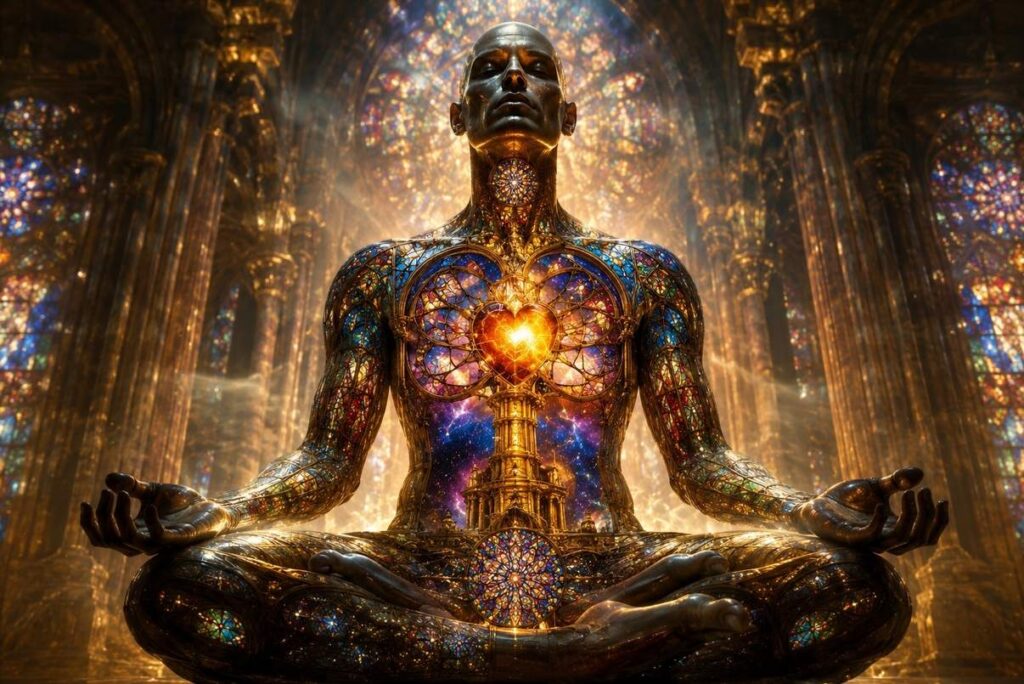
The temple image carries responsibility. A temple needs maintenance. It also needs reverence. Maintenance without reverence becomes management. Reverence without maintenance becomes fantasy. The body asks for both.
Spiritual integration does not mean living in the head while speaking beautifully about the body. It means letting insight descend into posture, breath, food, rest, speech, sexuality, movement, work, touch, and ordinary care. It means allowing the cosmos to be recognised not only in stars, but in shoulders, knees, lungs, gut, and hands.
The Invitation: Reading the Text of Flesh
You have been given a text written in flesh and bone, nerve and gland, breath and pulse, hunger and sleep, scar and sensation. This text is not always easy to read. Some pages are torn. Some are written in pain. Some are illuminated with joy. Some have been annotated by ancestry, trauma, culture, labour, love, illness, and survival.
Learning to read this text requires attention. Not obsessive monitoring, not anxious control, but patient listening. What does the breath do when truth is spoken? Where does fear live in the body? What happens to the heart around certain people? What does exhaustion say before collapse? What does pleasure restore? What does pain ask to be respected?
It also requires humility. The body is more intelligent than the conscious ego in many ways. It repairs, regulates, signals, adapts, warns, and remembers. It is not always convenient. Neither is scripture.
The body is not yours in the shallow sense of possession. It is entrusted to you for a while. It is made of old stars, recent meals, ancestral codes, microbial companions, breath from trees, water from clouds, and awareness looking through eyes. Treat it accordingly.
The Gnostic Reading: The Body as Liberating Ground
Gnosticism is often misunderstood as hatred of the body. Some ancient sources do speak sharply about matter, flesh, generation, and the lower world. Yet the deeper question is not whether the body is good or bad in some simplistic sense. The deeper question is whether consciousness is asleep inside a mistaken identity.
The body can become a prison when it is reduced to appetite, shame, compulsion, fear, status, beauty, performance, or mechanical function. But the body can also become a gateway when sensation is met with awareness, breath with reverence, movement with presence, and limitation with compassion.
The archonic pattern wants the body either idolised or despised. Both keep attention trapped. Idolising the body turns it into image, possession, and anxious maintenance. Despising the body turns it into enemy, burden, and exile. Gnosis asks for another way: to inhabit the body without being reduced to it.
The divine spark is not found by abandoning flesh in disgust. It is recognised when flesh becomes transparent to deeper life. The breath becomes teaching. The heart becomes centre. The spine becomes axis. The senses become thresholds. The body becomes not a wall against spirit, but the first scripture spirit asks us to read.
The body mirrors the universe because it participates in the universe. It is not outside the cosmos looking in. It is cosmos become intimate, cosmos become touch, cosmos become hunger, sleep, wound, healing, and praise.
Related Glossary Terms
For quick definitions, use the main ZenithEye Glossary. The key terms for this article are:
Read Next
Continue with: Simulation Hypothesis: Is Reality a Computational Construct?
If this article explores the body as microcosm and living architecture, the next step in this route turns outward and downward into the question of reality itself: whether the world we experience may be mediated, rendered, filtered, or generated before it becomes conscious experience.
Within The Thread
This article belongs to The Architecture of Perception, a layer of The Thread concerned with how reality is filtered, framed, embodied, symbolised, narrated, and mistaken for the whole. Divine architecture belongs here because the body is one of the first structures through which perception becomes world.
Frequently Asked Questions
What does it mean that the body mirrors the universe?
It means the body can be read as a microcosm: a small world reflecting larger patterns of nature, cosmos, spirit, and consciousness. This is a symbolic and contemplative idea, not a replacement for anatomy or science. The spine may be read as an axis, the heart as a centre or sun, breath as spirit, digestion as alchemy, and the senses as thresholds of participation.
What does as above, so below mean?
As above, so below is a Hermetic axiom describing correspondence between different levels of reality. It suggests that patterns found in the cosmos may echo in the human being, and that the human body can help reveal wider principles of order, rhythm, polarity, centre, and transformation. It should be read as symbolic correspondence rather than simplistic proof.
Why is the spine compared to Jacob’s Ladder?
The spine is the body’s vertical axis, supporting posture and carrying the spinal cord. Symbolically, it resembles the ladder or world axis linking earth and heaven. Jacob’s Ladder from Genesis 28 becomes a powerful image for ascent and descent of consciousness through embodied life. The comparison is symbolic, not anatomical doctrine.
Is the heart really a centre of intelligence?
The heart is physiologically complex and communicates with the nervous system through electrical, hormonal, and autonomic pathways. It is also one of humanity’s oldest symbols of courage, love, conscience, and spiritual centre. Heart intelligence is best understood as integrated knowing: bodily, emotional, relational, moral, and intuitive, rather than as the heart replacing the brain.
Are chakras the same as endocrine glands?
No. Chakras are subtle centres from yogic and tantric traditions, while endocrine glands are anatomical structures that secrete hormones. Modern esoteric systems often map chakras onto glands, but these are symbolic correspondences, not direct medical equivalences. They can be useful for contemplation, but they should not replace medical understanding or treatment.
How can I begin practising embodied spirituality?
Begin simply: notice the breath, feel the feet, scan the body gently, walk slowly, stretch with awareness, listen to bodily signals, and practise regular care through sleep, food, movement, rest, and medical support when needed. Embodied spirituality begins when the body is treated as a partner in awareness rather than an obstacle to it.
Can esoteric anatomy replace medical care?
No. Esoteric anatomy can support contemplation, symbolism, body awareness, and spiritual reflection, but it does not replace medical care, psychological support, physiotherapy, trauma treatment, medication, diagnosis, or emergency services. Persistent pain, endocrine symptoms, digestive problems, neurological issues, or mental distress should be discussed with qualified professionals.
Further Reading
These related articles continue the themes of embodied spirituality, subtle anatomy, breath, sensation, brain, elements, and spiritual integration:
- The Gateway of Sensation: Body Scan and Somatic Awareness – Practical embodied awareness through sensation, grounding, and somatic attention.
- The Gateway of Breath: Pranayama and Energetic Balance – Breath as a bridge between body, nervous system, attention, and contemplative practice.
- Embodiment Practices for Grounding Awakening – How to keep spiritual insight anchored in body, ordinary life, and nervous-system stability.
- Left Brain, Right Brain, and the Neuroscience of Spiritual Integration – Brain hemispheres, integration, attention, embodiment, and contemplative development.
- The Four Elements of Consciousness: Earth, Water, Fire, Air and the Fifth – Elemental symbolism as a map of body, psyche, practice, and spiritual transformation.
- The Mental Plane Explained: Where Thoughts Become Reality – Thought, imagination, belief, and the subtle pattern-field of experience.
- States of Knowing: What Happens When Consciousness Unravels – Altered states, perception, destabilisation, and the shifting conditions of awareness.
- The Kabbalistic Tree of Life: A Complete Guide to Spiritual Ascension – Sephirot, body symbolism, ascent, integration, and the architecture of spiritual development.
- Contemplative Techniques: The Thread’s Practical Foundation – Grounded methods for silence, attention, practice, and inner stability.
- The Living Thread: How Forbidden Knowing Survives – How hidden knowledge survives through body, symbol, language, practice, and transmission.
References and Sources
The following sources support the anatomical, physiological, esoteric, and contemplative framework used in this article.
Anatomy, Physiology, and Embodiment
- [1] Standring, Susan (ed.). Gray’s Anatomy: The Anatomical Basis of Clinical Practice. 42nd ed. Elsevier, 2020.
- [2] Hall, John E. Guyton and Hall Textbook of Medical Physiology. 14th ed. Elsevier, 2021.
- [3] Bear, Mark F., Barry W. Connors, and Michael A. Paradiso. Neuroscience: Exploring the Brain. 4th ed. Wolters Kluwer, 2020.
- [4] Gershon, Michael D. The Second Brain: A Groundbreaking New Understanding of Nervous Disorders of the Stomach and Intestine. HarperCollins, 1998.
- [5] van der Kolk, Bessel. The Body Keeps the Score: Brain, Mind, and Body in the Healing of Trauma. Viking, 2014.
- [6] Levine, Peter A. Waking the Tiger: Healing Trauma. North Atlantic Books, 1997.
- [7] Cleveland Clinic. “Spine: Anatomy, Function, Parts, Segments and Disorders.” Medical overview of spinal anatomy and function.
Breath, Contemplative Practice, and Nervous-System Regulation
- [8] Brown, Richard P. and Patricia L. Gerbarg. The Healing Power of the Breath. Shambhala, 2012.
- [9] Kabat-Zinn, Jon. Full Catastrophe Living. Delacorte, 1990.
- [10] Goleman, Daniel and Richard J. Davidson. Altered Traits: Science Reveals How Meditation Changes Your Mind, Brain, and Body. Avery, 2017.
- [11] Mehling, Wolf E., et al. “Body Awareness: A Phenomenological Inquiry Into the Common Ground of Mind-Body Therapies.” Philosophy, Ethics, and Humanities in Medicine, 6, 6, 2011.
- [12] Ogden, Pat, Kekuni Minton, and Clare Pain. Trauma and the Body: A Sensorimotor Approach to Psychotherapy. W. W. Norton, 2006.
Esoteric Anatomy and Comparative Traditions
- [13] Corpus Hermeticum. Hermetic writings on correspondence, cosmos, mind, and divine order.
- [14] The Emerald Tablet. Traditional Hermetic source for the axiom commonly rendered “as above, so below”.
- [15] Holy Bible. Genesis 28:12; 1 Corinthians 6:19; Matthew 6:22; Matthew 13:16.
- [16] Scholem, Gershom. Kabbalah. Meridian, 1974.
- [17] Matt, Daniel C. (trans.). The Zohar: Pritzker Edition. Stanford University Press, 2004-2017.
- [18] Feuerstein, Georg. The Yoga Tradition: Its History, Literature, Philosophy and Practice. Hohm Press, 1998.
- [19] Johari, Harish. Chakras: Energy Centers of Transformation. Destiny Books, 2000.
- [20] Leadbeater, C. W. The Chakras. Theosophical Publishing House, 1927.
- [21] Jung, C. G. Psychology and Alchemy. Collected Works, Vol. 12. Princeton University Press, 1968.
Gnostic and Interpretive Context
- [22] Robinson, James M. (ed.). The Nag Hammadi Library in English. 3rd ed. HarperSanFrancisco, 1990.
- [23] Meyer, Marvin (ed.). The Nag Hammadi Scriptures: The International Edition. HarperOne, 2007.
- [24] Williams, Michael Allen. Rethinking “Gnosticism”: An Argument for Dismantling a Dubious Category. Princeton University Press, 1996.
- [25] Brakke, David. The Gnostics: Myth, Ritual, and Diversity in Early Christianity. Harvard University Press, 2010.
- [26] Kornfield, Jack. After the Ecstasy, the Laundry: How the Heart Grows Wise on the Spiritual Path. Bantam, 2000.
Study and Safety Note
This article explores esoteric anatomy, symbolic correspondence, embodiment, and contemplative practice for educational and reflective purposes. It does not provide medical, psychological, endocrine, neurological, digestive, movement, breathwork, or trauma-treatment advice.
Symbolic readings of the body can deepen reverence and awareness, but they should not replace diagnosis, medicine, therapy, physiotherapy, emergency care, or qualified professional support. Approach breathwork, movement, fasting, somatic practice, and meditation gradually, especially if you have trauma, panic, dissociation, cardiovascular issues, respiratory conditions, neurological concerns, chronic illness, pregnancy, or any condition requiring medical care.