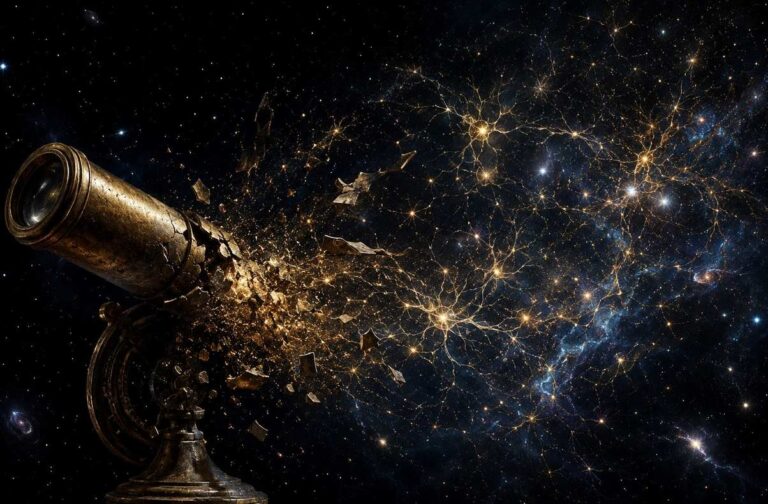
The Receiver Mind: Consciousness, Perception and the 0.0035% Problem
Article 1 of 4 in The Architecture of Perception series.
Human perception is not reality itself. It is a narrow, survival-shaped interface through which a much larger field is rendered into something the body can use.
Something interesting is happening at the meeting point of neuroscience, philosophy and ancient wisdom. Researchers are not proving the old spiritual maps, and the old spiritual maps are not replacing science. But both are brushing against the same question from different sides of the glass: does the brain produce consciousness, or does it receive, filter and localise something wider?
What we know with confidence is that human perception is extraordinarily narrow. The eye detects only a small band of the electromagnetic spectrum. The ear hears only a limited range of vibration. The nervous system does not show us everything. It selects, compresses, prioritises and edits. What we call reality is not the whole field. It is the field made usable.
This is not a failure of evolution. It is a triumph of filtration. The body did not evolve to reveal the totality. It evolved to keep the organism alive. Enough to navigate. Enough to eat, avoid danger, recognise faces, build tools, tell stories and survive long enough perhaps to ask why any of this exists.
But enough is not the same as all.
The gap between enough and all is where both science and spirituality begin to ask their most honest questions.
In Plain Terms
The receiver mind is the idea that the brain may not simply generate consciousness like a machine making steam. It may also filter, tune and localise awareness, the way a radio tunes a signal or a window admits a particular band of light. This is not a settled scientific claim. It is a useful bridge between consciousness studies, perception, ancient inner-vision symbols and the Gnostic insight that ordinary perception is not the whole of reality.
Primary Sources and Traditions Discussed
- Human perceptual limits and the electromagnetic spectrum.
- The brain as filter, editor and interface.
- The receiver hypothesis of consciousness.
- The hard problem of consciousness.
- Karl Pribram, David Bohm and holonomic brain theory.
- Integrated Information Theory and consciousness-first models.
- Third eye, inner vision and symbolic maps of expanded perception.
- Gnostic language of sleep, awakening, false perception and gnosis.
- Different nervous systems as different perceptual interfaces.
- Humility, curiosity and kindness as practical consequences of limited perception.
How to Read This Article
Read this as a careful bridge, not as a proof. The article does not claim that science has proven the soul, that the brain is only a radio or that ancient symbols should be treated as laboratory diagrams. It explores a functional question: if human perception is filtered, what follows for consciousness, gnosis and humility?
Article Map
- The Visible Slit: Why Perception Is Not Reality
- The Brain as Filter, Editor and Interface
- The Receiver Hypothesis: Brain as Tuner, Not Generator?
- The Hard Problem Has Not Gone Away
- Ancient Maps and Symbolic Languages of Inner Vision
- Different Interfaces, Different Worlds
- Living Without the Full Picture
- What This Article Is Not Saying
- Conclusion: The Window Is Not the Sky
- Related Glossary Terms
- Read Next
- Further Reading
- Frequently Asked Questions
- References and Sources

The Visible Slit: Why Perception Is Not Reality
The human eye sees only a narrow band of electromagnetic radiation. Visible light sits roughly between violet and red, while radio waves, microwaves, infrared, ultraviolet, X-rays and gamma rays remain invisible to unaided human sight.
A commonly cited estimate places visible light at roughly 0.0035 percent of the electromagnetic spectrum. The exact framing matters less than the existential wound it opens: what we see is not what exists. It is what our organism is equipped to register.
Bees perceive ultraviolet patterns on flowers that human eyes miss. Some snakes detect infrared radiation from warm bodies. Birds can navigate using magnetic fields. Every organism lives inside a different perceptual world, not because reality changes for each creature, but because each body receives a different slice of the available field.
The human eye is not a window onto reality. It is a slit. A beautiful slit, a useful slit, a slit through which paintings, faces, dawn skies and written words become possible. But still a slit.
What lies beyond that slit is not nothing. It is simply unseen.

The human eye is not a window onto reality. It is a slit.
The Brain as Filter, Editor and Interface
The nervous system does not deliver raw reality. It renders a usable world.
Light reaches the eye. Sound reaches the ear. Pressure, temperature, pain, balance and internal bodily signals arrive through other channels. But none of these becomes experience until the nervous system selects, compares, predicts and organises. The brain does not simply receive data. It interprets. It fills gaps. It suppresses what seems irrelevant. It amplifies what seems urgent. It edits the world into a form a body can act within.
This is not deception in the cheap sense. It is interface design. A computer desktop does not show you the actual electrical and computational processes inside the machine. It shows icons, folders and windows because those are usable. Likewise, the nervous system does not show the whole field of reality. It shows an action-ready rendering.
The problem begins when the interface forgets it is an interface.
In Gnostic language, this is close to the condition of sleep: not mere ignorance, but mistaken identity. The rendered world is treated as the whole world. The filter is mistaken for truth itself. The user forgets there is an operating system beneath the icons.
Gnosis begins when perception notices its own limits.

A filter is not a prison unless it forgets it is a filter.
The Receiver Hypothesis: Brain as Tuner, Not Generator?
The standard scientific view treats consciousness as closely dependent on brain activity. Damage the brain, alter the brain, stimulate the brain, drug the brain, deprive the brain of oxygen, and consciousness changes. This is not a minor observation. It is central to modern neuroscience.
Yet a different question keeps returning: does correlation settle the origin question? If a damaged radio distorts music, that does not prove the radio composed the song. It proves that the instrument shapes how the signal appears locally. The analogy is imperfect, but useful.
The receiver hypothesis asks whether the brain may function partly as tuner, filter, stabiliser or local interface for consciousness rather than as its sole manufacturer. This hypothesis has appeared in different forms across philosophy, psychical research, consciousness studies and contemplative thought.
Karl Pribram’s holonomic brain theory and David Bohm’s implicate order are often invoked in this territory. Pribram explored holographic models of memory and perception. Bohm proposed a deeper order from which the visible world unfolds. Later consciousness theories, including Integrated Information Theory, also challenge simplistic assumptions about consciousness as mere by-product, though they do not prove a spiritual field or personal survival beyond death.
Care is needed here. The receiver hypothesis is not established fact. It is not permission to dress speculation in a white coat and parade it as proof. It is a question kept open by the continuing difficulty of explaining subjective experience from physical processes alone.
The brain may generate consciousness. It may filter consciousness. It may participate in a process stranger than either word can hold. Honest inquiry begins by not pretending the question is already closed.
The instrument does not have to create the signal in order to shape what is heard.
The Hard Problem Has Not Gone Away
Philosopher David Chalmers named the hard problem of consciousness: why should physical processes give rise to subjective experience at all? Why is there something it is like to see red, taste honey, feel grief, hear rain or recognise beauty?
Neuroscience can map correlates. It can show what happens in the brain when a person sees red or feels pain. It can identify networks, pathways and signatures. But the first-person fact of experience remains stubborn. The map of neural activity is not the redness of red. The description of pain is not pain. The scan is not the sorrow.
The receiver hypothesis does not solve the hard problem. It reframes it. If consciousness is not created from nothing by neural machinery, but filtered, focused or localised through the nervous system, then the question changes. Instead of asking how matter manufactures awareness, we ask how awareness becomes personal, embodied and usable through matter.
This does not end the mystery. It relocates it.
That relocation matters because it prevents a premature closure. It allows science, philosophy and contemplative traditions to stand near the same threshold without pretending they are speaking the same language. The scientist describes the instrument. The contemplative describes the field as encountered. The philosopher asks why either description should exist at all.
The mystery is not an embarrassment. It is the honest shape of the question.
The hard problem has not gone away. It waits beneath every theory that explains the instrument but not the music.
Ancient Maps and Symbolic Languages of Inner Vision
Ancient traditions did not speak the language of electromagnetic spectra, predictive processing or neural correlates. They spoke in symbols: the third eye, the single eye, the Eye of Horus, the ajna chakra, celestial realms, veils, mirrors, ladders, lamps and hidden light.
These symbols should not be flattened into crude anatomy. The third eye is not merely the pineal gland. The Eye of Horus is not a secret diagram of the thalamus. The Gnostic Pleroma is not a location waiting to be photographed by a better telescope.
But neither should these symbols be dismissed as primitive fantasy. They are languages of encounter. They preserve the memory that ordinary perception is not the whole of knowing. They point toward the possibility that human awareness can become wider, subtler and less trapped inside its default interface.
The pineal gland is a useful example. Biologically, it is involved in circadian rhythm through melatonin production. Speculation about human pineal DMT remains controversial and should not be overstated. Symbolically, however, the pineal has long carried the meaning of inner light, rhythm, darkness, vision and the relationship between the body and cycles beyond conscious control.
The symbolic point does not depend on making inflated biological claims. Inner vision is not proved by pointing at one gland. It is explored by asking why so many traditions speak of a kind of seeing that is not ordinary sight.
Gnostic texts often describe awakening as recognition: a movement from sleep to sight, from false perception to direct knowing. The language is not merely moral. It is perceptual. Something was hidden, not because it was absent, but because the knower was not yet able to receive it.
Ancient maps do not prove the territory. They preserve the memory that a territory was encountered.
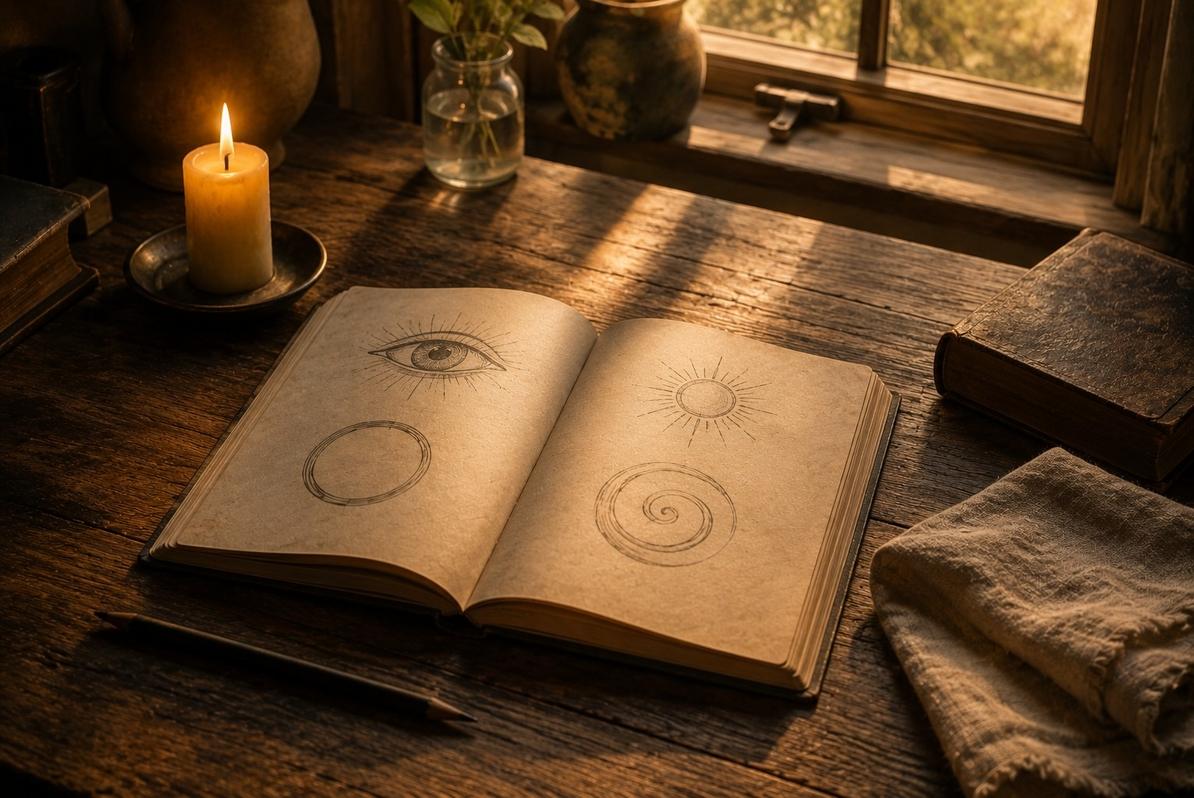
Inner vision is not ordinary sight made stronger. It is perception no longer trapped inside the visible slit.
Different Interfaces, Different Worlds
If perception is filtered, then each nervous system is a particular interface.
Your interface is shaped by genetics, body chemistry, trauma history, culture, language, attention, memory, spiritual practice, social conditioning and the environments that taught your body what mattered. No two people meet the world through exactly the same aperture.
This does not mean there is no reality. The world is real. Bodies are real. Consequences are real. Pain is real. Bread, rain, grief, tenderness and stone are not imaginary. But the experience of reality is mediated. We do not encounter the total field nakedly. We encounter a rendered version shaped by the organism receiving it.
One person enters a room and notices danger. Another notices beauty. Another notices social hierarchy. Another notices exits. Another notices light on wood. Another notices the emotional tone before anyone speaks. The room may be the same, but the interface differs.
This is why disagreement is often deeper than opinion. People are not only arguing from different conclusions. They are perceiving through different filters. A nervous system shaped by danger will render ambiguity differently from a nervous system shaped by safety. A contemplative mind trained in stillness will notice signals that a hurried mind cannot hear. A symbolic imagination will see pattern where a literal mind sees only object.
The Gnostic tradition understood this as captivity within false perception. The modern language might call it conditioning, prediction, nervous-system rendering or perceptual bias. The names differ. The practical problem remains: the interface can become mistaken for the world.

Different lenses do not create different suns. They render the light differently.
Living Without the Full Picture
The practical consequence of perceptual limitation is humility.
Not humiliation. Not self-erasure. Not pretending ignorance is wisdom. Humility means accurate proportion. It means knowing that one’s view is a view, not the entire field.
If the human eye sees only a narrow band of light, if the nervous system renders reality through survival-shaped filters, if culture and trauma and attention all shape what becomes visible, then certainty deserves caution. The person who claims to see everything may be the person most thoroughly captured by their own interface.
This humility changes how we treat others. It makes us slower to assume that disagreement means stupidity or bad faith. It makes us more curious about the filter through which another person is seeing. It allows us to ask: what is their nervous system showing them that mine is not? What is mine hiding that theirs might reveal?
This does not mean all views are equally true. Discernment remains essential. Some interpretations are distorted by fear, ideology, manipulation or projection. But humility protects discernment from becoming arrogance. It keeps the eye clean enough to keep learning.
The ancient instruction to know thyself is not self-obsession. It is the beginning of perceptual literacy. Know the instrument through which you know. Know the lens before declaring the sky.

Know the lens before declaring the sky.
What This Article Is Not Saying
This article is not saying that science has proven the soul, that the brain is only a radio, that all mystical claims are true or that every inner impression should be trusted as revelation.
It is not saying that perception is meaningless, that reality is imaginary or that everyone should abandon scientific rigour for spiritual speculation. The body is real. The brain matters. Neuroscience matters. Evidence matters. Clinical care matters. Grounding matters.
The article is also not saying that all interpretations are equal. A filtered world is not a free pass for fantasy. Filters can clarify, distort, protect, exaggerate or deceive. The fact that no one sees the whole field does not mean discernment is useless. It means discernment must become more humble, more embodied and more patient.
The receiver mind is a hypothesis and a metaphor. It is not a dogma. It is useful only if it makes perception more careful, not more inflated.
A wider view is not permission to abandon discernment. It is the reason discernment must deepen.
The Window Is Not the Sky
The receiver mind begins with a simple recognition: the nervous system is not the whole of reality. It is the window through which reality becomes available to this body, this history, this attention, this moment.
The window matters. Without it, there is no local experience, no face, no colour, no song, no grief, no bread, no morning light on the table. But the window is not the sky.
Human beings live by filters. We see through narrow light, hear through narrow vibration and know through nervous systems shaped by survival. The spiritual error is not having a filter. We cannot exist without one. The error is mistaking the filter for the whole.
Ancient traditions spoke of inner sight, awakening and gnosis because they recognised that ordinary perception is partial. Modern science, in a different language, shows that perception is constructed, selective and limited. Neither side needs to swallow the other. They can stand together at the threshold and admit the same thing: we do not see all that is.
This admission is not defeat. It is the beginning of wonder. It makes certainty softer, inquiry deeper and kindness more necessary.
No one sees the whole field. That is why the work continues.
Related Glossary Terms
These terms place the receiver mind within the wider ZenithEye map of consciousness, perception, direct knowing and symbolic inner vision.
- Consciousness
- Perception
- Receiver Mind
- Brain as Receiver
- Brain as Filter
- Receiver Hypothesis
- Hard Problem of Consciousness
- Electromagnetic Spectrum
- Visible Light
- Filtered Reality
- Nervous System Interface
- Third Eye
- Pineal Gland
- Inner Vision
- Expanded Awareness
- Gnosis
- Direct Knowing
- Recognition
- Metanoia
- The Architecture of Perception
- The Thread
Read Next
This article opens the Architecture of Perception series: a route on consciousness, filtering, nervous-system rendering, symbolic sight and the limits of human knowing.
- The Receiver Mind: Consciousness, Perception and the 0.0035% Problem
- The Filtered Self: How the Nervous System Renders Reality
- The Interface Is Not the World: Gnosis and the Limits of Human Perception
- Beyond the Visible Slit: Symbol, Third Eye and Expanded Awareness
Further Reading
Continue exploring consciousness, perception and the architecture of reality with these ZenithEye guides:
- States of Knowing – The phenomenology of altered perception and non-ordinary states of awareness.
- The Default Mode Network – The neuroscience of ego dissolution, self-reference and the loosening of ordinary identity.
- The All-Seeing Eye Decoded – The symbolic history of inner vision across Egyptian, Christian and esoteric traditions.
- Quantum Mind 2026 – Contemporary inquiry into quantum biology, integrated information and consciousness-first models.
- Simulation Hypothesis – Digital physics, informational reality and the possibility that the world behaves like rendered structure.
- Before the Matrix – Ancient Gnostic cosmology and its resonance with modern simulation theory.
- Attention: The First Gateway of Consciousness – Attention as the foundation of perceptual clarity and direct knowing.
- The Collapse of the Witness – What remains when the observing self begins to dissolve.
- Planes of Consciousness – A symbolic map of layered awareness and dimensions beyond ordinary waking identity.
- Reclaiming the Cortex – How somatic safety opens reflective awareness and direct knowing.
Frequently Asked Questions
What is the receiver mind?
The receiver mind is a way of describing consciousness in which the brain is not treated only as a generator of awareness, but also as a filter, tuner or local interface through which awareness becomes usable. It is a hypothesis and metaphor, not a settled scientific conclusion.
Does the brain produce consciousness or receive it?
The standard scientific view treats consciousness as closely linked to brain activity. Some philosophical and scientific models ask whether the brain may also filter, shape or localise consciousness rather than simply produce it. The question remains open, and this article treats it carefully rather than claiming proof.
What is the 0.0035% problem?
The 0.0035% problem refers to the claim that the visible portion of the electromagnetic spectrum is only a tiny fraction of the whole spectrum. Whether the exact number is used as a measurement or a teaching image, the deeper point remains: human perception receives only a narrow band of available reality.
Why does human perception filter reality?
Human perception is shaped for survival, navigation and action. The nervous system does not show everything. It selects, edits and prioritises information that helps the organism function. This makes perception useful, but not complete.
Is the receiver hypothesis the same as Gnosticism?
No. The receiver hypothesis is a modern way of questioning whether the brain produces or filters consciousness. Gnosticism is a religious and philosophical tradition centred on gnosis, direct knowing and awakening from false perception. The two can be placed in conversation, but they should not be collapsed into one another.
What do ancient symbols like the third eye mean in this context?
Symbols such as the third eye, the Eye of Horus or the single eye can be read as symbolic languages of expanded perception. They do not prove a scientific theory, but they preserve the idea that ordinary sensory perception is not the whole of knowing.
What is the practical meaning of perceptual limitation?
The practical meaning is humility. If each person experiences reality through a limited nervous system, then no one sees the whole field. This should make us slower to claim certainty, more curious about other perspectives and kinder toward people whose filters differ from ours.
References and Sources
This article draws upon neuroscience, philosophy of mind, consciousness studies and comparative esoteric traditions. No single framework is presented as definitive.
Scientific and Philosophical Sources
- Bohm, David. Wholeness and the Implicate Order. Routledge and Kegan Paul, 1980.
- Chalmers, David J. “Facing Up to the Problem of Consciousness.” Journal of Consciousness Studies, 1995.
- Pribram, Karl H. Brain and Perception: Holonomy and Structure in Figural Processing. Lawrence Erlbaum Associates, 1991.
- Tononi, Giulio, and Christof Koch. “Consciousness: Here, There and Everywhere?” Philosophical Transactions of the Royal Society B, 2015.
- Research on visible light, electromagnetic spectrum, perception, predictive processing and sensory filtering.
Esoteric and Comparative Traditions
- Robinson, James M., ed. The Nag Hammadi Library in English. Revised edition. HarperSanFrancisco, 1990.
- Layton, Bentley. The Gnostic Scriptures. Doubleday, 1987.
- Traditional sources on the ajna chakra, the Eye of Horus, the single eye, inner vision and symbolic maps of expanded perception.
- Contemporary comparative readings of Gnosticism, consciousness studies and spiritual perception.
Safety Notice: This article explores consciousness, perception, neuroscience, philosophy and esoteric traditions. It is not medical, psychological, neurological or psychiatric advice. If contemplation, meditation, altered-state practice or philosophical inquiry causes panic, derealisation, dissociation, paranoia, psychosis, mania, severe distress, suicidal thoughts or difficulty functioning, seek support from a qualified mental health professional or appropriate medical service. Do not use speculative consciousness models to reject clinical care, medication or grounded support.
Study Note: The receiver mind is not a claim that science has proven the soul. It is a careful bridge between perceptual limitation, the hard problem of consciousness, ancient symbolic language and the Gnostic intuition that ordinary perception is not the whole of reality. The point is not certainty. The point is humility before a field larger than the interface through which we meet it.