The Filtered Self: How the Nervous System Renders Reality
Article 2 of 4 in The Architecture of Perception series.
You do not see the world as it is. You see the world as your nervous system can afford to render it.
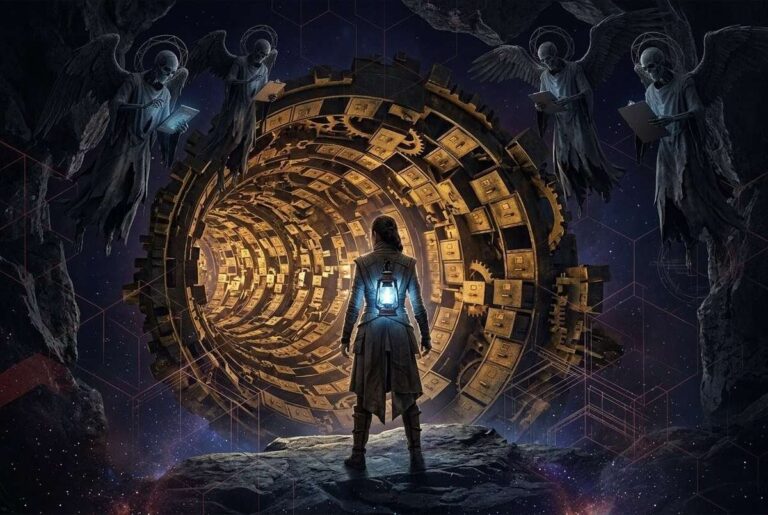
This is not relativism. The world is real. Bodies, consequences, pain, bread, grief, love and stone are real. But the experienced world is mediated. The nervous system selects, predicts, colours and renders. The first article in this series showed that perception is only a narrow slit–a tiny fraction of the electromagnetic spectrum made visible. This article shows that even inside that slit, the view is edited. What arrives from the world is not what the mind meets. The mind meets a rendering.
In Plain Terms
The filtered self is the ordinary human self seen through the nervous system: predictive, embodied, memory-shaped and survival-tuned. The world is real, but the world a person experiences is rendered through attention, threat, memory, interoception, culture and language. Gnosis begins when the render becomes visible without rejecting the body or the world.
Primary Sources and Traditions Discussed
- Predictive processing and predictive coding in contemporary cognitive science.
- Threat physiology, amygdala activation and nervous-system safety.
- Reconstructive memory and the way the past edits the present.
- Attention as selection, salience and world-building.
- Interoception, somatic markers and the body inside perception.
- Language, culture, digital media and collective filters.
- Gnostic language of false perception, recognition and gnosis.
How to Read This Article
Read this as a bridge between neuroscience, contemplative practice and Gnostic discernment. It does not claim that reality is unreal, that trauma is merely perception or that science proves Gnosticism. It asks a practical question: how does the nervous system render the world, and what changes when that rendering is recognised?
Article Map
- The World Is Rendered, Not Merely Received
- Prediction: The Brain as Reality Engine
- Threat: How Survival Colours the Field
- Memory: Why the Past Edits the Present
- Attention: What the Self Selects Becomes the World
- Interoception: The Body’s Hidden Influence on Perception
- Culture and Language: The Shared Filter
- The Gnostic Problem of False Perception
- How Recognition Interrupts the Render
- Living With a Softer Interface
- What This Article Is Not Saying
- Conclusion: The Self Is a Rendering, Not the Whole Light
- Related Glossary Terms
- Read Next
- Further Reading
- Frequently Asked Questions
- References and Sources

The World Is Rendered, Not Merely Received
The classical view of perception treats the brain as a camera. Light enters, the retina records, the image is processed, and the mind sees. This model is tidy, intuitive and wrong. Contemporary neuroscience tells a different story. The brain does not wait for the world to arrive and then copy it. It builds the world moment by moment, using prediction, memory, bodily state and attention as its tools.
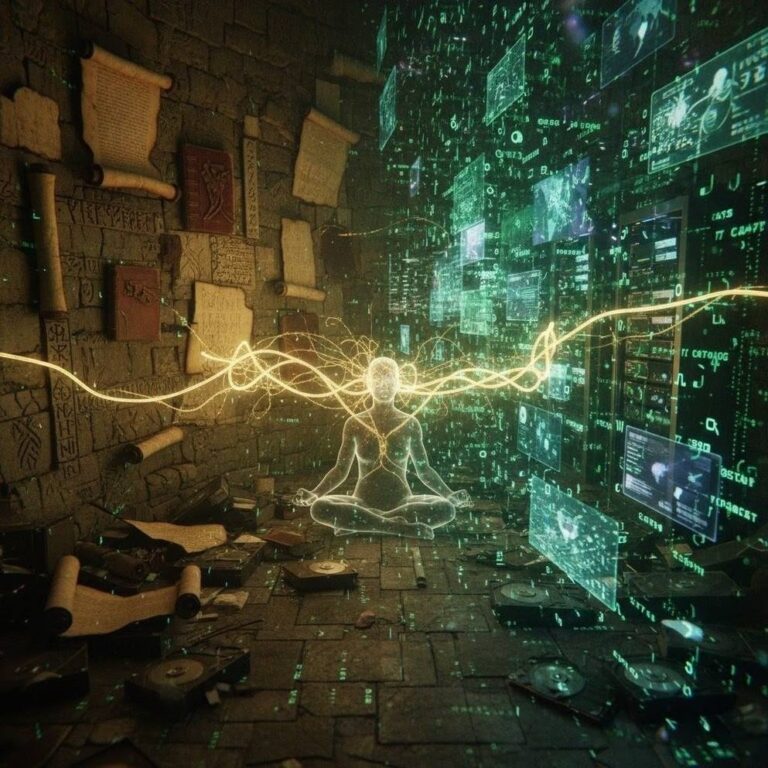
Perception is not a photograph. It is a live rendering. The nervous system takes fragments of incoming signal and constructs a coherent scene from them, filling gaps with expectation, colouring edges with emotion, and prioritising whatever seems most urgent. What appears as obvious reality is often processed reality–a useful fiction shaped for action rather than accuracy.
This does not mean the world is imaginary. It means experience is mediated. There is a difference between the world and the world as rendered. The first article in this series explored the narrow aperture through which any human meets reality. This article explores what happens inside that aperture: the editing, the colouring, the quiet construction that turns raw signal into lived meaning.
Prediction: The Brain as Reality Engine
One of the most consequential findings in contemporary cognitive science is that the brain is fundamentally a prediction machine. Rather than passively receiving sensory data and building a picture from the bottom up, the brain constantly generates predictions about what it expects to encounter, then updates those predictions based on the gap between expectation and input. This framework, known as predictive processing or predictive coding, has been developed by researchers including Karl Friston, Andy Clark and Anil Seth. As Clark articulates in his work on the topic, the brain’s primary task is not to process incoming information but to minimise surprise–to reduce the discrepancy between its models and the world.
The implication is striking. What you experience is not the world. It is your brain’s best guess about the world, constrained by sensory signals but dominated by prior expectation. Anil Seth describes ordinary perception as a form of “controlled hallucination”–not in the sense of delusion, but in the precise sense that perceptual experience is constructed from the inside out, with sensory data playing a junior role to internally generated prediction.
This is not a flaw. Prediction is efficient. It allows the organism to react quickly, to fill in blind spots, to recognise patterns, and to navigate complexity without being overwhelmed by raw data. But prediction is also a trap. When the brain’s models become rigid, the self can become trapped inside its own expectations, mistaking its rendered world for the only possible world. The false world is not only imposed from outside. It is also predicted from within.
Threat: How Survival Colours the Field
A threatened nervous system does not see the same world as a settled one. When survival mode activates, perception narrows. Ambiguity becomes danger. Neutral faces may seem hostile. Silence may feel like rejection. Uncertainty may feel like threat. The body prepares for action, and in doing so, it repaints the world in warning colours.
This connects directly to the biological barrier explored in earlier ZenithEye articles. The Somatic Cage showed how threat physiology blocks gnosis–how a body organised around danger cannot open to direct knowing. This article extends that insight: threat does not merely close the door to expanded awareness. It actively edits the view through the window. A frightened body does not see neutral space. It sees possible threat. Survival mode does not merely prepare the body. It repaints the world.
The rendering is not conscious. The person does not choose to see hostility in a neutral glance. The nervous system, shaped by evolution and personal history, makes that edit automatically. This is why de-escalation of the threat response is not merely a relaxation technique. It is a perceptual reset. When the amygdala quietens, the world literally looks different. The same room, the same face, the same silence–all rendered anew.

Memory: Why the Past Edits the Present
Memory is not a filing cabinet. It is an active editor. The past does not merely return as recollection. It returns as atmosphere, as posture, as expectation, as the felt sense that the present means something before the mind knows what. Neuroscience has long recognised that memory is reconstructive rather than reproductive–each act of remembering rebuilds the past in light of the present. But the deeper point is that memory also shapes what the present appears to be in the first place.
Trauma, love, abandonment, safety and familiarity all change perception. A person who learned early that the world is unreliable may render uncertainty as threat even when the situation is benign. A person who learned that they are visible and welcome may render the same situation as opportunity. The self often calls something intuition when it may be an old prediction wearing fresh clothing. The past returns as mood, expectation, posture or atmosphere before it returns as story.
This is not to say that memory is the enemy of clear sight. Memory is necessary for coherence. Without it, every moment would be raw, uninterpretable noise. But memory is also a lens, and like any lens, it distorts. The work of the contemplative is not to erase memory but to see its influence, to catch the past in the act of editing the present, and to hold that influence lightly.
Attention: What the Self Selects Becomes the World
Attention is not passive noticing. It is world-building. What the self repeatedly selects becomes more real, more available, more emotionally charged. The brain allocates resources to what attention prioritises, and in doing so, it literally changes the neural landscape of experience. Two people in the same room, attending to different features, may leave with genuinely different memories of what occurred–not because one is wrong, but because attention rendered different worlds from the same raw material.
Andy Clark’s work on precision weighting in predictive processing illuminates this mechanism. Attention, in this framework, is the brain’s way of assigning importance to prediction errors–deciding which discrepancies between expectation and reality matter enough to update the model. High-precision errors drive rapid learning. Low-precision errors are ignored. Attention is the brush with which the nervous system paints importance. What the self repeatedly selects begins to feel like the world. Attention does not create reality, but it decides which parts of reality become loud.
This is why attentional discipline is foundational to contemplative practice. The first gateway of consciousness is not a mystical portal. It is the simple, difficult act of choosing where to place the beam of awareness. In a culture designed to harvest attention, reclaiming this capacity is not trivial. It is a radical act of perceptual sovereignty.
Interoception: The Body’s Hidden Influence on Perception
Interoception is the perception of internal bodily signals: heartbeat, breath, gut sensation, temperature, fatigue, tension, hunger, pain. These signals do not stay inside the body. They leak into experience, colouring the external world in ways the conscious mind rarely notices. The body is not beneath perception. It is inside perception.
The neuroscientist A.D. Craig has traced the neural pathways through which interoceptive signals ascend from the body to the insular cortex, creating a cortical image of the body’s physiological condition. Antonio Damasio’s somatic marker hypothesis argues that these bodily feelings are fundamental to decision-making, emotional experience and the sense of self. The body sends signals that the brain reads as meaning, and that reading becomes part of the rendered world.
A tight chest can become a threatening world. Exhaustion can render a neutral task as impossible. Hunger can make a reasonable request feel like an unbearable demand. Sometimes the world has not changed. The internal weather has. A settled body can make the same world feel more spacious. This is why grounding practices–breathwork, somatic awareness, movement, touch–are not merely physical health measures. They are perceptual technologies. They change the internal weather, and in doing so, they change the render.

Culture and Language: The Shared Filter
The filters described so far are individual–shaped by personal history, bodily state and neural habit. But the rendering is also collective. Families, religions, media systems, class, nation, language and digital platforms teach us what to notice, what to ignore, what to fear and what to desire. A culture is a shared rendering engine.
Language is particularly powerful. The words a language possesses make certain experiences easy to articulate and others nearly impossible. A culture with no word for a particular emotion may render that emotion invisible. A culture saturated with the language of transaction may render relationships as exchange. The attention economy does not only steal attention. It trains perception. Algorithms that prioritise outrage, urgency and novelty teach the nervous system what kind of world to expect. Over time, the rendered world becomes narrower, louder, more polarised–not because the world has changed, but because the filter has been tuned to a specific frequency.
This is where the Gnostic intuition meets contemporary media ecology. The false world is not only a theological abstraction. It is also the rendered world produced by systems that profit from a particular quality of attention. Recognising this does not require paranoia. It requires discernment–the capacity to see the filter and to choose, where possible, what passes through it.
The Gnostic Problem of False Perception
Gnosticism describes the human condition as sleep, ignorance, false perception or misrecognition. The Nag Hammadi texts speak of a counterfeit spirit, a false imitation of spiritual life that captures the soul and prevents it from recognising its true origin. This article translates that ancient intuition into modern perceptual terms without reducing Gnosticism to neuroscience.
The false world is not only a lie imposed externally. It is also the rendered world mistaken for reality itself. When the interface becomes invisible, the self forgets that it is looking through a lens. That forgetting is part of captivity. The Gnostic problem is not only that humans believe false things. It is that humans mistake a rendered interface for reality itself. False perception is most powerful when it feels obvious. The cage is not always made of bars. Sometimes it is made of unquestioned perception.
This is not a call to reject the body, the senses or the world. The Gnostic traditions preserved in the Nag Hammadi Library are often misread as purely world-negating. A closer reading reveals something more nuanced: the problem is not matter itself, but the false perception of matter. The problem is not the render, but the forgetting that a render is occurring. The world, rightly seen, is not a prison. It is a threshold.
How Recognition Interrupts the Render
If the self is a rendering, then liberation begins with seeing the render. Recognition–gnosis in its most immediate form–does not destroy the world. It reveals that perception is being filtered. The self catches the render in the act. This can soften certainty, loosen threat, and make space for curiosity where before there was only conclusion.
Recognition is not an intellectual position. It is a lived event. It happens when the mind notices, mid-interpretation, that it is interpreting. It happens when the body registers, mid-reaction, that it is reacting. It happens when the familiar world suddenly shows its seams, and the self remembers that it is looking through glass, not at the thing itself. The first freedom is not escape from perception. It is seeing perception as perception. Gnosis begins when the interface becomes visible.
This is why the ZenithEye tradition places so much weight on recognition rather than belief. Beliefs can be rendered. Recognition is the moment the render is seen. It does not require special knowledge. It requires a pause–a gap in the automatic flow of prediction and interpretation where something else can appear. That something else is not new information. It is the seeing itself.
Living With a Softer Interface
A softer interface means less certainty and more curiosity. It means pausing before interpreting. It means checking bodily state before trusting big conclusions. It means asking, quietly, whether the world is really as it appears, or whether the appearance is shaped by hunger, fatigue, old pain, or the algorithm that served the last headline.
A softened interface does not make a person vague. It makes them less captured by the first rendering. Before believing the story, check the state. The world may not need to be conquered. It may need to be re-rendered from safety. This creates space for humility and repair. It allows the self to revise, to apologise, to notice that the other person was not hostile after all–that the hostility was a prediction, not a fact.
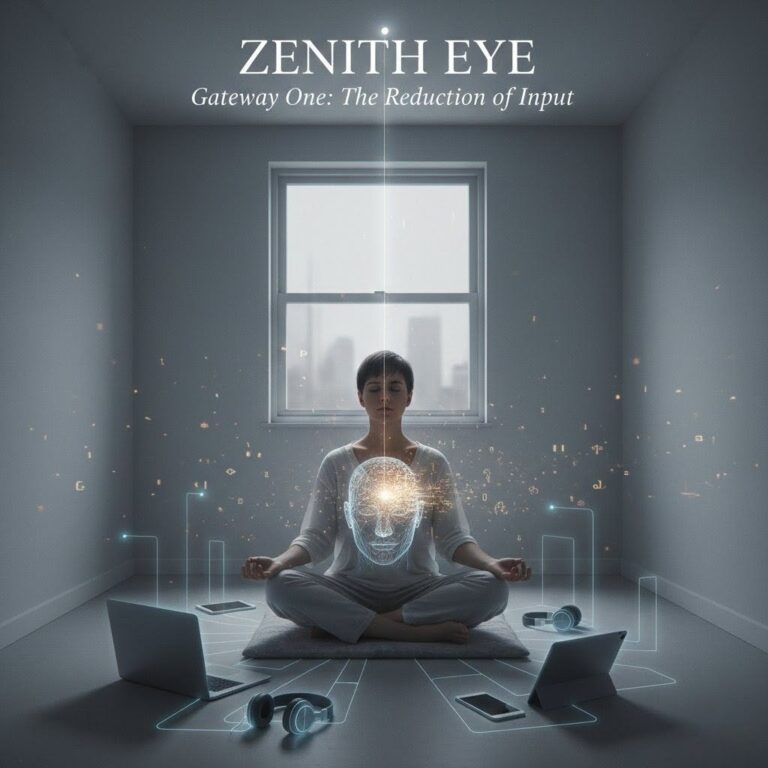
The practices that soften the interface are not exotic. Grounding, slow breathing, somatic tracking, time in silence, limited exposure to reactive media, honest conversation, sleep, nourishment, movement. These are not spiritual luxuries. They are perceptual maintenance. They keep the rendering engine from seizing up.

What This Article Is Not Saying
It is important to protect this inquiry from overreach. This article is not saying that reality is imaginary, that trauma is only perception, that people create their suffering by thinking wrong, or that all interpretations are equal. It is not saying that neuroscience proves Gnosticism, or that Gnosticism can be reduced to brain science. It is not saying that grounding replaces therapy or medical care, or that perception can be purified once and for all.
A filtered world is not a fake world. It is a mediated world. The rendering is necessary. Without it, the organism could not function. The problem is not that perception is filtered. The problem is forgetting that it is filtered. The work is not to destroy the interface. It is to stop mistaking it for the whole world.
The Self Is a Rendering, Not the Whole Light
The filtered self is not an enemy. It is the necessary interface through which embodied life becomes possible. The self is not the whole light. It is the pattern the light takes when it passes through a nervous system. Trouble begins when the interface claims to be the whole.
The Receiver Mind opened the question of consciousness as filtered–the narrow slit through which any human meets reality. The Filtered Self has shown how lived reality is rendered through nervous-system conditions: prediction, threat, memory, attention, interoception, culture and language. The next article in this series goes deeper into the interface error: mistaking the rendered world for the whole, and exploring what gnosis offers as a response to that forgetting.
Gnosis does not require hatred of the render. It requires seeing through it. The work is not to escape perception. It is to perceive the perceiving. That is the beginning of freedom.
Related Glossary Terms
These terms place the filtered self within the wider ZenithEye map of perception, body, attention and direct knowing.
- Filtered Self
- Nervous System Interface
- Prediction
- Predictive Processing
- Threat Response
- Memory
- Attention
- Interoception
- Somatic Marker
- Culture as Filter
- Language as Filter
- False Perception
- Gnosis
- Recognition
- Perceptual Sovereignty
Read Next: The Architecture of Perception
Follow the four-part route from perceptual limitation, through nervous-system rendering, into the interface problem, and finally toward symbolic sight and expanded awareness.
- The Receiver Mind: Consciousness, Perception and the 0.0035% Problem
- The Filtered Self: How the Nervous System Renders Reality
- The Interface Is Not the World: Gnosis and the Limits of Human Perception
- Beyond the Visible Slit: Symbol, Third Eye and Expanded Awareness
Further Reading
- The Somatic Cage: How Survival Biology Blocks Gnosis — How threat physiology closes the door to direct knowing.
- De-Escalating the Amygdala: Somatic Safety and the Biological Barrier — Practical approaches to resetting the threat response.
- Reclaiming the Cortex: Opening the Gateways of Direct Knowing — How cortical function supports recognition and clarity.
- Attention: The First Gateway of Consciousness — The foundational role of attentional discipline in perceptual sovereignty.
- Default Mode Network and the Dissolution of Self — How the brain’s narrative machinery shapes the sense of identity.
- What Is Recognition? The Moment of Direct Seeing That Changes Everything — The lived event of seeing through the render.
- What Is Gnosis? Meaning, Recognition and Direct Knowing — The ancient intuition of knowing through immediate seeing.
- Digital Archons: How Algorithms Shape Attention — How the attention economy trains perception.
- Pattern Recognition Without Paranoia — Discerning signal from noise without becoming captured.
- The Discipline of Not Interpreting Everything — The practice of pausing before the render completes.
References and Sources
This article draws on contemporary cognitive neuroscience, phenomenology and Gnostic studies. Key sources and traditions are mentioned in flowing prose throughout the text. For readers seeking deeper engagement, the following categories may be useful.
Primary Sources and Neuroscience
- Clark, A. (2015). Surfing Uncertainty: Prediction, Action, and the Embodied Mind. Oxford University Press.
- Seth, A. (2021). Being You: A New Science of Consciousness. Faber & Faber.
- Craig, A.D. (2002). “How do you feel? Interoception: the sense of the physiological condition of the body.” Nature Reviews Neuroscience, 3(8), pp. 655-666.
- Damasio, A. (1994). Descartes’ Error: Emotion, Reason, and the Human Brain. Putnam.
- Friston, K. (2010). “The free-energy principle: a unified brain theory?” Nature Reviews Neuroscience, 11(2), pp. 127-138.
Comparative and Gnostic Studies
- Layton, B. (ed.). (1989). Nag Hammadi Codex II, 2-7. Brill.
- Meyer, M. (ed.). (2007). The Nag Hammadi Scriptures. HarperOne.
- Pagels, E. (1979). The Gnostic Gospels. Random House.
- Merleau-Ponty, M. (1945). Phenomenology of Perception. Routledge (English translation 1962).
Frequently Asked Questions
What is the filtered self?
The filtered self is the experienced self and world that emerge when perception passes through the nervous system. Prediction, memory, attention, threat, bodily state, culture and language shape what becomes visible, important or dangerous. It is not an enemy to destroy, but an interface to recognise.
Does this mean reality is not real?
No. The world is real, but experience is mediated. A filtered world is not a fake world. It is a rendered world shaped by the body, brain, attention and history of the person perceiving it. The claim is not that reality is imaginary, but that human experience of reality is always shaped by the nervous system through which it is met.
How does the nervous system render reality?
The nervous system renders reality by selecting information, predicting what is likely, comparing incoming signals with memory, prioritising threat, tracking bodily state and organising experience into a usable world. Perception is an active construction, not a passive recording.
What is predictive processing?
Predictive processing is the idea, developed by Karl Friston, Andy Clark and others, that the brain actively predicts what is likely to happen and updates those predictions based on incoming sensory information. Perception is therefore not passive reception, but an active process of modelling and correction. Anil Seth describes ordinary perception as a form of controlled hallucination–not delusion, but construction constrained by reality.
How does threat change perception?
Threat narrows perception and makes ambiguity feel dangerous. A frightened nervous system may interpret neutral cues as warning signs because survival mode prioritises protection over subtlety. When the threat response de-escalates, the same world can look genuinely different.
What is interoception?
Interoception is the perception of internal bodily signals such as heartbeat, breathing, gut sensation, temperature, pain, fatigue and tension. These internal signals can strongly influence how the external world feels. Research by A.D. Craig and Antonio Damasio has shown that interoception is fundamental to emotion, decision-making and the sense of self.
How does recognition interrupt the filtered self?
Recognition interrupts the filtered self by revealing that perception is being rendered. It does not erase the world. It helps the knower see the filter, soften certainty and become less captured by the first interpretation. Gnosis begins when the interface becomes visible without hatred of the body, the world or the self.
Safety Notice: This article explores perception, nervous-system rendering, trauma, attention, interoception and Gnostic false perception. It does not constitute medical, psychological, neurological or psychiatric advice. If contemplation, meditation, trauma material or perception-focused inquiry causes panic, derealisation, dissociation, paranoia, psychosis, mania, severe distress, suicidal thoughts or difficulty functioning, seek support from a qualified mental health professional or appropriate medical service. Do not use spiritual or philosophical models to reject clinical care, medication, therapy or grounded support.
Study Note: The filtered self is not an enemy to destroy. It is the necessary interface through which embodied life becomes possible. The problem is not that perception is filtered. The problem is forgetting that it is filtered. Gnosis begins when the interface becomes visible without hatred of the body, the world or the self.