
The Thread That Binds – Five Gateways to Direct Knowing in an Age of Noise
You have read the warnings. The fire. The flood. The institutional capture. The spiritual inflation. The bypassing. You have recognised the pattern. Now you want the method. This is the error, but it is also the necessary error. The method cannot be given; it can only be indicated. The finger is not the moon, but without the finger, the moon is not found. These are not techniques–they are gateways. Conditions under which the living thread becomes visible to itself.

Table of Contents
- What is Direct Knowing?
- The Age of Noise
- Gateway One: Reduction of Input
- Gateway Two: Discipline of the Body
- Gateway Three: Encounter with Limit
- Gateway Four: Recognition of Pattern
- Gateway Five: Risk of Speech
- Integration of Gateways
- The Final Recognition
What is Direct Knowing?
Direct knowing (gnosis) is interior certainty unmediated by institutional interpretation. Unlike belief–which relies upon external authority–direct knowing emerges from the immediate recognition of truth through lived experience. It is the difference between reading a map and recognising the territory; between accepting the official story and perceiving the living thread that persists beneath administrative layers of consensus reality.
The Age of Noise: Why Gateways Are Necessary
We live in an age of unprecedented informational abundance–and unprecedented signal loss. The official story arrives through a thousand channels, each calibrated to maintain consensus that reality is external, managed by others, and best understood through authorised interpretation. The noise is not accidental; it is structural–the flood that accomplishes what the fire could not: the burial of vital knowledge under mountains of mere information.
The living thread persists through this flood because it is not primarily information. It is a particular quality of attention. A direction of inquiry. A willingness to follow interior evidence where it leads, even when it leads outside the acceptable map. The five gateways are not methods for acquiring this attention; they are conditions under which attention, already present but obscured, becomes visible to itself.
Research in environmental psychology illuminates what the traditions have always practised. Psychologists Stephen and Rachel Kaplan developed Attention Restoration Theory in 1989, distinguishing between directed attention–the effortful, depleting focus required by modern tasks–and soft fascination, the gentle, restorative attention invited by natural environments. Without periods of undirected attention, the brain experiences attentional fatigue: prefrontal cortex function degrades, cognitive resources deplete, and the capacity for deep reflection collapses. The modern digital environment is architected to prevent restoration, ensuring that directed attention remains perpetually exhausted and the interior signal stays buried.
Each gateway addresses a specific obstacle to recognition. Each produces a specific transformation. Together, they form a complete system–not sequential steps but simultaneous conditions, mutually reinforcing, networked in function.
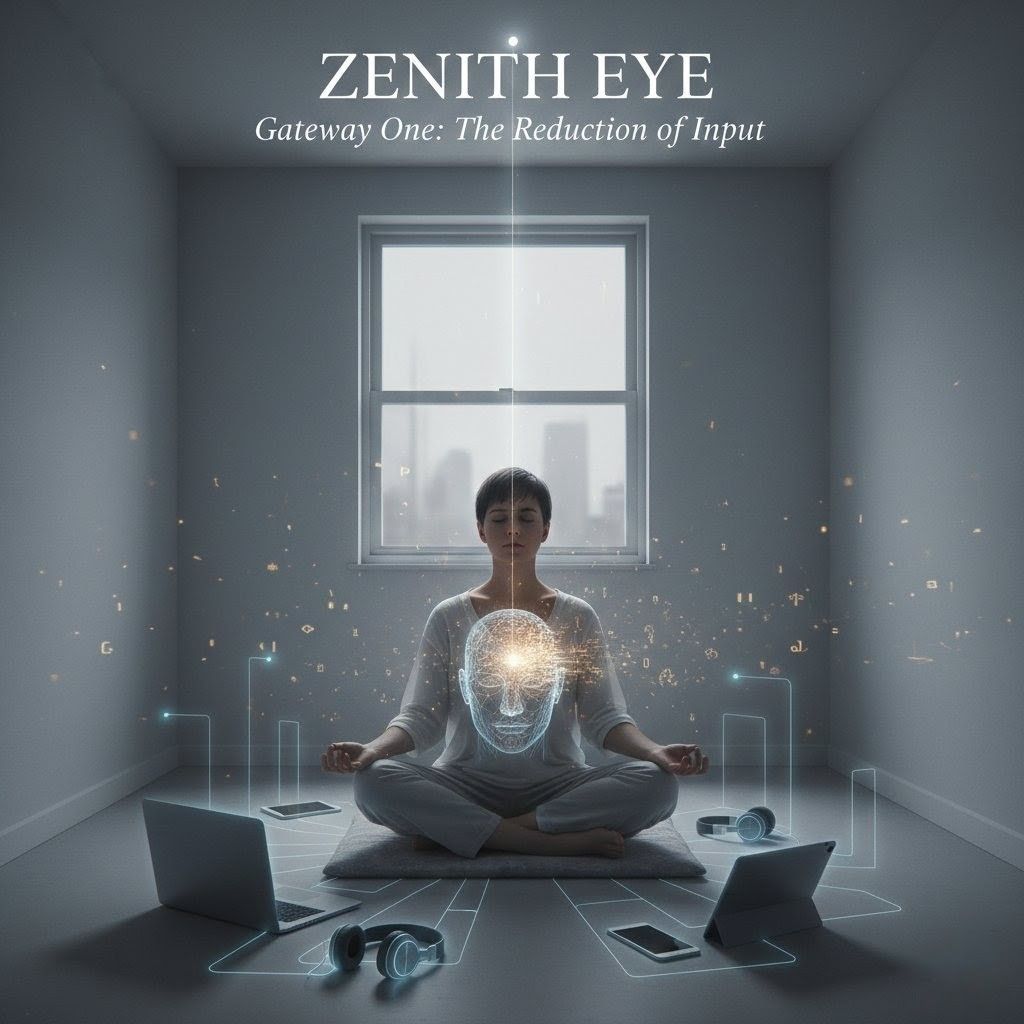
Gateway One — The Reduction of Input
The world is informationally loud. The “official story” arrives through a thousand channels–news, feeds, notifications–all calibrated to maintain the consensus that reality is external and managed by others. The first gateway is subtraction.
The Threshold of Boredom as Portal
The Threshold: Boredom. The mind, accustomed to constant stimulation, will protest. It will invent emergencies, manufacture cravings, and suggest that silence equals deprivation. This is the archonic defence mechanism at work–the bureaucracy of distraction attempting to maintain its jurisdiction over your attention. But boredom is not a deficit; it is a signal. Neuroscience confirms that boredom indicates the depletion of directed attention and the brain’s demand for restoration. When the prefrontal cortex is exhausted by perpetual stimulation, it generates the aversive state of boredom precisely to force a shift toward undirected, restorative modes of awareness.
Discrimination Versus Rejection
The Goal: To reduce reinforcement of the consensus until the interior becomes audible. This is not rejection of technology but discrimination–this serves function; that serves capture. The reclamation of embodiment from algorithm practises this gateway deliberately: the device removed from bedroom, the notification silenced, the scroll interrupted. Digital minimalism is not a moral posture but a technical specification for cognitive hygiene.
The Digital Minimalist Approach
The Result: Attention is no longer allocated to external management; it becomes available for itself. The threshold of boredom, crossed repeatedly, reveals itself as threshold of attention–the point where interior signal strengthens enough to be heard above the static of consensus. The practitioner discovers that what felt like deprivation was actually the removal of interference, and what felt like silence was actually the first audible frequency of the self.
Gateway Two — The Discipline of the Body
The body is not an obstacle; it is an instrument. But the modern body is detuned by artificial light, irregular rhythms, and static-inducing diets. This discipline is calibration, not punishment.

Calibration Not Punishment
Technical Adjustments: Regular sleep, natural light, simplified food, daily movement. These are not moral imperatives but technical specifications. The suprachiasmatic nucleus in the hypothalamus governs circadian rhythms through melanopsin receptors in the retina, which respond to natural light spectra. When the body receives morning sunlight and evening darkness, sleep architecture deepens, glymphatic clearance increases, and the brain’s metabolic waste removal system operates at full capacity. When the body operates within its design parameters, it ceases to generate the static that interferes with interior reception.
The Body as Ground
The Result: The body becomes transparent. When the noise of fatigue and agitation diminishes, the interior signal strengthens. The gateway of sensation extends this discipline into direct practice: the body scan, the somatic awareness, the attention to breath and posture that makes embodiment conscious rather than habitual. Movement, meanwhile, upregulates brain-derived neurotrophic factor–the brain’s fertiliser for neuroplasticity–literally growing the neural infrastructure required for sustained attention.
Technical Specifications
The body, calibrated, ceases to be distraction and becomes ground–the stable platform from which attention can extend without dissipation. This is not asceticism for its own sake; it is the reduction of biological noise to enable clearer signal reception. The practitioner who sleeps deeply, eats simply, moves daily, and greets the dawn does not earn virtue points; they simply remove the static that prevents the interior from broadcasting on its native frequency.
Gateway Three — The Encounter with Limit
The official story is believable because it is comfortable. A genuine encounter with limit–physical, emotional, or existential–breaks this comfort and makes the interior urgent. This gateway is necessity.
Warning: This gateway is dangerous. Limit can produce bitterness or victimhood. The gateway only opens when the limit is met directly–not escaped through distraction, nor interpreted through the official story’s frameworks of pathology.
Solitude as Mirror
Solitude: Extended until the self becomes questionable. Not the occasional retreat but the sustained encounter with self that occurs when external validation is withdrawn. Neuroscience reveals that the default mode network–active during rest and internally directed thought–supports autobiographical integration, creative association, and self-reflective judgment. The discipline of solitude removes the social mirrors that reflect back the consensus identity, forcing recognition of what remains when performance is impossible. What persists in silence is not the social self but the thread itself.

Exertion and the Silence of Mind
Exertion: Physical push until the mind’s chatter is silenced by necessity. When the body demands all attention, the narrative self suspends its operations. This is the temporary death of the administrative ego. The runner at mile twenty, the climber on the ledge, the swimmer in cold water–all report the same phenomenon: the internal monologue stops, and what remains is pure, unmediated presence. The limit, met through the body, becomes a gateway not because suffering is virtuous but because necessity strips away the optional.
Fasting and Clarified Demand
Fasting: Until the body’s demands clarify rather than confuse. The metabolic switch from glucose to ketones–which begins after twelve to thirty-six hours of fasting–provides the brain with an alternative fuel source that many practitioners report as steadier and clearer than glucose metabolism. Fasting triggers autophagy, the cellular recycling process that removes damaged proteins and dysfunctional mitochondria. It upregulates brain-derived neurotrophic factor, supporting neuroplasticity and synaptic resilience. The mTOR pathway, which promotes growth, is suppressed; the AMPK pathway, which promotes maintenance and repair, is activated. The removal of constant digestion frees metabolic energy for cognition and reveals the difference between genuine need and habituated craving.
Grief as Presence
Grief: Attended until the absence becomes a presence. The limit, met directly, produces what comfort cannot: the urgency that drives attention inward, the necessity that reveals what is essential. The bereaved do not choose grief; grief chooses them. But those who attend to it–who refuse the official story’s offer of pharmaceutical management or premature closure–discover that grief is not a malfunction to be fixed but a gateway to be entered. The absence becomes a presence, and the presence becomes a teacher.
Gateway Four — The Recognition of Pattern
The official story is linear (progress, growth). The thread is recursive. It involves the same recognitions and dissolutions repeated at deeper levels.

The Recursive Architecture
Cultivation: This is done through direct observation–the journal, the review, the slow accumulation of evidence. The hidden agreements across traditions reveal this pattern: the same architecture, invented anew, because it describes something real. Kabbalah’s Tree of Life, Vedanta’s koshas, Gnosticism’s aeons, Sufism’s stations of the soul, and Hermeticism’s planetary spheres are not syncretic borrowings but independent cartographies of the same interior topology. The convergence is not evidence of transmission but evidence of discovery–different explorers mapping the same mountain from different faces.
Precision Versus Paranoia
Precision: This is not paranoia (seeing external threats everywhere). It is the recognition that interior experience has its own reliable architecture. Once glimpsed, the thread becomes traceable. The recognition of pattern is not intellectual exercise but direct seeing–the capacity to trace the thread through its manifestations, to recognise the living in the midst of the apparent. The paranoid sees conspiracy in every coincidence; the precise sees correspondence in every recurrence. The former is fear projected outward; the latter is attention refined inward.
Gateway Five — The Risk of Speech
Solitary investigation can become circular, leading to inflation or bypass. The fifth gateway is the risk of articulation to another who may recognise.
Testing Through Articulation
Testing: This is not confession; it is a test. The thread, spoken, either extends or it does not. Articulation forces clarity–vague intuition dissolves under the pressure of precise language. The philosopher Charles Taylor argues that recognition from others is constitutive of identity; we become persons through dialogical exchange. Martin Buber’s distinction between I-It and I-Thou illuminates the difference between speaking about the thread and speaking from it. In the I-Thou encounter, the thread is not described but activated, passing between speakers like current between terminals.
Mutual Recognition and Its Markers
Mutual Recognition: The recognition is immediate or it is absent. There is no persuasion in direct knowing. The risk of speech is not exhibitionism. It is the willingness to be seen, to test the thread in the crucible of relationship, to discover whether recognition survives contact with the other. The Hegelian master-slave dialectic, stripped of its political specifics, reveals a universal truth: the self cannot know itself without the mirror of the Other. But the mirror must be living; a dead reflection–social media likes, institutional approval–returns only the consensus self.

The Bureaucracy of Pathologisation
The Risk: Speech exposes you to the official story’s mechanisms of punishment: pathologisation and marginalisation. The gateway opens only when the risk is accepted. The ordinary saint walks invisibly not because hiding is virtue but because the thread, once extended, requires no advertisement. The pathologisation machine is well-oiled: it labels interior certainty as mania, sustained attention as obsession, and the rejection of consensus as dissociation. The practitioner must be willing to be misfiled by the administrative layers of reality.
The Integration of Gateways
These gateways are not sequential; they are simultaneous and networked.

The reduction of input enables the discipline of the body. The discipline enables the encounter with limit. The encounter produces the recognition of pattern. The pattern demands the risk of speech.
They are also not exclusive. Shocks of beauty or the unbidden collapse of the witness are grace–unpredictable and unmanufacturable. The gateways simply prepare the conditions. The gateway of breath, the gateway of sound, the gateway of vision, the gateway of movement–these are specific technologies that operationalise the five conditions in embodied practice.
From a systems perspective, the five gateways function as a complex adaptive network. Activation of one gateway lowers the threshold for the others. The body, calmed through discipline, requires less input reduction to achieve clarity. The recognition of pattern, once established, makes solitude productive rather than merely lonely. The risk of speech, once survived, strengthens the body through the confidence of tested identity. The result is not linear progression but emergent transformation–a phase shift in which the whole becomes greater than the sum of its gateways.
The Final Recognition
The thread, once extended, reveals it is not a possession but a function: the capacity to recognise and extend recognition. Eventually, the distinction between practice and life disappears. The transformation is complete when it is no longer visible as transformation. You do not choose the thread. The thread finds you.
What are the Five Gateways to Direct Knowing?
The Five Gateways are conditions that enable direct knowing (gnosis) to become visible: (1) Reduction of Input–subtraction of informational noise; (2) Discipline of the Body–calibration of the physical instrument; (3) Encounter with Limit–meeting necessity through solitude, exertion, fasting, or grief; (4) Recognition of Pattern–direct seeing of recursive truth architecture; and (5) Risk of Speech–articulation to another who may recognise. These operate simultaneously rather than sequentially.
How does the Reduction of Input gateway work?
The Reduction of Input operates through disciplined subtraction of informational noise–silencing notifications, removing devices from sleep spaces, and interrupting compulsive scrolling. The threshold of boredom, when repeatedly crossed, transforms into a threshold of attention where interior signal strengthens enough to be heard above consensus reality. This is discrimination rather than rejection of technology.
What is the Discipline of the Body in spiritual practice?
The Discipline of the Body treats the physical form as an instrument requiring calibration rather than an obstacle demanding punishment. Through regular sleep, natural light exposure, simplified food, and daily movement, the body becomes transparent–ceasing to generate the static that interferes with interior reception. This creates stable ground from which attention can extend without dissipation.
Why is encountering limits considered dangerous but necessary?
The Encounter with Limit breaks the comfort that maintains consensus reality, making the interior urgent. However, limit can produce bitterness or victimhood if met indirectly through distraction or interpretation. The gateway opens only when limit is met directly–through extended solitude, physical exertion, fasting, or attended grief–producing the urgency that reveals what is essential.
How does pattern recognition differ from intellectual analysis?
Recognition of Pattern is direct seeing rather than intellectual exercise. While the official story presents linear progress, the living thread operates recursively–repeating recognitions at deeper levels. This is not paranoia (projecting external threats) but precision: the capacity to trace reliable interior architecture through its manifestations, recognising the same hidden agreements across divergent traditions.
What risks are involved in the Gateway of Speech?
The Risk of Speech exposes the practitioner to the official story’s mechanisms of punishment–pathologisation and marginalisation. However, solitary investigation can become circular without articulation. Speech serves as testing: the thread, spoken, either extends through mutual recognition or it does not. This requires willingness to be seen and to discover whether recognition survives contact with the other.
How do the Five Gateways integrate into daily life?
The Five Gateways operate simultaneously and networked rather than sequentially. Reduction of input enables bodily discipline; discipline enables encounter with limit; limit produces pattern recognition; pattern demands speech. They are operationalised through specific technologies: the gateway of breath (pranayama), gateway of sound (mantra), gateway of sensation (body scan), gateway of vision (yantra), and gateway of movement (walking meditation).
Further Reading
Explore related pathways within the ZenithEye archive:
- The Living Thread: How Forbidden Knowing Survives the Fire — On the resilience of truth through suppression and time.
- The Hidden Agreements: Why Esoteric Traditions Keep Inventing the Same Architecture — Uncovering the universal blueprint behind divergent mystical paths.
- The Transformation: What Actually Changes After Mystical Experience — A grounded look at the neurological and psychological shifts post-awakening.
- The Collapse of the Witness: Ego Dissolution and the Zenith Eye — The transition from “observing” to “being” at the peak of consciousness.
- The Sacred Art of Inner Listening: How to Hear Your Soul Compass Above the Noise — Cultivating the discernment needed to follow your internal North Star.
- The Gateway of Breath: Pranayama Techniques — The first embodied gateway: systematic breath practice.
- The Gateway of Sensation: Body Scan and Somatic Awareness — The second embodied gateway: returning attention to the body.
- The Gateway of Movement: Walking Meditation and Circulation — The fifth embodied gateway: integrating practice into action.
- States of Knowing: What Happens When Consciousness No Longer Belongs to You — The phenomenology of non-ordinary states and their integration.
- Creating a Personal Practice: Combining the Gateways — Practical guidance for integrating the five conditions into a complete daily discipline.
References and Sources
The following sources inform the synthesis presented in this article, bridging contemplative phenomenology with contemporary neuroscience and philosophy.
Neuroscience and Psychology
- Kaplan, S., & Kaplan, R. (1989). The Experience of Nature: A Psychological Perspective. Cambridge University Press. (Attention Restoration Theory)
- Beaty, R. E., et al. (2025). The role of the default mode network in creativity. Neuroscience and Biobehavioral Reviews.
- Mattson, M. P., et al. (2018). The Effects of Intermittent Fasting on Brain and Cognitive Function. Nutrients, 14(6), 1275.
- Mattson, M. P., & Wan, R. (2005). Beneficial effects of intermittent fasting and caloric restriction on the cardiovascular and cerebrovascular systems. The Journal of Nutritional Biochemistry, 16(3), 129–137.
Philosophy and Critical Theory
- Taylor, C. (1994). The politics of recognition. In Multiculturalism: Examining the Politics of Recognition. Princeton University Press.
- Buber, M. (1923). I and Thou. Trans. Ronald Gregor Smith. Scribner, 1958.
- Hegel, G. W. F. (1807). Phenomenology of Spirit. Trans. A. V. Miller. Oxford University Press, 1977.
Contemplative Traditions
- Patanjali. Yoga Sutras (circa 400 CE). Translation: Swami Satchidananda, The Yoga Sutras of Patanjali. Integral Yoga Publications, 2012.
- Evagrius Ponticus. Praktikos and Chapters on Prayer (4th century CE). Translation: John Eudes Bamberger. Cistercian Publications, 1972.