

Finding the Other: Recognition Without Community in an Age of Isolation
The fifth gateway is speech. The risk of articulation. The extension of the thread to another who may recognise. But what when the other is not found? What when the community does not exist, when the tradition has no local presence, when the seeker is alone in a landscape of consensus?
This is the modern condition. The seekers are isolated, connected by technology but separated by geography, each assuming their recognition is private. The assumption is wrong. The thread is shared. The recognition, though private in its arrival, is universal in its structure. The other exists. The problem is finding. Not the finding of any other. The finding of the one who recognises. This is not community. This is encounter.

The Isolation Is Structural (And By Design)
The modern world isolates with the efficiency of a system designed for consumption rather than communion. The nuclear family, the suburban home, the digital connection–these dissolve the traditional containers of recognition. The village or the guild once provided the possibility of encounter; the modern seeker lacks even the waiting room of tradition.
Sociologists have documented this collapse with precision. Robert Putnam’s landmark study Bowling Alone tracked the erosion of American communal life across the late twentieth century, demonstrating that religious attendance, union membership, and even informal social visiting declined steadily from the 1960s onward. The trend has accelerated in the digital age. The atomisation is not accidental; it is the structural consequence of an economy that profits from individual consumers rather than connected communities.
The spiritual marketplace offers substitutes: retreat centres, online forums, workshops. These gather seekers, but gathering is not recognition. The marketplace sells experience and belonging–the simulation of community. The thread is not extended here. It is consumed, packaged, and resold as “transformational experiences” with no refund policy.
The archons prefer you lonely. Lonely seekers are excellent consumers. They buy the books, attend the workshops, chase the peaks–never realising that the thread is not found in the marketplace, but in the recognition that passes between two who see.

The Digital Paradox
Digital connectivity creates a specific form of isolation: the illusion of proximity without the risk of presence. One can scroll through thousands of spiritual posts without encountering a single person. The algorithm, designed for engagement, surfaces the loudest voices rather than the quietest recognitions. The thread requires silence; the feed demands noise.
Research into online spiritual communities reveals a consistent pattern. A 2021 study published in Religions found that while digital platforms enabled seekers to access teachings previously restricted by geography, the majority reported feeling “spiritually unseen” despite high levels of online activity. The medium itself prevents the quality of attention that recognition requires. One cannot scan and recognise simultaneously.
The Recognition Has Signatures
The other is found not through declaration but through signature–the subtle markers that indicate one has actually visited the territory rather than read the travel brochure.
The Shared Territory
References that assume a common landscape without explaining it. The mention of “the collapse” or “the glimpse” without footnotes. The assumption that you know what is meant by “the thread” or “the Pleroma.” This is the shorthand of those who have passed through the same customs office.
The Desert Fathers understood this implicitly. When Abba Moses told a visiting brother, “Go, sit in your cell, and your cell will teach you everything,” he assumed a shared understanding of what the cell meant–not punishment but crucible, not prison but laboratory. The saying requires no explanation to one who has sat. To one who has not, it remains opaque.
The Question
One that seeks confirmation rather than an answer. “You know that moment when…” or “Have you noticed how…” These are not requests for information but feelers extended into the dark, checking if another intelligence inhabits the same frequency.
In Sufi tradition, this is called sohbet–spiritual conversation that occurs not through exposition but through mutual attunement. The question is the tuning fork. The response, if genuine, resonates on the same pitch. If false, it clangs.
The Resonance
An immediate recognition that points to the same territory, regardless of vocabulary. The Christian mystic and the Zen practitioner may use different maps, but both recognise the quality of attention in the other–that specific gravity of one who has stood before the uncreated light and returned bearing the marks.
The signature is not a code or a secret handshake. It is resonance–the harmonic vibration that occurs when two strings tuned to the same pitch are struck. The problem for the modern seeker is not sending, but receiving–the cultivation of attention that recognises signature amidst the noise of the spiritual marketplace.

The Encounter Is Risk (Predatory Dynamics)
The fifth gateway is risk. Articulation may be rejected; vulnerability may be exploited. The digital encounter–the primary form available to us–is often a simulation. Text and video allow for the performance and construction of identity. The thread, however, requires presence–the risk of being seen without preparation.
This is where the encounter becomes dangerous. The isolated seeker, hungry for recognition, is vulnerable to predatory consciousness–those who recognise the signature but use it for extraction rather than connection. The spiritual marketplace is full of hunters who have learned the language of the thread but serve the economy of consumption.
The Anatomy of Spiritual Predation
Predatory dynamics in spiritual contexts follow a recognisable pattern, well-documented in clinical literature on cult psychology and spiritual abuse. The predator identifies the seeker’s hunger for recognition and mirrors it back–not as mutual resonance but as bait. The initial encounter feels like the thread: sudden intimacy, shared language, the sense of having found the other. Then the extraction begins.
Signs of predatory encounter:
- Hierarchy creation: The other positions themselves as senior, advanced, or “teacher” without invitation, establishing a vertical relationship where recognition should be horizontal.
- Extraction: Energy, money, or sexual attention is requested as “part of the teaching” or “necessary for transmission.”
- Isolation reinforcement: The other suggests cutting ties with existing connections, increasing dependency. The seeker, already isolated, is pushed further into a closed dyad.
- Credential inflation: The predator claims special status, lineage, or secret knowledge unavailable to ordinary practitioners–the precise opposite of the humility that marks genuine recognition.
Genuine recognition never demands. It simply recognises. The thread is extended, not sold. The moment exchange enters–“I will recognise you if you…”–the encounter has been compromised by the marketplace.
The encounter, when genuine, is unmistakable. Time dissolves. The social self falls silent. There is no hierarchy, no transaction, no performance. This is not friendship or romance; it is the thread, extended–two consciousnesses acknowledging the same fundamental glitch in the simulation.

The Community Is Not Required
The traditional model assumes the monastery, the sangha, or the circle. The modern seeker, isolated, often assumes that without community, there is no thread. This assumption is institutional–a holdover from eras when the Church or the Temple controlled the means of recognition.
Historically, community was the container, not the content. The thread extended through individuals who met, recognised, and then separated. The Desert Fathers went to the wilderness not to escape community but to find a form of recognition that institutions could not provide. Abba Alonius summed up the paradox: “If a man does not say in his heart, in the world there is only myself and God, he will not gain peace.” Yet this solitude was never absolute. The Apophthegmata Patrum–the Sayings of the Desert Fathers–record constant travel between cells, brief but decisive encounters, and the recognition of shared territory across vast distances.
The Sufi tradition offers the majalis–gatherings that were temporary, uninstitutional, and often itinerant. The dervishes met, exchanged recognition through poetry and silence, and dispersed. The circle was not permanent; the thread was. Similarly, early Gnostic communities were deliberately decentralised, lacking the hierarchical structure that eventually allowed proto-orthodox Christianity to outlast them. Their weakness as an institution was their strength as a network.
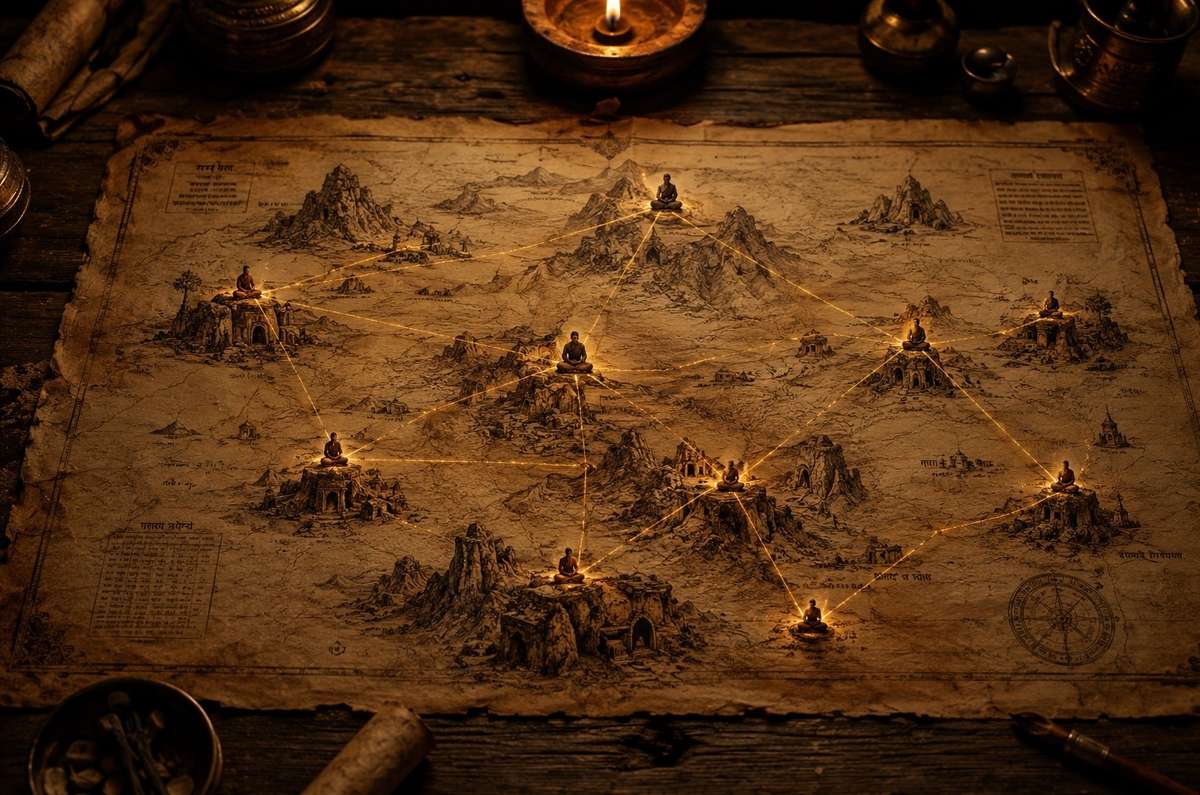
The modern seeker’s isolation is not a disadvantage; it is preparation–the necessary condition for learning to recognise without institutional scaffolding. The network that emerges is not community. It is a web–dispersed, intermittent, and uninstitutional. It consists of those you encounter briefly but recognise completely. The web does not require proximity; it requires alignment.
The Practice of Finding (Becoming Findable)
The seeker, isolated, practices availability–the cultivation of a signal strong enough to be detected by others scanning the same frequencies.
First, Avoid the Search
Search is desperate and readable as need. The marketplace tracks desperation; it leads to the marketplace. Instead, cultivate signal. Become findable by being unmistakably yourself. Amma Syncletica warned that many “live in the mountains and behave as if they were in the town, and they are wasting their time.” The same applies to digital hermits: one can be physically isolated while mentally performing for an invisible audience. The practice is not isolation of body but integrity of signal.
Second, Cultivate Preparedness
The cultivation of signature and attention to resonance. Know your own territory so well that you can recognise its echoes in others. This requires the discipline of nepsis–sober watchfulness. The Desert Fathers taught that the solitary must battle not external distraction but the “crowd of his own thoughts.” Only when the internal noise subsides can the subtle signal of another be detected.
Third, Exercise Discernment
Distinguishing the genuine from the inflated or bypassed performers of the spiritual marketplace. Look for those who listen more than they speak, who ask questions rather than provide answers, who share uncertainty rather than expertise. The genuine article does not advertise. It simply is.
Fourth, Maintain Patience
The knowledge that the other may not appear for years. The web is not dense; it is sparse but strong. One true recognition is worth more than a thousand workshop acquaintances. Anthony the Great spent twenty years in solitude before his recognition by others became widespread. The thread does not operate on the schedule of the marketplace.

The Thread Extended
The fifth gateway, in isolation, is harder. But the thread does not require ease; it requires direction. The isolated seeker extends the thread through availability and the willingness to risk when the moment warrants it.
The other exists. The web persists. The thread continues not through community but through encounter–the moment when two recognitions meet and the silence between words is sufficient.
You do not find the other. You become findable. The thread continues regardless.
Frequently Asked Questions
How do I recognise the other online without meeting in person?
Look for signature over performance. The genuine article asks questions rather than provides answers; shares uncertainty rather than expertise; references territory rather than maps. Predatory consciousness performs recognition; genuine recognition simply recognises. Trust the resonance, but verify through sustained interaction. Watch for the feeler question–the one that seeks confirmation rather than information.
Is isolation spiritually necessary, or just a modern condition?
Neither and both. Isolation is the modern condition, but it has always been the condition of the serious practitioner. The desert fathers sought isolation; the hermit traditions honour it. However, the goal is not isolation but discriminating connection–the ability to be alone without being lonely, and to connect without losing sovereignty. Amma Syncletica noted that one can be a solitary in the mind while living in a crowd, and a crowd in the mind while physically alone.
What are red flags that someone is mimicking recognition?
Mimics use the vocabulary without the territory. They speak of the collapse or the thread but cannot answer specific questions about their experience. They establish hierarchy immediately. They request resources–money, energy, sexual attention–as part of the teaching. Genuine recognition is marked by equality: two sovereign consciousnesses meeting as peers. The predator sells; the recogniser simply extends.
Can I practice the fifth gateway without ever finding the other?
Yes. The practice of availability–of becoming findable–is itself the work. It requires you to clarify your own recognition, to know your territory so thoroughly that you can describe it accurately. This clarification is the spiritual work, regardless of whether another ever validates it. As Abba Moses taught, Go, sit in your cell, and your cell will teach you everything.
How does this relate to the concept of the elect or chosen in Gnosticism?
The Gnostic election is not aristocracy but recognition–those who recognise the call and respond. It is not that some are chosen and others damned; it is that some recognise the prison and others mistake it for the world. Finding the other is finding those who have made the same recognition. The elect are not superior; they are simply awake.
What if I encounter the other but they are in a different tradition?
Tradition is the map; recognition is the territory. The Christian mystic and the Dzogchen practitioner may use different cartography, but both may recognise the same quality of attention. Do not let vocabulary confuse you. The thread crosses traditions as easily as light passes through different mediums. The Sufi majalis and the Desert Fathers’ brief encounters both demonstrate that alignment transcends doctrine.
How do I protect myself from spiritual predation while seeking the other?
Maintain sovereignty. Never surrender financial autonomy, sexual boundaries, or existing support networks to a new spiritual connection. Genuine recognition never demands extraction. If the other positions themselves as necessary for your progress, creates urgency, or suggests that your current connections are obstacles, these are predatory signals. The thread is extended between equals, not dispensed from above.
Further Reading
Extend your understanding through these verified resources from the ZenithEye archive:
- The Thread That Binds: Five Gateways to Direct Knowing in an Age of Noise — the complete framework for the gateway system
- The Discipline of Solitude: Extended Alone Time as Gateway to Recognition — mastering isolation as spiritual technology
- The Living Thread: How Forbidden Knowing Survives the Fire — the historical transmission of recognition across centuries
- Predatory Consciousness: Protection Against Psychic Predation — safety protocols for the spiritual marketplace
- Community Integration: Solitary vs. Supported Practice — navigating the tension between isolation and connection
- Spiritual Inflation: How to Recognise It in Yourself Before It Destroys You — discerning the difference between genuine recognition and egoic performance
- The Collapse of the Witness — when the observer dissolves and the mechanism of capture is revealed
References and Sources
The following works inform the historical, psychological, and contemplative framework of this article.
Primary Historical and Contemplative Sources
- Ward, Benedicta (trans.). The Sayings of the Desert Fathers: The Alphabetical Collection. Cistercian Publications, 1975. Includes the teachings of Abba Moses, Amma Syncletica, Anthony the Great, and Abba Alonius cited throughout.
- Athanasius of Alexandria. The Life of Antony (various translations). The foundational hagiography of desert monasticism, chronicling Anthony’s withdrawal c. 270 AD.
- Evagrius Ponticus. Praktikos and Chapters on Prayer (various translations). Primary source for the desert teaching on nepsis (watchfulness) and the eight logismoi.
- Palmer, G. E. H., Sherrard, P., & Ware, K. (trans.). The Philokalia: The Complete Text. Faber & Faber. Compendium of Orthodox contemplative psychology including the desert tradition.
Sociological and Psychological Studies
- Putnam, Robert D. Bowling Alone: The Collapse and Revival of American Community. Simon & Schuster, 2000. Documents the structural erosion of communal life and the rise of social atomisation.
- Marginean, Ioan. “Loneliness, Solitude, Community: Insights from the Apophthegmata Patrum.” Religions 14, no. 3 (2023): 295. Academic analysis of desert solitude as a manual for managing modern isolation.
- Lalich, Janja, and Tobias Richardson. “Cult Psychology and Spiritual Abuse.” In The Oxford Handbook of New Religious Movements, edited by James R. Lewis, 2nd ed., Oxford University Press, 2016. Framework for understanding predatory dynamics in spiritual contexts.
Comparative and Gnostic Studies
- Pagels, Elaine. The Gnostic Gospels. Random House, 1979. Definitive study of early Gnostic communities, their decentralised structure, and the concept of recognition as election.
- Chittick, William C. The Sufi Path of Love: The Spiritual Teachings of Rumi. SUNY Press, 1983. Context for Sufi sohbet (spiritual conversation) and the tradition of itinerant majalis.
Safety Notice: This article discusses spiritual predation and predatory dynamics in spiritual communities. If you believe you are in a controlling or exploitative spiritual relationship, please contact a licensed mental health professional or a recognised spiritual abuse recovery organisation. The information here is for discernment and education, not crisis intervention. If you are in immediate danger, contact emergency services.