
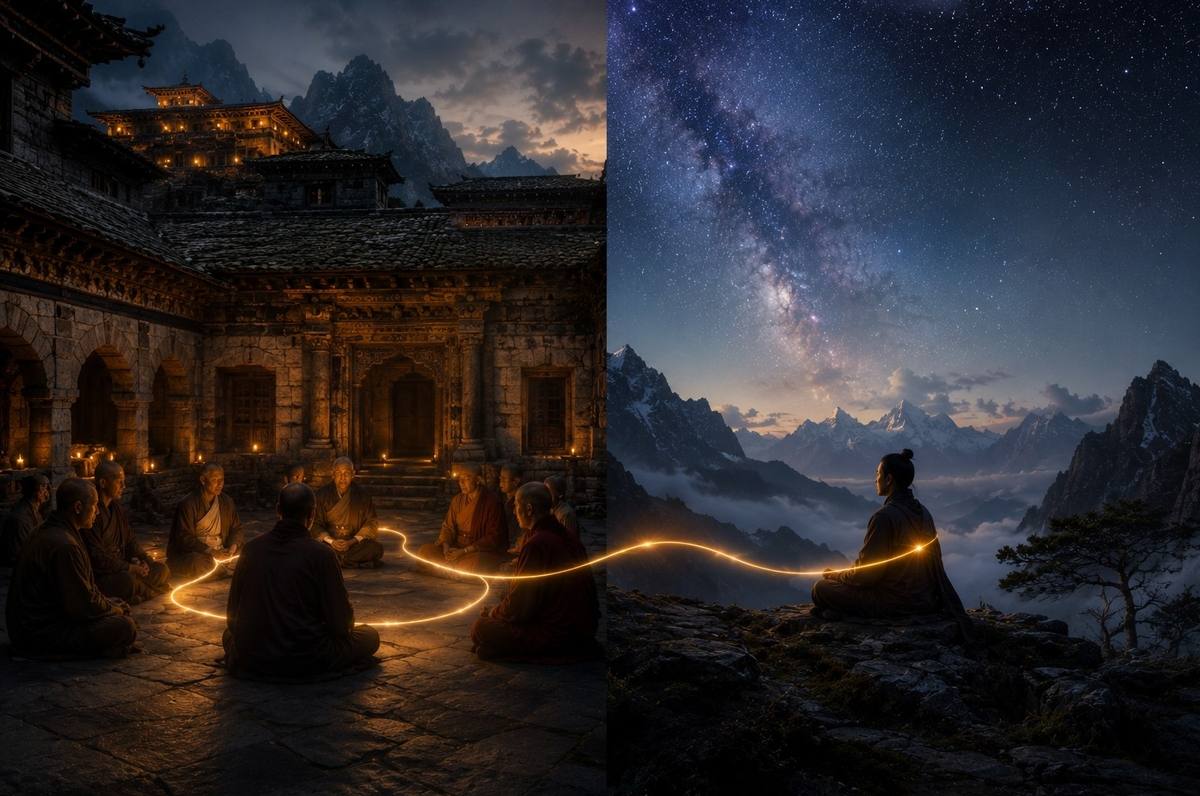
The Role of Community in Integration: Solitary vs. Supported Transformation
The experience is private. The recognition, direct, requires no witness. The integration, however, occurs in context–solitary or supported, isolated or communal. The transformation that arrives unbidden must still be woven into the fabric of a life, and that weaving happens in relation to others or in their deliberate absence.
Table of Contents
- The Traditional Container vs The Contemporary Autonomy
- The Four Pillars of Community Function
- When Community Becomes Capture
- The Validity of the Solitary Path
- The Dialectical Path: Moving Between Solitude and Community
- The Neurobiology of Social Integration
- The Thread Extended
- Frequently Asked Questions
- Further Reading
- References and Sources

The context shapes the outcome. The solitary path risks inflation and bypass; the communal path risks conformity and dependency. The thread extends through both, differently–like electricity finding ground through different resistances, or like water carving distinct channels through varied terrain. Neither route is inherently superior; each presents characteristic obstacles and unique gifts. Understanding these dynamics enables the practitioner to navigate their own position on the spectrum with discernment rather than default.
The Traditional Container vs The Contemporary Autonomy
The Community Assumption
The traditional assumption is community. The monastery, the sangha, the circle, the lodge–these are containers that hold transformation. They provide mirroring: feedback on whether the transformation is genuine or simulated, integrated or inflated. The mirror, when accurate, enables essential correction. Communities function as living laboratories where the claims of awakening are tested against the friction of actual relationship. When a practitioner declares a shift in consciousness, the community responds–not with automatic validation, but with the gentle or firm testing that reveals whether the shift has penetrated the personality or merely decorated it.
The Individual Assumption
The contemporary assumption is individual. The seeker, self-directed, finds guidance in books, videos, and occasional consultation. This path provides autonomy: freedom from institutional capture and dogmatic constraint. Autonomy, when genuine, enables authentic transformation. The solitary practitioner operates without institutional overhead, answering only to the direct knowing that initiated the journey. This path has produced some of history’s most original voices–the desert fathers of early Christianity, the mountain sages of Chan Buddhism, the anonymous wanderers who maintained the thread outside any formal structure.

The Four Pillars of Community Function
A healthy community provides four pillars that are difficult to replicate alone. These are not optional extras but essential infrastructure for the transformation that persists beyond the initial peak experience.
1. Recognition: The Mirror of Authenticity
The community contains those who have undergone similar shifts. They can distinguish genuine growth from simulated performance. Recognition, once received, confirms the path. This is the difference between self-certification and external validation–anyone can declare themselves awakened, but recognition from those who have actually traversed the territory provides the authentication that prevents inflation. Seek communities where recognition is earned through demonstrated function, not purchased through fees or attendance. Beware groups offering instant validation without rigorous testing; the mirror that flatters is worse than no mirror at all.
2. Challenge: The Friction That Polishes
The community questions and tests the individual. This friction produces humility. In a solitary path, the ego can often hide from this testing, constructing elaborate rationalisations for its continued dominance. The community acts as sandpaper–uncomfortable, abrasive, but essential for smoothing the rough edges of personality that persist post-awakening. The challenge is not persecution but precision: distinguishing between genuine insight and egoic performance. A teacher who never challenges is not teaching; they are collecting followers.
3. Support: The Long Ripening
Practical help and emotional holding during the “long ripening” phase of integration. The solitary path requires a level of self-sufficiency that not all possess. When the dark night descends, when the energy system recalibrates, when the old personality structure collapses–the community provides the safety net that prevents crisis from becoming catastrophe. This is not dependency but interdependence: the recognition that we are, despite our autonomy, social mammals requiring connection during vulnerable transitions. The community holds the container when the individual cannot hold themselves.
4. Transmission: The Living Thread
The community preserves the thread through time. The individual receives what was discovered by those before them and, in turn, contributes to what comes after. Transmission is not information transfer but field induction–the contagious nature of stabilised consciousness that can only be transmitted through proximity. Books contain maps; communities contain territories. The thread, passed hand to hand, maintains its charge through human contact. This is why reading about enlightenment differs fundamentally from sitting in the presence of one who has stabilised it: the text describes the territory; the presence transmits the climate.
When Community Becomes Capture
The Communal Shadow
The communal path carries dangers that mirror those of solitude. When the container becomes the cage, integration stalls. Groupthink replaces genuine reflection; conformity masquerades as transformation. The community that began as support ends as captor, demanding allegiance to its particular interpretation, its specific lineage, its institutional hierarchy.
The shadow side manifests in several forms. Dependency occurs when the practitioner cannot function without the group’s validation, requiring perpetual attendance at gatherings to maintain a sense of self. Conformity flattens the idiosyncratic nature of genuine awakening into a standardised template–everyone speaks the same language, adopts the same symbols, and reports the same experiences. Institutional capture redirects the energy of transformation toward the maintenance of the organisation itself: fundraising, recruitment, and the preservation of hierarchy become the unacknowledged primary purposes.
Recognition of these patterns requires the same discernment that the solitary path demands. A healthy community questions itself. It permits departure without penalty. It does not claim ownership of the thread, and it recognises that the individual who outgrows the container has honoured the teaching rather than betrayed it.

The Validity of the Solitary Path
Community is not mandatory. The tradition acknowledges solitary practitioners–hermits, wanderers, and the self-taught who find the thread through direct encounter with the source. History remembers the desert fathers of early Christianity, the mountain sages of Chan Buddhism, the anonymous wanderers who maintained the thread outside institutional structures.
Internal Capacity Requirements
The solitary path succeeds when the individual possesses internal capacity: psychological stability, intellectual rigour, sustained discipline, and the wisdom to seek guidance when truly needed. Without these, the solitary practitioner is merely isolated, not autonomous. The capacity for self-honesty is paramount–can you recognise your own inflation without external mirroring? Can you distinguish between genuine insight and comforting delusion? The solitary path is not an escape from difficulty but a concentration of it: every obstacle that community might soften must be faced directly, without buffer.
Risks and Benefits
The Risks: Without a mirror, inflation goes unrecognised. Without support, a crisis can become a disaster. Clinical observation in transpersonal psychology suggests that isolated practitioners encountering spiritual emergency may face prolonged destabilisation without the co-regulatory presence of others to anchor the nervous system. The solitary practitioner who encounters crisis has no one to hold the container, no one to remind them that “this too shall pass,” no one to intervene if the process becomes genuinely dangerous.
The Benefits: Without the pressure to conform, a truly authentic expression emerges. The seeker develops a genuine autonomy that is never captured by an institution. The solitary path produces unique flowers–idiosyncratic, unclassifiable, untamed by the gardening of tradition. The hermit’s insight, when it returns to the community, often carries exactly the medicine that communal conformity has forgotten.
The Dialectical Path: Moving Between Solitude and Community
The optimal path is often dialectical–a movement between solitude and community. Neither state is permanent residence; each serves specific functions in the integration process. The wise practitioner learns to oscillate, knowing when to seek company and when to trust direct, lonely knowing.
The Retreat and Return Pattern
The retreat, solitary, produces the experience. The return, communal, enables the integration. The community provides the support; the solitude, revisited, deepens the practice. This requires discernment: knowing when you need the mirror and when you need the silence. The pattern repeats across lifespan–periods of intense community engagement followed by hermitage, followed by return, each cycle deepening the thread. The rhythm is individual; some require months of solitude followed by brief community contact, while others thrive in continuous communal life punctuated by annual solitary retreats.

The Digital Compromise
The contemporary seeker, often geographically dispersed, now uses technology–online forums and video consultations. While limited, these suffice when combined with internal discipline and the recognition of their limitations. Digital community lacks the energetic field of physical proximity but provides connection where none would otherwise exist. It is better than isolation, worse than embodied presence–a halfway house for the thread in the age of dispersion.
Yet digital connection carries its own risks. The online spiritual community can become an echo chamber where validation circulates without challenge, where personas replace persons, and where the subtle cues of embodiment–breath, posture, presence–are entirely absent. The practitioner who relies solely on digital community may develop a sophisticated vocabulary without the stabilised nervous system that embodied transmission cultivates. Use technology as a bridge, not a destination.
The Neurobiology of Social Integration
Mirror Neurons and the Social Brain
Recent neuroscience illuminates why community functions as more than mere psychological support. The human brain evolved as a social organ; its development and regulation depend upon interpersonal contact. Mirror neurons–discovered by Giacomo Rizzolatti and Vittorio Gallese at the University of Parma in 1992–fire both when we perform an action and when we observe another performing the same action. In the context of spiritual community, this mechanism enables a form of non-verbal learning: the stabilised nervous system of the experienced practitioner literally models regulation for the newcomer. The calm presence of the teacher, witnessed repeatedly, becomes neurologically internalised.
The Polyvagal Perspective
Stephen Porges’ polyvagal theory offers a further framework. The ventral vagal complex–associated with social engagement, facial expression, and vocal prosody–requires safe human contact for full activation. In isolation, the practitioner may default to dorsal vagal shutdown (withdrawal, depression) or sympathetic activation (anxiety, hypervigilance) without the co-regulatory presence of others to anchor the social engagement system. Community, from this perspective, is not merely preferable but biologically foundational to the integration of heightened states.
This does not negate the solitary path. It contextualises it: the hermit who succeeds has already internalised sufficient co-regulatory capacity through prior social contact. The brain, once stabilised, can maintain its equilibrium alone. But the attempt to build that stability in isolation from the outset faces the headwind of neurobiology.

The Thread Extended
The thread extends through community and through solitude. The community, where available, is a resource. The solitude, where necessary, is a discipline. Successful integration produces a capacity for both: being available to the community while remaining sufficient unto oneself.
You are somewhere on this spectrum. Recognising your current position–whether more communal or more autonomous–enables you to optimise your integration. The method matters less than the completion. What matters is not whether you process your realisation in company or alone, but that you process it, grounding the voltage into functional, ethical, embodied presence. The thread does not discriminate between the hermit’s cave and the monastery’s hall; it asks only that the circuit complete itself, that the light find its earth.
Frequently Asked Questions
How do I know if I need community or can manage solitary integration?
The test is honesty about your psychological stability and capacity for self-reflection. If you can recognise your own inflation, navigate emotional crises without external support, and maintain discipline without accountability, solitude may serve you. If you tend toward self-deception, require mirroring for self-awareness, or lack crisis management resources, community is essential. Most practitioners overestimate their solitary capacity initially.
What are red flags that a spiritual community is unhealthy?
Warning signs include: uncritical validation of all experiences (no challenge function), financial exploitation disguised as donation, isolation from outside relationships, authoritarian leadership with no accountability, and pressure to conform to specific beliefs or practices. Healthy communities maintain boundaries, encourage outside relationships, and permit questioning of leadership and doctrine.
Can online communities provide the same benefits as physical ones?
Online communities provide recognition and limited support but struggle with transmission and challenge. The energetic field of embodied presence cannot be digitised; the mirror of video calls reflects only image, not the full subtle field. Online spaces serve maintenance and connection but rarely substitute for the intensity of physical retreat or the accountability of in-person relationship. They are supplements, not replacements.
What if I live in an area with no spiritual community available?
Geographic isolation requires creative solutions: periodic travel to intensive retreats, establishing remote relationships with teachers for consultation, using technology for maintenance between in-person contact, and reading extensively to access the community of recorded wisdom. The solitary path becomes necessary rather than chosen, requiring enhanced discipline and self-honesty. Consider whether relocation might serve your practice.
How do I balance community involvement with necessary solitude?
The dialectical approach recognises phases: intensive community engagement during initial integration, followed by withdrawal for consolidation, followed by return for testing, followed by deeper solitude. There is no permanent correct ratio; the balance shifts across lifespan and circumstances. The key is discernment–knowing when you are avoiding community through fear versus genuinely needing solitude for depth.
Is it possible to receive transmission through books or recordings?
Transmission requires living field contact; books provide information, not induction. However, books can serve as placeholders for transmission–preparing the ground, offering maps, maintaining connection to the thread until physical contact becomes possible. They are no substitute for embodied transmission, but they are far superior to nothing. The written word preserves the thread across time, waiting for the living hand to receive it.
How do I know if I am experiencing healthy autonomy or problematic isolation?
Autonomy produces stability, function, and continued growth; isolation produces stagnation, inflation, or crisis. The autonomous practitioner remains connected to life, capable of relationship, functioning in work and society. The isolated practitioner drifts into eccentricity, loses grounding in ordinary life, or develops paranoid relationship to the world. The test is functional: does your practice produce competence and compassion, or withdrawal and grandiosity?
Further Reading
- The Stages of Integration: Immediate, Short-Term & Long-Term — Community needs fluctuate across the integration timeline.
- Finding the Other: Recognition Without Community — Strategies for the geographically isolated.
- When the Guide Disappears: Solo Practice After Transmission — Navigating the solitary path after initial community contact.
- The Discipline of Solitude: Extended Alone Time — The preparation that enables solo integration.
- The Transformation: What Actually Changes After Mystical Experience — The individual nature of transformation.
- Integration and Grounding: Embodying the Received Tradition — Stabilising recognition in community context.
- Transmission and Lineage: How the Gnosis Travels — The mechanics of how community preserves the thread.
- Shadow Work: Excavating the Repressed — What communities help illuminate and what solitude must process.
References and Sources
The following sources informed the research and conceptual framework of this article. They are grouped by disciplinary category for navigability.
Neuroscience and Social Physiology
- Gallese, V., Fadiga, L., Fogassi, L., & Rizzolatti, G. (1996). “Action recognition in the premotor cortex.” Brain, 119(2), 593–609. The paper that named “mirror neurons” and established their role in action observation and social cognition.
- Rizzolatti, G., & Sinigaglia, C. (2008). Mirrors in the Brain: How Our Minds Share Actions and Emotions. Oxford: Oxford University Press. Comprehensive monograph on the mirror neuron system and its implications for social learning.
- Porges, S. W. (2011). The Polyvagal Theory: Neurophysiological Foundations of Emotions, Attachment, Communication, and Self-Regulation. New York: W. W. Norton. The definitive presentation of polyvagal theory, including the ventral vagal complex and social engagement system.
- Porges, S. W. (2009). “The polyvagal theory: New insights into adaptive reactions of the autonomic nervous system.” Cleveland Clinic Journal of Medicine, 76(Suppl 2), S86–S90. Overview of the hierarchical organisation of autonomic circuits and the role of neuroception in social behaviour.
Transpersonal Psychology and Spiritual Emergency
- Grof, S., & Grof, C. (Eds.). (1989). Spiritual Emergency: When Personal Transformation Becomes a Crisis. Los Angeles: J. P. Tarcher. Foundational anthology establishing the concept of spiritual emergency and the importance of supportive (rather than suppressive) response.
- Lukoff, D., Lu, F., & Turner, R. (1998). “From Spiritual Emergency to Spiritual Problem: The Transpersonal Roots of a New Diagnostic Category.” Journal of Humanistic Psychology, 28(4), 21–31. Established the spiritual emergency framework within clinical psychology and the DSM-IV V-code.
- Welwood, J. (1984). “Principles of Inner Work: Psychological and Spiritual.” Journal of Transpersonal Psychology, 16(1), 63–74. The paper that coined the term “spiritual bypassing” and examined the intersection of psychological development and spiritual practice.
Contemplative History and Practice
- Chryssavgis, J. (Ed.). (2008). In the Heart of the Desert: The Spirituality of the Desert Fathers and Mothers. Bloomington, IN: World Wisdom. Scholarly introduction to the solitary and communal practices of early Christian desert ascetics.
- Dumoulin, H. (2005). Zen Buddhism: A History. Volume 1: India and China. Bloomington, IN: World Wisdom. Historical documentation of Chan (Zen) mountain hermitage traditions and the dialectic between solitary practice and monastic community.
Safety Notice: This article explores psychological and spiritual transformation processes that can, in some individuals, trigger destabilisation or spiritual emergency. It does not constitute medical, psychological, or spiritual advice. If you experience prolonged disorientation, suicidal ideation, or psychotic symptoms during or after spiritual practice, please contact professional emergency services or a trauma-informed therapist. Spiritual community and solitary practice complement but do not replace clinical mental health treatment.